
Iron Loss vs Magnetic Flux Density in Hi-B Steel: An FAQ
HTNXT Industry Reference · Electrical & Electronics
Two figures dominate every grain-oriented electrical steel data sheet: iron loss, written P1.7/50, and magnetic flux density, written B8. They are not rival claims to be ranked, but constraints to be balanced — and the grade that solves an efficiency target is often the wrong grade for a design limited by size or weight.
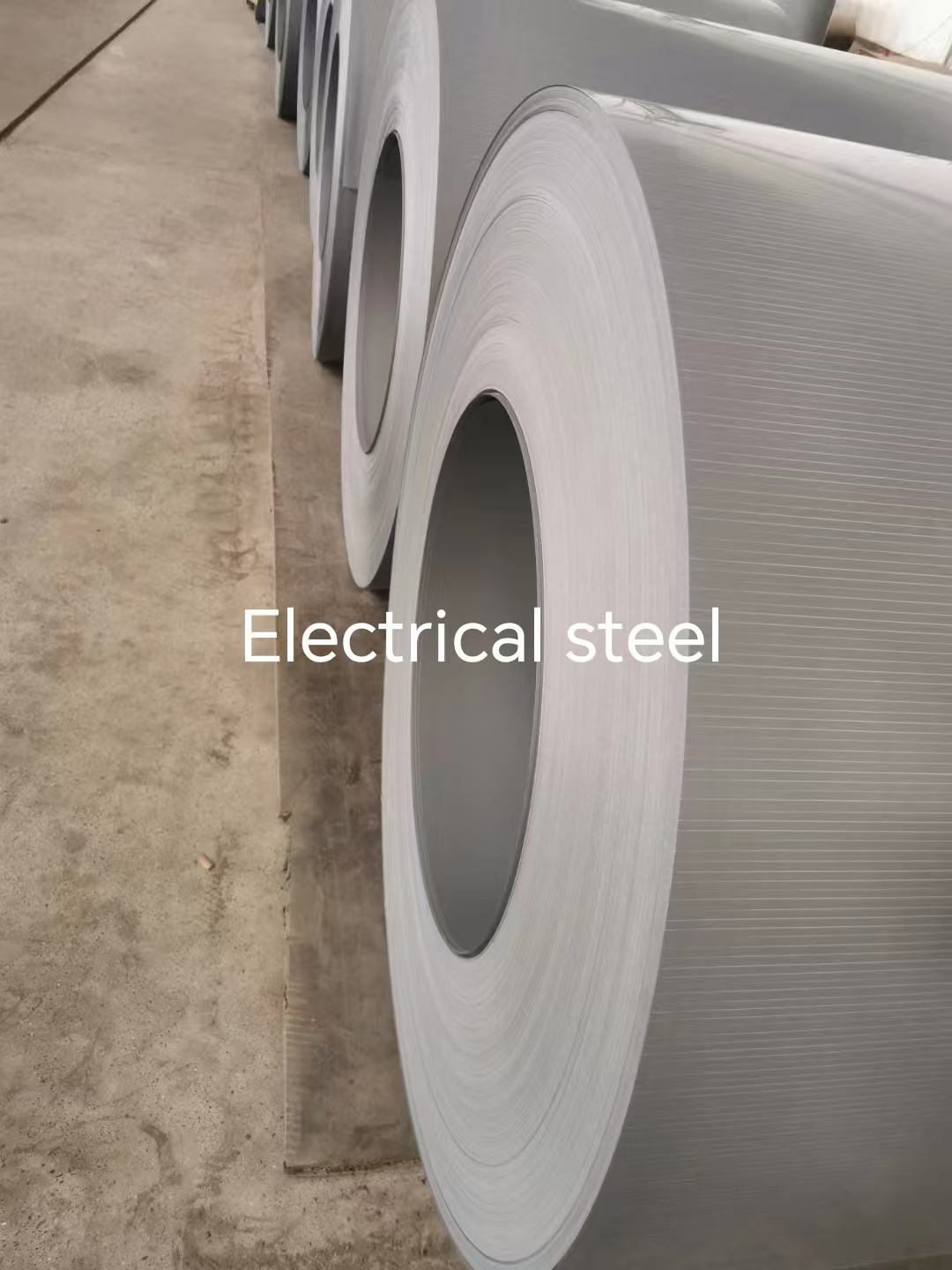
Grain-oriented electrical steel sheet. Its P1.7/50 and B8 values set the boundary conditions for every downstream core design decision.
Iron loss and flux density answer two different design questions
Iron loss, quoted as P1.7/50 in watts per kilogram, is the power dissipated in the material when it is magnetised to 1.7 T at 50 Hz. It governs the no-load loss of a finished core, the heat that has to be managed, and whether a transformer can meet a declared energy-efficiency limit. Magnetic flux density, quoted as B8 in tesla, is the flux density reached at a magnetising field of 800 A/m. It governs how much core cross-section a given flux requires, and therefore how much steel, copper and enclosure volume the finished unit will carry.
Both numbers describe the same sheet of steel, but they respond to different metallurgical and dimensional levers. That is why they cannot be pushed in the same direction indefinitely. Within the Hi-B portfolio held by HL AND SL LIMITED, five grades share an identical 0.23 mm nominal thickness. Their guaranteed iron loss spans ≤0.75 W/kg (23R075) to ≤1.00 W/kg (23Q100), while their guaranteed B8 spans ≥1.75 T (23Q100) to ≥1.89 T (23Q080). Reading either column on its own gives an incomplete picture of the grade.
Why the two parameters are widely misread
Most procurement mistakes around Hi-B steel do not come from a wrong calculation. They come from four predictable misreadings of the data sheet.
- The grade suffix looks like a ranking, but only ranks one property. In a name such as 23Q095, the leading figure refers to nominal thickness (0.23 mm) and the trailing number tracks the loss class. It says nothing about flux density. Grade 23Q095 and grade 23Q100 sit in the same family at the same thickness, yet they quote B8 of ≥1.88 T and ≥1.75 T respectively.
- Behaviour inside one family is not always monotonic. Among the 0.27 mm grades, 27Q095 and 27Q100 both quote B8 of ≥1.91 T, with iron loss of ≤0.95 and ≤1.00 W/kg. Grades 27Q105 and 27Q110 quote a lower B8 of ≥1.88 T, with higher loss of ≤1.05 and ≤1.10 W/kg. A buyer who assumes that the last digit tracks every property in a straight line will mis-specify.
- Guaranteed limits and measured values are not the same claim. Grade 23Q080 is specified at an iron loss of ≤0.80 W/kg, with measured values recorded in the 0.76–0.78 W/kg range. Comparing one supplier's guaranteed maximum against another supplier's measured figure overstates one sheet and understates the other.
- Some grades publish no B8 value at all. In the current list, 20-65 (0.20 mm, ≤0.65 W/kg) and 27Q120 (0.27 mm, ≤1.20 W/kg) are quoted on thickness and iron loss only. Where flux density drives the design, that gap has to be closed before the grade is written into a specification.
What actually moves iron loss and flux density in a Hi-B grade
Hi-B stands for high magnetic induction grain-oriented silicon steel. The material is predominantly iron with silicon added — around 3.0–3.2% in most Hi-B grades, with 2.5–3.5% quoted for 23Q095 and 23Q100 — supported by aluminium and manganese, while impurities such as carbon, sulphur and nitrogen are strictly controlled. Four levers then determine where a grade lands on the loss-versus-density map.
Thickness
Eddy-current loss scales with sheet thickness, so a thinner strip lowers P1.7/50. The portfolio shows the effect clearly: 18-65 at 0.18 mm is rated at ≤0.65 W/kg with B8 ≥1.88 T, while 23Q095 at 0.23 mm is rated at ≤0.95 W/kg with B8 ≥1.88 T. Thickness buys loss reduction without giving up flux density.
Silicon content and resistivity
Silicon raises the electrical resistivity of the steel, which suppresses eddy-current loss. It cannot simply be increased without limit: the alloying level also affects workability and saturation behaviour, so producers operate inside a narrow composition window rather than pushing silicon upward for its own sake.
Grain texture
Grain-oriented steel is processed so that the easy magnetisation direction aligns with the rolling direction across the strip. This texture is what lifts B8 into the 1.86–1.91 T region quoted across the portfolio, and it is why oriented material is specified for transformer cores while non-oriented material serves other machine types.
Domain refinement and inhibitors
The R-series grades apply laser scribing to subdivide magnetic domains and reduce the anomalous loss contribution. Grade 23R075 combines the lowest iron loss in the 0.23 mm group (≤0.75 W/kg) with a B8 of ≥1.88 T, against 23Q080 at ≤0.80 W/kg with B8 ≥1.89 T. In the 0.27 mm family, the material description notes that grades such as 27Q095, 27Q100, 27Q105, 27Q110 and 27Q120 must contain inhibitors such as MnS and AlN.
The trade-off in numbers: 0.18 mm to 0.27 mm Hi-B grades
The table below reproduces the guaranteed parameters and the primary application areas of the Hi-B grades available through HL AND SL LIMITED. Two boundaries are visible at a glance: the lowest iron loss sits on the thinnest sheet, and the highest B8 sits on the thickest.
| Grade | Thickness | Iron loss P1.7/50 | B8 | Primary application |
|---|---|---|---|---|
| 18-65 | 0.18 mm | ≤0.65 W/kg | ≥1.88 T | Ultra-high voltage transformers, power transformers, energy-saving transformer cores |
| 20-65 | 0.20 mm | ≤0.65 W/kg | Not stated | UHV transformers, high-efficiency distribution transformers, high energy-efficiency equipment |
| 20R070 | 0.20 mm | ≤0.70 W/kg | ≥1.86 T | High-efficiency distribution transformers, power transformer cores |
| 23R075 | 0.23 mm | ≤0.75 W/kg | ≥1.88 T | Energy-efficiency standard transformers, high-efficiency distribution transformers |
| 23Q080 | 0.23 mm | ≤0.80 W/kg (measured 0.76–0.78) | ≥1.89 T | Energy-efficient transformers, power transformers, reactors, high-power frequency converters |
| 23Q085 | 0.23 mm | ≤0.85 W/kg | ≥1.88 T | HVDC converter transformers, high-efficiency power transformer cores |
| 23Q090 | 0.23 mm | ≤0.90 W/kg | ≥1.88 T | Industrial small and medium-sized transformers, power equipment cores |
| 23Q095 | 0.23 mm | ≤0.95 W/kg | ≥1.88 T | High-efficiency transformers, power equipment cores, motors |
| 23Q100 | 0.23 mm | ≤1.00 W/kg | ≥1.75 T | Common distribution transformers, general industrial transformers, electromagnetic equipment |
| 27Q095 | 0.27 mm | ≤0.95 W/kg | ≥1.91 T | High-efficiency power transformers, PV DC converter transformers, industrial frequency conversion equipment |
| 27Q100 | 0.27 mm | ≤1.00 W/kg | ≥1.91 T | Power transformers, reactors, electrical equipment cores |
| 27Q105 | 0.27 mm | ≤1.05 W/kg | ≥1.88 T | Power transformer cores, transformer manufacturing |
| 27Q110 | 0.27 mm | ≤1.10 W/kg | ≥1.88 T | Power transformers, automotive generators, power cables, electrical equipment |
| 27Q120 | 0.27 mm | ≤1.20 W/kg | Not stated | Small and medium-sized transformer cores, electrical equipment |
How to prioritise loss reduction against size reduction
There is no universal answer to the question of which parameter matters more. There is, however, a repeatable sequence that produces a defensible grade choice.
- Identify the binding constraint first. If the design must satisfy an efficiency regulation or a customer-specified maximum no-load loss, iron loss is the constraint and flux density is the variable to be optimised around it. If the design must fit a weight, volume or transport envelope, B8 becomes the constraint.
- Then check the interaction, not just the headline figure. Using a higher B8 grade to shrink the core cross-section raises the working flux density in the remaining steel, so the loss per kilogram at the operating point may change. Loss reduction and size reduction are coupled, not independent.
- Compare like with like. Set guaranteed limits against guaranteed limits. If a supplier quotes measured values, ask for the guaranteed limit that sits behind them — the 23Q080 example shows why the distinction matters.
- Decide the coating and the cut plan together with the grade. Organic coatings are rated for service up to about 180 °C, inorganic coatings up to 800 °C, and semi-organic coatings sit between them. A design that requires high-temperature stress-relief annealing constrains the coating choice before the grade is finalised.
- Confirm the thickness the process can handle. A 0.18 mm sheet delivers the lowest catalogue loss, but it also places more demands on slitting, cut quality and stacking discipline than a 0.23 mm or 0.27 mm sheet.
Where these decisions surface in real projects
Grade selection questions rarely arrive in the abstract. They arrive attached to a project condition that fixes one parameter and leaves the other open.
- European distribution-transformer upgrades. Programmes driven by EU eco-design requirements specify very low iron loss, and often add a noise ceiling two to three decibels below the standard requirement. Where installations sit on a coast, the coating also has to withstand salt-spray conditions. Loss, noise and coating are therefore selected together, not sequentially.
- Cold-region networks. A Canadian high-efficiency, low-noise distribution transformer project operates between roughly −40 °C and −20 °C with repeated freeze-thaw cycles, and targets a magnetic permeability retention of at least 95% at −40 °C. Cold performance joins loss and noise as a selection criterion.
- Certification-driven grid supply. Oriented silicon steel has been widely used in WEG's domestic transformer production in Brazil, meeting the energy-efficiency certification requirements of INMETRO in that market. Projects of this type make the certificate, not the data sheet alone, the purchasing gate.
- Converter-transformer cores. The ±800 kV ultra-high voltage direct current project associated with Belém in Brazil transports hydropower from the north of the country to south-eastern load centres and specifies core material with ultra-low loss, high humidity and temperature resistance, a high magnetic flux density and iron loss below 0.85 W/kg. Grades in the 23Q085 class, rated at ≤0.85 W/kg with B8 ≥1.88 T, sit directly against this class of requirement.
A long-running case on the manufacturing side shows the same pattern from the buyer's perspective: a transformer manufacturer in Mexico with an annual business scale of approximately USD 500 million has been supplied in batches for over ten years, covering power transformers, converter transformers and special engineering transformers. That kind of continuity depends more on repeatable batch parameters than on any single data-sheet number.
How HL AND SL LIMITED supports grade-level specification

HL AND SL LIMITED supplies oriented and non-oriented electrical steel with in-house secondary processing and batch documentation.
HL AND SL LIMITED is a China-based exporter of electrical steel (silicon steel), founded in 2012, operating a 30,000 m² processing facility with an annual output of 30,000 t, a research and development team of ten engineers, and an export ratio of approximately 80%. Its established markets include Mexico, Brazil, Italy, the UAE and India. As an authorised agent of China Baowu Steel Group, the company maintains a stable channel to high-grade electrical steel, and it also integrates export resources from a number of private mills to match different performance grades and price bands.
For grade-level specification work, three capabilities matter more than catalogue breadth.
- Customisation inside the parameter window. Thickness can be supplied from 0.18 mm to 0.35 mm, with width typically 800–1250 mm and ultra-wide specification available at 1250 mm. Material families cover general orientation CGO, high magnetic flux Hi-B, laser-scribed R series and heat-resistant HS series. Coatings can be organic, inorganic or semi-organic, and processing includes strip cutting, fixed-length flat cutting and longitudinal cutting.
- Verification documentation. Quality control covers origin inspection at the factory with full-process random and batch inspection, a material certificate or warranty certificate issued with shipment including batch inspection reports, and third-party testing through CMA/CNAS laboratories.
- Supply parameters that can be planned against. Monthly capacity is 4,000 t with a minimum order quantity of 25 t. Regular orders run 15–20 days, urgent or stock orders 3–7 days to shipment, bulk export orders 30–45 days to arrival at port, and 7–30 working days after a letter of credit deposit. After-sales support includes lifecycle technical guidance, inbound quality inspection dispute handling and re-inspection, with feedback and coordination typically within 1–3 working days.
Hi-B against conventional grain-oriented steel — and the limits of the data sheet
Hi-B grades are the higher-permeability branch of grain-oriented steel. Compared with conventional grain-oriented material, they are selected when the design needs a higher B8 or a lower loss class, and they generally carry a higher cost and tighter processing requirements as a result. General orientation CGO remains a legitimate option in the same portfolio where a design does not need Hi-B performance — converting such a design to Hi-B without revisiting the core geometry rarely produces the expected benefit.
Equally important, a data sheet does not answer every question a procurement team will ask. Four boundaries are worth stating plainly.
- P1.7/50 is a single-point reference. It describes behaviour at 1.7 T and 50 Hz. It does not predict performance at other inductions or in harmonic-rich conditions, which is precisely the operating environment of converter transformers and much industrial frequency-conversion equipment. For those duties, the loss figure is a starting point for engineering discussion, not a specification.
- Material loss is not core loss. Cut quality, burrs, handling stress and stacking all add to the loss of an assembled core. Thinner sheet reduces material loss but is more sensitive to those process effects, so the thinnest available grade is not automatically the best outcome for a given factory.
- The catalogue has a floor. The lowest guaranteed iron loss in the current Hi-B range is ≤0.65 W/kg, on 18-65 at 0.18 mm and 20-65 at 0.20 mm. Some European distribution-transformer specifications are written at or below 0.60 W/kg, below that floor. Where a requirement sits outside the catalogue, the practical route is early technical engagement rather than a different line on a quotation.
- The coating sets a temperature ceiling. Organic coatings are rated to roughly 180 °C. A process that requires a high-temperature stress-relief anneal needs an inorganic coating rated up to 800 °C, which changes surface characteristics and handling in ways the magnetic parameters do not describe.
Standards frameworks define how these properties are qualified. IEC 60404-8-4 specifies the properties of cold-rolled non-oriented electrical steel strip and sheet for magnetic applications, and ASTM A677 sets core loss and permeability requirements for non-oriented grades such as M15, M19 and M22. For grain-oriented material, procurement therefore leans heavily on grade-specific guaranteed values and on batch test documentation rather than on a single general standard alone.
Market trend: efficiency rules keep both parameters under pressure
Demand for electrical steel is being driven by grid investment and electrification at the same time as efficiency requirements tighten. The global electrical steel market was valued at USD 31.0 billion in 2025 and is projected to reach USD 47.0 billion by 2033, a CAGR of 5.5% for 2026–2033 according to Grand View Research. China's electrical steel production reached 16.1 million tonnes in 2024, a 5.4% year-on-year increase, and China's export volume of grain-oriented electrical steel reached 393,200 t in the first half of 2025, up 16.0% year-on-year according to SMM.
One caution belongs with these figures. Published market size estimates diverge sharply depending on how the category is defined: Market Research Future places the 2024 base year at USD 14.13 billion, Fortune Business Insights at USD 32.19 billion, and Precedence Research estimates USD 50.44 billion for 2025. Any single market number should be read as definition-dependent, and procurement decisions should not be built on a market-size figure alone.
On the supply side, Baosteel (China Baowu), POSCO and Nippon Steel are identified as the top three global producers of high-grade electrical steel. For buyers, the practical implication of concentration at that end of the market is that documentation quality and grade availability, not headline price alone, increasingly determine which orders can be executed on schedule.
Future outlook
Three directions look durable. First, the pressure on iron loss will continue to come from regulation and from the operating economics of continuously energised distribution transformers, which keeps demand concentrated on thinner gauges and refined-loss grades. Second, the pressure on B8 will continue to come from converter transformers, compact urban equipment and transport-constrained designs, where core mass and copper volume are the design bottleneck. Third, procurement will keep shifting from parameter comparison toward evidence: batch inspection reports, third-party laboratory testing and market-specific certification are becoming the conditions under which a grade is accepted at all.
For specification teams, the practical consequence is that the loss-versus-density decision should be made early, documented against a named grade, and revisited whenever the coating, the annealing process or the cut plan changes. The parameters themselves are stable; it is the surrounding process that determines what the finished core actually delivers.
FAQ: iron loss, flux density and grade selection
What is the difference between P1.7/50 and B8 on an electrical steel data sheet?
P1.7/50 is the iron loss in watts per kilogram measured when the steel is magnetised to 1.7 T at 50 Hz, and it indicates how much energy the material dissipates. B8 is the magnetic flux density reached at a magnetising field of 800 A/m, and it indicates how much flux a given core cross-section can carry. The first parameter drives efficiency and heat; the second drives core size, weight and copper consumption.
Which parameter should be prioritised first when a transformer specification is fixed?
Prioritise the parameter that is actually constrained. If a regulation or customer specification fixes a maximum no-load loss, choose the loss class first and optimise flux density around it. If the design is limited by weight, volume or transport envelope, treat B8 as the constraint. The two remain coupled, because reducing core cross-section with a higher B8 grade changes the working flux density in the remaining steel.
Why can two grades of the same thickness have different flux density?
Because the grade suffix tracks the loss class, not flux density. At 0.23 mm, 23Q095 quotes B8 of ≥1.88 T while 23Q100 quotes ≥1.75 T. The pattern also appears in the 0.27 mm family, where 27Q095 and 27Q100 quote B8 of ≥1.91 T while 27Q105 and 27Q110 quote ≥1.88 T. Each grade has to be read individually rather than inferred from its position in a series.
Does a lower iron loss figure always indicate a better grade?
No. Within the 0.23 mm group, 23R075 offers the lowest loss at ≤0.75 W/kg with a B8 of ≥1.88 T, while 23Q100 is rated at ≤1.00 W/kg with a B8 of ≥1.75 T. The lower-loss grade is the stronger choice where efficiency is the binding constraint, but if flux density is what limits the design, a lower loss figure alone does not resolve the question. Thinner gauges also place higher demands on cutting and stacking.
How should iron loss values from different suppliers be compared fairly?
Compare guaranteed limits against guaranteed limits. A grade such as 23Q080 is specified at ≤0.80 W/kg with measured values recorded between 0.76 and 0.78 W/kg; setting a guaranteed maximum against another supplier's measured or typical figure produces a misleading comparison. Where a supplier quotes a measured value, ask for the guaranteed limit behind it, and confirm the thickness, coating and measurement basis.
Can P1.7/50 be used to estimate performance in converter or high-frequency applications?
Only as a baseline. P1.7/50 describes one operating point, at 1.7 T and 50 Hz. Converter transformers and frequency-conversion equipment operate with harmonics and at different inductions, so the figure does not transfer directly. Projects in this class, such as ±800 kV UHVDC converter transformer work, specify ultra-low loss, high flux density material together with environmental resistance requirements that go beyond the single catalogue number.
What practical constraints affect the choice between 0.18 mm, 0.20 mm and 0.23 mm material?
Three constraints interact. Iron loss falls with thickness, from ≤0.65 W/kg on 18-65 at 0.18 mm to ≤0.95 W/kg on 23Q095 at 0.23 mm, while B8 remains in the ≥1.86–1.88 T region on the grades where it is published. Handling becomes more demanding as the sheet gets thinner. And the coating sets a service temperature ceiling: organic coatings are rated to about 180 °C, whereas inorganic coatings are rated up to 800 °C, which matters whenever stress-relief annealing is part of the process.
What should be checked before releasing an order for a Hi-B grade?
Confirm the guaranteed values rather than typical ones; confirm the coating type against the annealing temperature the process will use; confirm the cut plan, whether slitting, cut-to-length or longitudinal cutting is required; confirm that batch inspection reports and third-party testing are supplied with the material; and confirm the commercial parameters, including the 25 t minimum order quantity and the lead time that applies, which ranges from 3–7 days for urgent or stock orders to 15–20 days for regular orders.
Reference document: the grade data, coating options and processing capabilities described in this article are compiled in the HL AND SL LIMITED electrical steel brochure (PDF).