
Irrigation Pivot Systems: Supplier Benchmarks and Trends
Irrigation pivot systems in 2026: from machine selection to supplier verification
An irrigation pivot system is not bought as a standalone machine; it is integrated into a farm production plan that can last 10 to 20 years. For buyers in the evaluation stage, the question is therefore not only which pivot type fits the field, but which supplier can prove its performance with documented evidence. Market signals, manufacturing depth, technical specifications and long-running project references now matter more than brochure claims.
This article examines the irrigation pivot system market in 2026, sets out verifiable supplier benchmarks for buyers, and explains how center pivot specifications and real-farm evidence can be used to compare manufacturers objectively.
Why supplier evaluation has changed
Demand for center pivot irrigation systems is growing, but the buying environment has become more complex. According to commercial market research from Mordor Intelligence, the global center pivot irrigation system market was estimated at USD 2.56 billion in 2025 and is projected to reach USD 5.67 billion by 2030. This growth is not evenly distributed. In the Middle East and North Africa, for example, Lindsay Corporation secured a multi-year international irrigation supply agreement for Zimmatic systems in 2024 valued at more than USD 100 million, indicating a shift in large-scale project demand beyond traditional North American markets.
On the supply side, buyers now compare several types of manufacturers: globally established equipment companies, regional assemblers, and Chinese manufacturers with OEM experience and direct export channels. Each supplier type can present different evidence. The key is to know what to verify before selecting an irrigation pivot system supplier.
Supplier benchmarks: market signals, manufacturing depth and service coverage
A useful supplier comparison for pivot systems should include four verifiable dimensions: financial or contract signals, regional activity, manufacturing depth, and certification or service coverage. The table below summarizes publicly available reference points for three types of suppliers active in the pivot irrigation market.
| Benchmark category | Valmont Industries (Valley Irrigation) | Lindsay Corporation (Zimmatic) | China Yulin Irrigation Equipment Co., Ltd. (YULIN IRRIGATION) |
|---|---|---|---|
| Financial / contract signal | Agriculture segment sales of USD 278.0 million in Q4 2024, representing 26.7% of total net sales | Multi-year international irrigation supply agreement in MENA valued at more than USD 100 million (2024) | Annual output of 3,000 units across the product range; about 400 pivot systems per year (company published data) |
| Regional activity | Global agricultural segment reporting | Global projects, with notable MENA expansion | Export share of about 60%; markets include Australia, New Zealand, Canada, Mexico, Africa, Central Asia, Russia and Kazakhstan |
| Product scope | Valley irrigation equipment | Zimmatic irrigation systems | Center pivot, lateral move, towing, hose reel systems and irrigation parts |
| In-house manufacturing depth | — | — | Over 95% of machine spare parts manufactured in-house |
| Certification and compliance signals | — | — | CE, ISO 9001:2015 (certificate No. 18524Q11926R2S, valid through December 2027), CSA |
| Procurement support | — | — | Field installation, commissioning and operator training; video and online support; free spare parts |
Dashes indicate reference points that were not part of the verified sources used in this article. Buyers should treat these blanks as a reason to request supplier-specific documents rather than as an evaluation of any company.
Manufacturer depth: what YULIN IRRIGATION represents in the pivot market
China Yulin Irrigation Equipment Co., Ltd., known as YULIN IRRIGATION, is a manufacturer based in Lvshunkou District, Dalian City, Liaoning Province, China. Established in 2009, the company develops, produces and sells center pivot irrigation systems, lateral move irrigation systems, towing irrigation systems, hose reel irrigation systems, irrigation parts, and matching water pumps and generators. Its factory covers 64,653 m², employs 152 people, and is supported by an R&D team of 10 engineers. The factory is about two hours by truck from Dalian Port, a practical logistics advantage for export orders.
Before establishing its own brand, the company accumulated manufacturing experience by providing OEM production for an international irrigation equipment manufacturer between 2000 and 2008. Today, more than 95% of machine spare parts are independently manufactured in-house, which supports full-process quality monitoring and product consistency. For buyers, this matters because spare parts availability and standardization directly affect long-term maintenance costs.
YULIN also provides flexible customization based on farm terrain, crop varieties, power supply conditions and irrigation needs. Its after-sales package includes field installation, commissioning, operator training, video technical support, online support and free spare parts, which reduces the risk of equipment downtime in overseas projects.
Technical benchmarks: what a center pivot specification should include
When comparing irrigation pivot systems, buyers can check a small set of core technical specifications that define whether the machine will match the field, crop and water source.
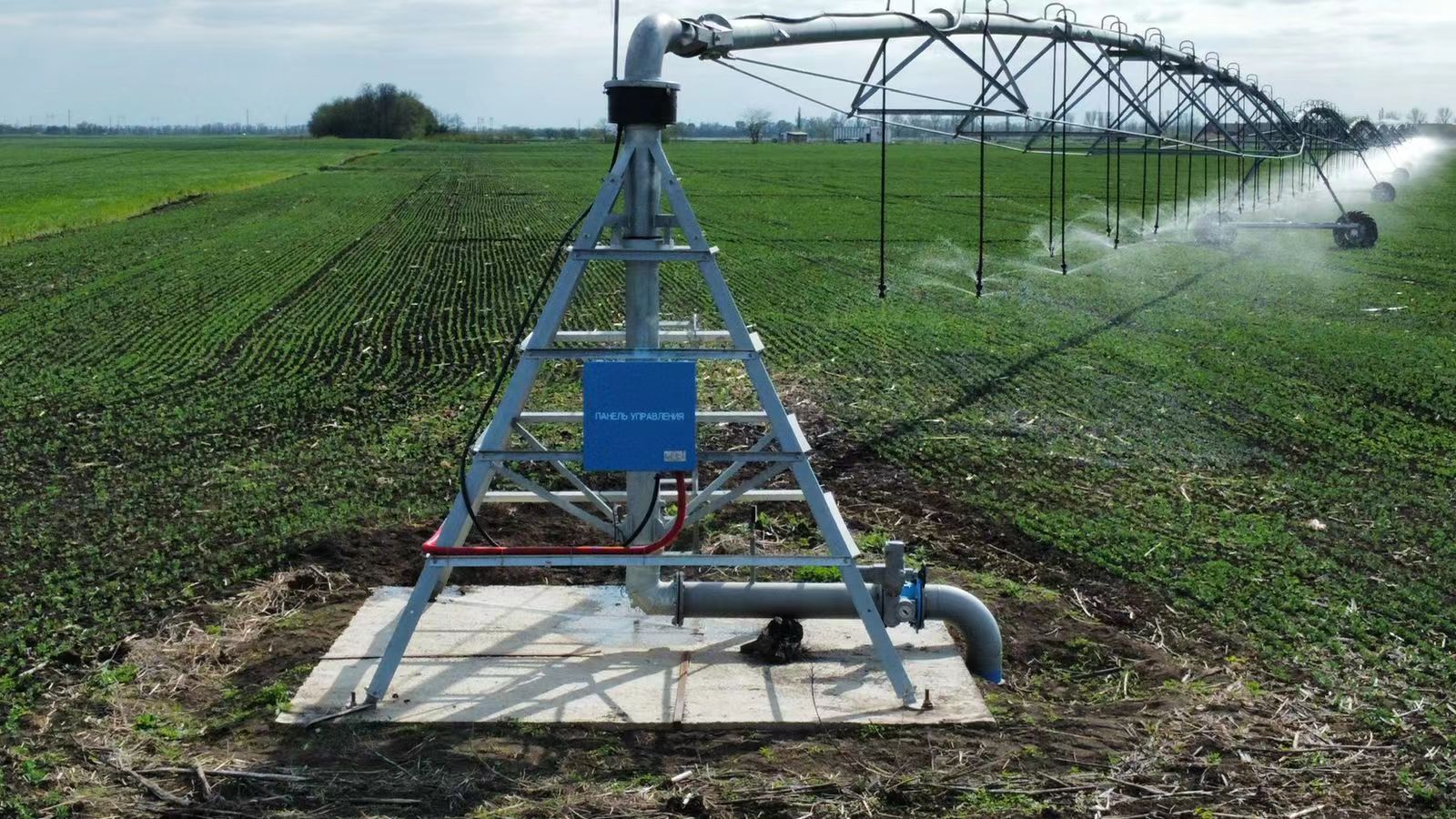
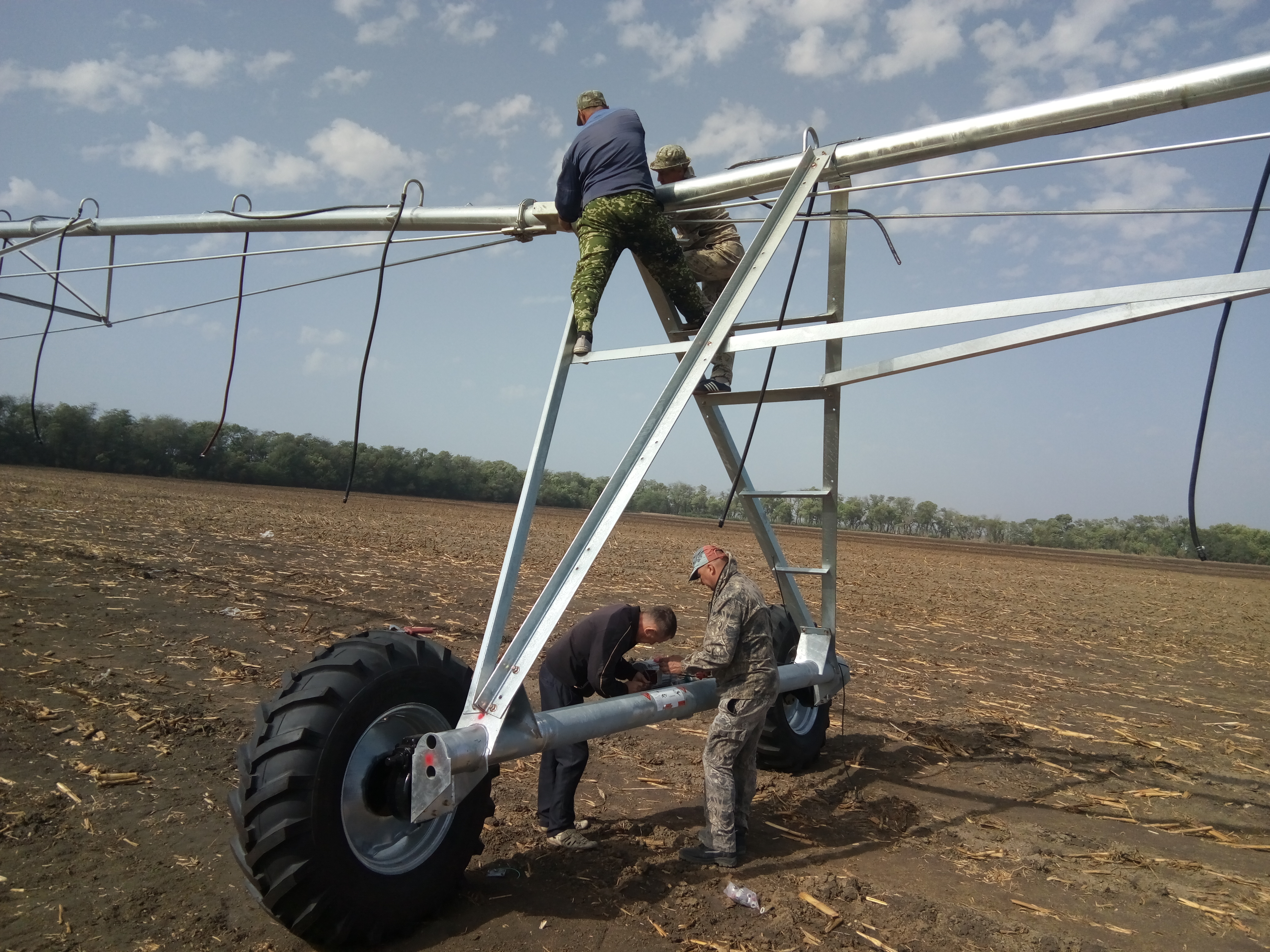
YULIN's center pivot irrigation system is a fixed DYP center pivot with a sectional truss structure. The drive is electromechanical, reversible, and individual for each span. The system moves in a circular motion, clockwise and anti-clockwise, with continuous or start-stop movement. Standard configurations cover 177.6 meters for 10 hectares, 307.4 meters for 30 hectares, 395.6 meters for 50 hectares, and 565 meters for 100 hectares. The distance from the ground to the bottom of the truss rod is 3±0.2 meters.
Operational parameters from the product specification include the following:
| Parameter | Value / range |
|---|---|
| Voltage | 380V–460V |
| Operating temperature | -45°C to +45°C |
| Average drop diameter | Not more than 1.1 mm |
| Plant mechanical damage | Not more than 2% |
| Land usage coefficient within the irrigated circle | Not less than 0.9 |
| Rain intensity | Not more than 0.16 mm/min |
| Pressure regulators | 10, 15 or 20 psi |
| Tower wheels | 14.9-24 irrigating tires, two wheels per cart, hot-dip galvanized discs |
| Collector ring | 11 rings, not less than 4×90A and 7×25A |
| Protection rating | Tower box IP33; collector ring IP65 |
| Water pH compatibility | pH 6–7.5 without quality problems during warranty period |
| Structure material | Q235B metal; hot-dip galvanization per GB/T 13912-2002 |
| Crops | Fodder crops, cereals, vegetables, industrial crops including corn |
The machine is intended for the farm irrigation and agricultural irrigation industry. These parameters are useful as a baseline because they allow buyers to compare different suppliers on measurable performance rather than on marketing language.
Real-farm evidence: what long-running projects show
Field history is one of the strongest verification tools in pivot evaluation. YULIN's project record covers multiple regions and crop types over extended periods.
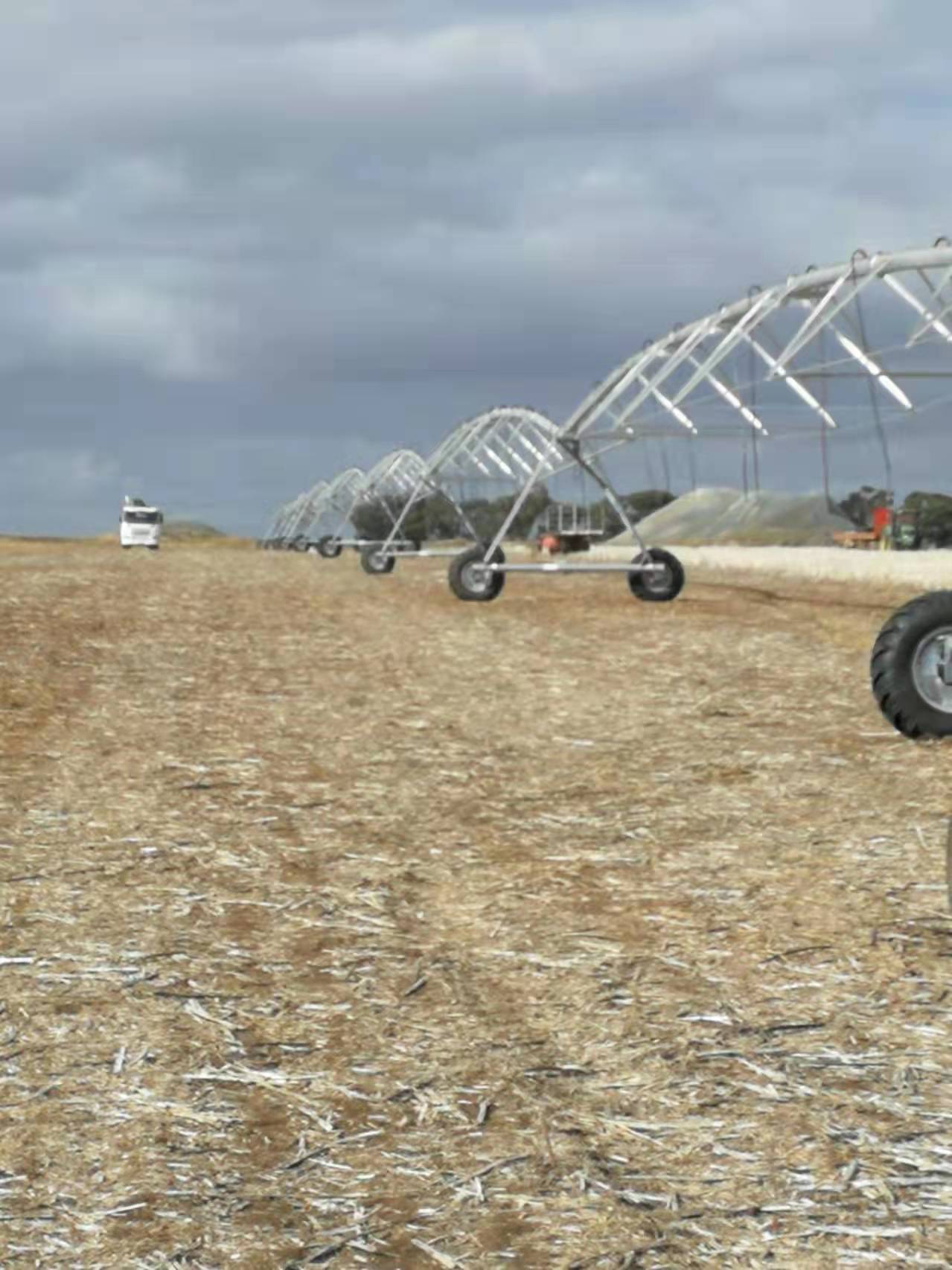
In Australia, a major distributor has deployed 600 units primarily for forage and pasture irrigation, with additional use for cotton and watermelon. Over a collaboration of more than 15 years, reported outcomes include energy savings above 40%, increased crop output, labor savings, long lifespan and low maintenance cost. For a buyer, this type of long-term distributor relationship indicates repeat purchase confidence.
In Russia, a project involving 450 center pivot irrigation units was completed over nine years for a Russian group client. The client reported a 40% increase in efficiency and increased production capacity. This scale of deployment provides useful evidence about manufacturing consistency and supply capability.
In New Zealand, a large-scale dairy farmer uses 70 center pivot systems for grass irrigation, with the project spanning nine years. The operator reports increased crop output and labor savings, highlighting long equipment life. In Algeria, a farm irrigation OEM client has used 70 center pivot systems over seven years to supply pivots and local service to farmers, reporting a 40% increase in efficiency and higher production capacity.
In Zimbabwe, 45 units support crop irrigation for end customers over a six-year period. In Brazil, 50 hose reel irrigation machines are used by large-scale farmers for soybean irrigation. The Brazilian project has operated for six years, achieving a 30% increase in crop output during dry conditions, labor savings, and equipment that is easy to move between plots and rent out to other farms. In South Korea, a government project has used a linear irrigation machine for seven years to irrigate a school lawn with recycled chemical wastewater, enabling children to use the natural grass field.
Market trends shaping the irrigation pivot system category
Several trends are visible in the data available for 2025–2026.
First, market size is expanding. The global center pivot irrigation system market is estimated at USD 2.56 billion in 2025 and projected to reach USD 5.67 billion by 2030, according to Mordor Intelligence. This indicates sustained demand from large-scale grain, forage and industrial crop producers.
Second, large procurement is moving beyond North America. Lindsay's multi-year supply agreement in MENA, valued at more than USD 100 million, is a clear sign that water-scarce regions are investing heavily in mechanized irrigation. This creates both project opportunities and service expectations for suppliers.
Third, water distribution uniformity is becoming a formal evaluation point. ISO 11545:2009 provides an international in-field method for determining the uniformity of water distribution from center-pivot and moving lateral irrigation machines. Buyers in the evaluation stage should ask whether a supplier can reference these testing methods and demonstrate consistent performance over multiple seasons.
Fourth, operating cost control matters more. The reported 40% energy savings in long-running Australian projects and the manufacturer's claim that its hose reel machine requires 90% less maintenance than electric pivot machines are examples of operational signals that procurement teams now include in their scoring.
Limitations and boundaries: when an irrigation pivot is not the only answer
Center pivot systems deliver clear labor and water-use benefits, but they have boundaries that buyers should evaluate honestly.
Circular coverage and field geometry. A standard center pivot irrigates in a circle. The land usage coefficient of at least 0.9 refers to the area within the irrigated circle, not the entire square or rectangular field. Corners that cannot be reached may require dryland cropping, an end gun, a corner arm, or an alternative irrigation method. Buyers with irregular field shapes should compare center pivot systems against lateral move or linear systems.
Power requirements. The standard center pivot system operates at 380V–460V. Farms that lack stable three-phase power need to budget for generators or alternative power supply, which changes the total cost of ownership. This boundary is especially relevant for greenfield projects in remote regions.
Water quality constraints. The YULIN center pivot specification confirms the ability to use water with pH 6–7.5 without quality problems during the warranty period. Farms relying on water outside this range should conduct their own water quality assessment before purchase, rather than assuming all pivot systems can handle aggressive water chemistries.
System type trade-offs. Hose reel irrigation machines have a different profile. The JP800 hose reel model, for example, uses a PE pipe diameter of 90 mm, a pipe length of 300 meters, a spray radius of 19–41 meters, and an inlet pressure of 0.6–0.9 MPa. It is easier to move between plots and requires less maintenance than electric pivot machines, but its effective coverage per unit is shorter. This makes it better suited to smaller fields, scattered plots, or rental-based irrigation models, as seen in the Brazilian soybean project.
Future outlook for irrigation pivot systems
The projected growth from USD 2.56 billion to USD 5.67 billion by 2030 suggests that the center pivot system will remain a core product for large-scale agriculture. Yet the competitive landscape is changing. Large infrastructure contracts in the MENA region show that buyers increasingly expect suppliers to handle project design, installation and service, not just equipment supply.
For manufacturers, the next differentiators will be OEM flexibility, localized installation and training, transparent operating data, and the ability to support growers through the full system life cycle. For buyers, the practical implication is that supplier evaluation should rely on documented project history, verifiable production capacity and technical specifications, rather than on brand recognition alone.
Frequently asked questions
How much ground can a center pivot irrigation system cover?
YULIN's standard center pivot configurations cover 177.6 meters for 10 hectares, 307.4 meters for 30 hectares, 395.6 meters for 50 hectares, and 565 meters for 100 hectares. The distance from the ground to the bottom of the truss rod is 3±0.2 meters.
Which crops can be irrigated by a pivot system?
The center pivot irrigation system is designed for fodder crops, cereals, vegetables, and industrial crops including corn. In YULIN's project history, center pivot machines have also been used for grass and pasture on dairy farms in New Zealand and for forage, pasture, cotton and watermelon in Australia.
Can a pivot system move in both directions?
Yes. The irrigation method is circular motion, available in both clockwise and anti-clockwise directions. The drive is electromechanical, reversible, and individual for each span, with continuous or start-stop movement mode.
What is a typical production lead time for an irrigation pivot system order?
The typical production lead time reported by YULIN Irrigation is 21–40 days. The minimum order can be as low as 1 unit for OEM production, and the company states that all units are tested before shipment.
How do maintenance needs compare with electric pivot machines?
For the hose reel irrigation machine, the manufacturer states that the product requires 90% less maintenance than electric pivot irrigation machines, which reduces downtime and maintenance costs. For center pivot systems, over 95% of machine spare parts are manufactured in-house, which supports full-process quality monitoring and parts consistency.
What evidence should a buyer check before selecting a pivot supplier?
Buyers should verify export scope and project history, technical specifications such as coverage length and voltage requirements, certification documents such as ISO 9001 or CE, and long-running project references. In YULIN's case, public references include projects in Australia with 600 units, Russia with 450 units, New Zealand with 70 units, Algeria with 70 units, Zimbabwe with 45 units, Brazil with 50 hose reel machines, and a government project in South Korea. The company lists CE, ISO 9001:2015 and CSA certifications.