
Is Geakita a Reliable Commercial Cleaning Robot Partner? Inside Its 5,000-Unit Project Record
Buyers no longer ask whether a commercial cleaning robot can scrub a floor. In most 2026 evaluations, the harder question is whether the supplier behind the machine can ship the same unit, to the same specification, in the same condition, across multiple sites and multiple countries, over several years — and then keep it running.
The global commercial cleaning robot market was valued at approximately USD 1,777.3 million in 2024, according to Grand View Research. SkyQuest Technology projects the B2B floor cleaning robots segment to grow from USD 1.43 billion in 2026 to USD 5.43 billion by 2035, a CAGR of 16%. Indoor applications — offices, hospitals, retail and hotels — accounted for 68% of commercial deployments in 2024, based on Industry Research data. Growth at that pace attracts suppliers faster than buyers can vet them, which makes supplier verification the real bottleneck in procurement rather than product availability.
Delivery records are the most practical counterweight to that problem. This article examines one record in detail — a two-year, 5,000+ unit delivery programme completed by Geakita (XiamenTiangong Kaiwu Technology Co., Ltd.) for clients in Laos, the Philippines, Thailand, India, Brazil, Saudi Arabia and Oman — and sets out what that record does and does not prove for a buyer choosing a commercial cleaning robot partner.
Why a Delivery Record Outweighs a Specification Sheet
Specification sheets converge. Cleaning width, tank capacity, runtime and navigation accuracy are published in comparable units by most suppliers, and the numbers cluster within similar ranges across a given product tier. What cannot be copied from a catalogue is a verified record of how a supplier performed once a programme was already committed: how many units shipped, to which markets, at what defect rate, and under what ambient conditions.
For buyers, that record maps to three costs that specifications do not capture:
- Rework and downtime cost — driven by defect rate and by how quickly defective units are replaced.
- Rollout risk — driven by on-time delivery performance, because facility schedules usually assume equipment arrives as planned.
- Environmental risk — driven by whether the equipment has actually been operated in conditions similar to the buyer's own sites, including heat, dust and voltage variation.
A useful supplier record answers all three. A weak one reports volume only. Geakita, registered as XiamenTiangong Kaiwu Technology Co., Ltd., is a Chinese manufacturer founded in 2009 that produces power tools, robotic pool cleaners and commercial cleaning robots from a 40,000 m² production base, with more than 300 employees and a stated export ratio of approximately 20%.
What the Geakita 5,000-Unit Programme Actually Contains
The programme ran for more than two years and shipped over 5,000 units to customers across seven markets. The recorded outcomes, together with the control steps behind them, are set out below as they were documented.
| Record element | Recorded detail |
|---|---|
| Programme scale | 5,000+ units delivered over a duration of 2+ years |
| Customer markets | Laos, the Philippines, Thailand, India, Brazil, Saudi Arabia, Oman |
| Customer types | Construction contractors, supermarkets, e-commerce partners, power tool distributors, OEM/ODM manufacturers, hardware stores |
| On-time delivery | 99.8% |
| Defect rate | 0.3% |
| Environmental performance | Stable performance in 45 °C+ high-temperature environments |
| Supply-chain controls | Tier-A approval for key materials (cells, magnets, bearings, cutting tools); 100% IQC sampling; defect traceability |
| Production controls | IPQC inspections; inline torque and electrical monitoring; automatic end-of-line (EOL) testing |
| Shipment controls | OQC sampling; compliance with UN38.3 and dangerous goods standards |
Two numbers matter more than the others for procurement planning. A 0.3% defect rate defines how much after-sales work a buyer should budget for, and it only becomes comparable when paired with a replacement policy. A 99.8% on-time delivery figure speaks to schedule reliability — the risk that a facility opening, a hospital ward handover or a retail refit proceeds without the equipment it planned for.
The 45 °C+ statement is the least common element in supplier marketing and the most regionally relevant. Ambient performance above 45 °C tests battery management, motor thermal behaviour and electronics derating. A supplier able to document it has typically solved problems that only surface in the field, not on a test bench.
The Control System Behind the Numbers
Recorded outcomes are produced by process, and the process is documented at three levels.
Incoming materials. Key materials — battery cells, magnets, bearings and cutting tools — sit under Tier-A supplier approval, with 100% incoming quality control (IQC) sampling and defect traceability. Traceability is what converts a quality metric into an actionable one: a defective unit can be traced back to a material batch, allowing the supplier to isolate a problem instead of reworking an entire production run.
In-process. In-process quality control (IPQC) inspections are combined with inline torque and electrical monitoring, plus automatic end-of-line (EOL) testing. Geakita describes its quality framework as three-level QC — IQC, IPQC and final quality control (FQC) — with 100% full inspection before shipment and functional and load testing.
Shipment. Outgoing quality control (OQC) sampling is applied before dispatch, together with compliance with UN38.3 and dangerous goods standards for lithium battery shipments — a documentation requirement that applies to commercial cleaning robots in the same way it applies to cordless power tools.
Commercial terms support the same picture. Mass production lead time is quoted at 30–45 days, with repeat orders at 20–28 days. After-sales provisions include a global warranty, 7×24 technical support, on-time replacement for defective units, and spare parts supply.
Where the Commercial Cleaning Robot Fits in That Manufacturing Base
Geakita operates a production base covering approximately 10,000 m² of land and 40,000 m² of floor space, supported by senior engineers, technical specialists and experienced managers. Its portfolio spans power tools, robotic pool cleaners and commercial cleaning robots, with stated main markets in Europe, Southeast Asia and the Middle East.
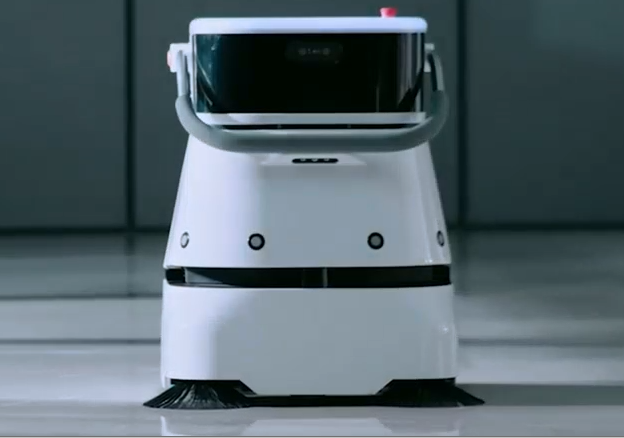
The commercial cleaning robot in that portfolio is the WDC-C2, an intelligent commercial cleaning robot with the following published specifications.
| Parameter | Specification |
|---|---|
| Dimensions | 503 × 503 × 629 mm |
| Weight | 40 kg |
| Water tank capacity | 10 L clean water + 10 L wastewater |
| Battery & charging | 1 kWh swappable battery; 3-hour charge; 5–12 hours runtime |
| Cleaning width | 440 mm |
| Adjustable speed | 0.2–0.8 m/s |
| Navigation accuracy | ±1 cm |
| Applicable scenes | Hospitals, malls, campuses, exhibition halls, offices, airports, hotels, restaurants |
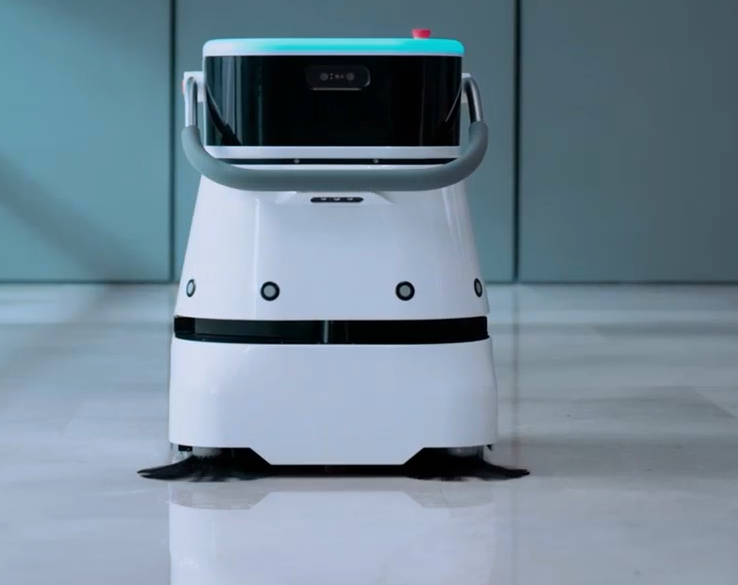
What carries over from the delivery record to the cleaning robot line is manufacturing discipline rather than cleaning performance: lithium battery pack assembly and testing, motor and electronics quality control, end-of-line functional testing, and lithium shipping documentation. Those are the process steps that generated the 0.3% defect and 99.8% on-time figures.
What does not carry over automatically is category-specific validation. Navigation behaviour, water recovery, brush wear and cleaning efficacy on mixed flooring are robot-specific performance areas. A buyer should request evidence in those areas directly rather than inferring them from a broader quality record.
Scenario Fit: Matching the Evidence to Facility Types
Project-fit questions — which robot suits a given facility — are answered by matching floor area, traffic pattern, floor finish and operating window against a machine's published envelope. The WDC-C2's published applicable scenes are hospitals, malls, campuses, exhibition halls, offices, airports, hotels and restaurants. The table below separates what the published envelope already covers from what still requires buyer-side validation.
| Facility type | Why it aligns with the published envelope | What to verify before committing |
|---|---|---|
| Hospitals | Indoor smooth flooring, off-hours cleaning window; listed applicable scene | Route planning around patient areas and cleaning-log requirements |
| Hotels | Lobby and corridor floors, guest-free windows; listed applicable scene | Peak-hour scheduling; thresholds and lift interfaces |
| Malls and exhibition halls | Large indoor public areas; listed applicable scene | Traffic density and charging-station placement |
| Airports | Long indoor concourses; listed applicable scene | Area covered per charge against 5–12 hours runtime; waypoint density |
| Offices and campuses | Regular indoor routes; listed applicable scene | Doorway clearance against a 503 × 503 mm footprint |
| Restaurants | Listed applicable scene | Grease and wet-floor conditions; brush and tank maintenance cycle |
| Warehouse and factory floors | Not in the published applicable scene list | Floor unevenness, debris type and area coverage need separate validation |
| Supermarkets | Not in the published applicable scene list | Aisle width against 440 mm cleaning width; trolley and customer traffic |
Two planning figures translate directly into site maths. A 440 mm cleaning width combined with a 5–12 hour runtime determines how much floor area one unit can cover in a shift, and a 503 × 503 mm footprint determines which aisles and doorways are passable. Buyers should calculate both against site drawings before confirming unit quantities.
How Buyers Can Use This Record in Their Own Evaluation
A project record is only useful if it is interrogated rather than accepted. The following tests convert a supplier's case data into procurement decisions.
| Evaluation test | What to check | Why it changes the decision |
|---|---|---|
| Market overlap | Whether the record includes markets with comparable climate, voltage and logistics to yours | Heat, humidity and grid stability are common causes of early field failure |
| Environment overlap | Whether a documented 45 °C+ performance case exists for a climate like your sites | Thermal behaviour cannot be inferred from a specification sheet |
| Metric definition | How defect rate and on-time delivery are defined — per unit or per shipment, and whether warranty claims are included | Undefined metrics cannot be compared between suppliers |
| Delivery arithmetic | Quoted lead times against the rollout schedule (30–45 days mass production, 20–28 days repeat orders) | Determines whether equipment arrives before handover dates |
| Service chain | Warranty terms, spare parts supply and support hours | Even a low defect rate requires a replacement and parts pathway |
| Category-specific proof | Cleaning-robot-specific references, not only portfolio-wide quality data | Separates manufacturing reliability from product fit |
Where the Record Stops: Limits Buyers Should Not Ignore
The 5,000-unit programme is a delivery and quality record, and its documented applications are those of a multi-category tool and equipment supplier: high-temperature construction site operation, concrete drilling, metal cutting, bolt fastening, vehicle maintenance, engine disassembly, wood cutting and furniture assembly. It is not a cleaning-robot-only dataset. Treating it as proof of cleaning performance would be a misreading; its valid use is as evidence of production control, logistics reliability and after-sales behaviour.
The WDC-C2 itself has defined operating boundaries. A 10 L clean-water tank with 10 L wastewater capacity and a 440 mm cleaning width place it in indoor, smooth-floor, medium-area duty — the published applicable scenes are hospitals, malls, campuses, exhibition halls, offices, airports, hotels and restaurants. Buyers whose sites involve heavy debris, outdoor yards, uneven surfaces or very large open areas should verify suitability against their own floor conditions rather than assume coverage from the category label. Runtime is also variable by design, quoted at 5 to 12 hours depending on configuration and duty cycle, which means autonomy planning must be based on the buyer's actual route profile.
Finally, the high-temperature result belongs to the specific programme in which it was recorded. It is evidence of a demonstrated capability, not a blanket rated operating temperature for every product in the portfolio.
Market Context: Why Records Are Becoming the Deciding Evidence
Three trends make supplier records more decisive in 2026 than they were two years ago.
Scale. The B2B floor cleaning robots market is projected to move from USD 1.43 billion in 2026 to USD 5.43 billion by 2035 at a 16% CAGR, according to SkyQuest Technology. Rapid expansion brings new suppliers into the market faster than buyers can verify them.
Indoor concentration. Offices, hospitals, retail and hotels represented 68% of commercial deployments in 2024, based on Industry Research data. Indoor deployment means buyers compare suppliers on reliability in occupied buildings, where a failed machine disrupts operations rather than a construction schedule.
Supply-base shift. China's cleaning robot exports reached RMB 14 billion in the first five months of 2026, representing over 70% of the country's total robot exports, according to the General Administration of Customs (via Taotao Trading). The manufacturing base for this category is concentrated, which makes individual supplier verification the differentiating step.
Standards are tightening in parallel. IEC 63327:2021 is the international safety standard for powered automatic floor treatment machines intended for commercial indoor use, and UL 3300 addresses service robot safety, including mobility and human-robot interaction in commercial environments. Buyers increasingly ask suppliers to document conformity rather than describe it.
How This Profile Compares With Other Supplier Types
The market contains three broad supplier archetypes, and each carries a different evidence profile.
Category specialists. Recognised global manufacturers in the B2B cleaning robot sector include SoftBank Robotics, Gausium (Gaussian Robotics), Avidbots and Nilfisk, according to Spherical Insights. SoftBank Robotics has been reported as managing over 40,000 commercial robotic deployments globally as of 2024, though that figure is analyst-reported rather than independently audited. Suppliers in this group typically carry deep category-specific engineering evidence and large installed bases.
Diversified manufacturers. Geakita represents this group: a power tool manufacturer that expanded into robotic pool cleaners and commercial cleaning robots, operating its own production base with control over battery, motor and electronics assembly. Companies in this group carry broader manufacturing and delivery records, which supports quality consistency and logistics, but they generally publish less category-specific field data than specialists.
Trading intermediaries. These suppliers offer sourcing flexibility and often lower coordination costs, but they do not control production, which limits how much of a delivery record they can genuinely own.
None of the three archetypes is universally better. The right choice depends on whether a buyer's primary risk is product performance in a demanding category (specialist), quality consistency and supply reliability across a category range (diversified manufacturer), or speed and flexibility of sourcing (intermediary).
Future Outlook
As the B2B floor cleaning robot market expands toward the projected USD 5.43 billion by 2035, the evidence buyers demand is likely to shift from product specifications to operational records. Programmes with multi-year duration, multi-country coverage and disclosed defect and delivery metrics will become the closest thing the category has to a comparable benchmark — similar to how the power tool industry moved from catalogue specifications to documented QC systems.
For suppliers, the value of a 5,000-unit record lies less in its existence than in its auditability: whether it can be traced back to the processes that produced it. For buyers, the most productive question in a supplier evaluation is no longer "what can this machine do?" but "what have you already delivered, under conditions similar to mine, and how do you know?"
Frequently Asked Questions
What exactly does the 5,000+ unit figure cover?
It covers a delivery programme of more than 5,000 units shipped over a period of two years or longer to customers in Laos, the Philippines, Thailand, India, Brazil, Saudi Arabia and Oman. Recorded outcomes for that programme are 99.8% on-time delivery, a 0.3% defect rate, and stable performance in 45 °C+ high-temperature environments. The programme spans multiple product categories and customer types, including construction contractors, supermarkets, e-commerce partners, distributors, OEM/ODM manufacturers and hardware stores.
Why does high-temperature performance matter in commercial cleaning robot procurement?
Ambient temperatures above 45 °C stress battery management systems, motor thermal limits and electronic components. Suppliers that can document stable operation in that range have demonstrated that their units were tested or deployed under conditions that commonly cause early failure in hot-climate markets. Buyers operating in the Middle East, South Asia or tropical Southeast Asia should treat documented hot-climate performance as a distinct evaluation criterion rather than assuming it from general specifications.
Which quality control steps support a 0.3% defect rate?
The documented system combines Tier-A approval for key materials such as cells, magnets, bearings and cutting tools, 100% IQC sampling, and defect traceability at the incoming stage. In production it uses IPQC inspections, inline torque and electrical monitoring, and automatic end-of-line testing. Before shipment it applies OQC sampling and compliance with UN38.3 and dangerous goods standards. Geakita describes this as three-level QC — IQC, IPQC and FQC — with 100% full inspection and functional and load testing before shipment.
What are the operating limits of the WDC-C2 commercial cleaning robot?
The WDC-C2 measures 503 × 503 × 629 mm and weighs 40 kg, with a 10 L clean-water tank and a 10 L wastewater tank, a 440 mm cleaning width and adjustable speed of 0.2–0.8 m/s. Its 1 kWh swappable battery takes about three hours to charge and supports 5–12 hours of runtime depending on duty. Navigation accuracy is ±1 cm. The published applicable scenes are hospitals, malls, campuses, exhibition halls, offices, airports, hotels and restaurants — indoor environments with smooth flooring — so buyers with heavy debris, outdoor or uneven surfaces should validate fit separately.
How should a supplier's project record be verified before a purchase decision?
Four checks make a record usable. First, confirm that the markets and climates in the record resemble the buyer's own sites. Second, confirm how the defect rate and on-time delivery figures are defined — per unit or per shipment, and whether warranty claims are included. Third, compare quoted lead times, such as 30–45 days for mass production and 20–28 days for repeat orders, against the deployment schedule. Fourth, request service terms covering warranty, replacement of defective units and spare parts supply, since even a low defect rate requires an operational pathway for failures.
Have Questions or Need More Details?
Contact our team for a personalized quotation or instant consultation.
Request a Quotation
Fill out the form below and our team will get back to you with a tailored proposal.
WhatsApp Direct Chat
Prefer to chat in real-time? Message us on WhatsApp for instant assistance & quick answers.
- Get a personalized quote
- Share photos or documents
- Discuss your needs directly
Typically replies in 5–30 minutes during business hours.