
Is Your Digital Label Printer Supplier Built to Last? A 5-Year Factory Benchmark
Industry Reference · Packaging & Printing
Is Your Digital Label Printer Supplier Built to Last? A 5-Year Factory Benchmark
A durable label press is a five-year production asset, not a specification sheet. This benchmark compares the Grandoprint GR350S with platforms from HP Indigo, Durst, Epson and Domino across the four dimensions that decide long-term viability — structural durability, uptime behaviour, serviceability and lifecycle support.
A digital label press is a five-year asset before it is a printing machine. Procurement teams sign capital orders on that basis, yet the evaluations that precede those orders often stop at print resolution, printhead count and headline speed — properties that describe installation day rather than year five.
The market context makes that gap more consequential. The global digital label printer market was valued at USD 3.097 billion in 2024 and is projected to reach USD 8.654 billion by 2035, according to Market Research Future, which also forecasts a compound annual growth rate of 9.79% for the category between 2025 and 2035. Category growth widens the supplier field faster than it improves the buyer's ability to screen it.
This reference benchmarks one platform — the Grandoprint GR350S, produced by Nanjing Grando Digital Technology Co., Ltd., a digital inkjet equipment manufacturer operating dual bases in Nanjing and Shanghai — against established label press manufacturers including HP Indigo, Durst, Epson and Domino. The question is not which press prints best on day one. It is which supplier can still support that press as a working production asset five years later.
Benchmark method: the GR350S position is built from manufacturer-published technical facts; market context uses verifiable third-party data. Where a durability dimension cannot be verified for a competing platform, this article states the question a buyer should put to that supplier rather than assuming a value.
Why the Five-Year Frame Changes the Supplier Decision
Purchase price is the first cost of a label press, not the defining one. Over a five-year horizon the cost profile shifts toward consumables, wear parts, service labour, spare parts logistics and the revenue lost during unplanned stops. Two presses with identical print specifications can therefore produce very different five-year economics depending on how their structure, media path and support model were designed.
The installed base is also weighted toward demanding environments. Industrial label printers account for approximately 42.5% of the total label printer market by product segment, according to Dataintelo — so a large share of installed machines sits in production settings where availability is measured against shipment commitments rather than print samples.
That reframes what a buyer is actually selecting. A supplier is being chosen for a frame that will not loosen under years of web tension, for rollers and rewinding assemblies that can be replaced rather than redesigned around, for a curing architecture that can be serviced, and for a support structure that still answers in the fourth year of ownership.
The Evaluation Gap: Spec Sheets Describe Day One
Most digital label printer comparisons converge on a familiar set of attributes: maximum speed, print width, colour configuration, resolution and unit price. Those attributes are necessary but not sufficient, because they are largely silent on the properties that determine whether a platform remains productive.
A durability-oriented evaluation instead asks:
- Structural platform: what load-bearing frame, enclosure and roller specification carry the media path?
- Media handling: how are unwinding, rewinding, tension and lateral deviation controlled on long runs?
- Curing architecture: how many curing modules are used, and can they be serviced independently?
- Quality evidence: which inspections and functional tests are performed before shipment, and what is documented?
- Service entity: is after-sales support delivered by the manufacturer, an authorised distributor or a third party?
- Lifecycle path: is there a documented route for software upgrades and hardware module expansion?
These six questions form the backbone of the benchmark that follows.
What the GR350S Build Evidence Shows
The GR350S is a roll-to-roll UV digital inkjet label press. Its published material specification lists an industrial metal frame, a sheet-metal enclosure, precision metal rollers, a paper roll shaft, dedicated roll-to-roll feeding and rewinding assemblies, an inkjet printing unit, UV curing modules, and an electrical control cabinet using industrial electrical components. Four points in that description carry disproportionate weight over a five-year ownership period.
1. A load-bearing structure rather than a covered chassis
An industrial metal frame paired with a sheet-metal enclosure is a structural decision, not a cosmetic one. On a roll-to-roll press the frame resists the tension and vibration that accumulate across thousands of metres of web travel; registration stability in year four is largely a function of how rigidly that path was built in year one.
2. Precision metal rollers in the media path
Rollers are wear components in continuous label production. Specifying precision metal rollers indicates a component that can be measured, replaced and re-ordered — the practical difference between scheduled maintenance and an unplanned engineering project.
3. Roll-to-roll assemblies sized for industrial roll diameters
The GR350S supports an unwinding diameter of up to 700 mm, with intelligent deviation correction and a label sensor for mark tracking. For a packaging converter that combination determines how long the press runs between operator interventions and how reliably it holds register on long, narrow label webs.
4. Dual UV curing modules with an optional varnish path
Dual UV curing is supported across the GR350S configurations, with an optional post-coating varnish system and spot varnish enhancement. Independent curing capacity matters for throughput; a serviceable varnish module matters for premium cosmetics, beverage and brand labels where gloss and tactile effect are part of the specification.
The print engine is a UV digital piezoelectric inkjet architecture using Epson S3200-U1 / S3200-U3 printheads, configured for CMYK plus white with optional varnish. Documented output parameters are a printing width of 110–350 mm, an acceptable media width of 120–360 mm, continuous output at 20–100 m/min, a 380V supply at approximately 10 kW consumption, and a machine footprint of 2850 × 1400 × 2040 mm.
Structural claims are easier to trust when they sit on documented process control. Nanjing Grando Digital Technology Co., Ltd. holds ISO 9001:2015 certification (Cert. No. 19926Q00205R001) for the research, development and production of digital inkjet equipment. The GR350S uses a High-Precision Industrial Inkjet Control System V1.0 (Reg. No. 2025SR0599079) and holds an anti-collision function patent (No. ZL 2023 2 1184513.3).
Uptime: Inspection Discipline and Pre-Shipment Testing
Uptime is rarely a single component. On a digital label press it is the product of substrate handling, defect detection and the maintenance routine the supplier designs into the machine.
The GR350S quality process includes inline inspection via sensors and vision systems for real-time defect, web break and roll diameter monitoring; a CIS-based high-resolution real-time defect detection system; and 100% functional testing before delivery. The practical value of real-time defect detection on a roll-to-roll label press is that it intercepts a repeating fault during the run rather than during finishing, where a defective run has already become waste.
Installation outcomes are best read through documented deployments. Grandoprint reports an OEM customer active in Brazil and Italy running 20 GR350S units for label printing and packaging production. Over a one-year operating period the reported results were stable operation with high printing consistency, a 30% reduction in production setup time, and effective support for variable data printing and multi-SKU orders. Buyers evaluating any platform should request comparable reference data, including the operating window and the maintenance routine behind it.
Serviceability and Lifecycle Support: The Underweighted Half
Serviceability is where supplier durability becomes measurable, because it can be described in commitments rather than adjectives. Grandoprint's published after-sales model for the GR350S covers:
- Warranty: usually one year, subject to contract terms.
- Installation and commissioning: on-site installation, commissioning and trial operation after delivery.
- Operator training: equipment operation and routine maintenance.
- Technical support: telephone and remote online support, plus on-site maintenance services.
- Remote monitoring: real-time monitoring of equipment operating status with fault warning.
- Spare parts: original spare parts inventory with fast response support.
- Localised service: technical service centres or authorised distributors established in overseas markets.
- Upgrades: software version upgrades and hardware module expansion.
Two of those items deserve specific attention during supplier evaluation. A spare parts inventory commitment determines whether a worn roller or curing module becomes a two-day stop or a six-week stop. An upgrade path — software versions plus hardware module expansion — is the clearest available signal that a supplier intends to keep an installed platform current rather than treating it as a discontinued generation.
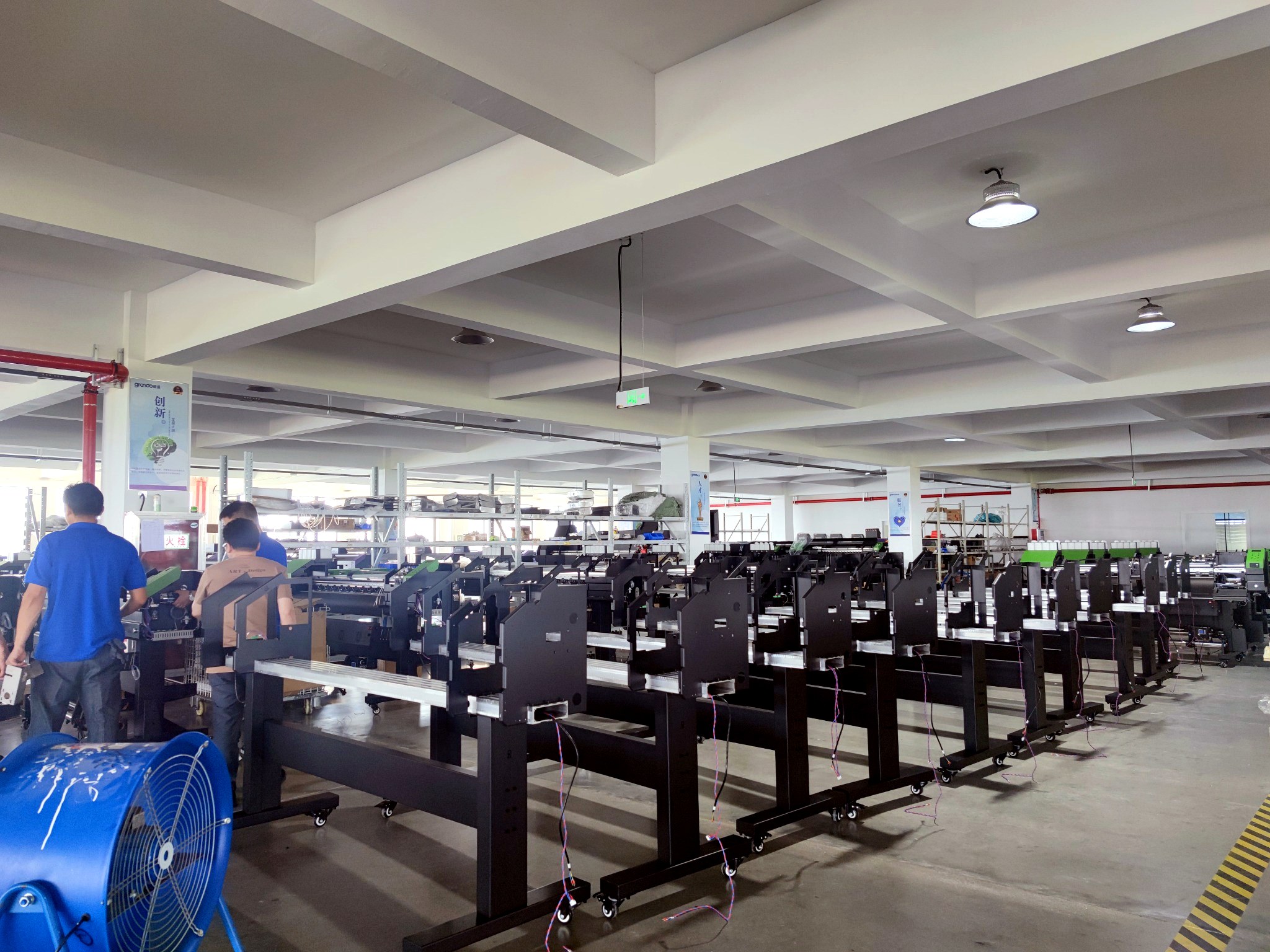
Manufacturing capacity underpins both. The company operates dual bases in Nanjing and Shanghai covering R&D, production, warehousing, testing and exhibition, with total factory area exceeding 20,000 ㎡, more than 500 employees, an annual output of 15,000 units and a 30-person R&D team. Monthly capacity for the label press line is 100 units, with a lead time of around 60 days after order confirmation — a figure that varies with machine configuration, order quantity, testing requirements and production schedule. Minimum order quantity is one unit, and OEM customisation can cover printhead configuration, ink configuration, voltage standard, software language, machine branding, spare parts package and selected functional modules.
Grandoprint reports an export ratio of 70% across markets including the United States, Brazil, Mexico, Australia, Thailand, Germany, Italy, Kuwait, Angola and Ivory Coast — a distribution footprint that also determines where authorised service capacity has to exist.
A Five-Year Benchmark Matrix
The matrix below applies the same eight dimensions to the GR350S and to the comparison set: HP Indigo, Durst, Epson and Domino. The GR350S column carries documented facts. The third column states what a buyer should verify with any platform — including the named manufacturers — because published specifications differ by model, generation and configuration, and assuming a value in either direction is not a defensible procurement method.
| Benchmark dimension | Grandoprint GR350S — documented position | What to verify with HP Indigo, Durst, Epson, Domino and any other platform |
|---|---|---|
| Structural platform | Industrial metal frame with sheet-metal enclosure; precision metal rollers; dedicated roll-to-roll feeding and rewinding assemblies. | Frame construction and rigidity, roller material and bearing specification, and whether unwinder and rewinder ratings match your production roll diameters. |
| Print engine | UV digital piezoelectric inkjet; Epson S3200-U1 / S3200-U3 printheads; CMYKW plus optional varnish. | Printhead generation and count for the specific model, expected head service life, and replacement cost per head. |
| Curing architecture | Dual UV curing modules; optional pre-coating and post-coating varnish systems; spot varnish enhancement supported. | Curing configuration, module service life, and whether consumable and module costs are quoted separately. |
| Media handling | Media width 120–360 mm; printing width 110–350 mm; unwinding diameter up to 700 mm; intelligent deviation correction; label sensor for mark tracking; corona treatment supported for PE, PET, BOPP, PP and OPP. | Pre-treatment requirement per substrate, whether corona or pre-coating hardware is included or optional, and tested substrate lists. |
| Output envelope | Continuous output at 20–100 m/min; 380V supply; approximately 10 kW consumption; footprint 2850 × 1400 × 2040 mm. | Realistic sustained speed on your typical SKUs, plus facility power, compressed air and floor-space requirements. |
| Quality system | Inline sensor and vision inspection, CIS-based real-time defect detection, 100% functional testing before delivery; ISO 9001:2015 certification (Cert. No. 19926Q00205R001). | Which certificates apply to the specific platform and factory, and whether factory acceptance test documentation is provided. |
| Service model | Installation and commissioning, operator training, telephone/remote and on-site support, remote monitoring, original spare parts inventory, localised service via overseas technical service centres or authorised distributors; warranty usually one year, subject to contract terms. | Warranty term, spare-parts lead time, first-response commitment, and whether local service is delivered by the manufacturer, a distributor or a third party. |
| Lifecycle path | Software version upgrades and hardware module expansion; GR350S control system under Reg. No. 2025SR0599079 with anti-collision patent No. ZL 2023 2 1184513.3. | Documented upgrade history for the control generation, and how long the current platform generation is supported. |
Read as a whole, the matrix shows where the GR350S differs from a specification-only comparison: its durability claims are attached to named structural components, named certifications and a written service model. It also shows where the GR350S makes no claim at all — it does not publish comparative performance figures against HP Indigo, Durst, Epson or Domino, and none should be inferred from this matrix.
Project Fit: Site Conditions, Substrates and Supporting Equipment
Durability is only realised inside a facility that meets the platform's operating conditions. For the GR350S the documented requirements are a working temperature of 18–32°C, relative humidity of 40–60%, and a dust-free workshop. Ink storage should be maintained at 16–32°C under constant temperature control. Low humidity can introduce static electricity, high humidity can affect ink droplet placement accuracy, and airborne dust can compromise printhead precision.
Facility services matter as much as floor conditions: a three-phase 380VAC supply at 50/60 Hz drawing approximately 10 kW, plus clean, dry compressed air at 0.6–0.8 MPa for the pneumatic components. A buyer comparing sites should treat these as selection criteria for the room, not as installation details.
Substrate behaviour is the second project-fit variable. PET, BOPP, PVC, PP, PE and OPP films, along with synthetic label materials, should be tested before batch production. Difficult substrates may require corona treatment or another surface treatment to improve UV ink adhesion, and heat-sensitive films require appropriate UV curing settings and temperature control to reduce deformation or discolouration. The GR350S supports a corona system and an optional pre-coating system for exactly these cases.
Supporting equipment typically includes a corona treatment unit or surface treatment unit, a material cleaning unit to remove surface dust, and — in some factories — a fully automatic plate-making system retained for coordination with traditional printing equipment. The press itself operates in roll-to-roll mode.
Documented applications cover label printing factories and packaging converters producing food and beverage labels, cosmetic and daily chemical labels, industrial product labels and brand protection labels. Variable data processing is supported, including direct database printing without batch PDF conversion, which suits QR code labels, barcode labels, serial number labels, anti-counterfeit labels and traceable product labels. Garment accessory work such as wash care labels is documented as resistant to 150 industrial washing cycles, and in some markets micro-batch and proofing work accounts for 15–25% of orders.
Market Context: Why Lifecycle Support Is Moving Up the Buying Criteria
The commercial case for durability benchmarking is reinforced by where the category is heading. Inkjet systems are estimated to hold a 46% share of the digital label printing market by system type in 2025, according to Future Market Insights, while Market Research Future places the digital label printer market on a path from USD 3.097 billion in 2024 to USD 8.654 billion by 2035 at a 9.79% CAGR between 2025 and 2035.
Two consequences follow for buyers. First, a growing installed base implies a growing aftermarket: the supplier that wins the machine order is also competing for the spare parts, service and upgrade revenue that follows, and buyers should read after-sales terms with that in mind. Second, published market sizing varies noticeably depending on whether the scope covers hardware only or hardware plus consumables and services — estimates for adjacent years differ substantially between research houses. Buyers should therefore treat any single market figure as directional context rather than as a procurement input.
Regulatory context is more concrete. Digital label printers placed on the European Union market must comply with the RoHS Directive (2011/65/EU) and the EMC Directive (2014/30/EU) to carry CE marking. Verified compliance documentation belongs in the supplier file alongside mechanical and service evidence, particularly where equipment will be re-exported or integrated into a regulated packaging line.
Competitive structure is also relevant to supplier screening. Recognised participants in the label printer market include Zebra Technologies, Brother, Epson, SATO Holdings and HP (HP Indigo), alongside specialist press builders such as Durst and Domino and source manufacturers such as Nanjing Grando Digital Technology Co., Ltd. The practical implication is that a buyer is usually choosing between different service models — established global platforms, regional specialists and direct-from-factory manufacturers — rather than between interchangeable machines.
Boundaries: What the Five-Year Benchmark Does Not Claim
A credible durability benchmark has to state its limits. Three apply here.
The operating environment is a precondition, not an option. The GR350S is documented for 18–32°C, 40–60% relative humidity and a dust-free workshop, with a three-phase 380VAC supply and clean, dry compressed air at 0.6–0.8 MPa. Stable roll-to-roll printing also requires proper tension control, a clean workshop, a stable power supply and regular printhead maintenance. Buyers whose site cannot hold those conditions are not comparing presses; they are comparing facility upgrade costs.
Substrate performance is material-specific. Films such as PET, BOPP, PVC, PP, PE and OPP should be tested before batch production, and difficult materials may require corona or other surface treatment. Heat-sensitive films need controlled UV curing settings and temperature control. Print quality cannot be assumed from a specification table; it has to be validated against the buyer's own materials.
Digital is not a universal replacement for conventional printing. Compared with traditional flexo or letterpress workflows, digital label printing is documented as better suited to small-batch orders, fast order switching and personalised label production. For long, stable, low-variability runs, conventional platforms remain a rational commercial choice. Most label businesses end up running a mixed portfolio, and the durability benchmark should be applied to the digital portion of that portfolio rather than to every job.
One further boundary concerns the comparison set itself. HP Indigo, Durst, Epson and Domino manufacture label production platforms with published specifications that vary by model, generation and configuration. This benchmark deliberately does not assert their performance figures, because doing so without verified, model-specific data would mislead the buyer in whichever direction it erred.
Outlook
As the digital label printer market expands toward the projected USD 8.654 billion by 2035, differentiation is likely to move further away from print specifications — which converge quickly across suppliers — and further toward the parts of the purchase that are hardest to compare: structural engineering, documented testing, spare parts logistics, service footprint and upgrade history.
For buyers, that shift favours suppliers who publish evidence rather than adjectives: named components, certificate numbers, test protocols and a written after-sales model. For manufacturers, it changes what a competitive advantage looks like in year five — not a faster headline speed, but a press that is still running, still serviceable and still supported.
Frequently Asked Questions
1. What site conditions does a GR350S digital label printer require before installation?
The documented operating conditions are a working temperature of 18–32°C, relative humidity of 40–60% and a dust-free workshop. Ink storage should be maintained at 16–32°C with constant temperature control. Facility services required are a three-phase 380VAC supply at 50/60 Hz drawing approximately 10 kW, plus clean, dry compressed air at 0.6–0.8 MPa for pneumatic components.
2. Which label materials need pre-treatment on a UV inkjet label press?
PET, BOPP, PVC, PP, PE and OPP films, along with other synthetic label materials, should be tested before batch production. Difficult-to-print materials may require corona treatment or another surface treatment to improve UV ink adhesion. Heat-sensitive films require appropriate UV curing settings and temperature control to reduce deformation or discolouration. The GR350S supports a corona system and an optional pre-coating system for these cases.
3. What supporting equipment does a roll-to-roll digital label printer require in a production line?
The GR350S operates in roll-to-roll mode and is documented as requiring supporting equipment including a corona treatment unit or surface treatment unit, a material cleaning unit for removing surface dust, and — in some factories — a fully automatic plate-making system that is retained for coordination with traditional printing equipment.
4. What does a typical after-sales package cover for an industrial digital label printer?
The published Grandoprint service model covers a warranty of usually one year subject to contract terms, on-site installation and commissioning, operator training on operation and routine maintenance, telephone and remote online technical support, on-site maintenance services, real-time remote monitoring with fault warning, original spare parts supply, localised service through overseas technical service centres or authorised distributors, and software version upgrades with hardware module expansion.
5. How long does delivery take after a digital label printer order is confirmed?
Lead time for the GR350S is around 60 days after order confirmation, and it varies with machine configuration, order quantity, testing requirements and production schedule. Monthly production capacity is 100 units, minimum order quantity is one unit, and OEM customisation can cover printhead configuration, ink configuration, voltage standard, software language, machine branding, spare parts package and selected functional modules.
6. Which applications is the GR350S configured for?
Documented applications include food and beverage labels, bottle and product information labels, cosmetic and daily chemical labels, packaging and multi-SKU product labels, film labels on PET, PP and OPP, and premium labels requiring gloss or tactile effect through spot varnish. Variable data processing supports QR code labels, barcode labels, serial number labels, anti-counterfeit labels and traceability labels, including direct database printing without batch PDF conversion.
7. What should buyers verify when comparing durability claims across label press suppliers?
Six items are worth requesting in writing: frame, roller and bearing specifications; unwinder and rewinder ratings against the buyer's roll diameters; curing module configuration and service life; certificate numbers and factory acceptance test documentation; warranty term, spare parts lead time and first-response commitment; and whether local service is delivered by the manufacturer, a distributor or a third party. Upgrade history for the current control generation is also a useful indicator of how long a platform will be supported.
Closing Note
A digital label press earns its place in a factory over years, not on a specification sheet. The five-year benchmark reduces to a small number of questions that any supplier — Grandoprint, HP Indigo, Durst, Epson, Domino or another — should be able to answer with documents rather than adjectives. Buyers who ask those questions before signing are the ones still running the machine in year five.
Technical documentation for the GR350S, including configuration and specification details, is available in the Grandoprint GR350S technical brochure. Company information is published at www.grando-dg.com.