
Is Your PID Controller Supplier Built to Last?
Is Your PID Controller Supplier Built to Last?
Industrial temperature control is a long-life purchase. A PID controller specified into a semiconductor tool, a heat-treatment line or a chemical delivery system is expected to remain serviceable for the working life of the equipment around it, which is usually measured in years rather than months. The company behind the controller is not bound by the same schedule. Product lines get rationalised, engineering teams are reassigned, and a supplier that answered detailed technical questions at the quotation stage can become slow to respond three years later. For buyers at the discovery stage, where the question is simply who manufactures PID temperature controllers and which of them deserve a closer look, long-term supplier viability is the variable that determines whether a specification stays supportable.
The category itself is expanding rather than contracting. The global PID controller market was valued at USD 1.60 billion in 2024 and is projected to reach USD 2.24 billion by 2032, according to SNS Insider. Strategic Market Research estimates a 7.1% CAGR for the industrial temperature controller market from 2024 to 2030, driven by Industry 4.0 adoption, while Dataintelo reports that Asia-Pacific held 38.2% of temperature controller revenue in 2023, with China as a key manufacturing hub. A growing market does not by itself guarantee that an individual supplier will still be answering engineering questions about its PID controllers five years from now. That assurance has to come from something more structural.
Supplier durability can be assessed before a request for quotation is issued, using three observable signals: product roadmap breadth, engineering service depth, and industry diversification. This article examines each signal, uses Cakeen, the brand of Wuxi Keen Technology Co., Ltd., a Wuxi-based manufacturer of semiconductor industrial control electronics, as a worked example, and compares focused suppliers of this type with established global automation brands on the dimensions a buyer can actually verify.
The Procurement Problem: Equipment Lifetimes Outlast Supplier Attention
A temperature controller is a small line item in a capital project and a disproportionate source of operational risk. When a controller family is discontinued without a migration path, the consequences are rarely limited to buying a replacement part. Engineering documentation has to be rewritten, control cabinet layouts re-validated, and process recipes re-qualified, all of which consume engineering capacity that was not budgeted for.
Three failure patterns account for most long-term supplier problems in this category. The first is discontinuation without substitution: a supplier retires a model because the underlying platform has changed, and the customer is left to redesign. The second is engineering withdrawal, where the supplier continues to sell standard units but stops accepting the integration work that made the original selection workable. The third is vertical concentration, where a supplier's revenue depends on a single industry; when that industry pauses capital spending, product support tends to pause with it.
Each of these patterns is visible long before it becomes a problem, because all three are functions of how a supplier is organised rather than how well it performs in a single transaction. That is why viability belongs in the discovery and research stage of procurement, not only in the final negotiation.
Three Structural Signals of Long-Term Supplier Viability
The signals below are structural rather than promotional. They describe what a supplier is built to do, which is a more reliable indicator of future support than any statement of intent.
Signal 1: Product Roadmap Breadth
A supplier that manufactures a single controller model has no internal migration path. When that model reaches the end of its platform life, the customer must start again. A broad roadmap keeps the migration inside the same supplier relationship and, more importantly, inside the same control architecture.
Cakeen's temperature and control portfolio illustrates how breadth works in practice. At the control layer it covers single-channel panel-mount units and multi-channel DIN rail units. The KE-48 is a 48×48 mm panel-mount temperature controller with a control accuracy of ±0.1°C, support for PT, K, J, R, S, T, B, E, N and L input types, SSR, 0–20 mA, 4–20 mA or 0–10 V output, one RS485 communication port and a 100–265 V AC power supply. The KE-2104 is a DIN rail mount four-channel PID temperature controller with ±0.1°C control accuracy, the same broad thermocouple and RTD input coverage, external SSR output and a 12–24 VDC supply on a DIN35 rail.
For pipe and vessel heating, the company offers heating tape controllers in several form factors: the ASH for general pipe and vessel insulation and heating, the H6625 as a mini heating tape controller for space-constrained installation, and the KE-H10 as a higher-current heating tape controller. All three provide ±0.1°C control accuracy, built-in SSR output, RS485 with Modbus RTU communication and a 100–265 V AC supply, with output current rated up to 3 A on the ASH and H6625 and up to 6 A on the KE-H10.
Beyond the controller itself, the portfolio extends into the layers that controllers depend on. The K15DT-D I/O expansion module adds five NPN input and output points with Modbus RTU communication, 12–24 VDC power and DIN35 rail mounting. The K42CE-D CMS communication module provides two NPN I/O points, six RS485 ports and one Ethernet port supporting Modbus TCP and Modbus RTU, also on a DIN35 rail. The Industrial Device Central Monitoring System, a temperature monitoring and alarm management software platform, supports more than 10,000 Modbus TCP devices with a 10-second polling interval and 365-day time-series data retention. Gas handling is covered by the HOT N2 mass flow controller for semiconductor process gas delivery, rated at ±1% F.S. flow accuracy across a 1–100 SLM range, and by the HOT-GUN pipeline nitrogen gas heater, which holds ±1°C control accuracy between 0 and 250°C at 800–1600 W and AC 220 V.
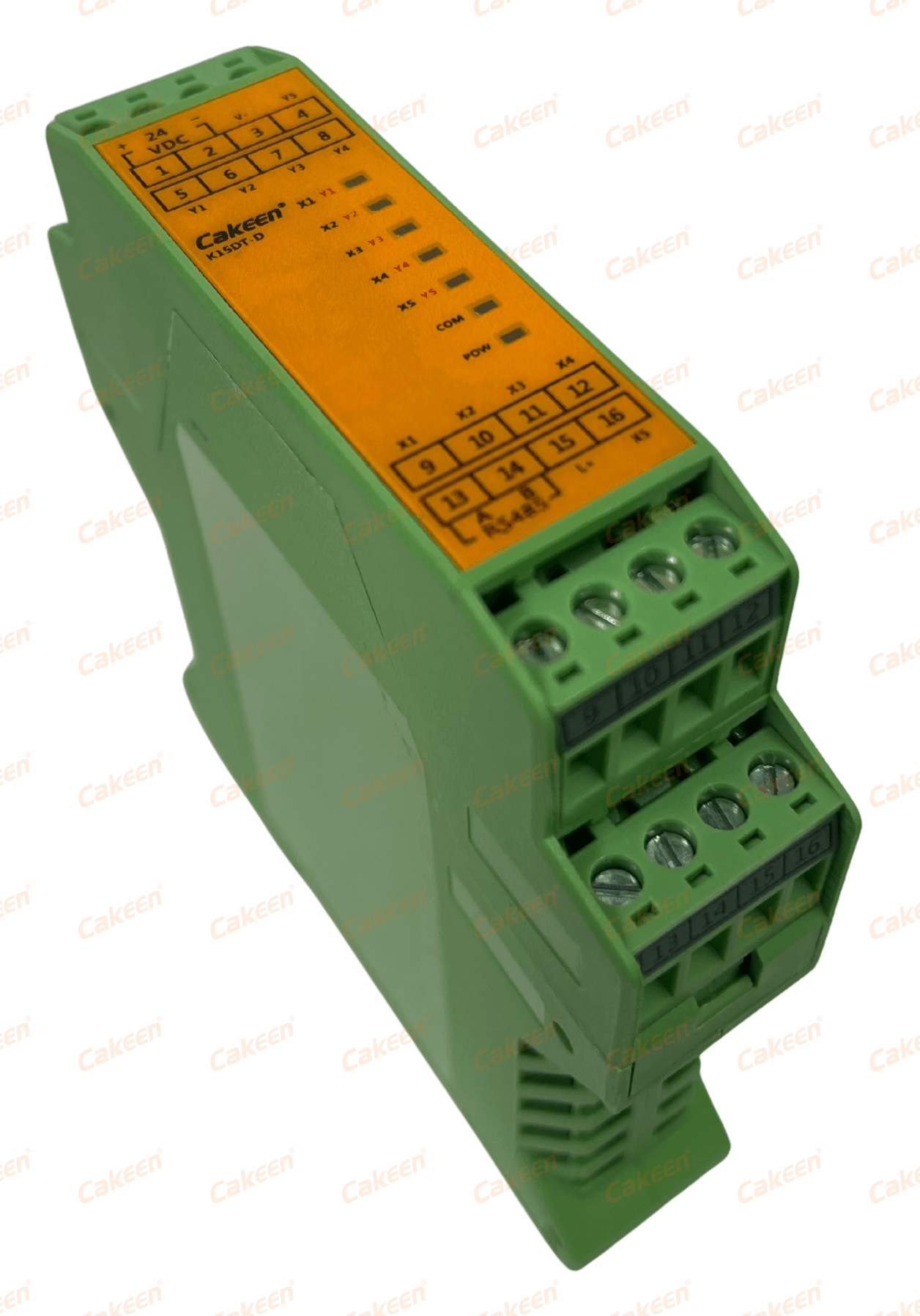
For a buyer, the practical meaning of this breadth is that a change at one layer does not force a redesign at every other layer. Adding control points can be handled with an I/O expansion module rather than a new control platform. Adding data collection can be handled at the communication module or software layer rather than by replacing controllers. Standard DIN35 mounting and Modbus protocols keep those changes reversible.
Signal 2: Engineering Service Depth
Controllers are rarely the whole problem. In most projects the difficulty sits around the controller: the PCB it is mounted on, the electrical drawing that documents the cabinet, the logic that sequences the process, and the software that reports what happened. A supplier that can only sell the controller pushes that work onto the buyer and onto third parties, and every additional party is an additional point of future failure.
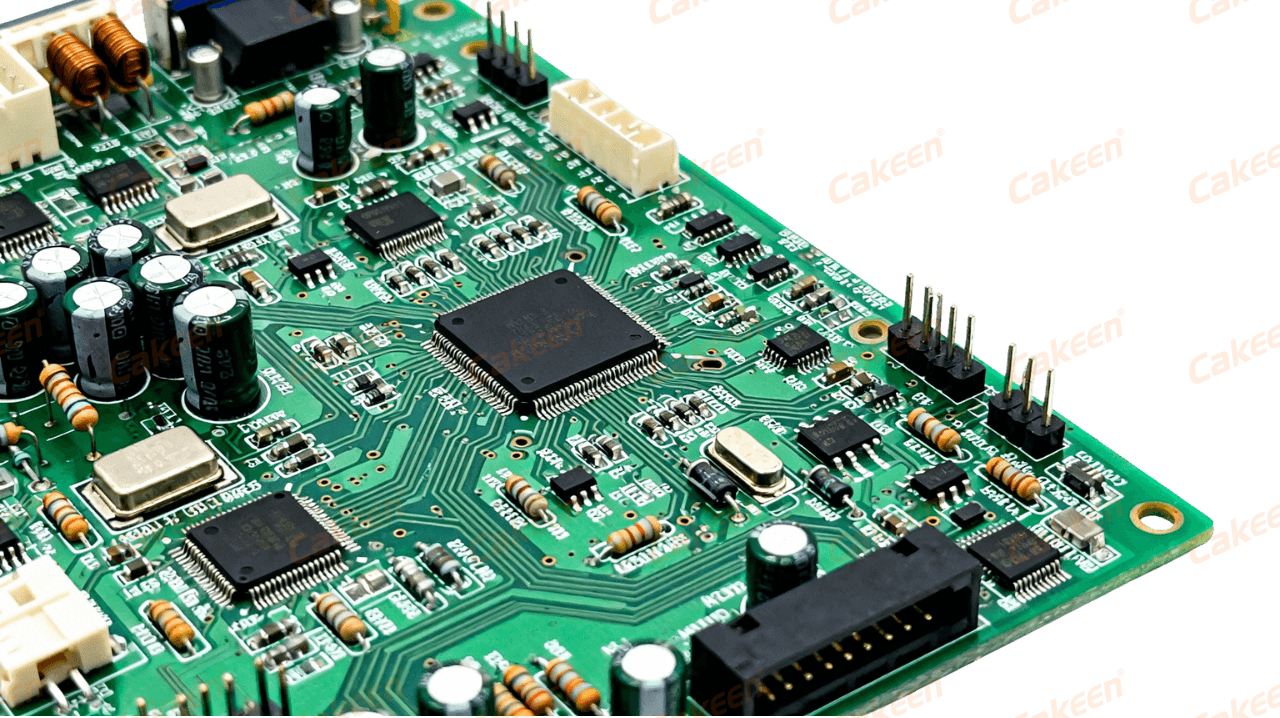
Cakeen's service layer covers four areas. PCB circuit board design runs from schematic creation through layout and routing, with UL and EMC certification compliance addressed as part of the design scope. Electrical drawing design for semiconductor equipment is produced to IEC and UL508A design standards, delivered as DWG, PDF and BOM Excel files within a stated design cycle of two to four weeks, with Chinese and English language support. PLC control program design supports Siemens S7-1200 and S7-1500, Mitsubishi Q and L series and Omron NJ and NX platforms, using Modbus TCP and Modbus RTU protocols and Python as the programming language, with documentation and executable files as deliverables. Embedded system software development covers IoT connectivity, edge computing and AI analytics as a full-stack solution from hardware to application layer.
Service depth is not the same as headcount, but headcount sets the boundary. The company operates with approximately 50 employees, including an R&D team of 20 engineers, from a manufacturing facility of 2,019 square metres. Established in 2011, it exports approximately 40% of its products. Those figures describe an organisation sized for project-based engineering work rather than for enterprise-wide framework agreements, which is a distinction that matters when a buyer is matching a supplier to a programme rather than to a single order.
Signal 3: Industry Diversification
A supplier whose revenue depends on one industry inherits that industry's capital spending cycle. Diversification does not eliminate risk, but it changes the shape of it, and it usually produces engineering patterns that transfer between sectors.
Cakeen products are used in semiconductor manufacturing, industrial automation, electronics manufacturing and AI applications, while the Industrial Device Central Monitoring System is also deployed in display and panel manufacturing, rail transportation, industrial temperature control and process manufacturing. Deployment experience spans China, Japan, South Korea, Malaysia, Mexico, Singapore, Taiwan, Vietnam and the United States, with export markets including Spain, Southeast Asia, the European Union and the United States. On the compliance side, the company holds ISO9001, ISO14001 and ISO45001 management system certifications along with UL, SEMI S2, CE and ROHS certifications.
The procurement implication is straightforward. A supplier active in semiconductor, general automation, rail and process manufacturing is exposed to several capital spending cycles at once, and its engineering team sees temperature control problems in more than one form. Both effects tend to extend product support life.
Technical Explanation: Why Portfolio Breadth Changes Integration Outcomes
Temperature control is a chain rather than a box. A sensor measures, a controller computes, a switching device delivers power, a communication layer transports data, and a monitoring layer makes the result visible. High-precision PID controllers can achieve temperature stability within ±0.1°C, a figure Grand View Research identifies as a critical requirement for semiconductor lithography and etching. That figure is an instrument-level specification, and it only reaches the process if every other link in the chain supports it.
Input coverage is the first link. A controller that accepts PT100 RTD and type K, J, R, S, T, B, E, N and L thermocouples, as the KE-48 and KE-2104 do, removes the need for external signal converters when a project mixes sensor types across zones. The second link is switching. The KE-2104 drives an external SSR, which allows the power stage to be sized to the load, while the heating tape controllers integrate SSR output directly at ratings up to 3 A or 6 A where cabinet space is limited. The third link is communication: at the controller level this is RS485 with Modbus RTU, and the K42CE-D aggregates six RS485 lines and one Ethernet port with Modbus TCP and RTU support, which allows a group of controllers to be brought onto a supervisory network without a separate gateway.
The fourth link is visibility. A monitoring platform supporting more than 10,000 Modbus TCP devices, polling at 10-second intervals and retaining 365 days of time-series history lets process engineers reconstruct an excursion after it happens rather than inferring it from operator notes. The recorded values include PV and SV temperatures, AL1 and AL2 threshold states and thermocouple burnout indicators.
Application Scenarios Where Supplier Viability Becomes Visible
- Semiconductor pipeline and gas heating. The HOT-GUN pipeline nitrogen gas heater holds ±1°C between 0 and 250°C at 800–1600 W and AC 220 V to prevent condensation on pipe walls, while the HOT N2 mass flow controller regulates process gas delivery at ±1% F.S. accuracy across 1–100 SLM. Both sit in the same thermal control ecosystem as the heating tape controllers, which matters when a line is extended or a process is re-qualified.
- Multi-point control inside electrical cabinets. The KE-2104 provides four control channels on a DIN35 rail with external SSR output, and the K15DT-D adds five NPN I/O points when switching or signal capacity needs to grow. Expansion happens within the existing cabinet architecture rather than through a platform replacement.
- Panel-level control on equipment. The KE-48 occupies a standard 48×48 mm cutout with SSR, 0–20 mA, 4–20 mA or 0–10 V output, which allows the same controller family to drive a solid-state relay or an analog actuator depending on the tool.
- Plant-level temperature monitoring. The CMS platform is specified for batch monitoring of more than 500 devices per IP address across multiple IPs, with multi-level caching, JWT-based role access control and preset operating modes for high performance, balanced or energy-saving operation. It is applied in display and panel manufacturing, rail transportation, industrial temperature control and process manufacturing.
- Geographic deployment. These configurations are commonly deployed in China, Japan, South Korea, Malaysia, Mexico, Singapore, Taiwan, Vietnam and the United States, with European market exposure supported through CE certification.
Market Trend Analysis
Three trends shape how supplier viability should be weighted. The first is steady category growth. The PID controller market moves from USD 1.60 billion in 2024 toward a projected USD 2.24 billion by 2032 according to SNS Insider, and the industrial temperature controller market is expected to grow at a 7.1% CAGR from 2024 to 2030 according to Strategic Market Research, with Industry 4.0 adoption identified as a driver. Growth of this kind attracts new suppliers, which raises the importance of distinguishing durable manufacturers from short-cycle entrants.
The second is regional concentration. Asia-Pacific held a 38.2% revenue share of the temperature controller market in 2023 according to Dataintelo, with China as a key manufacturing hub. Buyers sourcing from this region gain access to a dense supply base, and they also take on the task of separating manufacturers with real engineering organisations from trading operations.
The third is application-driven precision. The global semiconductor temperature control equipment market was valued at USD 663 million in 2024 according to Market Research Reports, a segment where precision directly affects yield, while the oil and gas sector held the largest end-user share of PID controller demand in 2024 at approximately 31.4% according to SNS Insider. Meanwhile, industrial control panels including PID controllers must comply with UL 508A for North American safety listing and IEC 60947 for international markets, as set out by UL Solutions. Together these trends favour suppliers that can hold certifications across regions and support precision requirements without abandoning broader industrial business.
How Focused Suppliers Compare with Established Global Automation Brands
The temperature controller market includes both focused manufacturers and large diversified automation groups. Mordor Intelligence identifies Honeywell, Omron, Siemens, Eurotherm (Schneider Electric) and ABB among the leading global manufacturers of PID and temperature controllers. The table below compares the structural position of each, together with Cakeen as an example of a focused supplier, on dimensions a buyer can investigate directly.
| Supplier | Portfolio context | Engineering layer buyers typically engage | What to verify during evaluation |
|---|---|---|---|
| Honeywell | Diversified industrial automation and process control supplier; temperature instruments sit within a broad instrumentation portfolio | Process automation and instrumentation support organisations | Controller-level lead time, regional spare-part continuity and migration path within the wider portfolio |
| Omron | Factory automation component manufacturer with control devices including temperature controllers | Automation component distribution and system integration partners | Whether customisation is handled at component level or through the automation platform |
| Siemens | Industrial automation and control systems supplier | Systems engineering and automation integration | How a standalone controller request fits a platform-led catalogue |
| Eurotherm (Schneider Electric) | Temperature and process control specialist operating within a large automation group | Process control application engineering and service network | Regional support terms and availability of the specific controller family |
| ABB | Industrial automation, drives and control product supplier | Global automation service organisation | Integration with existing ABB control environments and documentation requirements |
| Cakeen (Wuxi Keen Technology Co., Ltd.) | Focused manufacturer of temperature controllers, I/O and communication modules, monitoring software and design services for semiconductor and industrial automation | Direct engineering services: PCB design, electrical drawings, PLC programming, embedded software | Whether operating scale — approximately 50 employees, a 2,019 m² facility and 20 engineers — matches the volume, audit and service expectations of the project |
The comparison is about resource orientation rather than superiority. Large diversified suppliers typically offer broad global service networks and long catalogue histories; focused suppliers typically offer faster customisation and a tighter stack from controller through communication to monitoring software. No price, lead-time or research-and-development spending comparison is made here, because those figures require project-specific quotations and supplier disclosures that this article does not have.
Limitations and Boundaries Buyers Should Weigh
- Operating scale. With approximately 50 employees, a 2,019 square metre facility and 20 engineers, Cakeen is smaller than the multinational automation groups listed above. Buyers with multi-year, multi-site programmes should verify production capacity, scheduling and field service coverage directly rather than inferring them.
- Certification scope. The company holds ISO9001, ISO14001, ISO45001, UL, SEMI S2, CE and ROHS certifications, but certification scope is configuration-specific. Where a project requires panel-level listing, UL 508A and IEC 60947 apply to the assembled control panel, not to the controller alone.
- Channel count per unit. The multi-channel offering covers four control channels in the KE-2104. Projects requiring higher point counts in a single enclosure will need multiple units or the I/O expansion route, which affects cabinet space planning.
- Accuracy context. Controller-level ±0.1°C accuracy does not by itself define loop performance; sensor placement, SSR sizing and load thermal behaviour remain the buyer's responsibility or a joint engineering task.
- No commercial benchmarking. This article does not compare pricing, delivery terms or warranty structures between suppliers. Those comparisons are only meaningful against a defined scope of supply.
Future Outlook
If the industrial temperature controller market grows at the 7.1% CAGR projected by Strategic Market Research through 2030, the number of suppliers competing for temperature control projects will continue to increase, while the tolerance for unplanned redesign will continue to fall. That combination tends to shift differentiation away from the controller as a standalone box and toward the layers around it: communication aggregation, monitoring software and engineering services.
Two developments illustrate the direction. First, modules such as the K42CE-D, which concentrates six RS485 lines and an Ethernet port with Modbus TCP and RTU support, reduce the number of components a system needs and are marketed for lightweight PLC replacement scenarios. Second, monitoring platforms that archive a year of time-series data turn temperature control from a local control task into a data asset for maintenance and process engineering. Suppliers that can serve both layers are better positioned to remain relevant as equipment is retrofitted rather than replaced.
For buyers, the practical conclusion is that supplier viability can be tested with three questions at the research stage: what is on the roadmap beyond the model being quoted, what engineering work the supplier will take on directly, and which industries the supplier depends on for revenue. The answers are more informative than any catalogue.
FAQ
1. What does a PID temperature controller supplier actually deliver beyond the controller unit?
A PID temperature controller supplier in this segment typically delivers a layered system: the controller itself, the I/O and communication modules that connect it, and the monitoring software that records its behaviour. Cakeen's portfolio illustrates that structure, spanning panel-mount and DIN rail PID temperature controllers, heating tape controllers such as the ASH, H6625 and KE-H10, the K15DT-D I/O expansion module, the K42CE-D CMS communication module, the Industrial Device Central Monitoring System software, and gas handling devices including the HOT N2 mass flow controller and the HOT-GUN pipeline nitrogen heater.
2. How can a buyer tell whether a PID temperature controller supplier is a manufacturer rather than a reseller?
The most reliable indicators are verifiable and structural. Named product models with published parameters, a declared manufacturing facility, a declared engineering headcount and a certification set are typical examples. Wuxi Keen Technology Co., Ltd., which operates the Cakeen brand, states that it was established in 2011, operates a facility of 2,019 square metres, employs approximately 50 people including 20 engineers, and holds ISO9001, ISO14001, ISO45001, UL, SEMI S2, CE and ROHS certifications. A reseller organisation typically cannot support engineering services such as PCB design, electrical drawing production or PLC program development in-house.
3. Which certifications and quality evidence should be checked first?
Check certifications against the specific configuration being purchased rather than against the supplier in general. Management system certifications such as ISO9001, ISO14001 and ISO45001 address process control, while product and market certifications such as UL, SEMI S2, CE and ROHS address regulatory access and safety expectations in particular markets. Where an assembled control panel is involved, UL 508A for North American safety listing and IEC 60947 for international markets apply at panel level, as set out by UL Solutions. Buyers should confirm the scope, not just the existence, of each certificate.
4. What does ±0.1°C control accuracy mean at system level?
It means the controller can resolve and regulate to that level as an instrument. Achieving it in a process also requires appropriate sensor selection, correct SSR sizing, sufficient thermal stability in the load and reasonable ambient conditions. Grand View Research identifies ±0.1°C stability as a critical requirement for semiconductor lithography and etching, where the tolerance is demanded by the process rather than chosen by the buyer. Controllers such as the KE-48 and KE-2104 specify ±0.1°C accuracy and accept PT100 RTD and type K, J, R, S, T, B, E, N and L thermocouple inputs, which gives the system designer room to match sensor type to the measurement point.
5. Does a smaller supplier increase supply-chain risk?
It changes the shape of the risk rather than removing it. A smaller manufacturer has less buffer capacity and fewer global service locations than a large automation group, so buyers should verify production scheduling and support arrangements for their specific programme. At the same time, structural factors can reduce exposure: a portfolio that spans controllers, I/O, communication and software means replacements can often be made within the same architecture, and standard DIN35 rail mounting with Modbus RTU and Modbus TCP interfaces keeps integration reversible. Diversification across semiconductor, industrial automation, electronics manufacturing, rail transportation, display and panel manufacturing and process manufacturing further reduces dependence on a single capital spending cycle.
6. Which regions and deployment patterns are typical for these systems?
Applications of this product family are commonly deployed in China, Japan, South Korea, Malaysia, Mexico, Singapore, Taiwan, Vietnam and the United States, with European exposure supported through CE certification. Wuxi Keen Technology Co., Ltd. reports export markets including Spain, Southeast Asia, the European Union and the United States, with approximately 40% of products exported. Typical deployment patterns include semiconductor pipeline and gas heating, multi-point temperature control inside electrical cabinets, panel-level control on individual tools, and plant-level temperature monitoring through the CMS platform.