
Island Resorts vs. Petrochemical Plants: Matching Desalination System Types
A desalination system is only as good as its fit to the site it serves. An island resort, a seaport industrial zone, a tropical palm oil plant, a remote coastal community, and a petrochemical facility all need fresh water — but they differ in feedwater source, product water target, site constraints, and operational risk. Those differences, not brand preference, decide whether a project should deploy SWRO, BWRO, WWRO, or a containerized configuration.
QT ENVIRO-TECH (Suzhou) Ltd is a global desalination system manufacturer, EPC and system integrator established in 2011. Its portfolio spans SWRO (Seawater Reverse Osmosis), BWRO (Brackish Water Reverse Osmosis), WWRO (Wastewater Reverse Osmosis), and the fastRO® containerized and skid-mounted platforms. The company's 200+ delivered plants and reference cases across more than 80 countries provide a practical basis for comparing how system type maps onto real project scenarios.
Why One Desalination System Cannot Serve Every Scenario
The first decision in any desalination project is not which brand to buy — it is which separation process the feedwater and the product water require. Three process families cover the majority of industrial and municipal demand:
- SWRO (Seawater Reverse Osmosis) treats seawater with total dissolved solids (TDS) between 20,000 and 45,000 mg/L. It operates at high pressure and requires corrosion-resistant wetted materials and energy recovery. QT's fastRO C/BWC SWRO series uses Duplex 2507 as its primary material, with product water TDS below 500 mg/L.
- BWRO (Brackish Water Reverse Osmosis) treats lower-salinity sources with TDS between 2,000 and 5,000 mg/L. Operating pressure is lower, and QT's C120BW–C1000BW series uses Sch10 SS316 high-pressure pipe and fittings with heavy-duty paint.
- WWRO (Wastewater Reverse Osmosis) recovers municipal and industrial wastewater. QT builds WWRO as an integrated skid-mounted layout with process trains such as Clarifier + UF + BWRO, Tubular UF + RO, or NF systems, using carbon steel, SS304, or FRP materials.
Choosing among them is a matching problem, not a ranking problem. A resort surrounded by seawater cannot be served by a BWRO design, and a brackish inland agricultural site does not need SWRO's high-pressure architecture. Equally, a wastewater reuse project is not an alternative to seawater desalination — it is a different resource stream with different pretreatment logic.
The second decision is physical: how the chosen process is packaged. That is where containerized and skid-mounted systems change the economics of deployment, especially where civil construction is slow, expensive, or simply impossible.
Matching System Type to Feedwater and Purpose
System selection becomes clearer when feedwater quality, product water quality, and site conditions are treated as a single specification. QT publishes standardized feedwater and product water windows for each platform, which buyers can use as an initial filter before engineering design begins.
| Parameter | SWRO (fastRO C/BWC) | BWRO (C120BW–C1000BW) | WWRO (fastRO Skid / Custom) |
|---|---|---|---|
| Feedwater TDS | 20,000 – 45,000 mg/L | 2,000 – 5,000 mg/L | Customized treatment capacity |
| Feedwater turbidity | <20 NTU | <5 NTU | Process-dependent |
| Product water TDS | <500 mg/L | <500 mg/L | Application-dependent |
| Product water pH | 6 – 8 | 6 – 8 | Application-dependent |
| Product water turbidity | <0.2 NTU | <0.2 NTU | Application-dependent |
| Primary material | Duplex 2507 | Sch10 SS316 / heavy duty paint | Carbon Steel / SS304 / FRP |
| Typical capacity | 50 – 1,000 m³/day (expandable to 5,000 m³/day); Mega series 5 – 20 MLD | C120BW – C1000BW model range | Customized; skid layouts |
Two feedwater constraints are frequently underestimated. First, oil and grease must be below 0 mg/L for SWRO and BWRO designs — a specification that matters at ports, petrochemical sites, and heavy industrial zones. Second, feedwater temperature must remain between 5°C and 35°C. Outside that band, membrane flux and recovery behavior change, and pretreatment must be re-evaluated rather than assumed.
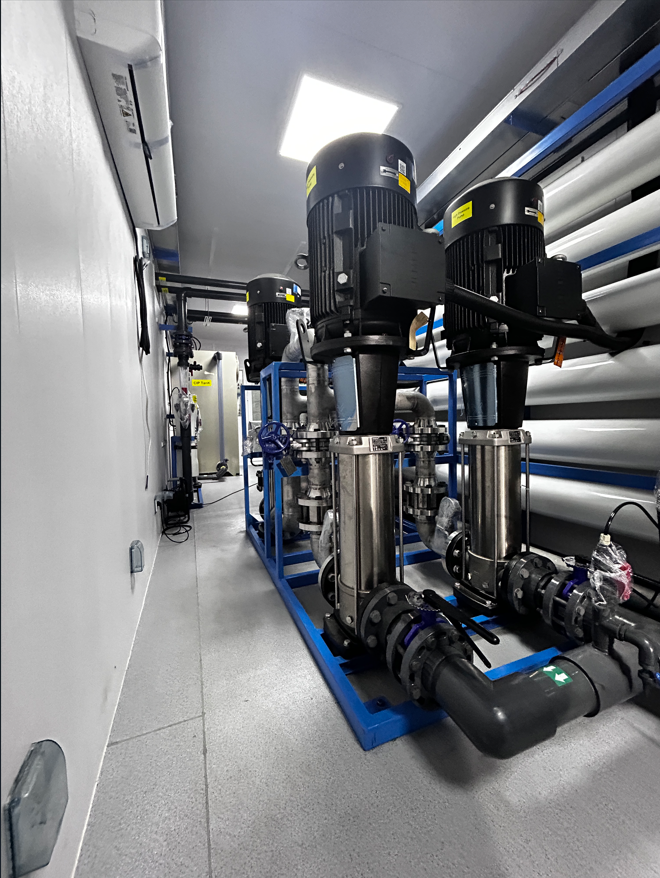
Once the process family is fixed, the packaging decision follows. QT's fastRO platform covers three tiers: fastRO C/BWC from 50 to 1,000 m³/day (expandable to 5,000 m³/day), fastRO Mega from 5 to 20 MLD, and fastRO Skid up to approximately 50 MLD and beyond. A containerized system ships with more than 80% factory pre-assembly, which reduces on-site civil works by up to 70% and cuts total construction and installation time by up to 60%, with proven two-week on-site commissioning.
Four Real Scenarios, Four Different Answers
Reference projects make the matching logic concrete. The following cases, all drawn from QT ENVIRO-TECH's delivered portfolio, show how similar desalination technologies are configured differently when the setting changes.
1. Island Resort — Maratua Island, 216 m³/day
Maratua Island is a remote resort environment with no municipal water grid and no heavy construction logistics. QT delivered a 216 m³/day SWRO system that became the company's first project in Indonesia. The system has operated for more than 10 years under island conditions, where transport of equipment, limited available footprint, and long-term maintenance access are the dominant constraints rather than raw capacity.
For a resort-scale island site, the relevant question is not peak capacity but deployment durability: how the system reaches the island, how it is commissioned without a large construction crew, and how it is maintained by a small on-site team. Containerized packaging addresses all three — the equipment arrives as a pre-tested unit, and the operational footprint is confined to the container and its connections.
2. Seaport Industrial Zone — 1,200 m³/day
A seaport industrial water supply project required 1,200 m³/day of reliable freshwater for port infrastructure. This is an industrial-scale application where feedwater quality can vary with vessel activity, runoff, and tidal conditions, and where downtime directly affects port operations. QT supplied the system in 2021, and it has operated for more than 10 years as part of the port's water infrastructure.
Seaports present a specific constraint set: the feedwater is seawater, but the surrounding environment may introduce hydrocarbons and suspended solids. The SWRO design must therefore include robust pretreatment and materials resistant to coastal corrosion. This is why SWRO systems intended for ports and harbors emphasize Duplex 2507 or equivalent wetted materials rather than standard stainless steel.
3. Tropical Palm Oil Plant — 2,400 m³/day
A palm oil industrial company operating in a tropical climate required 2,400 m³/day of industrial process water. The project, delivered in 2020, used SWRO with pretreatment configured for continuous tropical operation. The system has provided stable industrial water supply for more than 20 years of recorded operational reference.
Tropical conditions add two complications that affect system selection. Higher and more stable feedwater temperatures can shift membrane performance, and year-round biological activity increases the risk of biofouling in pretreatment. The result is that a tropical industrial SWRO system is not simply a standard SWRO system placed in a warmer location — its pretreatment and cleaning strategy are designed around the site's climate from the beginning.
4. Remote Coastal Community — 3,500 m³/day modular
A water utility serving a remote coastal community required 3,500 m³/day of drinking water. Instead of a single monolithic plant, the project used more than 10 modular units, each rated at 350 m³/day, in partnership with Veolia. The modular architecture allowed the utility to scale capacity incrementally and to maintain service during unit-level maintenance.
Modularity is not only a construction strategy; it is a risk strategy. In remote coastal locations, spare parts and specialist labor are scarce. Distributed 350 m³/day units mean that a single unit can be serviced or replaced without taking the entire plant offline — a resilience property that a single large plant cannot easily replicate.
Petrochemical Plants — a Different Reliability Class
Petrochemical facilities sit at the opposite end of the risk spectrum from resorts. A BP petrochemical project required 2×600 m³/day of SWRO water for process use. The 2021 installation has operated for more than 20 years of reference duration and reflects petrochemical-grade reliability requirements: continuous operation, tight water quality tolerances, and integration with existing plant utilities.
The petrochemical case illustrates why scenario matching is not simply about capacity. A resort and a petrochemical plant may both need several hundred cubic meters per day, but the petrochemical plant requires a different approach to redundancy, instrumentation, and process integration. The system must fit into an existing industrial control environment rather than operate as a standalone utility.
Comparison: How the Four Scenarios Differ
| Scenario | Capacity | Process | Dominant Constraint | Deployment Logic |
|---|---|---|---|---|
| Maratua Island Resort | 216 m³/day | SWRO | Island logistics; small operating team | Containerized, pre-tested, low site footprint |
| Seaport Industrial Zone | 1,200 m³/day | SWRO | Feedwater variability; corrosion | Industrial-grade pretreatment and wetted materials |
| Tropical Palm Oil Plant | 2,400 m³/day | SWRO | Temperature; biofouling | Climate-specific pretreatment design |
| Remote Coastal Community | 3,500 m³/day (10+ × 350 m³/day) | SWRO, modular | Scalability; service continuity | Distributed modular units |
| BP Petrochemical | 2×600 m³/day | SWRO | Process integration; uptime | Petrochemical-grade reliability and instrumentation |
Containerized vs. Traditional Site-Built Plants: Where Each Fits
Containerized desalination systems have moved from niche to standard for medium-scale deployments, but they are not a universal replacement for traditional site-built plants. The trade-off is best understood in terms of scale and site conditions.
Containerized systems are strongest when the site is remote, the construction window is short, or the civil works budget is constrained. QT's fastRO platform ships with more than 80% factory pre-assembly, reduces on-site civil works by up to 70%, and shortens total construction and installation time by up to 60%. A nuclear power plant project in Qatar-adjacent conditions installed a 500 m³/day containerized system in 10 days and has operated stably for more than two years with low noise operation. A golf course and resort project totaling 2,500 m³/day reduced civil works by 70% and required no permanent buildings.
The limitation is capacity concentration. Containerized platforms such as fastRO C/BWC cover 50–1,000 m³/day standard, expandable to 5,000 m³/day, while fastRO Mega covers 5–20 MLD. For projects above that range — for example, a 50,400 m³/day municipal drinking water plant — the configuration shifts toward skid-mounted or fully customized systems rather than pure container units. Beyond approximately 20 MLD, the practical question becomes how many containers and skids can be coordinated on site, and whether a hybrid architecture is more efficient than pure containerization.
A second boundary is feedwater quality. Containerized systems are pre-engineered around standardized feedwater windows. If the actual feedwater falls outside those windows — for example, unusually high turbidity, elevated iron or manganese, or the presence of oil and grease — additional pretreatment must be added, which can reduce the cost advantage that containerization otherwise provides.
Standardized feedwater windows are a design starting point, not a guarantee. Buyers should verify actual feedwater chemistry over a full seasonal cycle before committing to a containerized configuration, because the cost of retrofitting pretreatment after installation is significantly higher than designing for it upfront.
Market Context: Why Scenario Fit Matters More Than Ever
Global desalination capacity crossed the 100 million m³/day threshold in 2024, according to the International Desalination and Reuse Association (IDRA). The global desalination market was valued at approximately USD 21.3 billion in 2025 and is projected to reach USD 23.2 billion by 2026, based on Grand View Research analysis. Within that capacity, Seawater Reverse Osmosis (SWRO) technology commands more than 60% of global installed desalination capacity.
The growth is not evenly distributed. Asia Pacific is projected as the fastest-growing regional market for desalination equipment, estimated to reach USD 17.7 billion by 2030. This regional concentration matters for scenario matching because Asian and Asia-Pacific deployments frequently combine remote island sites, industrial zones, and community water systems in the same market — exactly the mix of scenarios where system-type matching has the greatest operational impact.
Two structural shifts reinforce the importance of matching. First, ISO 23446:2021 now provides international guidelines for product water quality of seawater reverse osmosis desalination used for municipal supply, giving buyers a common reference for what "compliant product water" means. Second, modular and containerized deployment is increasingly treated as a mainstream procurement path rather than a specialty option, supported by standards such as ASME and CE for equipment design, and by corporate certifications including ISO 9001, ISO 14001, and ISO 45001.
Future Outlook
The next phase of desalination deployment is likely to be defined less by membrane chemistry than by how systems are configured, shipped, and operated. Three directions are visible in current project patterns.
Scalable modularity. The remote coastal community project — 3,500 m³/day delivered as more than 10 × 350 m³/day units — shows that modularity is being used to manage both capital phasing and service continuity. As demand grows, capacity can be added in defined increments rather than through a single oversized plant.
Digital operations. QT's Digital Water Plant platform integrates real-time SCADA visualization, AI agent support for energy and chemical optimization, predictive equipment health monitoring, and automatic work-order dispatching. For remote sites — islands, coastal communities, off-grid industrial locations — this reduces the skilled-labor dependency that has historically limited where desalination systems can be operated reliably.
Energy integration. PV-integrated solar-powered desalination has moved from pilot to delivered-project status. QT's portfolio includes PV-integrated SWRO for off-grid deployment, including a government aid project providing 500 m³/day of fresh water. For island resorts and remote coastal communities, solar integration changes the operating cost structure and reduces dependence on delivered fuel.
The common thread is that system type and deployment model will continue to converge. The question for buyers is no longer "what is the best desalination technology" but "which configuration fits this specific site, feedwater, and purpose over its full operating life."
Frequently Asked Questions
How do I choose between SWRO, BWRO, and WWRO for a resort, an industrial site, or a community water supply?
The choice is determined by feedwater salinity and intended product water use, not by site type alone. SWRO treats seawater with TDS of 20,000–45,000 mg/L and produces water below 500 mg/L TDS. BWRO treats brackish sources with TDS of 2,000–5,000 mg/L. WWRO recovers municipal or industrial wastewater and is configured with process trains such as Clarifier + UF + BWRO or Tubular UF + RO. A coastal resort or seaport needs SWRO; an inland agricultural site with brackish groundwater may be better served by BWRO; a facility seeking to reuse its own wastewater needs WWRO.
What is the typical lead time for a containerized desalination system, from order to commissioning?
Lead time is project-dependent. QT's standard delivery window is typically 8–12 weeks, with factory pre-assembly completed within two weeks and two-week on-site installation proven on executed projects. Larger projects extend this: a 20 MLD containerized SWRO project was delivered as a full EPC scope in nine months. Containerized systems are pre-tested before shipping, which shortens on-site commissioning compared with site-built plants.
What customization options are available for a site-specific desalination project?
Standard customization includes equipment branding, color customization, process configuration, and site-specific design. Additional options include container size and configuration, voltage adaptation, and brand-color finishing. QT operates as an EPC integrator providing OEM, ODM, and customizable production services, with a minimum order quantity of one unit. Customization is also available for larger projects through the Customized SWRO/BWRO/WWRO skid-mounted platform, which supports capacities from approximately 50 MLD upward.
Can a desalination system be expanded later without rebuilding the entire plant?
Yes, if the original configuration is modular. QT's fastRO Mega platform allows capacity to be added in 5 MLD increments by adding roughly four to five containers per additional 5 MLD without re-engineering the existing system. The remote coastal community project demonstrates this at a smaller scale: 3,500 m³/day total capacity was delivered as more than 10 modular units of 350 m³/day each, allowing phased deployment and unit-level service continuity.
What are the standard purchasing terms and acceptance criteria for containerized desalination projects?
The minimum order quantity is one unit for containerized systems. Delivery terms include ISO container shipping for 20ft, 40ft, and 40ft HC configurations, flatbed transport for skid systems, and modular shipping for large projects. Acceptance typically includes factory acceptance test (FAT), site acceptance test (SAT), and performance guarantee testing. Systems are factory-assembled, pre-tested, and quality-verified before shipping. Payment terms for international projects may include Letter of Credit, T/T wire transfer, or open account for established clients.
For detailed specifications, project references, and configuration options across SWRO, BWRO, WWRO, and fastRO® platforms, the company profile is available here: QT ENVIRO-TECH Corporate Profile (PDF).
Have Questions or Need More Details?
Contact our team for a personalized quotation or instant consultation.
Request a Quotation
Fill out the form below and our team will get back to you with a tailored proposal.
WhatsApp Direct Chat
Prefer to chat in real-time? Message us on WhatsApp for instant assistance & quick answers.
- Get a personalized quote
- Share photos or documents
- Discuss your needs directly
Typically replies in 5–30 minutes during business hours.