
JISI vs. Established Gel Ice Pack Makers: A Buyer's Matrix
A gel ice pack is a sealed, reusable cooling element filled with a water-based gel that is conditioned to a defined temperature band and holds that band for a measured period inside an insulated container. For Health & Medicine buyers, the manufacturer behind that pack has quietly become a procurement variable rather than a packaging afterthought.
The category is large and, more importantly, imprecisely defined. The global gel ice pack market was valued at USD 14.56 billion in 2025, a figure driven in part by chronic pain management alongside pharmaceutical cold chain demand (The Business Research Company). A narrower definition of the reusable ice pack segment puts the market at approximately USD 1.962 billion in 2024, with a projected path to USD 2.862 billion by 2035 (Market Research Future). The gap between those two numbers is not a contradiction; it reflects how differently analysts scope the category. That same ambiguity is what makes supplier comparison unusually difficult for buyers.
This article builds a comparison matrix for gel ice pack suppliers serving Health & Medicine cold chain programmes, using JISI Cold Chain (Changzhou Jisi Cold Chain Technology Co., Ltd.) as the reference point against suppliers that buyers commonly shortlist. It covers the dimensions that decide long-term supply relationships: R&D and engineering profile, certification and documentation, production capacity and quality control, customisation flexibility, procurement terms, and supply posture across multi-year programmes.
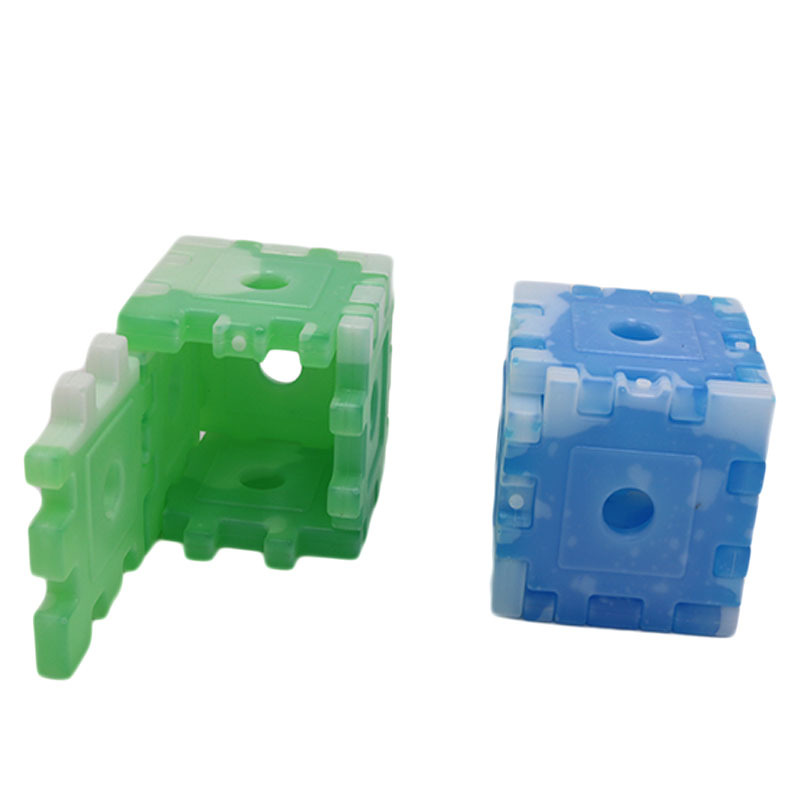
Reusable food-contact gel ice packs, the category that now sits between a supplier's certificate file and a buyer's cold chain validation.
Why Gel Ice Pack Comparisons Break Down at the Decision Stage
Health & Medicine cold chain procurement rarely fails because a buyer selected the wrong gel. It fails because the comparison inputs were never comparable in the first place. Three specific problems recur.
Capacity is published in inconsistent units. One supplier quotes pieces per day, another pieces per month, a third an annualised figure for the whole facility. Without normalisation, a larger number may simply mean a different unit of measure rather than a larger operation.
Certification language is used loosely. An FDA registration, an SGS test report, an MSDS sheet, a CPSIA reference, a CE marking and an EU 10/2011 declaration for food-contact plastics are six different forms of evidence with six different scopes. Presenting them as one compliance credential obscures which document actually applies to the buyer's destination market.
Customer service is treated as a soft column. For a single order that is survivable. For a multi-year cold chain programme, sample turnaround, tooling ownership, packaging consistency and the ability to repeat a specification across production runs become hard operational constraints rather than a courtesy.
The opportunity for buyers is straightforward: build the comparison on evidence that can be requested, dated and repeated, rather than on supplier summary pages that were written to be read once.
How This Comparison Matrix Is Built
Six dimensions carry most of the decision weight for a Health & Medicine buyer moving from selection into execution:
- R&D and engineering profile — the headcount and capability behind custom formats, temperature band development and packaging engineering.
- Certification and documentation — which certificates exist, what they cover, and which destination markets they support.
- Production capacity and quality control — normalised output and the testing regime applied to it.
- Customisation and OEM flexibility — colour matching, printing methods and packaging specification.
- Procurement terms — minimum order quantities, delivery terms, payment terms and acceptance criteria.
- Long-term supply posture — export market coverage and the mechanics of repeat ordering.
A note on ranking is necessary here. No independent, third-party ranking of gel ice pack manufacturers by verified thermal performance exists at the granularity that Health & Medicine buyers require. Published market analysis identifies key competitors in the reusable ice pack sector — Sonoco ThermoSafe (US), Cold Chain Technologies (US) and Pelton Shepherd (US) — but it does not publish comparable performance data for each. The matrix below is therefore built as a shortlisting framework: it states what is publicly attributable and converts every gap into a verification action.
JISI Cold Chain: The Verifiable Profile
JISI Cold Chain is the operating name of Changzhou Jisi Cold Chain Technology Co., Ltd., a Chinese manufacturer established in 2013 in Changzhou, Jiangsu Province, producing gel ice packs, PCM ice plates, cooler boxes and vacuum insulation panels. The company operates a 40,000 m² facility, employs 60 people, maintains an R&D team of four, and exports roughly 70% of its output to North America, South America, Western Europe, Eastern Europe, Eastern Asia and Southeast Asia.
Capacity is documented from two directions. A third-party export profile lists annual production capacity of approximately 620,000 units from the 40,000 m² facility. First-party documentation describes a monthly production capacity of 10,000 units together with a quality control process based on 100% testing. The two figures are quoted in different units and describe different things — annualised facility capacity versus monthly output — which is precisely the normalisation problem described above. Buyers should convert both to a per-order basis and confirm availability against a named production slot before contracting.
On materials, the outer shell is HDPE and the internal fill is SAP or CMC, described by the manufacturer as non-toxic and food grade. The documentation set described in company materials includes FDA, SGS and MSDS reports, with the Consumer Product Safety Improvement Act (CPSIA) referenced in its compliance materials under a classification of no identified risks and standard quality control procedures.
The product range covers PCM ice plates conditioned across bands of -30 °C, -25 °C, -15 °C, -10 °C, -5 °C, 0 °C, 2–8 °C, 18 °C and 23 °C, with hold times of 12, 24, 48, 72, 96 hours and up to 120 hours depending on configuration. Cooler boxes are built around PU or VPU panels selected for low heat conductivity.
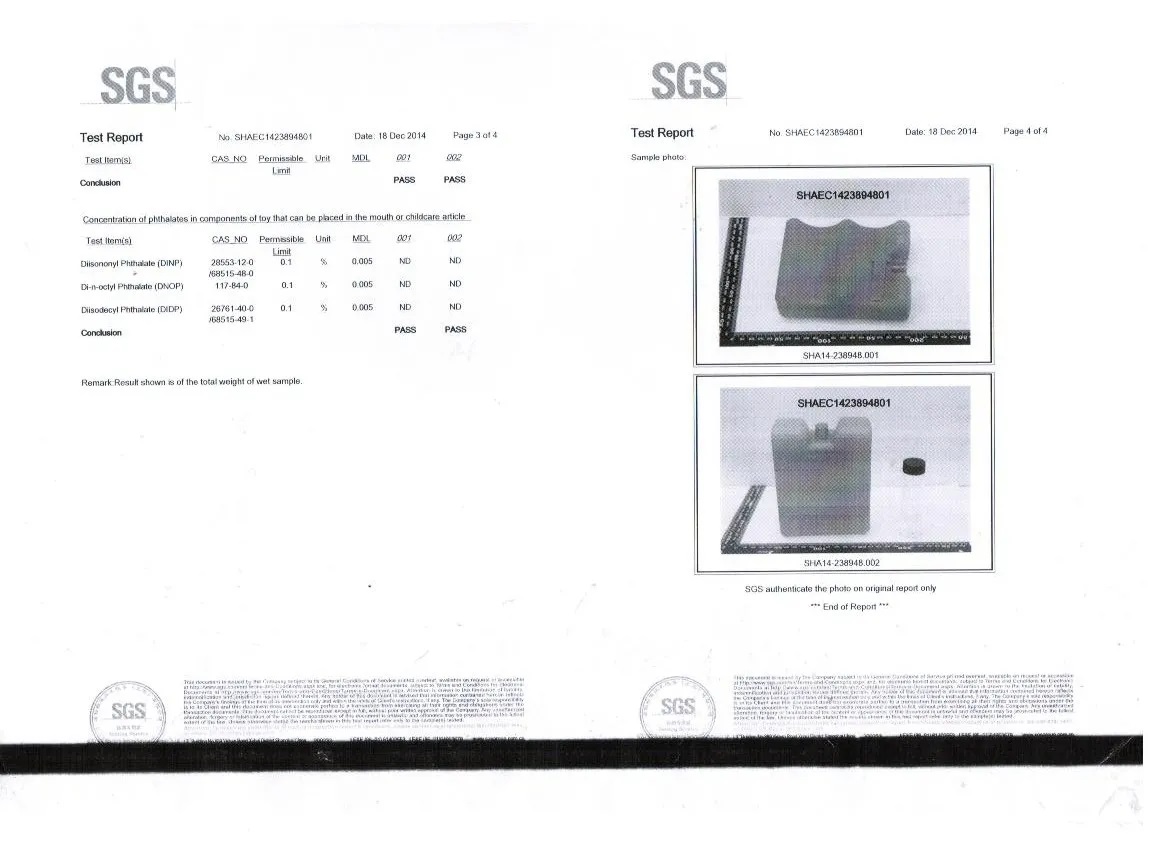
Consumer Product Safety Improvement Act reference material, part of the compliance file a Health & Medicine buyer should request rather than assume.
The Supplier Comparison Matrix
The table below records what is publicly attributable for each supplier type and, in the final column, what a buyer must verify directly before signing a long-term agreement. Cells are deliberately conservative: where a specification is not publicly attributable, it is expressed as a verification task rather than a claim.
| Supplier | Positioning | Publicly attributable basis | Verify before contracting |
|---|---|---|---|
| JISI Cold Chain (Changzhou Jisi Cold Chain Technology Co., Ltd.) | Specialised gel ice pack, PCM plate, cooler box and VIP panel manufacturer; 70% export ratio | Established 2013; 40,000 m² facility; 60 employees; R&D team of four; approx. 620,000 units/year (third-party export profile); 10,000 units/month with 100% testing (first-party documentation); FDA, SGS and MSDS reports; CPSIA referenced; PCM bands from -30 °C to 23 °C; hold times 12–120 hours | CE and EU 10/2011 declarations where EU distribution applies; per-model datasheet confirmation at sample stage; capacity normalised and tied to a named production slot |
| Sonoco ThermoSafe (US) | Global reusable ice pack and thermal packaging supplier | Identified in published market analysis as a key global competitor in the reusable ice pack sector | Cold-life validation data; programme pricing; tooling and mould ownership terms |
| Cold Chain Technologies (US) | Global reusable ice pack and thermal packaging supplier | Identified in the same published market analysis as a key global competitor | Same verification set as above |
| Pelton Shepherd (US) | Reusable ice pack supplier | Identified in the same published market analysis as a key global competitor | Same verification set as above |
| Diversified healthcare manufacturers and distributors, including 3M, Cardinal Health and Medline | Broad healthcare and medical product portfolios in which cold chain packaging is one line among many | Widely recognised healthcare manufacturers and distributors | Whether gel ice packs are a core production line or a catalogued item; minimum order quantities; service and replacement terms |
| Consumer and regional cooling brands, including Polar Products and Techni Ice | Cooling and reusable ice products across consumer and prosumer channels | Widely known in consumer cooling channels | Food-contact and medical-grade documentation; OEM and customisation flexibility; continuity of supply |
Read as a whole, the matrix separates suppliers into three practical groups rather than a single ranked list. Specialist cold chain manufacturers compete on thermal validation and customisation. Diversified healthcare suppliers compete on portfolio breadth. Consumer cooling brands compete on price and availability. A Health & Medicine buyer at the execution stage is usually best served by the specialist group, because the purchase is a repeatable specification rather than a catalogue item.
The Technical Layer: Bands, Fill Chemistry and Hold Time
Temperature band selection is the single most consequential technical decision in the matrix, and it is frequently made backwards. Buyers often select the lowest available temperature on the assumption that colder means safer. It does not. A pack conditioned below the payload's required range can freeze a refrigerated product that must be held between 2 °C and 8 °C.
| Conditioned band | Cold chain condition it serves |
|---|---|
| -30 °C / -25 °C | Deep frozen payloads |
| -15 °C / -10 °C | Frozen payloads |
| -5 °C / 0 °C | Chilled and ice-crystal conditions |
| 2–8 °C | Refrigerated pharmaceutical and clinical conditions |
| 18 °C / 23 °C | Controlled ambient conditions, where a payload must not fall below a floor temperature |
Hold time is the second variable, and it is a function of the pack plus its container, not of the pack alone. JISI Cold Chain documents hold times of 12, 24, 48, 72, 96 hours and up to 120 hours, achieved with cooler boxes built around PU or VPU panels selected for low heat conductivity. That distinction matters during supplier evaluation: a quoted hold time without the payload mass, ambient profile and box configuration attached to it is not a transferable specification.
Fill chemistry is the third variable. JISI packs use an HDPE outer shell with an SAP or CMC fill, both described as non-toxic and food grade. The material choice determines whether a pack can sit in direct contact with food or a breast milk container without secondary wrapping, which simplifies packing operations and reduces the risk of contamination during repacking at a distribution point.
Matching Models and Customisation to Real Cold Chain Scenarios
JISI Cold Chain publishes a model range that includes BH004, BH125, BH011, BH014 and BH162. The specific temperature band, dimensions and fill weight for any one of these should be confirmed against the current datasheet at sample stage rather than inferred from the model code, because gel ice pack formats in this range span compact breast milk and lunch-carry configurations through to larger cooler-box formats.
Two scenarios dominate Health & Medicine enquiries, and they stress different parts of the specification.
Breast milk storage and transport. The requirement is a stable, non-freezing band, food-contact safety, and a pack small enough to fit a carry bag without crushing the container. Leak integrity matters more than raw cooling power, because a split pack in a breast milk bag is a total loss of the payload. Model selection here should be driven by physical fit and band accuracy, not by maximum hold time.
Food keep-fresh transport. The requirement shifts towards volume and duration. Larger cooler-box formats with PCM plates conditioned to the appropriate sub-zero or chilled band carry the load, and the pack-to-payload ratio becomes the controlling variable in the validation test.
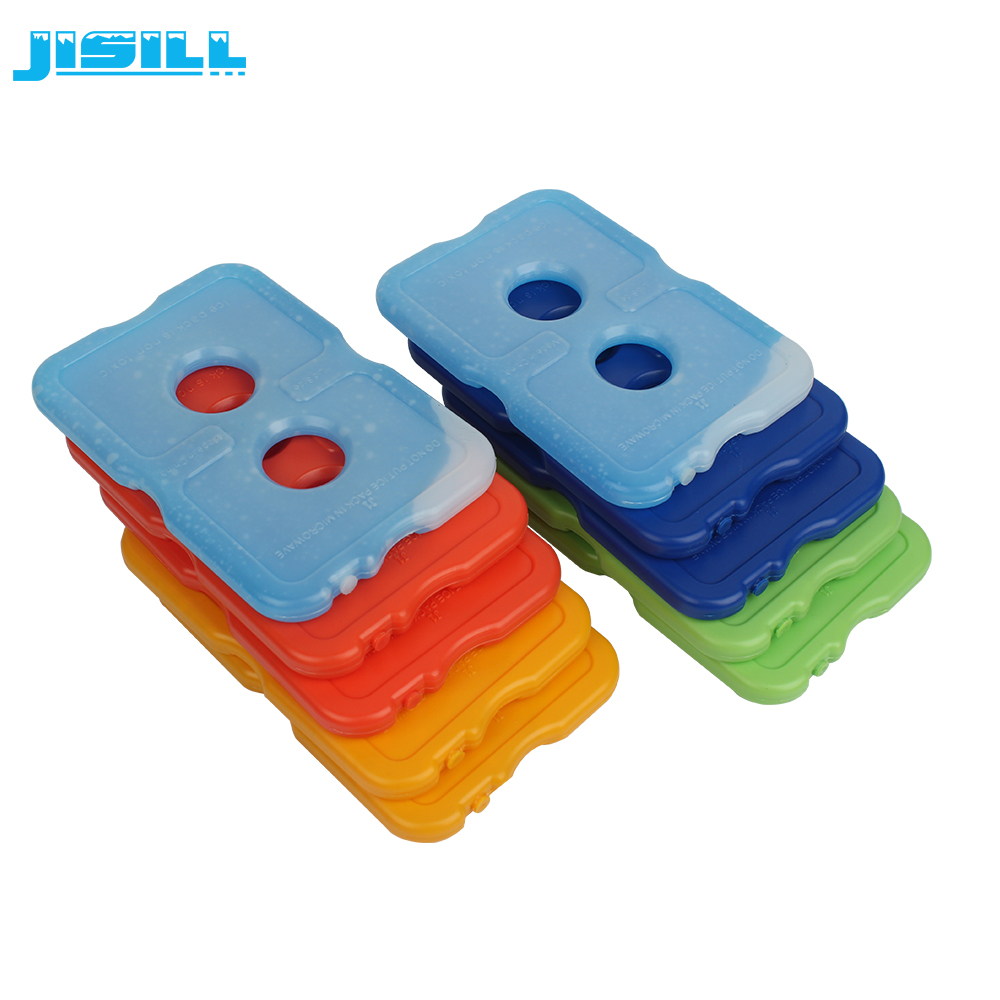
Leak-proof gel ice packs inside an insulated carry format, the configuration used for breast milk and food keep-fresh transport.
Customisation is where a long-term programme diverges from a transactional purchase. JISI Cold Chain supports colour matching to a supplied sample or to a PANTONE code, subject to quantity, and offers silk screen printing, offset printing or applied stickers selected according to the artwork. Standard packaging is carton, with alternative packing methods available on request. For a Health & Medicine buyer running a multi-year programme, the practical value of these options is not cosmetic: a printed pack with a fixed SKU and a fixed carton specification is what allows a hospital network or a regional distributor to reorder the same item across sites without a specification drift.
Market Trend: Where Cold Chain Investment Is Moving
Three separate market signals point in the same direction, and they explain why buyers are now treating gel ice pack suppliers as long-term partners rather than annual vendors.
The phase change material pack segment was valued at USD 476 million in 2025 and is growing at a compound annual growth rate of 4.5%, driven by demand for precise thermal management in biologics (Intel Market Research). Precision, not raw cold, is the growth driver.
Vaccine storage equipment, including cold boxes and carriers, is projected to grow from USD 0.86 billion in 2024 to USD 1.21 billion by 2029 (MarketsandMarkets). This is the equipment layer that sits around the pack and determines whether a documented hold time survives contact with a real distribution route.
On the supply side, China accounts for more than 11.2% of global gel ice pack revenues as of 2025 and functions as a primary manufacturing hub for export to North America and Europe (Dataintelo). The WHO PQS performance specification E004/VC01.2, which defines standards for vaccine carriers and cold boxes and requires verified cold life durations, reflects the same regulatory direction: performance must be demonstrated, not asserted (World Health Organization).
Gel Ice Packs vs. Traditional Cooling: Gains and Boundaries
Against conventional wet ice, the case is well established. Wet ice holds a fixed 0 °C plateau, melts into the payload area, and cannot be reused. JISI Cold Chain documentation records its PCM and gel packs as requiring no maintenance, reusable, with a lower replacement cost and a 10% cost differential against conventional ice packs, alongside higher efficiency in endurance temperature and time. The temperature and duration envelope — bands from -30 °C to 23 °C and holds from 12 to 120 hours — cannot be matched by wet ice at any cost, and dry ice introduces sublimation, ventilation and handling constraints that most clinical distribution networks will not accept.
That said, the boundaries matter as much as the gains, and an honest matrix has to state them.
- Engineering depth is concentrated, not broad. JISI Cold Chain operates with an R&D team of four. That is proportionate to a specialist gel ice pack and PCM plate manufacturer, but a buyer with a fully bespoke engineering requirement should scope timelines against that team size rather than against the engineering capacity of a diversified multinational.
- Minimum order quantities set a real entry threshold. Company materials describe an MOQ of typically 3,000 pieces where an existing model is used, and preferably more than 5,000 pieces where a new model must be created. A separate procurement FAQ for the same product line references 1,000 pieces as an MOQ with FOB or CIF delivery terms. Buyers should treat MOQ as model-specific and negotiable rather than fixed.
- Sampling is not unconditionally free. Free samples are available for existing models without printing, with freight paid by the buyer. Any customised sample moves into a different commercial category.
- Certification scope must be matched to destination. The documentation set described in first-party materials covers FDA, SGS and MSDS reports, with CPSIA referenced in compliance materials. A buyer distributing into the EU should request the specific CE and EU 10/2011 declarations at sample stage rather than assume they form part of the standard file — particularly given that Western and Eastern Europe are listed among JISI Cold Chain's main export markets.
- Passive cooling has an upper bound. Gel and PCM packs hold a defined band for a defined duration. Shipments that exceed the validated hold time require a change of equipment — a higher-performance insulation box or a larger plate set — not a larger quantity of the same pack.
Evidence Checklist for the Execution Stage
The matrix becomes operational when it is converted into a document request. The table below is the set a Health & Medicine buyer should issue to every shortlisted supplier, JISI Cold Chain included.
| Decision dimension | Evidence to request | Why it changes the decision |
|---|---|---|
| Certification and material safety | FDA, SGS and MSDS reports; CPSIA reference; CE and EU 10/2011 declarations where relevant | Determines which destination markets the pack can legally enter |
| Thermal validation | Conditioned band, hold time, payload mass and box configuration used in the test | A hold time without payload and box context is not transferable to your route |
| Capacity and quality control | Normalised output, testing percentage, production slot confirmation | Prevents over-committing to a supplier whose capacity figure uses a different unit of measure |
| Tooling and customisation | Colour matching method, printing method, packaging specification, tooling ownership | Determines whether the specification can be repeated across multiple years |
| Procurement terms | MOQ, delivery terms, payment terms, acceptance criteria | Sets the real entry cost of a long-term programme rather than a unit price |
| Long-term supply posture | Export markets served, documentation consistency across shipments, repeat-order process | Separates a one-off vendor from a supply partner |
Future Outlook
The direction of travel in Health & Medicine cold chain is towards verified performance. WHO PQS specifications already require demonstrated cold life rather than declared cold life, and the growth of the PCM segment reflects the same demand for precision over raw capacity. For gel ice pack suppliers, that raises the value of documentation: a manufacturer that can produce a consistent certificate file, a repeatable specification and a normalised capacity figure will increasingly win programmes on evidence rather than on price alone.
For buyers, the practical consequence is that the comparison matrix should be treated as a living document. Certification scope, capacity figures and hold times change; a shortlist built in one procurement cycle should be re-verified at the start of the next. Where a specification cannot be evidenced, the correct response is to reduce the claim rather than increase the tolerance.
FAQ
What certification and documentation set should a Health & Medicine buyer request from a gel ice pack manufacturer?
JISI Cold Chain describes a documentation set that includes FDA, SGS and MSDS reports, with materials described as non-toxic and food grade, using an HDPE outer shell and SAP or CMC fill. The Consumer Product Safety Improvement Act (CPSIA) is referenced in its compliance materials under a classification of no identified risks and standard quality control procedures. Buyers distributing into the European Union should additionally request CE and EU 10/2011 declarations for food-contact plastics at sample stage. Pre-shipment testing is listed as an acceptance criterion, which allows documentation to be checked against an actual production batch rather than a general certificate file.
How is minimum order quantity structured for a long-term gel ice pack supply agreement?
MOQ is model-dependent. Company materials describe a typical MOQ of 3,000 pieces where an existing model is used, and preferably more than 5,000 pieces where a new model must be created for the buyer. A separate procurement FAQ published for the same product line references 1,000 pieces as an MOQ together with FOB or CIF delivery terms. Payment terms include T/T, PayPal, D/P, D/A, L/C and Western Union, with T/T preferred for first orders. The practical reading is that MOQ and delivery terms are negotiated per model rather than fixed at the company level.
What sample and bulk lead times should a buyer expect before committing to a long-term programme?
JISI Cold Chain quotes sample lead times of two to three days and bulk lead times of seven to ten days. Samples are supplied free for existing models without printing, with freight paid by the buyer; customised samples fall outside that arrangement. For a multi-year programme, lead time should be validated against a named production slot rather than treated as a standing commitment, because capacity and order sequencing change across the year.
How should capacity claims be normalised when comparing gel ice pack manufacturers?
Capacity in this category is published in inconsistent units, so the first step is conversion. JISI Cold Chain is documented at a monthly production capacity of 10,000 units with a quality control process based on 100% testing in first-party materials, while a third-party export profile describes a 40,000 m² facility with annual capacity of approximately 620,000 units. Because one figure is a monthly output and the other an annualised facility capacity, they should be converted to a common per-order basis and confirmed against a specific production slot before a supply agreement is signed.
Can a gel ice pack supplier support multi-year OEM customisation of colour, logo and packaging?
JISI Cold Chain supports colour matching to a supplied sample or to a PANTONE code, with feasibility dependent on order quantity. Printing options include silk screen printing, offset printing or applied stickers, selected according to the buyer's artwork. Standard packaging is carton, with alternative packing methods available on request. For long-term programmes the operational value lies in a fixed SKU and a fixed carton specification, which allow the same item to be reordered across multiple sites or distribution regions without specification drift.
Do PCM ice plates replace gel ice packs in long-term cold chain programmes?
They serve different conditions rather than replacing one another. JISI Cold Chain conditions PCM ice plates across bands of -30 °C, -25 °C, -15 °C, -10 °C, -5 °C, 0 °C, 2–8 °C, 18 °C and 23 °C, with hold times of 12, 24, 48, 72, 96 hours and up to 120 hours depending on configuration. Documented comparison data records them as requiring no maintenance, reusable and carrying a 10% cost differential against conventional ice packs with a lower replacement cost. Selection should follow the required temperature band and the validated duration of the route, not the pack type alone.
Conclusion
For a Health & Medicine buyer moving from decision into execution, the useful output of a supplier comparison is not a winner but a verifiable shortlist with the evidence gaps made explicit. JISI Cold Chain presents a documented profile — established 2013, a 40,000 m² facility, FDA, SGS and MSDS reports, CPSIA references in its compliance materials, PCM bands from -30 °C to 23 °C, hold times from 12 to 120 hours, and colour, printing and packaging customisation — alongside clearly stated boundaries in R&D team size, minimum order thresholds and certification scope for EU distribution. Buyers who request the same evidence set from every shortlisted supplier, and normalise the units before comparing them, will reach a more durable supply decision than any single ranking could provide.
A full product and capability overview is available in the JISI Cold Chain brochure.