
JM-901 vs Laifen: What Specs Mean for Electric Shaver Buyers
Electric shaver procurement decisions are rarely settled by brand name alone. At the decision stage, B2B buyers must compare motor specifications, safety controls, cost levels, and the real-world limits of each configuration. This article examines the JM-901, an ODM electric shaver produced by Ningbo Jinmi Electrical Appliance Technology Co., Ltd., and compares it with Laifen, a brand known for its self-developed linear motor. The goal is to help procurement teams interpret what the published specs mean for a shaver program.
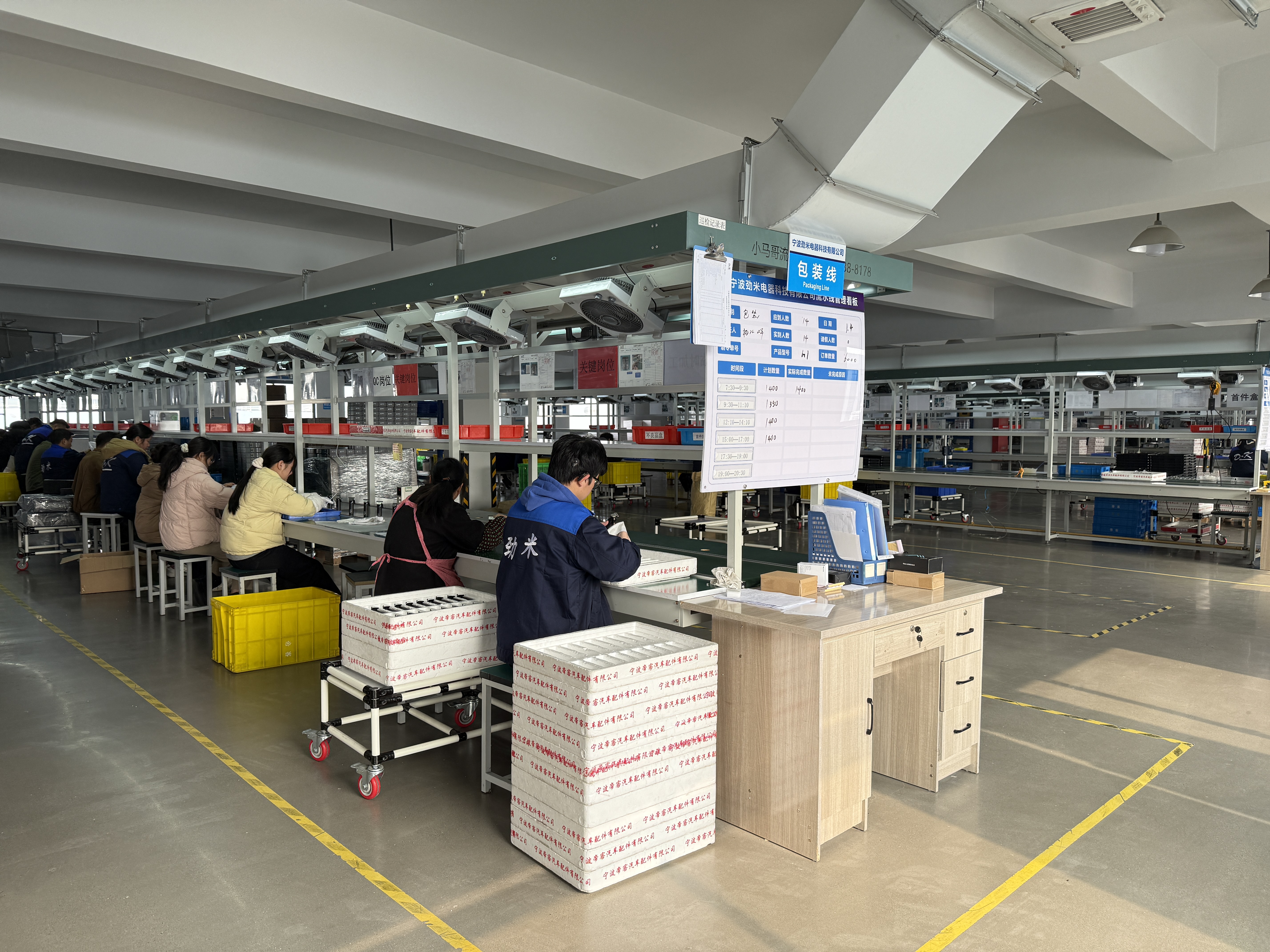
Ningbo Jinmi Electrical Appliance Technology Co., Ltd. is a Chinese OEM/ODM manufacturer based in Cixi, Zhejiang. It supplies electric shavers, hair clippers, and personal-care products to global buyers. The company operates a 28,000-square-meter facility with more than 300 employees and ten finished-product assembly lines. It also produces precision components such as aluminum alloy casings and personal-care hardware, which gives it a vertically integrated position in shaver manufacturing.
The Procurement Problem: Comparing Two Linear-Motor Shavers
For buyers evaluating an ODM custom shaver program, the core problem is not whether one model is better in every way. It is whether a candidate model offers the right combination of performance, safety, and price for a specific market segment. The comparison between the JM-901 and Laifen is useful because both products use linear motors but differ in motor origin, frequency, rated life, and price. These differences affect product positioning, warranty planning, and after-sales service expectations.
Market demand is also evolving. The global electric shaver market was valued at approximately USD 14.39 billion in 2024 and is projected to reach USD 21.60 billion by 2032, according to Markets and Data. China's domestic electric shaver market was estimated at USD 1.89 billion in 2024, with a projected compound annual growth rate of 8.4% through 2030, according to Next Move Strategy Consulting. These numbers do not tell a buyer which model to choose, but they help justify why procurement teams should build a structured comparison framework rather than relying on brand recognition.
Brand Solution: How the JM-901 Positions Against Laifen
The JM-901 is positioned as a lower-cost, travel-friendly electric shaver. According to Ningbo Jinmi's product comparison, the JM-901 uses a domestically sourced linear motor with a vibration frequency of 14,000 times per minute, compared with 12,000 times per minute for Laifen's self-developed motor. That is a 16.7% higher vibration frequency, which indicates potentially faster cutting. The manufacturer also lists lower noise, sharp cutting, high drop/impact resistance, corrosion/rust resistance, and fast heat dissipation as technical advantages. The same comparison puts the JM-901 at approximately 10% lower cost than Laifen.
From a procurement perspective, these figures should be read as positioning signals. A 10% price gap can be meaningful in high-volume orders, but it is only one input. The buyer still needs to validate actual cutting performance, noise level, and durability with samples before making a final sourcing decision.
Technical Explanation: Motor, Safety, and Quality Controls
Motor architecture and rated life
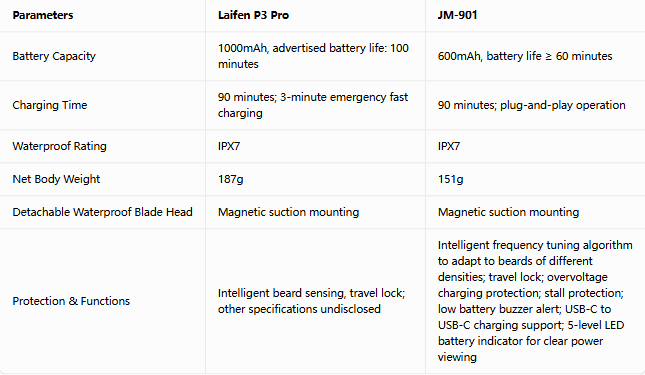
The JM-901 belongs to the reciprocating foil-shaver category, where the linear motor drives the cutter in a back-and-forth motion. The table below summarizes the main specification differences between the JM-901 and Laifen based on manufacturer-supplied comparison data.
| Parameter | JM-901 | Laifen |
|---|---|---|
| Motor type | Domestically sourced linear motor | Self-developed linear motor |
| Vibration frequency | 14,000 times per minute | 12,000 times per minute |
| Rated motor service life | Over 200 hours | 500 hours |
| Relative cost | Approximately 10% lower | Reference point for comparison |
This comparison highlights a trade-off. The JM-901 has a higher vibration frequency but a shorter rated motor life than Laifen. A 200-hour motor life, at five minutes of daily use, translates to more than six years of operation. Buyers can decide whether the longer 500-hour rating of Laifen's motor justifies its price premium in their target segment.
Safety and overheating risk control
For procurement teams, safety verification matters as much as shaving performance. The manufacturer states that overheating risk is managed by stall protection and overvoltage protection. Production-level controls include temperature sensor real-time monitoring, circuit reliability inspection, incoming material quality control, production process spot checks, finished product aging tests, thermal safety verification, and finished product safety performance testing.
In addition, electric shavers generally fall under IEC 60335-2-8, the safety standard for household shavers, hair clippers, and similar appliances up to 250V. For washable models, IPX4 or IPX7 waterproof ratings are commonly referenced under UL/CSA 60335-2-8 amendments. Buyers should request certification documents and test reports rather than relying on marketing descriptions.
Application and Use Cases: Where JM-901 Fits
Based on the manufacturer comparison, the JM-901's compact size and lower noise make it suitable for business travel. That positioning can support travel-focused private-label products, household shaver lines, or entry-level electric shaver programs where buyers want a linear motor experience at a moderate cost.
For brands that plan to enter new markets, the JM-901 can serve as a baseline for an OEM brand shaver program. It can also be customized under an ODM arrangement when buyers need adjustments to color, branding, packaging, or accessory sets. The company's product range includes single-, double-, and triple-head shavers, according to publicly available company information, so procurement teams can compare model types within the same supplier base.
Market Trends Affecting Electric Shaver Procurement
Cordless shavers accounted for 83.95% of the U.S. market in 2024, driven partly by USB/Type-C charging convenience, according to Grand View Research. At the same time, foil shavers held a 55.8% share of global revenue in 2024, while rotary shavers are projected to be the fastest-growing sub-segment, according to Data Bridge Market Research. For ODM buyers, this means charging interface, portability, and shaver head architecture should be evaluated as market-positioning variables, not just technical details.
The competitive landscape is still concentrated around established global brands. Philips, Braun, Panasonic, and Xiaomi collectively hold an estimated 25-30% of the global electric shaver market. For manufacturers such as Ningbo Jinmi, the opportunity is not necessarily to replace these brands but to offer buyers an alternative path through OEM/ODM development.
Comparison with Traditional Alternatives and Limitations
Traditional electric shaver designs are commonly grouped into foil and rotary systems. Foil shavers use oscillating blades behind a slotted foil, while rotary shavers use circular cutters under perforated caps. Both designs have well-documented trade-offs in closeness, skin comfort, maintenance, and noise. The JM-901 vs Laifen comparison sits within the linear-motor foil category, where motor frequency and blade movement are central to product claims.
The main limitation of the JM-901 comparison is motor life. Laifen's self-developed motor is rated at 500 hours, while the JM-901's motor is rated at over 200 hours. For heavy-use professional channels, that difference could matter. A higher vibration frequency does not automatically guarantee a more comfortable shave either; foil geometry, blade sharpness, and user habits all influence the result. Finally, the 10% cost difference is based on manufacturer-supplied comparison data, not a formal market price study. Order volume, customization, certification, logistics, and tariffs can change the final cost gap.
Buyers should therefore treat the JM-901 as a value-oriented ODM option, not as a universal replacement for higher-priced shavers. Its best-fit scenarios are programs where price sensitivity, portability, and low noise are more important than maximum rated motor life.
Future Outlook for ODM Electric Shaver Programs
As the global electric shaver market expands, ODM buyers are likely to place more weight on transparent component data, safety evidence, and manufacturing capacity. The trend toward cordless, Type-C charging products means that battery and charging design will continue to influence buying decisions. For manufacturers like Ningbo Jinmi, vertical integration in precision hardware, injection molding, and final assembly can shorten development cycles and make customization easier.
At the same time, brands that choose ODM partners will need to verify long-term quality through sample testing, factory audits, and certification review. The JM-901 vs Laifen comparison is one example of how a relatively small specification gap can create a different value proposition. The winning strategy for buyers is not to pick the cheapest or the most powerful model, but the one that aligns with their target user, service model, and pricing.
Frequently Asked Questions
Does the higher motor frequency of the JM-901 mean it is a better electric shaver than Laifen?
Not necessarily. The JM-901's motor vibrates at 14,000 times per minute versus 12,000 for Laifen, a 16.7% difference that indicates potentially faster cutting. Actual comfort and closeness depend on foil design, blade quality, skin sensitivity, and user technique.
How long does the JM-901 motor last compared with Laifen?
The JM-901's domestically sourced linear motor is rated for over 200 hours of use. Based on five minutes per day, that is more than six years. Laifen's motor is rated at 500 hours. Buyers should compare motor life against intended usage patterns and warranty plans.
Does the JM-901 cost less than Laifen?
According to the manufacturer's comparison, the JM-901 costs about 10% less than Laifen. Final cost depends on order volume, customization requirements, packaging, certifications, logistics, and destination-market duties.
What safety and quality checks support the JM-901?
The manufacturer states that overheating risk is controlled by stall protection and overvoltage protection. Production controls include temperature sensor monitoring, circuit reliability inspection, finished product aging tests, thermal safety verification, and safety performance testing. Buyers should also verify compliance with IEC 60335-2-8 and applicable waterproof ratings.
Which buyer segments should consider the JM-901?
Based on available comparison data, the JM-901 is positioned for buyers who prioritize lower cost, compact size, lower noise, and business-travel convenience. Brands targeting premium segments or heavy-use professional markets may prefer models with longer rated motor life, and should validate this with samples and warranty calculations.
Reference document: Ningbo Jinmi product brochure
Have Questions or Need More Details?
Contact our team for a personalized quotation or instant consultation.
Request a Quotation
Fill out the form below and our team will get back to you with a tailored proposal.
WhatsApp Direct Chat
Prefer to chat in real-time? Message us on WhatsApp for instant assistance & quick answers.
- Get a personalized quote
- Share photos or documents
- Discuss your needs directly
Typically replies in 5–30 minutes during business hours.