JONSON Induction Heater Models, Build Materials, and Certificate Scope
Induction heater suppliers are usually shortlisted on three claims: power range, efficiency and certification. The weakness in that process is traceability. A power range tells you which models exist, not which one you are buying; a certification headline tells you a document exists, not which part numbers it names. This reference takes a model-level approach to the JONSON induction heater portfolio, records what the build materials actually are, and separates what the certification documents on file cover from what a catalogue entry merely repeats.
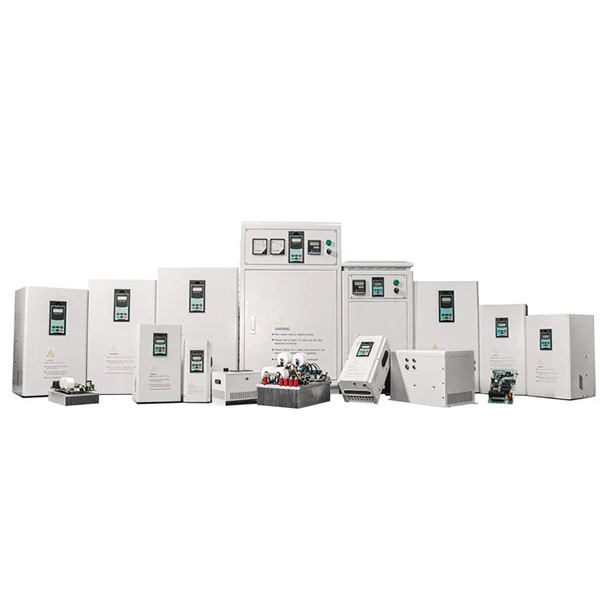
JONSON builds induction heating machines across several power classes; the model number, not the brand name, defines what is inside the enclosure.
What supplier capability evidence has to answer
Supplier capability evidence is the set of model-level specifications, material declarations and third-party documents that a buyer can check against a purchase order without relying on the supplier's own summary. In induction heating it answers four questions in sequence: whether the supplier builds the power class you need, whether the build specification holds at that power class, whether the electrical behaviour is documented rather than asserted, and whether each claim can be matched to a document with a number on it.
JONSON is the induction heating brand of Guangdong Jiangxin Electronic Technology Co., Ltd., a manufacturer founded in 2011 and based in Shunde District, Foshan, Guangdong Province, China. Company data records a 3,000 m² facility, 60+ staff, a 30+ engineer R&D team, an annual output of 120,000 units, monthly capacity of 10,000 units and a 40% export share, with main markets including Europe, the United States, India and Indonesia. Those figures describe scale and export orientation. They do not describe what a particular model is made of, which is the part of a supplier assessment that survives first contact with a production line.
The portfolio, model by model
Breadth in this category is not one design scaled up. The published range moves from a 5 kW wall-mounted unit through 20 kW and 30 kW frames to a 100 kW industrial machine, and the electrical architecture changes with it: smaller single-phase models use a half-bridge series resonant circuit, while the JS1000-100 uses a full-bridge series resonant circuit. Cooling options, enclosure dimensions and weight shift accordingly. The table below consolidates the model-level data.
| Model | Type | Rated power | Supply | Structure / cooling | Recorded detail |
|---|---|---|---|---|---|
| JS1300-005/008 | Wall-mounted induction heater | 5 kW / 8 kW | 380 V, adaptation 380 V ±20% | Wall-mounted | 295×169×145 mm; carton or wood frame; 20–100% power adjustment |
| JS1300-10/15 | Wall-mounted induction heater | 10 kW / 15 kW | 380 V, adaptation 300–400 V | Wall-mounted | 7.3 kg; 356×178×178 mm; HS code 8514400090; CE, ISO, RoHS listed |
| JS1300-5/8/15/20/30 | Bearing induction heater | 5 / 8 / 15 / 20 / 30 kW | Three-phase 380 V, 50 Hz / 60 Hz | 480×250×355 mm | 20.7 kg; outer casing in thickened aluminium alloy; copper coil |
| JS1000-20 | Industrial induction heater | 20 kW | 380 V, adaptation 300–400 V | Wall-mounted; air-cooled or water-cooled | 250×390×240 mm; CE, ISO |
| JS1000-30 | High-frequency induction heating machine | 30 kW | 380 V | Wall-mounted; air-cooled or water-cooled | 450×245×261 mm; CE, ISO |
| JS1000-100 | 100 kW industrial induction heater | 100 kW | Three-phase 380 V, 50 Hz / 60 Hz | Wall-mounted; air-cooled or water-cooled | 140–150 A input, 200–220 A output; 635×445×315 mm; 35 kg; CE, ISO |
| JS-1600 | Induction steam generator | 30 / 40 / 50 kW | 380 V, 50 Hz / 60 Hz, ±20% | Heat conversion efficiency ≥99% | 20–100% power adjustment; 5–40 kHz operating frequency |
| JS-1600-8/12/15 | Induction hot air generator | 8 / 12 / 15 kW | 380 V, adaptation 300–400 V | Vertical type | Outlet 80–130; wind pressure 800–1000 PA; HS code 8516109000; CE, ISO, RoHS listed |
| JS-JR-008 | Instant induction water heater / room heater | 3.5–8 kW | 220 V, ±20% | Tempered glass outer casing | ≥90% heat conversion efficiency; 20–100% power adjustment |
Two adjacent product lines sit alongside the heater models and matter when a project mixes heating with process air or steam. The custom-voltage platform covers 110 V, 240 V and 660 V inputs across rated power segments of 500 W–10 kW, 5–60 kW, 5–200 kW and 30–200 kW, with ±20% voltage adaptation and 20–100% power regulation. The single-phase full-bridge 8 kW electromagnetic heating control board is specified at 220 V with a 160–260 V input window, ≥98% heat conversion efficiency, and is built on aluminium alloy and copper. For buyers who assemble rather than purchase complete units, the control board is a separate and legible starting point.
Build materials: copper coil, 304 liner, thickened casing
Material declarations are where capability statements either become checkable or stay decorative. Three material classes recur across almost the entire JONSON range, and each has a specific procurement meaning.
Copper heating coil
Every model in the portfolio lists copper wire as the core heating coil. The coil is the working element: it carries the current that generates the alternating field, and its geometry sets the coupling distance to the load. Because the coil is also the part most likely to be modified for a specific workpiece, material consistency here is a production-control question rather than a marketing one. Documented coil parameters differ by power class — the 100 kW machine specifies a 95 square line, 40 m length and 80–100 µH inductance, while smaller units specify thinner line and shorter runs.
304 stainless steel liner
Where the product handles water, steam or an air stream, JONSON's material specification lists a 304 stainless steel inner liner. This applies to the JS-1600 induction steam generator, the JS-1600-8/12/15 hot air generator, the JS1000 series and the JS1300 heater families. For a buyer, the liner declaration is the practical answer to a corrosion and water-quality question: it defines what the fluid actually contacts, independently of the exterior finish.
Thickened aluminium alloy and thickened cold-rolled steel plate
Outer casings are specified as thickened aluminium alloy combined with thickened cold-rolled steel plate on the bulk of the range. On a wall-mounted product this is not cosmetic. The 100 kW unit weighs 35 kg and the bearing heater 20.7 kg, so casing rigidity and mounting integrity are structural requirements before they are aesthetic ones. Two deliberate exceptions are worth noting rather than smoothing over: the JS-JR-008 instant water heater / room heater uses a tempered glass outer casing, and the JS1300-5/8/15/20/30 bearing heater lists a thickened aluminium alloy casing without the cold-rolled steel element.
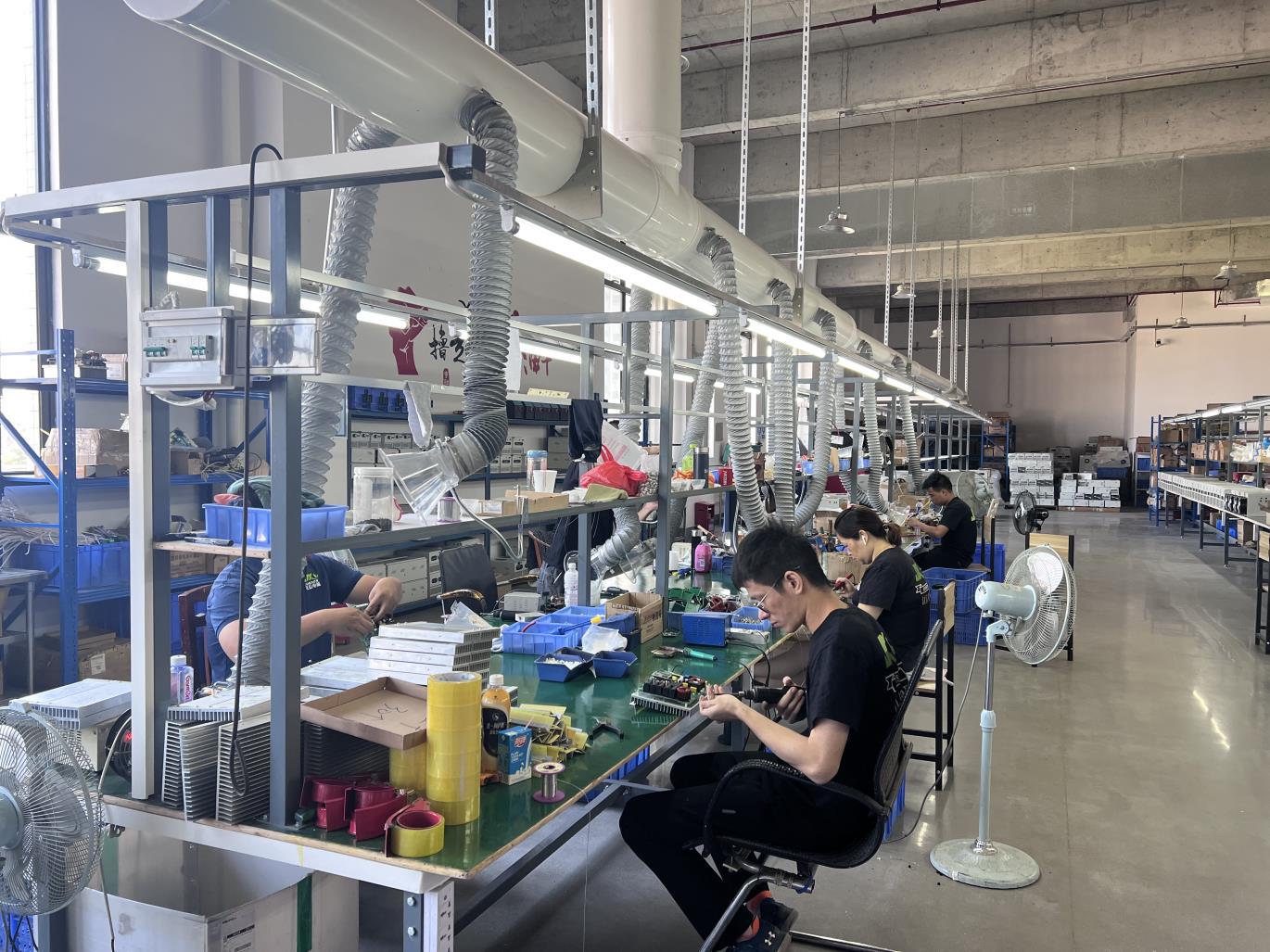
Assembly work on induction heating equipment. Material declarations become verifiable only when they are tied to a model number and a build stage.
Electrical behaviour that shows up in the data sheet
Across the range, power adjustment is specified as 20–100% stepless — a 5:1 turndown on nearly every model, with the 70 kW and 80 kW industrial heaters listed at 25–100%. Stepless adjustment matters in processes that hold temperature rather than simply reach it, such as barrel heating on plastics machinery or a steam generator running below peak demand.
Heat conversion efficiency is stated per model rather than as a single company figure: ≥95% on the smallest units and on the 100 kW machine, ≥98% on the 40 kW / 50 kW / 60 kW heaters and the custom-voltage platform, ≥99% on the 70 kW / 80 kW industrial heaters and the JS-1600 steam generator, and ≥90% on the JS-JR-008. Reporting these separately is more useful than a single headline number, because it shows where the specification changes.
Control and protection details are consistent enough to plan around. The control system is described as a DSP-based high-speed automatic phase-locking tracking system; start time is under 1 second; instantaneous overcurrent protection is ≤2 µs; and overload protection trips at 130%. Load temperature detection is supported across 0–1000 °C with accuracy up to ±1 °C. PID power adjustment accepts a 0–5 V input on the smaller models, while the JS1000-100 accepts 0–5 V or RS-485 — the difference between a manually set unit and one addressable from a line controller. Ambient envelopes are recorded as −20 to 50 °C on the JS1000 series, −20 to 40 °C on the JS1300-005/008 and JS-JR-008, and −25 to 55 °C on the 70 kW / 80 kW heaters, with relative humidity up to 95% throughout.
Certifications: what the documents actually cover
Certification is the section most often compressed into a logo row. The documents behind the JONSON range are specific enough to be read individually, and reading them individually changes what a buyer should request.
| Document | Reference | Issuing body | Validity | Scope as recorded |
|---|---|---|---|---|
| ISO 9001:2015 Quality Management System | 02826Q00032R001 | Beijing Zhong An Zhi Huan Certification Center Co., Ltd. (Zhong An Certification) | Issued 2026-01-06, valid to 2029-01-07 | Production and sales of household fast-heating electric water heaters (electromagnetic heating furnaces) within the qualification licence scope; production and sales of electromagnetic heating controllers and coil heating elements for household appliances. Standard: GB/T 19001—2016 / ISO 9001:2015 |
| CE Certificate of Conformity | KEYS23032915001EM-02 | Guangdong KEYS Testing Technology Co., Ltd. | Issued 2023-04-07, valid to 2028-04-07 | Listed models JS1200-005, JS1200-006, JS1200-008, JS1200-010. Standards: EN IEC 55014-1:2021, EN IEC 55014-2:2021, EN IEC 61000-3-2:2019+A1:2021, EN 61000-3-3:2013+A1:2019+A2:2021 |
| RoHS | Stated in model product data | — | — | Listed for JS1300-10/15 and for the JS-1600-8/12/15 hot air generator |
Beyond the supplier's own file, buyers in Europe and other regulated markets can frame the request against the international safety framework for electroheat equipment: IEC 60519-1 for general electroheat safety, IEC 60519-3 for induction and conduction heating specifically, and ISO 13850 for emergency stop functionality. Asking a supplier to map its documentation to these references produces a more comparable answer than asking whether the product is "certified". For customs and logistics planning, industrial induction heating equipment classifies under HS heading 8514.40, while the hot air generator is recorded under 8516109000.
Where the range is applied
The documented application list is broad and consistent across the family: plastics and rubber, food processing, chemical reactions, crude oil pipeline heating, textile printing and dyeing, aquaculture heating, metal heat treatment, building heating and medicinal herb drying. The bearing heater line addresses mounting and fitting work, where a bearing is heated before installation. The JS-JR-008 instant water heater is oriented toward hotels, hospitals and schools, and its ≥90% heat conversion figure sits below the ≥95–99% band of the industrial models — an honest difference between a small water-heating product and an industrial process unit.
JONSON's own project record describes a deployment of 100 units across Indonesia, China, Vietnam, Russia and India, serving Industrial Induction Heater OEM and ODM clients. The reported outcomes from that record are overall thermal efficiency of 95%–98%, comprehensive energy savings of 30%–70% against traditional heating equipment, a service life of 5–10 years, lifespan extended by three times and zero major failures. These are supplier-reported results from a supplier-defined project set; they are useful as a description of how the equipment behaves in the field, and they are not a substitute for measurement on your own load.
Comparison with conventional heating, and where the claims stop
Against resistance-element and combustion-based heating, the structural difference is where the heat is generated. Induction systems generate heat inside the workpiece or the barrel wall through electromagnetic coupling rather than transferring it from a separate element, which is why the documented loss profile is lower and why the equipment carries no combustion emissions. That difference is real and is the basis for the efficiency figures reported above.
The boundaries are equally concrete, and a supplier assessment that omits them is incomplete.
- Certificate scope is narrower than catalogue scope. The CE certificate on file names specific models; other families list CE in their product data. Model-level matching is the buyer's responsibility to enforce.
- Efficiency and savings figures are supplier-reported. The 95%–98% thermal efficiency and 30%–70% energy savings come from JONSON's own project record and are not independently verified at a third-party site. A payback calculation should use measured data from a comparable installation.
- There is a power floor. Adjustment stops at 20% of rated power on most models and 25% on the 70 kW / 80 kW units. A process that needs sustained operation below that band is better served by a smaller frame than by a larger one turned down.
- Wall-mounted formats impose structural requirements. A 35 kg 100 kW unit and a 20.7 kg bearing heater need mounting provision, service clearance and cable routing planned before delivery, not after.
- Cooling choice is a site constraint. Air-cooled or water-cooled options exist on the JS1000 series; the choice depends on ambient conditions and on whether cooling water of adequate quality is available.
- Small water heaters sit in a different efficiency class. The JS-JR-008 at ≥90% should not be compared directly with a 100 kW industrial machine at ≥95%.
Market context for capability scrutiny
Global Market Insights values the global induction heating system market at USD 2.4 billion in 2026, rising to USD 4.1 billion by 2035. That figure should be read with a caution: MarketsandMarkets publishes a materially smaller valuation for a narrower definition of the same category, and the two are not comparable because they measure different product boundaries. They should not be aggregated. The directional signal is what matters for a buyer — the category is expanding, which means more suppliers entering with catalogue-level claims and fewer with model-level documentation. That is the practical reason capability evidence has become a procurement step rather than a formality.
An evidence checklist for the RFQ
JONSON's stated commercial terms are a monthly capacity of 10,000 units, a standard production lead time of 7–14 days, a minimum order quantity of 1 unit, and quality control comprising 100% pre-shipment testing with product inspection by SGS. These are the parameters a buyer can build a request around; the following items convert them into verifiable evidence.
- Model-specific CE document or test report naming the ordered part number.
- RoHS declaration for the exact part number, where the destination market requires it.
- Copy of the ISO 9001:2015 certificate (02826Q00032R001) with its scope statement.
- Dimensional drawing confirming enclosure size and mounting points for the chosen frame.
- Material declaration for coil, liner and casing, including any deviation such as a tempered glass or aluminium-only casing.
- Cooling requirement — air or water — and the ambient envelope for the installation site.
- Control interface specification: 0–5 V PID, or 0–5 V and RS-485 where line integration is planned.
- Pre-shipment test record and the SGS inspection report for the shipment.
Outlook
Induction heating procurement is shifting from brand-level assurance toward document-level assurance, driven by the same forces that push factories to report energy and emissions data: claims that cannot be matched to a part number and a certificate number are increasingly difficult to defend internally. JONSON's portfolio already provides the raw material for that shift — a documented model range from 5 kW to 100 kW, a consistent material specification built on copper coils, 304 stainless liners and thickened aluminium alloy or cold-rolled steel casings, and an ISO 9001:2015 certificate valid to 2029 alongside a CE certificate valid to 2028. The company also states a ten-year whole-machine service-life commitment with one year of free maintenance and lifetime maintenance support. The next step for buyers is not to ask whether the supplier is certified, but which certificate covers which model — and to put that question in writing at the RFQ stage.
FAQ
Which JONSON induction heater models cover the 5 kW to 100 kW range?
The documented range runs from the JS1300-005/008 at 5 kW and 8 kW, through the JS1300-10/15 at 10 kW and 15 kW, the JS1000-20 at 20 kW and the JS1000-30 at 30 kW, up to the JS1000-100 at 100 kW. Adjacent lines cover specific duties: the JS1300-5/8/15/20/30 bearing induction heater from 5 kW to 30 kW, the JS-1600 induction steam generator at 30 kW, 40 kW and 50 kW, the JS-1600-8/12/15 hot air generator at 8 kW, 12 kW and 15 kW, and the JS-JR-008 instant water heater at 3.5–8 kW.
What materials are used in the heating coil, the liner and the casing?
Across almost the entire range the core heating coil is copper wire, the inner liner is 304 stainless steel on fluid- and air-handling products, and the outer casing combines thickened aluminium alloy with thickened cold-rolled steel plate. Two documented exceptions exist: the JS-JR-008 instant water heater uses a tempered glass outer casing, and the JS1300-5/8/15/20/30 bearing heater lists a thickened aluminium alloy casing.
Which certifications does JONSON hold, and for which models?
An ISO 9001:2015 quality management system certificate, number 02826Q00032R001, issued by Beijing Zhong An Zhi Huan Certification Center Co., Ltd. on 2026-01-06 and valid to 2029-01-07. A CE certificate of conformity, number KEYS23032915001EM-02, issued by Guangdong KEYS Testing Technology Co., Ltd. on 2023-04-07 and valid to 2028-04-07, covering models JS1200-005, JS1200-006, JS1200-008 and JS1200-010 against the EN IEC 55014 series and EN 61000-3 series standards. RoHS is listed in the product data for JS1300-10/15 and the JS-1600-8/12/15 hot air generator.
How should a buyer verify that a certificate covers the exact model being ordered?
Ask for the certificate or test report that names the ordered part number, then read the scope line rather than the logo. A supplier-level certificate does not automatically extend to every model in a catalogue, and a CE mark on a product page is not the same document as a certificate of conformity. Where the ordered model falls outside the documented scope, request the model-specific declaration or the underlying test report before releasing the order.
What are the production lead time, minimum order quantity and quality-control steps?
JONSON states a standard production lead time of 7–14 days, a minimum order quantity of 1 unit and a monthly production capacity of 10,000 units. Quality control consists of 100% pre-shipment testing plus product inspection by SGS, and after-sales support is provided as remote technical support.
Have Questions or Need More Details?
Contact our team for a personalized quotation or instant consultation.
Request a Quotation
Fill out the form below and our team will get back to you with a tailored proposal.
WhatsApp Direct Chat
Prefer to chat in real-time? Message us on WhatsApp for instant assistance & quick answers.
- Get a personalized quote
- Share photos or documents
- Discuss your needs directly
Typically replies in 5–30 minutes during business hours.