
JONSON Induction Heater Technical Buying Guide: B2B FAQ
Industrial process heat is being re-specified, and the questions buyers ask have changed with it. Evaluation teams now compare power stages, coil geometry, control loops and protection timing before they compare price.
That shift is measurable. The global induction heating system market was valued at USD 2.39 billion in 2024 and is projected to reach USD 4.5 billion by 2035, according to WiseGuyReports. Global Market Insights records more than 550,000 induction heating systems in operation as of mid-2024, with Asia-Pacific accounting for roughly 40% of that installed base. Electrification is also reshaping the adjacent equipment category: Market Research Future estimated the global industrial boiler and steam generator market at USD 54.79 billion in 2024, with a visible shift toward electric and induction-based heat sources.
This reference is written for the stage where a buyer has already decided to look at induction heating and now needs to check whether a specific unit fits a specific project. It answers the technical questions that recur in B2B evaluations — heat conversion efficiency, voltage adaptation, materials, stepless power regulation, soft-start and overcurrent protection — using the published parameters of the JONSON induction heater line and the operating data of Guangdong Jiangxin Electronic Technology Co., Ltd.
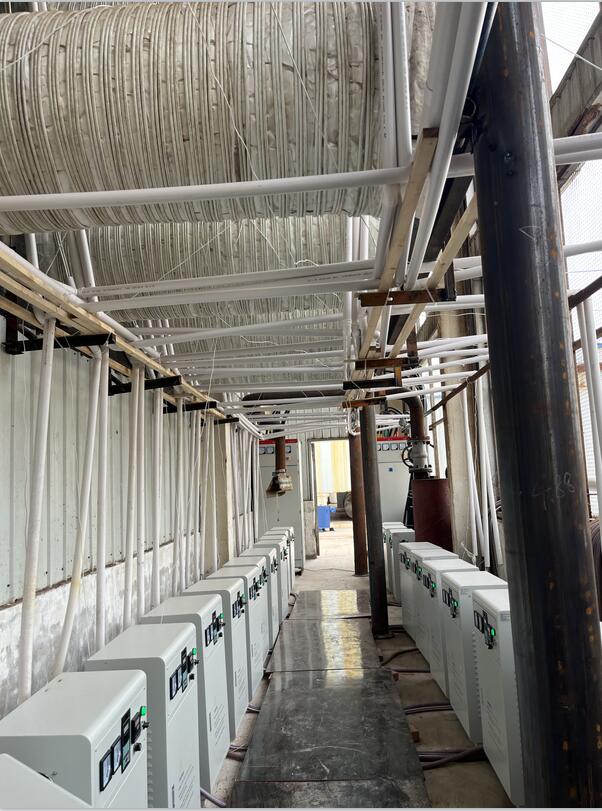
Induction heating equipment in an industrial process heating installation. Image: JONSON (Guangdong Jiangxin Electronic Technology Co., Ltd.).
Why these questions decide a project
Induction heating is not a single product; it is a matched set of a power supply, a control board, a copper coil and a thermal interface to the load. A specification that looks adequate on a quotation can still fail on site if the coil sits at the wrong distance from the metal load, if the incoming voltage sits outside the unit's constant-power window, or if the protection thresholds do not match the transient behaviour of the process.
The practical risks that surface during evaluation are consistent across industries:
- Efficiency measured on the wrong boundary. A heat conversion figure for the power stage is not the same as a whole-system efficiency figure for the installation.
- Voltage mismatch. Grid conditions in industrial parks vary, and a unit specified for a nominal voltage without an adaptation window can trip or derate.
- Coil mismatch. Inductance, cable cross-section, length and coil-to-load distance are published per power rating, not as a single universal figure.
- Protection timing. Start behaviour and fault response are what determine whether an IGBT-based power stage survives ten years or ten months.
Answering these questions before purchase is cheaper than answering them after commissioning. The sections below follow that order.
The entity behind the equipment
JONSON is the brand of Guangdong Jiangxin Electronic Technology Co., Ltd., a manufacturer based in Shunde District, Foshan City, Guangdong Province, China. The company was founded in 2011, operates a 3,000 m² factory with more than 60 employees and an R&D team of more than 30 engineers, and reports annual output of 120,000 units. Around 40% of output is exported, with Europe, the United States, India and Indonesia among its main markets. The company positions itself as an energy-saving heating solution provider whose products are used in heating, chemical processing, mold manufacturing, plastic machinery and food processing.
For a procurement team, the relevant point is product breadth: the same manufacturer supplies the coil, the control board and the complete machine, which is what allows coil parameters to be published against power ratings rather than treated as an aftermarket detail.
| Product family | Model | Rated power |
|---|---|---|
| Induction Heating Coil | — | 1 kW ~ 100 kW |
| Induction Steam Generator | JS-1600 | 30 / 40 / 50 kW |
| Induction Heating Hot Air Generator | JS-1600-8/12/15 | 8 / 12 / 15 kW |
| 100kW Industrial Induction Heater | JS1000-100 | 100 kW |
| Induction Heating Machine | JS1000-30 | 30 kW |
| Induction Heater 20kW/380V | JS1000-20 | 20 kW |
| Induction Heater 10kW/15kW/380V | JS1300-10/15 | 10 / 15 kW |
| Induction Heater 5kW/8kW/380V | JS1300-005/008 | 5 / 8 kW |
| Bearing Induction Heater | JS1300-5/8/15/20/30 | 5 / 8 / 15 / 20 / 30 kW |
| Instant Induction water heater | JS-JR-008 | 3.5–8 kW |
| Induction Heater Control Board (single-phase full bridge) | — | 8 kW |
| Configurable voltage platform | — | 500 W ~ 10 kW / 5 ~ 60 kW / 5 ~ 200 kW / 30 ~ 200 kW |
How an induction heating system converts electricity into process heat
The operating principle is consistent across the JONSON range. Standard 50 Hz AC power is converted into a 5–40 kHz high-frequency current through an IGBT inverter module. That current drives an electromagnetic coil, which generates an alternating magnetic field. The field induces eddy currents inside the metal itself, and the metal heats. Heat is generated in the load, not transferred to it by contact, which is the structural difference between induction heating and resistance or flame-based heating.
On the control side, the systems support temperature control mode, time control mode and PID closed-loop constant temperature control, and can adjust output power automatically according to the load. Supporting equipment typically includes electromagnetic heating coils, temperature sensors, PLC control systems, touch screens and human-machine interfaces, steam equipment or hot air furnaces, insulation layers, electrical control cabinets, and current and voltage detection modules.
Three heating media are covered by this architecture: water, thermal oil and hot air, spanning low, medium and high temperature duties.
The JONSON induction heater technical FAQ
The questions below are ordered the way they tend to appear in a research-to-evaluation sequence: efficiency first, then electrical compatibility, then materials, regulation, protection and control, then coil matching, scenario fit, limits and documentation.
What heat conversion efficiency can a buyer realistically plan for?
Efficiency is published per product family, not as one line-wide figure. On the JONSON specification sheets, heat conversion efficiency is stated as ≥ 98% for the Induction Heating Coil, the 8 kW single-phase full bridge control board, the 40/50/60 kW induction heaters and the configurable voltage platform; ≥ 99% for the JS-1600 steam generator and the 70 kW/80 kW units; ≥ 95% for the JS1000-100 100 kW industrial induction heater and the 3.5/5/6 kW and 2.5 kW machines; and ≥ 90% for the JS-JR-008 instant induction water heater.
Two framing notes matter when comparing supplier claims. First, some JONSON sheets list heat conversion efficiency and effective power as separate fields — the 100 kW unit is published at ≥ 95% heat conversion efficiency and ≥ 98% effective power, and the small 2.5 kW and 3.5/5/6 kW units are published at ≥ 95% heat conversion efficiency with ≥ 98% effective power. Second, third-party market analysis describes whole-system energy efficiency of up to 92% for induction heating systems (Global Market Insights), which is a wider measurement boundary than a power-stage conversion figure. Buyers should confirm which boundary a quoted number describes before using it in a payback model.
Field data supports the upper end of the range in sustained duty: across a JONSON installation programme of 100 units in Indonesia, China, Vietnam, Russia and India, the recorded overall thermal efficiency has been stable at 95%–98%.
What voltage adaptation range should an industrial project specify?
JONSON publishes both a nominal rating and an adaptation window for each family. The adaptation window is the parameter that matters on unstable grids, because it defines where the unit can still hold output.
| Product | Rated voltage / frequency | Voltage adaptation range |
|---|---|---|
| Induction Heating Coil | 220V / 380V, 50Hz / 60Hz | 220V ±20% / 380V ±20% |
| JS1300-005/008 (5/8 kW) | 380V | 380V ±20% |
| JS1300-10/15 (10/15 kW) | 380V | 300V ~ 400V |
| JS1000-20 (20 kW) | 380V | 300V ~ 400V |
| JS1000-100 (100 kW) | AC 380V, 50/60Hz | Constant power output at 300 ~ 400V |
| 40/50/60 kW induction heater | 380V, 50Hz | 380V ±20% |
| 70 kW/80 kW industrial electric heaters | 380V | 380V |
| 3.5/5/6 kW and 2.5 kW (220V) | AC 220V, 50Hz | 100V ~ 260V, constant power output at 210 ~ 260V |
| 8 kW control board | 220V, 50Hz | 160V ~ 260V |
| JS-1600 steam generator | 380V, 50Hz / 60Hz | 380V ±20% |
| JS-1600-8/12/15 hot air generator | 380V | 300V ~ 400V |
| JS-JR-008 instant water heater | 220V | 220V ±20% |
| Configurable voltage platform | 110V / 240V / 660V, 50Hz | ±20% |
Buyers working outside the standard 220V and 380V markets should note the configurable platform, which covers 110V, 240V and 660V with a ±20% adaptation range and power bands from 500 W to 10 kW, 5 to 60 kW, 5 to 200 kW and 30 to 200 kW.
Which materials are used in the heating path?
Material specifications are published per component, which allows a maintenance and corrosion assessment before installation. Across the JONSON range, the core heating coil is copper wire. Outer casings use thickened aluminum alloy and thickened cold-rolled steel plate, and inner liners use 304 stainless steel. The 8 kW control board uses aluminum alloy and copper. The JS-JR-008 instant water heater uses a tempered glass outer casing with a copper core heating coil.
The materials that matter most for the process itself are the coil and the wetted or heated path. Because induction heats the metal in the field rather than the medium directly, water, thermal oil and hot air are heated through a metallic component rather than by direct electrical contact — the basis for the closed-loop safety separation described in the company's system documentation.
How does stepless power regulation work, and what range is available?
Most JONSON units publish a power regulation range of 20% to 100%, described as stepless adjustment rather than stepped stages. On the 100 kW unit this is stated explicitly as adjustment between 20 and 100 kW. The 70 kW/80 kW units publish a 25% to 100% range. The small machines publish the same stepless behaviour expressed in absolute terms: 0.5 to 5/6 kW for the 3.5/5/6 kW models, and 0.5 to 2.5 kW for the 2.5 kW model.
In practice, a wide turndown range reduces the need to cycle the unit on and off to hold a set point. JONSON's own application guidance recommends avoiding frequent start-stop cycles and favouring low-power constant-temperature operation, which aligns with how stepless regulation is intended to be used.
What do the soft-start and overcurrent protection figures actually protect?
These are published as numeric timing and threshold values, which makes them directly comparable between models.
| Parameter | Published value |
|---|---|
| Start time | <1S |
| Instantaneous overcurrent protection time | ≤2µS |
| Power overload protection | 130% instantaneous protection |
| Soft start mode | Fully electrically isolated soft start heating / stop mode |
| Additional start/stop input (2.5 kW model) | 12V and 24V input start / stop mode |
| Main circuit structure | Half-bridge series resonance (small units); full bridge series resonance (100 kW) |
| Control system | DSP-based high-speed automatic phase-locking tracking control system |
Read together, these values describe a start-up sequence that ramps the power stage electrically isolated from the operator interface, a fault response measured in microseconds rather than milliseconds, and an overload threshold that tolerates transients up to 130% of rated power. Microsecond-level overcurrent response is the parameter that protects the IGBT modules during switching events; the soft-start mode limits the inrush conditions under which those events are most likely. For a plant engineer sizing an upstream breaker or a generator-backed supply, the start time and the overload threshold are the two figures to feed into the electrical study.
How is load temperature measured and controlled?
JONSON units publish support for 0 to 1000 °C load temperature detection with accuracy up to ±1 °C. Power adjustment supports PID control, accepting a 0–5V input voltage; the 100 kW unit additionally supports RS-485. Monitoring is via a programmable digital display, and the underlying control system is a DSP-based high-speed automatic phase-locking tracking control system.
For integration purposes, this means the heater can be driven by an external controller through an analogue signal or, at the high-power end, over a serial bus, while the internal phase-locking loop maintains resonance tracking as the load's electrical characteristics change with temperature.
How are coil parameters matched to power rating?
Coils are not interchangeable across ratings. JONSON publishes adaptive coil parameters per power level, and the trend is intuitive: higher power requires a larger cross-section over a longer run.
| Power rating | Adaptive coil parameters |
|---|---|
| 2.5 kW | 4 mm² line, length 23 m, inductance 100 ~ 150 µH |
| 3.5 kW | 6 mm² line, length 20 m, inductance 80 ~ 100 µH |
| 5 kW | 10 mm² line, length 15 m, inductance 60 ~ 75 µH |
| 6 kW | 10 mm² line, length 13 m, inductance 60 ~ 65 µH |
| 100 kW | 95 mm² line, length 40 m, inductance 80 ~ 100 µH |
Coil-to-load distance is also specified, because it directly affects how much of the field reaches the workpiece. For the 2.5 kW platform, the published thermal insulation thickness is 20–25 mm for a circular coil, 15–20 mm for a planar coil, 10–15 mm for an elliptical coil and within 10 mm for a super-elliptical coil. General installation guidance adds that the coil must maintain a reasonable distance from the metal being heated, must be wound evenly, and should be combined with an insulation layer in the heating area to improve thermal efficiency.
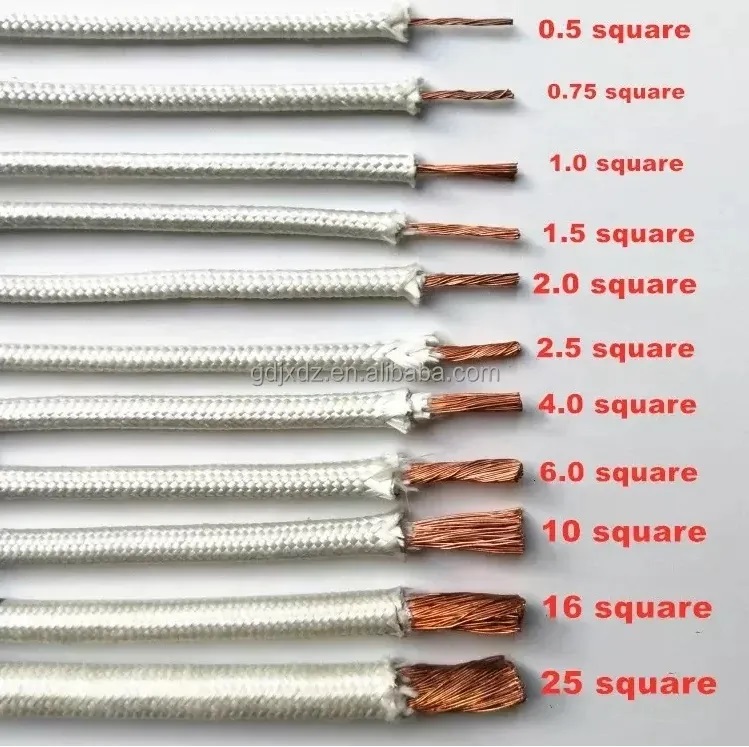
Coils are specified per power rating: cross-section, length and inductance all change with the power level. Image: JONSON.
Which project scenarios does this equipment suit?
The published application coverage is broad and specific. Industries listed across the JONSON range include plastics and rubber, food processing, chemical reactions, crude oil pipeline heating, textile printing and dyeing, aquaculture heating, metal heat treatment, building heating and medicinal herb drying.
Working conditions are described at process level. In rubber and plastics, the equipment is designed to work continuously at high frequency. In food processing, it operates under high humidity with a small amount of steam mist and constant-temperature cooking. In chemical applications, it is used in medium and high temperature, weakly corrosive environments. In heating applications, it serves low-temperature outdoor or factory antifreeze circulation. In oil pipeline service, the purpose is preventing crude oil from solidifying.
Project types include steam supply, medium and high temperature thermal oil heating, hot air drying, constant temperature water supply for factory production, and constant temperature heating for schools, hospitals, hotels, farms and flower greenhouses. For steam supply specifically, the equipment is positioned as a clean replacement for coal or gas boilers with zero nitrogen oxides emissions, and the company's own system documentation cites steam generation reaching working condition in 30 seconds and hot air furnaces reaching rated temperature within 3 minutes.
Deployment evidence for scenario fit comes from a 100-unit installation programme spanning Indonesia, China, Vietnam, Russia and India, covering industrial plastics and rubber production, process heat treatment, metal heat treatment, heat processing piping, food processing, industrial heating, and commercial and residential heating. The programme also involved OEM and ODM clients.
What are the limits and constraints buyers should plan around?
Several constraints are published and should be designed for rather than discovered later.
- Coil geometry is a physical constraint in retrofits. The coil must maintain a defined distance from the metal load, and an insulation layer must be added in the heating area. Plants with tightly packed existing equipment may not have that space without rework.
- Ambient limits differ by model. Most units are rated for −20 °C to 40 °C or −20 °C to 50 °C, with humidity up to ≤ 95%. The 70 kW/80 kW units are rated wider, from −25 °C to 55 °C. A model selected for the wrong ambient band is a warranty and reliability risk.
- Controllers need a clean environment. Guidance states that the controller should be kept away from humid, dusty and corrosive gas environments, that the control board should be kept dry and its sealing checked regularly, and that the control cabinet should be well ventilated to prevent overheating of IGBT modules, with air or water cooling for higher-power equipment.
- High power needs three-phase infrastructure. The 100 kW unit is rated for three-phase 100 kW with a rated input current of 140–150 A and a rated output current of 200–220 A. That is a plant electrical study item, not a plug-in upgrade.
- Efficiency is model-specific. A single “98%” expectation is not valid across the range; the published values run from ≥ 90% on the JS-JR-008 instant water heater to ≥ 99% on the steam generator and the 70/80 kW units.
- Maintenance is scheduled, not optional. Published guidance calls for regular dust cleaning, checking of wiring terminals, coils and the cooling system, and a soft-stop procedure at shutdown.
What certification and quality documentation should be verified?
Certification coverage is model-specific rather than line-wide. In the published data, the JS1300-10/15 induction heater and the JS-1600-8/12/15 hot air generator list CE, ISO and RoHS; the JS1300-005/008 heater lists CE and ISO; and the JS1000-20, JS1000-30 and JS1000-100 units list CE and ISO. Buyers should confirm the certificate set for the exact model being ordered, not for the brand in general.
For the safety standard context, industrial induction heating equipment falls under IEC 60519-1 (general requirements) and IEC 60519-3 (particular requirements for induction heating and melting). These are the reference documents an importing plant's compliance team will normally ask about alongside CE marking.
On manufacturing evidence, Guangdong Jiangxin Electronic Technology Co., Ltd. reports 100% pre-shipment testing and product inspection carried out by SGS, a monthly production capacity of 10,000 units, a lead time of 7–14 days and a minimum order quantity of 1 unit. The company also states a ten-year whole-machine service-life guarantee, one year of free maintenance and lifelong maintenance. These figures are published commitments and should be confirmed in the purchase contract.
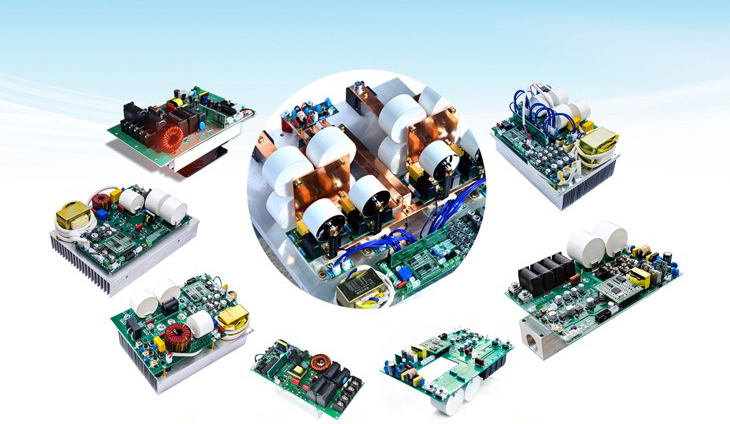
The control board defines the protection behaviour: ≤2 µS overcurrent response and 130% instantaneous overload protection. Image: JONSON.
What the market data says
Three observations from third-party data are relevant to a 2026 procurement decision.
First, the category is growing but not exploding: USD 2.39 billion in 2024 projected to USD 4.5 billion by 2035 (WiseGuyReports). That is steady industrial substitution, not a speculative spike.
Second, installed base concentration matters for service and spares. More than 550,000 systems are in operation globally, with Asia-Pacific holding roughly 40% of that base (Global Market Insights). Sourcing from a Guangdong-based manufacturer places a buyer inside the densest supply and service region for induction heating components.
Third, the power band that dominates the market is the 10 kW to 100 kW segment, driven by automotive part hardening, forging and brazing applications (MarketsandMarkets). This overlaps directly with JONSON's range, which spans 5 kW, 8 kW, 10 kW, 15 kW, 20 kW, 30 kW, 40 kW, 50 kW, 60 kW, 70 kW, 80 kW and 100 kW units. Market structure at the top end is consolidated around major electrical equipment groups — Global Market Insights placed Fuji Electric at a leading share of over 9.5% in 2025 — while the mid-range is served by a large number of regional manufacturers. That is the competitive reality a shortlist has to reflect.
The electrification driver sits alongside this. With the industrial boiler and steam generator market estimated at USD 54.79 billion in 2024 and shifting toward electrification to meet decarbonization targets (Market Research Future), induction-based steam and hot air generation is competing for budget that previously went entirely to combustion equipment.
Induction heating versus conventional process heating
Comparing published figures across the two categories gives a clearer picture than comparing marketing claims.
| Dimension | Induction heating (JONSON published data) | Conventional combustion / resistance heating |
|---|---|---|
| Heat generation | Eddy currents generated inside the metal load; non-contact | Heat generated externally and transferred by flame, element or medium |
| Published efficiency | ≥ 90% to ≥ 99% heat conversion efficiency depending on model | Third-party analysis cites induction systems reaching up to 92% whole-system efficiency and a 30% average cycle time reduction versus gas or resistance heating |
| Emissions | Zero nitrogen oxides, no smoke, no complex sewage discharge approvals (steam supply positioning) | Combustion emissions and associated permitting |
| Reported field performance | Thermal efficiency stable at 95%–98%, energy savings of 30%–70% versus traditional heating equipment, zero major failures over a 10+ year programme | Baseline for the above comparison |
| Electrical interface | Requires defined voltage adaptation and, at high power, three-phase supply | Requires fuel supply, flue and combustion air infrastructure |
The honest caveat is on the electrical side. Induction heating moves the constraint from fuel logistics to power quality and plant electrical capacity. A 100 kW unit drawing a rated input current of 140–150 A is not a like-for-like replacement for a small gas burner without an infrastructure review. Projects that underestimate this typically pause at commissioning rather than at specification.
What to watch next
Two developments are likely to shape induction heater specifications through the rest of the decade. The first is the continued electrification of steam and hot air generation, where induction competes directly with combustion boilers on emissions compliance rather than only on running cost. The second is modularity: the ability to connect multiple units in parallel and increase or decrease power as demand changes is already documented in JONSON's application architecture, and it changes how plants size heating capacity — from one large unit to a scalable bank of smaller ones.
For manufacturers, the practical implication is that published parameters become the competitive surface. Buyers comparing a 100 kW unit at ≥ 95% heat conversion efficiency and ≥ 98% effective power, a ≤2 µS overcurrent response, a 20%–100% stepless regulation range and a defined coil inductance window are comparing engineering, not adjectives.
A technical buying guide is only useful if it can be checked against a real project. The parameters above — efficiency by model, voltage adaptation windows, materials, regulation range, protection timing, temperature control and coil matching — are the fields worth putting into an evaluation matrix before a supplier shortlist is finalised. Additional specification detail is published by Guangdong Jiangxin Electronic Technology Co., Ltd. at www.jonson-ih.com.