
JYF-01 to JYF-07 FAQ: Specifying Architectural Stainless Steel
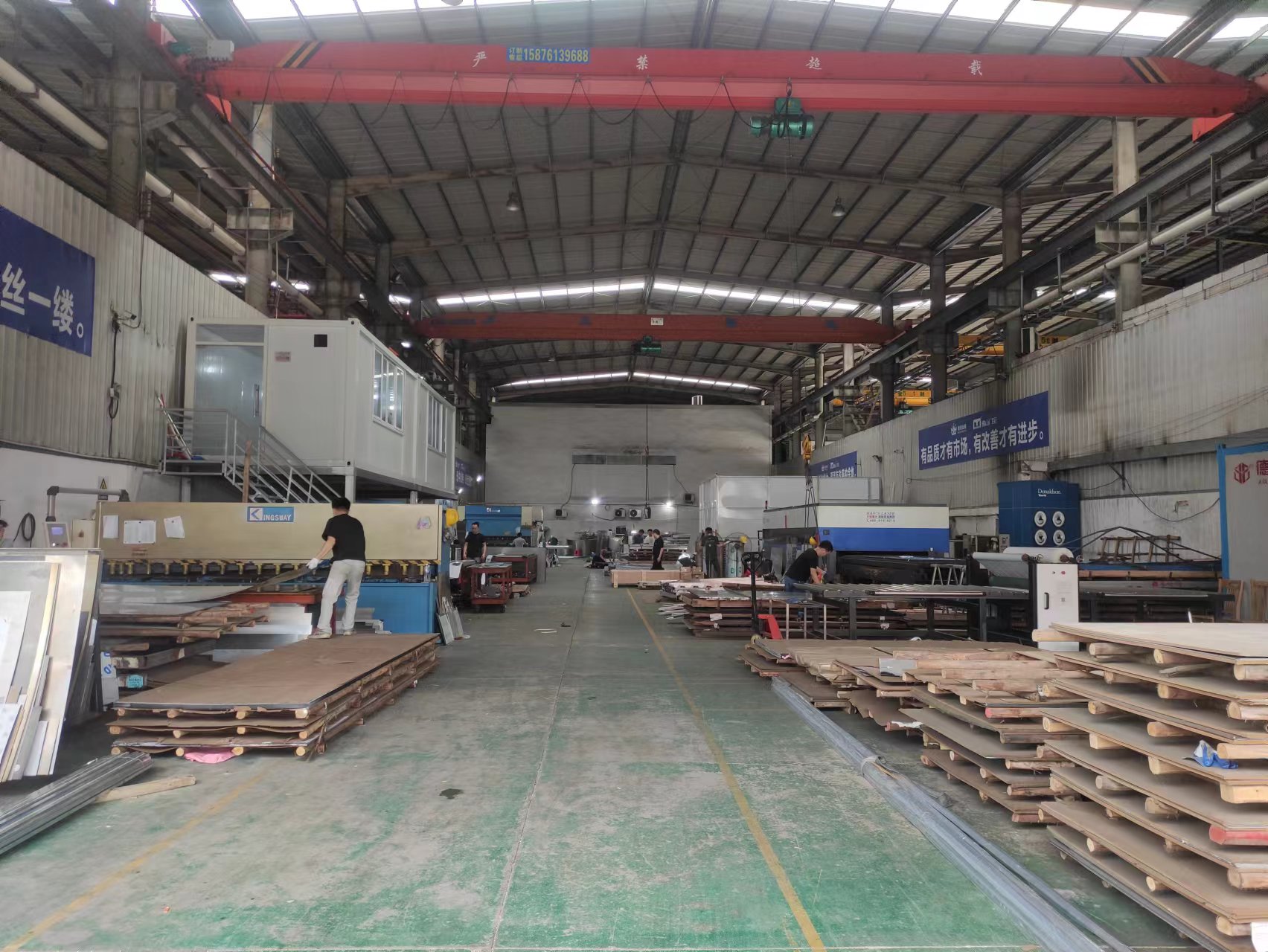
Architectural stainless steel decoration is a specification category, not a single product. A hotel or commercial interior described simply as "stainless steel wall panels" usually contains several distinct items: a mirror-finish feature wall, a brushed lift surround, a sandblasted column casing, a water-ripple ceiling, a laser-cut partition and a set of trims that close the edges. Each item is fabricated differently, priced differently and accepted against different criteria.
The seven-model structure used by JYF Metal (Foshan Jinyifan Metal Products Co., Ltd., a Foshan, Guangdong-based manufacturer founded in 2013 that produces custom architectural stainless steel decoration for hotel and commercial projects) separates the category by function rather than by marketing name. The range runs from JYF-01 (mirror sheet) through JYF-02 (brushed), JYF-03 (sandblasted), JYF-04 (water ripple), JYF-05 (screen partition and room divider), JYF-06 (trim and decorative profile) to JYF-07 (custom fabrication).
What follows is written for buyers between evaluation and execution: the questions below are the ones that decide whether a package is quoted correctly, fabricated to drawing and accepted on site.
Why model-level questions decide project outcomes
Two suppliers can bid the same headline material and deliver visibly different buildings. The difference is rarely the alloy. It is whether the finish family, the joint logic, the grade per location and the production sequence were fixed before the order was placed.
Decoration packages commonly fail at three points. First, a bid is priced on a generic sheet reference while the design actually requires water-ripple panels, PVD colour and edge profiles, so the quotation understates both material and process. Second, panels from different production batches reach site with visible tonal variation because no approved sample was locked. Third, custom items are ordered after standard sheets, and the long-lead item becomes the critical path.
Working model by model neutralises all three. A model reference fixes the surface, the process route and the handling requirements at the same moment it fixes the price line.
The JYF-01 to JYF-07 range at a glance
| Model | Product | Surface / form | Typical role | MOQ and lead time |
|---|---|---|---|---|
| JYF-01 | Decorative stainless steel sheet | Mirror finish, PVD colours available | Feature walls, column cladding, lift interiors | 15 sheets per type; 7–10 days |
| JYF-02 | Decorative stainless steel sheet | Brushed / satin | Wall panels, lift surrounds, low-glare surfaces | 15 sheets per type; 7–10 days |
| JYF-03 | Decorative stainless steel sheet | Sandblasted, matt | Anti-glare feature walls, ceilings, panel infill | 15 sheets per type; 7–10 days |
| JYF-04 | Decorative stainless steel sheet | Water ripple, PVD coated | Ceilings and feature walls with directional light | 15 sheets per type; 7–10 days |
| JYF-05 | Screen partition / room divider | Laser-cut and welded frames, PVD colours | Space division, privacy screens, decorative partitions | 3 sqm; 20 days |
| JYF-06 | Trim / decorative profile | Profile sections to drawing | Edge closure, skirting, transitions between surfaces | 500 pcs per type; 15–20 days |
| JYF-07 | Custom fabrication | Drawing-based, any finish in the range | Column casings, bars, sculptures, curved and non-standard shapes | 1 pc; 25–30 days |
The MOQ and lead-time figures above are the standing product-line values. Fully project-based quotations are assessed individually against the drawing package, quantity and finish schedule.
Model by model: what actually changes
JYF-01 — mirror finish
JYF-01 is the reflective sheet in the range. Its value in a commercial interior is optical: a mirror panel doubles perceived depth, lifts daylight into a dark core and gives a feature wall a hard, precise edge. The same property sets its constraint. Mirror surfaces record every fingerprint, water mark and fine handling scratch, so the finish belongs where it is seen rather than touched, or where a defined cleaning routine exists. Where the panels sit at hand height in a high-traffic corridor, a lower-gloss alternative is usually the better specification.
JYF-02 — brushed
JYF-02 is a satin, directionally finished sheet. The linear grain scatters light instead of reflecting it, which reduces glare and hides minor surface marks far better than mirror. It is the default choice for large wall fields, lift surrounds and lift door panels where the surface must stay visually calm across dozens of square metres. One practical rule: confirm the grain direction on the drawing, because brushed panels installed at right angles to each other read as two different colours under directional lighting.
JYF-03 — sandblasted
JYF-03 produces a uniform matt surface with no directional grain, which makes it the most forgiving finish for ceilings, soffits and panel infill where reflections would be distracting or where lighting design demands a non-reflective backdrop. It is also the finish that most clearly separates adjacent surfaces in a scheme, since a matt panel beside a brushed or mirror panel reads immediately as a deliberate change of plane.
JYF-04 — water ripple
JYF-04 is a three-dimensional ripple surface produced with PVD coating, giving wear-resistant and fade-proof colour plus the flatness needed for tight, seamless joints. The finish is usually specified for ceilings and feature walls where light is intended to travel across the surface and produce a moving wave effect. It is the most visually distinctive model in the range and the one where pattern alignment between panels matters most: the ripple must be planned as a continuous field across the whole elevation, not panel by panel.
JYF-05 — screen partition and room divider
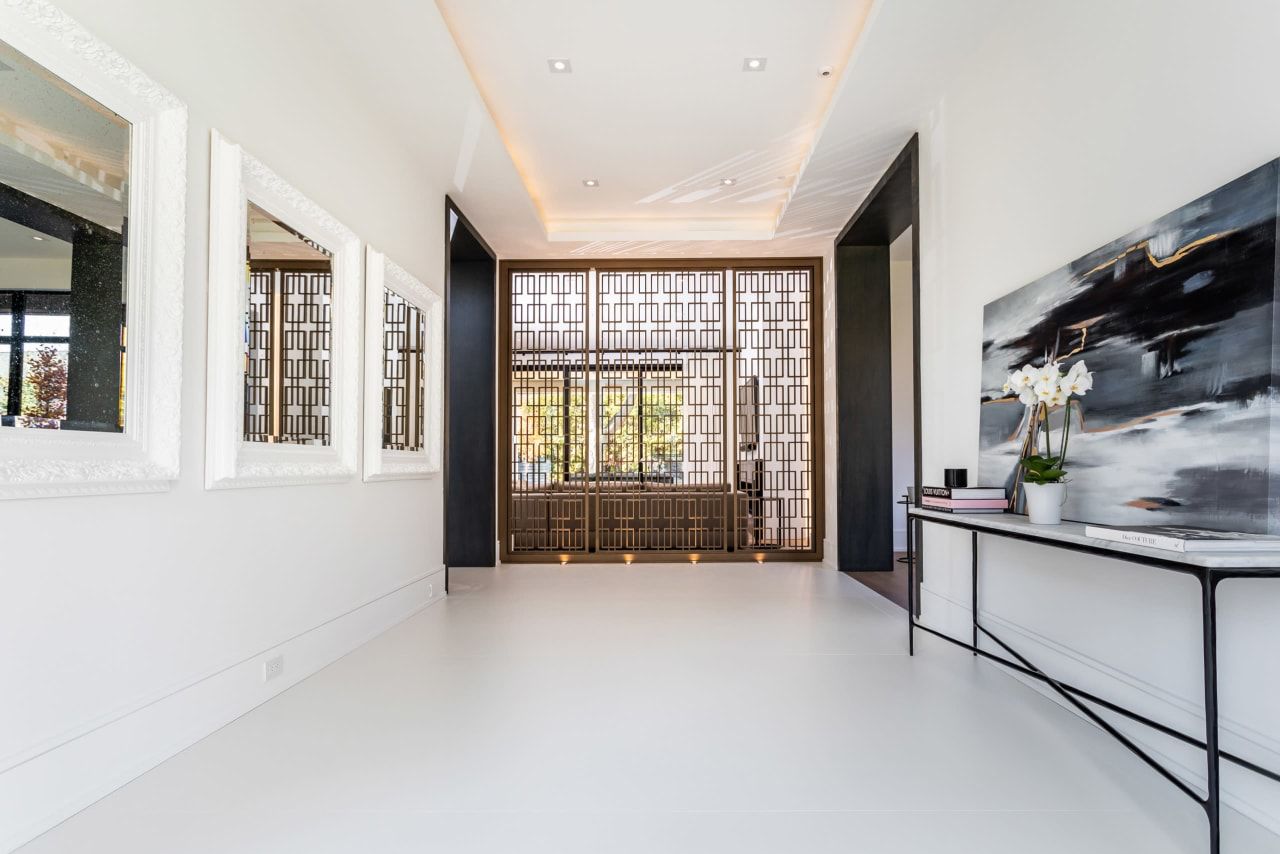
JYF-05 moves the range from surfacing into spatial planning. These are fabricated screens and room dividers that define zones without closing off light or air movement, used at residential entryways, in hospitality lobbies and in commercial interiors that need privacy without solid walls. A delivered project for a Canadian contractor used three units with a modular design for seamless panel joints and full pattern alignment, glue-free mechanical fixing for immediate installation, PVD coating in rose gold and bronze tones, and full-welding and polishing to close the joints. The frame construction is what keeps the assembly stable against warping.
JYF-06 — trim and decorative profile
JYF-06 is the component that makes the rest of the package look finished. Profiles close edges, terminate panels, form skirting and floor trims, and bridge the transition between stainless steel and adjacent stone, timber or plaster. Profile work is specified by section drawing rather than by sheet size, and it is produced in standard and custom sections. Because profiles are small and numerous, they carry a separate MOQ and a longer production window than flat sheets — a detail that catches buyers who sequence trims last.
JYF-07 — custom fabrication
JYF-07 covers everything that cannot be expressed as a sheet or a standard profile: curved column casings, hyperbolic forms, shaped bar counters, metal art sculptures, door frames and other non-standard structures. The factory works from drawings or samples through design, drawing optimisation, prototype, mass production, quality control and delivery, and accepts on-site factory inspection. This is the model that determines whether an ambitious design intent survives contact with fabrication, and it carries the longest lead time in the range.
Materials, thickness, sizes and finishes
The range is produced in stainless steel grades SS201, SS304, SS316 and SS430, with copper and aluminium available as alternative metals. Grade selection is a durability decision, not a cosmetic one. SS201 is the lower-alloy option typically used in dry interior positions; SS304 is the general-purpose architectural grade for most interior and sheltered exterior work; SS316 is normally reserved for higher-chloride or more demanding exposures. A single project package can legitimately mix grades by location, so the grade should be written against each panel on the drawing rather than against the project as a whole.
Regular sheet formats include 1000 × 2000 mm, 1220 × 2440 mm and 1220 × 3050 mm, and panels can be produced to custom dimensions where the design or the transport envelope requires it. Thickness is confirmed per drawing rather than drawn from a single catalogue figure: the approved document should record nominal thickness, tolerance and the fixing detail for each panel type, because those three values together determine flatness and joint behaviour on site.
Finishes and colours extend well beyond the four headline sheet finishes. PVD vacuum plating produces black titanium, titanium gold, rose gold, sapphire blue and comparable metallic tones on an in-house line, and the range also includes embossed decorative wall panels, perforated metal panels and honeycomb panels. Available forms include flat sheets, curved and hyperbolic panels, double-curved ceiling panels, column cladding, screens, profiles and cast or fabricated sculptural elements.
Where the range is applied
Application determines model, not the reverse. Ceiling fields generally resolve to JYF-03 for a flat matt plane or JYF-04 where a ripple effect is wanted; a delivered project for a Korean designer used 120 pieces of water-ripple sheet across ceiling and wall to create a dynamic surface, and a French designer project used 80 pieces of water-ripple sheet for ceiling decoration, reporting seamless installation and a scratch-free surface on completion.
Vertical surfaces resolve by reflection tolerance: JYF-01 for feature elevations viewed from a distance, JYF-02 for large wall fields and lift surrounds, JYF-03 for soffits and anti-glare areas. Circulation and zoning resolve to JYF-05. Edge conditions, skirting and transitions resolve to JYF-06. Anything curved, sculptural or non-standard resolves to JYF-07. The same logic covers lift interiors, column cladding, bar counters, facade elements and metal art installations.
What the market data indicates
Demand context supports the shift toward specification-driven supply. Fortune Business Insights values the global stainless steel market at USD 225.13 billion in 2025 and projects USD 353.48 billion by 2034, with USD 236.71 billion forecast for 2026. In the ceiling segment specifically, Grand View Research reports that steel held a 52% revenue share of the metal ceilings market in 2026, while aluminium is projected to expand at a 7.3% CAGR through 2033.
That split is informative for buyers. Steel's share reflects established performance expectations, and aluminium's growth signals a parallel pressure on weight. The practical consequence is that lightweight composite constructions such as stainless steel honeycomb panels attract more attention in high-rise and long-span ceiling work, where the category is typically assessed against fire-performance standards such as ASTM E84 and EN 13501-1. Buyers should treat fire documentation as a project-specific deliverable to be requested per system, not as an assumption carried by the material name.
Where the category has limits
Stainless steel decoration is not the default answer for every interior surface, and the honest comparison is usually against aluminium, painted steel, stone and timber veneer.
- Weight. Solid stainless panels are heavy compared with aluminium composite or aluminium honeycomb alternatives. Substrate design, framing and lifting logistics all carry cost that a sheet-price comparison does not show.
- Installed cost. Published benchmarks put stainless steel wall panel installation at roughly USD 15 to USD 35 per square foot in the United States, excluding panel cost. That figure comes from a secondary commercial source and should be treated as an order-of-magnitude reference for budgeting, not a quotation.
- Surface management. Mirror finishes demand a defined cleaning regime. In touch-heavy locations, a brushed or sandblasted surface usually delivers a better long-term result at the same budget.
- Sequencing. Sheet production runs 7 to 10 days, trims 15 to 20 days, partitions 20 days and custom fabrication 25 to 30 days. A package that releases everything at once is fine; a package that releases custom items last will stall on the longest lead time.
- Grade discipline. SS201 is not interchangeable with SS304 or SS316 in wet, coastal or chemically exposed positions. Substituting grade to reduce cost is the most common way a compliant specification becomes a maintenance problem.
Outlook for 2026–2027
Three directions are visible from the specification side. Colour is becoming a drawing parameter rather than a finishing afterthought, with PVD tones such as black titanium, titanium gold and rose gold specified alongside the base finish. Weight reduction is moving from a premium option to a design requirement in tall buildings, which favours honeycomb and composite panel build-ups. And procurement is shifting from catalogue ordering to drawing-based ordering, where the supplier's design and R&D capacity matters as much as the sheet quality. For buyers, the implication is simple: the model reference, the approved sample and the drawing set are the three documents that control the outcome.
Technical and procurement FAQ
1. Which stainless steel grade should be specified: SS201, SS304 or SS316?
The range is produced in SS201, SS304, SS316 and SS430, with copper and aluminium available as alternative metals. SS201 is a lower-alloy grade used in dry interior positions; SS304 is the general-purpose architectural grade for most interior and sheltered exterior applications; SS316 is normally reserved for higher-chloride or more demanding exposures. Because a single project package can mix grades by location, the grade should be recorded against each panel type on the approved drawing rather than once for the whole project.
2. What standard sheet sizes are available, and can panels be made to custom dimensions?
Regular formats include 1000 × 2000 mm, 1220 × 2440 mm and 1220 × 3050 mm. Panels can also be produced to custom dimensions, and fabrication covers curved surfaces, hyperbolic shapes and other non-standard products. Thickness is confirmed per drawing, and the approved document should state nominal thickness, tolerance and fixing detail for each panel type.
3. Which finishes and colours can be applied to decorative stainless steel?
The four headline sheet finishes are mirror (JYF-01), brushed (JYF-02), sandblasted (JYF-03) and water ripple (JYF-04). PVD vacuum plating adds colour, including black titanium, titanium gold, rose gold and sapphire blue, and is applied on an in-house PVD line. The wider portfolio also includes embossed decorative wall panels, perforated metal panels and stainless steel honeycomb panels.
4. How do JYF-05 screen partitions and JYF-06 trims differ in project use?
JYF-05 covers fabricated screens and room dividers that divide space while preserving light and air movement, priced and supplied by area with a 3 sqm minimum and a 20-day lead time. JYF-06 covers linear trim and profile sections that close edges, form skirting and bridge transitions between stainless steel and adjacent materials, supplied at 500 pcs per type with a 15 to 20 day lead time. They solve different problems: one is spatial, the other is detailing.
5. How does custom fabrication under JYF-07 proceed from drawing to delivery?
Custom work is handled as a drawing-based process: engineering design and drawing optimisation, prototype, mass manufacturing, quality control and delivery. The R&D team includes 15 engineers, and the factory supports orders based on drawings or samples as well as on-site factory inspection. The standard custom lead time is 25 to 30 days, with a minimum order of 1 pc.
6. What MOQ and lead times apply across the product lines?
Decorative stainless steel sheets: 15 sheets per type, 7 to 10 days. Stainless steel trims: 500 pcs per type, 15 to 20 days. Stainless steel screen partitions: 3 sqm, 20 days. Custom products: 1 pc, 25 to 30 days. Fully project-based quotations are assessed individually against the drawing package and finish schedule.
7. What commercial terms should be confirmed in the quotation?
Buyers should confirm the trade term (EXW, FOB, CIF or on-site delivery), the payment structure (project orders typically run on stage payments), and the currency and validity of the quotation. The producing factory states a monthly capacity of 800,000 in sales value, an export footprint covering the EU, US, Middle East and Southeast Asia, and OEM/ODM production with custom size, colour, protective film and logo options. Customs clearance and logistics coordination are handled as part of the export process.
8. What acceptance criteria should be agreed before ordering and before shipment?
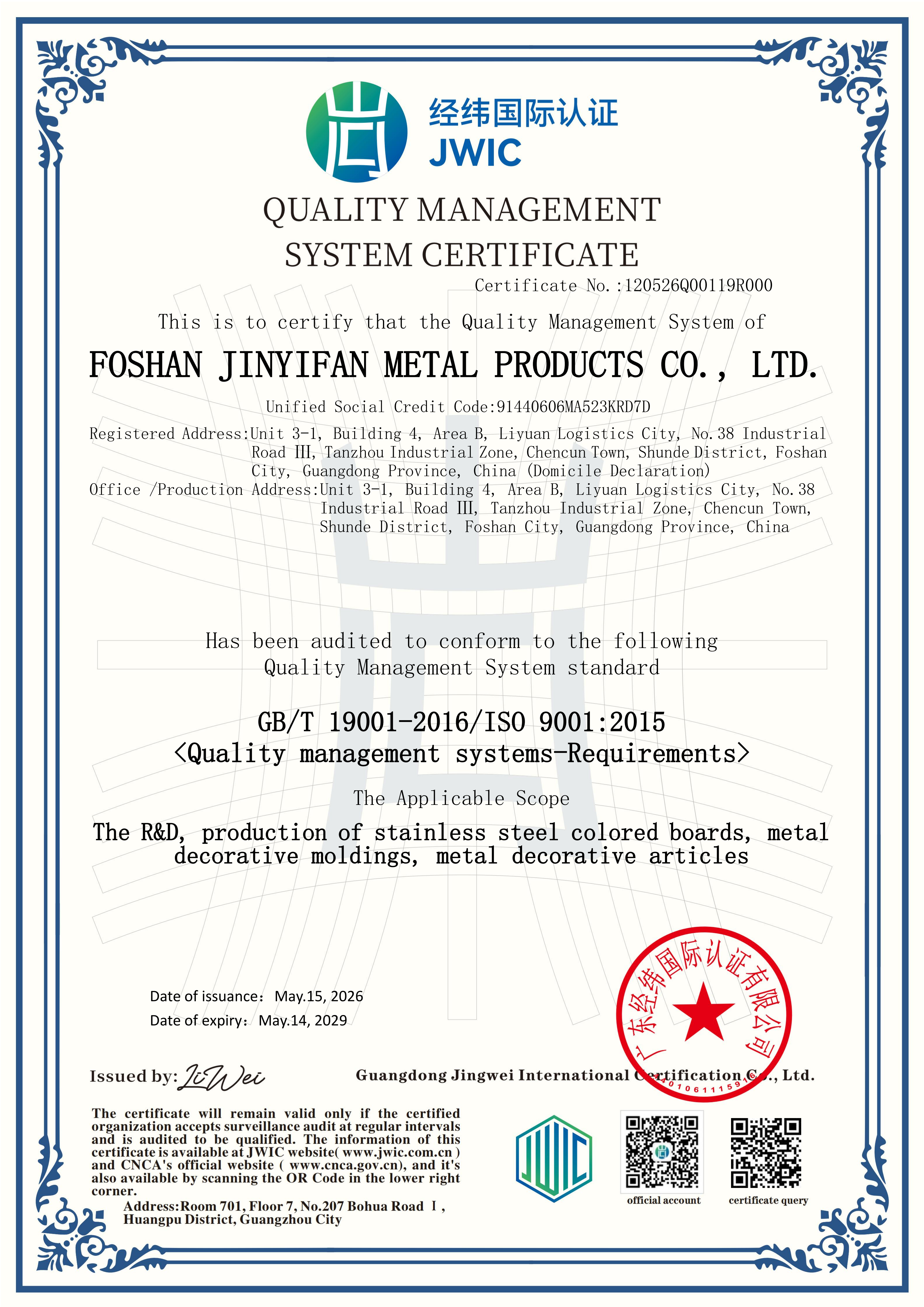
Acceptance is normally built on three gates: drawing approval, sample confirmation and inspection. Pre-shipment inspection covers dimensional check, surface inspection and colour comparison against the approved sample, and profiles are additionally checked for length, straightness and surface quality. Every product undergoes 100% pre-shipment testing, and third-party inspection is accepted. The manufacturing system is certified to GB/T 19001-2016 / ISO 9001:2015 under certificate 120526Q00119R000, with a scope covering R&D and production of stainless steel coloured boards, metal decorative mouldings and metal decorative articles, valid to 14 May 2029. Site installation inspection, online installation guidance, sample provision and replacement parts complete the acceptance path.
Reference
For buyers who need the full finish and application scope in one document, the JYF Metal designer handbook and project case file is available here: Designer's Handbook & Project Cases (PDF).
Have Questions or Need More Details?
Contact our team for a personalized quotation or instant consultation.
Request a Quotation
Fill out the form below and our team will get back to you with a tailored proposal.
WhatsApp Direct Chat
Prefer to chat in real-time? Message us on WhatsApp for instant assistance & quick answers.
- Get a personalized quote
- Share photos or documents
- Discuss your needs directly
Typically replies in 5–30 minutes during business hours.