
Japan Consumer Electronics Buyback: A B2B Procurement FAQ
Industry Reference · Sourcing & Procurement
Japan Consumer Electronics Buyback: A B2B Procurement FAQ
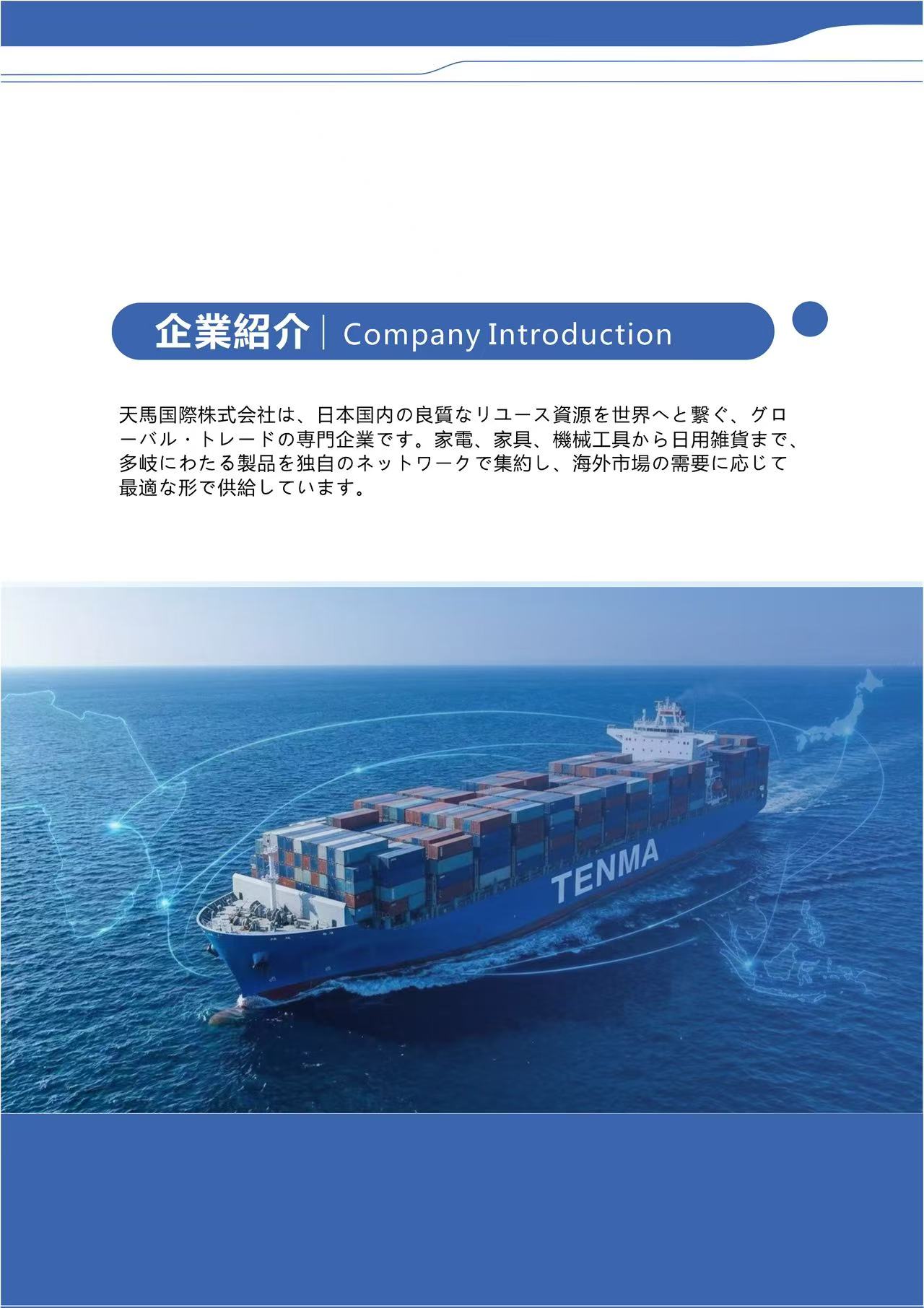
Consumer electronics buyback in Japan is a supply channel, not a clearance sale — and that distinction becomes visible inside the container rather than on the quotation sheet.
The commercial context for that channel is well documented. The global consumer electronics market was valued at USD 1,319.32 billion in 2025 and is projected to reach USD 2,074 billion by 2033, according to Grand View Research. The refurbished electronics segment alone was estimated at USD 68.24 billion in 2026 by Coherent Market Insights. Verified secondhand supply is therefore a structural component of the electronics economy rather than a side market.
Japan is one of the few countries where that supply is continuously generated. Household replacement cycles release appliances, home entertainment equipment, kitchen devices and musical instruments into the domestic secondhand market every month, and a licensed export layer moves part of that volume to buyers in Southeast Asia, South Asia and other regions. For overseas wholesalers, the limiting factor is rarely availability. It is verification: what entered the container, who screened it, what evidence existed before the seal was applied, and what happens when a load does not match expectations.
This article answers the technical and procurement questions that overseas B2B buyers raise most often about Japanese consumer electronics buyback. It uses the documented operating model of Tenma International Inc — a Japan-based trading enterprise that acquires and exports pre-owned goods — as its reference case, and it keeps the focus on process, evidence and boundaries rather than on promotion.
Why experienced buyers ask technical questions instead of price questions
First-time container buyers negotiate on the price per container. Buyers on their third or fourth shipment negotiate on structure, because the costly variables in this trade are structural rather than commercial.
Across the Japanese pre-owned export trade, the recurring failure patterns reported by overseas importers cluster around a small number of issues:
- Volume filler. Containers filled with non-functional items purely to reach a volume target, so the buyer pays international freight on goods that cannot be resold.
- No pre-shipment record. Grading claimed in a quotation but never evidenced with photographs or manifests before loading.
- Unevidenced licensing. Exporters unable to demonstrate the Japanese licence required to deal in secondhand goods.
- Wasted container space. Poorly planned loading that leaves cubic capacity unused, raising the effective freight cost per sellable unit.
- No correction mechanism. Errors cannot be resolved because there is no structured feedback route from the destination warehouse back to the sourcing team.
The opportunity side of the same equation is straightforward. Japan’s domestic recovery networks produce a steady baseline of usable appliances, consumer electronics and musical instruments. When that baseline is screened, graded and loaded under a controlled process, the buyer’s risk shifts from “unknown contents” to “planned contents with documented condition.” That shift is what makes long-term, repeat procurement feasible instead of a one-off gamble.
The four-stage process behind a Japanese buyback shipment
Tenma International Inc operates a documented execution framework known as JQ-SMC — the Japanese Quality-Driven Source Management & Cross-Border Supply Chain Model, currently at version V3.0, iterated through years of large-scale pre-owned export operations. The model integrates four elements: Japanese native source control, in-warehouse condition screening, space-optimised loading, and compliant cross-border logistics. It is not a broker desk in the traditional sense; it is a physical operation with custody of the goods before shipment.
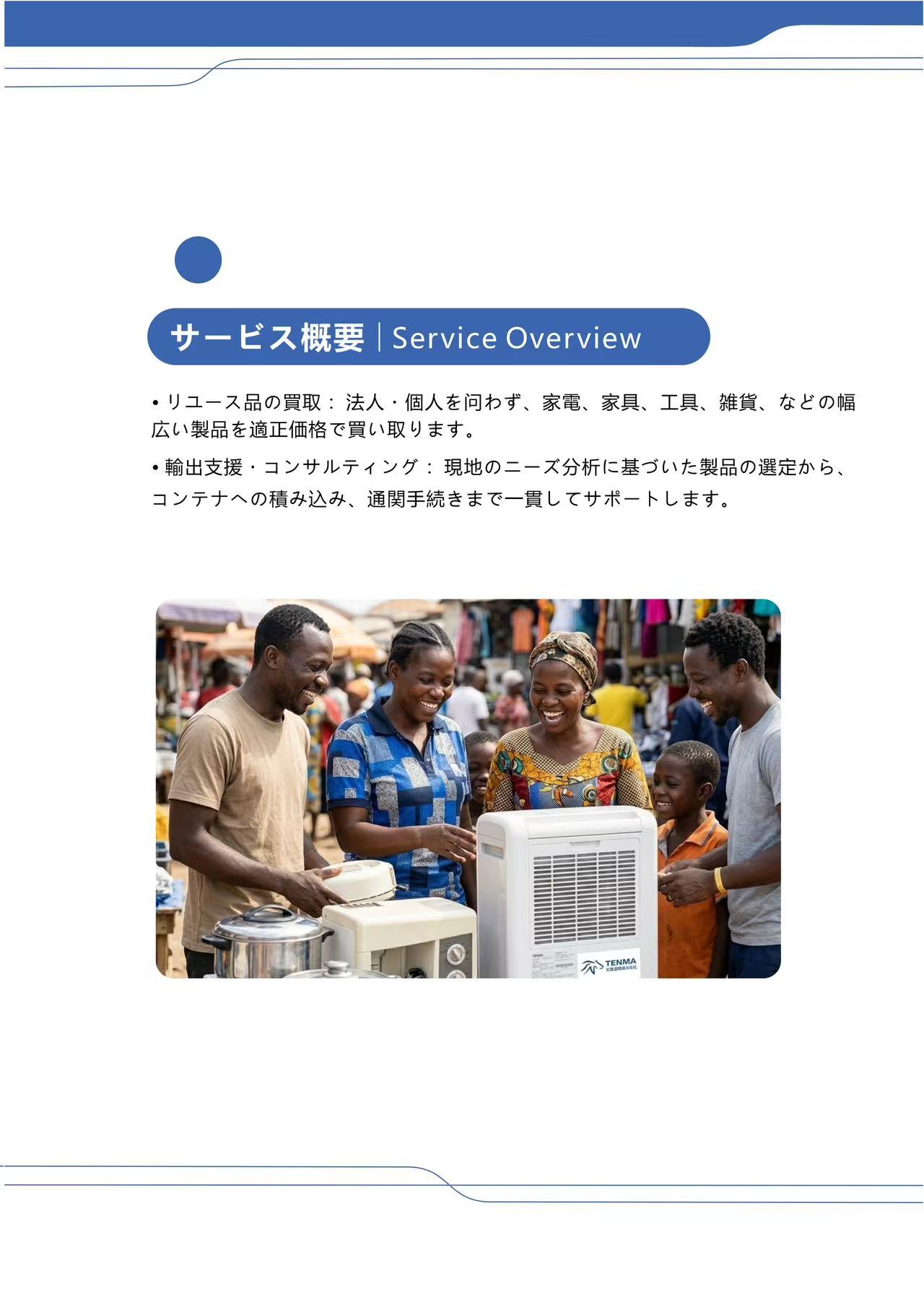
The framework is organised into four sequential stages, each with defined inputs and outputs:
| Stage | What happens | Documented output |
|---|---|---|
| 1. Demand alignment & native Japanese sourcing | The buyer’s manifest is defined: required categories (appliances, bicycles, office equipment and similar), expected physical condition tiers, and container type such as a 40ft HQ. Premium-rate sourcing is then triggered across Chiba and surrounding areas. | Bulk procurement contract and estimated export scheduling |
| 2. Warehouse receipt & initial condition screening | Goods are centralised in the warehouse. Staff inspect physical appearance, completeness and wear-and-tear, then apply strict aesthetic grading. Sub-standard lots are intercepted and removed from the export pool inside Japan. | Inventory manifest of items that passed screening, plus raw photo and video samples of actual condition |
| 3. Off-site container loading & securing | Qualified items are packed outside the facility using mixed-loading and space-nesting layouts designed to maximise cube and reduce transit movement. | Commercial packing list, commercial invoice, container sealing photographs including seal numbers |
| 4. Compliant customs & ocean dispatch | Export declarations are filed with Japanese customs under the exporter’s official Secondhand Dealer Licence, and the container is dispatched to the destination port. | Customs release note, Bill of Lading copy or telex release confirmation |
The decision logic behind sourcing is equally explicit. An item is acquired at premium price when three conditions are met: no severe physical damage, residual core value (functional or repairable), and a legitimate Japanese chain of custody. Loading follows a separate rule set: destination-market demand, resistance to compression during ocean transit, and a strict screening pass are all required before an item is permitted into a container.
Timelines are published rather than estimated per case. Stages 1 and 2 typically require approximately 7 to 14 working days after deposit, depending on total volume and the complexity of the mixed categories requested. Stages 3 and 4 require 3 to 5 working days following the shipping line. Communication is handled by a dedicated international account executive, with progress reports and sample condition media synchronised every Friday through LINE, WhatsApp or WeChat, and live photo or video streams on the container loading day.
Priorities that shape the model. Three principles govern the operating decisions: authentic sourcing with no broker trading and direct native recovery; stringent quality control that prefers higher local screening costs over allowing a defective item to ship; and absolute compliance with Japanese Secondhand Dealer law so that regulatory risk does not transfer to the buyer.
What the model explicitly does not cover
A procurement FAQ is only useful if it states boundaries as clearly as capabilities. The condition screening stage covers initial physical appearance, completeness and wear-and-tear grading. It does not include secondary cleaning, electrical or functional testing, or repair. The programme is committed to a “what you see is what you get” basis: the graded condition recorded in Japan is the condition that ships.
Consequently, a buyer who requires tested, electrically verified units with a functional warranty is looking for a different sourcing model, not a better version of this one. Additional boundaries are equally relevant at the execution stage:
- The model is built for full container load and bulk LCL B2B trade only. It is not designed for individual or low-volume cross-border e-commerce retail.
- Import customs clearance, tariffs, inland logistics and local retail performance in the destination country remain the buyer’s responsibility, as do local market price fluctuations.
- Order modifications — reducing bicycles, expanding appliances, or shifting grade proportions — are flexible before the container is sealed, because sourcing can be immediately re-pivoted and the packing list adjusted. Once the container is sealed, modifications are locked.
- Cargo can shift in transit. Mixed-loading planning and securing reduce the likelihood, and the post-arrival review explicitly covers whether transit movement occurred, but a physical container is never a zero-movement environment.
Measured outcomes: what changes inside the container
The most frequently cited outcome of the JQ-SMC process is the reduction of the arrival scrap rate — the volumetric share of heavily damaged or unusable material found when the container is devanned at the destination port and which cannot be resold. The programme records a baseline of 20% reduced to 1%, measured per individual heavy container delivery.
The measurement method matters as much as the number. It cross-references destination port devanning inventory reports from buyers, for example in Cambodia and Thailand, against the pre-shipment warehouse interception logs maintained in Japan. Tenma International’s internal benchmark reference for blind-box lots is an arrival defect rate of 15% to 30%; the programme measures its own result against that reference at 1%, with a stated position of zero international junk mixture.
The second measurable lever is container economics. The model targets an improvement of more than 15% in container space utilisation for bulky freight such as appliances and eco-bicycles, achieved through a proprietary multi-category mixed-loading technique that nests items of different shapes — for example, nesting bicycles alongside appliances — to reduce the per-item freight cost absorbed by the buyer.
The third lever is time and communication cost, where the stated objective is a reduction of cross-border procurement trust costs and communication time for global B2B buyers by 50%. The operational expression of that objective is standardised documentation, scheduled weekly reporting, and live loading visibility rather than ad hoc updates.
Financially, the practical effect of the scrap-rate result is that buyers stop paying international freight on unsellable material, and stop absorbing the local labour and municipal waste-disposal costs that junk removal generates at the destination warehouse. The impact is immediate — it appears the first time a container is devanned.
Categories and application scenarios
The buyback category range is broad because Japanese household turnover is broad. Documented categories include second-hand home appliances, furniture and sundries, optical instruments, and game consoles, alongside a wider consumer electronics base covering household electronics, home entertainment electronics, smart home devices, kitchen appliances and used household devices. A separate and commercially significant cluster covers musical instruments: guitars and bass, pianos and keyboards, studio audio equipment, professional music gear and DJ equipment.
Third-party market data supports the demand logic behind that spread rather than the sourcing capability itself. The global smart home market reached USD 164.13 billion in 2026 according to Mordor Intelligence. The refurbished appliance market, which includes kitchen and household goods, is expected to grow from USD 10.1 billion in 2024 to USD 32.8 billion by 2034, according to Precedence Research. The global musical instrument market was valued at USD 13.8 billion in 2025, with string instruments projected to hold a 36.05% share in 2026, according to Fortune Business Insights.
It is worth noting where estimates diverge, because divergence is informative for buyers building a category case. Fortune Business Insights records the 2026 smart home market at USD 180.12 billion, against Mordor Intelligence’s USD 164.13 billion — a difference driven largely by whether smart appliances are counted alongside infrastructure. Category sizing is a directional input for procurement planning, not a substitute for validating a specific grade mix against a specific destination market.
Comparison with traditional Japanese pre-owned sourcing
The clearest way to position a managed buyback process is against the paper-trading model that still dominates parts of the market. The differences are operational, and each one maps to a cost the buyer either absorbs or avoids.
| Dimension | Paper-trading broker / blind-box lots | Managed four-stage procurement (JQ-SMC) |
|---|---|---|
| Physical custody | Acts as intermediary; typically never inspects, tests or cleans the cargo | Physical warehouse operation in Chiba with goods held before loading |
| Condition screening | None before loading | Physical appearance, completeness and wear grading applied before loading |
| Scrap in container | Obsolete or dismantled items used as volume filler | Sub-standard lots intercepted inside Japan and excluded from shipment |
| Licensing | Often not evidenced to the buyer | Official Japanese Secondhand Dealer Licence held and used for declarations |
| Space utilisation | Loaded by convenience, leaving cube unused | Planned mixed-loading layout targeting more than 15% utilisation improvement |
| Pre-shipment evidence | Usually none | Manifest, raw condition photo and video records, sealing photographs with seal numbers |
| Post-arrival correction | Ad hoc; no structured route back to sourcing | Structured discharge feedback loop into purchasing thresholds and screening metrics |
The honest qualification is that the managed model is not universally superior. It requires the buyer to accept wholesale secondhand conditions — no functional guarantee, no repair, no secondary cleaning — and to commit to bulk container volumes. Buyers seeking small trial quantities, individual units, or electrically certified refurbs with warranty coverage will find this structure unsuitable regardless of how well it performs on scrap rate. The model’s advantage is concentrated where volume, repeatability and documented condition matter more than per-unit guarantees.
Market trend analysis: from price per container to predictability per container
Two documented trends are reshaping how overseas buyers evaluate Japanese supply.
The first is the shift from spot purchasing to repeat procurement. Volume growth in refurbished electronics and appliances makes single-container opportunism less attractive than a predictable monthly or quarterly flow, because destination wholesalers need consistent grade mixes to serve their own retail and distribution customers. As supply relationships lengthen, the buyer’s evaluation criteria move from the lowest quoted price toward evidence density, screening discipline and documentation reliability.
The second is regulatory and compliance pressure at the destination end. In the United States, 25 states have enacted electronics recycling laws, including Extended Producer Responsibility mandates in states such as New York and California, according to the US EPA and NCER. Regulatory attention of that kind does not fall directly on an importer in Southeast Asia, but it signals the direction of travel for global secondhand electronics trade: provenance and compliance documentation increasingly determine which supply chains remain viable. An exporter operating under a Japanese Secondhand Dealer Licence and producing standard export documentation is structurally better positioned for that environment than an unlicensed intermediary.
A third and quieter trend is category broadening. Buyback requirements are no longer limited to large white goods. Smart home devices, kitchen appliances and professional music gear — guitars, basses, keyboards, studio audio and DJ equipment — now appear in the same procurement conversations as appliances, which puts pressure on exporters to handle multi-category mixed loads competently rather than specialising in a single product family.
Future outlook
As Japanese pre-owned export volumes mature, differentiation is likely to consolidate around three capabilities rather than around pricing: verified licensing, documented pre-shipment condition evidence, and a functioning feedback loop that improves the next container based on the last one.
The feedback loop is the least visible and arguably the most consequential of the three. In the JQ-SMC model, once a container is discharged and devanned in Thailand or Cambodia, buyer feedback on opening condition and minor flaws is synchronised back to the Chiba warehouse screening team, which then dynamically adjusts native purchasing price thresholds and screening metrics. This turns each shipment into calibration data for the next one — the operational definition of a long-term supply relationship rather than a repeated transaction.
For B2B buyers entering Japanese buyback procurement in 2026 and beyond, the practical implication is that supplier selection should weigh the repeatability of the process as heavily as the composition of the first quotation. A supplier who can evidence interception before shipment, document loading, and absorb destination feedback into sourcing standards is delivering something a lower-priced blind-box lot cannot replicate.
FAQ: technical and procurement questions from overseas buyers
1. What exactly does a Japanese consumer electronics buyback supplier deliver to an overseas B2B buyer?
It delivers a sealed ocean container of graded, physically screened second-hand goods sourced from Japanese domestic recovery networks. In the documented JQ-SMC process, the buyer receives a bulk purchase contract, an inventory manifest of items that passed condition screening with raw photo and video records, a commercial packing list and invoice, container sealing photographs including seal numbers, and finally a customs release note with a Bill of Lading copy or telex release confirmation. The goods categories are agreed in advance — appliances, consumer electronics, home entertainment devices, kitchen appliances, optical instruments, game consoles, or musical instruments such as guitars, keyboards and studio audio equipment.
2. Which licence does a Japanese exporter need in order to ship used consumer electronics legally?
Dealing in secondhand goods in Japan requires an official Secondhand Dealer Licence. In this model the licence is held by the exporter and used to file legitimate export declarations with Japanese customs. The practical significance for a buyer is that regulatory compliance stays on the Japanese side of the transaction: the export documentation is processed under the licence holder’s corporate credentials, and destination-side import clearance, tariffs and inland logistics remain the buyer’s responsibility.
3. How is condition screened before loading, and is anything tested?
Condition screening covers initial physical appearance, completeness and wear-and-tear levels, and results in aesthetic grading of each lot. Heavily damaged, cracked or dismantled items are filtered out inside Japan. It is important to be precise about the boundary: this stage does not include secondary cleaning, electrical or functional testing, or repair. The commitment is “what you see is what you get” based on the graded physical condition recorded before shipment, not a functional guarantee.
4. What do the arrival scrap rate and container utilisation figures actually measure?
The arrival scrap rate measures the volumetric percentage of heavily damaged or entirely unusable material found when a container is devanned at the destination port and cannot be resold. It is measured per individual heavy container delivery by cross-referencing destination devanning inventory reports with the pre-shipment interception logs held in Japan. The programme records a reduction from a 20% baseline to 1%, against an internal benchmark reference of 15% to 30% for blind-box lots. Container utilisation is a separate metric: the model targets an improvement of more than 15% in space usage for bulky freight through mixed-loading layouts that nest different item types, which lowers the freight cost carried by each sellable unit.
5. Can the category mix or grade proportions be adjusted during an order?
Yes, up to a defined point. Modifications such as scaling down bicycles, expanding appliance volumes, or shifting grade proportions are flexible before the container is physically loaded and sealed, because sourcing can be re-pivoted immediately and the packing list adjusted, with any financial or volumetric differences settled. Once the container is sealed, modifications are locked. This is also why the revision policy and the shipping schedule are usually agreed at the same time as the procurement manifest.
6. What happens after the container is devanned at the destination port?
Both parties conduct an online review focused on aesthetic matching consistency — whether the grading met expectations and whether transit shifts occurred. In this model that review is not simply a dispute mechanism. Feedback on opening condition and minor flaws is synchronised back to the Japanese warehouse screening team, which uses it to refine native purchasing thresholds and screening metrics for subsequent shipments. A second practical element is that sub-standard items blocked before shipment can be reported to the buyer, giving visibility into what was intercepted rather than only what was delivered.
7. What are the limits of this model for a long-term supply relationship?
Three limits are structural. First, no functional or electrical guarantee is provided, so buyers whose end market requires tested and warrantied units need a different sourcing structure. Second, the model is designed for full container load and bulk LCL B2B trade, not for single-unit or small-volume cross-border retail. Third, the buyer carries destination-side responsibility for customs clearance, tariffs, inland transport and local sales performance, including market price movements. Long-term suitability therefore depends on whether the buyer’s business model is built on wholesale volume with accepted condition tiers, rather than on unit-level assurance.
Reference summary. The four-stage JQ-SMC process sequence is: demand alignment and native Japanese sourcing; warehouse receipt and initial physical condition screening; off-site scientific container loading and securing; and compliant Japanese customs clearance with managed ocean dispatch. Documented outputs are the bilingual bulk purchase contract, condition screening manifest with raw media, packing list and invoice with sealing photographs, and Bill of Lading or telex release with export permit.
Reference material: Tenma International Inc corporate brochure (PDF download) — Tenma International Inc brochure. Company information: tenma-corp.com. Tenma International Inc is based at 750 Kanayama, Kashiwa-shi, Chiba, 270-1455, Japan, and operates a 3,000 m² facility serving export markets including Cambodia, Pakistan and Thailand.