
Jewellery Safes: Specs, Certification & Procurement Limits
Jewellery Safes: Specs, Certification & Procurement Limits
Jewellery safes are a constrained procurement category. The buyer is not choosing a general-purpose lock box; they are specifying a storage asset for gold, diamonds, watches, documents and family records—items whose value is often high and whose loss is difficult to reverse. In practice, the decision turns on documented specifications and certification scope rather than broad security claims.
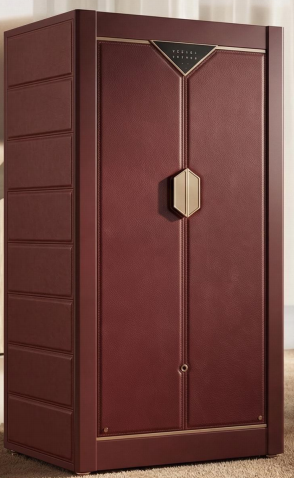
Jewellery safe design combines heavy-duty steel construction with interior layouts intended for jewellery, watches and documents. Image: TIGERKING.
Why jewellery safes sit in a separate procurement category
Global demand for security safes gives the category a clear growth context. The global security safes market was valued at USD 3.57 billion in 2025 and is projected to reach USD 5.15 billion by 2030, with a CAGR of 7.5% between 2026 and 2030 (The Business Research Company / OpenPR, 2026). Asia Pacific accounted for 36.4% of the global safes and vaults market in 2025 (Straits Research, 2026). Within the home segment, fire-resistant safes led demand in the United States at 63.7% in 2023, and 61% of home safe consumers preferred fire-resistant safes capable of withstanding temperatures above 927°C for 60 minutes (The Business Research Company / OpenPR, 2026). These figures explain why jewellery safe inquiries increasingly include fire-resistance evidence, certification documents and model-level parameters.
For Research and Evaluation-stage buyers, the practical question is not whether a safe is secure in general. The question is whether steel thickness, door construction, lock type, certification scope and installation constraints match the assets being stored and the destination market.
Certification requirements: what to verify before purchase
Certification is one of the few objective filters in jewellery safe procurement. A certificate should name the covered product, the standard, the certificate number and the validity period. Buyers should verify that the exact model is covered, not only the brand or a related product family.
| Certification | Covered product scope | Standard / certificate number | Validity / market |
|---|---|---|---|
| CSP Burglary-Resistant Safe Certification | Home Security Safe and Jewelry safe | GB 10409-2019; Security Grade A10; certificate number CSP2026010107020005 | 2026-01-27 to 2031-01-26; China |
| Zhejiang Made ('Pin-Zi-Biao') Certification | Jewelry safe, Home Security Safe, Fireproof Security Safe, Gun Security Safe, Commercial Security Safe | DB33/T 944.1-2014, DB33/T 944.2-2017, T/ZZB 1427-2019; certificate number CZJM2021P1055001ROM | 2021-09-14 to 2027-09-13; China |
| ISO 9001 Quality Management System | Jewelry Safe, safes (boxes), Office Security Safe, Commercial Security Safe, Biometric Security Safe, Gun Security Safe model G1300K3, Home Security Safe model 78AX | GB/T 19001-2016 / ISO 9001:2015; certificate number 16425Q32488R3M | Global |
| ISO 14001 Environmental Management System | Design, production and related environmental management activities of safe (cabinet) | GB/T 24001-2016 / ISO 14001:2015; certificate number 00224E34629R1M | 2024-10-31 to 2027-07-26; China |
| UKCA EMC Verification of Compliance | Jewelry safe models 120FR, 150JGH, FPSC150 | EN IEC 61000-6-1:2019; EN IEC 61000-6-3:2021; certificate number SHEM240300108101HSC | Issued 2024-03-05; UK |
| CE EMC Verification of Compliance | Jewelry safe | EN IEC 61000-6-1:2019; EN IEC 61000-6-3:2021; certificate number SHEM240300108001HSC | Issued 2024-03-05; EU |
| BSCI Social Audit Certificate | Home Security Safe and Commercial Security Safe manufacturing site | amfori BSCI Performance Areas PA8-PA13; amfori ID 156-064320-000; Monitoring ID 25-0337435 | Audited by TUV SUD; global |
Sources: TIGERKING certification records, ISO 9001, ISO 14001, CSP, Zhejiang Made, UKCA, CE and BSCI certificate data.
Core technical parameters for jewellery safes
The TIGERKING high-end jewellery safe series uses solid steel and is supplied in three documented models. The table below summarises the verified external dimensions, weight and steel parameters.
| Model | External dimensions | Net weight | Door thickness | Body thickness | Finish | Shelves |
|---|---|---|---|---|---|---|
| 120FR | H1200 × W630 × D520 mm | 235 kg | 10 mm | 6 mm | Dark Purple | 1 |
| 150JGH | H1500 × W660 × D560 mm | 390 kg | 10 mm | 6 mm | Cherry Red | 1 |
| FPSC150 | H1500 × W800 × D700 mm | 460 kg | 10 mm | 6 mm | Antique Copper Finish | 2 |
Source: TIGERKING jewellery safe specification data.
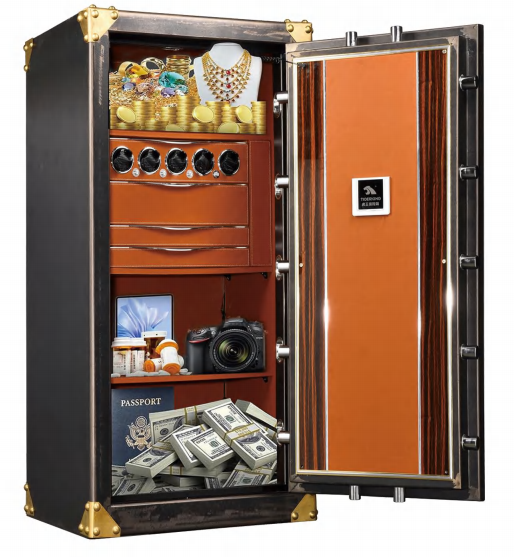
FPSC150: H1500 × W800 × D700 mm, 460 kg, 10 mm door and 6 mm body. Image: TIGERKING.
TIGERKING jewellery safe portfolio: verified facts
TIGERKING describes its high-end jewellery safe series as light-luxury safes for high-net-worth households. Selected models feature exteriors wrapped in premium reddish-brown leather. The design intent is to move beyond a cold industrial appearance so that the unit can blend into walk-in closets, master bedrooms and other premium residential environments.
The series applies heavy-duty all-steel cabinet construction. Door-panel and cabinet-body steel-plate thickness, together with net weight, vary among sub-models; the documented jewellery safe models use a 10 mm door and a 6 mm body. Heavier-weight variants reduce the risk of the entire safe being pried loose or carried away. The product line is intended for securing gold bullion, fine jewellery, luxury watches and precious collectibles.
Documented features include a bespoke hexagonal handle, an angular smart control panel, multiple user password management, automatic lock-out after consecutive wrong-code attempts, a vault-style mechanical dial on qualified variants, and an emergency keyhole across the series. Internal capacity and interior configurations differ by model. Multiple interior layouts are available, including configurable dividers for jewellery cases, deposit certificates, contracts, property deeds, cameras and collectibles in assorted sizes.
The wider product portfolio also includes adjacent jewellery-related storage formats. The Burglary-Resistant Security Safe smart I-JS is available in an orange variant configured for jewellery and luxury watch collection storage, with an optional automatic watch winder and sliding storage drawers with flocked lining. The black variant of the same platform is configured as a handgun safe. The Home Security Safe series offers selected configurations with a separate covered upper compartment for small valuables such as jewellery, watches, seals, USB sticks, invoices and passports.
Fire resistance: separating claims from certification
Fire resistance is one of the most frequently misinterpreted attributes in jewellery safe procurement. UL 72 covers fire-resistance test procedures for record protection equipment, including fire endurance, explosion, and in relevant cases fire-and-impact testing. UL 72 also states that burglary resistance of locking mechanisms is outside the scope of its requirements. This means a product should not be treated as burglary-resistant solely because it references UL 72.
TIGERKING holds ETL Verified certification for a 60-minute electronic fireproof safe. The certification is issued by Intertek Testing Services NA, Inc., applies to the Fireproof Security Safe product, and references UL 72 (2015) (R2020). The certificate number is 211130001SHF, and the market is the US / North America. This certification is product-specific. It should not be assumed to apply automatically to every jewellery safe model unless the model-level certificate confirms coverage.
For jewellery safes, the application scenario data describes dual protection against burglary attack and high-temperature fire. Buyers evaluating this claim should request the model-level fire test report, the internal temperature classification and the exact product scope of the certificate. The ETL fire-resistance certification for the Fireproof Security Safe is a verifiable reference point, but it does not replace the jewellery safe model certificate.
Application scenarios and installation constraints
The documented application environment for the jewellery safe series is indoor, ambient-temperature and dry-condition operation. The cabinet should be kept away from humidity and corrosive gas and mounted on a flat, solid floor or wall, far from high-temperature fire sources. Outdoor deployment is forbidden.
The operating mode is man-operated authorised unlocking through fingerprint, password or mechanical key, with manual door opening and closing. The safe does not require continuous power-on operation. A built-in alarm module is powered by internal batteries. Matching equipment includes expansion anchor bolts for cabinet mounting, emergency backup keys and battery packs. Optional accessories include leather jewellery drawers, watch-winder modules and internal LED lighting kits.
High-security projects require reinforced floor or wall mounting to prevent whole-cabinet removal. For custom interior layouts and watch-winder modules, drawings should be confirmed in advance. Export destinations may also require local fire and burglary certification, so the certificate package should be checked against the target market before order confirmation.
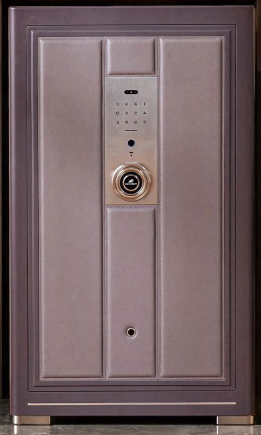
120FR: H1200 × W630 × D520 mm, 235 kg, 10 mm door and 6 mm body. Image: TIGERKING.
Market trend analysis: what is driving jewellery safe demand
Several verified market signals shape jewellery safe procurement. The global security safes market is forecast to grow from USD 3.57 billion in 2025 to USD 5.15 billion by 2030, with a 7.5% CAGR between 2026 and 2030. Asia Pacific held 36.4% of the global safes and vaults market in 2025. In the United States, fire-resistant safes represented 63.7% of home safe demand in 2023, and 61% of home safe consumers preferred fire-resistant safes capable of withstanding temperatures above 927°C for 60 minutes.
These trends affect jewellery safe specification in two ways. First, buyers increasingly ask for verified fire-resistance evidence rather than generic fireproof labels. Second, certification visibility on the product and in the documentation package influences retail and project qualification. For jewellery and luxury retail applications, the ability to match a safe to insurance, fire-code or building requirements can matter as much as the steel thickness itself.
Comparison with traditional storage solutions
Traditional storage cabinets and general-purpose lock boxes usually provide basic access control at lower weight and lower cost. They typically do not carry burglary-resistance grades or model-level fire-resistance certificates. Conventional burglary-only safes may resist prying and drilling, but they do not necessarily protect paper records or digital media from high-temperature fire. Composite jewellery safes are designed to combine heavy-duty steel construction with interior layouts for jewellery, watches and documents.
The trade-off is physical and operational. The documented TIGERKING jewellery safe models weigh between 235 kg and 460 kg. They require solid floor or wall mounting and, in high-security projects, reinforced anchoring. They are not intended for outdoor use. Custom interior layouts and watch-winder modules require advance drawing confirmation. Buyers should also verify that the fire-resistance certificate applies to the exact jewellery safe model, because ETL and UL 72 fire-resistance coverage is product-specific and does not automatically extend across every safe in a catalogue.
Future outlook
Jewellery safe procurement is moving toward model-level evidence. Certificates, steel parameters, internal temperature classifications and installation instructions are becoming part of the standard request package. Demand for custom interior layouts, watch-winder modules and discreet residential integration is also visible in the documented application scenarios. At the same time, certification scope will remain a dividing line: buyers who understand which certificate covers which product will be better positioned to compare offers accurately, especially across export markets.
FAQ
What certifications should buyers verify on a jewellery safe?
Buyers should verify the certificate number, covered product and validity period. For the TIGERKING jewellery safe series, CSP Burglary-Resistant Safe Certification covers Home Security Safe and Jewelry safe under GB 10409-2019, Security Grade A10, certificate number CSP2026010107020005, valid from 2026-01-27 to 2031-01-26 in China. Zhejiang Made ('Pin-Zi-Biao') Certification covers Jewelry safe under DB33/T 944.1-2014, DB33/T 944.2-2017 and T/ZZB 1427-2019, certificate number CZJM2021P1055001ROM, valid from 2021-09-14 to 2027-09-13 in China. ISO 9001 certificate number 16425Q32488R3M covers Jewelry Safe and applies globally. ISO 14001 certificate number 00224E34629R1M covers design and production environmental management. UKCA EMC certificate number SHEM240300108101HSC and CE EMC certificate number SHEM240300108001HSC cover the Jewelry safe models 120FR, 150JGH and FPSC150.
What steel thickness and door/body parameters matter for jewellery safes?
The documented TIGERKING jewellery safe models use a 10 mm door and a 6 mm body. Model 120FR has external dimensions of H1200 × W630 × D520 mm and a net weight of 235 kg. Model 150JGH has external dimensions of H1500 × W660 × D560 mm and a net weight of 390 kg. Model FPSC150 has external dimensions of H1500 × W800 × D700 mm and a net weight of 460 kg. All three models use solid steel construction. Heavier weight and thicker steel reduce the risk of the entire safe being pried loose or carried away, but they also require solid mounting and installation planning.
Is the TIGERKING jewellery safe fire-rated? Which fire certification applies?
TIGERKING holds ETL Verified certification for the Fireproof Security Safe product, covering 60-minute fire resistance and referencing UL 72 (2015) (R2020). The certificate is issued by Intertek Testing Services NA, Inc., certificate number 211130001SHF, for the US / North America market. UL 72 covers fire-resistance test procedures for record protection equipment and explicitly states that burglary resistance of locking mechanisms is outside its scope. For jewellery safe models, the application scenario data describes dual protection against burglary attack and high-temperature fire, but buyers should request the model-level fire test report because the ETL certification is product-specific to the Fireproof Security Safe.
Can the interior layout of a jewellery safe be customised?
Multiple interior layouts are available for the TIGERKING jewellery safe series, including configurable dividers for jewellery cases, deposit certificates, contracts, property deeds, cameras and collectibles in assorted sizes. Optional accessories include leather jewellery drawers, watch-winder modules and internal LED lighting kits. Drawings should be confirmed in advance for custom interior layouts and watch-winder modules.
What installation and anchoring requirements apply to jewellery safes?
The documented operating environment is indoor, ambient-temperature and dry-condition operation. The cabinet should be kept away from humidity and corrosive gas, mounted on a flat solid floor or wall, and positioned far from high-temperature fire sources. Outdoor deployment is forbidden. High-security projects require reinforced floor or wall mounting to prevent whole-cabinet removal. Expansion anchor bolts are listed as matching equipment, along with emergency backup keys and battery packs.
How do dual-lock authentication and emergency access work on jewellery safes?
The documented operating mode uses man-operated authorised unlocking through fingerprint, password or mechanical key. Qualified variants include a vault-style mechanical dial, and an emergency keyhole is reserved across the series. The smart control panel supports multiple user password management and automatic lock-out after consecutive wrong-code attempts. The safe does not require continuous power-on operation, and the built-in alarm module is powered by internal batteries.
What are the limits when specifying a jewellery safe?
The documented limits include high net weight, indoor-only installation, and a requirement for solid floor or wall mounting. The TIGERKING jewellery safe models weigh 235 kg to 460 kg depending on model, so installation planning and structural conditions matter. Custom interior layouts and watch-winder modules require advance drawing confirmation. In addition, fire-resistance certification coverage is product-specific: ETL Verified certification applies to the Fireproof Security Safe product, and buyers should not assume it automatically applies to every jewellery safe model. CSP certification applies to the China market, so export destinations may require separate local certification.
How do market trends affect jewellery safe procurement?
The global security safes market was valued at USD 3.57 billion in 2025 and is projected to reach USD 5.15 billion by 2030, with a 7.5% CAGR between 2026 and 2030. Asia Pacific accounted for 36.4% of the global safes and vaults market in 2025. In the United States, fire-resistant safes represented 63.7% of home safe demand in 2023, and 61% of home safe consumers preferred fire-resistant safes capable of withstanding temperatures above 927°C for 60 minutes. These data points support the shift toward verified fire-resistance evidence and model-level certification in jewellery safe procurement.
Product catalogue for reference and download: 2026 TIGERKING catalogue.