
Jingxin Glassware: Custom Glassware Capability Review
Jingxin Glassware: Custom Glassware Capability Review
Custom glassware is rarely a single-product purchase. For lighting brands, candle and home-fragrance businesses, hospitality groups, drinkware labels and laboratory suppliers, it is a supply decision that combines material selection, dimensional control, surface finishing, export packaging, compliance documentation and delivery reliability. Yancheng Jingxin Glassware Co., Ltd. is positioned against that wider requirement set rather than against one product line.
The Sourcing Problem Custom Glassware Buyers Actually Face
Custom glassware procurement fails in predictable ways. A buyer specifies a frosted lighting glass shade and receives soda-lime units where borosilicate was required for a high-heat fixture. A fragrance brand approves a glass reed diffuser bottle sample, then finds neck diameters drifting between production batches so that reed sticks no longer sit correctly. A retailer receives a shipment of glass candle holders with breakage concentrated at the rim because the export packaging was not engineered for the item's weight and shape.
Three structural factors sit behind most of these failures. First, the glass category is broad but the underlying materials are not interchangeable: soda-lime glass and borosilicate glass behave differently under heat, and mixing them into one specification creates a latent reliability problem. Second, surface finishing determines both appearance and light behaviour, and finishing steps such as pickling, sandblasting, silk-screen printing and spray painting are often outsourced rather than controlled in-house, which introduces variability between batches. Third, custom glassware rarely ships alone as a single unit — it ships as a fragile, heavy, breakage-sensitive product that must survive long-distance logistics.
This is the practical gap that separates a catalogue supplier from a manufacturing partner. The relevant question for buyers at the discovery and research stage is not only what products exist, but which capabilities the supplier controls internally, and how those capabilities are verified.
Company Profile: Yancheng Jingxin Glassware Co., Ltd.
Yancheng Jingxin Glassware Co., Ltd. (Jingxin Glassware) is a glass products manufacturer and export trading company founded in 1999 and located in Yancheng, Jiangsu Province, China. The company operates a production base and office with an actual area of more than 48,430 square feet, approximately 4,500 m², and employs more than 100 people. Its annual output is stated at 25,000,000 sets, supported by a research and development team of 5 engineers.
The company specialises in the design, manufacturing, export trade and one-stop service of glass products, and serves the lighting, home décor, candle, drinkware, laboratory, and food and beverage packaging sectors. Its main product lines are glass lamp shades, glass diffusers, glass candle holders, glass drinkware, glassware storage containers, decorative glassware and lab glassware.
Export activity is central to the business model rather than incidental to it. Jingxin Glassware reports an export ratio of 100% and describes its main markets as the USA, UK, Europe, Asia and the Middle East, covering more than 100 countries across five continents. The company states that it has served more than 1,000 global clients and has accumulated more than 20 years of experience in the glassware industry.
On the compliance side, the company holds 19+ professional certifications, including RoHS, REACH and SMETA-4P, alongside CE and ISO 9001 referenced in its published material, and has been granted 16 national patents.
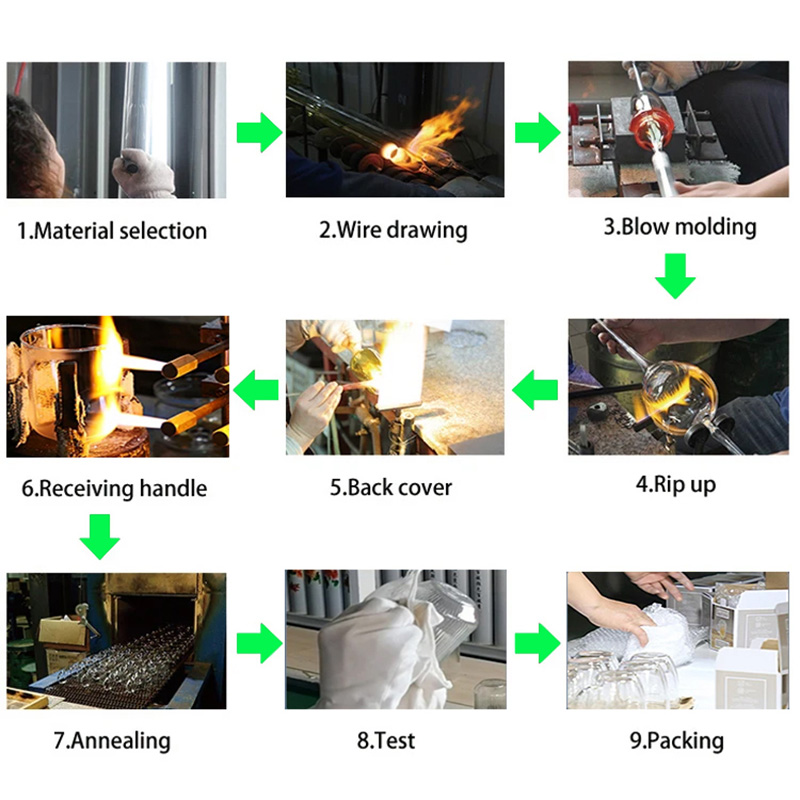
Glass manufacturing is a multi-stage process; controlling the stages internally is what stabilises repeat orders.
Core Competitiveness: What the Manufacturing Base Supports
Dual glass capability: soda-lime and borosilicate
The most consequential capability fact is that Jingxin Glassware maintains fully equipped production lines for both soda-lime and borosilicate glass. This matters because the two materials answer different questions. Soda-lime glass is the cost-effective choice for decorative lighting and ambient illumination, while borosilicate glass is the material selected where temperature variation, direct heat or chemical exposure is part of normal operation.
Because both material routes are available in-house, a buyer sourcing a mixed programme — for example, decorative glass candle cups alongside heat-resistant lighting components — can consolidate sourcing without forcing one material to do two jobs. The company states that this configuration supports flexible production scheduling and reliable supply for mid-to-high volume orders.
In-house surface finishing
Finishing is where custom glassware most often diverges from its approved sample. Jingxin Glassware's in-house surface-finishing capabilities include acid pickling, sandblasting, silk-screen printing, stamping, decalcomania and spray painting. Keeping these operations inside the same facility shortens the loop between forming and finishing and removes a common source of batch-to-batch inconsistency.
For buyers, the practical implication is that a single specification can combine several treatments — a frosted surface with a printed brand mark, or a translucent tinted finish with a fired decal — without the specification fragmenting across several vendors with separate tolerances.
Quality control and documentation
The company applies quality control from raw material through finished goods and performs 100% pre-shipment inspection, supplemented by third-party testing on request. Certification coverage including RoHS, REACH and SMETA-4P is directly relevant to buyers shipping into the European Union and the United Kingdom, where restricted-substance declarations and social-compliance documentation are routine requirements rather than optional extras.
Customisation and sample development
Jingxin Glassware provides OEM/ODM custom logos, packaging, graphics, sizes, colours and surface effects, supported by fast sample development with experienced technicians. Published timelines indicate sample lead times of roughly 5 to 7 working days after specification confirmation for many lines, with mass production typically in the range of 20 to 30 working days after sample approval. Sample lead times vary by product; the double-wall glass fragrance diffuser bottle, for example, is published at 15 to 20 days for sampling and 25 to 35 days for mass production.
Minimum order quantities are generally published in the range of 500 to 1,000 pieces and are described as negotiable for larger-volume or long-term programmes.
Technical Explanation: Matching Glass Type to Application
Material choice determines whether a glassware programme performs as specified. The two material families Jingxin Glassware produces behave measurably differently.
| Property | Soda-lime glass | Borosilicate glass (Type 3.3) |
|---|---|---|
| Composition basis | Silica-based, most common glass type | Silica and boron trioxide |
| Linear coefficient of thermal expansion | Approximately 9 × 10⁻⁶ / °C | Approximately 3.3 × 10⁻⁶ / °C |
| Practical thermal behaviour | Tolerates temperature differences up to roughly 40 °C; heat resistance up to around 120 °C in lighting use | Withstands rapid change from −40 °C to +260 °C in press-moulded industrial shades; up to 300 °C differential cited for laboratory use |
| Typical role | Decorative and ambient lighting, decorative home glassware | High-heat lighting, explosion-proof covers, signal glass, laboratory glassware |
Opal glass versus surface-frosted glass
Two products that look similar on a specification sheet can behave very differently over a service life. Opal glass is produced by adding opacifying agents into the glass batch itself, so light diffusion is distributed through the full thickness of the material and does not wear away. Surface-frosted glass achieves diffusion through a surface treatment, which is effective but is a surface property rather than a bulk one.
Products such as the JX1004 opal white glass globe lamp shade and the JX1184 blown glass lampshade with G9 thread use solid opal white bodies with uniform opacity and typical light transmission in the 45–65% range, producing glare-free ambient illumination with the light source hidden.
Hand-blown versus machine-pressed
Manufacturing method is a design decision, not a quality ranking. Hand-blown glass is individually crafted, carries natural bubbles and flow lines that read as authentic artisan character, and is typically specified for decorative and high-end design projects. Its dimensional tolerance is wider, generally stated at ±1–3 mm. Machine-pressed glass is formed in high-precision moulds with consistent dimensions and uniform wall thickness, cited at approximately ±0.5 mm, offering lower unit cost and higher batch-to-batch uniformity — the appropriate route for industrial, commercial or large-scale programmes requiring strict dimensional consistency.
This distinction is worth holding onto during procurement. Selecting hand-blown glass for a project that actually requires tight mechanical consistency, or machine-pressed glass for a design-led installation, produces friction that no amount of supplier management resolves.
Product Portfolio by Application
Lighting: glass lamp shades, lamp covers and light globes
The lighting range covers the main fitter systems used in residential and commercial fixtures. The JXHB-010 cylinder glass tube light shade is a mouth-blown borosilicate unit with a 100 mm diameter, 150 mm height, 42 mm fitter opening for standard E27 lamp holders and 3–4 mm wall thickness. Its milk-frosted surface delivers 45–65% uniform light transmission, with heat resistance up to 250 °C. The JX1004 opal white glass globe lamp shade offers a 150 mm globe with a 60 mm opening for E27 holders and 3.0–5.0 mm wall thickness, with anti-yellowing behaviour stated as permanent.
For higher-transmission applications, the JXHB-002 clear ribbed glass pendant shade uses a 200 mm clear soda-lime globe with a 100 mm fitter opening; its vertical fluted ribbing produces 85–95% light transmittance with decorative refracted patterns. The JX1407 borosilicate glass globe lamp shade is a hand-blown clear sphere at 150 mm diameter with a threaded bottom fitter, and the JX1184 blown glass lampshade with G9 thread is available across a 6–20 cm diameter range for G9 holders.
Where the operating environment is the constraint rather than the aesthetic, the range extends into industrial glass. The JX1830 explosion-proof borosilicate glass lamp shade is press-moulded at 118 mm diameter and 132 mm height with 6.0–10.0 mm wall thickness, rated IK10 for mechanical impact and tested for thermal shock from −40 °C to +260 °C. The JX1832 pressed borosilicate signal glass lamp shade uses a uniform 5 mm pressed wall with a stated continuous working range of −60 °C to +450 °C.
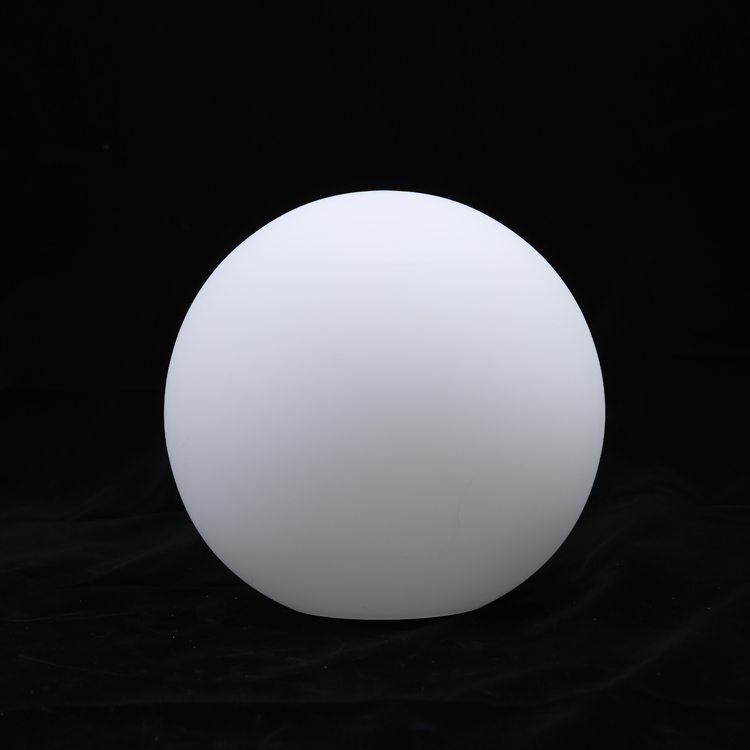
Opal white glass globes diffuse light through the full glass thickness rather than through a surface coating.
Candle, home fragrance and decorative glassware
The decorative and candle range covers glass candle holders, glass candle cups, glass reed diffuser bottles, glass domes, glass cloches, glass vases, glass oil lamps, glass terrariums, glass Christmas ornaments and glass storage jars.
The JX31850 painted double-wall borosilicate glass candle cup is built from borosilicate 3.3 glass at 95 mm outer diameter and 105 mm height, with a hollow double-wall air chamber separating inner and outer walls. Spray-painted translucent colour finishes are available across blue, green, orange, pink, purple, cyan and smoky brown. The JX3207 textured dot pattern glass candle holder is a press-moulded soda-lime cylinder at 9.5 cm diameter and 12 cm height with approximately 420 ml inner capacity and a hobnail embossed exterior.
In home fragrance, the JX1722 double wall glass fragrance diffuser bottle is offered in small (70 × 110 mm), middle (75 × 140 mm) and large (85 × 170 mm) formats in a gourd profile, supplied as an empty bottle with reed sticks optional. Decorative formats include the JX3211 clear glass dome with black round base at 100 mm diameter and 150 mm height, the JX3212 glass cloche with a solid spherical top knob at 100 mm diameter and 160 mm height, the JX3317 glass terrarium in a hand-blown borosilicate teardrop profile with a side access opening and top hanging loop, and the JX5107 borosilicate glass storage jar with bamboo lid at 500 ml capacity.
Drinkware and beverage service
The JXGC-005 double-wall insulated glass cup is a hand-blown 3.3 high-borosilicate tumbler in a curved egg-shaped profile, available in 150 ml, 250 ml and 350 ml capacities with 2.0–2.8 mm glass thickness. Its thermal resistance range is stated at −20 °C to 150 °C, it complies with REACH, LFGB and RoHS for food-contact use, and it supports bottom laser-engraved logos for private-label programmes.
Laboratory glassware
Laboratory lines are produced from 3.3 borosilicate glass and cover beakers, flasks, tubes and reagent bottles. The JX6109 borosilicate glass 3.3 laboratory beaker is offered across a capacity range from 5 ml to 10,000 ml with 2–5 mm wall thickness. The JX6102 high borosilicate handled glass beaker adds an integrated anti-scald handle in 100 ml, 250 ml, 500 ml and 1,000 ml sizes. The JX6207 borosilicate glass Erlenmeyer flask is supplied in 50 ml, 100 ml, 250 ml, 500 ml and 1,000 ml capacities with a conical body, narrow mouth and flat stable base. The JX6402 borosilicate glass round-bottom test tube is a 100 ml seamless round-bottom tube with uniform wall thickness, and the JX6703 glass graduated lab reagent bottle uses a 69 mm outer diameter, 105 mm height and GL45 threaded mouth with 1.5–3 mm hand-blown wall thickness.
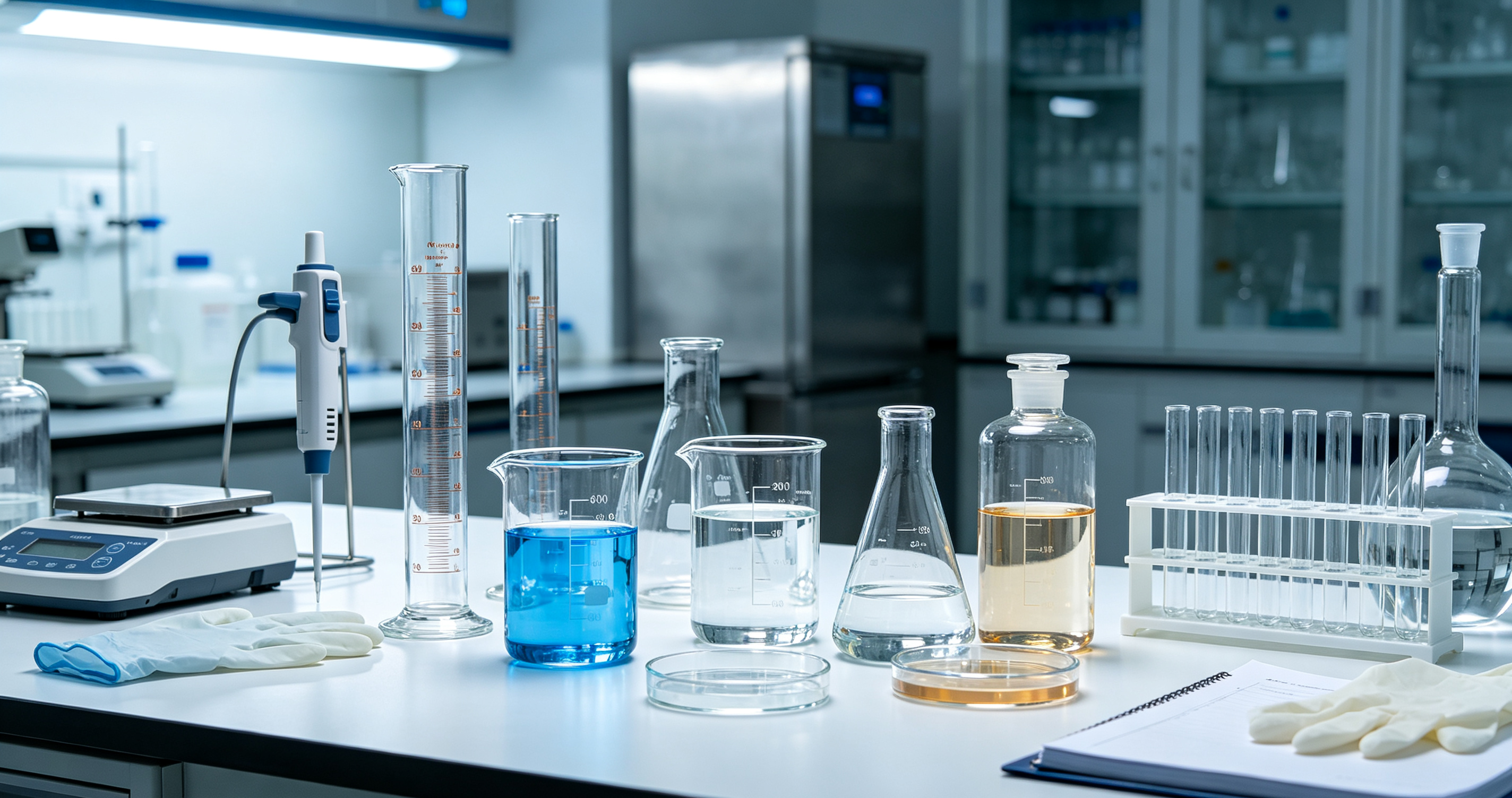
Laboratory lines use 3.3 borosilicate glass with graduated scales and autoclavable construction.
Application and Use Cases
The company's own project documentation describes several applications that illustrate how the capability set is applied in practice.
- Luxury retail lighting (2015). A French client required opal white glass globe lamp shades for permanent wall decoration at Galeries Lafayette in Paris. The specification called for uniform light diffusion, ultra-thick glass construction for a high-traffic retail environment, consistent opal colour across all units and anti-yellowing behaviour over an extended service life.
- Deep-sea aquaculture lighting (2018). A Chilean customer required ultra-thick transparent lamp shades for deep-sea fish farming, an environment combining high pressure, saltwater immersion and continuous 24/7 operation. The project required pressure resistance, sea-water resistance and optical clarity in a single component.
- Custom coloured beverage packaging. A large United States winery required solid cobalt blue glass bottles with colour integration through the glass body rather than surface coating, pressure-tested for carbonated and sparkling wine applications, with colour consistency maintained across large production runs.
- Event and wedding glassware. A customer in Estonia commissioned transparent glass candle cups in different sizes for wedding table centrepieces, requiring heat-resistant glass suitable for open-flame candle use with consistent quality across all units.
The pattern across these projects is consistent: the requirement was not a catalogue item but a component engineered against an operating environment — retail durability, saltwater pressure, internal bottle pressure, or open-flame exposure.
Comparison with Traditional Sourcing Options, and Where the Limits Are
Buyers evaluating Jingxin Glassware are usually choosing between it and two alternatives: standard catalogue glassware sourced through trading intermediaries, and plastic or acrylic components in decorative and lighting applications.
| Dimension | Catalogue / intermediary sourcing | Plastic or acrylic components | Jingxin Glassware (direct manufacturing) |
|---|---|---|---|
| Material control | Material often unspecified beyond colour and shape | Not applicable — polymer substrate | Specified soda-lime or borosilicate 3.3, with both production lines in-house |
| Optical durability | Varies by source | Plastic and acrylic alternatives can lose 20–30% of light output within 10 years and may yellow or haze | Glass does not yellow or haze; opal diffusion runs through the full body thickness |
| Thermal behaviour | Frequently undisclosed | Limited; unsuitable for high-heat fixtures | Borosilicate shades rated to 250 °C in lighting use and −40 °C to +260 °C in press-moulded industrial grades |
| Customisation | Restricted to available stock | Mould cost typically prohibitive at low volume | OEM/ODM on sizes, openings, wall thickness, colour, finishing and packaging |
| Documentation | Depends on the intermediary | Varies | 19+ certifications including RoHS, REACH and SMETA-4P; 100% pre-shipment inspection |
That comparison is not one-directional, and buyers should treat the following boundaries as design constraints rather than as defects.
- Hand-blown dimensional tolerance is wider than machine-pressed tolerance. Hand-blown glass is stated at ±1–3 mm, versus approximately ±0.5 mm for machine-pressed glass. Projects that depend on tight mechanical fit should specify pressed glass or accept that hand-blown units vary.
- Material limits are absolute. Soda-lime glass tolerates temperature differences up to roughly 40 °C and lighting use to about 120 °C. Specifying soda-lime for a high-heat fixture, direct-heat application or rapid temperature cycling is a specification error, not a supplier failure.
- Order economics favour volume. Minimum order quantities are typically published at 500 to 1,000 pieces. Genuine custom tooling and custom colour matching are most efficient at scale; very small bespoke runs are possible but terms are negotiated rather than standard.
- Lead times require planning. Typical sample lead times of 5–7 working days and mass production of 20–30 working days mean that a programme from brief to delivered goods will realistically span several weeks before international transit is added.
- Glass remains glass. Despite 100% pre-shipment inspection and reinforced export packaging, breakage in long-distance freight is not eliminated entirely; the appropriate mitigation is documented inspection on arrival and agreed after-sales handling terms.
Market Trend Analysis
Several demand drivers described in the company's market documentation align with broader, widely recognised shifts in the glassware and adjacent categories.
The substitution of glass for plastic in food contact, beverage service and decorative applications continues to be driven by consumer preferences for non-toxic, reusable and recyclable materials. Glass is 100% recyclable, and both soda-lime and borosilicate formats are produced lead-free across the Jingxin range.
In lighting, the durability argument is quantifiable at the component level. Plastic and acrylic shades tend to degrade optically, whereas glass maintains stable transmission over its service life. For hospitality and retail projects where fixtures are specified for years rather than seasons, this favours glass as the lower‑longevity‑cost option, even where the unit price is higher.
In food storage and kitchen organisation, the shift towards glass containers for pantry and dry-goods storage reflects the same material logic, supported by the popularity of stackable, visually uniform storage formats.
In laboratory and scientific supply, demand is tied to research and testing activity in pharmaceuticals, biotechnology, chemicals and environmental monitoring. The trend toward borosilicate glass over plastic in laboratory applications follows from chemical resistance, thermal stability and recyclability rather than from marketing preference.
Finally, in seasonal decoration, glass Christmas ornaments are increasingly treated as a premium option relative to plastic, with repeat purchasing behaviour attached to collectible, themed ornament collections. None of these trends make glass the correct answer everywhere; they indicate where material substitution is moving, and why buyers are increasingly specifying material rather than just shape.
Procurement Criteria Checklist
For buyers at the research stage, the following criteria translate the capability facts above into evaluation questions.
- Material specification. Is the required glass type stated explicitly as soda-lime or borosilicate 3.3, with the operating temperature range documented?
- Fitter and dimensional control. Is the fitter opening locked to the fixture standard (E27, E14, G9 or custom), and is the applicable tolerance consistent with the chosen manufacturing method?
- Optical requirement. Is the target transmission range clear — 45–65% for opal diffusion, 85–95% for clear ribbed transmission — and does the chosen finish match it?
- Finishing combination. Are all required surface treatments available from a single production route, avoiding split-supplier tolerance stack-up?
- Compliance documentation. Are RoHS, REACH and social-compliance documents available for the destination market, with third-party testing available on request?
- Sample validation. Is a pre-production sample approved and retained as the reference standard before mass production begins?
- Packaging and breakage terms. Is export packaging agreed in writing, and are after-sales handling terms for damage defined in advance?
- Programme timing. Do sample and mass-production lead times fit the launch window once international logistics is included?
Future Outlook
Read against the underlying demand shifts, Jingxin Glassware's position rests on a specific combination rather than on any single asset: dual soda-lime and borosilicate production capacity, in-house surface finishing across six named processes, an export-oriented operating model with a stated 100% export ratio, and a compliance base of 19+ certifications with 16 national patents.
The natural next questions for buyers are less about product breadth than about programme depth — whether custom engineering requests are handled through documented drawing review, whether material traceability is maintained across repeat orders, and whether supply continuity holds as order volumes scale. These are questions answered through sampling and pilot orders rather than through published specifications.
What can be assessed now is the shape of the capability: a manufacturer that has been in operation since 1999, sells almost entirely across borders, serves six end sectors from a single site, and produces across two distinct glass material families. For buyers whose specification spans decorative and technical glassware, that breadth is the meaningful starting point.
FAQ
1. What is borosilicate glass and why is it used for lighting and laboratory applications?
Borosilicate glass is a high-performance glass type made from silica and boron trioxide, known for extremely low thermal expansion and high resistance to heat and thermal shock. Compared with ordinary soda-lime glass, borosilicate glass — often referenced as Type 3.3 glass — has approximately one-third the thermal expansion coefficient and can withstand temperature differences up to about 300 °C without breaking. This is why it is specified for laboratory glassware, industrial lamp shades, high-heat lighting fixtures and medical devices. The added boron trioxide produces a more stable molecular structure that expands and contracts less during temperature change, preventing the thermal stress that cracks ordinary glass. Within the Jingxin Glassware range, borosilicate glass is used in products including JX1416, JX1407, JX1722, JX3211 and JX5107, and across the laboratory lines.
2. What is opal glass and how does it differ from surface-frosted glass in lighting use?
Opal glass is a milky-white glass created by adding opacifying agents, such as tin dioxide or phosphate compounds, to the glass batch during melting. Light diffusion occurs throughout the full thickness of the glass, so it does not fade, yellow or degrade over time. Surface-frosted glass achieves diffusion only on the surface layer and can wear or show fingerprints more readily. Both approaches reduce glare and hide the light source, but they carry different service-life characteristics. In the Jingxin range, opal glass appears in products such as the JX1004 opal white glass globe lamp shade, the JX1184 blown glass lampshade with G9 thread, and the JX1188 marble swirl glass globe lamp shade, with typical light transmission in the 45–65% range.
3. What is thermal shock resistance and why does it matter for glass products?
Thermal shock resistance is the ability of a material to withstand sudden temperature change without cracking. Thermal shock occurs when different parts of an object expand at different rates; when the resulting internal stress exceeds the material's strength, the object cracks or breaks. Resistance depends on three factors: a low coefficient of thermal expansion, high thermal conductivity, and high mechanical strength. Borosilicate glass, with a coefficient of thermal expansion of approximately 3.3 × 10⁻⁶ / °C, withstands rapid change from about −40 °C to +260 °C in press-moulded industrial grades. Soda-lime glass, at approximately 9 × 10⁻⁶ / °C, has limited thermal shock resistance, typically tolerating differentials up to about 40 °C. For lighting, thermal shock resistance becomes decisive when fixtures sit in environments with wide temperature variation or when bulbs generate significant heat.
4. How should a buyer choose between hand-blown and machine-pressed glass?
The choice depends on whether the project prioritises dimensional consistency or artisan character. Hand-blown glass is individually crafted, carries natural bubbles and flow lines, and has a stated dimensional tolerance of ±1–3 mm; it suits decorative and high-end design projects such as boutique hotels, designer lighting collections and art installations. Machine-pressed glass is manufactured in high-precision moulds with a stated dimensional accuracy of approximately ±0.5 mm, offering lower unit cost and higher batch-to-batch uniformity; it suits industrial, commercial and large-scale programmes requiring strict dimensional consistency. Because the tolerance ranges differ, the manufacturing method should be fixed before the fitter opening and fixture compatibility are finalised.
5. How can a glass lamp shade be installed without breaking it?
Installation is a sequence rather than a single action. Switch the fixture off and allow the glass to cool completely; verify that the fitter opening matches the lamp holder type, such as E27, E14 or G9; slide the shade gently onto the holder or mounting ring; secure it with the supplied ring, screws or locking mechanism; check that it is firmly seated and does not wobble; reinstall the bulb if removed; then switch the fixture on and confirm alignment. Handle the shade with clean, dry hands or gloves, never force a shade onto a holder, and inspect for cracks or chips before installation. Heavier glass shades require a fixture rated for the weight. A damaged shade should not be installed.
6. What is the correct way to clean glass lamp shades?
Turn the lamp off and let the shade cool to room temperature, then remove it carefully with both hands. Use warm water with mild dish soap, avoiding abrasive or alcohol-based cleaners, and wipe with a soft microfiber cloth or sponge rather than a scouring pad. Frosted and opal surfaces should be treated with gentle pressure only, since abrasives can damage the finish. Rinse with clean water and dry immediately with a lint-free cloth to prevent water spots. Never immerse glass shades in hot water, as thermal shock may cause cracking, and avoid ammonia or alcohol-based cleaners on painted, printed or decal finishes. Inspect for hidden cracks after cleaning before reinstalling.
Further reference. Product specifications, model numbers, dimensions and available finishes described in this review are drawn from the manufacturer's published product documentation. The full Yancheng Jingxin Glassware Co., Ltd. glass lamp shades catalogue is available for download: Glass Lamp Shades Catalogue — Yancheng Jingxin Glassware Co., Ltd.