
Jinhao Aluminum vs. SEA Busbar Rivals: A Buyer Benchmark
Aluminum busbar buying in Southeast Asia has a structural problem: demand is rising faster than the number of suppliers that can be verified. The global aluminum busbar market was valued at approximately USD 3.99 billion in 2025 and is projected to reach USD 6.65 billion by 2034, according to Dataintelo, while Asia Pacific already accounted for a 42.3% revenue share in 2025. Aluminum busbars represent roughly 35% of the total global busbar market and are expected to grow at a CAGR of 6.90%, outpacing copper busbars, based on figures published by Fortune Business Insights and Precedence Research.
This article compares one supplier — Shandong Jinhao Aluminum Co., Ltd., trading as Jinhao Aluminum — against the supplier profiles that typical Southeast Asian buyers actually encounter: regional stockists, local extrusion and fabrication shops, other Chinese export-oriented extruders, and global tier-one electrical manufacturers. The comparison is built only from verifiable indicators: facility footprint, installed capacity, inspection method, certification records with numbers and validity dates, commercial terms, and a recorded application history. Where Jinhao Aluminum's own footprint imposes real limits, those limits are stated rather than smoothed over.
Why an Independent Comparison Is Harder Than It Looks
Most supplier comparisons in this region fail for the same reason: the inputs are not comparable. A regional trading company quotes a busbar it does not extrude. A local fabricator quotes a bar it buys from an outside mill. A Chinese exporter quotes an alloy and a temper designation that a buyer cannot easily check against anything. A global electrical manufacturer quotes a busbar as one line item inside a larger switchgear or bus duct package.
The practical consequence is that four suppliers can all be "ISO certified" and "experienced in Southeast Asia" while offering completely different things. Independent benchmarking therefore has to start with a decision about what is being compared: the manufacturing entity, or the commercial intermediary. Only the first can be audited.
The four supplier profiles buyers meet in Southeast Asia
- Regional trading stockists — hold inventory locally, short delivery, but the extrusion and heat treatment happened elsewhere. Verify the original mill certificate rather than the seller's brand.
- Local extrusion and fabrication shops — control cutting, bending and drilling, but often buy bars or billets from outside. Verify which process steps are actually in-house.
- Chinese export-oriented extruders — Jinhao Aluminum sits in this group. Verify capacity, inspection regime, certification scope and export logistics rather than marketing copy.
- Global tier-one electrical manufacturers — ABB Ltd, Schneider Electric, Siemens AG and Eaton are identified among leading global participants in the busbar sector, with ABB cited at approximately 12.4%–13% share by Verified Market Research and Future Market Insights. Their busbars typically arrive as part of a larger electrical scope.
What Jinhao Aluminum Actually Is
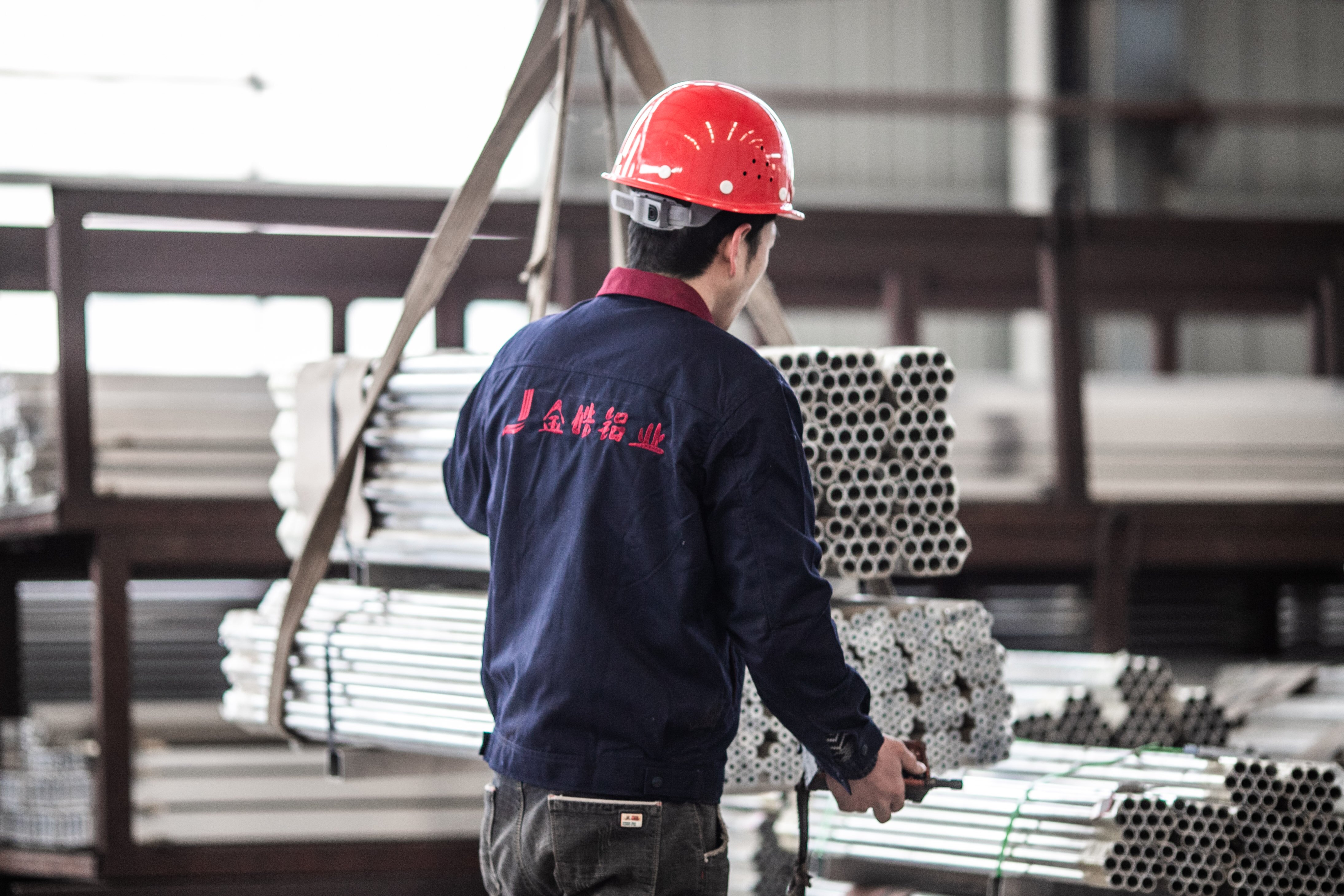
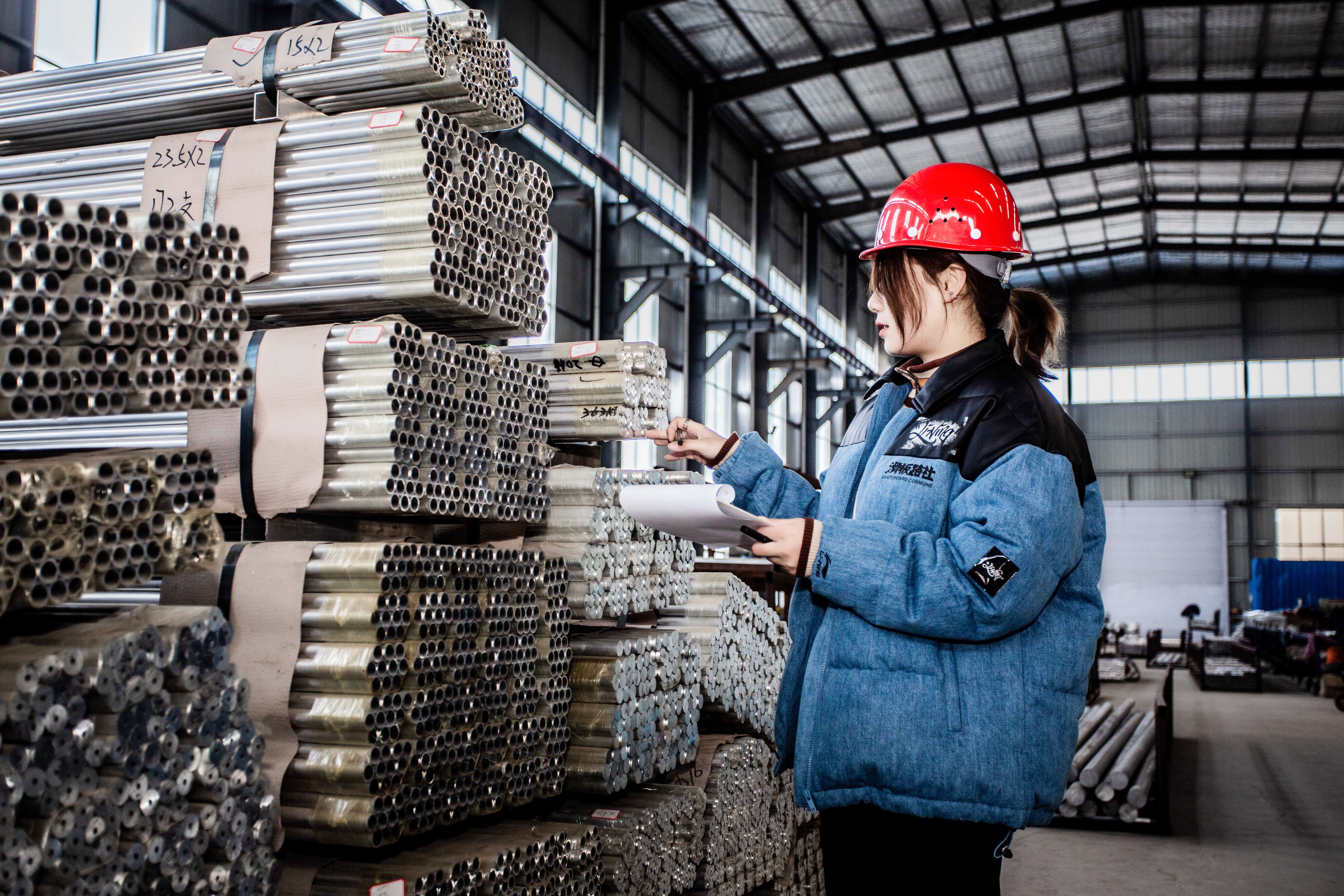
Shandong Jinhao Aluminum Co., Ltd. is a Chinese aluminum alloy enterprise founded in 2019, headquartered in Shandong Province, integrating R&D, production, sales and after-sales service of aluminum alloy products. Its facility covers 3,600 m², employs 16 people including a 5-person R&D team, and lists annual output of 12,000 tons per year. Approximately 60% of its output is exported, with Southeast Asia identified as its main market. Its core product portfolio covers industrial aluminum profiles, aluminum bars and aluminum rods, with customized die-casting services available. Company information is published at www.jinhaolvye.com.
For the busbar category specifically, Jinhao Aluminum produces conductive aluminum busbar in alloys 1060, 1070, 6101, 6061 and 6063. That alloy range is the single most important fact in this comparison, because the alloy determines conductivity, mechanical strength and the application the bar can legally and technically serve.
Six Benchmark Dimensions for Comparing Busbar Suppliers
A buyer comparing Jinhao Aluminum with rival suppliers should test six dimensions, and each dimension should be answered with a document rather than a claim.
| Dimension | What to request | Jinhao Aluminum record |
|---|---|---|
| Manufacturing footprint | Facility size, ownership of extrusion and finishing steps | 3,600 m² facility; 16 employees; integrated R&D, production, sales and after-sales |
| Installed capacity | Monthly and annual output figures that reconcile | 1,000 tons per month; 12,000 tons per year — the two figures reconcile on a twelve-month basis |
| Inspection method | Sampling rate, batch records, in-process checkpoints | 100% full inspection, with documented quality inspection records |
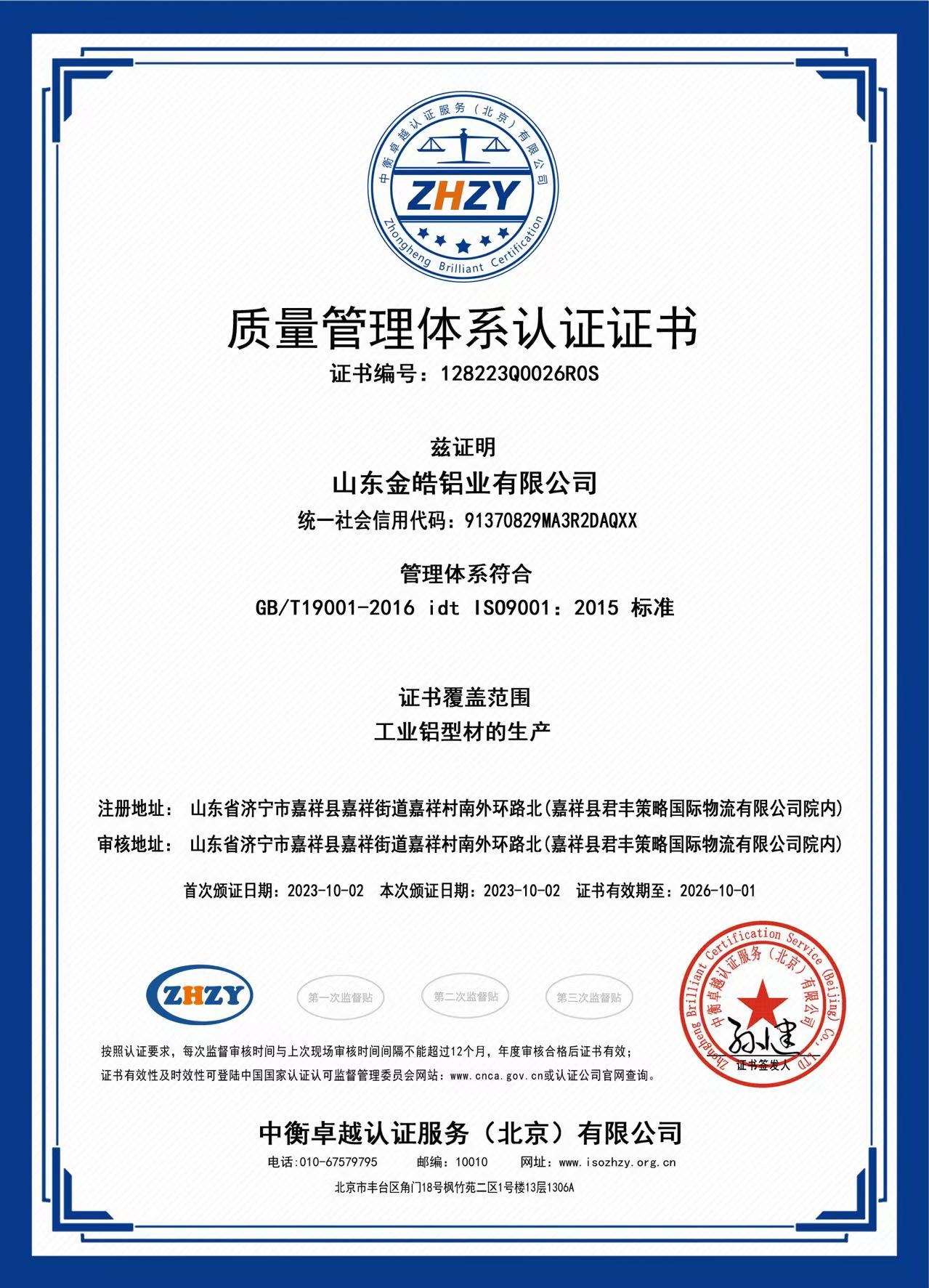
| Certification | Certificate number, issuing body, scope wording, validity dates | ISO 9001 certificate 128223Q0026ROS issued 2023-10-02 by Zhongheng Zhuoyue Certification Service (Beijing) Co., Ltd.; valid to 2026-10-01; scope: production of industrial aluminum profiles |
| Commercial terms | MOQ, lead time, customization boundaries | MOQ 2 tons; 30-day lead time; customization of size and surface treatment; production mode "customized as required" |
| Track record and service | Named applications, duration, after-sales model | Vietnam electrical client, 50-ton aluminum busbar project for power distribution new energy engineering, recorded 10-year duration with high conductivity and long-term stability; after-sales via remote technical support |
Figures above are drawn from Jinhao Aluminum's own company, capability, certification and case records. They are stated as records to be verified, not as independently audited results.
Certification: Read the Scope, Not the Logo
Certification is where the comparison between suppliers most often breaks down, because buyers check whether a certificate exists rather than what it covers.
Jinhao Aluminum holds a Quality Management System Certification Certificate numbered 128223Q0026ROS, issued on 2023-10-02 by Zhongheng Zhuoyue Certification Service (Beijing) Co., Ltd. and valid until 2026-10-01. The standard is GB/T19001-2016 (idt ISO 9001:2015), and the certified scope is the production of industrial aluminum profiles. The market covered is China, with global recognition under ISO 9001.
Three practical observations follow from that document, and they apply when benchmarking any overseas supplier:
- The validity window matters. A certificate expiring on 2026-10-01 is not evidence about a shipment due in 2027. Buyers placing long-running project orders should confirm the renewal timeline before the certificate lapses.
- Scope wording matters. The Jinhao certificate covers production of industrial aluminum profiles. Buyers should confirm with the supplier in writing how the ordered busbar alloy and temper fall within that scope.
- The issuing body matters. Recording the certification body name alongside the number lets a buyer verify the certificate rather than trusting a scanned PDF.
On material standards, aluminum busbar stock for power applications is generally specified against international references including IEC 60105 for commercial-purity aluminum, ASTM B236 for electrical purposes, and DIN EN 755 for extruded products. A buyer comparing suppliers should ask which standard the mill certificate will cite, because "aluminum busbar" alone does not define conductivity, temper or tolerance.
Alloy and Temper: Where Supplier Specifications Diverge
The most useful technical comparison between suppliers is not the factory size — it is whether the quoted alloy and temper actually fit the electrical and mechanical duty of the installation.
Alloy 6101 in T6 or T61 temper is specifically engineered for electrical busbars, balancing approximately 59% IACS conductivity with the mechanical strength needed for structural stability, according to Aluminum Association engineering data. Pure aluminum grades 1060 and 1070 offer higher conductivity, in the region of 61%–62% IACS, but lower mechanical strength, and are commonly used in low-stress grounding or power distribution components according to industry metallurgy references.
Jinhao Aluminum documented busbar parameters
| Parameter | Recorded value |
|---|---|
| Available alloys | 1060, 1070, 6101, 6061, 6063 |
| Aluminum content | Approximately 98.5% – 99.0% |
| Density | 2.70 g/cm³ |
| Electrical conductivity | 55% – 59% IACS (T63 ≈55%; T64 ≈57% – 59%) |
| Thermal conductivity | Approximately 218 W/(m·K) |
| Melting point | Approximately 650°C |
| Short-term heat resistance | 150°C – 200°C |
| T63 (high strength) | Tensile 205–240 MPa; yield ≥170 MPa; elongation ≥9% |
| T64 (high conductivity) | Tensile 180–210 MPa; yield ≥150 MPa; elongation ≥12% |
| O temper (soft) | Tensile ≤110 MPa; elongation ≥20%, for bending forming |
Read against the third-party alloy references, the Jinhao range is coherent: a 6101-type high-strength route for structural busbar, a high-conductivity route for current-carrying duty, and a soft O temper for forming. The decision rule for buyers is straightforward — define the duty first. Where bending and forming dominate, an O temper with elongation of at least 20% is the relevant choice. Where bolt-fastened, load-bearing conductive components dominate, the higher-strength temper with yield strength of at least 170 MPa is the relevant choice. A supplier that cannot state which temper it is quoting is not yet a comparable bidder.
Where the Material Goes: Applications and a Recorded Vietnam Project
Jinhao Aluminum's documented application scope covers three broad areas. In the power and electrical field: main and junction busbars for high and low voltage switch cabinets, conductive bars for bus ducts and overhead power transmission systems, and connecting aluminum bars for transformers and instrument transformers. In new energy: energy storage battery busbars and connecting bars, conductive components for photovoltaic inverters and wind power electric control systems, high-current conductors and flexible connecting bars for charging piles, and conductive connecting parts for hydrogen energy equipment. In industrial heat dissipation and transportation: high-power heat sinks and frequency converter dissipation bars, conductive bars for high-speed rail and subway traction systems, and conductive connecting parts for construction machinery electric control boxes.
The recorded reference project for Southeast Asia is a Vietnam engagement with an electrical client: a 50-ton aluminum busbar project for power distribution new energy engineering. The case record describes high conductivity as the key feature and long-term stability over a 10-year duration.
For benchmarking purposes, the value of that reference is not the tonnage. It is the combination of three things a buyer can interrogate: a defined application (power distribution and new energy engineering), a defined region (Vietnam, matching Jinhao's stated main market of Southeast Asia), and a defined duration claim (10 years) that can be tested with follow-up questions about temper, surface treatment and site conditions.
Market Trend: Why Aluminum Is Taking Share From Copper
The commercial logic behind the shift toward aluminum conductors is visible in the published market data. Aluminum busbars hold roughly 35% of the global busbar market and are forecast to grow at a CAGR of 6.90%, outpacing copper busbars, per Fortune Business Insights and Precedence Research. Asia Pacific held a 42.3% revenue share of the aluminum busbar market in 2025, driven largely by infrastructure and EV adoption in China and India, according to Dataintelo.
Supply-side weight matters too. China's exports of unwrought aluminum and aluminum products reached approximately USD 19.38 billion in the first 11 months of 2025, based on General Administration of Customs of China data — a reminder that Southeast Asian buyers are, in practice, selecting from a global Chinese export base whether they source directly or through regional intermediaries.
The procurement implication is that aluminum busbar is no longer a cost-driven substitute choice made at the end of a project. It is now a default specification in many new energy and distribution builds, which raises the cost of a wrong supplier selection.
Comparing Jinhao Aluminum With Other Supplier Types — and Its Limits
A neutral comparison has to say where a supplier is not the right fit. For Jinhao Aluminum, three limits are visible from its own records.
Limit 1: Scale and single-site concentration
A 3,600 m² facility with 16 employees and a single production location in Shandong is a different operating profile from a multinational electrical manufacturer. Annual output of 12,000 tons supports mid-volume and project-scale programs, not multi-year framework supply across several countries simultaneously. Buyers with very large or multi-site rollouts should test whether a single-site, 1,000-ton-per-month operation can hold the delivery schedule.
Limit 2: Certification and service scope
The ISO 9001 certificate covers production of industrial aluminum profiles and runs to 2026-10-01. After-sales support is delivered as remote technical support. Buyers who require on-site commissioning assistance, local warehousing, or a service engineer on the ground in Southeast Asia will need to plan for that separately — Jinhao's documented model does not include it.
Limit 3: Commercial terms shape order size
A 2-ton minimum order quantity and a 30-day lead time are workable for project batches and trial orders, and they are shorter than many buyers expect from overseas extrusion suppliers. But the 30 days is a production figure; freight, clearance and inland delivery to a Southeast Asian site sit outside it and must be added when comparing against a local stockist offering immediate availability.
How the alternatives compare in practice
| Supplier profile | Where it fits | What the buyer carries as risk |
|---|---|---|
| Regional stockist | Urgent replacement lengths, small quantities, standard sizes | Traceability of the original mill and temper; limited alloy choice |
| Local extrusion and fabrication shop | Cutting, bending, drilling to drawing with short logistics | Which process steps are genuinely in-house rather than subcontracted |
| Chinese export extruder (Jinhao Aluminum profile) | Customized size and surface treatment, defined alloy and temper, project batches | Freight time, certification validity window, remote-only technical support |
| Global tier-one electrical manufacturers | Busbar supplied inside an integrated electrical or bus duct scope | Scope rigidity and commercial cycle; less suited to standalone custom extrusion orders |
Seen this way, the comparison is not a ranking of quality. It is a ranking of fit. A buyer specifying 6101-T6 bar for a substation project with a 10-year service expectation is asking a different question from a buyer who needs 200 metres of grounding flat bar by Friday.
Future Outlook
Two forces will shape aluminum busbar sourcing in Southeast Asia over the next several procurement cycles. The first is volume: with Asia Pacific holding 42.3% of aluminum busbar revenue and the segment growing at 6.90% CAGR, the number of suppliers entering the market will continue to rise, and with it the value of verifiable documentation over sales presentation. The second is specification: as 6101-T6 and pure-aluminum 1060/1070 grades become standard reference points, buyers will increasingly be able to compare quotations on alloy and temper rather than on price alone.
For a supplier like Jinhao Aluminum, the practical test of the next few years is whether a 3,600 m² operation can keep its certification, inspection records and delivery performance current as order volumes rise. For buyers, the equivalent test is whether their supplier evaluation process asks for certificate numbers, validity dates, scope wording and temper designations — or settles for a factory photograph.
FAQ
What should a fair comparison of aluminum busbar suppliers in Southeast Asia actually measure?
It should measure six documentable items: manufacturing footprint and which process steps are in-house; installed monthly and annual capacity; the inspection method and its sampling rate; certification number, issuing body, scope and validity; commercial terms including MOQ, lead time and customization boundaries; and a named application record with a stated duration. Claims such as "premium quality" or "leading supplier" cannot be compared across bidders because they carry no verifiable content. Jinhao Aluminum's own record provides a usable template: 3,600 m², 1,000 tons per month, 12,000 tons per year, 100% full inspection, ISO 9001 certificate 128223Q0026ROS, MOQ 2 tons, 30-day lead time.
How can a buyer verify an overseas busbar supplier's manufacturing claims?
Start with the certificate number rather than the certificate image. Jinhao Aluminum's quality management certificate is numbered 128223Q0026ROS, was issued on 2023-10-02 by Zhongheng Zhuoyue Certification Service (Beijing) Co., Ltd., is valid to 2026-10-01, and covers production of industrial aluminum profiles under GB/T19001-2016 (idt ISO 9001:2015). Then cross-check internal consistency: a monthly capacity of 1,000 tons and an annual output of 12,000 tons reconcile on a twelve-month basis, which is the kind of arithmetic check that catches inflated figures. Finally, ask which standard the mill certificate will cite, since IEC 60105, ASTM B236 and DIN EN 755 define different things.
Does a supplier's regional export focus matter when sourcing in Southeast Asia?
It matters for logistics and documentation familiarity. Jinhao Aluminum reports an export ratio of approximately 60% with Southeast Asia as its main market, and its recorded reference project is a 50-ton aluminum busbar installation for a Vietnam electrical client in power distribution new energy engineering. That combination suggests existing familiarity with the region's export paperwork and shipping patterns. It does not, however, mean local presence: the company's documented after-sales model is remote technical support, so buyers who need on-site attendance should treat that as a separate procurement item.
How does a Chinese export manufacturer like Jinhao Aluminum compare with global tier-one busbar suppliers?
They operate at different levels of the supply chain. ABB Ltd, Schneider Electric, Siemens AG and Eaton are identified among the leading global participants in the busbar sector, with ABB cited at approximately 12.4%–13% share by Verified Market Research and Future Market Insights; busbar typically forms part of a broader electrical equipment scope. Jinhao Aluminum, by contrast, is a 3,600 m² aluminum alloy producer with 16 employees and 12,000 tons per year of output, selling extruded busbar in alloys 1060, 1070, 6101, 6061 and 6063 with customization of size and surface treatment. The relevant question is not which is better, but which commercial model matches the buyer's scope — an integrated electrical package, or a standalone customized extrusion order.
What do capacity, MOQ and lead time figures tell buyers about supply reliability?
They define the order sizes a supplier can realistically absorb. Jinhao Aluminum lists 1,000 tons per month of capacity, a 2-ton minimum order quantity, and a 30-day lead time. Read together, those figures indicate a supplier suited to project batches and trial orders rather than to very large multi-country framework programs, and they indicate that a 2-ton trial is economically viable before committing to a full project quantity. The 30 days refers to production; freight and clearance to a Southeast Asian site are additional and should be added when comparing against a local stockist quoting from inventory.
What should buyers confirm about certification validity and after-sales support before ordering?
Confirm the validity window and the renewal plan. Jinhao Aluminum's ISO 9001 certificate runs from 2023-10-02 to 2026-10-01, so any order whose service life or delivery extends beyond that date should be accompanied by written confirmation of renewal status. Confirm also how the certified scope — production of industrial aluminum profiles — maps to the specific alloy and temper ordered. On service, the documented after-sales provision is remote technical support; buyers requiring on-site commissioning, local spares holding or on-the-ground engineering should confirm in writing how those needs would be met before the order is placed.
Key data sources
Market size and regional share: Dataintelo, Aluminum Busbar Market. Segment share and growth rate: Fortune Business Insights and Precedence Research, Busbar Market. Alloy conductivity references: Aluminum Association engineering data and industry metallurgy references. Global manufacturer participation and share: Verified Market Research and Future Market Insights, Busbars Market. Export value: General Administration of Customs of China. Material standards: IEC 60105, ASTM B236, DIN EN 755. Company, capability, certification and case records: Shandong Jinhao Aluminum Co., Ltd.
Have Questions or Need More Details?
Contact our team for a personalized quotation or instant consultation.
Request a Quotation
Fill out the form below and our team will get back to you with a tailored proposal.
WhatsApp Direct Chat
Prefer to chat in real-time? Message us on WhatsApp for instant assistance & quick answers.
- Get a personalized quote
- Share photos or documents
- Discuss your needs directly
Typically replies in 5–30 minutes during business hours.