
Judging AI Vision Inspection Suppliers for the Long Run
An AI vision inspection system is bought once and then expected to hold its accuracy for the entire life of a packaging line — usually far longer than the sales relationship that produced it. That gap between a short procurement cycle and a long operating horizon is why supplier sustainability has become an evaluation criterion in its own right for AI Vision Inspection Equipment, rather than a courtesy question asked at the end of a negotiation.
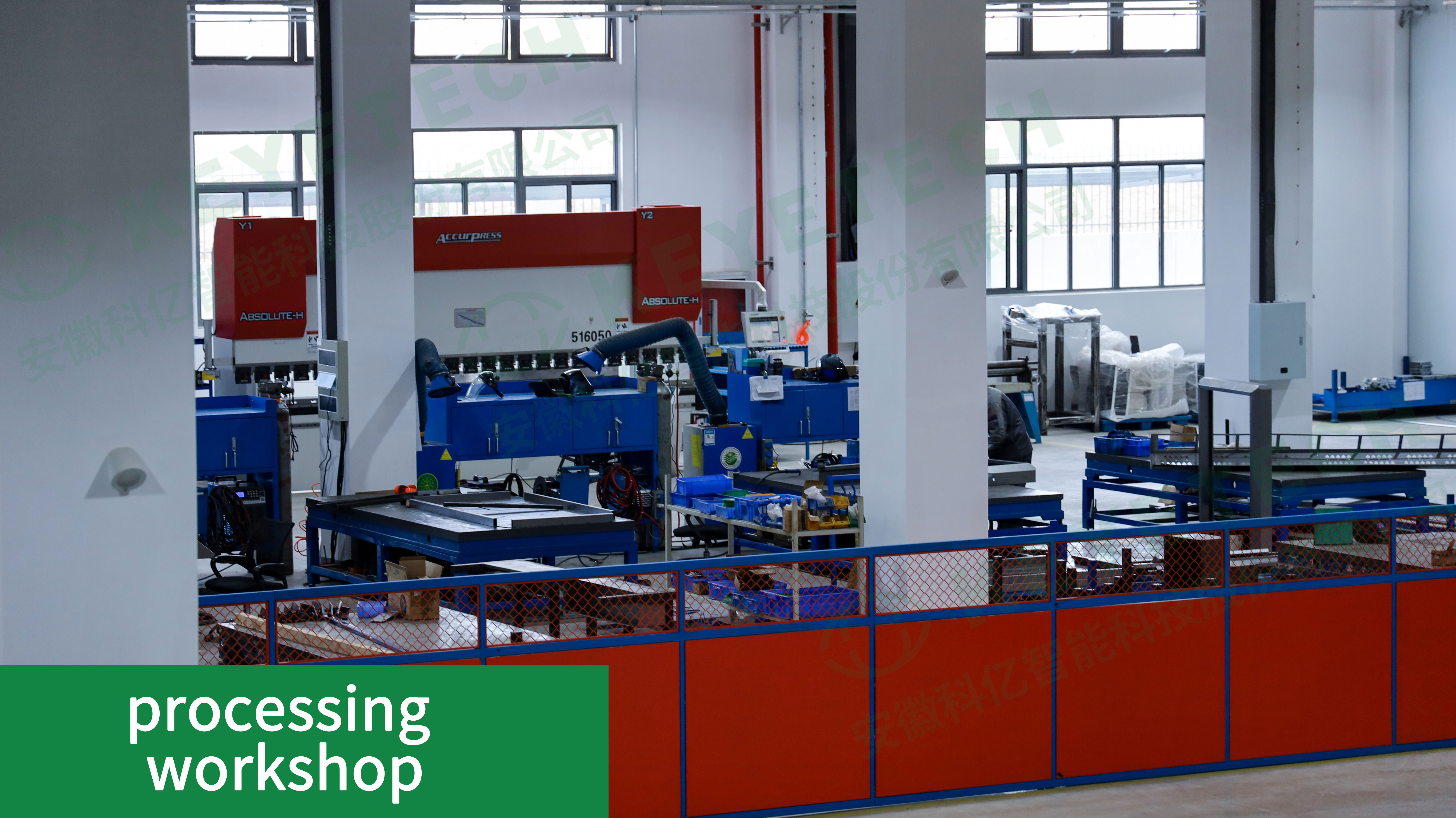
Manufacturing depth is one of the few supplier attributes a buyer can verify before a purchase order — and one of the few that predicts behaviour after installation.
The category is expanding quickly. Precedence Research estimates the global AI vision inspection market at USD 39.38 billion in 2026, with a projected compound annual growth rate of 22.83% between 2026 and 2035. Growth at that scale attracts new manufacturers every year, which makes screening harder rather than easier: more suppliers look credible on a specification sheet, and fewer of them can be verified on the variables that decide whether the machine still performs in year five.
Supplier sustainability is an operating constraint, not a purchase-phase courtesy
In this category, the machine is the smaller half of the relationship. An inspection system ships with a defect library that reflects the samples available at commissioning. Over the following years, packaging formats change, resin batches change, print artwork changes, and defect classes appear that were not in the original specification. Each of those changes requires someone to retrain or extend the model, re-validate the optical configuration, and keep the control software supported on a current platform.
A supplier that cannot run that loop turns a working inspection station into a fixed-function camera within a few seasons. That is an operational risk, not a commercial one, and it rarely appears in a quote comparison.
Pricing behaviour reinforces the same point. Public price lists are not the norm in this category; quotations vary with the number of inspection stations, camera count, defect library scope, acceptance protocol and service terms. Two quotes for a bottle visual inspection machine can therefore describe different amounts of equipment and different acceptance criteria. Normalising scope before comparing commercial terms belongs inside the sustainability assessment, because the under-scoped system is usually the first item renegotiated after installation.
Definition: what long-term supplier sustainability means in AI vision inspection
Supplier sustainability in AI vision inspection refers to a manufacturer’s capacity to keep an installed system performing to its original specification over the multi-year life of a production line — through model retraining, defect-class extension, spare-part availability, software maintenance and documented compliance. It is an engineering and organisational property of the supplier, and it is assessed separately from machine speed or unit price.
The definition is deliberately narrow. It does not ask whether a supplier is large, or whether its equipment is the fastest on the market. It asks whether the engineering organisation that built the machine will still be able to modify it when the buyer’s packaging changes.
A five-dimension evaluation framework
The framework below converts that definition into evidence a procurement team can request during the research and evaluation stages. Each dimension is paired with a document or statement that a supplier should be able to produce without preparation.
| Dimension | What it tests | Evidence a buyer can request |
|---|---|---|
| 1. Corporate continuity | Whether the manufacturer will still exist and still build this product family | Founding year, facility ownership and size, headcount, annual output, product-line history |
| 2. Engineering depth | Whether models can be retrained and extended as defect classes change | Scope of in-house development, algorithm team composition, R&D headcount, stated R&D investment trend |
| 3. Delivery and commercial commitments | Whether supply can be scheduled, repeated and expanded | Monthly capacity, quoted lead time, minimum order quantity, quality-control regime, customisation options |
| 4. Compliance evidence | Whether the machine can legally be placed on the target market | Certificate number, issuing body, standards cited, certified scope, market coverage |
| 5. Installed base and support model | Whether the supplier has operated this equipment long enough to know its failure modes | Named references, duration of relationships, unit counts, service model, export footprint |
The dimensions are ordered by how cheaply they can be verified, not by importance. A buyer can establish dimensions 1, 3 and 4 from documents in a single exchange; dimensions 2 and 5 usually require a technical conversation and a reference check.
Dimension 1 — Corporate continuity and production record
Anhui Keye Intelligent Technology Co., Ltd. (KEYETECH) is an AI vision inspection equipment manufacturer based at No. 56 Chang’an Road, High-Tech Zone, Hefei, Anhui, China. The company was established in 2011 and reports 15 years of visual inspection experience. Its production site is a self-built facility of 29,000 m² with approximately 300 employees and an annual output of 3,000 units.
For a buyer, the useful part of that record is not the age itself but what age implies. A manufacturer that has been building the same product family since 2011 has accumulated failure modes, spare-part history and a service record that a newer entrant cannot synthesise. Facility ownership matters for a different reason: a self-built plant is a fixed asset that constrains how quickly a supplier can exit a product line, which is a crude but real proxy for continuity.
The questions to ask are specific. How long has this exact product family been in production? Is the assembly site owned or leased? What share of annual output is allocated to export orders? Vague answers to any of the three are a signal to slow down.
Dimension 2 — Engineering depth: who maintains the model
In an AI inspection system, the algorithm is the asset that depreciates fastest and costs the most to renew. A supplier that licenses its algorithms, or buys cameras and writes only the application layer, cannot shorten the retraining loop when a new defect class appears — every change waits on an external release cycle.
KEYETECH states that its core technologies are led by a doctoral team from the University of Science and Technology of China (USTC), with three PhDs from the university’s Pattern Recognition Laboratory covering imaging systems, AI algorithms and software control. Its R&D team is listed at 56 engineers. The company reports that optical solutions, industrial cameras, AI algorithms and software architecture are all developed in-house, that its core technology chain is 100% localised, and that annual R&D investment continues to increase.
Two hardware details support the same claim. The company builds its own edge computing unit, which provides inference capacity at the machine rather than in an external server room, and it operates its own servers hosting AI algorithm models used across inspection tasks. For a buyer, the practical translation is that a defect-library change, a lighting change or a throughput re-tuning can be handled inside one engineering organisation instead of across a supply chain.
Dimension 3 — Delivery, capacity and commercial commitments
Delivery terms are the cheapest available evidence of whether a supplier can support a multi-year programme. KEYETECH lists a monthly capacity of 100 units, a quoted lead time of 45–60 days, a minimum order quantity of 1 unit, and 100% testing before shipment. OEM/ODM cooperation and logo customisation are offered, with export markets covering the EU, the US, the Middle East and Southeast Asia.
Read together, those figures describe a supplier configured for both single-machine orders and repeat programmes. A minimum order quantity of one unit lowers the entry barrier for a first installation or a pilot line; a monthly capacity of 100 units indicates that a follow-on order for additional lines does not require a new production slot to be created from scratch. The 45–60 day lead time should be treated as a standard quoted figure rather than a contractual guarantee during peak demand, and it is worth asking how capacity is allocated when order books tighten.
Customisation deserves a caution of its own. Branding and configuration changes are common in this category, but they also create long-term dependency: a custom station layout or a bespoke defect library is maintained by the supplier that created it. Buyers should confirm in writing how customised elements are documented, so that a future engineer — inside the supplier or elsewhere — can service the machine.
Dimension 4 — Compliance evidence: read the certificate, not the badge
Compliance is the dimension most often reduced to a logo on a brochure. In practice, a certificate is only useful to a buyer if five fields can be read from it: the certificate type, the certificate number, the issuing body, the standards cited, and the certified scope.
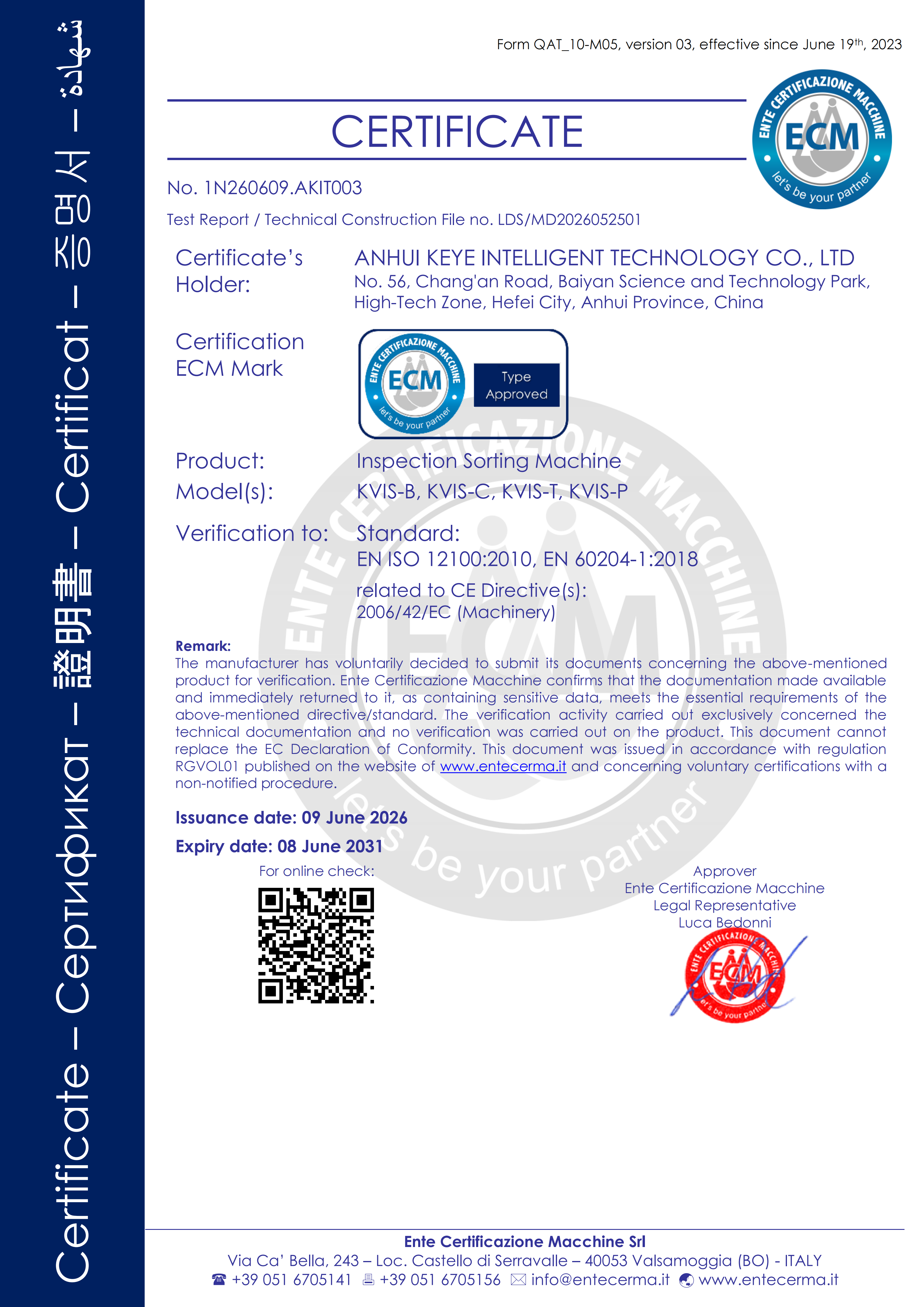
Certificate documentation is verifiable evidence. The certified scope, not the badge, determines whether a specific model is covered.
| Field | Recorded value |
|---|---|
| Certificate type | CE |
| Certificate number | No. 1N260609.AKIT003 |
| Issuing body | Ente Certificazione Macchine Srl |
| Standards cited | EN ISO 12100:2010; EN 60204-1:2018 |
| Certified scope | Inspection Sorting Machine |
| Markets referenced | EU / US / Middle East |
The two standards cited address different risks. EN ISO 12100:2010 deals with machinery risk assessment and risk reduction; EN 60204-1:2018 deals with the electrical equipment of machines. A certificate citing both therefore covers machine-safety design logic and electrical safety, which is the combination most packaging plants are asked to evidence during an installation audit.
The scope line is where buyers should slow down. The certificate is issued for an “Inspection Sorting Machine”. If the purchase order names the bottle camera inspection machine (KVIS-B-CC06S), the cap visual inspection machine (KVIS-C), the preform visual inspection system (KVIS-C) or the plastic parts visual inspection machine (KVIS-SU), the buyer should confirm that the specific model and configuration sit inside that certified scope, and record the confirmation alongside the certificate number. Certificates do not transfer automatically to a modified machine.
Dimension 5 — Installed base and support model
Reference installations answer a question that specifications cannot: has this supplier operated its equipment long enough, in comparable conditions, to know how it degrades?
KEYETECH reports more than 2,000 clients across food, pharmaceuticals, daily chemicals, textiles, liquor, new energy, electronic components and tobacco. Named references include Mengniu, Yili, Haitian and Lee Kum Kee in food; Sinopharm, Taiji Group and Yunnan Baiyao in pharmaceuticals; Unilever and Procter & Gamble in daily chemicals; Moutai Group and Wuliangye in liquor; CATL and Gotion High-Tech in new energy; Nippon Chemi-Con and Samyoung in electronic components; and China Tobacco for packaging inspection.
Duration is more informative than unit count. One packaging-material supplier to Unilever and Procter & Gamble has reportedly run 15 units for four years; ALPLA is cited with 10 units over five years and a reported 99% yield rate; a distillery project involving glass bottle inspection is cited at 10 units over three years. A four- or five-year reference implies at least one full cycle of model maintenance, which is precisely the capability a buyer is trying to assess.
The support model should be read with equal care. KEYETECH describes after-sales as remote support. Its export ratio is stated at 10%, with main markets in the EU, USA and Southeast Asia and products shipped to more than 50 countries. For a buyer outside China, that combination means the service relationship will be remote-first, and local response arrangements should be agreed in writing rather than assumed.
Where KEYETECH lands against the framework
Applied to the five dimensions, the verifiable record is as follows. Continuity: established 2011, 15 years of visual inspection experience, 29,000 m² self-built facility, approximately 300 employees, 3,000 units annual output. Engineering: in-house optics, cameras, algorithms and software, a core technical team drawn from USTC with three PhDs from its Pattern Recognition Laboratory, and a 56-engineer R&D team. Delivery: 100 units monthly capacity, 45–60 day lead time, minimum order quantity of one unit, 100% testing. Compliance: CE certificate No. 1N260609.AKIT003 issued by Ente Certificazione Macchine Srl, citing EN ISO 12100:2010 and EN 60204-1:2018. Installed base: more than 2,000 clients, multi-year references, remote after-sales support.
How to use this: the paragraph above is a description, not a ranking. It shows what a completed assessment looks like when each dimension is answered with a document or a stated fact rather than an adjective. The same five slots can be filled for any candidate supplier, and comparing filled frameworks is more reliable than comparing brochures.
Technical explanation: why an in-house optics-to-software stack lengthens service life
An inspection decision travels through five stages: illumination, image capture, algorithm inference, control decision and reject actuation. Each stage has its own tolerances, and a defect that cannot be imaged cannot be detected, no matter how capable the model is behind it.
When the optical design, camera, algorithm and control software come from one organisation, a change to the defect specification can be resolved at the stage where it actually originates. If a bottle defect sits behind a surface reflection, the correction may be a lighting geometry change rather than a model change; if a cap thread defect is a resolution limit, it may be a camera and lens change; if a preform defect is a classification problem, it is a training problem. Suppliers that own only the algorithm layer must first determine whether the problem is theirs, which lengthens the loop precisely when production is waiting.
Inference architecture matters for the same reason. KEYETECH describes an edge computing unit that runs inference at the machine and its own server environment hosting the algorithm models used across inspection tasks. Running inference locally keeps cycle time predictable on a line running 300 pieces per minute, and it keeps the retraining workflow inside the supplier’s own infrastructure rather than dependent on an external cloud provider’s roadmap.
Application fit across packaging formats
Long-term supplier assessment is format-specific in practice, because a supplier’s service depth is usually uneven across product families. The table below summarises the stated maximum speeds and inspection scope of the KEYETECH packaging inspection range.
| Equipment | Model | Stated maximum speed | Typical inspection scope |
|---|---|---|---|
| Bottle visual inspection machine | KVIS-B | 300 pcs/min | Black spots, colour difference, impurities, threads, rings, notches, flash, bubbles, holes, uneven thickness, deformation, size, inkjet, trademark, die number |
| Bottle camera inspection machine | KVIS-B-CC06S | 300 pcs/min | Same defect families, camera-based configuration |
| Cap visual inspection machine | KVIS-C | 2,500 pcs/min | Black spots, colour difference, impurities, thread, pressing ring, broken ring, notch, batch edge, burr, flash, deformation, dimension, gasket, inner plug, die number |
| Cap Camera Inspection Machine | KVIS-C | 2,500 pcs/min | Lid inspection across the same defect set |
| Preform visual inspection system | KVIS-C | 600 pcs/min | Mouth, support ring, body and bottom defects: specks, colour, foreign items, screw, thread, hole, crack, scratch, burr, flash, deformation |
| Plastic Parts Visual Inspection Machine | KVIS-SU | 600 pcs/min | 360° appearance inspection: black spots, colour difference, impurity, thread, pressing ring, flash, deformation, dimension |
| Cup visual inspection system | KVIS-T | 300 pcs/min | Label placement defects, black spots, impurities, gaps, flash, holes, deformation across cup body, mouth, inner wall and outer bottom |
| IML camera detection system | KVIS-T | 300 pcs/min | In-mould label defects on cup body, mouth, inner wall and outer bottom |
| AI Label Inspection Machine | KVIS-T | 1,500 pcs/min | Label trapping, labelling and in-mould labelling on bottles |
| Post Filling Inspection Machines | KVIS-B-CC | 36,000 BPH | Missing cap, sealing, liquid level, label condition, ring integrity, cap position and surface damage after filling |
| AI Printing Inspection Machine | KVIS-B-CC | 60–70 pcs/min | Missing characters, printing ghosting, colour difference, ink splash on printed areas |
The spread is informative. Cap and label inspection sit at the high end of the stated range because those formats are presented to the camera in a controlled orientation; bottle, cup and IML inspection sit lower because the system must resolve defects across a rotating, curved surface. A buyer planning a multi-format line should treat these as separate procurement decisions with separate acceptance tests, even when the same supplier is used throughout.
Market trend: growth raises the screening burden
Two market figures explain why sustainability assessment has moved to the front of the evaluation process. Precedence Research places the global AI vision inspection market at USD 39.38 billion in 2026, with a 22.83% compound annual growth rate projected through 2035. Separate secondary analysis cited in the same market data set estimated the 360-degree bottle inspection segment alone at USD 1.84 billion in 2024.
The consequence is structural. A fast-growing category continuously adds suppliers whose commercial teams mature faster than their engineering service records. It also stretches the support tail: an installed base purchased during a growth phase requires maintenance and model updates for years after the original sale, and the suppliers least able to provide that support are often the ones most willing to discount. For buyers, growth in this market raises rather than lowers the value of documentation-first screening.
A second, quieter trend is the standardisation of documentation itself. As packaging buyers in the EU and North America formalise installation audits, certificate numbers, standard citations and certified scope statements are being requested at the quotation stage rather than at handover. Suppliers who can produce them quickly are advantaged; buyers who ask for them early avoid a late-stage compliance surprise.
AI vision versus traditional inspection approaches
Supplier sustainability assessment sits on top of a technology choice, and the two are frequently conflated. The table below separates them.
| Approach | Strength | Constraint |
|---|---|---|
| Manual visual inspection | Flexible; adapts to new defect types without programming | Rate-limited and inconsistent over long shifts; difficult to audit; increasingly hard to staff at high line speeds |
| Rule-based machine vision | Deterministic and easy to validate for a fixed, well-defined defect | Brittle when lighting, colour or product geometry shifts; each new defect class requires new rule engineering |
| AI vision inspection | Learns from samples; handles colour variation and complex surface defects across bottle, cap, preform, cup and plastic parts | Depends on representative training samples, a maintained defect library and a supplier able to retrain models over time |
Boundaries worth stating plainly. Stated throughput figures — 300 pcs/min for bottle inspection, 2,500 pcs/min for caps, 600 pcs/min for preforms and plastic parts, 36,000 BPH for post-filling inspection — are configuration-specific maximums reported by the manufacturer, not results from a published cross-vendor benchmark. Realised speed depends on the defect set, the reject mechanism and how the product is presented to the camera, so an acceptance test on the buyer’s own samples should be treated as the governing number.
The same caution applies to service depth. KEYETECH describes after-sales as remote support, and its stated export ratio of 10% indicates that most of its installed base is in China. Buyers in the EU, the US or Southeast Asia should therefore verify local response arrangements, spare-part logistics and model-update terms for their own region instead of inferring them from the domestic record. The 45–60 day lead time is similarly a quoted standard that may move during peak demand.
Future outlook
Three developments are likely to shape how suppliers in this category are judged over the next several years. The first is the formalisation of model lifecycle management: buyers will increasingly ask not only what a system detects today, but how a new defect class is added, how the change is validated, and who owns the training data. The second is consolidation pressure. A 22.83% projected growth rate supports many participants, but the installed base accumulated during the growth phase will need servicing, and servicing an AI inspection fleet requires engineering depth that smaller assemblers may not sustain.
The third is compliance drift. Machinery safety and electrical standards are revised periodically, and a certificate issued today will eventually need re-verification against a newer edition. Suppliers that maintain their own technical files can renew documentation on their own schedule; buyers should ask how often certification is refreshed and who is responsible for the cost.
None of these developments changes the underlying question. In a category where the machine outlives the purchase order, the sustainable supplier is the one whose engineering organisation, documentation and production capacity are all still pointed at the product line the buyer has installed.
Frequently asked questions
What should a buyer check first when screening AI vision inspection equipment manufacturers for a long-term relationship?
Start with engineering scope and production history, because both determine whether the machine can be maintained later. Concretely: how long the specific product family has been in production, whether the facility is owned or leased, how many engineers work on algorithms and software, and whether optics, cameras, algorithms and control software are developed in-house. A supplier that assembles third-party components can still deliver a working machine, but every subsequent model change then depends on an external vendor’s release cycle rather than on the supplier’s own engineering team.
Which certification details should be recorded before ordering AI vision inspection equipment?
Record five fields: certificate type, certificate number, issuing body, standards cited, and certified scope. For KEYETECH equipment the CE certificate is numbered No. 1N260609.AKIT003, issued by Ente Certificazione Macchine Srl, citing EN ISO 12100:2010 and EN 60204-1:2018, with a certified scope of “Inspection Sorting Machine” and references to the EU, US and Middle East markets. EN ISO 12100:2010 addresses machinery risk assessment and risk reduction; EN 60204-1:2018 addresses the electrical equipment of machines. Buyers should confirm in writing that the model and configuration named on the purchase order fall inside the certified scope, since certification does not transfer automatically to a modified machine.
How should throughput figures such as 300 pcs/min for bottle inspection or 2,500 pcs/min for caps be interpreted?
They are configuration-specific maximums, not guaranteed production rates. Within the KEYETECH range, bottle, cup and IML inspection are stated at 300 pcs/min, preform and plastic parts inspection at 600 pcs/min, label inspection at 1,500 pcs/min, cap inspection at 2,500 pcs/min, and post-filling inspection at 36,000 BPH. Realised throughput depends on the defect set being inspected, the reject mechanism, the product presentation method and the line’s own stability. Buyers should convert the stated figure into an acceptance test using their own samples and defect samples, and write the resulting rate into the contract rather than the catalogue number.
What lead time, minimum order quantity and capacity signals indicate a supplier can sustain long-term supply?
Read them as a set rather than individually. KEYETECH quotes a minimum order quantity of 1 unit, a lead time of 45–60 days and a monthly capacity of 100 units, with 100% testing before shipment. A minimum of one unit supports a pilot or single-line installation; a monthly capacity of 100 units means a follow-on order for additional lines does not require a new production slot to be created; and a defined lead time indicates a planning process rather than ad hoc scheduling. The remaining question is allocation policy during peak demand, which should be asked explicitly and documented.
How does a supplier’s R&D team composition affect long-term support?
An AI inspection system is maintained by the people who can retrain models and modify optics. KEYETECH’s R&D team is stated at 56 engineers, and its core technical team is a doctoral team from the University of Science and Technology of China, including three PhDs from the university’s Pattern Recognition Laboratory working across imaging systems, AI algorithms and software control. The practical implication is that defect-class extension, model retraining and optical adjustments can be handled inside one engineering organisation, which shortens the interval between a production problem being reported and a validated fix being deployed.
What are the limits of a sustainability assessment built on published supplier facts?
Published facts describe the manufacturer, not the machine’s performance on a specific product. Throughput figures, reference-project yield results and service descriptions in this category are supplier-reported and are not governed by a standardised cross-vendor benchmark protocol. A sustainability assessment should therefore be paired with a sample test on the buyer’s own product and a written service agreement specifying response time, spare-part availability and model-update terms for the buyer’s region. KEYETECH lists remote after-sales support and a 10% export ratio, which means international service depth should be verified for each destination market rather than assumed from the domestic installed base.
Reference document
For buyers who want the underlying company and product data in one place, KEYETECH publishes an English-language corporate brochure covering its facility, engineering organisation and packaging inspection range: KEYETECH corporate brochure (2026 English edition, PDF). It is a supplier document and should be read alongside independent verification, not in place of it.
Have Questions or Need More Details?
Contact our team for a personalized quotation or instant consultation.
Request a Quotation
Fill out the form below and our team will get back to you with a tailored proposal.
WhatsApp Direct Chat
Prefer to chat in real-time? Message us on WhatsApp for instant assistance & quick answers.
- Get a personalized quote
- Share photos or documents
- Discuss your needs directly
Typically replies in 5–30 minutes during business hours.