
Judging a Freeze-Dried Strawberry Supplier by Repeat Demand, Not Claims
Long-term freeze-dried strawberry supply is decided less by the first purchase order than by the twenty-fifth. Buyers at the Decision and Execution stages are rarely short of suppliers able to deliver a compliant sample; the shortage is of evidence that the same specification, the same moisture window and the same documentation will hold across seasons, freight lanes and audit cycles. That makes supplier evaluation an evidence problem rather than a brochure problem.
This article examines how durable performance in freeze-dried strawberry ingredients can actually be assessed at the point of contract signature. It uses one manufacturer's published retail and process record as a working case, and separates the signals that transfer to B2B procurement from the ones that do not. UrSnacks (有零有食) is the core freeze-dried fruit brand of FUJIAN YOULINGYOUSHI TECHNOLOGY CO., LTD., a freeze-dried fruit manufacturer headquartered in Jinjiang, Quanzhou, Fujian, China, which also operates the UrOrchard brand for international markets.

Why repeat demand tests a supplier differently from a first-order specification
A freeze-dried strawberry specification is a snapshot. Moisture content, particle size distribution, colour, bulk density, microbial load and residue limits can all be stated at sample stage, and at sample stage most qualified suppliers will look broadly comparable. What separates them is the ability to reproduce that snapshot when the raw material itself changes — and strawberry raw material changes every season, by origin, by harvest window and by post-harvest handling.
This is the structural difference between consumer goods and industrial ingredients. In a snack product, a drift in colour or texture is absorbed by the brand's own quality process. In a bakery filling, a cereal inclusion or a beverage powder, the same drift surfaces downstream in a customer's own production line and complaint record. Buyers therefore need suppliers whose output is stable enough to be planned around, not merely compliant on delivery day.
The evidence gap in freeze-dried strawberry procurement
Conventional supplier scorecards are weighted heavily toward certificate portfolios, quoted price and lead time. Certificates are useful but structurally limited: a BRCGS, ISO 22000 or HACCP certificate attests to the existence of a managed system at a point in time, not to what happens to the eightieth batch. Audits share the same limitation. Neither instrument produces continuous evidence.
Meanwhile, buyers in retail-facing categories often hold an underused dataset: end-market demand behaviour. Repurchase rates, review distributions and complaint frequencies are generated continuously, at volume, and without the supplier's own interpretation layer. For a category where the global freeze-dried strawberry market was valued at approximately USD 1.86 billion in 2024 and is expected to grow at a compound annual rate of 5.9% through 2035 (WiseGuyReports), the practical question is no longer whether supply exists, but whether it can be allocated predictably to long-term customers.
That reframes supplier evaluation. The question shifts from “can this supplier meet the specification?” — answerable with a sample — to “does this supplier's output stay within the specification when nobody is watching the sample?” — answerable only with accumulated evidence.
What the published record shows
UrSnacks publishes a set of retail performance indicators from its Chinese mainland consumer business. They are company-reported figures rather than third-party audited statistics, and should be read as such, but they are unusually specific for the ingredient category and they cover multiple selling cycles rather than a single campaign.
| Published indicator | Reported figure | What the metric actually tests |
|---|---|---|
| Sustained top-one position, freeze-dried fruit on Tmall | No.1 position maintained | Whether demand persists across consecutive selling cycles rather than spiking once |
| Hero-SKU repurchase rate | Above 40% | Product acceptance after repeat use, not after first trial |
| Negative-review rate | 1.94% | Failure frequency in the delivered product experience |
| Product experience rating | 4.8 / 5.0 | Sensory and quality perception at the point of consumption |
| Service and logistics rating | 5.0 / 5.0 | Delivery execution as experienced by the receiving customer |
| Average positive review rate | 94% | Aggregate satisfaction across the reviewed order base |
| Creator matrix | 46,000+ creators | Distribution breadth and continuity of content-driven demand |
| Cumulative orders | 12.08M+ | Absolute volume processed through the fulfilment system |
Two of these carry more procurement weight than the rest. The first is the sustained top-one position. A ranking that holds across periods implies that raw-material intake, production scheduling and fulfilment keep pace with demand without degrading the product — a continuity property rather than a marketing property. The second is the negative-review rate of 1.94%. A low failure frequency at high order volume is the closest consumer-market analogue to a defect rate, and defect rate is what industrial buyers ultimately price into their own risk models.
These consumer indicators sit alongside a separate, third-party-commissioned assessment: according to a Market Position Statement by Frost & Sullivan, UrSnacks ranked No.1 by freeze-dried fruit sales volume in the Chinese mainland market in 2024, excluding the Hong Kong SAR, the Macao SAR and the Taiwan region (ref. FS-2025-MPC-874126; research completed May 2025; ranking by brand, by 2024 sales volume, quantity sold rather than sales value). The two datasets measure different things — one platform performance, one category-wide volume — and neither substitutes for plant-level verification.
Reading the numbers without over-reading them
The transfer logic from retail evidence to B2B confidence runs through four steps.
- Volume implies process exposure. 12.08M+ cumulative orders means the production system has been exercised repeatedly, not demonstrated once. Systems fail under repetition, and repeated exposure is where instability becomes visible.
- Repurchase above 40% implies stable sensory output. Consumers re-buy a fruit snack largely on texture and flavour consistency. A hero-SKU repurchase rate above 40% is therefore indirect evidence that freeze-drying curves and raw-material intake are being held within a workable window over time.
- A 1.94% negative-review rate implies a bounded failure mode. Reviews capture late deliveries, damaged packaging, off-flavour and foreign matter. A rate this low across a large order base suggests these failure modes are being contained rather than merely tolerated.
- A 5.0/5.0 service and logistics score implies delivery execution. For an ingredient with a 12–18 month ambient shelf life and cross-border logistics requirements, delivery reliability is not a soft metric — it is the difference between a customer's production plan holding or slipping.
What these figures do not do is certify a specification. They are demand-side and experience-side indicators generated in one market and one channel. Their value to a European or North American industrial buyer is that they reduce the probability of a hidden process problem; they do not replace the buyer's own qualification protocol.
The process controls that make repetition possible
Consumer evidence is only credible if it is traceable to a mechanism. In freeze-dried strawberry production, the mechanisms that govern batch-to-batch consistency fall into five groups.
Raw-material gatekeeping
Contamination and variability are managed at intake rather than at dispatch. The company implements raw-material pre-inspection including multi-residue pesticide screening and heavy-metal testing before materials enter production. Sourcing is direct from 10+ core fruit production regions, with long-term cooperation maintained with suppliers in core categories including strawberry, apple, durian and banana, and full traceability from orchard to factory. Per-batch finished-product pesticide residue testing supports compliance with EU, US, Japan, Korea and Southeast Asia maximum residue limit standards.
Drying and cleanroom control
Freeze-drying is run on standardised fruit-specific drying curves inside a GMP-300K cleanroom, with low-temperature vacuum sublimation drying and in-line moisture content monitoring. Per-batch Brix and acidity sampling of strawberry raw material is used to characterise incoming lots before processing, and statistical process control plus per-batch sample retention provide a retrievable record of what each batch actually was.
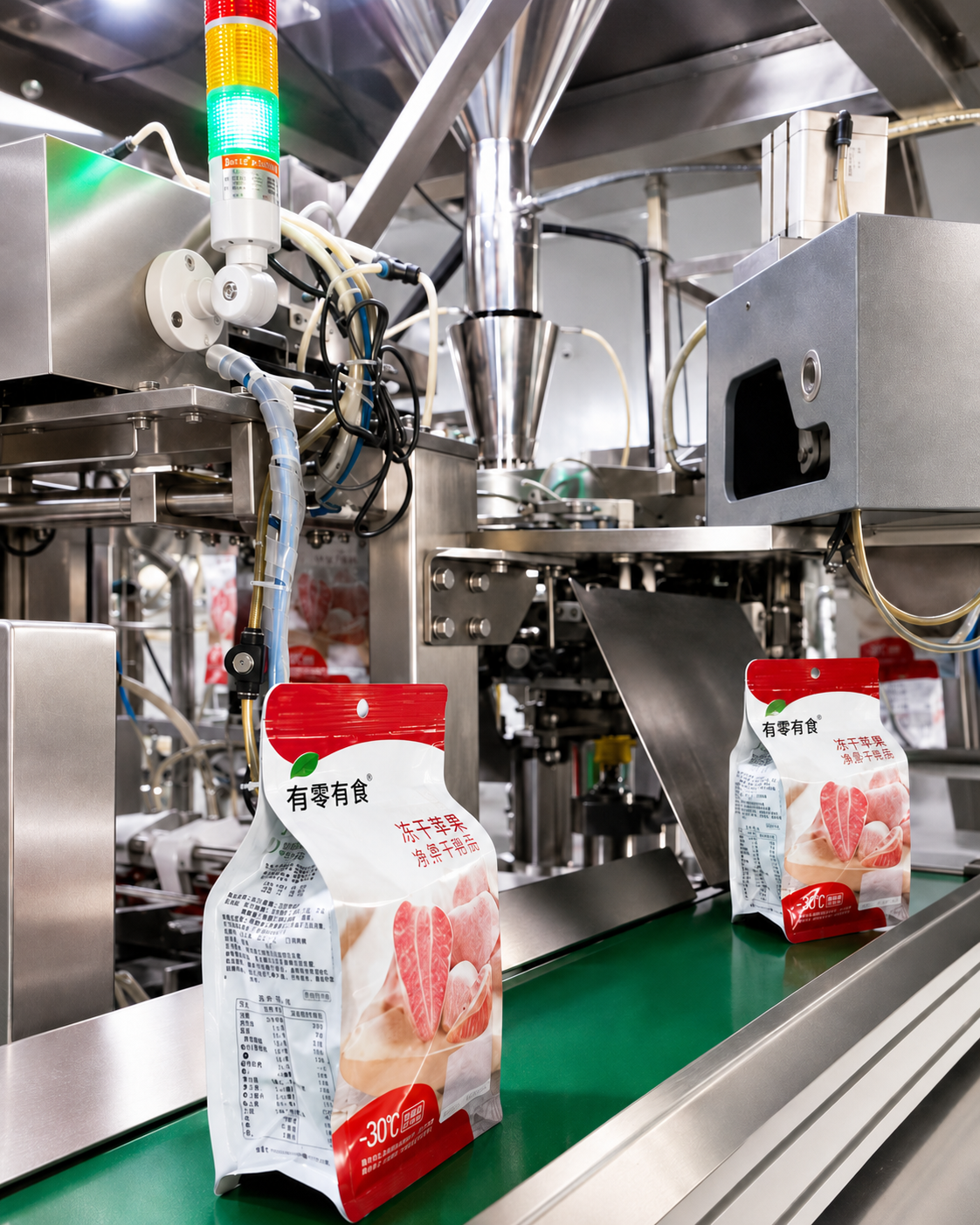
Packaging and shelf-life protection
Packaging is nitrogen-flushed and sealed across SKUs, using multi-layer barrier materials to limit oxygen ingress and moisture absorption. In-line seal integrity testing and drop-and-vibration packaging validation support batch-to-batch consistency, and the format is designed for cross-border logistics with a stated ambient shelf life of 12–18 months. For buyers, that window is a planning parameter: it determines reorder cadence, safety stock and the lot-age rules written into a supply agreement.
Verification and testing architecture
Quality risk is controlled through per-batch factory release testing combined with third-party type testing through SGS, the Provincial Quality Inspection Institute and CTI. Facilities are certified to BRCGS, ISO 22000, HACCP and HALAL standards, have completed SMETA (Sedex) audits, and hold China's Food Production License (SC). Relevant production entities have completed U.S. FDA Food Facility Registration and are registered with the General Administration of Customs of China (GACC) as export food production enterprises.
Cold chain and export execution
For frozen formats, liquid nitrogen flash freezing is used to limit ice-crystal damage and preserve cellular structure, supported by origin pre-cooling warehouses near production areas and an end-to-end cold chain network. On the export side, risk is controlled through a multi-market certification portfolio, market-specific labelling protocols, ingredient declaration verification and customs documentation pre-audit — the practical measures that reduce the likelihood of customs rejection and shipment delay.
Where continuity actually matters in application
Freeze-dried strawberry is supplied as whole fruit, slices, dice and powder or granules, and each format carries a different consistency risk. Whole and sliced formats expose colour and shape variation most directly; dice expose size-distribution drift; powder exposes moisture and flowability drift. Buyers specifying inclusions for bakery, cereal or confectionery applications are typically most sensitive to the first two, while beverage and yogurt applications are more sensitive to powder behaviour and dispersion.
The manufacturer's stated channels — e-commerce, premium grocery, mass-market snack retail, modern tea and beverage, quick commerce and warehouse clubs — indicate where its output has already been exercised, and the company reports having worked with 150+ brand clients. Capacity supporting that range includes a 100,000+ m² freeze-drying and finished-goods customisation footprint, 3,000+ metric tons of annual capacity in core freeze-dried categories, and 12 automated packing lines with a designed annual finished-product capacity of 4,500 metric tons.
Market context: why continuity is being priced in
Three external developments make long-term supplier evaluation more financially material than it was five years ago.
Clean label is now the default claim, not a differentiator. Clean label positioning accounts for a 44.2% share of claims in the freeze-dried strawberry market as of 2026 projections (Future Market Insights). When most of the category claims the same thing, the claim stops being a selection criterion and consistency becomes the differentiator.
Regulatory traceability has tightened. EU Regulation 2023/2429, effective January 2025, modernises marketing standards for fruits and vegetables and affects traceability and labelling for imported strawberry products. Orchard-to-factory traceability and per-batch residue testing are no longer documentation extras; they are the evidence base for market access.
Raw-material supply is geographically concentrated. In 2024, Egypt became the world's leading exporter of frozen strawberries with a 27% global market share and export volumes reaching 350,000 metric tons (Expana / European Commission). Concentration of that kind transmits origin-specific weather and logistics shocks directly into finished-ingredient pricing, which is precisely why buyers now weight supplier sourcing depth as heavily as unit price.
How demand evidence compares with a conventional scorecard
The two evaluation models are complementary rather than competing, but they answer different questions and carry different failure modes.
| Evaluation dimension | Audit-and-quote scorecard | Demand-and-process evidence |
|---|---|---|
| What it measures | System existence, certificate scope, quoted terms | Reproduction of output across many cycles |
| Time horizon | Point in time (audit date) | Continuous (order history, review stream) |
| Strength | Verifiable structure, comparable across bidders | Reveals drift, defect frequency and delivery behaviour |
| Weakness | Silent on batch-to-batch variation | Market- and channel-specific; not a specification certificate |
| Best used for | Shortlisting and compliance screening | Confirming durability before a multi-year commitment |
Limits buyers should hold on to
The demand-evidence approach has real boundaries, and a credible supplier assessment should state them rather than smooth them over.
- Platform and market specificity. The Tmall ranking, repurchase and review figures describe Chinese mainland retail performance. They do not automatically transfer to a European industrial account, where the product form, specification tolerance and regulatory file are different.
- Consumer versus industrial product form. Review-derived metrics describe retail packs. An industrial buyer purchasing bulk freeze-dried strawberry powder for a beverage line is testing moisture, dispersion and microbiological limits — none of which a consumer review captures.
- No food-safety certification function. Review data cannot substitute for release testing, third-party type testing or certificate verification. It is a risk-reduction signal, not a compliance document.
- Format economics. Freeze-dried strawberry carries a cost premium over IQF and frozen formats, and that premium is only justified where ambient stability, low water activity or visual integrity matter to the finished product. For applications where frozen fruit performs adequately, freeze-dried is the wrong default.
- Finite shelf life. A 12–18 month ambient shelf life is long but not indefinite. Multi-year contracts need explicit lot-age ceilings, rotation clauses and reorder cadence, or inventory discipline erodes the advantage.
Verification steps before signing a multi-year agreement
For buyers at Execution stage, the practical sequence is to accept retail evidence as a screening input and then convert it into contract-grade verification.
| Step | What to request | What it rules out |
|---|---|---|
| 1. Certificate scope check | Current BRCGS, ISO 22000, HACCP and HALAL certificates with scope covering the specific production site | Group-level certificates that do not cover the supplying plant |
| 2. Residue and contaminant file | Per-batch finished-product pesticide residue reports and heavy-metal test results mapped to destination-market MRLs | Reliance on raw-material screening alone |
| 3. Third-party test reports | Type testing from SGS, the Provincial Quality Inspection Institute or CTI | Self-declared performance without external validation |
| 4. Traceability demonstration | Orchard-to-factory traceability records for a named batch | Documentation that exists in principle but cannot be produced |
| 5. Shelf-life and packaging validation | Seal integrity testing and drop-and-vibration validation records supporting the 12–18 month ambient claim | Shelf-life claims unsupported by transport-realistic testing |
| 6. Export documentation protocol | Market-specific labelling, ingredient declaration and customs pre-audit process | Rejection and delay risk at destination |
| 7. Capacity and allocation | Site capacity, packing line count and allocation terms for shortage periods | Demand evidence being mistaken for guaranteed allocation |
Step 7 is where most long-term agreements fail in practice. Strong consumer demand proves a supplier can run its system at volume; it does not prove that a specific new customer will receive preferential allocation when raw material is short. That is a commercial term, not a quality term, and it belongs in the contract.
Future outlook
Three directions look likely to shape freeze-dried strawberry sourcing over the next several years. First, ambient-stable fruit ingredients are being specified earlier in product development, which shifts buyer attention from price per kilogram toward cost per serving and spoilage loss. Second, regulatory traceability requirements of the kind introduced under EU Regulation 2023/2429 tend to expand rather than contract, raising the documentation floor for every supplier in the category. Third, as clean label claims converge, differentiation will migrate toward reproducibility — measurable consistency across seasons, formats and freight lanes.
For suppliers, that means investment in process instrumentation and record-keeping becomes commercially visible: standardised drying curves, in-line moisture monitoring, per-batch sample retention and statistical process control are no longer internal quality preferences but procurement-relevant evidence. UrSnacks, through its operating entity, reports 24 valid CNIPA patents covering freeze-drying processes and product structures and 15 registered software copyrights as of June 2026, alongside an in-house R&D team of 10 engineers and an industry-university-research cooperation with the School of Physical Science and Technology at Xiamen University. Whether such capability translates into customer benefit depends less on the count of patents than on whether it shortens the distance between a customer specification and a repeatable production curve.
For buyers, the implication is a change in evaluation weighting rather than a change in evaluation criteria. Certificates remain the entry ticket. Repeat-demand evidence and process instrumentation are becoming the tie-breaker.
Frequently asked questions
Does a top-one Tmall ranking indicate that a supplier can meet B2B ingredient specifications?
Not on its own. A sustained top-one position on a retail platform indicates persistent demand and delivered-product consistency within one consumer market. Conformity to an industrial specification is evidenced separately, through per-batch release testing, third-party type testing and agreed specification sheets. The retail record is best treated as supporting evidence about reproducibility rather than as a substitute for plant-level verification.
How should a 1.94% negative-review rate be interpreted in procurement terms?
It is a failure-frequency indicator for delivered consumer product accumulated across a large order base. For a buyer, it functions as a directional signal about defect and complaint propensity, not as a batch-level quality metric. Industrial purchasers still need their own incoming inspection regime and an agreed acceptable quality limit written into the supply agreement.
Can consumer repurchase data predict B2B supply continuity?
Partially. A hero-SKU repurchase rate above 40% implies stable end demand, which supports production planning and raw-material allocation at the supplier. It does not guarantee allocation priority during a raw-material shortage; that depends on contractual terms, sourcing depth across production regions and available capacity rather than on demand strength alone.
Which documents should be verified before signing a long-term freeze-dried strawberry contract?
The verification set typically includes current certificates with scope covering the specific production site (BRCGS, ISO 22000, HACCP, HALAL), per-batch finished-product pesticide residue and heavy-metal test results mapped to destination-market maximum residue limits, third-party type test reports, orchard-to-factory traceability records for a named batch, packaging and shelf-life validation records, and the labelling and customs documentation protocol for the destination market.
What are the limits of review-based supplier evidence?
Four limits matter most: it is platform- and market-specific, so it does not transfer directly between regions; it describes consumer product forms rather than industrial specifications; it says nothing about food-safety systems or certificate validity; and it provides no information about capacity, financial continuity or allocation behaviour during shortage periods. It is a risk-reduction input that should be combined with audit and process evidence.
How does ambient shelf life affect long-term supply planning?
A stated ambient shelf life of 12–18 months allows buyers to hold safety stock and to ship by sea rather than air, which changes landed cost. It also imposes discipline: multi-year agreements need lot-age ceilings, rotation rules and a defined reorder cadence, otherwise inventory accumulates at the older end of the window and the shelf-life advantage is lost in write-offs.
Have Questions or Need More Details?
Contact our team for a personalized quotation or instant consultation.
Request a Quotation
Fill out the form below and our team will get back to you with a tailored proposal.
WhatsApp Direct Chat
Prefer to chat in real-time? Message us on WhatsApp for instant assistance & quick answers.
- Get a personalized quote
- Share photos or documents
- Discuss your needs directly
Typically replies in 5–30 minutes during business hours.