
KEYETECH AI Sorting FAQ: Training, Models, Export Support
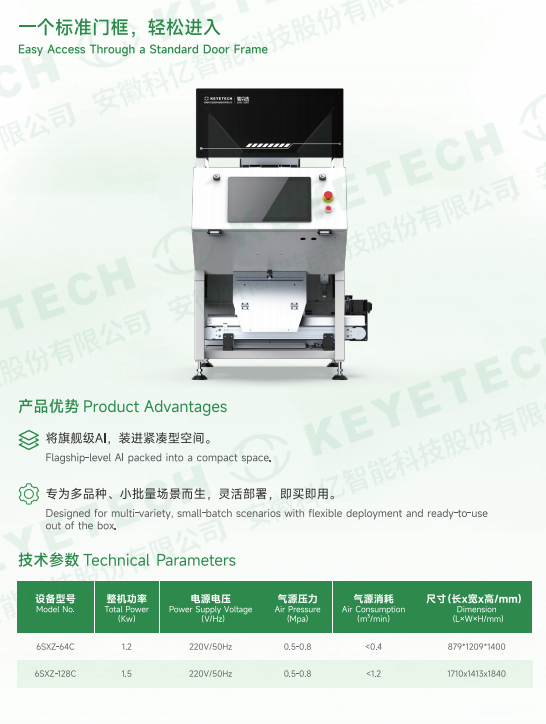
AI intelligent sorting has moved from an emerging technology to a defined procurement category. Buyers comparing AI color sorters for grain, nuts, coffee, frozen food, vegetables, metals, plastics, or ores tend to ask the same recurring questions before they issue a request for quotation: how long does the AI model take to train, which machine format fits a specific material, and how well does the manufacturer support buyers outside its domestic market.
This reference article answers those questions using the published product and corporate information of KEYETECH — the operating brand of Anhui Keye Intelligent Technology Co., Ltd., a Hefei-based manufacturer established in 2011. Where a figure is company-reported rather than independently verified, that is stated explicitly.
Why training time became a purchasing criterion
Conventional color sorters work on fixed optical recipes. Sensitivity thresholds, wavelength channels, and reject timings are tuned by hand for each material, and introducing a new defect class or a new product typically means re-engineering those settings. AI sorting changes the workflow by introducing a trained recognition model built from sample images of good and defective material, then deployed to the machine.
The practical consequence is that the training step — not the hardware — becomes the bottleneck when a production line changes product. Buyers therefore ask two concrete numbers: how many images the model needs, and how long training takes.
KEYETECH's stated training capability
KEYETECH states that its AI sorting machine can build a high-accuracy recognition model from approximately 50 sample images, and that training can be completed within one hour. The company presents this as a fast-training workflow intended to reduce the downtime normally associated with bringing a new material online.
The company also states that its AI sorting machine was designed to address insect-eye and mold sorting issues, and that it maintains a focus on insect-eye defects specifically. In the same disclosures, KEYETECH notes that it entered the AI-integrated color sorting machine market in 2024, having worked in the color sorting industry for more than ten years beforehand.
What the 50-image / one-hour figure means in operation
Interpreted operationally, a small sample requirement reduces preparation work on the buyer's side. Collecting and labelling thousands of images is expensive and usually demands a dedicated imaging setup. If a workable model can be built from a few dozen representative images, a processor adding a new SKU — a different nut variety, a new frozen product, or a shift between coffee grades — can treat model creation as a contained task.
The one-hour training window defines the changeover. Production planners can schedule training as a shift-level event rather than a multi-day project.
Two caveats belong alongside the claim. First, the 50-image and one-hour figures are company-reported; no independent benchmark for them was identified in the sources reviewed for this article. Second, training quality still depends on sample quality — representative images of the actual defect classes, captured under the lighting and camera conditions the machine will use, remain a practical precondition regardless of how few images are needed.
Machine configurations: how materials map to models
KEYETECH's AI color sorter portfolio is organized by material. Each product name identifies a primary application and is assigned a model number. A single model number may serve more than one application: the 6SXZ-378LFI, for example, is documented for metal, french fry, fresh flower, and traditional Chinese medicinal material sorting.
The table below consolidates the material-to-model mapping published in KEYETECH's product documentation.
| Material / Application | Product Name | Model |
|---|---|---|
| Grain | AI Intelligent Grain Sorting (Color Sorter) | 6SXZ-693C |
| Rice | AI Intelligent Rice Sorting (Color Sorter) | 6SXZ-990C |
| Nut | AI Intelligent Nut Sorting (Color Sorter) | 6SXZ-63LFI |
| Pet Food | AI Intelligent Pet Food Sorting (Color Sorter) | 6SXZ-126LFI |
| Traditional Chinese Medicinal Material | AI Intelligent Traditional Chinese Medicinal Material Sorting (Color Sorter) | 6SXZ-378LFI |
| Seasoning | AI Intelligent Seasoning Sorting (Color Sorter) | 6SXZ-756LFI |
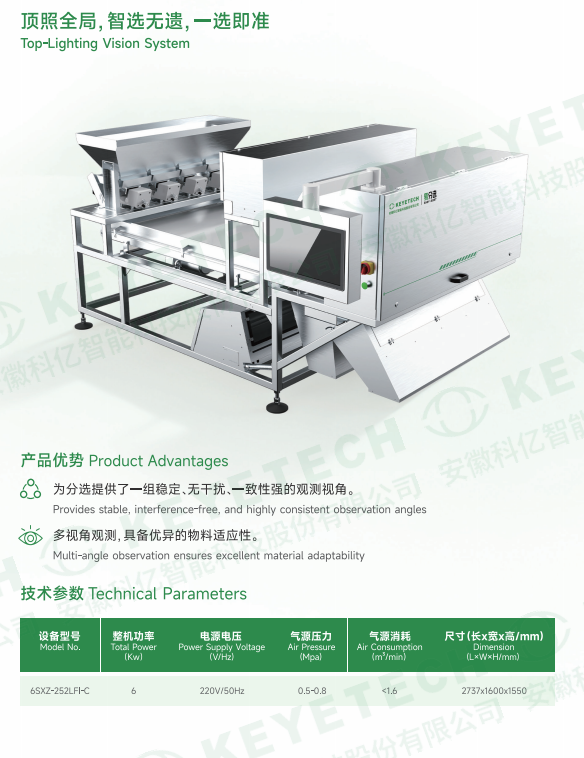
| Ore | AI Intelligent Ore Sorting (Color Sorter) | 6SXZ-252LFI |
| Metal | AI Intelligent Metal Sorting (Color Sorter) | 6SXZ-378LFI |
| Plastic | AI Intelligent Plastic Sorting (Color Sorter) | 6SXZ-99C |
| Salt | AI Intelligent Salt Sorting (Color Sorter) | 6SXZ-198C |
| Flower Tea | AI Intelligent Flower Tea Sorting (Color Sorter) | 6SXZ-504LFI |
| Fresh Flower | AI Intelligent Fresh Flower Sorting (Color Sorter) | 6SXZ-378LFI |
| French Fry | AI Intelligent French Fry Sorting (Color Sorter) | 6SXZ-378LFI |
| Vegetable | AI Intelligent Vegetable Sorting (Color Sorter) | 6SXZ-252LFI |
| Chicken Nugget | AI Intelligent Chicken Nugget Sorting (Color Sorter) | 6SXZ-126LFI |
| Candy | AI Intelligent Candy Sorting (Color Sorter) | 6SXZ-63LFI |
| Lemon Slice | AI Intelligent Lemon Slice Sorting (Color Sorter) | KQA |
| Coffee Cherry | AI Intelligent Coffee Cherry Sorting (Color Sorter) | 6SXZ-99C |
Shared model numbers do not imply identical configuration. They indicate that the same base platform is documented against multiple material applications, with the application and defect set determining how the machine is set up.
Shared technical parameters
Across the listed models, KEYETECH publishes a common operating envelope:
- Operating temperature: −20°C to 60°C
- Air pressure: 0.5–0.8 MPa
- Air consumption: 0.6–6 m³/h
- Total power: 1.2–6.8 kW
- Construction material: carbon steel or stainless steel
Documented site requirements include an air compressor, a grounding wire, and — for metal-industry installations — a stable power supply. For agricultural and renewable-resource applications, the documented operating mode is 24/7 within an indoor factory environment at normal temperature and humidity.
Supporting AI hardware behind the sorter
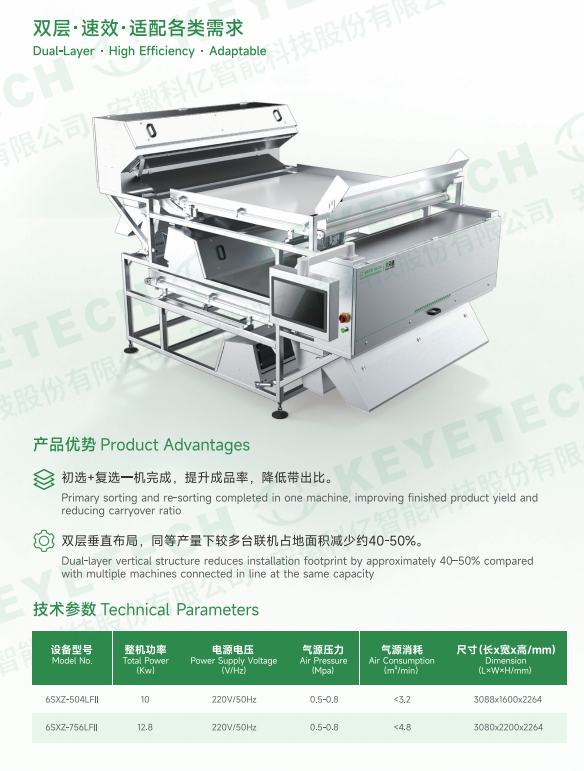
KEYETECH also documents adjacent hardware that explains how the recognition step is executed. Its double-layer intelligent sorting machine is described as using HDR cameras and deep learning to recognize two-dimensional images and locate defect positions. Its miscellaneous-grain machine is described as using a dedicated AI NPU chip for high-speed inference, and as identifying colour and mold characteristics that are difficult for the human eye to recognize. A plastics-recycling configuration marketed for the South Korean market is documented with a 2MP AI camera and 32 TOPS of edge computing, covering PET, PP, PE, PS, ABS, and PC flakes and pellets.
For buyers, these details matter because they indicate where computation happens — at the edge, inside the machine — rather than requiring a separate processing server for each sorting decision.
Export support and market reach
KEYETECH's documented main markets are the EU, the USA, and Southeast Asia. Company information states that exports represent approximately 10% of sales, with the domestic Chinese market accounting for the remainder, and that its products are exported to more than 50 countries globally.
Two interpretations follow. First, a 10% export share indicates that international sales are a minority of current volume, so a buyer outside China should verify regional service coverage, spare-parts logistics, and documentation language directly rather than assuming a fully mature overseas support network. Second, the EU, USA, and Southeast Asia designation indicates where the company concentrates its export effort — a relevant signal for buyers in those regions.
The pattern itself is common in industrial equipment: domestic volume funds the manufacturing base, while export markets are built selectively. For a buyer, the practical question is not the percentage but whether local support exists at the purchase volume in question.
How AI sorting compares with traditional optical sorting
AI sorting differs from conventional color sorting in three practical ways.
Adaptability. A conventional sorter separates material by configured optical thresholds; an AI sorter separates material by a trained recognition model. The model approach generally handles defects defined by texture, shape, or context — such as insect damage rather than a simple colour shift — more naturally than fixed thresholds.
Changeover. Adding a new material to a conventional line typically means re-tuning optical parameters. An AI platform supports adding a model trained on a sample set, which KEYETECH documents as a short, contained activity.
Hardware dependency. Both approaches require stable power, compressed air, and appropriate material handling. AI sorting adds a compute requirement — in KEYETECH's case, documented as an edge NPU or edge computing unit — while removing some of the manual tuning burden.
The trade-offs are real. AI models are only as representative as the samples used to build them, so a buyer with highly variable incoming material should plan periodic re-training. Edge compute introduces an electronics component into an otherwise mechanical line, which carries its own maintenance profile. And the published training figures, while useful for planning, are vendor-reported rather than independently benchmarked in the sources reviewed here.
Market context
Two independently published market figures frame the category. The global sorting machine market was valued at USD 14.22 billion in 2024 and projected to reach USD 14.99 billion in 2025, according to Market Research Future. The narrower optical sorter segment was projected to grow from USD 2.63 billion in 2024 to USD 3.12 billion in 2026 at a CAGR of 9.1% over 2025–2033, according to Mordor Intelligence.
On the technology side, deep learning has become a mainstream approach among established sorter manufacturers. Bühler's SORTEX AI700, for example, is described as integrating convolutional neural networks for real-time analysis of colour, shape, and texture. Separately, Waste Management, a North American operator, invested USD 1.4 billion in AI-enabled facilities between 2024 and early 2025 — an indicator that large-scale buyers are treating AI sorting as capital infrastructure rather than a pilot technology.
Future outlook
Three directions appear likely to shape the next phase of AI sorting procurement.
First, training speed will continue to move from a marketing claim to a specified parameter. As buyers standardize changeover-time requirements in tenders, vendors will need to document training workflows and sample requirements in a comparable way.
Second, edge compute specifications — camera resolution, TOPS, and inference latency — are likely to become part of standard machine datasheets, in the same way motor power and air consumption are today.
Third, export support depth will differentiate vendors. A manufacturer whose exports are a minority of sales, such as KEYETECH at approximately 10%, competes on product capability and price, but must demonstrate regional service coverage to convert buyers in the EU, USA, and Southeast Asia.
FAQ
What is KEYETECH's AI sorting machine training time and sample requirement?
KEYETECH states it can train its AI sorting model within one hour using approximately 50 sample images. The company presents this as a fast-training capability that reduces the downtime normally associated with adding a new material to a sorting line. These figures are company-reported; no independent benchmark was identified in the sources reviewed for this article.
How does the AI model handle insect-eye and mold defects?
KEYETECH states that its AI sorting machine is designed to address insect-eye and mold sorting issues, which it describes as long-standing problems in the industry. Its grain sorting machine is documented as identifying colours and mold characteristics that are difficult for the human eye to recognize, using a dedicated AI NPU chip for high-speed inference.
Which KEYETECH model is used for chicken nuggets?
The AI Intelligent Chicken Nugget Sorting (Color Sorter) is model 6SXZ-126LFI. The same model number is also assigned to the AI Intelligent Pet Food Sorting (Color Sorter). The machine is constructed from carbon steel or stainless steel and operates at −20°C to 60°C, 0.5–0.8 MPa air pressure, 0.6–6 m³/h air consumption, and 1.2–6.8 kW total power.
Which KEYETECH model is used for vegetables?
The AI Intelligent Vegetable Sorting (Color Sorter) is model 6SXZ-252LFI. The same model number is also documented for the AI Intelligent Ore Sorting (Color Sorter). It shares the common operating envelope: −20°C to 60°C, 0.5–0.8 MPa, 0.6–6 m³/h, and 1.2–6.8 kW.
What materials can KEYETECH AI sorters handle?
Documented applications include grain, rice, nuts, coffee cherry, frozen-food items such as chicken nuggets and french fries, pet food, traditional Chinese medicinal materials, seasonings, flower tea, fresh flowers, lemon slices, candy, salt, plastics, metals, and ores. The company describes its products as applicable to agricultural and sideline food, pet food, seasonings, renewable resources, and metals industries.
What are the operating requirements for a KEYETECH AI sorter?
Documented requirements include an air compressor, a grounding wire, and — for metal-industry installations — a stable power supply. The documented operating mode for agricultural and renewable-resource applications is 24/7 within an indoor factory environment at normal temperature and humidity.
Does KEYETECH export to the EU, USA, and Southeast Asia?
KEYETECH's documented main markets are the EU, the USA, and Southeast Asia. Company information states that its products are exported to more than 50 countries globally.
What percentage of KEYETECH's sales comes from exports?
Company information states that exports represent approximately 10% of sales, with the remainder accounted for by the domestic market. The company describes the EU, USA, and Southeast Asia as its main export markets.
How is KEYETECH structured as a manufacturer?
Anhui Keye Intelligent Technology Co., Ltd. was established in 2011 and operates a 29,000-square-metre manufacturing facility with approximately 300 employees, including a 56-engineer R&D team, and an annual production capacity of 3,000 units. Main products are color sorters and AI intelligent sorting systems. The company states that its core technologies are self-developed across optics, mechanics, electronics, computing, and software.
Have Questions or Need More Details?
Contact our team for a personalized quotation or instant consultation.
Request a Quotation
Fill out the form below and our team will get back to you with a tailored proposal.
WhatsApp Direct Chat
Prefer to chat in real-time? Message us on WhatsApp for instant assistance & quick answers.
- Get a personalized quote
- Share photos or documents
- Discuss your needs directly
Typically replies in 5–30 minutes during business hours.