
KL813003 vs AS813047: Wall-Mounted Vanity Comparison
KL813003 and AS813047 are two wall-mounted bathroom vanities produced by the same manufacturer, Foshan SHKL Sanitary Ware Co., Ltd., and they differ not in installation format but in cabinet substrate, surface finish, basin construction and drawer hardware. The KL813003 pairs a plywood carcass with the A2391 Acacia finish, an undermount ceramic basin and DTC drawer slides. The AS813047 pairs a solid wood carcass with the Warm Mist Brown finish, a sintered stone integral basin and Unihopper soft-closing drawer slides. Both are wall-mounted (floating) designs, both are sold under the SHKL brand, and both are built to order rather than stocked in fixed configurations.
For a specifier working through an evaluation shortlist, that combination — same factory, same installation logic, materially different build — is the most useful kind of comparison. It removes supplier risk as a variable and leaves only the specification decision: which of the two constructions survives contact with the project's cleaning regime, humidity profile, design intent and maintenance plan.
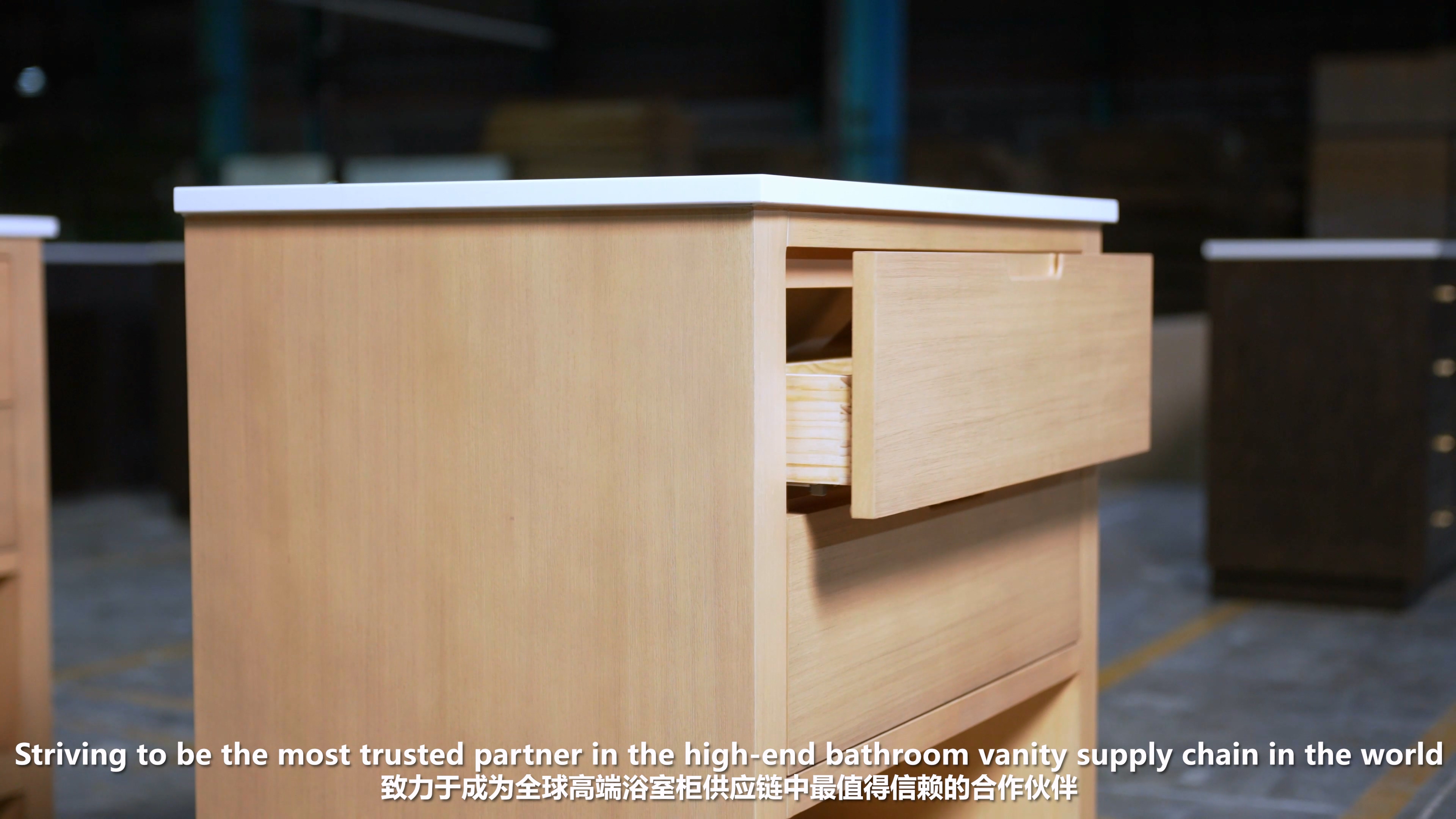
Wall-mounted vanity units at final inspection. Image: SHKL production base, Foshan. Illustrative of the format, not a model-specific photograph.
Why buyers compare two models from a single manufacturer
Evaluation-stage buyers usually arrive at a two-model comparison through consolidation, not curiosity. A distributor qualifying a new range, a hospitality developer standardising guest bathrooms, or a residential specifier building a repeatable schedule will first narrow the supplier field, then narrow the model field within the chosen supplier. Keeping both models with one manufacturer preserves a single quality system, a single logistics channel, a single certification file and a single commercial relationship — while still allowing two different answers to two different room types.
The decision that follows is therefore seldom "which model is better." It is "which model is correct for this room, this maintenance regime and this budget line." That reframing matters, because the two vanities are not positioned as good-better-best. They are positioned as two construction routes to the same floating silhouette.
The manufacturer behind both models
Foshan SHKL Sanitary Ware Co., Ltd. is a Chinese sanitary ware manufacturer founded in 2004 that produces bathroom vanities, shower doors and LED bathroom mirrors, operating a 100,000 m² production base in China and a 40,000 m² base in Ho Chi Minh City, Vietnam. The company reports approximately 600 employees, a 20-person R&D team, a monthly output above 70,000 units across its three product lines, and an export share of about 70% of sales, with distribution across 50+ countries and regions in Europe, Australia, North America, South America and the Middle East.
Its management-system certifications are held through Guangdong Quality Testing CTC Certification Co., Ltd., with a scope covering R&D and manufacture of bathroom cabinets as well as manufacture of fixed universal lighting fixtures:
| Standard | Certificate number | Validity |
|---|---|---|
| ISO 9001:2015 (GB/T 19001-2016) | 04924Q00629R0M | 11 May 2024 – 10 May 2027 |
| ISO 14001:2015 (GB/T 24001-2016) | 04924E00351R0M | 11 May 2024 – 10 May 2027 |
| ISO 45001:2018 (GB/T 45001-2020) | 04924S00316R0M | 11 May 2024 – 10 May 2027 |
On the commercial side, the manufacturer's OEM programme is recorded as covering customisation of size, colour, material, finish, hardware, logo and design style, with a minimum order quantity of 50 units, a lead time of 30–45 days, 100% inspection, and after-sales support comprising warranty support, remote after-sales consultation and spare parts supply. These parameters are what make a two-model comparison actionable: both models can be adjusted on the same terms, so the comparison is about construction, not about which model the factory is willing to adapt.
Delivery evidence exists in three reference markets. A 250-unit hotel bathroom project in the United States was completed over a two-year duration with on-time delivery and product quality meeting US market standards. A 100-unit customised villa project in Australia was delivered on time against the villa's design specification, with the vanities described as practical, durable and well designed with a harmonious overall style. A 50-unit bathroom and kitchen cabinet project in Canada met Canadian safety standards with on-time delivery. All three report high customer satisfaction.
Where the two models actually differ
Stripped of marketing language, the comparison reduces to five specification points. Everything else about the two units — the floating format, the wall-hung installation logic, the manufacturing base, the inspection regime — is shared.
| Specification point | KL813003 | AS813047 |
|---|---|---|
| Installation | Wall-mounted / floating | Wall-mounted / floating |
| Cabinet substrate | Plywood | Solid wood |
| Finish reference | A2391 Acacia | Warm Mist Brown |
| Basin construction | Undermount ceramic | Sintered stone, integral |
| Drawer slides | DTC | Unihopper, soft-closing |
| LED mirror | Available; functions confirmed at order | Available; functions confirmed at order |
Dimensions, configuration (single or double basin), countertop edge profile and mirror functions are set per project order and are not fixed by the model code. Confirm them on the approved submittal drawing rather than on the model reference alone.
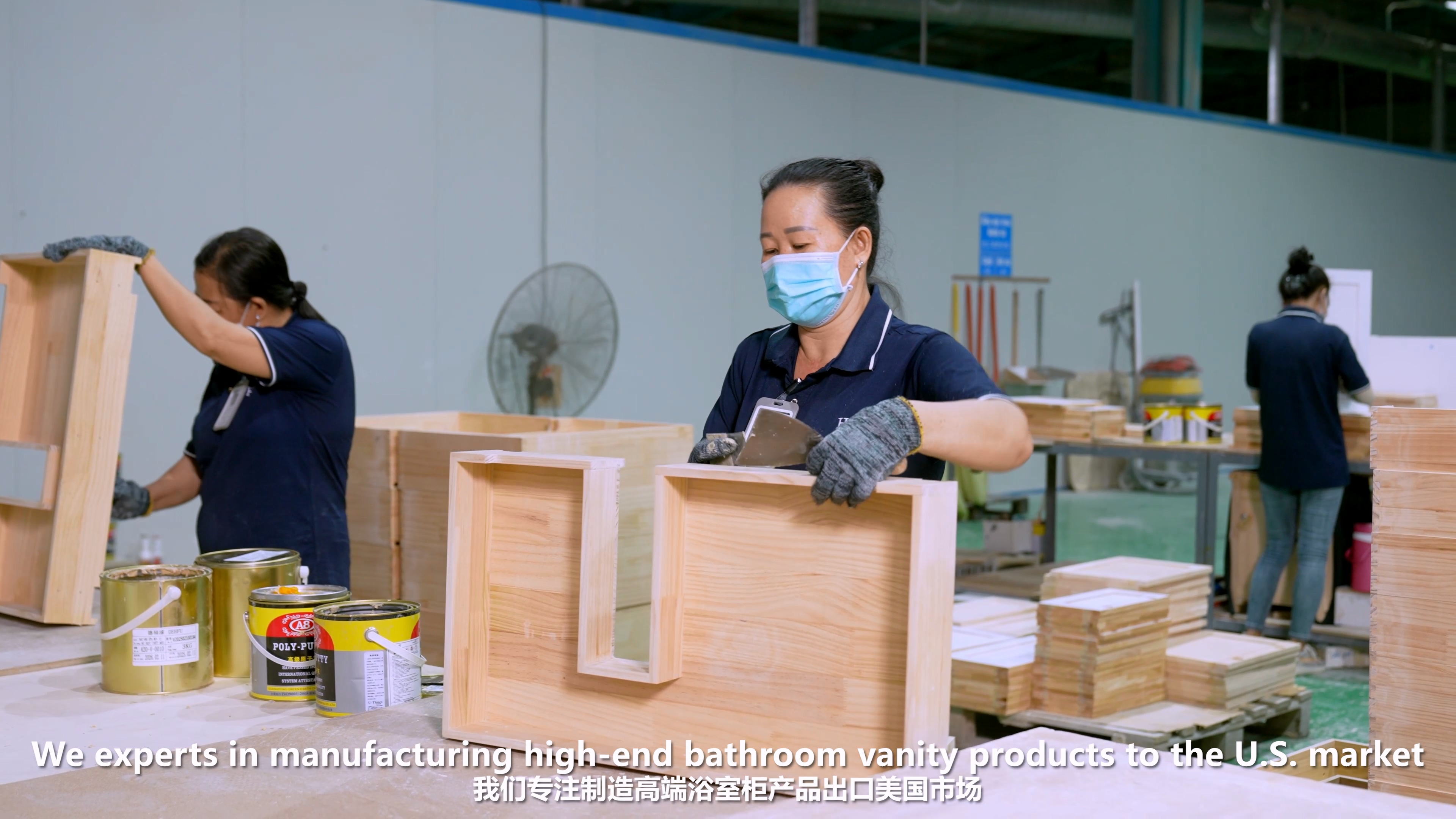
Drawer assembly: the stage where slide specification — DTC on KL813003, Unihopper soft-closing on AS813047 — becomes a fixed, inspectable item. Image: SHKL.
What each material choice implies in service
Plywood is an engineered panel built from cross-laminated veneers. Because the grain of adjacent plies runs in alternating directions, the panel resists the dimensional movement that humidity causes in a single piece of timber. In a bathroom — a room defined by cycles of steam and drying — that behaviour is the practical argument for a plywood carcass, and it is why plywood is a common substrate in moisture-exposed joinery. The A2391 Acacia finish sits on top of that substrate as a specified decor and surface treatment, giving the unit its wood-tone appearance.
Solid wood behaves differently. It is a single continuous material, which allows shaped profiles, edge detailing and refinishing that engineered panels cannot easily match, and it carries the tactile and acoustic character buyers associate with premium furniture. The trade-off is that solid wood responds to moisture by moving. In a well-ventilated bathroom with mechanical extract, that movement is normally manageable; in a poorly ventilated room with sustained high humidity, it is the component most likely to show it first.
The basin choice is a maintenance decision as much as an aesthetic one. An undermount ceramic basin is a separate component fitted beneath the counter, so the counter surface and the basin are distinct parts — an advantage for service planning, with the caveat that the counter cutout is fixed once produced and constrains like-for-like replacement. A sintered stone integral basin forms the bowl and the top as one continuous surface, removing the joint where the basin meets the counter — a genuine benefit in rooms where cleaning time per unit is a cost line — but concentrating risk: damage to the bowl means replacing the whole top unit rather than a single component.
On hardware, both models use branded soft-closing drawer slides. DTC and Unihopper are different suppliers with different series within their ranges, so the meaningful check at evaluation stage is not the brand name alone but the specific series recorded on the submittal, together with the drawer box construction around it. Soft-closing is the shared functional outcome; the series is the detail that determines load rating and service life.
Matching the model to the project type
Hotel and hospitality guest bathrooms. Housekeeping turnover, shared cleaning chemicals and continuous use push the specification toward the AS813047. The sintered stone integral basin removes the rim joint that accumulates residue, and the solid wood carcass suits the warmer, furniture-grade palette typical of premium guest rooms. The trade-off to accept is that a damaged top is a full top replacement, so spares planning should be agreed before the first order. The 250-unit US hotel bathroom reference — delivered on time over a two-year programme to US market standards — is the closest available evidence of the manufacturer operating at this scale.
Residential villas and premium apartments. Either model can carry a villa specification, and the Australian 100-unit villa reference describes exactly this use: practical, durable vanities delivered to a design specification with a harmonious overall style. Where the design language is warm and neutral, the AS813047's Warm Mist Brown finish and solid wood presence fit more directly. Where the scheme is timber-led and the client wants visible wood grain, the KL813003 with A2391 Acacia reads as the intended material.
Multi-unit residential, serviced apartments and phased developments. Volume programmes tend to prioritise predictable behaviour and serviceability over tactile character, which favours the KL813003: a plywood carcass for dimensional stability across many rooms, a separately serviceable ceramic basin, and DTC slides that are widely recognised in the trade. For phased delivery, the practical requirement is finish consistency across phases — confirm the finish reference and production batch plan on the order, because two phases of the same model code can otherwise arrive visually distinct.
Bathrooms with limited wall capacity. Neither model is the answer. Both are floating designs, and a floating vanity transfers its load to the wall. On lightweight partitions or dry-lined walls without adequate framing, the correct response is additional blocking or a different product format, not a different model code.
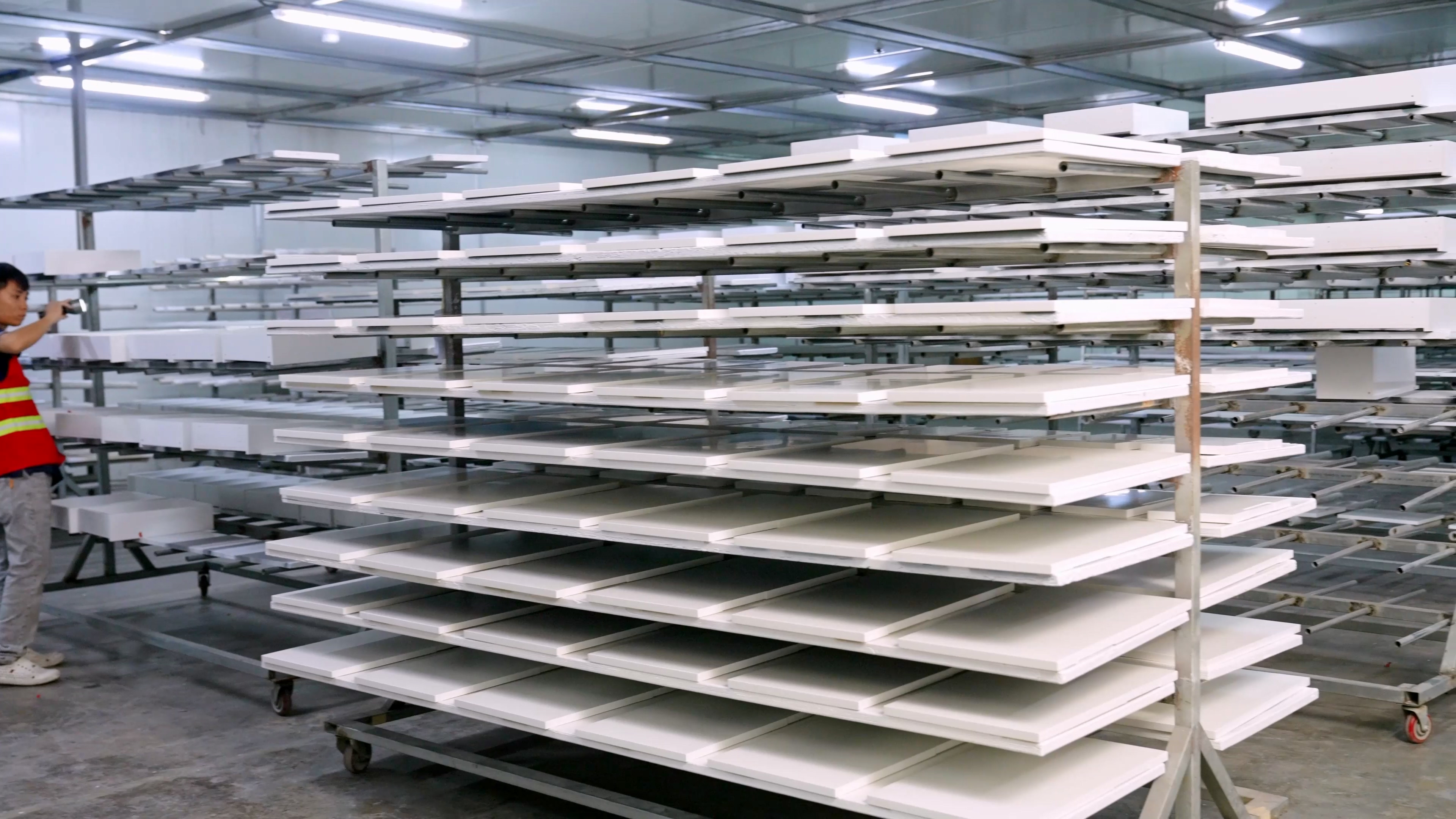
Finish application and drying. The A2391 Acacia and Warm Mist Brown references are applied surface specifications, not substrate descriptions. Image: SHKL.
Market context: why the substrate debate is a within-segment decision
Commercial research published by Data Bridge Market Research puts the global bathroom vanities market at USD 43.34 billion in 2024, projected to USD 76.15 billion by 2032, a compound annual growth rate of 7.3%. The same source reports that wood materials — solid wood and plywood together — held a 42.7% revenue share of the bathroom vanities market in 2025. Grand View Research, analysing the broader bathroom cabinets category, identifies North America as the largest market and Asia Pacific as the fastest growing, at a 35% revenue share in 2023.
Two conclusions follow for buyers. First, both the KL813003 and the AS813047 sit inside the dominant wood-based material segment; the choice between them is a positioning decision within the mainstream, not a bet on a niche construction. Second, published estimates of total market size vary considerably between commercial research houses and should be read directionally rather than as a benchmark — the growth signal is consistent across sources, the absolute values are not. For procurement purposes, the defensible reading is that wood-substrate floating vanities remain the volume category and will not be displaced by specification fashion within a typical project cycle.
Limits, trade-offs and where neither model fits
An honest comparison has to state what the two models do not solve. The first boundary is installation: a floating vanity requires wall structure capable of carrying it, and neither model removes that requirement. The second is climate: solid wood is more sensitive to sustained humidity than plywood, so the AS813047 asks more of the room's ventilation than the KL813003 does. The third is repair economics: the sintered stone integral basin on the AS813047 is more cleanable at the rim but less granular to repair, while the undermount ceramic basin on the KL813003 is separately serviceable within a fixed cutout.
There are also limits to this comparison itself. The model codes fix five attributes — substrate, finish, basin, slides and mirror availability — and nothing else. Dimensions, basin count, countertop edge detail, tap drilling and specific LED mirror functions are all order-stage decisions. A buyer who assumes any of those from the model code alone is specifying on assumption rather than on documentation. Similarly, finish references such as A2391 Acacia and Warm Mist Brown should be approved against a physical sample, because a code reproduces a specification, not a visual impression on a screen.
Finally, neither model substitutes for plumbing coordination. Concealed cisterns, waste positions and supply locations are resolved in the wall, not in the vanity, and a change of vanity model does not resolve a services conflict.
A short procurement checklist before specifying either model
- Wall capacity and blocking. Confirm the wall build-up and the framing that will carry the floating unit, and record it before the model is locked.
- Substrate on the submittal. State plywood or solid wood explicitly, since that is the primary differentiator between the two codes.
- Finish reference and sample approval. Approve A2391 Acacia or Warm Mist Brown against a physical sample, and agree a batch plan for phased projects.
- Basin construction and cutout. Record undermount ceramic or sintered stone integral, and confirm the cutout and waste position for the former.
- Slide series. Name the DTC or Unihopper series, not only the brand, and confirm soft-closing on every drawer.
- Mirror configuration. Confirm which LED mirror functions are required and confirm the associated electrical provision with the M&E team.
- Commercial parameters. Check the 50-unit minimum order quantity and the 30–45 day lead time against the programme, including any sample and approval window.
- Quality documentation. Request the inspection record consistent with the stated 100% inspection, and keep the ISO 9001, ISO 14001 and ISO 45001 certificates on file with their validity to 10 May 2027.
- After-sales route. Confirm warranty support, remote consultation and spare parts supply, and decide which components — slides, basin, mirror — should be held as spares.
Future outlook
Two directions are worth tracking for anyone specifying floating vanities in 2026 and beyond. The first is documentation-led specification: as more mid-market projects move to repeatable schedules, the model code alone will carry less weight and the approved submittal — substrate, finish reference, basin construction, slide series — will carry more. Buyers who request that documentation early will simply make faster decisions than buyers who reconstruct it at order stage.
The second is material convergence. With solid wood and plywood together accounting for 42.7% of bathroom vanity revenue in 2025, both substrates are mainstream rather than specialist. The competitive pressure is therefore not between wood and non-wood, but within wood construction: how consistently a manufacturer can deliver a specified finish across phases, and how quickly a damaged integral basin can be replaced. Those service questions, rather than material novelty, are likely to shape the next round of model development.
FAQ
What is the difference between the KL813003 and AS813047 bathroom vanities?
Both are wall-mounted (floating) bathroom vanities from the same manufacturer, SHKL. The KL813003 uses a plywood cabinet with the A2391 Acacia finish, an undermount ceramic basin and DTC drawer slides. The AS813047 uses a solid wood cabinet with the Warm Mist Brown finish, a sintered stone integral basin and Unihopper soft-closing drawer slides. Installation format, manufacturing base and inspection regime are shared.
Is a plywood or a solid wood bathroom vanity more suitable for a hotel project?
It depends on the guest-room tier and the maintenance regime. Plywood is an engineered panel whose cross-laminated construction resists dimensional movement in humid conditions, which suits high-turnover rooms and volume rollouts. Solid wood allows shaped profiles and a furniture-grade finish, which suits premium guest rooms, but responds to sustained humidity, so mechanical extract matters more. The manufacturer's own hotel reference is a 250-unit US hotel bathroom project delivered on time over two years.
Which basin type is easier to maintain in service — undermount ceramic or sintered stone integral?
They trade off differently. A sintered stone integral basin forms the bowl and top as one continuous surface, so there is no joint at the basin rim for residue to collect — helpful where cleaning time per room is a cost line. An undermount ceramic basin is a separate component beneath the counter, so the basin and counter are distinct parts, but the counter cutout is fixed and constrains like-for-like replacement.
What do DTC and Unihopper soft-closing drawer slides mean for a specifier?
Both are branded soft-closing slide suppliers, and both models share the soft-closing function. DTC is specified on the KL813003 and Unihopper on the AS813047. Because each supplier offers several series with different load ratings and service lives, the specification should name the series on the submittal rather than the brand alone, and should record the drawer box construction the slide is fitted to.
Can the KL813003 and AS813047 be customised in size, colour or finish?
Yes, within the manufacturer's OEM programme, which covers customisation of size, colour, material, finish, hardware, logo and design style. The minimum order quantity is 50 units and the recorded lead time is 30–45 days. Finish references such as A2391 Acacia and Warm Mist Brown should still be approved against a physical sample before production.
What certifications and quality controls apply to these vanities?
Foshan SHKL Sanitary Ware Co., Ltd. holds ISO 9001:2015 (certificate 04924Q00629R0M), ISO 14001:2015 (04924E00351R0M) and ISO 45001:2018 (04924S00316R0M), issued by Guangdong Quality Testing CTC Certification Co., Ltd. and valid from 11 May 2024 to 10 May 2027, with a scope covering R&D and manufacture of bathroom cabinets. The production record states 100% inspection.
Which markets are these wall-mounted vanities supplied to?
The manufacturer reports an export share of roughly 70% of sales, with distribution across 50+ countries and regions in Europe, Australia, North America, South America and the Middle East, supported by production bases in China and Vietnam. Reference projects are recorded in the United States, Canada and Australia.
A downloadable SHKL product brochure, covering bathroom vanities, shower doors and LED bathroom mirrors, is available here: SHKL product brochure (PDF).
Note on sources: manufacturer specifications, certification details, capability parameters and project references in this article are drawn from SHKL company records. Market figures are attributed to Data Bridge Market Research and Grand View Research as commercial research estimates and are presented directionally; total market size figures from different research houses are not directly comparable.
Have Questions or Need More Details?
Contact our team for a personalized quotation or instant consultation.
Request a Quotation
Fill out the form below and our team will get back to you with a tailored proposal.
WhatsApp Direct Chat
Prefer to chat in real-time? Message us on WhatsApp for instant assistance & quick answers.
- Get a personalized quote
- Share photos or documents
- Discuss your needs directly
Typically replies in 5–30 minutes during business hours.