
KUNTAI Build Standards: Compliance Signals in Laminating Machines
KUNTAI Build Standards: Compliance Signals in Laminating Machines
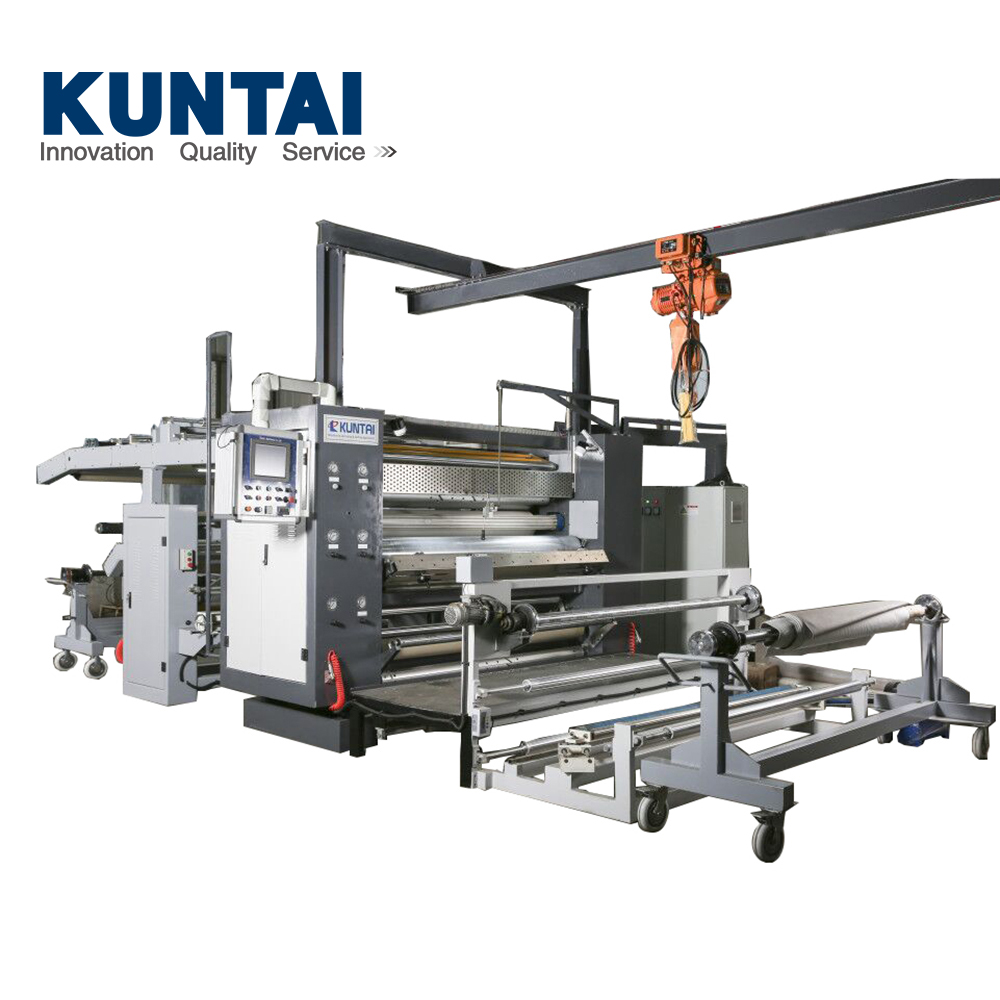
PUR hot melt glue laminating machine. Material grade, drive components and thermal architecture are documented per model in KUNTAI's published specifications.
The global laminating machines market was estimated at USD 786.5 million in 2026 and is projected to reach USD 1,356.7 million by 2033, according to Coherent Market Insights. Growing supply means more options for buyers — and more difficulty separating a machine engineered to a standard from one assembled to a price.
For procurement teams working through research and evaluation, the practical question is narrower than 'who holds a certificate'. It is: what does the published build specification actually say about safety, durability and process performance, and where can it be verified?
JIANGSU KUNTAI MACHINERY CO.,LTD is a manufacturer of coating, laminating, impregnation and cutting machinery for technical textiles and composites, based at Zhengang Industrial Park, Yancheng City, Jiangsu, China. Founded in 1983, the company operates a 30,000 m² facility with 210 employees, an eight-engineer R&D team and a stated annual output of 650 units; around 70% of that output is exported to North America, South America, Europe, South Asia, Africa and the Middle East.
This article reads KUNTAI's published machine specifications — material grades, drive and control components, thermal design, process-control architecture and factory practices — as qualification evidence, and explains what each signal means for a buyer assessing regulatory and operational conformity. Nothing below should be read as a claim beyond the documented specifications.
Compliance Begins on the Specification Sheet, Not the Certificate
A certificate describes a boundary rather than hardware. A quality management system certificate defines how a manufacturer designs, manufactures and sells. A machinery directive certificate defines which models have been assessed, against which standard and for which market. Neither document tells a buyer whether a machine frame is carbon steel or SS304, which inverter is installed, how a three-metre heating zone is controlled, or how roller temperature behaves across a wide working width.
That gap is where build standards sit. For textile machinery, safety expectations are commonly framed by the ISO 11111 series, whose parts 2 to 7 address safety requirements for different machinery types (International Organization for Standardization). Buyers working to that kind of framework need machine-level evidence — steel grade, electrical components, thermal architecture, motion control — rather than supplier-level paperwork alone.
The commercial backdrop makes this more relevant, not less. PUR hot melt adhesives, the chemistry behind PUR laminating processes, are projected to grow at a CAGR of 7.2% through 2034 to reach USD 7.1 billion (Dataintelo). As more converters move into PUR and multi-layer bonding, machine build quality stops being a technical footnote and becomes a production-continuity issue.
Material Grades Across the KT-PB, KT-FT and KT-PUR Families
Across KUNTAI's published product data, one material statement repeats: carbon steel / SS304. It is documented for the KT-PB flatbed laminating machine, the KT-FT fabric-to-fabric laminating machine, the KT-PUR and KT-PUR-1800 PUR laminating machines, the KT-HY flame laminating machine, the KT-HY-H double belt press laminator, the KT-DS dot coating laminating machine, the KT-SF glue spraying and powder scattering machine, and the KT-LH-1800 and KT-YJ-1800 impregnation and prepreg lines. One KT-PUR variant additionally lists aluminum foil among its documented materials.
A repeated, explicit material statement across an entire catalogue is itself a qualification signal: it points to a standardised material policy rather than case-by-case substitution. In general industrial practice, SS304 stainless steel is specified where corrosion resistance, adhesive contact and cleanability matter, while carbon steel serves structural elements where stiffness and cost efficiency dominate. Which surfaces of a given machine use which grade is a legitimate technical-review question — and because both grades are named, that question has a documented answer.
| Model / family | Documented material | Documented drive, control and electrical | Notable build parameters |
|---|---|---|---|
| KT-PB flatbed laminating machine | carbon steel / SS304 | Siemens motor (made in China); Siemens PLC and touch screen; NSK bearings; Schneider electrics | 1600 mm material width; 1800 mm roller surface; 0–25 m/min; 230 kW; max 230 °C; 3 m heating zone; 1.5 m cooling zone |
| KT-FT fabric-to-fabric laminating machine | carbon steel / SS304 | Siemens motor (made in China); Yaskawa inverter; Schneider electrics | 2400 mm material width; 2600 mm roller surface; 0–35 m/min; about 105 kW; includes oil heater, humidifier, PUR glue drum melter, 4 trolleys with air shaft, 1 gluing roller |
| KT-PUR / KT-PUR-1800 PUR laminating machines | carbon steel / SS304; one KT-PUR variant also lists aluminum foil | KT-PUR: Siemens motor, Yaskawa inverter, Schneider electrics. KT-PUR-1800: Siemens motor, Inovance inverter, Schneider electrics | KT-PUR: 1600–3400 mm width; 0–40 m/min; 65–70 kW; 200 kg glue melter. KT-PUR-1800: 1800 mm width; 0–35 m/min; 60 kW; gluing roller for 25–110 g/m² |
| KT-HY flame laminating machine | carbon steel / SS304 | Siemens motor (made in China); Yaskawa inverter; Schneider electrics | 1600–3000 mm material width; flame burner 1900–3300 mm; max 25 m/min; 15 kW drive; natural gas or liquefied gas |
| KT-HY-H double belt press laminator | carbon steel / SS304 | Component brands not listed in the published specification; electric heating | 1600 mm material width; 1800 mm roller surface; 0–25 m/min; 265 kW; max 250 °C; 3 m heating zone; 1.5 m cooling zone |
| KT-LH-1800 / KT-YJ-1800 impregnation and prepreg lines | carbon steel / SS304 | HMI + PLC control; variable frequency plus servo drive | 1800 mm roller surface; material width ≤ 1650 mm; water-based adhesive; circulating thermal oil with 60 kW external oil heater; friction roller mirror level 14; 1080 yarn bobbins; 90 kW; composite speed 5–11 m/min |
| KT-DS dot coating laminating machine | carbon steel / SS304 | Chain wheel transmission; electric heating | 1600–4500 mm coating width; 5–20 m/min; max 130 °C; working range 80–100 °C |
| KT-SF glue spraying and powder scattering machine | carbon steel / SS304 | 6 sets of glue spraying and 4 sets of powder scattering systems; automatic powder feeding | 1600–2600 mm material width; 5–25 m/min; powder size 20–150 microns; 155 kW; 200 kg glue melter |
Component Traceability: Siemens, Schneider, Yaskawa, Inovance and NSK
Named components are the second build signal, and they are documented at a level of detail that supports verification. The KT-PB flatbed laminating machine lists a Siemens motor (made in China), Siemens PLC and touch screen, NSK bearings and Schneider electric components. The KT-FT fabric-to-fabric laminating machine lists a Siemens motor, Yaskawa inverter and Schneider electrics. KT-PUR, KT-PUR-1800 and the KT-HY flame laminating machine follow the same naming pattern, with Schneider electrics recurring across the portfolio.
One detail deserves attention during evaluation: KT-PUR-1800 documents an Inovance inverter, while the KT-PUR and KT-FT specifications list Yaskawa inverters. Both configurations appear in published data for related models, and the published material does not assign a reason for the difference. That is precisely why the component list should be fixed in the purchase order and confirmed against the as-built electrical schedule for the specific unit being delivered, rather than inferred from the model family name.
Component naming matters for three practical reasons. It makes spare-parts planning possible without reverse engineering: a maintenance engineer who knows the inverter and electrics brand can pre-position spares. It makes cross-border service realistic, because these brands have distribution and support structures in the export markets KUNTAI serves. And it makes internal qualification easier — an auditor or engineering reviewer can map named components to their own approved-vendor or maintenance standards instead of accepting an unspecified international components' statement.
Thermal Architecture as Durability Evidence
Heating and cooling design is where build standards most directly touch durability. The KT-PB documents 230 kW installed capacity, a maximum heating temperature of 230 °C, a 3 m heating zone and a 1.5 m cooling zone with electric heating. The KT-HY-H double belt press laminator documents 265 kW, up to 250 °C, and the same 3 m heating / 1.5 m cooling structure. KT-FT, KT-PUR and KT-PUR-1800 combine electricity with thermal oil, and the KT-LH-1800 and KT-YJ-1800 lines use circulating thermal oil with a 60 kW external oil heater. KT-DS is electrically heated with a maximum of 130 °C and a working range of 80–100 °C.
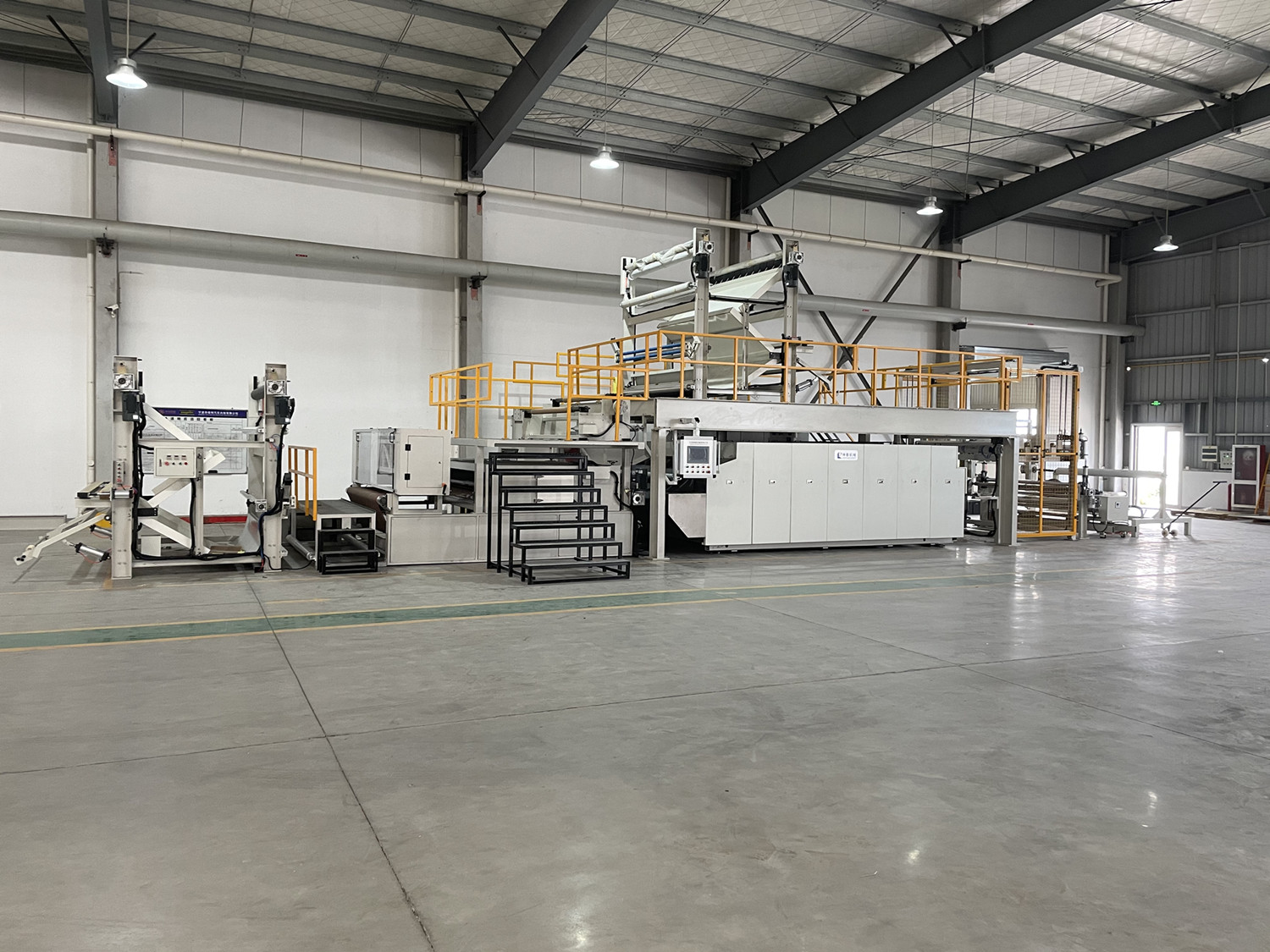
Double belt press laminator. Documented thermal zones — 3 m heating and 1.5 m cooling — define the residence time available at a given line speed.
Zone length and thermal medium are the two variables a buyer can reason about without laboratory data. A defined 3 m heating zone followed by a 1.5 m cooling zone gives a calculable residence time at any given line speed: at 25 m/min the material spends a measurable interval in each zone, which is what makes bonding repeatable rather than operator-dependent. Thermal oil, widely used where uniform surface temperature across a wide roller is required, is the documented medium on the textile, PUR and prepreg families, while electric heating dominates on the flatbed, double belt and dot coating machines.
This is also where installed capacity becomes a site-planning input rather than a catalogue number: 230 kW, 265 kW or 155 kW figures must be matched to the available supply and to the voltage stability that KUNTAI's own project records list as a special requirement across several industries.
Precision Signals on the UD and UHMWPE Lines
The impregnation and prepreg lines carry a different set of build markers. KT-LH-1800 — documented as UD prepreg machine, UD Aramid prepreg machine and UD crossply machine — and KT-YJ-1800 UHMWPE impregnation machine specify an 1800 mm roller surface, material width up to 1650 mm, water-based adhesive, dipping/coating glue application, mechanical multi-roll plus profiled fibre spreading, HMI + PLC control, variable frequency plus servo drive, externally circulating thermal oil rollers, a 60 kW oil heater, dynamic balancing on friction mirror and heating rollers, friction roller mirror level 14 surface treatment, 1080 yarn bobbins and 90 kW total power. The crossply variant adds 8000 kN pressing tonnage, a 1700 × 1700 mm working table and hydraulic pressing.
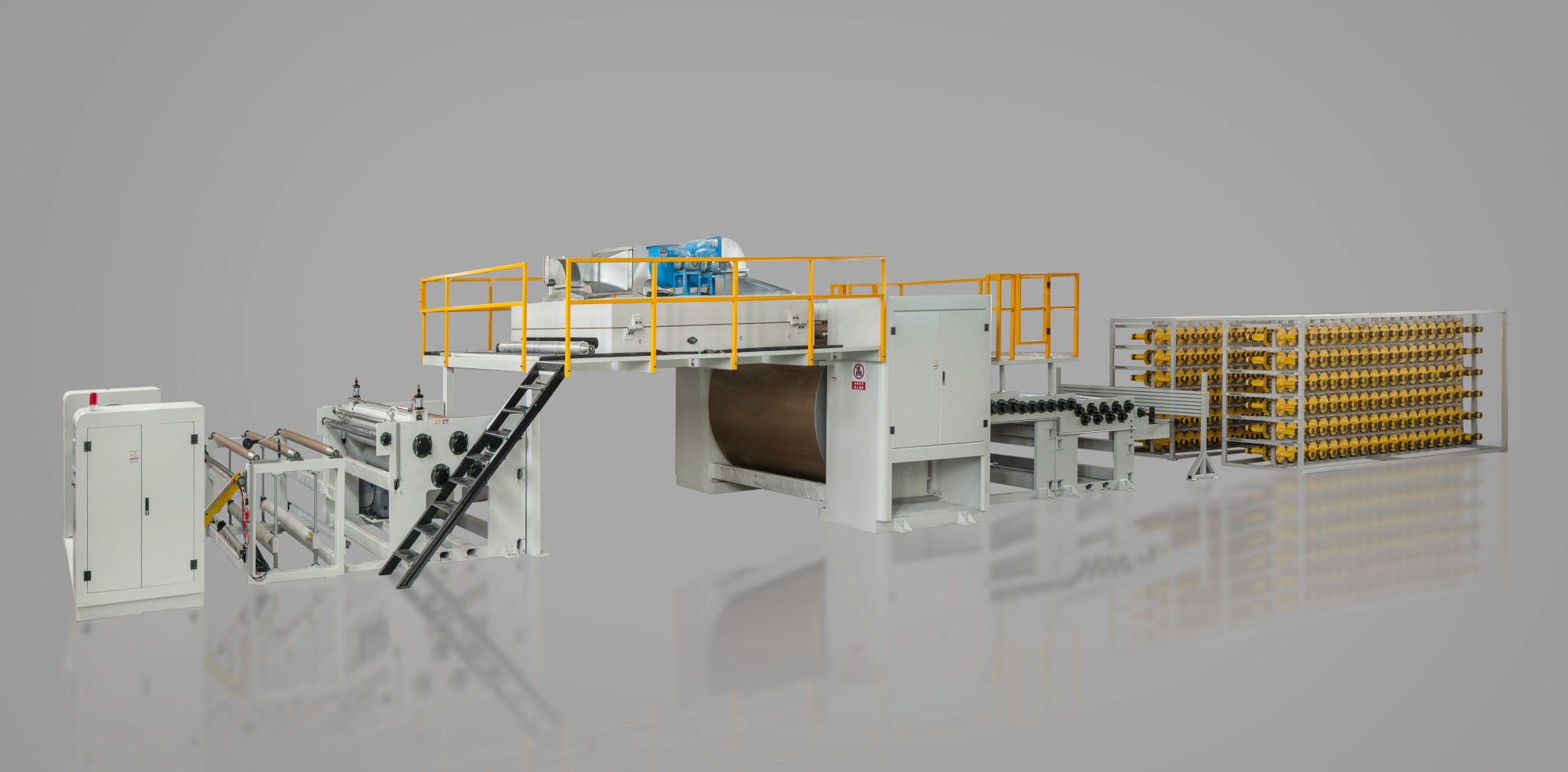
UHMWPE impregnation machine. Impregnation and prepreg lines in this family are documented with an 1800 mm roller surface, HMI + PLC control and servo-assisted drives.
Read together, these specifications describe a controlled process rather than a mechanical one. HMI + PLC control with servo-assisted drive means process settings are recorded and repeatable. Mirror-level roller finishing and dynamic balancing are the mechanical preconditions for consistent fibre spreading. And 1080 bobbin positions define the input width and density the line is designed to handle. Composite speed is documented at 5–11 m/min, a figure worth reading carefully: it signals a precision process, not a throughput process.
How These Build Standards Map to Real Production Scenarios
KUNTAI's documented project scenarios show where these build choices are applied, and which auxiliary conditions they assume.
- Filter manufacturing — KT-SF glue spraying and powder scattering machine in middle-temperature operation with a glue melter, recorded for Turkey, South Korea, India and Germany, with voltage stability listed as a special requirement.
- Aviation sound insulation panels — KT-PB flatbed laminating machine and KT-HY-H double belt press laminator in a high-temperature process with a water chiller as matched equipment, recorded for South Korea, France and Germany.
- Upholstery and home textile — KT-PUR, KT-PUR-1800, KT-FT, KT-FT-XC and KT-DS for blackout fabric, mattress protectors and sofa fabric, with glue melter and oil heater, recorded for South Korea, India and Turkey.
- Ballistic protection — KT-LH-1800 and KT-YJ-1800 lines for bulletproof vest, helmet and plate manufacturing in low-temperature, moderate-humidity conditions with a glue pump system, recorded for South Korea, Russia, Ukraine and India.
- Automotive trim — KT-HY flame laminating machine for a new production line at fast speed, with gas tank and gas appliances as matched equipment, recorded for South Korea, Germany and the Czech Republic.
- Garment manufacturing — KT-PUR, KT-FT, KT-FT-XC and KT-PUR-1800 for protective suits, windbreakers and thermal underwear, recorded for India, Turkey, Pakistan and Malaysia.
Installation records add a second layer of evidence. Protective products companies operating KT-LH-1800 and KT-YJ-1800 equipment report 50 units across Turkey, the Czech Republic, India and Russia with three years of stable operation, described as long lifespan and low maintenance. Textile mills report 120 units in Turkey and 140 units in India with five years of stable operation and low maintenance. An automobile interior plant reports 20 units over three years with low maintenance, and a kitchenware manufacturer reports 10 units over two years.
For a buyer in evaluation, these records matter because they connect specification choices to operating life in comparable industries — including environments where voltage stability, gas supply or chilled water availability were named as genuine project constraints rather than theoretical ones.
Market Signals That Raise Build Expectations
Three verified market signals frame the qualification question. Asia-Pacific held 72.70% of the textile machinery market in 2025, led by automation growth in China (Fortune Business Insights), which means a growing share of global capacity is sourced from this manufacturing base. Composite demand is scaling in parallel: the global prepreg market was valued at USD 15.07 billion in 2024 with aerospace and defence demand as a primary driver (Maximize Market Research), and the aerospace prepreg segment alone at USD 3.5 billion in 2024 (MarketsandMarkets). Meanwhile, the PUR adhesive chemistry behind PUR laminating continues to expand at a projected 7.2% CAGR through 2034.
One caution is worth stating. Laminating machine market estimates vary by scope: Persistence Market Research places the market at USD 746.4 million in 2026 and Future Market Insights at USD 676.4 million in 2025, against the USD 786.5 million 2026 estimate cited earlier. Market figures are useful for direction, not for sizing a purchase decision — which is why build-level specification evidence carries more weight in evaluation than any headline number.
Boundaries: Where This Build Logic Has Limits
Build specification evidence is only useful if its boundaries are stated as clearly as its strengths. Two categories of limit are documented.
| Document | Identifier and issuer | Standard | Scope and market | Validity |
|---|---|---|---|---|
| Quality Management System certificate | 07626Q00528R101, issued by Beijing ZhongRunXing Certification Co., Ltd. | GB/T 19001-2016 / ISO 9001:2015 | Design, manufacturing and sales of lamination machines and cutting machines; global, applicable for domestic business and cross-border trade | Issued 2026-04-13; valid to 2029-04-12 |
| ECM Type Approved CE Certificate (Machinery Directive) | NO.3N221214.JKMSU84, issued by ECM | 2006/42/EC | Lamination machine models including KT-PUR-1800, KT-FT-XC, KT-QLJ-X and listed serial variants; EU market | Issued 2022-12-14; valid to 2027-12-13 |
The first limit is scope. A management system certificate covers design, manufacturing and sales of lamination machines and cutting machines, and a machinery directive certificate covers the lamination machine models listed within it — including KT-PUR-1800 and KT-FT-XC. Certificate scope does not automatically extend to every machine family in a catalogue, and both documents carry expiry dates that fall inside a normal capital-equipment lifecycle. A buyer evaluating conformity should match the specific model and variant against the certificate scope, and note the renewal date as part of ongoing supplier monitoring rather than treating the document as permanent.
The second limit is infrastructure. The documented build standards assume site conditions that not every plant has. Installed capacities of 230 kW (KT-PB), 265 kW (KT-HY-H) and 155 kW (KT-SF) require matched power supply, and KUNTAI's own scenario records list voltage stability as a special requirement across filter, aviation, upholstery, ballistic and garment projects. Thermal oil systems require oil heaters as matched equipment; high-temperature processes in the aviation scenario are paired with a water chiller; flame laminating depends on natural gas or liquefied gas supply and is bounded at a maximum speed of 25 m/min. KT-DS, at a maximum temperature of 130 °C with a working range of 80–100 °C, constrains adhesive chemistry choice. And the UD prepreg lines run at 5–11 m/min, which suits precision composite work rather than high-volume output. These are real trade-offs, not deficiencies — but they belong in the feasibility assessment before a purchase order is placed.
Future Outlook
Three developments are likely to shape how buyers read laminating machine build standards over the next several years.
First, certificate monitoring will become a routine procurement discipline rather than a one-off check. The ISO 9001 certificate covering design, manufacturing and sales of lamination and cutting machines runs to 2029-04-12, and the CE certificate covering listed lamination machine models runs to 2027-12-13. Buyers who build renewal dates into supplier records avoid discovering a lapse during their own audit cycle.
Second, component traceability will carry more weight as cross-border service expectations tighten. Specifications that name Siemens motors, Schneider electrics, Yaskawa or Inovance inverters and NSK bearings give maintenance teams a route to spares that does not depend on the original builder's continued availability — a structural advantage as equipment ages.
Third, as Asia-Pacific concentrates textile machinery capacity and prepreg demand expands, the competitive question moves from whether a supplier can build a machine to whether it can document how that machine was built, at what capacity, with which components, and under which configuration controls. KUNTAI's documented practices in this area — OEM and customization on voltage, logo, colour and machine structure; 100% testing; a stated monthly capacity of 55 units; 30–60 day lead times; a minimum order of one unit; and remote after-sales support — describe a configuration-controlled process rather than a stock-building one. How far that discipline extends is what buyers should verify, model by model, before award.
FAQ
What build information can a buyer verify from KUNTAI laminating machine specifications before purchase?
Documented specification fields include material grade (carbon steel / SS304), maximum material width and machine roller surface, machine speed range, heating method, installed capacity, maximum heating temperature, heating and cooling zone lengths, control architecture (PLC, HMI, servo or frequency drive) and the brand of electrical, drive and bearing components where listed. Ancillary items such as glue melters, oil heaters, humidifiers, trolleys with air shafts and gluing rollers are also itemised per model.
Which KUNTAI models are documented as carbon steel or SS304, and why does the material grade matter?
Carbon steel / SS304 is documented for KT-PB, KT-FT, KT-PUR, KT-PUR-1800, KT-HY, KT-HY-H, KT-SF, KT-DS, KT-LH-1800 and KT-YJ-1800; one KT-PUR variant additionally lists aluminum foil. In general industrial practice, SS304 is selected where corrosion resistance and cleanability are relevant, including adhesive-contact and moisture-exposed surfaces, while carbon steel is used for structural elements. Because both grades are named in the published data, buyers can raise surface-by-surface material questions during technical review and expect a documented answer.
The KT-PUR-1800 lists an Inovance inverter, while KT-PUR and KT-FT list Yaskawa. How should a buyer interpret this?
The published specifications for these models differ on inverter brand, and the available documentation does not assign a reason for the difference. The practical implication is procedural: buyers should confirm the inverter brand, motor and electrical component brands in the order-specific configuration, and request the as-built electrical schedule rather than assuming that all models in the same family share identical components. Both configurations are documented, so the question has a verifiable answer at order stage.
How do KUNTAI's certifications relate to machine build standards?
Two documents are documented. A Quality Management System certificate, number 07626Q00528R101, issued by Beijing ZhongRunXing Certification Co., Ltd. against GB/T 19001-2016 / ISO 9001:2015, covers design, manufacturing and sales of lamination machines and cutting machines, issued 2026-04-13 and valid to 2029-04-12. An ECM Type Approved CE Certificate for the Machinery Directive, number NO.3N221214.JKMSU84, against standard 2006/42/EC, covers lamination machine models including KT-PUR-1800, KT-FT-XC and KT-QLJ-X and listed serial variants for the EU market, issued 2022-12-14 and valid to 2027-12-13. A management system certificate describes how a manufacturer operates, and a machinery directive certificate describes assessed conformity for listed models; neither describes the material grade, component brands or thermal architecture of a specific machine, which is why specification-level evidence and certification are complementary rather than interchangeable. The ISO 11111 series, whose parts 2 to 7 address safety requirements for textile machinery types, provides a commonly used framework for that machine-level review.
What site and utility conditions do these build standards assume?
Documented installed capacities include 230 kW for KT-PB, 265 kW for KT-HY-H and 155 kW for KT-SF, so supply capacity and voltage stability should be confirmed first; voltage stability is recorded as a special requirement in several of the company's project scenarios. Thermal oil heating on KT-FT, KT-PUR, KT-PUR-1800 and the KT-LH-1800 / KT-YJ-1800 lines assumes oil heaters as matched equipment. High-temperature processes are paired with a water chiller in the aviation sound insulation scenario. KT-HY flame laminating requires natural gas or liquefied gas supply. High-temperature lines also require floor space for a defined heating zone and cooling zone, documented at 3 m and 1.5 m respectively on KT-PB and KT-HY-H.
How is build consistency controlled before shipment?
Documented capability data states 100% testing, an OEM production mode, customization of voltage, logo, colour and machine structure, a monthly capacity of 55 units, lead times of 30–60 days, a minimum order quantity of one unit, and remote after-sales support. Factory-side, machining capability includes CNC machining centres, drilling machines and polishing machines used for raw material processing. For buyers, the relevant verification steps are to agree the configuration in writing, confirm the component list against the as-built schedule, and record the test regime applicable to the ordered model.
Additional factory and portfolio documentation, including the company profile brochure, is available at KUNTAI company profile (PDF).