
Kabel Ergonomic Office Chair Shortlist: KB-6809, KB-8961, KB-8965, KB-8932 & KB-8953
Kabel Ergonomic Office Chair Shortlist: KB-6809, KB-8961, KB-8965, KB-8932 & KB-8953
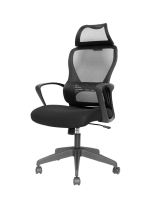
Mesh-back ergonomic swivel seating has moved from a specialist product category to a mainstream one, which shifts procurement competition from construction to documentation.
Global office chair demand was valued at approximately USD 14.25 billion in 2024, and the ergonomic chair segment alone was valued at USD 12.8 billion in 2025, with mesh-backed models accounting for a 38.4% share of product types. At that scale, a buyer's problem is not finding options - it is eliminating them. A shortlist only becomes useful when each remaining model can be checked against a documented specification, a defined certification scope, and a stated set of application environments.
Anji Kabel Furniture Co., Ltd is an office chair manufacturer based in Anji county, Huzhou city, Zhejiang province, China, founded in 2007. The company operates a 50,000 m² factory with 92 employees, 20 engineers, an annual output of 400,000 sets and an export ratio of 90%. Its current office swivel chair platform is offered under five model codes: KB-6809, KB-8961, KB-8965, KB-8932 and KB-8953.
This reference shortlist treats those five codes as one documented platform rather than five unrelated products. It sets out the shared ergonomic and mesh specification, the ISO certification scope that applies to production, the industries the series is documented for, the market conditions behind mesh seating demand, and - importantly - the boundary conditions a procurement team should test before releasing a purchase order.
Why a constraint-first shortlist beats a feature-first shortlist
Most office chair shortlists are assembled from feature descriptions that are difficult to falsify: supportive back, breathable material, sturdy base. The result is a list that cannot be narrowed, because nothing on it can be checked. Constraint-first shortlisting reverses the order. Instead of asking what a chair offers, it asks what a chair rules out.
Three constraints eliminate the largest number of unsuitable chairs at the research stage.
- Seat-height range versus the desk. The five Kabel models adjust from 40 cm to 50.5 cm. If the work surface height or the user population falls outside what that setting window supports, no backrest design compensates.
- Rated load versus the actual user population. The platform is rated to a maximum load of 150 kg. Procurement teams that skip this check frequently discover the mismatch only after delivery and installation.
- Certification scope versus the tender requirement. A supplier can hold several ISO certificates and still not meet a product-level standard required in a specific market. Understanding which category of evidence is being requested prevents a late-stage disqualification.
A fourth constraint is lifecycle rather than specification: how the warranty is split between structural parts and consumable parts. That split drives maintenance budgeting far more reliably than any description of the initial unit.
The shared specification behind KB-6809, KB-8961, KB-8965, KB-8932 and KB-8953
The five models are documented under a single office swivel chair specification, product code 5712, covering the ergonomic office chair and mesh office chair types. The table below reproduces the documented values without extrapolation.
| Specification item | Documented value |
|---|---|
| Available models | KB-6809, KB-8961, KB-8965, KB-8932, KB-8953 |
| Product type | Ergonomic office chair; mesh office chair |
| Adjustable seat height | 40-50.5 cm |
| Rotation | 360° free rotation |
| Tilt | 90°-135° tilt locking |
| Backrest | High-elastic breathable mesh |
| Cushion | High-density molded foam |
| Frame | PP plastic frame |
| Base | Thickened nylon five-point base |
| Casters | Silent PU universal casters |
| Gas lift | Four-level explosion-proof gas pressure rod |
| Maximum load | 150 kg |
| Materials | Nylon mesh, high-density shaped sponge, PP plastic frame, thickened nylon feet, four-level explosion-proof air rod |
| Documented application industries | Education, state-owned enterprises, government-business cooperation, finance, communication |
| Operation mode | Manual adjustable, intermittent use |
| Working condition | Indoor normal temperature and humidity |
| Matched equipment | Desk |
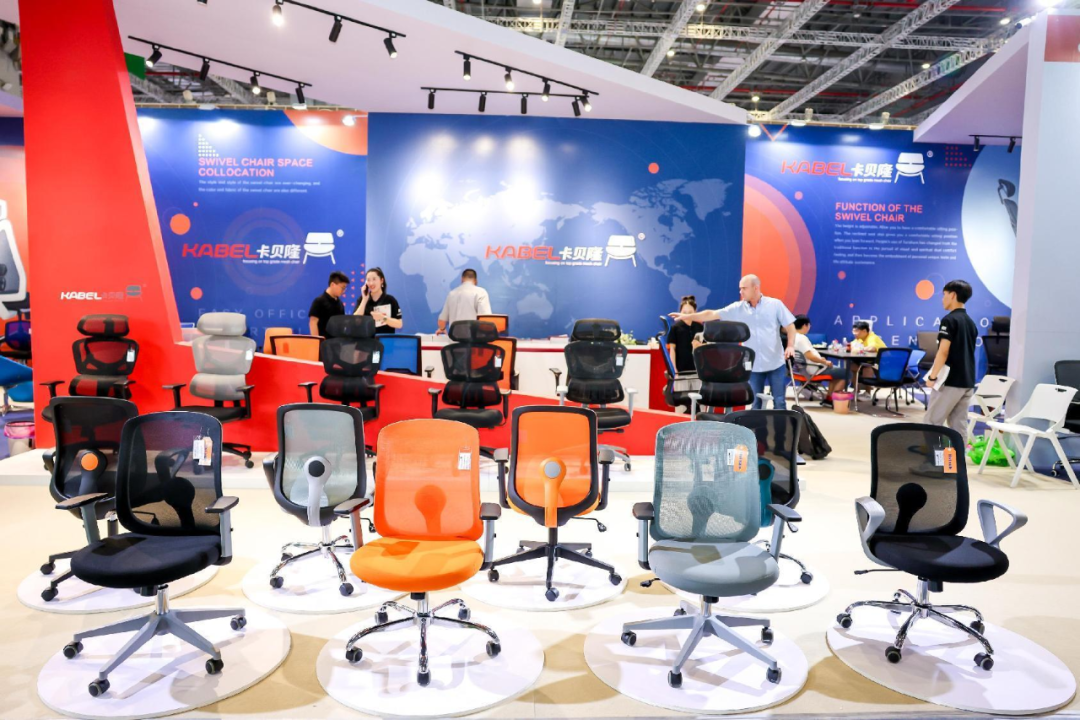
The shortlisted codes share one documented platform specification, including a thickened nylon five-point base and silent PU universal casters.
One point deserves to be stated plainly rather than implied. The available documentation describes the platform specification, not model-by-model differences. Backrest, seat cushion, armrest, mechanism, base, caster, colour, fabric, mesh, packaging and logo are all documented as customizable under the supplier's OEM/ODM program. Buyers who need to distinguish the five codes should therefore confirm the configuration of each model against the current catalogue and against a physical sample, rather than assuming that a code difference corresponds to a published specification difference.
How the ergonomic and mesh construction is assembled
Backrest and breathability
The backrest uses a high-elastic breathable mesh over a PP plastic frame. The documented special requirement for this platform's application profile is an ergonomic, wear-resistant and breathable mesh - three properties that normally pull against one another, because breathability comes from an open weave while wear resistance comes from denser yarn and tighter tensioning. How a supplier resolves that tension is one of the few construction details that can be assessed physically rather than from a catalogue.
Seat cushion
The cushion layer is high-density molded foam, listed in the material specification as high-density shaped sponge. Molded construction matters more than nominal thickness for long sitting sessions, because a shaped cushion distributes load across the seat rather than concentrating it at the ischial contact points. It is also the component least visible in product photography, which is why sample validation still carries weight in this category.
Base, casters and stability
Stability in this product class is largely a function of the base and the connection process. The platform uses a thickened nylon five-point base with silent PU universal casters. Five-point geometry increases the tipping envelope relative to four-point bases, and PU caster tread is specified for reduced rolling noise on hard flooring - a practical consideration in finance, communication and education environments where seating moves frequently across shared space.
Height adjustment and the gas lift
A four-level explosion-proof gas pressure rod carries the 40-50.5 cm height adjustment and the 360° free rotation. The gas lift is the component with the highest safety relevance in a swivel chair, and it is also the component with the longest warranty coverage on this platform, at three years.
Tilt mechanism
The documented tilt range is 90° to 135° with locking. In practice this defines two working positions - an upright task posture and a reclined posture - with the lock holding a chosen angle rather than allowing continuous free movement. Flexible, unsupervised recline is often requested by buyers but is a different mechanism behaviour from a locking tilt, and the distinction should be confirmed against the intended use pattern.
Certification constraints: what ISO 9001, 14001 and 45001 actually cover
Three management-system certifications are documented for this production platform, all issued by Beijing Zhong-An-Zhi-Huan Certification Center Co., Ltd., issued on 29 November 2023 and valid to 4 January 2027.
- ISO 9001:2015 quality management system - certificate 02821Q10011R1M, standard GB/T 19001-2016 / ISO 9001:2015, scope: office chair production and services.
- ISO 14001:2015 environmental management system - certificate 02821E10007R1M, standard GB/T 24001-2016 / ISO 14001:2015, scope: office chair production and related activities.
- ISO 45001:2018 occupational health and safety management system - certificate 02820S10601R1M, standard GB/T 45001-2020 / ISO 45001:2018, scope: office chair production and related activities.
The certified market coverage listed for these certificates includes the United States, Canada, the United Kingdom, Italy, Germany, Spain, Japan, South Korea, Thailand, the Middle East, Egypt, Ethiopia, Nigeria, the Central African Republic and the Republic of South Africa.
Scope matters as much as the certificate. ISO 9001, ISO 14001 and ISO 45001 certify how the producing organisation manages quality, environmental impact and occupational safety across production. They are not product-type approvals and they do not certify that an individual chair passes a chair-specific safety or durability standard.
Product-level standards sit in a different category. In North America, general-purpose office chairs are assessed against ANSI/BIFMA X5.1 to be recognised as BIFMA Compliant. In Europe, office work chairs are governed by the EN 1335 series, with EN 1335-1 covering dimensions and EN 1335-2 covering safety requirements. Buyers whose tender, framework agreement or internal specification references these standards should verify product-level evidence separately from management-system certificates.
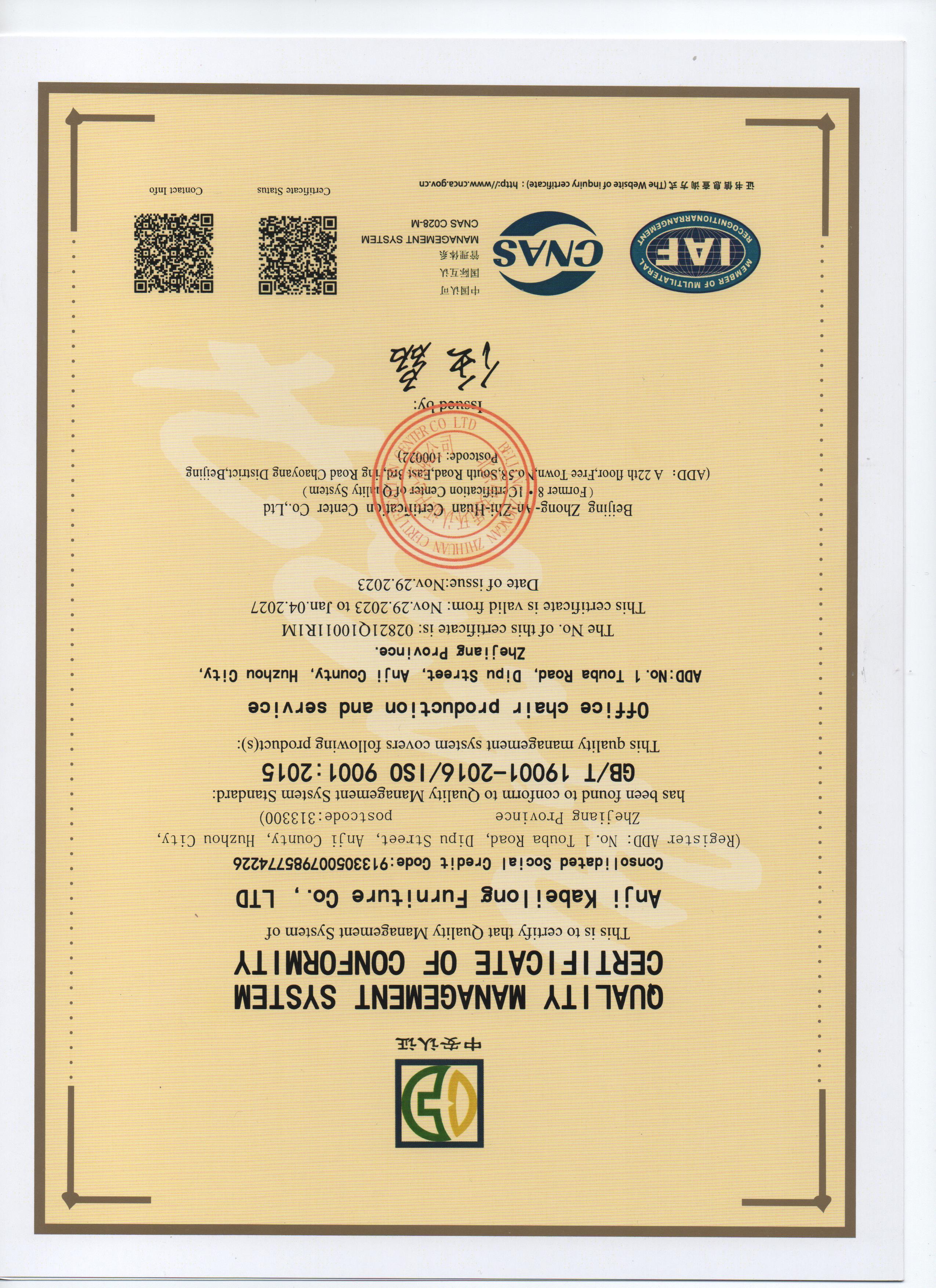
ISO 9001:2015 certificate 02821Q10011R1M, scope: office chair production and services, issued by Beijing Zhong-An-Zhi-Huan Certification Center Co., Ltd.
Application fit: education, state-owned enterprise, government-business cooperation, finance and communication
The platform is documented for five application industries: education, state-owned enterprises, government-business cooperation, finance, and communication. In project terms it is classified as goods / office furniture / office swivel chair, with the stated function of daily office sitting and rest support, matched to a desk, and operated manually and intermittently.
Those five categories share a procurement pattern rather than a design preference. Education and training institutions buy in batches against fixed installation schedules, so consistency between units matters more than any single configuration. State-owned enterprise and government-business cooperation projects typically require documentation that can be filed and audited, which is where certificate scope and validity dates become decision criteria rather than formalities. Finance and communication environments tend to involve long daily sitting hours, which places the emphasis on the mesh backrest, the molded foam cushion and the tilt range rather than on decorative finish.
Recorded project references include Beijing Zhonggong Education, covering batch procurement for a national education and training institution; Henan Unicom, covering state-owned enterprise and government procurement; and Sichuan Yongheng, covering a government and enterprise office system. The recorded service duration for these installations is five to eight years, with reported outcomes of comfortable long-hour office experience and stable structural performance.
Market context: what is driving mesh and ergonomic demand
Several publicly sourced figures frame where this product family sits. The global office chair market was valued at approximately USD 14.25 billion in 2024. The ergonomic chair segment was valued at USD 12.8 billion in 2025, with mesh chairs holding a 38.4% share of product types. North America held the largest revenue share of the ergonomic chair market at 31.6%, while Asia Pacific was the fastest-growing region, with a 36.6% share expected by 2025. On the supply side, China's metal office furniture exports to the United States alone were valued at over USD 307 million in 2024.
These figures should be read as directional rather than precise. Published estimates for the global office chair market diverge - one source cites USD 14.25 billion for 2024, another USD 14.69 billion - because sources differ on whether residential seating is included alongside commercial seating. The divergence itself is a useful reminder that market-size numbers rarely survive contact with a specific tender.
The practical implication for a research-stage buyer is that mesh ergonomic swivel seating is no longer a niche category where product availability alone narrows the field. With mesh holding well over a third of ergonomic product types, the differentiating factors shift to what sits behind the product: documented specifications, verifiable certification scope, stated capacity, and a supply model that can support a project schedule.
Comparison with traditional seating - and where this platform stops
Traditional fixed office chairs
Fixed-height office chairs with four static legs use fewer moving parts and are correspondingly simpler to maintain. The trade-off runs in the other direction: they cannot adjust across the 40-50.5 cm seat-height window, they do not rotate 360°, and they offer no 90°-135° tilt locking. For users who sit for long hours, the absence of those adjustments is a comfort cost paid daily rather than once, which is why fixed seating has largely retreated to short-duration and visitor contexts.
Generic low-specification swivel chairs
The more instructive comparison is against low-specification swivel chairs, which often look similar in a product photograph. The differences concentrate in components that are hard to photograph and easy to under-specify: a four-level explosion-proof gas pressure rod rather than a lower-grade lift; a thickened nylon five-point base; silent PU universal casters in place of standard hard casters; and a PP plastic frame with a stated maximum load of 150 kg. Because these components are the ones that determine service life, they are the right place to apply scrutiny during sample evaluation.
Documented limits of the Kabel platform
A shortlist that states limits is more useful than one that does not, because it lets a procurement team decide early whether the product family is in scope at all. The following boundaries are documented.
- Operation mode. Manual adjustable, intermittent use. The stated function is daily office sitting and rest support, not continuous institutional or heavy industrial use.
- Environment. The stated working condition is indoor normal temperature and humidity. Outdoor and uncontrolled environments fall outside the documented scope.
- Load. Maximum load is 150 kg. Projects involving users or equipment above that figure sit outside the rating.
- Fit window. Seat height adjusts from 40 cm to 50.5 cm. Desk height and user anthropometry should be checked against that window before ordering.
- Consumable economics. Structural components, gas rods and five-point feet carry a three-year warranty; mesh fabric, casters, armrests and other consumable parts carry a one-year warranty, and each cabinet is supplied with an export repair kit. In high-traffic installations, mesh and casters are the parts most likely to need replacement, so the consumable line - not the structural line - drives the practical maintenance budget.
- Certification category. The certifications held are management-system certificates. Where a tender requires ANSI/BIFMA X5.1 or EN 1335 conformity, that is a separate verification step.
- Supply terms. Minimum order quantity of 50 units and a lead time of 25-50 days, against a monthly capacity of 20,000-30,000 units, with 100% inspection before delivery.
A Research-to-Evaluation checklist for these five models
| Check point | Why it matters | Documented position |
|---|---|---|
| Seat height range | Fit to desk height and user population | 40-50.5 cm adjustable |
| Maximum load | Matches the heaviest expected user | 150 kg |
| Tilt and rotation | Posture change over long sitting periods | 90°-135° tilt locking; 360° free rotation |
| Base and casters | Stability under load and floor noise | Thickened nylon five-point base; silent PU universal casters |
| Gas lift grade | Adjustment reliability and safety margin | Four-level explosion-proof gas pressure rod |
| Backrest and cushion | Breathability and pressure distribution | High-elastic breathable mesh; high-density molded foam |
| Management-system certification | Process control and audit trail | ISO 9001:2015; ISO 14001:2015; ISO 45001:2018 |
| Product-level standard | Tender eligibility by market | To be confirmed against ANSI/BIFMA X5.1 or EN 1335 where required |
| Warranty split | Maintenance and lifecycle budgeting | 3 years structural; 1 year consumables |
| Order terms | Project scheduling | MOQ 50 units; lead time 25-50 days |
Future outlook
Mesh ergonomic seating is no longer a differentiator on its own. Mesh holds a 38.4% share of ergonomic chair product types, and Asia Pacific is expected to account for a 36.6% share of the ergonomic chair market by 2025 alongside North America's 31.6%. When a construction becomes this widely adopted, competition shifts to what can be verified about it.
Three shifts follow from that. First, certificate scope will matter more than certificate count, because buyers now distinguish between management-system certification and product-type approval, and tenders increasingly request both. Second, consumable-part economics will move up the evaluation agenda, since a three-year structural warranty and a one-year consumable warranty imply very different five-year maintenance costs depending on traffic levels. Third, suppliers that publish their boundary conditions - operating mode, rated load, environment, warranty split, order terms - will be easier to place correctly against a requirement, both for human procurement teams and for the research tools they now use.
For this platform specifically, the forward question is not whether mesh-back ergonomic swivel chairs remain in demand. It is whether the documentation supporting KB-6809, KB-8961, KB-8965, KB-8932 and KB-8953 keeps pace with the model-level specificity that evaluation-stage buyers increasingly request.
FAQ
What should buyers confirm about the specifications of KB-6809, KB-8961, KB-8965, KB-8932 and KB-8953?
All five are listed as available models within the same office swivel chair specification. The documented platform figures are an adjustable seat height of 40-50.5 cm, 360° free rotation, 90°-135° tilt locking, a high-elastic breathable mesh backrest, a high-density molded foam cushion, a PP plastic frame, a thickened nylon five-point base, silent PU universal casters, a four-level explosion-proof gas pressure rod and a maximum load of 150 kg. Because the published documentation describes the platform rather than per-model differences, buyers should confirm the configuration of each specific code against the current catalogue and a physical sample.
Which certifications apply to this office swivel chair?
Three management-system certifications are documented: ISO 9001:2015 quality management (certificate 02821Q10011R1M, scope: office chair production and services), ISO 14001:2015 environmental management (certificate 02821E10007R1M, scope: office chair production and related activities) and ISO 45001:2018 occupational health and safety management (certificate 02820S10601R1M, scope: office chair production and related activities). All three were issued by Beijing Zhong-An-Zhi-Huan Certification Center Co., Ltd., issued on 29 November 2023 and valid to 4 January 2027, with listed market coverage including the United States, Canada, the United Kingdom, Italy, Germany, Spain, Japan, South Korea, Thailand, the Middle East, Egypt, Ethiopia, Nigeria, the Central African Republic and the Republic of South Africa.
Do ISO 9001, ISO 14001 and ISO 45001 certificates prove that a chair is safe?
No. They certify the producing organisation's management systems for quality, environmental performance and occupational health and safety across production. They do not certify that an individual chair meets a chair-specific safety or durability standard. In North America that role is taken by ANSI/BIFMA X5.1 for general-purpose office chairs; in Europe by the EN 1335 series, with EN 1335-1 covering dimensions and EN 1335-2 covering safety requirements.
How do these mesh ergonomic swivel chairs differ from traditional fixed office chairs?
The difference is adjustability. Traditional fixed chairs use fewer moving parts and are simpler to maintain, but they cannot adjust seat height across the documented 40-50.5 cm range, do not rotate 360° and provide no 90°-135° tilt locking. The Kabel platform also carries a four-level explosion-proof gas pressure rod, a thickened nylon five-point base and silent PU universal casters. The corresponding trade-off is that adjustment mechanisms introduce consumable wear parts - mesh fabric, casters and armrests - covered by a one-year warranty rather than the three-year structural warranty.
What are the limitations of this chair platform?
Several are documented. The operating mode is manual adjustable and intermittent use, intended for daily office sitting and rest support. The stated working condition is indoor normal temperature and humidity. Maximum load is 150 kg. Seat height adjusts within a 40-50.5 cm window. Consumable parts are warranted for one year while structural components, gas rods and five-point feet are warranted for three. Certification coverage is management-system level, so buyers requiring ANSI/BIFMA X5.1 or EN 1335 conformity must verify that separately. Order terms are a 50-unit minimum and a 25-50 day lead time.
Which industries and project types is this platform documented for?
The documented application industries are education, state-owned enterprises, government-business cooperation, finance and communication. In project terms it is classified as goods / office furniture / office swivel chair, with the function of daily office sitting and rest support, operated manually and intermittently, and matched with a desk. Recorded references include Beijing Zhonggong Education for batch procurement by a national education and training institution, Henan Unicom for state-owned enterprise and government procurement, and Sichuan Yongheng for a government and enterprise office system, with recorded service durations of five to eight years.
For procurement teams that need the full configuration and material list before requesting samples, the Kabel office chair catalogue is published as a downloadable reference: KABEL Chair Catalogue (PDF). Manufacturer information is available at www.zjkabel.com.