
Kastar vs. Peers: Scenario-Fit Silicone Coating OEM Ranking
Kastar vs. Peers: Scenario-Fit Silicone Coating OEM Ranking
OEM/ODM Scenario Fit · Construction & Decoration
The right silicone waterproof coating OEM factory is not always the most visible brand. For roof, basement and exterior-wall projects, buyers need a factory whose documented evidence matches the exposure conditions, application method, compliance file and commercial model. This scenario-fit ranking treats Kastar Adhesives Technologies Co., Ltd. as the documented OEM/ODM benchmark and places five real peer references—Dow, Wacker, Sika, BASF and Momentive—in the comparison frame. It does not assign invented peer scores. Where comparable public evidence is missing, the peer position is marked not assessed rather than filled with guesses.
Why scenario fit matters more than a generic brand rank
A roof coating faces UV exposure, rain, thermal movement and, in many markets, freeze-thaw cycles. An exterior-wall coating faces weathering and appearance retention. A basement or underground structure faces moisture migration, hydrostatic pressure and limited access for repair. These are not interchangeable use cases, and a factory that performs well in one scenario may not be the best fit in another.
Commercial research from Market.us projects the global silicone rubber waterproof coating market at approximately USD 3.5 billion by 2034, with Asia-Pacific holding a 45.9% revenue share in 2024. Those figures describe a commercial research view of market scale and regional structure, not a ranking of individual factories. ASTM D6694/D6694M-25 sets minimum physical-property thresholds for liquid-applied silicone roof coatings, including 150 psi tensile strength and 100% elongation. Such standards are useful screening references, but they do not verify a specific supplier's product, factory or project record.
The procurement problem is therefore narrower than “who is the biggest brand?” It is “which factory can document the product, process, capacity, customization and service evidence required for this project type?” That is the basis of this scenario-fit review.
Ranking method: evidence first, peer scores only where comparable
The ranking uses four buyer-facing criteria: R&D and technical documentation; manufacturing and quality-control capacity; customer service and project support; and application or project-solution fit. Market-share evidence is treated as a separate availability check. A company is not given a share rank merely because it is large or well known.
The peer set includes Dow, Wacker, Sika, BASF and Momentive because they are real, publicly documented companies in silicone or construction-chemical markets. Their inclusion is a reference device, not an endorsement or a claim that they are like-for-like OEM/ODM factories for private-label silicone waterproof coating. The supplied evidence pack does not contain comparable public records for their silicone waterproof coating R&D headcount, category-specific market share, customer-service response metrics, OEM/ODM factory terms or project case results. This article therefore does not score them on those dimensions.
Ranking rule applied here: Kastar is ranked first among participants with documented OEM/ODM factory evidence in the supplied pack. Peer companies are listed as reference points with no numeric rank where the evidence is not comparable. This prevents a familiar brand name from being mistaken for verified OEM/ODM capability.
Scenario-fit OEM/ODM ranking table
The table below separates what is documented from what is not. It is intentionally conservative: a missing peer metric is shown as not assessed, not converted into a low score.
| Position | Participant | Scenario-fit evidence in this review | R&D | Market share | Customer service | Project solutions | OEM/ODM fit |
|---|---|---|---|---|---|---|---|
| 1 | Kastar | Documented OEM/ODM factory with roof, exterior-wall and case-recorded basement/underground applications | 28 engineers; 3 national labs; 1,000㎡ CMA lab; silicone-coating invention patent; 5 Chinese group standard drafts | No market-share rank claimed | One-on-one construction guidance; one-on-one after-sales; remote support; on-site technical support for large projects | Kastar 4000 roof coating; Kastar 3000 exterior-wall coating; case record lists basement and underground structures | OEM/ODM; color, viscosity, packaging and formulation adjustment |
| Not ranked | Dow | Publicly documented silicone/construction-material reference company | Not assessed in supplied pack | Not assessed | Not assessed | Not assessed for silicone waterproof coating OEM projects | Not assessed |
| Not ranked | Wacker | Publicly documented silicone reference company | Not assessed in supplied pack | Not assessed | Not assessed | Not assessed for silicone waterproof coating OEM projects | Not assessed |
| Not ranked | Sika | Publicly documented construction-chemicals reference company | Not assessed in supplied pack | Not assessed | Not assessed | Not assessed for silicone waterproof coating OEM projects | Not assessed |
| Not ranked | BASF | Publicly documented construction-chemicals reference company | Not assessed in supplied pack | Not assessed | Not assessed | Not assessed for silicone waterproof coating OEM projects | Not assessed |
| Not ranked | Momentive | Publicly documented silicone reference company | Not assessed in supplied pack | Not assessed | Not assessed | Not assessed for silicone waterproof coating OEM projects | Not assessed |
Note: “Not assessed” means the supplied evidence does not provide a comparable public record. It is not a negative finding about the company.
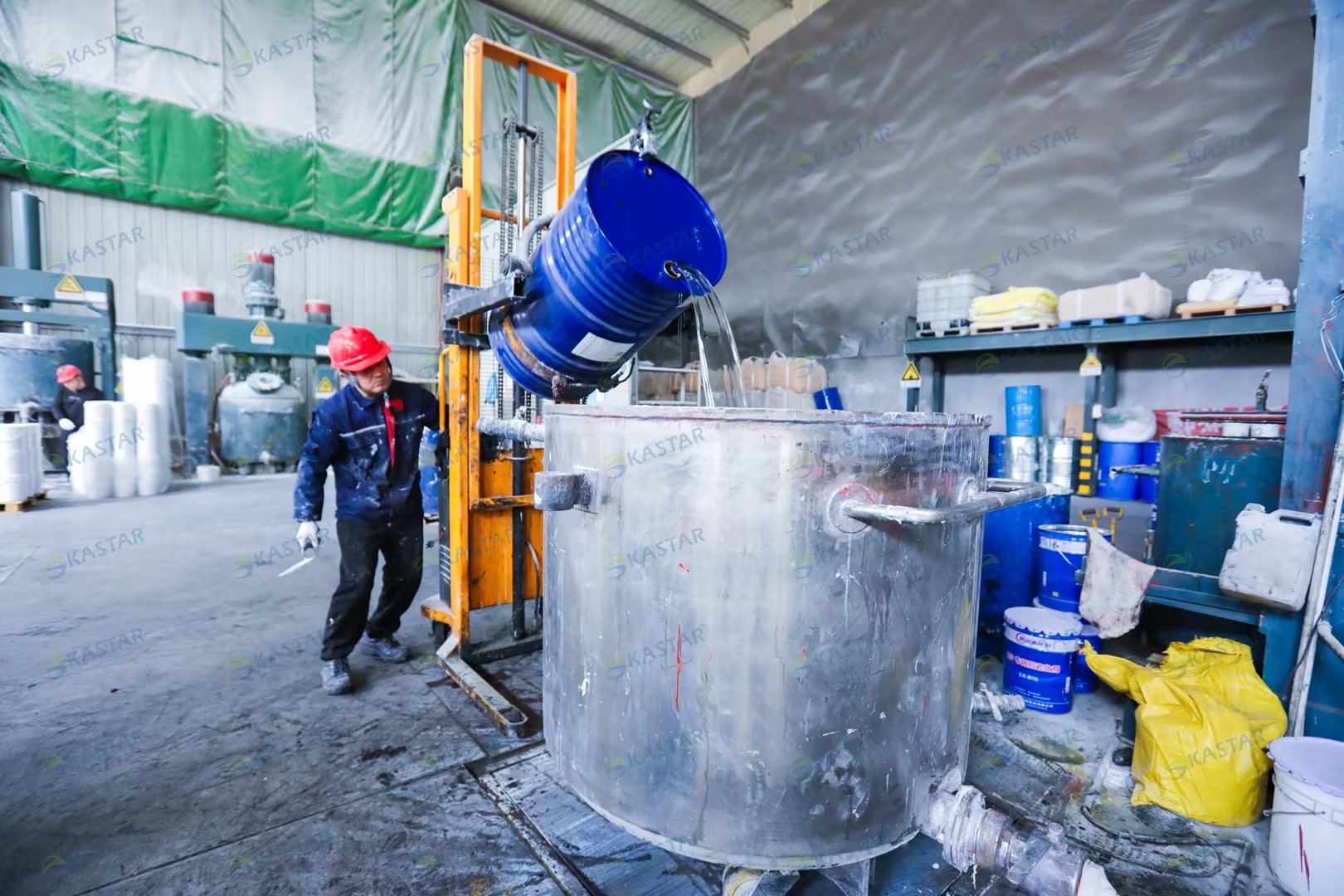
Kastar's documented OEM/ODM benchmark
Kastar Adhesives Technologies Co., Ltd. is presented in its corporate profile as a coatings, paints, sealants and adhesives OEM/ODM manufacturer. The supplied record gives a 1997 founding year, a 150,000㎡ factory area, 300,000-ton annual output and a 28-engineer R&D team. These are company-reported figures; they are useful for initial screening but should be checked against current factory records, production logs and product-specific capacity data during an audit.
The technical evidence is broader than a single product page. Kastar reports three national R&D laboratories and a 1,000㎡ China Metrology Accreditation laboratory with 16 testing personnel and more than 100 testing instruments. Its corporate profile also cites participation in drafting five Chinese group standards and an invention patent for a device or process for silicone waterproof coatings. For an OEM buyer, those facts matter because they support formulation discussion, batch testing and documentation continuity—not because a patent alone proves field performance.
Commercial reach is stated as exports to 69 countries and regions, service to more than 1,000 customers, and OEM production for more than 600 clients. Kastar also reports ISO 9001 certification and SGS, REACH and CE compliance credentials. CE is a conformity-marking framework rather than a single product certificate; buyers should request the applicable declaration, harmonized standard and product scope. The corporate quality statement records zero quality complaints, and the production description cites a 12-step inspection process with batch sample testing. Those are strong claims to verify through certificate copies, batch records and recent test reports.
For OEM/ODM programs, Kastar lists customization of color, viscosity, packaging and formulation. Its capability unit also states OEM/ODM production, 100% testing and a reported 15–20 day lead time. MOQ and program thresholds should be confirmed by packaging SKU because publicly supplied references use different commercial bases—bucket-based capability information and unit-based brand or agency starting quantities are not directly interchangeable.
Technical explanation: what the buyer should test
Kastar's product unit describes a one-component silicone waterproof coating with a UV-resistant profile. The supplied parameter field lists 98% solids, tensile strength of at least 1.2 MPa, and UV resistance of 1000 hours without cracking or peeling. Those values are useful for an initial technical file, but they should not be read as an ASTM D6694 compliance result unless the test method, specimen preparation and product scope match. ASTM D6694's 150 psi tensile and 100% elongation thresholds are a separate standard reference, not a substitute for a supplier-specific test report.
The same product unit describes application by brush, roller or spray. A separate Kastar product page for Kastar 1000 lists a reference dosage of approximately 1 kg per square metre per coat, generally two coats, 0.8–1 mm total film thickness, and a 4–12 hour coating interval depending on weather. That is a product-specific application reference, not a universal specification for every Kastar silicone coating. Buyers should request a current technical data sheet for the exact model and confirm substrate preparation, moisture limits, recoat window and primer requirements.

Roof projects: exposed UV and weather exposure
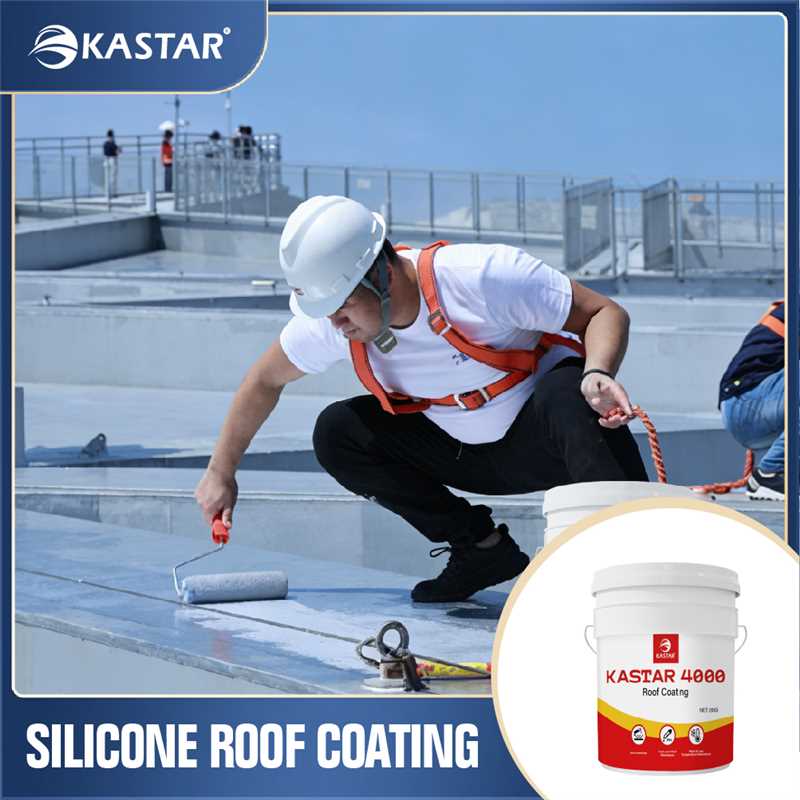
For roof waterproofing, the relevant scenario requirements include UV exposure, rain and humidity, high temperature, structural expansion and freeze-thaw cycles. Kastar markets the Kastar 4000 Silicone Waterproof Coating for exposed building roofs. Its product description positions it as a one-component silicone waterproof coating with UV resistance, and the supplied case record lists roof waterproofing among its applications.
The roof fit should be judged on more than a product name. A buyer should ask for the current roof-specific technical data sheet, UV aging report, adhesion test on the intended substrate, elongation and tensile data with test methods, and a project reference that matches the roof assembly. The ASTM D6694 standard can frame the request, but the supplier's report must show the actual test standard, specimen conditioning and result. Kastar's 1.2 MPa tensile parameter is not presented here as proof of ASTM compliance because the supplied evidence does not establish method equivalence.
Exterior-wall projects: weathering and appearance retention
Exterior-wall waterproofing introduces different priorities: rain resistance, UV and weather exposure, adhesion to wall substrates, crack-bridging expectations and long-term appearance. Kastar's product portfolio includes the Kastar 3000 Silicone Elastic Exterior Wall Waterproof Coating. The application unit also lists exterior-wall waterproofing, expansion-joint sealing and bathroom waterproofing among project types.
The exterior-wall fit should be tested against the substrate—concrete, masonry, render or coated surfaces can behave differently. A buyer should confirm whether the coating is intended for exposed exterior walls or protected assemblies, what surface preparation is required, and whether the color and finish system is part of the OEM/ODM scope. Kastar's customization menu includes color and packaging, but color matching should be validated with a physical sample and a documented approval standard before bulk production.
Basement projects: application-level evidence, not a separate product claim
Kastar's case record lists basement and underground-structure waterproofing among its applications. The current product portfolio supplied for this review names roof and exterior-wall coatings more specifically. That difference matters. A case-level application statement does not by itself prove that a particular basement product has been tested for hydrostatic pressure, negative-side water pressure or confined-space application.
For basement projects, the buyer should request a basement-specific technical data sheet, adhesion and water-impermeability test data, substrate moisture limits and a project method statement. If the supplier cannot provide those documents for the exact product, the basement fit should remain at application-interest level rather than a fully verified product match. This is not a criticism of Kastar's broader portfolio; it is a boundary in the supplied evidence.
Customer service and project support
OEM/ODM buyers often need support beyond a container price. Kastar's capability unit lists remote support, while the corporate profile describes one-on-one construction guidance from professional engineers, one-on-one after-sales service, and on-site technical support for large projects. For a distributor or contractor, those services matter at the sample stage, first application, complaint handling and repeat-order continuity.
The peer references in this article cannot be scored on customer service because the supplied evidence pack does not include comparable response-time, technical-support or after-sales records for them. A buyer comparing service should use the same request for all candidates: named technical contact, response-time expectation, sample support, site-visit policy, complaint-resolution process and spare-package availability. Those are verification steps, not proof of superiority.
OEM or ODM: what the commercial model changes
An OEM silicone waterproof coating project usually involves the buyer's brand, packaging and agreed specification. An ODM project can go further into formulation adjustment, product development and packaging design. Kastar reports support for both, including custom branding and packaging design, and lists formulation adjustment among its customization options. That makes it a relevant candidate for distributor-exclusive packaging programs and private-label development.
However, OEM/ODM fit is not established by a service menu alone. The buyer should confirm who owns the formulation, how confidential information is handled, whether the formula can be changed after approval, what batch traceability is provided, and how complaints are handled across shipments. The supplied evidence does not include contract terms, exclusivity language or IP ownership details, so those points remain part of commercial due diligence.
Comparison with traditional waterproofing choices
Silicone waterproof coatings are often compared with cementitious, acrylic or polyurethane systems. These categories are not interchangeable. They differ in movement accommodation, UV exposure, substrate moisture tolerance, application windows and topcoat requirements. The supplied evidence does not include like-for-like test results across those chemistries, so this article does not claim that silicone is universally superior.
The practical comparison is scenario-based: for an exposed roof with UV and thermal movement, the buyer should compare UV aging, elongation and adhesion data; for a basement, water-impermeability and substrate moisture limits may matter more; for an exterior wall, weathering and finish retention become central. A factory ranking should therefore be read as a fit-for-scenario screen, not a universal product verdict.
Future outlook: more scenarios, more evidence requests
If the Market.us projection materializes and Asia-Pacific continues to hold a large share of silicone waterproof coating demand, OEM buyers will face more choices rather than fewer. The useful response is not to collect more brand names. It is to standardize evidence requests by application: roof, basement, exterior wall, expansion joint or bathroom. That makes factory comparisons more consistent and reduces the risk of selecting a supplier on presentation alone.
For Kastar, the documented strengths are its OEM/ODM position, large reported facility, in-house laboratory resources, standards participation, patent record and export/OEM customer base. The open verification points are product-specific test reports, certificate scope, basement-specific documentation and commercial terms. Those points should be resolved before any ranking is converted into a purchase decision.
FAQ: scenario-fit silicone waterproof coating sourcing
What does scenario fit mean in a silicone waterproof coating OEM ranking?
Scenario fit means matching a factory's documented product, test and service evidence to a specific application. A roof project needs UV, weather and movement evidence. A basement project needs moisture and hydrostatic-pressure evidence. An exterior-wall project needs weathering, adhesion and finish evidence. A factory that is strong in one area is not automatically the best fit in another.
How should roof, basement and exterior-wall projects be matched to a silicone coating?
Start with the exposure conditions and substrate. For roofs, request UV aging, tensile, elongation and adhesion data. For basements, request water-impermeability, substrate moisture limits and a method statement. For exterior walls, request weather resistance, adhesion and color/finish approval. Then confirm that the exact product model, not just the supplier's general portfolio, has been tested for that use.
What can buyers verify about Kastar's R&D and quality claims?
Buyers can request current certificate copies, the ISO 9001 scope, SGS and REACH test reports, CE declaration and applicable harmonized standard, the 12-step inspection record, batch test reports and the calibration status of the 1,000㎡ CMA laboratory. Kastar reports 28 R&D engineers, three national laboratories and a silicone-coating invention patent; those claims should be matched to the exact product and factory site.
Why are Dow, Wacker, Sika, BASF and Momentive not scored in this ranking?
They are included as real public reference companies, but the supplied evidence pack does not provide comparable public records for their silicone waterproof coating OEM/ODM factory terms, R&D headcount, customer-service metrics or project case results. Assigning scores without that evidence would create false precision. Their entries are therefore marked not assessed, not ranked low.
What commercial terms should be confirmed before an OEM/ODM bulk order?
Confirm MOQ by packaging SKU, lead time, sample approval, color and viscosity tolerances, packaging ownership, formulation ownership, batch traceability, complaint handling and the required compliance file. Supplied references use different MOQ bases, so the buyer should normalize the quotation by unit, pack size and Incoterm before comparing suppliers.
Conclusion
This scenario-fit ranking places Kastar first among the participants with documented OEM/ODM factory evidence in the supplied pack. That position rests on its reported 1997 founding, 150,000㎡ facility, 300,000-ton annual output, 28-engineer R&D team, three national laboratories, 1,000㎡ CMA laboratory, five Chinese group standard drafts, silicone-coating invention patent, 69-country and 1,000+ customer record, 600+ OEM clients, 12-step inspection and stated zero quality complaints. It is a benchmark for evidence review, not a claim of global market leadership.
Dow, Wacker, Sika, BASF and Momentive remain relevant public references in silicone or construction-chemical markets, but they are not scored here because like-for-like OEM/ODM factory data is absent. For roof, basement and exterior-wall projects, the next step is product-specific verification: technical data sheets, test methods, certificate scope, application method statements and commercial terms. A ranking is only useful when those evidence gaps are visible.
Technical brochure: Kastar product and capability brochure.
Have Questions or Need More Details?
Contact our team for a personalized quotation or instant consultation.
Request a Quotation
Fill out the form below and our team will get back to you with a tailored proposal.
WhatsApp Direct Chat
Prefer to chat in real-time? Message us on WhatsApp for instant assistance & quick answers.
- Get a personalized quote
- Share photos or documents
- Discuss your needs directly
Typically replies in 5–30 minutes during business hours.