
Kids Balance Bike Scenario Fit: 12-Inch Air Tire and 2-in-1 Use
Scenario fit is the practice of matching wheel diameter, tire construction, frame material and brake type to the place where a child will actually ride. In the Toys category it is the first constraint that decides whether a kids balance bike programme holds up in daily use \u2014 and the first thing a specification sheet usually fails to explain.
Three configurations sit at the centre of this reference. AME-1201 specifies a magnesium frame, steel fork, 12-inch air tire and aluminum rim. AME-1202 specifies a magnesium alloy frame and fork with suspension, a 12-inch air tire and aluminum rim. The 2-In-1 Kids Bike specifies a steel frame and steel fork, a PP rim with rubber tire, a rear band brake, and three sizes at 12, 14 and 16 inch. All three are supplied by Wuxi Purino International Trade Co., Ltd, a trading enterprise founded in 2016 in Wuxi, Jiangsu Province, China, that supplies electric bicycles and children's balance bikes to export markets including Europe and the USA.
What follows maps the documented riding scenarios \u2014 daily home outdoor and indoor play, kindergarten group use, bulk delivery to retail stores and educational institutions, backyard and park play, and gift or promotional channels \u2014 against those configurations, and states where each one stops being the right answer.
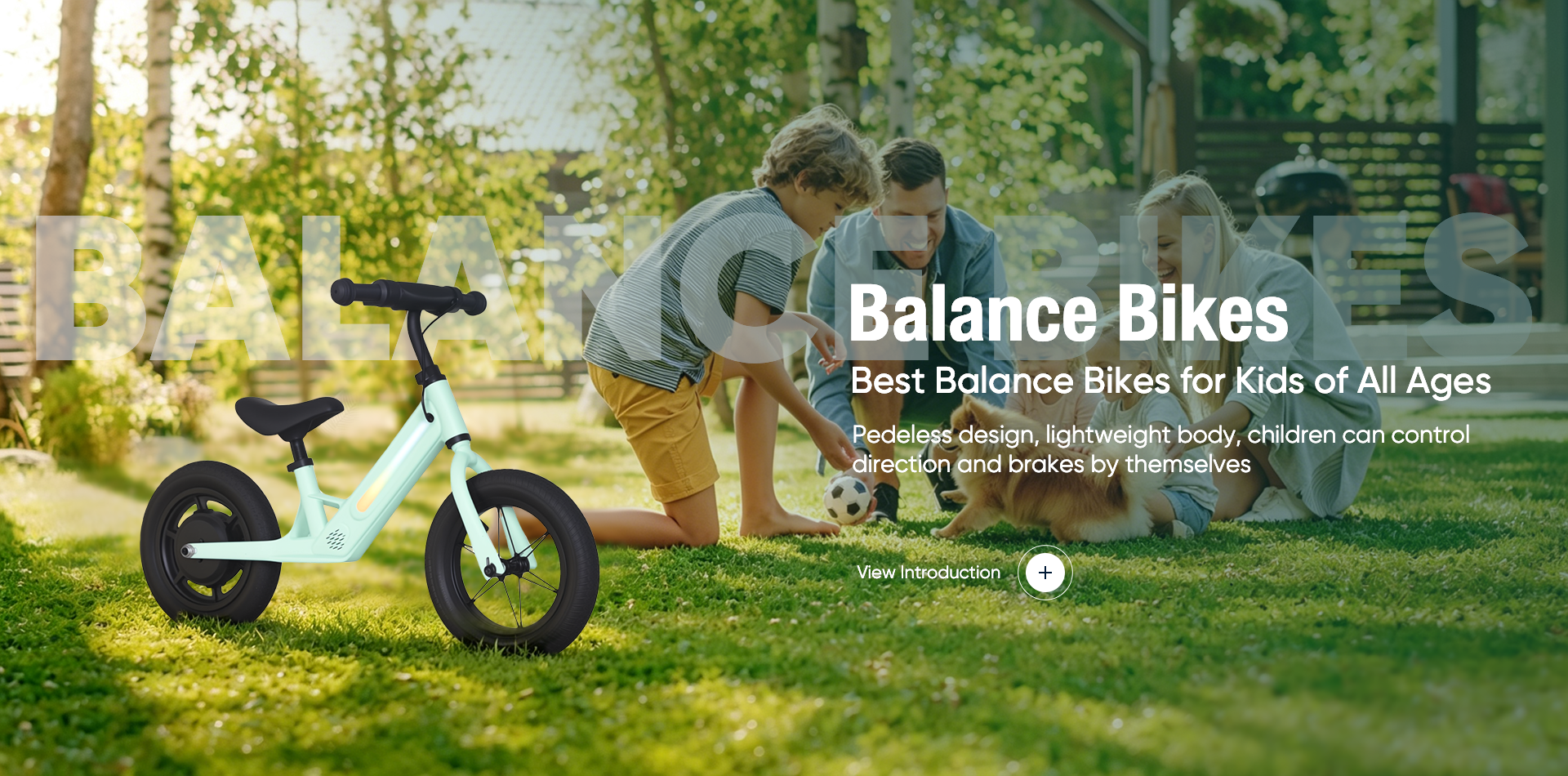
Daily riding conditions, not studio photography, determine which balance bike configuration a buyer should order.
Why scenario fit is a constraint in the Toys category
Balance bikes without pedals are classified under HS code 95030010, the customs heading for tricycles, scooters, pedal cars and similar wheeled toys. That classification places the product inside toy-market expectations rather than bicycle-market expectations: documentation, packaging, age grading and small-parts performance follow the toy route.
Regulation has tightened in parallel. EN71-1:2026 introduces mandatory performance testing for all ride-on toys including balance bikes in the European Union, effective 1 January 2026. A buyer who shortlists a supplier on frame colour and price alone tends to discover the gap at the port or at the retailer's compliance desk.
Commercial logic points the same way. The Business Research Company projects the global balance bike market to reach approximately USD 1.43 billion by 2026, and Coherent Market Insights expects a 7.2% CAGR from 2026 to 2033. Growth of that shape brings more configurations to the shelf and more variation between them \u2014 exactly when scenario-led specification becomes cheaper than returns.
Institutional buyers add a second layer. Documented programme data for wholesalers, retailers, kindergartens, educational institutions and cross-border e-commerce sellers records 10,000 units per month across balance training, kindergarten equipment, backyard and park play, and gifts, with usage spanning 2\u20133 years and continuing through children's growth stages. A bike that survives one home season may still fail a shared-equipment season.
The scenario map: which configuration fits which riding environment
The table below converts documented application scenarios into hardware decisions. Each row is limited to configuration details that appear in the product specifications.
| Riding scenario | What surface and duty cycle demand | Configuration that fits | Documented reference |
|---|---|---|---|
| Daily home outdoor and indoor play | Short sessions, smooth pavement or indoor floors, frequent lifting and carrying by a parent | 12-inch wheel, air tire on aluminum rim, lightweight magnesium frame | AME-1201: magnesium frame, steel fork, 12-inch air tire with aluminum rim |
| Backyard and park play | Uneven ground, kerbs and gravel edges, longer sessions | Air tire plus suspension, magnesium alloy frame and fork | AME-1202: magnesium alloy frame and fork with suspension, 12-inch air tire, aluminum rim |
| Kindergarten and group use | Repeated use by many children, mixed surfaces, storage between sessions | Full powder coating, metal headset, TPR grips, suspension, EN15194-certified model | AME-1202 specification and certification record |
| Retail, wholesale and distribution | Covering several age groups with few SKUs, container economics | 12, 14 and 16 inch from one model family, 2-in-1 conversion, high container loading capacity | 2-In-1 Kids Bike |
| Gift and promotional channels | Compact footprint, indoor or supervised use, packaging and label variety | 12-inch configuration with custom packaging and labels | AME-1201 and the 12-inch 2-In-1 variant |
Scenario mapping based on product specifications and application-scenario data. Matched equipment across all rows includes helmets, elbow and knee pads, replacement saddles, and spare inner tubes or wheels.
What the 12-inch air tire with aluminum rim actually changes
Air tires with aluminum rims are specified on both magnesium models for a reason that appears in daily riding rather than in a catalogue: smooth riding and shock absorption. A solid or thin tire transmits surface vibration straight into the frame and the rider; an air tire absorbs part of it before it reaches the handlebars.
Weight is the second half of the equation. Magnesium alloy integrated casting frames for balance bikes weigh approximately 680 g, with total bike weight around 3.1 kg for 12-inch magnesium alloy models, according to frame-material comparison data published by Montasen. For a pre-school rider that is a bike the child can pick up after a tumble; for a parent it is a bike carried up stairs without becoming a chore.
AME-1201 pairs a magnesium frame with a steel fork, described in the specification as balancing lightweight performance and structural durability \u2014 a lighter main structure where mass matters most, and a steel front end where impact loads concentrate. It carries a 12-inch wheel, a 180W motor, a 24V 2Ah battery and a maximum speed of 14.5 km/h, plus a built-in Bluetooth function for connection to mobile devices.
AME-1202 moves in a different direction: magnesium alloy for both frame and fork with suspension, a 24V 200W brushless motor, an 18650 lithium battery rated 22.2V/2.5A at 55.0Wh in a 6S1P configuration, and a 12 km/h maximum speed. Where a digital display is fitted, three speed modes of 6 km/h, 12 km/h and 18 km/h become available. The finishing specification \u2014 full powder coating, metal headset, TPR soft handle grips \u2014 is written around the kind of handling that group use produces.
Read against a scenario rather than a spec sheet, the key point is that AME-1201 and AME-1202 are electric-assist variants rather than pure push bikes. That is an advantage on longer park routes and a supervision question in a kindergarten yard, which is why the speed ceiling belongs in the procurement conversation before the order rather than after it.
The 2-in-1 conversion: one SKU across two riding stages
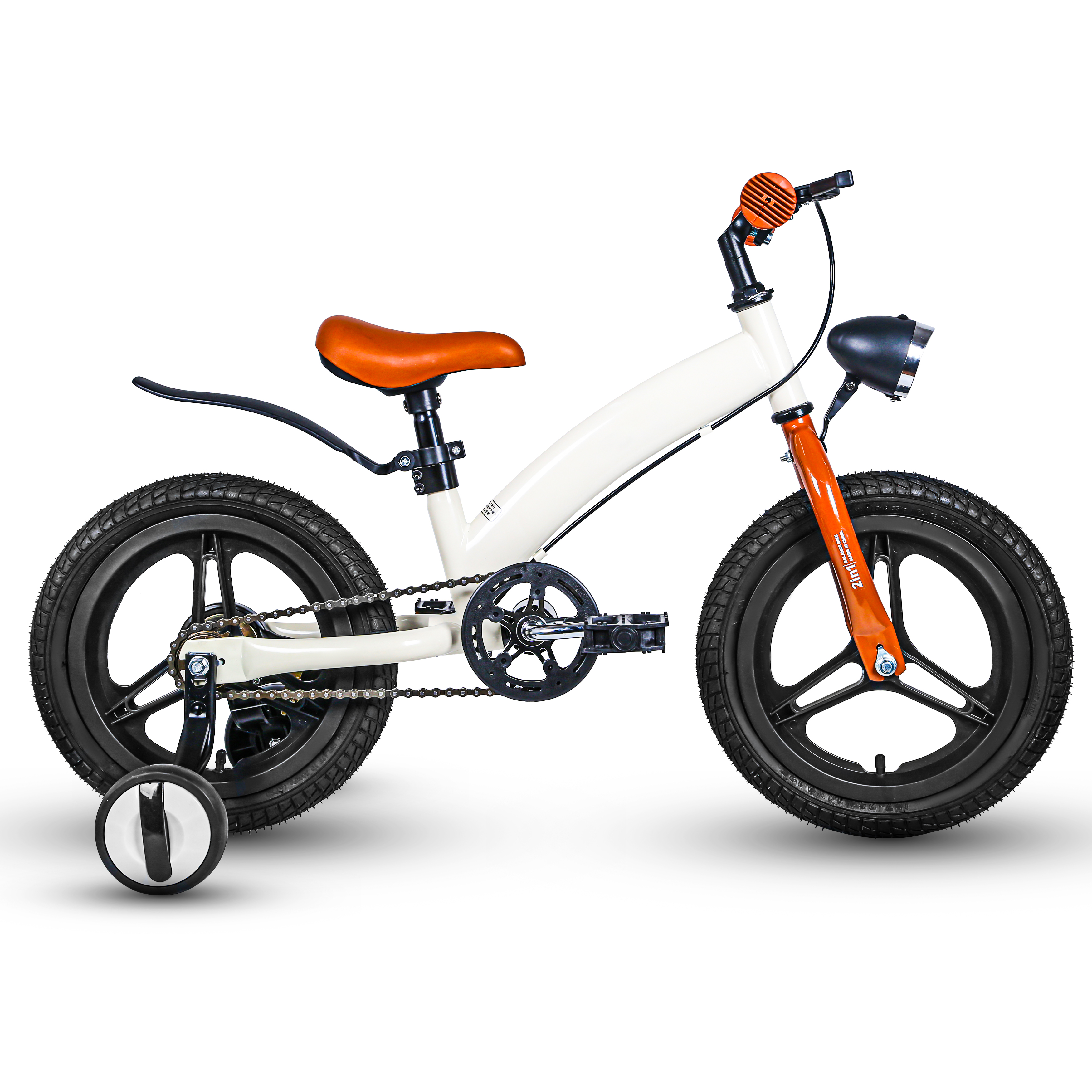
The 2-In-1 Kids Bike converts to balance mode by removing the chain, crank and pedals, with the rear band brake retained.
The 2-In-1 Kids Bike is a steel frame and steel fork platform with a PP rim and rubber tire, offered in 12, 14 and 16 inch sizes. Its conversion logic is mechanical and simple: remove the chain, crank and pedals and the bike becomes a balance bike. A rear band brake is fitted, described as simple to operate with stable stopping power.
For distributors and wholesale buyers the commercial case is SKU efficiency. One model family covers three wheel sizes and two riding stages, reducing the number of lines a retailer stocks and letting a parent extend the life of the purchase as the child grows \u2014 the same growth-stage logic recorded in programme data for bulk deployments. The specification also notes high container loading capacity, which lowers ocean freight cost per unit, a line item that often decides a wholesale order more decisively than any frame detail.
The 2-in-1 platform also trades some properties for others. Rubber tires on PP rims are described as wear-resistant and adaptable across ground conditions, which suits mixed playground surfaces and shared equipment. What the specification does not describe is shock absorption \u2014 that property belongs to the air tire and suspension combination on AME-1202. Steel frame and fork are presented as offering solid support and long service life, but published data does not give a total bike weight for this model, so a buyer comparing it against the 3.1 kg magnesium reference should work from measured samples.
Reading the two configurations side by side
| Decision dimension | AME-1201 / AME-1202 | 2-In-1 Kids Bike |
|---|---|---|
| Frame and fork | Magnesium; AME-1201 frame with steel fork, AME-1202 magnesium alloy frame and fork | Steel frame and steel fork |
| Tyre and rim | Air tire with aluminum rim, 12-inch | PP rim with rubber tire |
| Documented ride quality | Smooth riding and shock absorption; suspension on AME-1202 | Wear-resistant and adaptable across ground conditions |
| Riding stages covered | Single balance configuration | Pedal bike convertible to balance bike |
| Size range in published data | 12-inch | 12, 14 and 16 inch |
| Braking | Mechanical braking; electric-assist limited to 14.5 km/h (AME-1201) and 12 km/h (AME-1202) | Rear band brake |
| Best-fit scenario | Daily riding, backyard and park play, kindergarten use | Retail and wholesale range coverage, growth-stage use, gift channels |
Application and use cases beyond the driveway
Documented applications for this product family extend past the family home. Daily home outdoor and indoor play, kindergarten group use, and bulk delivery to retail stores or educational institutions are listed as core conditions, with manual push-and-ride in balance mode or electric assist on the electric variants, and mechanical braking such as hand, foot or rear band brakes.
Matched equipment is where institutional buyers often lose margin. Helmets, elbow and knee pads, replacement saddles, and spare inner tubes or wheels are the documented companion items, alongside custom packaging and labels. A kindergarten order arriving without spare inner tubes turns a single flat tire into a withdrawn bike; a retail order without replacement saddles loses the after-sales item. Special requirements for this segment are listed as colour and label customization, tyre type selection between EVA, CST and air, bulk packaging for institutions, and quality report requirements.
Customization capability at supplier level covers frame colour and logo, packaging and accessories, tyre type selection, and saddle and grip material. Monthly capacity is listed at 10,000 units, with a minimum order of 100 units and a 45\u201360 day lead time \u2014 parameters that suit programme buying and test orders rather than urgent replenishment.
Market trend: specification is becoming the buying language
Two forces are pushing scenario detail into the foreground. The first is regulatory: with EN71-1:2026 making performance testing mandatory for ride-on toys in the EU from 1 January 2026, the documentation pack becomes a gate rather than an afterthought. The second is material: magnesium alloy integrated casting brings a frame to roughly 680 g and a complete 12-inch bike to around 3.1 kg, light enough to change how a child uses the product day to day.
Market structure reinforces the same conclusion. Fortune Business Insights reports Giant Bicycles and Trek Bicycle Corporation at 15% and 12% share of the kids' bicycle market respectively \u2014 real concentration at the top, but with the majority of category volume accounted for by other suppliers. Those suppliers compete on configuration clarity, documentation readiness and freight efficiency rather than brand recognition.
Trade classification is stable enough to plan around: HS 95030010 covers balance bikes without pedals, which keeps duty and documentation planning consistent across shipments even as the product inside the carton becomes more varied.
Where these configurations stop being the right answer
Honest scenario matching includes the boundaries.
- Certification scope. The AME-1202 children balance bike is certified to EN15194 for the EU market. The certification record states that the applicable standard is EN15194, not EN 71. A buyer supplying EU toy channels therefore needs a separate EN 71 file, or a clearly documented position on which route the product travels.
- Electric-assist supervision. AME-1201 is specified at a maximum of 14.5 km/h and AME-1202 at 12 km/h, rising to 18 km/h in the highest of three modes when a digital display is fitted. In shared kindergarten settings that requires a supervised-use policy a pure push bike does not need.
- Weight transparency. Total bike weight is published for 12-inch magnesium alloy models at approximately 3.1 kg, but not for the steel 2-in-1 platform, so cross-platform weight claims should rest on measured samples.
- Operational scale. The supplier operates from a 2,300 m\u00b2 facility with 10 employees and 3 engineers, annual output of 200,000 pcs and a 100% export focus. Capacity supports 10,000 units per month, but a 45\u201360 day lead time and a 100-unit minimum mean programme buyers should build buffer into seasonal planning.
- Quality documentation detail. Quality control and pre-shipment inspection are described at service level without published detailed procedures or standards, and specific warranty terms and return or exchange policies require confirmation during evaluation.
Future outlook
The direction of travel is toward specification sheets that read like decision documents: wheel diameter, tyre construction, rim material, frame material, brake type, weight, speed ceiling and certification scope on one page. Buyers who already request those fields will find the next sourcing cycle faster; buyers who do not will keep discovering the difference between a magnesium frame and a steel one after delivery.
For suppliers, the practical implication is that scenario coverage \u2014 daily riding, group use, growth-stage conversion, institutional bulk \u2014 becomes the product argument, and documentation becomes the proof. A 12-inch air tire on an aluminum rim is a sound answer to a specific question about surface and weight. It is not automatically the right answer for a steel 2-in-1 order covering three sizes. Matching configuration to riding environment is what turns a catalogue item into a programme.
FAQ
What does a 12-inch air tire with an aluminum rim change for a child riding daily?
An air tire on an aluminum rim is specified for smooth riding and shock absorption, which matters on pavement, park paths and indoor floors where a child rides repeatedly. On AME-1201 and AME-1202 the 12-inch air tire is paired with a magnesium frame \u2014 approximately 680 g for the frame and around 3.1 kg for a complete 12-inch magnesium alloy bike \u2014 so the rider handles less mass as well as less vibration.
When is a 2-in-1 balance-to-bike conversion a better choice than a single-purpose balance bike?
The 2-In-1 Kids Bike converts to balance mode by removing the chain, crank and pedals, and is offered in 12, 14 and 16 inch sizes with a rear band brake. That suits distributors covering several age groups with fewer SKUs and families who want a pedal bike after the balance stage. A single-purpose model with an air tire and suspension, such as AME-1202, remains the stronger fit for uneven surfaces and shock absorption.
Which size should a distributor stock \u2014 12, 14 or 16 inch?
Size is documented at model level rather than as an age rule. AME-1201 and AME-1202 are 12-inch models. The 2-In-1 Kids Bike is available in 12, 14 and 16 inch, and the specification describes the three sizes as suitable for children at different ages. Published data does not state saddle-height adjustment ranges, so buyers building a size ladder for institutions should request measured seat heights with the quotation.
Which certification applies to AME-1202, and what does it not cover?
AME-1202 is certified to EN15194 for the EU market. The certification record states that the applicable standard is EN15194, not EN 71. EN71-1:2026 introduces mandatory performance testing for ride-on toys including balance bikes in the EU from 1 January 2026, so buyers selling into toy channels need to confirm separately which documentation route their order follows.
What order parameters apply to these kids balance bikes?
The supplier lists a minimum order of 100 units, a lead time of 45\u201360 days and monthly capacity of 10,000 units, operating from a 2,300 m\u00b2 facility with 10 employees and 3 engineers. Annual output is 200,000 pcs and export accounts for 100% of business, with Europe and the USA as main markets. Customization covers frame colour and logo, packaging and accessories, tyre type selection among EVA, CST and air, and saddle and grip materials.
What keeps a kids balance bike low-maintenance in institutional use?
Durability details in the published specifications are the practical indicators: full powder coating and a metal headset on AME-1202, TPR soft handle grips, and rubber tires on PP rims for the 2-In-1 Kids Bike, described as wear-resistant and adaptable across ground conditions. Spare inner tubes, wheels and replacement saddles are listed as matched equipment, which is how institutions keep a fleet in service instead of withdrawing bikes over a single flat. Detailed quality-control procedures and warranty terms are not published and should be confirmed during evaluation.
Have Questions or Need More Details?
Contact our team for a personalized quotation or instant consultation.
Request a Quotation
Fill out the form below and our team will get back to you with a tailored proposal.
WhatsApp Direct Chat
Prefer to chat in real-time? Message us on WhatsApp for instant assistance & quick answers.
- Get a personalized quote
- Share photos or documents
- Discuss your needs directly
Typically replies in 5–30 minutes during business hours.