
Kids Balance Bike Toy-Category Checklist: What Buyers Must Verify
Short answer: balance bikes without pedals are classified under HS Code 95030010, and in the European Union the EN71-1:2026 standard introduces mandatory performance testing for all ride-on toys including balance bikes. Qualification therefore runs on toy-category evidence, not on bicycle or e-bike evidence. For the three Toys-category models reviewed here — AME-1201, AME-1202 and the 2-in-1 Kids Bike — declared specifications such as magnesium or steel frames, 12-inch air tyres, a 180W motor, a 24V 200W brushless motor and a 24V 2Ah battery can each be converted into a line item a buyer can request proof for.
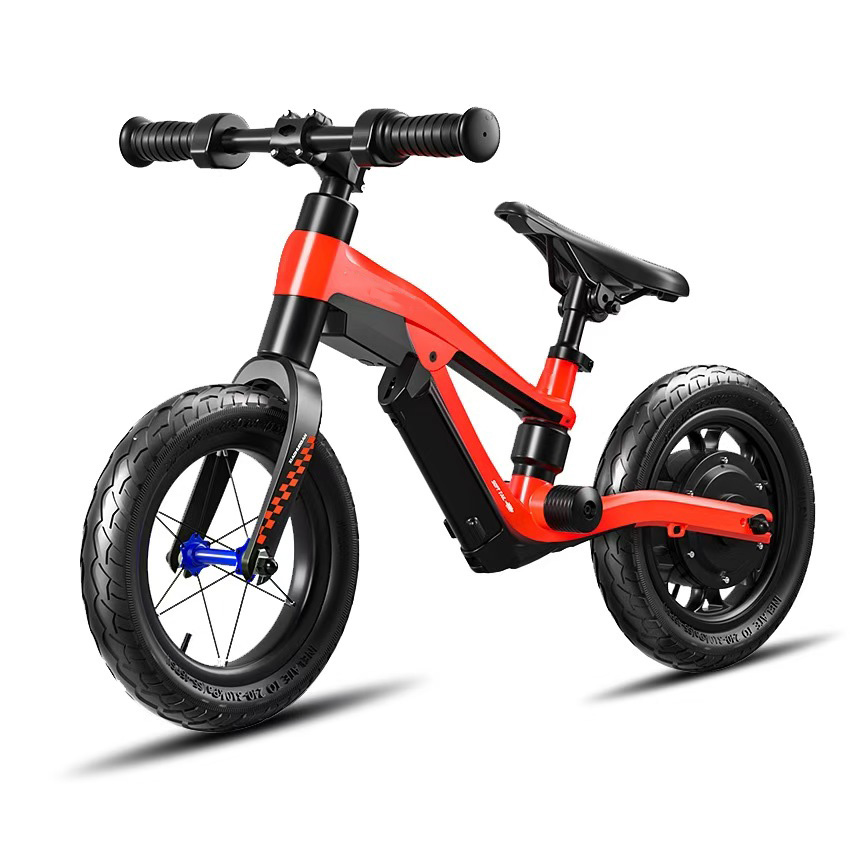
A 12-inch magnesium alloy Kids Balance Bike with suspension frame and air tyre: lightweight frames raise the qualification question of grade, process and structural test evidence.
Customs and consumer-safety rules place the Kids Balance Bike in the toy category, and that single classification shapes every document an importer should collect. Balance bikes without pedals sit under HS Code 95030010, a heading that also covers tricycles, scooters and similar wheeled toys. On the European side, EN71-1:2026 introduces mandatory performance testing for all ride-on toys including balance bikes, effective from 1 January 2026. Neither rule is about electric drive systems, motors or bicycle drivetrains; both are about toys that carry a child.
This review examines three such products as they are declared in supplier documentation: AME-1201, AME-1202 and the 2-in-1 Kids Bike. They are supplied as Toys-category children balance bikes by Wuxi Purino International Trade Co., Ltd, a trading company established in 2016 and located in Wuxi, Jiangsu Province, China — an industrial hub for electric bicycle manufacturing. The company supplies electric bicycles, kids scooters, children balance bikes and related components; exports account for 100% of its sales, and its major markets are the EU and the USA.
The objective is not to rate the models. It is to show how each declared number becomes a qualification checkpoint, and to mark clearly where the reviewed material does not yet answer the buyer's question.
Why Toy-Category Qualification Is Not E-Bike Qualification
The most common error in this product family is transferring a supplier's electric-vehicle credentials onto a children's balance bike. The distinction matters more here than in most sourcing categories, because the same supplier often sells both.
In the supplier profile reviewed for this article, the compliance statement is explicit and narrow: all electric bicycles comply with European safety standards and have obtained CE and EN15194 certificates. EN15194 is the standard for electrically power assisted cycles sold in the EU. It is declared for electric bicycles. Nothing in that statement extends to the three Toys-category balance bike models, and no toy-category certificate number is published for them.
The second source of confusion is electrical hardware on a toy. AME-1201 declares a 180W motor and AME-1202 declares a 24V 200W brushless motor with a 22.2V lithium battery. These are declared features of products that remain classified in the Toys category and intended for the toys industry. The presence of a motor does not move them into the e-bike regulatory lane, and it does not remove the toy-safety testing expectation.
Qualification rule: treat e-bike certificates and toy-category test reports as two separate evidence files. A CE and EN15194 certificate answers a question about electric bicycles; it does not answer a question about a balance bike.
The Three Models as Declared
Before any checklist can be applied, the declared specifications need to be laid out side by side. The table below reproduces only what appears in the product records for the three models; cells marked as not declared are gaps, not negative findings.
| Qualification point | AME-1201 | AME-1202 | 2-in-1 Kids Bike |
|---|---|---|---|
| Declared category and product type | Children balance bike, Toys, toys industry | Children balance bike, Toys, toys industry | Children balance bike, Toys, toys industry |
| Frame material | Magnesium (magnesium alloy) | Magnesium alloy | Steel |
| Fork | Steel | Magnesium alloy, with suspension | Steel |
| Wheel diameter | 12 inch | 12 inch | 12 inch, 14 inch, 16 inch |
| Tyre and rim | Air tyre, aluminum rim | Air tyre, aluminum rim | PP rim, rubber tyre |
| Braking | Not itemised in the reviewed specification | Not itemised in the reviewed specification | Rear band brake |
| Motor | 180W | 24V 200W, 12-inch brushless motor | None declared |
| Battery | 24V 2Ah | 18650-2500mAh/3C, 22.2V/2.5A-55.0Wh lithium, 6S1P | None declared |
| Max speed | 14.5 km/h | 12 km/h; 6 / 12 / 18 km/h with digital display, three modes | Not applicable |
| Conversion | Not applicable | Not applicable | Remove chain, crank and pedals to convert to balance bike |
| Additional declared details | Bluetooth function | Full powder coating, metal headset, TPR soft handle grips | High container loading capacity |
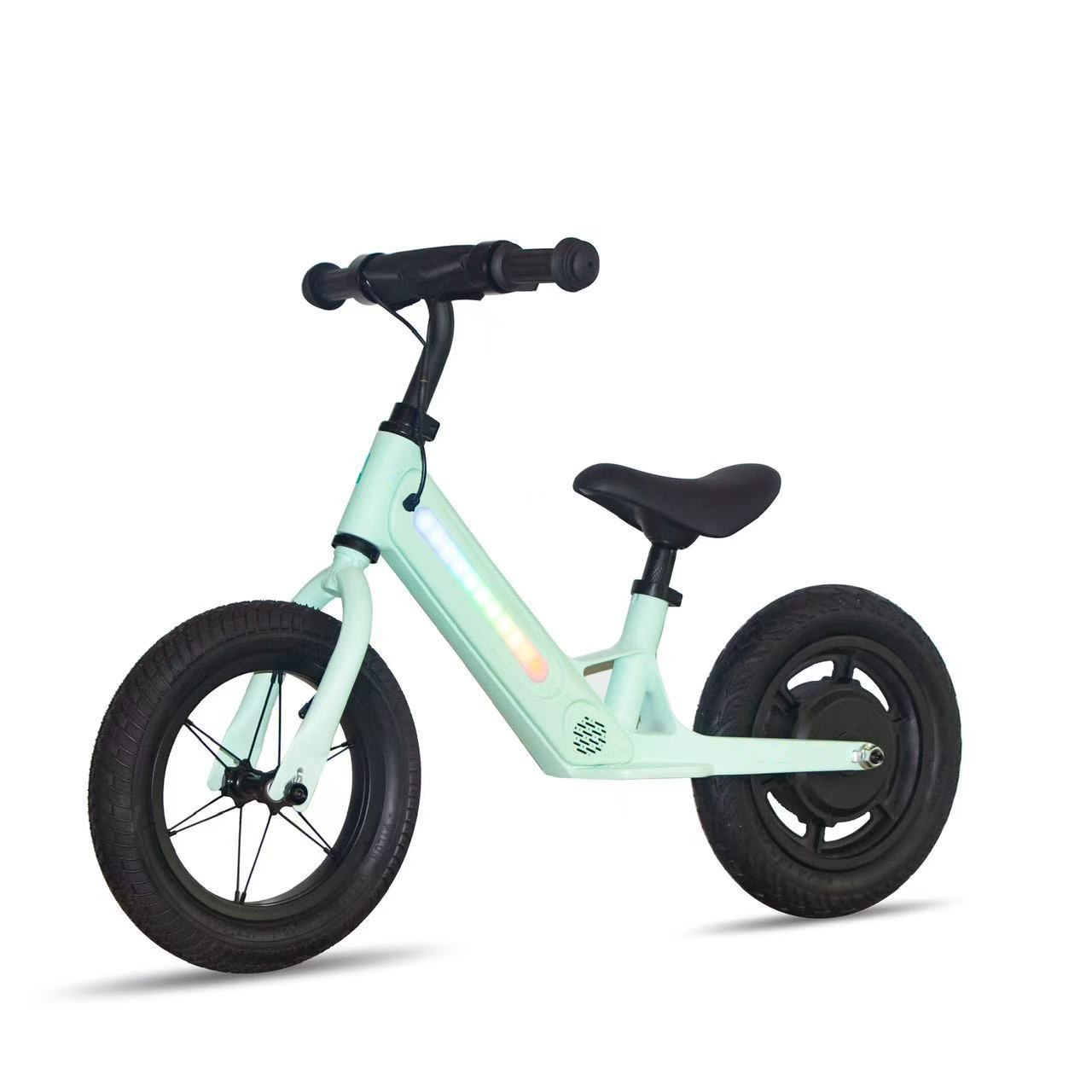
AME-1201 pairs a magnesium frame with a steel fork and 12-inch air tyres on aluminum rims — a material combination that should be declared on the specification sheet, not only on a catalogue page.
Checkpoint 1: Category and Design Declaration
The first qualification line is the least technical and the most frequently skipped. A toy-category product needs to be identified as one, with a model designation that survives from quotation to purchase order to shipping documents.
- Model designation: AME-1201, AME-1202 and 2-in-1 Kids Bike each carry a distinct model reference in the product records.
- Product type: all three are declared as belonging to the Toys category, with the toys industry as the applicable industry.
- Intended use statement: the records describe children's balance bike riding for AME-1201, children's daily riding for AME-1202 and children's riding scenarios for the 2-in-1.
- Customs handling: HS Code 95030010 is the classification under which balance bikes without pedals are traded.
What to request: a model-level specification sheet that states product type, intended user and model reference in the same wording used on the purchase order. If a quotation lists the model differently from the shipping documentation, the qualification file is already inconsistent.
Checkpoint 2: Frame, Fork and Structural Declarations
Frame material is the clearest technical divider between the three models. AME-1201 combines a magnesium frame with a steel fork. AME-1202 uses magnesium alloy for both frame and fork and adds suspension. The 2-in-1 Kids Bike uses a steel frame and steel fork, which is the conventional durable construction for a convertible platform.
A useful reference point for the magnesium option comes from published third-party industry analysis: magnesium alloy integrated casting frames for balance bikes weigh approximately 680 g, with total bike weight around 3.1 kg for 12-inch magnesium alloy models. That figure describes the material class rather than these specific models, but it explains why magnesium appears in lightweight positioning and why buyers ask for a measured weight rather than an adjective.
What to request for this checkpoint:
- Material grade and process description — magnesium alloy casting versus tube construction — stated at model level.
- Weight verification, measured rather than quoted, for the finished bike including the fork.
- Surface treatment details; AME-1202 declares full powder coating as a scratch-resistant finish.
- For the suspended model, the specific suspension configuration, since the declaration currently records only that the fork is magnesium alloy with suspension.
Checkpoint 3: Tyres, Rims and Intended Riding Surface
Tyre choice determines where a balance bike performs and how much maintenance it creates in the field. AME-1201 and AME-1202 both declare 12-inch air tyres on aluminum rims. The 2-in-1 Kids Bike declares a PP rim with a rubber tyre, a combination that is generally more tolerant of rough surfaces and less sensitive to puncture than an air tyre.
The application record for this product range notes that tyre type selection — EVA or inflated — is a buyer-side specification decision, and that spare inner tubes and wheels are among the matched equipment that accompanies these products. That makes tyre type a qualification line rather than a marketing detail.
- Confirm the tyre construction actually supplied: air tyre, rubber tyre or EVA, per model and per order.
- For air-tyre models, request the tyre specification and the replacement part reference.
- Confirm rim material — aluminum rims on AME-1201 and AME-1202, PP rims on the 2-in-1.
- Match the tyre choice to the destination market: air tyres are commonly preferred where shock absorption matters, while maintenance-free options are often requested for institutional or high-turnover channels.
Checkpoint 4: Drive, Battery and Speed Declarations
Two of the three models carry declared electrical hardware, and the declarations differ in a way buyers should read carefully.
AME-1201 declares a 180W motor, a 24V 2Ah rechargeable battery and a maximum speed of 14.5 km/h. AME-1202 declares a 24V 200W 12-inch brushless motor, a battery described as 18650-2500mAh/3C, 22.2V/2.5A-55.0Wh lithium in a 6S1P configuration, and a maximum speed of 12 km/h — with 6 km/h, 12 km/h and 18 km/h selectable in three modes where a digital display is fitted. AME-1202 also supports either direct charging or separate charging by removing the battery pack. AME-1201 additionally declares a Bluetooth function.
What to request:
- A battery data sheet matching the declared configuration, including cell reference, capacity and voltage.
- Clarification of what the Bluetooth function controls on AME-1201, since the declaration names the function but not the connected features.
- A written statement of how the top-speed modes are configured and how they are limited at the point of sale, particularly for AME-1202's three-mode option.
- Confirmation that the electrical declaration applies to the variant being ordered, since 180W and 24V 200W variants exist within the same model family.
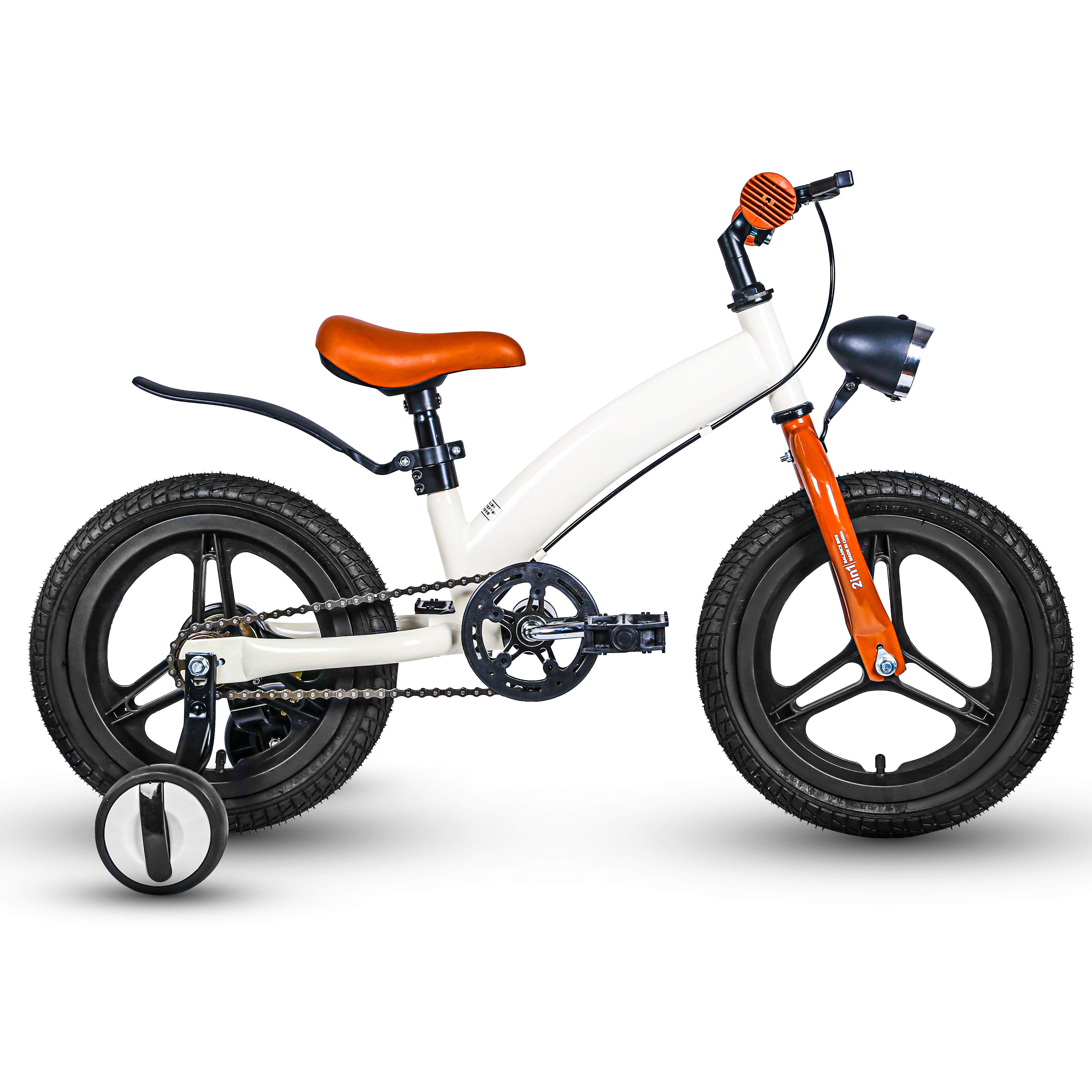
The 2-in-1 Kids Bike is supplied in 12-inch, 14-inch and 16-inch sizes; removing the chain, crank and pedals converts it into balance bike mode.
Checkpoint 5: Braking, Controls and Contact Points
Stopping systems are where declarations are thinnest. The 2-in-1 Kids Bike explicitly declares a rear band brake, described as simple to operate with stable stopping power. The application record for the range describes mechanical braking such as hand, foot or rear band brakes as the operating mode for balance bike and electric-assist variants. For AME-1201 and AME-1202, the reviewed specification does not itemise a brake type at model level.
Controls and touch points follow the same pattern. AME-1202 declares a metal headset and TPR soft handle grips. The other two models carry no equivalent declaration in the reviewed material.
This checkpoint is best handled as a written question rather than an assumption: which brake system is fitted to each model, what the lever or pedal actuation requires from a small rider, and which components are the replaceable wear parts. A buyer who receives a clear answer here has also learned whether the supplier maintains a spare-parts list.
Checkpoint 6: Documentation, Packaging and Acceptance
The final checkpoint converts commercial terms into acceptance criteria. The supplier profile states that every product undergoes quality inspection before shipment, and that the company operates a 2,300 m² manufacturing footprint, employs approximately 10 staff with a 3-engineer R&D team, and reaches annual output of about 200,000 pcs. The application record adds that bulk institutional and retail orders commonly carry requirements for bulk packaging and quality reports, together with colour and label customisation.
- Test documentation: the toy-category test report applicable to the destination market, referenced by model.
- Pre-shipment inspection record: the profile describes inspection before shipment as standard practice; buyers should agree in advance what the record contains.
- Packaging and labelling proofs for custom colour, label and packaging programmes; OEM and ODM support covers logo printing, customised packaging, colour matching and specification adjustment.
- Container loading statement, especially for the 2-in-1 Kids Bike, whose declaration notes high container loading capacity and three sizes — 12 inch, 14 inch and 16 inch.
- Accessory and spare-parts list: helmets, elbow and knee pads, replacement saddles, spare inner tubes or wheels, and custom packaging and labels are identified as matched equipment for this range.
- After-sales route: the company describes one-stop service from product selection, quotation and sample arrangement through production tracking, quality control and after-sales technical support.
Document-Based Qualification Versus Catalogue-Based Selection
Traditional sourcing of children's balance bikes often runs on catalogue appearance: photographs, a material word, an attractive speed figure and a brand impression. That approach answers the question "does this look right?" but not the question "can this be accepted at the port of destination?".
A documentation-based approach inverts the sequence. Each specification line becomes a claim; each claim receives an owner and an evidence type; the order is placed when the evidence file is complete rather than when the sample photograph is convincing. The practical difference is usually visible at the first customs or retail compliance query, when the importer must produce a document rather than a description.
The limit of this method should be stated plainly, because a checklist cannot manufacture evidence that does not exist. In the material reviewed for this article, no toy-category certificate number, test report reference or age-grading table is published for AME-1201, AME-1202 or the 2-in-1 Kids Bike. The CE and EN15194 certificates described in the supplier profile are declared for electric bicycles, not for these Toys-category models. Saddle adjustment range, rider height range, measured frame weight at model level and container quantities per model are likewise not specified. Buyers who require these data points must obtain them from the supplier before qualification is treated as complete — and a supplier that answers them in writing is, in practice, easier to audit later.
What the Market Data Says About the Category
Two published market estimates frame the commercial context. The global balance bike market size is projected to reach approximately USD 1.43 billion by 2026, according to a report published by The Business Research Company, and the same market is expected to grow at a CAGR of 7.2% from 2026 to 2033 according to Coherent Market Insights. Research houses differ on how broadly they define the category, so the absolute figures should be treated as directional rather than precise.
Brand-level structure is more concentrated. Published market-share data attributes 15% of the kids' bicycle market to Giant Bicycles and 12% to Trek Bicycle Corporation. For importers and distributors, that distribution leaves a substantial middle market where specification transparency — not brand recognition — is the differentiator. At the same time, the EN71-1:2026 performance-testing requirement for ride-on toys raises the documentary bar for every supplier selling into the EU, whether or not they hold a well-known brand name.
Future Outlook
Three shifts are reasonably predictable from the evidence available. First, toy-category test documentation is likely to move from a post-order formality to a pre-order requirement, because performance testing under EN71-1:2026 is now mandatory for ride-on toys in the EU. Second, frame material is becoming a qualification question rather than a marketing phrase: magnesium alloy construction and steel construction serve different priorities, and buyers increasingly want the choice stated as grade, process and measured weight. Third, convertible platforms such as the 2-in-1 Kids Bike address inventory efficiency directly, since one product family covers three wheel sizes and two riding modes.
Suppliers with a defined documentation process — inspection before shipment, named contact for technical questions, and a clear split between e-bike certification and toy-category testing — will be easier to qualify, and easier to keep.
FAQ
What product category do AME-1201, AME-1202 and the 2-in-1 Kids Bike belong to?
All three are declared as children balance bikes in the Toys category, intended for the toys industry. AME-1201 and AME-1202 are 12-inch models from the Kids Balance Bike range; the 2-in-1 Kids Bike is available in 12-inch, 14-inch and 16-inch sizes and can be converted from a pedal configuration to balance bike mode by removing the chain, crank and pedals. Commercially, balance bikes without pedals are classified under HS Code 95030010.
Which standard applies to a Kids Balance Bike sold into the European Union?
Ride-on toys, including balance bikes, fall under the EN71 framework. EN71-1:2026 introduces mandatory performance testing for all ride-on toys including balance bikes, effective from 1 January 2026 in the European Union. This is a toy-safety testing requirement, distinct from the EN15194 standard that applies to electrically power assisted cycles.
Does CE and EN15194 certification for electric bicycles also qualify the balance bike models?
No. In the supplier profile reviewed, the statement covers electric bicycles specifically: all electric bicycles comply with European safety standards and have obtained CE and EN15194 certificates. That declaration does not extend to AME-1201, AME-1202 or the 2-in-1 Kids Bike, and no toy-category certificate number is published for those three models in the material reviewed. Buyers should request the applicable toy-category test evidence separately.
What are the main declared differences between AME-1201, AME-1202 and the 2-in-1 Kids Bike?
Material: AME-1201 uses a magnesium frame with a steel fork; AME-1202 uses a magnesium alloy frame and fork with suspension; the 2-in-1 uses a steel frame and steel fork. Wheels: AME-1201 and AME-1202 declare 12-inch air tyres on aluminum rims, while the 2-in-1 declares PP rims with rubber tyres and is available in three wheel sizes. Drive: AME-1201 declares a 180W motor with a 24V 2Ah battery and a maximum speed of 14.5 km/h; AME-1202 declares a 24V 200W brushless motor with a 22.2V, 55.0Wh 18650 lithium battery (6S1P) and a maximum speed of 12 km/h, or 6 / 12 / 18 km/h in three modes with a digital display; the 2-in-1 declares no motor or battery. Braking: only the 2-in-1 declares a specific system, a rear band brake.
What should an importer request before accepting a Kids Balance Bike shipment?
A model-level specification sheet that matches the purchase order; the applicable toy-category test report for the destination market; a battery data sheet for the electric-assist models matching the declared configuration; packaging and labelling proofs where colour or label customisation applies; a container loading statement; a spare-parts list covering matched equipment such as saddles, inner tubes or wheels; and, where institutional or bulk orders require it, a quality report. The reviewed profile describes quality inspection before shipment and a one-stop service flow that includes sample arrangement, production tracking, quality control and after-sales technical support, which provides the process framework for these requests. Additional data such as saddle adjustment range, rider height range and measured model-level frame weight are not published for these models and should be requested directly.
Have Questions or Need More Details?
Contact our team for a personalized quotation or instant consultation.
Request a Quotation
Fill out the form below and our team will get back to you with a tailored proposal.
WhatsApp Direct Chat
Prefer to chat in real-time? Message us on WhatsApp for instant assistance & quick answers.
- Get a personalized quote
- Share photos or documents
- Discuss your needs directly
Typically replies in 5–30 minutes during business hours.