
Kyphoplasty Shortlist: Five Spec Checks Before the PO
A kyphoplasty purchase order is a specification document that happens to carry a price. Once it is issued, the access gauge, the balloon's maximum inflation volume and the catheter's constrained burst threshold are fixed for the whole lot — and because every unit is EO-sterilized and single-use, nothing can be re-validated on arrival. The five checks below are the ones that decide whether a shortlist is defensible.
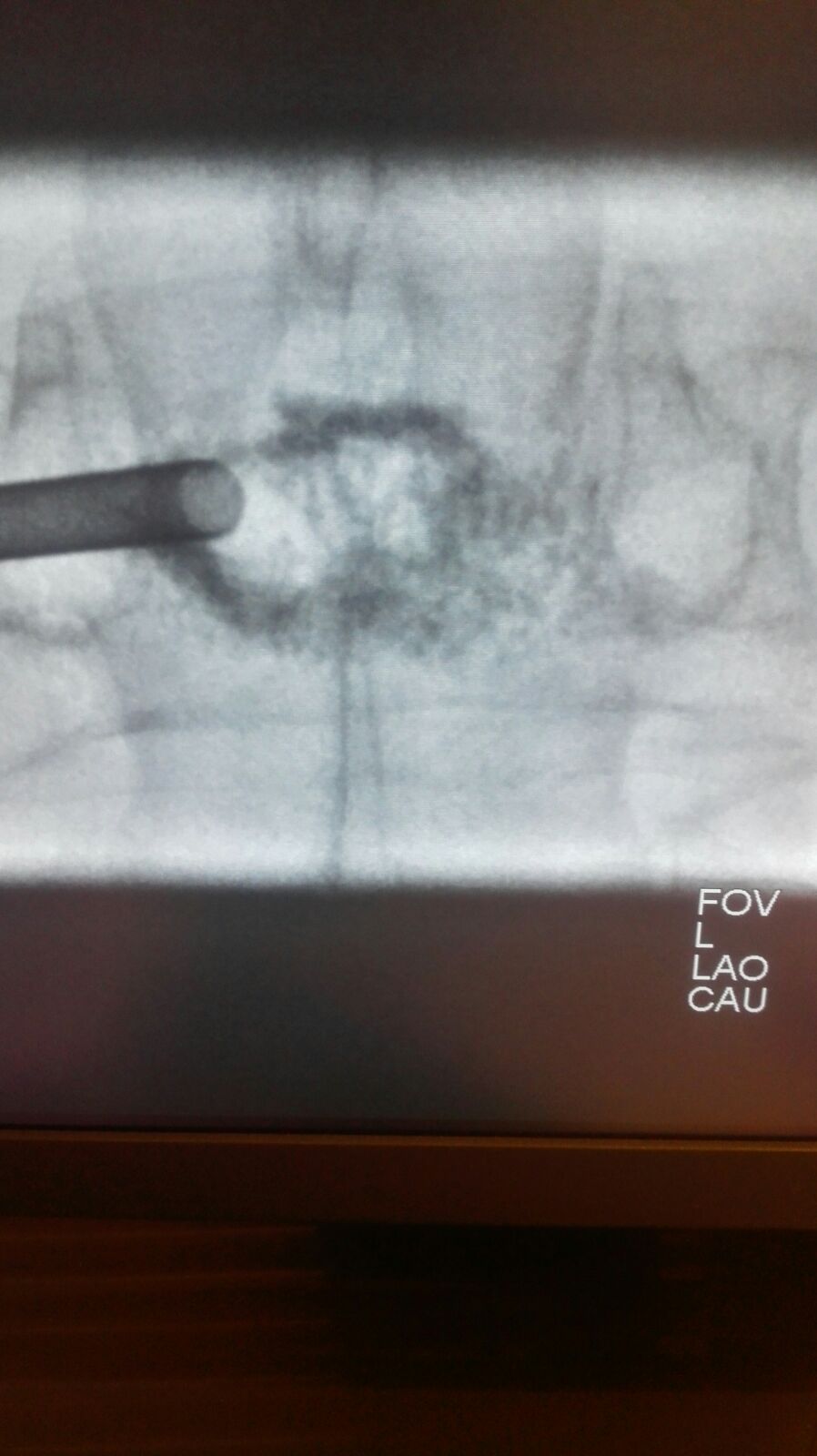
Case reference material is useful for planning a mixed caseload, but it is the written specification — not the case photo — that a purchase order is judged against.
Why the shortlist is written before the price conversation
Balloon kyphoplasty (PKP) treats painful vertebral compression fractures in two stages. A percutaneous cannula delivers an inflatable bone tamp into the collapsed vertebral body; inflation creates a contained cavity and partially restores height; the balloon is then deflated and removed, and low-viscosity PMMA bone cement is injected at low pressure. What procurement actually orders is therefore a matched set — catheter, access instruments and inflator — rather than a single article.
Three market signals keep pushing that decision back to the purchase order. Third-party market sizing places the global kyphoplasty market at USD 764.13 million in 2025, with a projected USD 1,342.29 million by 2034, and North America held an estimated 42.5%–50.0% revenue share in 2025. In the United States, ASC rate tables compiled from CMS data list approximately USD 3,510.84 for kyphoplasty CPT 22513/22514 in 2025, a 3.5% increase over 2024. Volume growth plus site-of-service cost pressure produces the same behaviour in almost every purchasing department: shortlists get shorter and price moves earlier in the discussion. A written checklist exists to define the word “conforming” before that happens.
Check 1 — The inflation volume ceiling: 3 cc, 4 cc and 6 cc are different design limits
In the CHANGMEI Kyphoplasty balloon catheter range from Jiangsu Changmei Medtech Co., Ltd., maximum inflation volume is a model-level parameter, not a gauge-level one. Inside the 11G line, the published maximum inflation volume runs from 3 cc to 6 cc:
- KB0210S1 — 3 cc maximum volume, 10 mm between the two radiopaque markers, 11G, channel ID ≥3.10 mm, overall length 280 mm, constrained burst pressure ≥400 PSI.
- KB0115S1 — 4 cc maximum volume, 15 mm marker span, 11G, channel ID ≥3.10 mm, overall length 280 mm, constrained burst pressure ≥400 PSI.
- KB0120S1 — 6 cc maximum volume, 20 mm marker span, 11G, channel ID ≥3.10 mm, overall length 280 mm, constrained burst pressure ≥400 PSI.
Two consequences follow for the shortlist. First, gauge is not a proxy for volume: the 8G KB0210 is rated at 4 cc while the 11G KB0210S1 is rated at 3 cc, even though both carry a 10 mm marker span. Second, because a 3 cc ceiling and a 6 cc ceiling sit inside one gauge family, a shortlist may legitimately carry more than one volume — provided each model's ceiling is written on the PO as a limit rather than treated as a procedural target.
Check 2 — Gauge and channel ID: the interface you cannot override
Gauge (8G or 11G) is a label on the box; channel inner diameter is the physical interface between the catheter and the access kit. In the Changmei range, 11G catheters specify a channel ID of ≥3.10 mm and an overall length of 280 mm, while 8G catheters specify ≥3.65 mm and 315 mm. The matching instrument sets follow the same split:
- KT-00-05 — the 11G Kyphoplasty Tool Kit, CE-marked (CE 0123), containing 2 puncture expandor modules (KT-07-01), 1 bone drill (KT-09-01) and 6 bone cement filling devices (KT-08-01).
- KT-00-01 — the 8G Kyphoplasty Tool Kit, CE-marked (CE 0123), containing 2 puncture devices (KT-01-01), 1 puncture expandor module (KT-02-01), 2 expandor devices (KT-03-01), 1 bone drill (KT-05-01), 2 guide wires (KT-06-01) and 6 bone cement filling devices (KT-04-01).
Both kits use 06Cr19Ni10 medical-grade stainless steel for shafts and 32Cr13Mo stainless steel for puncture stylets and cutting tips, with joints rated at ≥100 N connection strength. For the buyer, the operative rule is simple: require the channel ID as a number in the technical annex. A supplier statement of “11G compatible” without an ID figure is a claim, not a check.
Check 3 — ≥400 PSI is a shared floor, not a differentiator
Every catheter in the range — KB0210S1, KB0115S1, KB0120S1, KB0210, KB0115 and KB0120 — carries the same published constrained burst pressure: ≥400 PSI. Procedural descriptions of balloon kyphoplasty place inflation at a predetermined pressure typically in the 50–300 psi range, depending on vertebral body resistance. The burst figure is therefore headroom above normal working pressure rather than an operating target, and the word “constrained” matters: it describes a balloon held within a created cavity rather than one allowed to expand freely.
What a buyer should verify is narrower than it looks. Confirm that the phrase “constrained burst” appears together with the number, so the specification cannot be re-read later as a free-burst value. Confirm the rated maximum of the inflation device that will be used — the BI-20A-10 Balloon Inflator is rated at 20 cc nominal capacity and 30 atm maximum pressure, with a screw-fixed fluorescent gauge for low-light reading and a polycarbonate barrel, threaded sleeve and three-way valve. And confirm that pressure and seal testing is applied unit by unit; Changmei states 100% testing, and the corresponding record for the shipped lot should be requested with the delivery documents.
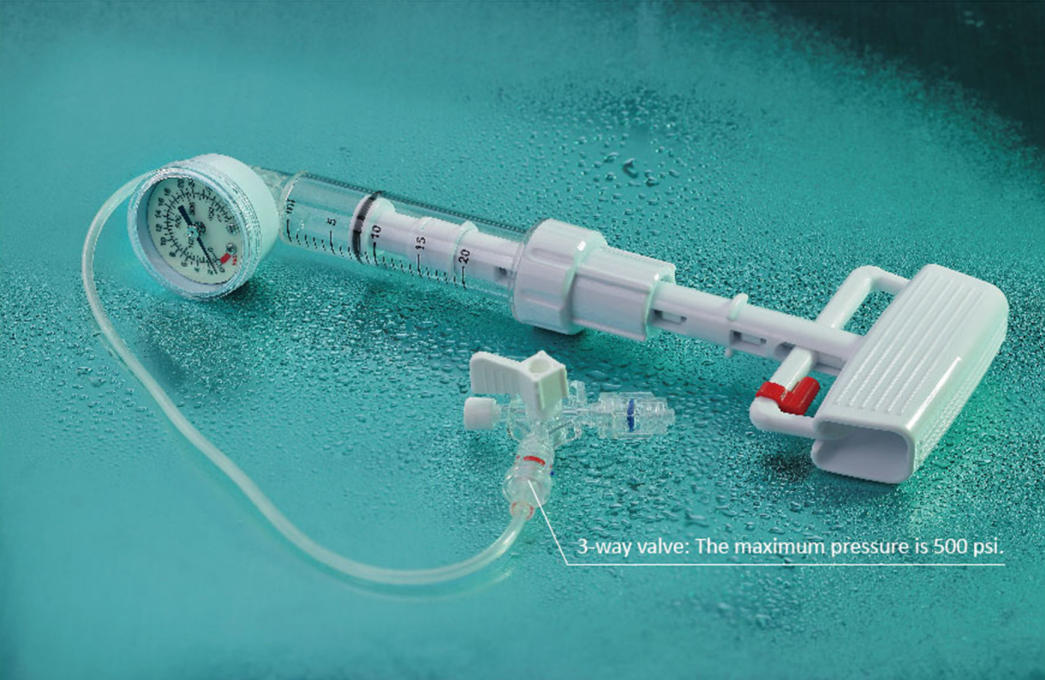
The inflator's rated maximum pressure is a separate specification from the catheter's ≥400 PSI constrained burst threshold; both belong on the PO annex.
Check 4 — Marker span and working length: how “customized but qualified” is built
Two radiopaque markers define the working length that the surgeon sees under fluoroscopy. Changmei catheters use tantalum marker bands and a polyurethane shaft with an 06Cr19Ni10 stainless-steel stylet for visibility and pushability, with the balloon film formed from medical-grade thermoplastic polyurethane using a four-wing pleating process. The available marker spans are 10 mm (KB0210, KB0210S1), 15 mm (KB0115, KB0115S1) and 20 mm (KB0120, KB0120S1).
Here is where a shortlist stops being a list of competitors. KB0210S1 and KB0115S1 are not alternatives to one another — they are two configurations of the same qualified platform. Both are 11G with a ≥3.10 mm channel ID and 280 mm overall length; both carry ≥400 PSI constrained burst pressure; both are EO-sterilized, single-use and validated for a 3-year shelf life; both pair with the KT-00-05 kit and the BI-20A-10 inflator. Only two parameters change: 10 mm and 3 cc versus 15 mm and 4 cc. That is controlled variation, and it lets a hospital offer two cavity geometries without holding two incompatible systems, two access kits and two training pathways.
Verified model parameters at a glance
| Model | Gauge | Channel ID | Marker span | Length | Max volume | Constrained burst |
|---|---|---|---|---|---|---|
| KB0210S1 | 11G | ≥3.10 mm | 10 mm | 280 mm | 3 cc | ≥400 PSI |
| KB0115S1 | 11G | ≥3.10 mm | 15 mm | 280 mm | 4 cc | ≥400 PSI |
| KB0120S1 | 11G | ≥3.10 mm | 20 mm | 280 mm | 6 cc | ≥400 PSI |
| KB0210 | 8G | ≥3.65 mm | 10 mm | 315 mm | 4 cc | ≥400 PSI |
| KB0115 | 8G | ≥3.65 mm | 15 mm | 315 mm | 4 cc | ≥400 PSI |
| KB0120 | 8G | ≥3.65 mm | 20 mm | 315 mm | 6 cc | ≥400 PSI |
Check 5 — The document bundle that travels with the lot
Specifications that cannot be evidenced are opinions. For a cross-border PKP order, the document annex should be settled before the PO number is assigned. On the Changmei side, the stated position is: CE-MDR marked balloon catheters; CE 0123 marking on the KT-00-05 and KT-00-01 instrument sets; manufacture under an ISO 13485-certified quality system in a TÜV SÜD-audited facility with ISO Class 7 cleanroom assembly; and U.S. market authorization for the catheters under FDA 510(k) clearance K223709, Product Code HRX, Class II, 21 CFR 888.1100, cleared on 16 August 2023. Sterilization is ethylene oxide, devices are single-use, and shelf life is validated at 3 years.
Supplier-side parameters belong in the same annex, because they determine whether the specification can be delivered repeatedly: a 51,985 m² facility in Jiangsu, 235 employees and a 40-engineer R&D team, an annual output of 1,000,000 kyphoplasty balloon catheters, a 30% export ratio, and distribution across the EU, USA, Asia, South America and the Middle East. Standard commercial terms are a 30–45 day lead time and a 10-set minimum for in-stock items, with OEM/ODM quantities negotiable. Customization options cover balloon diameter and length, cannula size and length, handle colour and logo, packaging design, and labelling language.
The company also states that it was the first Chinese manufacturer to obtain EU MDR CE certification for kyphoplasty system products — a claim worth noting in a tender file, and worth verifying against the certificate itself rather than a brochure.
The five checks as an internal sign-off sheet
| # | Spec to verify | Value to require in writing | Evidence to request | Failure mode if skipped |
|---|---|---|---|---|
| 1 | Maximum inflation volume | Model-specific ceiling (3 cc / 4 cc / 6 cc) | Model specification sheet per line item | Volume ceiling assumed from gauge; wrong balloon ordered for the planned cavity |
| 2 | Channel ID and length | ≥3.10 mm / 280 mm (11G); ≥3.65 mm / 315 mm (8G) | Technical annex with numeric ID; kit part numbers | Catheter and access kit from different gauge families in one tray |
| 3 | Constrained burst pressure | ≥400 PSI, stated as constrained | Specification wording; unit-level pressure and seal test record; inflator rated maximum | “400 PSI” re-read later as free burst; inflator rating never checked |
| 4 | Marker span and working length | 10 / 15 / 20 mm, matched to the model | Per-model parameter table | Two nominal “options” that are actually incompatible systems |
| 5 | Regulatory and sterilization bundle | CE-MDR catheters, CE 0123 kits, ISO 13485, 510(k) K223709, EO, single-use, 3-year shelf life | Certificates, IFU, lot traceability, test records | Shipment held at customs or at goods-in for missing paperwork |
Worked example: a two-model shortlist that stays narrow and defensible
Consider a spine centre standardizing on 11G access for its kyphoplasty caseload and wanting more than one cavity geometry without doubling its instrument inventory. The checklist produces a shortlist of exactly two catheters, plus one conditional third:
- Base case: KB0210S1 — 10 mm span, 3 cc ceiling. The smaller marker span and lowest volume ceiling in the 11G range.
- Extension: KB0115S1 — 15 mm span, 4 cc ceiling. Identical channel ID, length, pressure floor and sterilization status.
- Conditional: KB0120S1 — 20 mm span, 6 cc ceiling, added only where the planned envelope requires the top of the 11G volume range.
- Fixed accessories: KT-00-05 11G instrument set and BI-20A-10 inflator, so the entire platform shares one channel interface and one inflation device.
This is a shorter list than a typical tender document, and that is the point. Every line shares the same access geometry, the same ≥400 PSI constrained burst floor and the same documentation route, so the only variability the store has to manage is span and volume — the two variables the procedure actually uses. If the caseload also includes cases that require the wider 8G channel, the same logic is repeated with KB0210, KB0115 and KB0120 plus the KT-00-01 kit, and the two lines should be kept visibly distinct in both the catalogue and the tray.
What this checklist will not tell you
A specification shortlist is not a clinical decision, and it should not be presented as one. Patient selection remains outside its scope: contraindications for balloon kyphoplasty include burst fractures with posterior cortical disruption, retropulsed bone fragments in the spinal canal, asymptomatic fractures, active systemic or local infection, uncorrectable coagulopathy, and allergy to implant components such as PMMA, contrast medium or latex, with relative contraindications including severe spinal stenosis and vertebral collapse beyond roughly 75–80% of original height. None of that is resolved by a purchase order.
The checklist also stops at the device boundary. A PKP procedure additionally requires C-arm fluoroscopy, a balloon inflation unit and a bone cement mixing system, and none of those dependencies are covered by catheter and kit specifications. Three further limits are worth stating plainly. A larger maximum inflation volume is a design ceiling, not evidence of better height restoration, and no such claim is made here. An 11G line does not replace an 8G line where the access trajectory requires the larger channel. And because sterile single-use devices cannot be re-sterilized, forecast accuracy matters more than unit price — a 30–45 day standard lead time leaves little room for a mid-quarter correction.
Why this discipline is likely to tighten
The direction of travel favours buyers who write specifications early. A market projected to move from USD 764.13 million in 2025 to USD 1,342.29 million by 2034 attracts more suppliers, more private-label programmes and more near-identical catalogue sheets, which raises the value of a check that can be evidenced rather than asserted. Site-of-service shifts matter too: with an ASC rate of roughly USD 3,510.84 for CPT 22513/22514 in 2025, ambulatory centres buy in smaller, more frequent lots, where a single incompatible gauge choice is proportionally more disruptive.
Regulation reinforces the same effect. EU MDR certification for kyphoplasty system products is a documented barrier that not every supplier has crossed, and the paperwork burden it creates naturally migrates into procurement annexes. The likely outcome is that “gauge, volume ceiling, channel ID, constrained burst pressure, document bundle” becomes a standard five-line table in tender templates — which is precisely the format this shortlist is designed to fit.
FAQ
Does an 11G label guarantee that an 11G balloon catheter fits my existing 11G kit?
No. The gauge designation describes the access size, but the working interface is the channel inner diameter. In the Changmei range, 11G catheters specify a channel ID of ≥3.10 mm and an overall length of 280 mm, while 8G catheters specify ≥3.65 mm and 315 mm. The 11G KT-00-05 instrument set and the 8G KT-00-01 set are built to pair with their respective catheter families and the BI-20A-10 inflator. The channel ID figure, not the gauge letter, is what should appear in the technical annex.
What are the maximum inflation volumes of KB0210S1 and KB0115S1, and why do both exist?
KB0210S1 is rated at a maximum volume of 3 cc with a 10 mm distance between the two radiopaque markers; KB0115S1 is rated at 4 cc with a 15 mm marker span. Both are 11G, both have a ≥3.10 mm channel ID and 280 mm overall length, and both specify ≥400 PSI constrained burst pressure. They coexist because they offer two cavity geometries on one qualified platform: the upper end of the 11G volume range is the 6 cc, 20 mm KB0120S1.
Is ≥400 PSI constrained burst pressure a differentiating specification?
Within this range it is a shared floor rather than a point of difference: KB0210S1, KB0115S1, KB0120S1, KB0210, KB0115 and KB0120 all specify ≥400 PSI. The term “constrained” is the part worth protecting in a tender document, because it defines the test condition as a balloon held within a cavity rather than freely expanded. Procedural descriptions place working inflation at a predetermined pressure typically in the 50–300 psi range, so the burst figure functions as headroom.
Can one supplier cover both 8G and 11G kyphoplasty workflows?
In this case, yes. Jiangsu Changmei Medtech produces both lines: 11G catheters KB0210S1, KB0115S1 and KB0120S1 with the KT-00-05 kit, and 8G catheters KB0210, KB0115 and KB0120 with the KT-00-01 kit, with the BI-20A-10 inflator used across the platform. The company supports OEM/ODM customization of balloon diameter and length, cannula size and length, handle colour and logo, packaging and labelling language, with a 30–45 day lead time and a 10-set minimum for standard in-stock items.
Which documents should be in the annex before a cross-border PO is released?
At minimum: CE-MDR marking for the balloon catheters; CE 0123 marking for the KT-00-05 and KT-00-01 instrument sets; evidence of manufacture under an ISO 13485-certified system in a TÜV SÜD-audited facility; the FDA 510(k) clearance reference for the catheters (K223709, Product Code HRX, Class II, 21 CFR 888.1100, cleared 16 August 2023); confirmation of ethylene oxide sterilization, single-use status and the 3-year validated shelf life; and the instructions for use. Lot-level pressure and seal test records should be requested alongside the shipment.
The consolidated 8G and 11G specification set referenced throughout this shortlist is available in the manufacturer's product brochure: Kyphoplasty System Products (8G & 11G) — CE and FDA.
Have Questions or Need More Details?
Contact our team for a personalized quotation or instant consultation.
Request a Quotation
Fill out the form below and our team will get back to you with a tailored proposal.
WhatsApp Direct Chat
Prefer to chat in real-time? Message us on WhatsApp for instant assistance & quick answers.
- Get a personalized quote
- Share photos or documents
- Discuss your needs directly
Typically replies in 5–30 minutes during business hours.