
Kyphoplasty Supplier Longevity: Regulatory, Sterilization, and Scale
Kyphoplasty Supplier Longevity: Regulatory, Sterilization, and Scale
Balloon kyphoplasty (PKP) is a repeat-order business. A hospital or clinic typically standardises on one balloon catheter, one matched tool kit and one pressure inflator, then reorders that configuration for years. For distributors, the practical consequence is that the most expensive supplier failure is rarely a poor first shipment — it is a supplier that can no longer deliver the same device, with the same documentation, three years later.
This reference article examines kyphoplasty supplier longevity across three continuity dimensions that distributors can actually audit: regulatory continuity, sterilization and shelf-life continuity, and manufacturing scale continuity. It uses model-level evidence from the CHANGMEI Kyphoplasty range — the KB0115 and KB0120 balloon catheters, the KB0210S1 11G catheter, the KT-00-05 tool kit and the BI-20A-10 balloon inflator — to show what an auditable continuity check looks like in practice.
Jiangsu Changmei Medtech Co., Ltd. is a vertically integrated medical device manufacturer established in 2013 and headquartered in Jiangsu, China, specialising in the full-cycle development of minimally invasive surgical instruments — from original design and prototyping through regulatory clearance to commercial-scale production. Its kyphoplasty portfolio is marketed as CHANGMEI Kyphoplasty. The company operates a 51,985 m² manufacturing facility, employs approximately 235 staff including 40 engineers, and reports an annual production capacity of 1,000,000 units of kyphoplasty balloon catheter.
Why Reorder Risk Outlasts the First Order
Most kyphoplasty supply decisions are still made on evidence that exists at the sample or quotation stage: unit price, the tactile behaviour of the catheter, the completeness of the tray, and a stated lead time. Those factors decide who wins the first order. They say very little about whether the same order can be repeated in year three.
In practice, four failure modes account for most continuity losses in this category, and none of them is a clinical quality defect in the ordinary sense:
- Model drift — a supplier rationalises its range and the specific gauge, marker span or working length that a hospital standardised on is phased out.
- Scope drift — a certificate or clearance still exists, but no longer names the exact model variant actually being shipped.
- Documentation drift — sterilization and shelf-life records exist for the product line, but cannot be retrieved per lot when a distributor's customer audits the supply chain.
- Capacity drift — production capacity exists on paper but is reallocated to a larger customer or a different product family, extending lead times without any formal discontinuation notice.
Each of these breaks a distribution programme without ever appearing in a defect report. That is why longevity deserves to be treated as a distinct evaluation category, separate from product performance and separate from price.
Four Continuity Pillars a Distributor Should Audit
Supplier longevity is not a single number, and it is not the same thing as company size. It is the intersection of four verifiable conditions, each of which produces its own evidence trail.
| Continuity pillar | What the distributor is verifying | Evidence that should exist |
|---|---|---|
| Regulatory continuity | That clearances and certifications remain valid and name the exact models being stocked | FDA 510(k) clearance, CE-MDR marking and declaration, ISO 13485 certification, certificate scope covering the model family and gauge |
| Sterilization and shelf-life continuity | That every lot is ethylene-oxide (EO) sterilized, single-use, and inside a validated shelf life | Sterilization validation, lot number and date of manufacture, packaging seal test records, current instructions for use (IFU) |
| Scale continuity | That the production line has capacity headroom and in-house process control | Facility area, annual output, headcount and engineering staff, cleanroom class, quality-system audit scope |
| System continuity | That catheter, tool kit and inflator stay gauge-matched as a set over time | Documented accessory pairing, component schedules, change-control notification practice |
The pillars are cumulative rather than substitutable. A supplier with strong capacity but narrow certificate scope is a different risk from a supplier with broad clearances but thin documentation practices, and a distributor's exposure depends on which of the two a given market regulator is more likely to question.
Regulatory Continuity: Reading Scope, Not Just the Certificate
Regulatory continuity means the clearance or certification behind a device still covers the exact model, gauge and configuration being supplied — not merely that the manufacturer holds a certificate of some kind.
For the CHANGMEI Kyphoplasty balloon catheter range, the published regulatory position includes U.S. market authorisation under FDA 510(k) clearance K223709, Product Code HRX, Class II, under 21 CFR 888.1100, cleared on 16 August 2023, together with CE-MDR marking and ISO 13485 certification of the quality system. The Kyphoplasty Tool Kit KT-00-05 is an 11G kit carrying CE marking under notified body number CE 0123 and ISO 13485 certification. The Balloon Inflator BI-20A-10 is described as CE MDR certified and registered as an NMPA China Class II device.
Industry reporting also identifies Jiangsu Changmei Medtech as the first Chinese company to receive the EU Medical Device Regulation (MDR) CE certificate for its kyphoplasty system products, under Regulation (EU) 2017/745. That distinction matters less as a marketing claim than as a signal about how early the company built its technical file and clinical evaluation infrastructure for the European market.
For a distributor, regulatory continuity resolves into specific verification questions:
- Model coverage. Does the clearance or declaration of conformity name the gauge and length variants you actually stock? The CHANGMEI 8G balloon family comprises the KB0210 (10 mm marker span), KB0115 (15 mm) and KB0120 (20 mm); the 11G family comprises the KB0210S1 (10 mm), KB0115S1 (15 mm) and KB0120S1 (20 mm).
- Accessory coverage. Catheter, kit and inflator are separate devices with separate evidence; a balloon catheter clearance does not automatically describe the tool kit or the inflation device.
- Currency. Certificates are time-bound documents. A PDF supplied during sampling is not proof of current status — the notified body register and the FDA database are.
- The distribution right itself. A manufacturer-held clearance does not by itself authorise commercial distribution in every jurisdiction; several markets require a separate local registration held by the legal manufacturer or its authorised representative.
Sterilization and Shelf-Life Continuity: What the Documentation Should Show
The balloon catheters in this range are single-use devices sterilized by ethylene oxide (EO), with a validated three-year shelf life; the tool kits and the BI-20A-10 inflator are likewise EO-sterilized single-use products. Every balloon catheter unit passes factory pressure and seal testing before release, intended to minimise intraoperative burst or leakage risk.
Those statements cover the product. Continuity is about the paperwork behind them, and there are four items a distributor can reasonably request before committing to multi-year stock:
- The sterilization method and its validation basis — confirming EO as the sterilization route and that the cycle is validated for the device configuration supplied.
- The shelf-life claim and how it is dated — a validated three-year shelf life is only useful if the date of manufacture is printed and legible on each unit's labelling.
- Lot-level traceability — lot number, sterilization batch reference and release records retrievable after the fact.
- Packaging integrity records — the factory pressure and seal testing referenced in the product documentation, and how failures are dispositioned.
Boundary to note: because these are single-use EO devices with a defined three-year shelf life, the inventory horizon is fixed. Distributors supplying tenders that stipulate a minimum remaining shelf life at delivery need to work backwards from expiry dates when planning reorder cycles — a longer shelf-life validation would change that calculation, but the validated figure here is three years. Re-sterilization and reuse are prohibited; the device must be used within the stated conditions and according to the official IFU.
Model-Level Evidence: What Consistency Looks Like Across the Range
Range consistency is easiest to verify when a supplier publishes the same parameter set for every model. The CHANGMEI Kyphoplasty catheter range does this, which allows a distributor to read across models rather than evaluate each one in isolation.
| Model | Gauge | Marker span | Channel ID | Working length | Max volume | Constrained burst pressure |
|---|---|---|---|---|---|---|
| KB0210 | 8G | 10 mm | ≥3.65 mm | 315 mm | 4 cc | ≥400 PSI |
| KB0115 | 8G | 15 mm | ≥3.65 mm | 315 mm | 4 cc | ≥400 PSI |
| KB0120 | 8G | 20 mm | ≥3.65 mm | 315 mm | 6 cc | ≥400 PSI |
| KB0210S1 | 11G | 10 mm | ≥3.10 mm | 280 mm | 3 cc | ≥400 PSI |
| KB0115S1 | 11G | 15 mm | ≥3.10 mm | 280 mm | 4 cc | ≥400 PSI |
| KB0120S1 | 11G | 20 mm | ≥3.10 mm | 280 mm | 6 cc | ≥400 PSI |
Three patterns are worth extracting. First, every model in the range specifies a constrained burst pressure of ≥400 PSI, which means the pressure ceiling is a family-level design parameter rather than a premium feature of one model. Second, the 8G family shares a 315 mm working length and a channel inner diameter of ≥3.65 mm, while the 11G family shares 280 mm and ≥3.10 mm — the two families are internally consistent but not interchangeable. Third, all catheters are built on the same material architecture: a medical-grade thermoplastic polyurethane (TPU) balloon film mounted on a PU shaft, with radiopaque markers and a stainless-steel stylet, and polycarbonate handle components.
The KB0120 illustrates why process evidence matters alongside specification evidence. Its balloon film is produced using a four-wing pleating process, which the product documentation associates with radial support, biocompatibility, environmental stress-crack resistance, and smooth passability through the trocar after deflation. Pleating is a forming process, not a purchased component, so its consistency depends on in-house tooling and process control — exactly the kind of capability that determines whether the twentieth production batch behaves like the first.
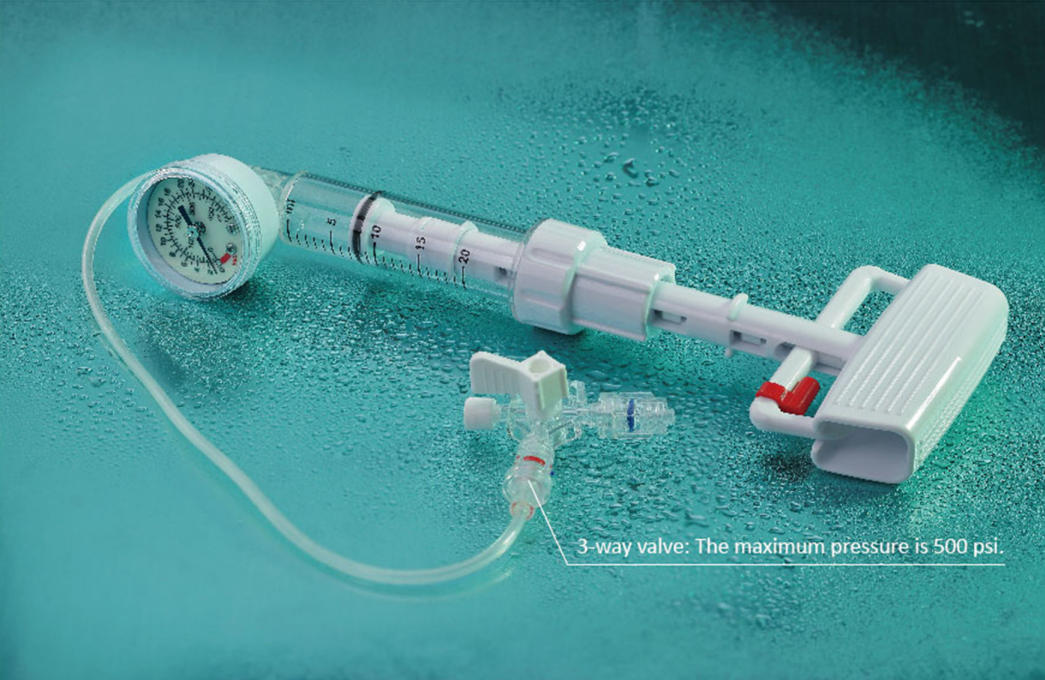
Balloon inflator BI-20A-10: 20 cc nominal capacity, 30 atm maximum pressure, supplied with a 10 ml syringe, EO-sterilized for single use — the accessory that defines the pressure envelope of the PKP set.
The accessory half of the system
Continuity failures are as likely to originate in accessories as in catheters, because accessories are the components distributors reorder most frequently and stock in the greatest depth.
The Kyphoplasty Tool Kit KT-00-05 is an 11G, CE-marked (CE 0123) and ISO 13485-certified, EO-sterilized single-use PKP instrument set. Each kit contains 2 puncture expandor modules, 1 bone drill and 6 bone cement filling devices. Most metal parts use 06Cr19Ni10 medical-grade stainless steel, while the puncture stylet and puncture expandor cutting tips use 32Cr13Mo stainless steel, and all joints are rated at a connection strength of not less than 100 N. It is engineered to pair with the 11G Kyphoplasty Balloon Catheter KB0210S1 and the BI-20A-10 inflator.
The Balloon Inflator BI-20A-10 is a single-use, EO-sterilized device intended for hydraulic pressurization of kyphoplasty balloon catheters to dilate the vertebral body and form a cavity for bone cement injection in PKP and vertebroplasty procedures. Its nominal capacity is 20 cc, its maximum pressure is 30 atm, and it is supplied preconfigured with a 10 ml syringe. The barrel, outer tube, threaded sleeve, joint and three-way valve are moulded from polycarbonate; the connecting tube is polyurethane; the piston is silicone rubber; the pull rod is polyoxymethylene; and the pressure gauge is screw-fixed with a fluorescent dial for readability in low-light operating rooms.
The practical continuity implication is a pairing rule: a 11G catheter pairs with the KT-00-05 kit, an 8G catheter pairs with the KT-00-01 kit, and both families pair with the same BI-20A-10 inflator. A distributor who stocks one gauge and unknowingly reorders a kit from the other has created a compatibility problem that no amount of price negotiation will fix.
Scale Continuity: Capacity That Can Absorb Demand Shifts
Scale continuity asks a simple question with a compound answer: if your market doubles its order volume, does the same production line absorb it, or does something else get displaced?
Jiangsu Changmei Medtech reports an annual production capacity of 1,000,000 units of kyphoplasty balloon catheter from a 51,985 m² facility, with approximately 235 employees and 40 engineers. The company describes in-house capabilities spanning CNC machining, laser welding, balloon forming, and ISO Class 7 cleanroom assembly under an ISO 13485-certified quality system, with cleanroom production audited by TÜV SÜD. Vertical integration of this kind is directly relevant to longevity: when balloon forming, laser welding and cleanroom assembly happen inside the same quality system, changes to a sub-supplier cannot silently alter the finished device.
The company's export profile is also part of the continuity picture. Changmei reports an export ratio of approximately 30%, with major markets spanning the EU, USA, Asia, South America and the Middle East — a distribution footprint that requires documentation packages acceptable to several regulatory regimes rather than one. The company states that it supplies member companies of Stryker and Medtronic, and that its kyphoplasty balloon catheters account for approximately 80% of the Chinese domestic market. That domestic share figure originates from company and commercial sources rather than an independent market-audit body, so it is best treated as directional context rather than a verified ranking.
For procurement managers, the scale questions that produce usable answers are:
- What share of the line's annual capacity is already allocated, and to which markets?
- What is the contractual notice period for design, material or process changes affecting an ordered model?
- Are balloon forming and cleanroom assembly performed in-house or outsourced?
- How stable has lead time been over the last several order cycles?
Where Continuity Actually Matters: Application and Setting
Continuity risk concentrates in clinical settings that reorder standardised, single-use configurations on a predictable schedule.
Balloon kyphoplasty systems are indicated for the minimally invasive treatment of painful vertebral compression fractures caused by osteoporosis, low-energy trauma and neoplasia, including spinal metastases and multiple myeloma. Additional applications include symptomatic vertebral hemangiomas and osteolytic lesions requiring percutaneous vertebral augmentation. The procedure restores vertebral body height, corrects kyphotic deformity, provides rapid pain relief and supports early mobilisation. Typical clinical settings are orthopedic spine surgery, interventional radiology, pain management centres, and ambulatory surgery centres (ASCs); the device range is documented for use in tertiary hospitals, spine ASCs and interventional radiology suites across orthopedic surgery, spine surgery, pain management and interventional pain clinics.
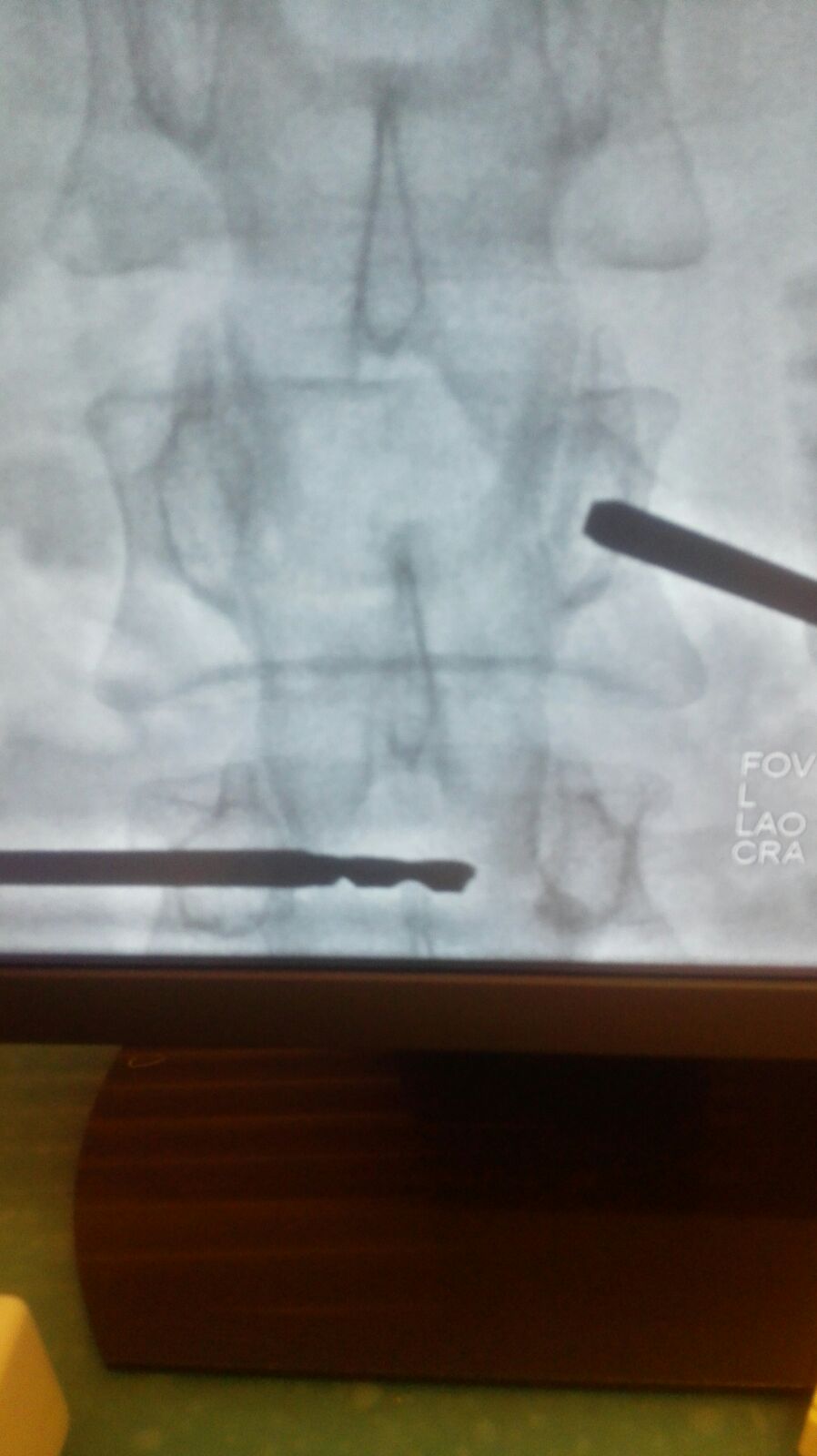
Documented application context: vertebral compression fractures treated with the eggshell technique — the kind of standardised, repeat-order procedure in which catheter, kit and inflator continuity matters most.
Mechanically, the procedure runs in two stages. In cavity creation, a working cannula is introduced transpedicularly or parapedicularly and an inflatable bone tamp is inflated with iodinated contrast to a predetermined pressure — typically in the range of 50–300 psi depending on vertebral body resistance — displacing cancellous bone outward and partially restoring vertebral height. In cement augmentation, the balloon is deflated and removed and the contained cavity is filled with low-viscosity PMMA bone cement under low pressure.
That 50–300 psi working range is worth reading against the ≥400 PSI constrained burst pressure specified for the CHANGMEI catheter family. The specification is a design ceiling, not an operating target; it describes the margin the device is built to hold rather than the pressure a clinician should approach routinely. Distributors should be careful not to present the burst figure as a performance claim about a procedure.
Two boundaries belong in any distributor conversation. First, patient selection and contraindication screening remain clinical responsibilities: documented contraindications include damaged vertebral posterior edges and burst fractures with posterior cortical disruption, retropulsed bone fragments in the spinal canal, nerve injury, active systemic or local infection, uncorrectable coagulopathy, asymptomatic fractures, and allergies to implant components such as PMMA, contrast medium or latex. Relative contraindications include severe spinal stenosis, vertebral collapse beyond 75–80% of original height, and non-ambulatory paraplegic patients. Second, the manufacturer's IFU governs use; a supplier's continuity documentation does not substitute for it.
Market Context: Growing Procedure Volume, Higher Documentation Barriers
The commercial case for auditing supplier longevity rests on procedure volume that is expected to keep expanding rather than on any single year's pricing.
One published forecast covering the kyphoplasty market values the global market at USD 764.13 million in 2025, USD 813.50 million in 2026, and projects USD 1,342.29 million by 2034, with a forecast period of 2026–2034. Separate market research estimates place North America's revenue share at 42.5% to 50.0% in 2025. These figures should be read with a definitional caveat: published kyphoplasty market estimates vary materially depending on whether bone cement and vertebroplasty procedures are bundled into the scope, so a range of estimates exists for the same year across different research houses.
Two structural trends sit underneath the numbers. The first is the shift of vertebral augmentation procedures into ambulatory and outpatient settings, which raises the value of a standardised, tray-based system that a smaller facility can stock and reorder predictably. The second is regulatory: EU MDR compliance has become a genuine barrier to entry in this category, and a supplier that has already cleared it holds a position that late movers cannot replicate quickly. For distributors, both trends point the same way — the switching cost of a supplier relationship increases over time, which raises the cost of choosing badly at the start.
Comparing Sourcing Models — and the Limits of Each
Distributors generally choose between transactional sourcing, which optimises unit cost per order, and programme sourcing, which optimises the total cost of a repeatable supply relationship. Neither is universally better, and the honest comparison includes the constraints of the programme model.
| Evaluation dimension | Transactional sourcing | Programme sourcing |
|---|---|---|
| Primary optimisation | Unit price and availability at order time | Model consistency, documentation and lead-time stability |
| Regulatory exposure | Re-verified per purchase | Continuously tracked across model variants and accessories |
| Sterilization evidence | Often limited to a certificate | Lot-level records available on request |
| Inventory planning | Reactive to tenders won | Planned against a validated three-year shelf life |
| Component compatibility | Risk of mismatched gauge pairings | Gauge-matched catheter, kit and inflator sets |
| Switching cost | Low | Higher, because clinical staff standardise on a configuration |
The limits of the programme model are real and should be stated plainly:
- Clearance scope does not travel automatically. A CE-MDR marking or an FDA 510(k) clearance held by the manufacturer does not authorise a distributor to place the device on every market; local registration requirements may still apply.
- Gauge families are not interchangeable. The 8G family uses a ≥3.65 mm channel inner diameter and a 315 mm working length; the 11G family uses ≥3.10 mm and 280 mm. Mixing a catheter from one family with a kit from the other is a compatibility failure, not a preference.
- Shelf life defines the inventory ceiling. A validated three-year shelf life limits how much stock can be held beneficially, and tenders requiring substantial remaining shelf life at delivery narrow that window further.
- Domestic share claims need independent verification. The approximately 80% Chinese domestic market figure is a company and commercial-source claim with limited independent corroboration, and should not be presented to customers as an audited statistic.
- OEM and ODM flexibility has boundaries. Customisation in this range covers gauge, length and instrument configuration; it does not extend to automatic regulatory approval of the customised variant in every destination market.
- Documentation depends on the manufacturer's quality system. Lot-level sterilization and release records can only be retrieved if they were generated and retained in the first place — which is precisely why the audit belongs before the contract, not after.
Future Outlook
Three developments are likely to shape how distributors evaluate kyphoplasty suppliers over the next several years.
First, documentation expectations will continue to tighten. As more markets require traceability from sterilization batch to delivered unit, suppliers with mature lot-level record systems will become structurally easier to work with than suppliers who must retrofit those systems.
Second, the procedural shift toward ambulatory and outpatient settings will reward suppliers whose systems are complete rather than partial. A facility that performs a limited number of kyphoplasty procedures per month is poorly served by assembling a catheter from one source, a kit from another and an inflator from a third; a gauge-matched PKP system reduces both SKU complexity and the risk of an intraoperative mismatch.
Third, regulatory differentiation will keep widening in the European market, where MDR compliance already separates early movers from manufacturers still in transition. Combined with market growth forecasts through 2034, that suggests the competitive question in this category is shifting away from who can supply a balloon catheter, and toward who can supply the same balloon catheter, with the same documentation, on the same lead time, for the next several years.
Frequently Asked Questions
Is a kyphoplasty balloon catheter single-use, and what sterilization method and shelf life apply?
Kyphoplasty balloon catheters are single-use sterile medical devices and reuse is prohibited. They are sterilized by ethylene oxide (EO) and carry a validated three-year shelf life. The device should be used immediately once the package is opened; re-sterilization and reuse are not permitted. The official instructions for use govern handling in all cases.
What contraindications apply to balloon kyphoplasty, and who is responsible for screening?
The procedure is not applicable for patients with a damaged vertebral posterior edge, nerve injury, infection at the operative site, or uncorrectable coagulopathy. Broader contraindication screening also covers burst fractures with posterior cortical disruption, retropulsed bone fragments in the spinal canal, asymptomatic fractures, active systemic or local infection, and allergies to implant components such as PMMA, contrast medium or latex. Relative contraindications include severe spinal stenosis, vertebral collapse beyond 75–80% of original height, and non-ambulatory paraplegic patients. Case selection and screening remain the responsibility of the treating clinician, with reference to the full IFU.
Which models make up the 8G and 11G kyphoplasty balloon catheter families?
The 8G family consists of the KB0210 (10 mm distance between radiopaque markers), KB0115 (15 mm) and KB0120 (20 mm), sharing a 315 mm overall length and a channel inner diameter of ≥3.65 mm. The 11G family consists of the KB0210S1 (10 mm), KB0115S1 (15 mm) and KB0120S1 (20 mm), sharing a 280 mm overall length and a channel inner diameter of ≥3.10 mm. Every model in both families specifies a constrained burst pressure of ≥400 PSI, maximum inflation volumes between 3 cc and 6 cc depending on model, a TPU balloon film on a PU shaft, and EO sterilization for single use.
What should a distributor request in order to verify EO sterilization and shelf-life records?
A distributor can reasonably request the sterilization method and its validation basis for the supplied configuration, confirmation of the validated shelf life and where the date of manufacture appears on the labelling, lot-level traceability linking a delivered unit to its sterilization batch and release record, and the packaging seal testing records referenced in the product documentation. Because the shelf life is validated at three years, tender requirements that specify minimum remaining shelf life at delivery also need to be reconciled against reorder cycle planning.
Are the balloon catheter, the tool kit and the inflator covered by the same regulatory evidence?
No. They are separate devices with separate documentation. In the CHANGMEI Kyphoplasty range, the balloon catheters are described as FDA 510(k) cleared under K223709 (Product Code HRX, Class II, 21 CFR 888.1100, cleared 16 August 2023), CE-MDR marked and ISO 13485 certified; the Kyphoplasty Tool Kit KT-00-05 is an 11G set carrying CE marking under notified body number CE 0123 and ISO 13485 certification; and the Balloon Inflator BI-20A-10 is described as CE MDR certified and registered as an NMPA China Class II device. A distributor assembling a complete PKP system should verify each component's evidence separately.
What capacity evidence supports long-term supply continuity?
Jiangsu Changmei Medtech reports an annual production capacity of 1,000,000 units of kyphoplasty balloon catheter, produced at a 51,985 m² facility with approximately 235 employees and 40 engineers, including ISO Class 7 cleanroom assembly under an ISO 13485-certified quality system audited by TÜV SÜD. The company also reports an export ratio of approximately 30%, with major markets in the EU, USA, Asia, South America and the Middle East. Reported domestic share — approximately 80% of the Chinese kyphoplasty balloon catheter market — originates from company and commercial sources and is best treated as directional context rather than independently audited market data.
Reference material: the product data covering the CHANGMEI Kyphoplasty 8G and 11G systems, including CE and FDA documentation context, is available as a downloadable PDF: Kyphoplasty System Products (8G & 11G) — CE and FDA.