
Coating line: what is and how is it adapted to each industry
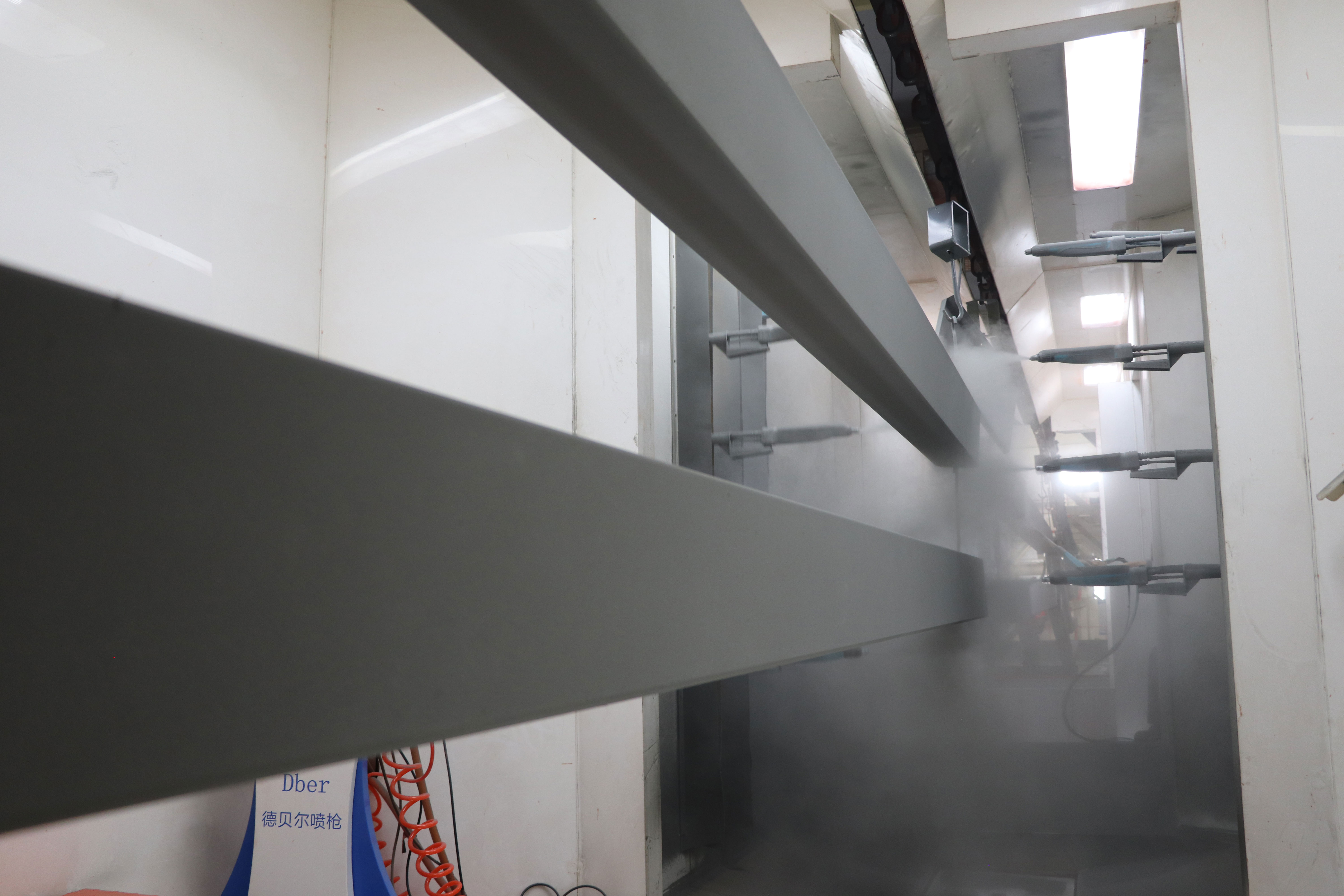
Powder coating lines are commonly used in the metalworking industry for protective and decorative finishes.
Coating line: what it is and how it adapts to each industry
In today's industrial environment, the question "what is a coating line" arises alongside another more practical one: what does my part need to achieve a repeatable and cost-effective finish? A coating line is an integrated system of equipment that applies paint or coating onto industrial surfaces to achieve protection, durability, and aesthetic finishing. Its design is not universal; it depends on the sector, material, part geometry, and production volumes.
This article is aimed at buyers and technical managers who are in the early evaluation phase. The goal is to provide a broad reference on what types of lines exist, which industries use them, what technical capabilities characterize them, and what factors should be considered before defining a project. Throughout the text, specific manufacturer data is mentioned, but the focus is on interpretation for the purchasing decision.
The problem a coating line solves
In many plants, surface finishing is still done with manual processes. This practice generates several drawbacks: film thickness is not uniform between parts, transfer efficiency depends on operator skill, cycle times are difficult to plan, and exposure to volatile organic compounds requires additional environmental controls. When demand grows or customers require traceability, the manual process becomes a bottleneck.
The automatic coating line responds to that need through standardization. PLC control governs the sequence of operations, spraying can be done with robots or reciprocating systems, and part transport operates continuously. This does not eliminate the human factor, but it shifts it to programming, supervision, and maintenance tasks.
A manufacturer reference: Attractivechina
Among the manufacturers participating in the customized automatic line segment is Attractivechina, a trade name of Guangdong Chuangzhi Intelligent Equipment Co., Ltd. The company was founded in 2005 and is located in the National High-Tech Industrial Development Zone of Zhaoqing, Guangdong Province, China. It has a plant of approximately 35,548 square meters, about 280 employees, and an R&D team of 54 engineers. Its annual production capacity is 60 units.
Attractivechina specializes in the design and manufacturing of automated and customized coating production lines, as well as environmental protection equipment. Its main portfolio includes lines for cookware, wood, auto parts, metal, and industrial equipment. These lines serve sectors such as auto parts, rail transit, furniture, musical instruments, cookware, home appliances, metallurgy, low-altitude equipment, and heavy industrial machinery.
The company exports to several markets, including Vietnam, Indonesia, Brazil, United Arab Emirates, Turkey, Mexico, India, United States, Russia, and Singapore. Export business represents 20% of its total sales. For an industrial buyer, this data provides signals of production capacity, technical experience, and geographic reach.
Technical characteristics of a coating line
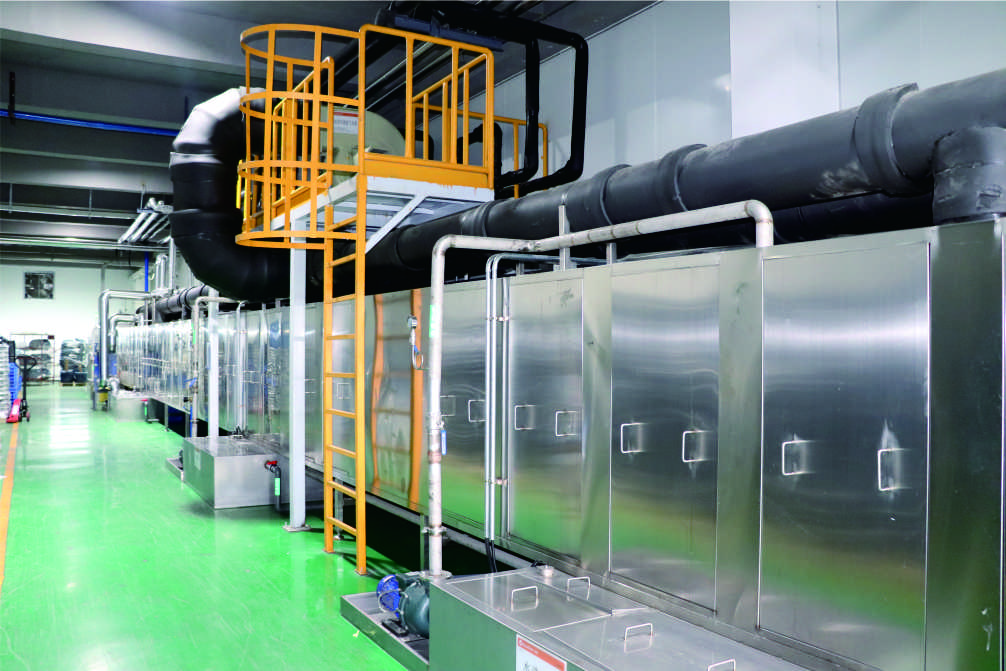
An automatic coating line is composed of several stations connected by a transport system. The associated equipment, according to turnkey projects, includes: pretreatment equipment, drying equipment, automatic sandblasting machine, spray booth, preheating oven, curing oven, cooling system, transport system, dust removal equipment, VOC treatment system, environmental protection equipment, electrical control system, and MES production management system.
The typical flow begins with pretreatment of the part, which cleans and conditions the surface to improve adhesion. Then, the part goes to drying and, in some processes, to automatic sandblasting. The coating application is carried out in closed booths, where spraying can be manual, reciprocating, or robotic. Finally, the part enters the curing oven, cools, and is unloaded. Throughout the process, electrical control regulates temperatures, times, and speeds.
Depending on the type of line and the part material, specific configurations are used. For example, lines for automotive plastic parts work with ABS+PC material and require booths with controlled temperature and humidity. Lines for metal can spray large-format aluminum panels and profiles. Lines for wood process solid wood and MDF parts. This variety explains why customization is a central criterion in selection.
Applications by sector
The usefulness of a coating line is best understood by reviewing specific cases. Below are five sectors with different requirements.
Auto parts
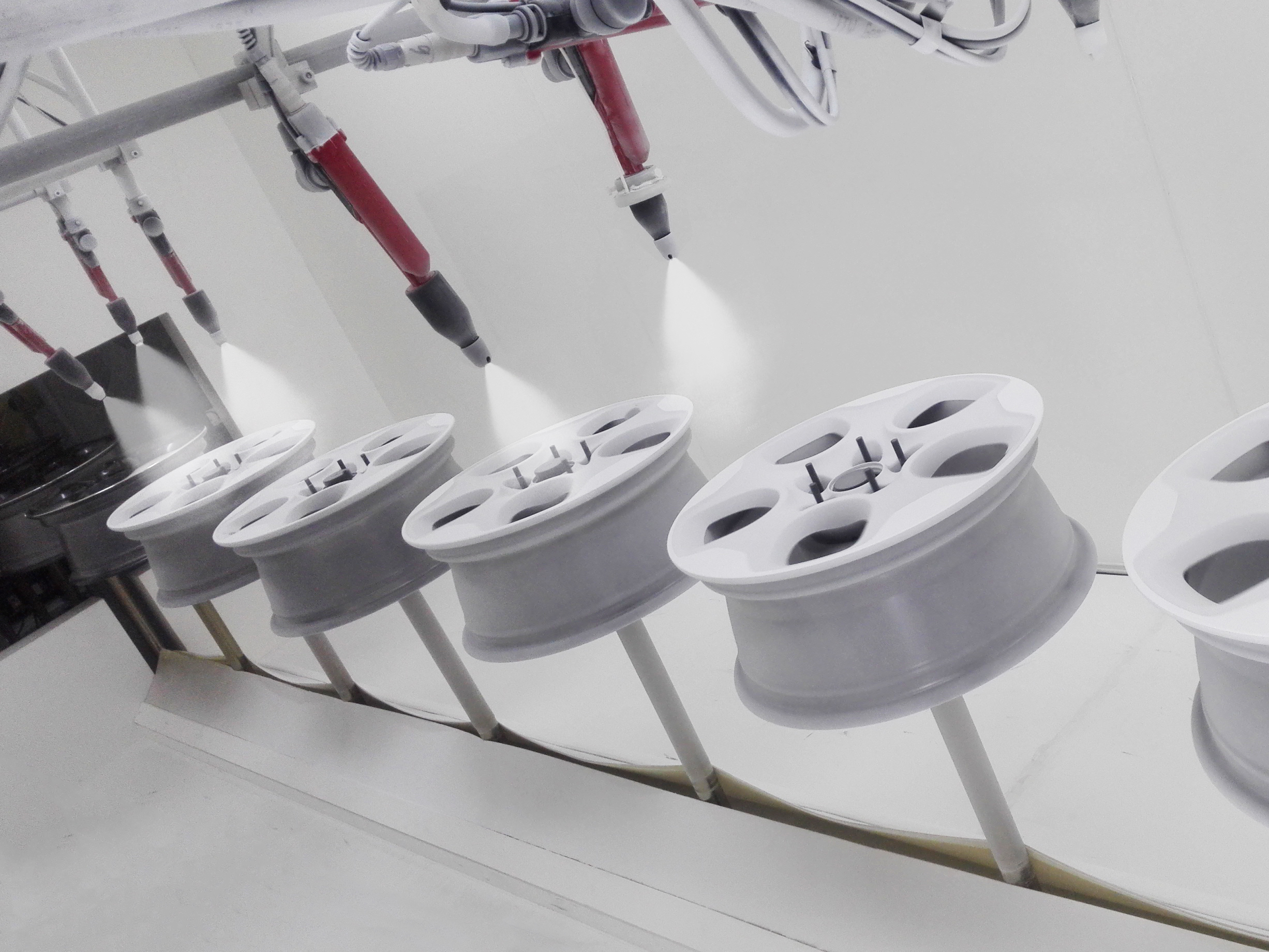
Coating lines for auto parts are designed for bumpers, wheel hubs, hubcaps, fuel tanks, chassis, interior parts, and car logos. The reference material is ABS+PC, common in plastic components of the vehicle's interior and exterior.
In a typical automatic configuration, the working system can operate 336 days a year for 22 hours a day. The paint booth temperature is maintained at 25 ± 2 °C and relative humidity at 65 ± 10%. The production cycle is 45 seconds per tray, equivalent to 1,760 trays per day, with an equipment utilization rate of 85%. Tool trays accept parts up to 1,350 mm long, 900 mm wide, and 200 mm high. This line requires a workshop of approximately 100 m long, 38 m wide, and 5.4 m high.
Cookware and home appliances
Lines for cookware process non-stick pans, air fryer pans, soup pots, rice cooker inner pots, cake molds, and coatings for home appliances. Materials can be aluminum alloy or stainless steel, aluminum alloy, and copper composites.
A line of this type can achieve production of 800 to 1,000 parts per hour. The standard part size is 220 mm diameter by 160 mm height, with a maximum of 300 mm diameter and 160 mm height. The distance between parts is 450 to 900 mm. Regarding hanging, 4 inner pots or 20 lids can be placed per hanger. The anodizing line speed is 1,200 mm/min, and the curing oven linear speed is 1,000 mm/min, adjustable between 0.5 and 1.5 m/min. The facility can operate on natural gas and electricity.
Metal, aluminum profiles, and construction materials
Coating lines for metal are used for doors, windows, steel cabinets, construction materials, cabinet components, sheet metal parts, lighting fixtures, and aluminum sheets. The representative example is coating aluminum panels and profiles.
In a medium-to-high production configuration, the working system can be 300 days a year and 20 hours a day. Spraying is carried out using a reciprocator with manual support. The motorized conveyor allows parts up to 7,000 mm long, 2,000 mm wide, and 2,200 mm high, one part per hanger. The maximum capacity is 5,000 m² per day, and the belt speed is 3,000 mm/min, adjustable between 2,000 and 4,000 mm/min.
Wooden furniture and musical instruments
Lines for wood are designed for wooden furniture and musical instruments. The category includes guitars, pianos, wooden beds, dining tables, wooden chairs, and wooden speakers. The processed materials are solid wood and MDF.
A typical line processes parts such as table legs, chair backs, seats, front legs, and frames. In an 8-hour shift, production is 1,422 parts. The standard part size is 100 x 50 x 1,400 mm, with a maximum of 610 x 710 x 1,400 mm. The pitch between parts is 300 mm per hanger. The design line speed is 4,000 mm/min, adjustable between 2,000 and 6,000 mm/min, and the required power is electricity.
Industrial equipment, transportation, and low altitude
In the industrial equipment segment, coating lines are used for gondola cars, flat cars, tank cars, SQ6 special cars, closed cars, and grain cars. They are also applied to buses, tank trucks, injection molding machines, and machine frames.
These projects typically combine manual and robotic spraying, with transport via floor conveyor. Capacity depends on the car or vehicle model; in a line designed for China Railway cars, for example, 20 units of gondola, flat, or tank cars can be processed per 7.5-hour shift, in addition to special cars and export units.
| Sector | Typical parts | Reference capacity |
|---|---|---|
| Auto parts | Bumpers, wheel hubs, panels, logos | 1,760 trays/day |
| Cookware | Pans, rice cookers, molds | 800–1,000 parts/hour |
| Metal and construction | Aluminum panels and profiles | 5,000 m²/day |
| Wood and instruments | Furniture, guitars, pianos | 1,422 parts/shift |
| Industrial equipment | Railway cars, buses, machinery | Depending on model and project |
Market and trends
The coating equipment market is expanding. According to SNS Insider, the global coating equipment market was valued at USD 18.5 billion in 2023 and is projected to reach USD 30.4 billion by 2032. In parallel, Grand View Research estimates that the powder coating equipment segment will reach USD 5.22 billion by 2033, with a compound annual growth rate of 5.9%.
The Asia Pacific region accounted for about 47.2% of powder coating equipment market revenue in 2025, driven by the industrialization of China and India. The automotive industry is the main end-use segment, with a share of approximately 27.3%. In this scenario, automatic systems already represent more than half of the market, indicating that buyers prioritize repeatability and reduction of operating costs.
On the regulatory front, the EN 16985:2018 standard has become the European reference for spray booths for organic materials, replacing previous standards such as EN 12215 and EN 12981. For manufacturers exporting to Europe, compliance with this type of standard is a relevant requirement when evaluating a supplier.
On the competitive front, names like Nordson, Dürr, Wagner, and Gema appear as international references in the coating equipment space. Asian manufacturers like Attractivechina compete with a focus on customized lines and turnkey projects, broadening options for buyers looking for a solution tailored to their plant.
Comparison with traditional solutions
Compared to manual painting, automatic lines offer clear advantages in uniformity, productivity, and environmental control. However, they are not the optimal answer for all cases.
| Criterion | Manual process | Automatic line |
|---|---|---|
| Uniformity | Variable depending on operator | High and reproducible |
| Productivity | Limited by shift and skill | High, with continuous operation |
| Initial investment | Low | High |
| Flexibility for short runs | High | Medium; requires programming and tooling changes |
| Environmental compliance | Harder to control | Facilitates VOC treatment and booth control |
A reasonable limit is the flexibility of format changes. When a plant works with very small batches and highly heterogeneous parts, changing hangers, trays, and programs can reduce the advantage of automation. In those cases, a hybrid solution with manual stations and automatic sections may be more balanced. It is advisable to evaluate the product mix and expected occupancy level before deciding the degree of automation.
Future outlook
The advancement of smart manufacturing points to greater integration between the coating line and MES management systems. This allows recording parameters such as temperature, humidity, speed, and material consumption in real time, improving the traceability required by sectors such as auto parts and home appliances.
At the same time, environmental pressure favors the use of powder coatings and electrophoretic systems, which reduce the emission of volatile organic compounds. VOC treatment equipment and material recovery systems are becoming standard components. For buyers, this means that evaluating a line cannot be limited to the paint booth; it must consider the environmental protection system as part of the project.
Finally, the projected market growth in Asia Pacific and the relevant role of the automotive sector suggest that coating lines will continue to be a strategic investment area in the coming years.
Frequently asked questions
What is a coating line?
It is an integrated system of equipment that applies paint or coating onto industrial parts in an automated or semi-automated way. It includes pretreatment, application, curing, and auxiliary transport and environmental control systems.
What industries use coating lines?
They are used in auto parts, cookware, home appliances, wooden furniture, musical instruments, metal and construction materials, as well as in industrial equipment, heavy machinery, buses, and railway rolling stock.
What materials can be processed?
Depending on the line, plastics such as ABS+PC, aluminum alloys, stainless steel composites, copper, solid wood, and MDF can be processed. Each material requires specific pretreatment and curing parameters.
What production capacity does an automatic line have?
It depends on the sector. For example, cookware lines can produce between 800 and 1,000 parts per hour; auto parts lines, 1,760 trays per day; metal lines, up to 5,000 m² per day; and wood lines, about 1,422 parts per 8-hour shift.
What environmental and quality standards are associated?
Projects mention standards such as ISO 9001, ISO 14001, and ISO 45001. In Europe, EN 16985:2018 is the reference for spray booths for organic materials.
What data is needed to define a coating line?
Among others: part type and material, dimensions, weight, production volume, work shifts, available space, energy sources, and environmental requirements. With this information, a manufacturer can configure the booth size, spray type, and curing system.
For a more detailed reference on Attractivechina's configurations, capacities, and projects, the corporate brochure can be downloaded at the following link: Attractivechina corporate brochure (PDF).
Have Questions or Need More Details?
Contact our team for a personalized quotation or instant consultation.
Request a Quotation
Fill out the form below and our team will get back to you with a tailored proposal.
WhatsApp Direct Chat
Prefer to chat in real-time? Message us on WhatsApp for instant assistance & quick answers.
- Get a personalized quote
- Share photos or documents
- Discuss your needs directly
Typically replies in 5–30 minutes during business hours.