
LED Lighting FAQs: Sourcing, Specs and Project Tips
Most specification failures in LED Lighting projects do not come from the technology. They come from questions left unanswered at the quotation stage: which color temperature belongs in a lobby, whether Ra≥90 justifies its premium over Ra≥80, how wide the PCB needs to be, what a 120° beam angle actually changes on a wall, and how far a supplier's OEM or ODM offer really extends. This reference addresses those questions using documented product data, published standards and third-party market evidence, so procurement teams, lighting brands and specifiers can compare offers on identical terms.
Why the Same LED Lighting Questions Recur in Every Tender
LED Lighting has shifted from an alternative to a default. Grand View Research values the global LED lighting market at USD 106.9 billion in 2025, with a projected reach of USD 197 billion by 2033. The IEA reported that lighting accounted for approximately 8% of global electricity demand in 2024, roughly 2,200 TWh, which keeps energy performance on the agenda of nearly every commercial project. Adoption data from the U.S. Energy Information Administration shows how far the shift has already gone: 90% of U.S. households reported using LED bulbs for indoor lighting in 2024, and residential LED penetration reached 63% of homes using mostly LEDs by early 2024, up from 4% in 2015.
Because the technology is now familiar, competitive differentiation has moved from “LED or not” to interpretation. Two suppliers can quote the same wattage and the same LED density per meter and still deliver visibly different results, because color temperature, CRI, PCB construction, IP rating and dimming behavior decide the outcome. For a buyer at evaluation stage, the practical task is to convert vague requirements — “warm and premium,” “bright enough for retail,” “safe outdoors” — into figures that can be quoted, sampled and tested.
The Four Specification Groups That Decide Most Projects
1. Color Temperature: 3000K, 4000K, 6000K and the Values Between
Color temperature sets the atmosphere before any other parameter is noticed. In documented LED strip ranges, the recurring values are 2700K, 3000K, 3500K, 4000K, 5000K, 6000K and 6500K. Practical allocation follows the function of the space:
- 2700K–3000K — hospitality, ambient and residential settings where warmth is part of the design intent. Documented models covering 2700K–3000K include the XP–BD18DC24V–2835–140D–8MM full spectrum strip and the CA–DC24V–2835–180D–8mm–3000K acoustic wall strip, which is documented at 3000K only.
- 4000K — neutral white for office lighting, indoor lighting and mixed-use commercial interiors, documented on commercial and architectural ranges.
- 6000K — cool white for technical, retail and back-of-house areas, documented across indoor, decorative, smart and hospitality-compatible ranges.
- 6500K — appears on the energy saving and high luminous efficiency ranges (G7–DC24V–2835–126D–8mm and G10–DC24V–2835–238D–10mm).
One recurring buyer dilemma is mixing families. If a project combines a 6500K energy-saving strip with a 6000K full-spectrum strip on the same visible plane, the difference is detectable. Parallel runs that will be seen together should be specified from a single product family, even when the underlying application differs.
2. CRI: What Ra≥80, Ra≥90, Ra≥95 and Ra≥97 Change
CRI describes how faithfully a light source renders color relative to a reference source. In documented product data, four levels appear, and each maps to a different commercial purpose:
| CRI level | Typical documented use | Documented examples |
|---|---|---|
| Ra≥80 | General illumination, energy saving lighting, decorative and outdoor ranges where output and cost drive the decision | G7–DC24V–2835–126D–8mm (5W/m, 126 LEDs/m, 34–36 LM/LED); CA acoustic wall strip; XP–C818 silicone strip |
| Ra≥90 | Commercial interiors, office lighting, hospitality and retail where finish and skin tones matter | XP–C13DC24V–6060–48D–10MM (18W/m, 110–120 LM/LED); XP–B10 household strip; XP–D5 multi-color; XP–SM smart strip |
| Ra≥95 | Tunable and dimmable architectural work, boutique hospitality, gallery-adjacent interiors | XP–D11DC24V–2835–120D–8MM tunable (2700K–6000K); XP–D4DC24V–2835–192D–8MM dimmable; XP–BD14 hospitality range |
| Ra≥97 | Museums and galleries, luxury retail, jewelry stores and education applications where color accuracy is the specification | XP–BD18DC24V–2835–140D–8MM full spectrum (12W/m, 140 LEDs/m, 55–65 LM/LED) |
The buyer dilemma here is honest: higher CRI is not free. At Ra≥97 the documented output on the full-spectrum strip is 55–65 LM/LED, while an ultra-bright Ra≥80 strip documents up to 160 LM/LED. Projects that need brightness for a supermarket aisle and projects that need color accuracy for a jewelry display are therefore specifying different products, not different price points of the same product.
3. PCB Width and Copper Construction
The PCB is where sourcing conversations often become imprecise. Across documented LED strip models, the published board figures are widths of 8 mm, 9.3 mm (DK3–DC24V–2835–240D–9.3mm), 10 mm and 12 mm, and every documented strip in this range specifies a double-layer copper PCB.
PCB width governs two practical outcomes. First, fit: an 8 mm strip enters narrow aluminum channels and tight coves that a 10 mm or 12 mm board will not, which is why under cabinet lighting, wardrobe and mirror applications tend to be specified on narrower boards. Second, thermal and current behavior over long runs, where a wider board and double-layer copper construction generally provide more margin. Buyers who ask for “PCB thickness” should note that thickness and copper weight are not part of the published specification set for these models; where a project requires a defined copper weight or board thickness, that belongs in a custom OEM specification and should be confirmed at sampling rather than assumed from a catalog line.
4. Voltage, Beam Angle and IP Rating
Three further parameters separate a workable quotation from an unworkable one:
- Voltage. Most documented strip families run at 24V DC. Magnetic track lighting in the documented range runs at 48V (XP–CX–18), outdoor strip can be specified at 220V (XP–CH2AC220V–2025–240D–8MM), and at least one documented family supports both 24V and 220V (XP–A10DC24V–2835–120D–8mm).
- Beam angle. The documented 120° beam angle on the 48V magnetic track lighting module XP–CX–18 (30W, Ra≥90, 3000/4000/6000K, aluminum and PC construction) is the figure that matters for wall washing lighting, because it determines how evenly light spreads across a vertical surface at a given offset.
- IP rating. IP20 covers indoor lighting in dry locations and appears across the majority of documented strip models. IP65 is documented on the architectural XP–C13DC24V–6060–48D–10MM range. IP68 is documented on the XP–C5 waterproof strip, the XP–C818 silicone strip, the XP–CH1 COB strip and the 220V XP–CH2 outdoor strip.
How XPUP LED Structures Its Offer Around These Questions
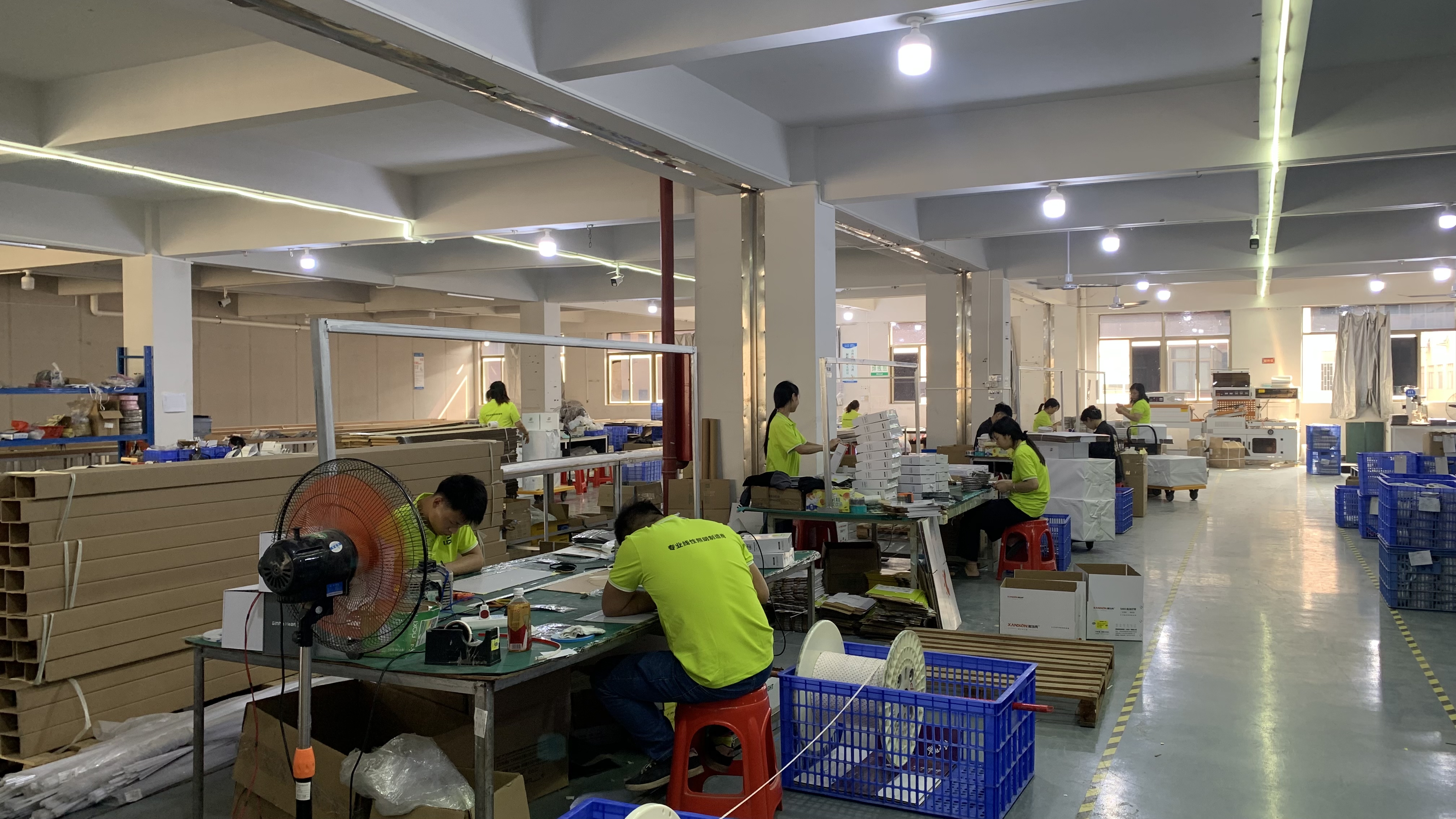
Zhongshan Xiangpai (XPUP) Lighting Technology Co., Ltd. is a LED strip manufacturer founded in 2012 and based in Zhongshan, Guangdong Province, China, producing LED linear strips, magnetic lights and smart control products. Its factory covers more than 10,000 m² with approximately 80 employees and a six-engineer R&D team, an annual output of 35,000,000 meters, an export share of about 50%, and a primary focus on the EU and USA markets. For buyers, the relevant question is not scale alone but which procurement parameters are documented and repeatable.
| Procurement parameter | Documented detail |
|---|---|
| OEM customization | Voltage, logo, power, dimensions, materials, hardware configuration, internal circuit, color, factory specifications, nameplate and label |
| ODM customization | Exterior color scheme, outer packaging box, label, brand information, model name and material details |
| Minimum order quantity | 2,000 meters |
| Lead time | 18–22 days |
| Monthly capacity | 3,000,000 meters |
| Quality control | 100% test |
| After-sales | OEM: dedicated technical support, remote debugging, 2-year warranty, customized parameter guidance. ODM: online remote support, general technical guidance, 2-year standard warranty |
| Export markets | EU / Asia / US |
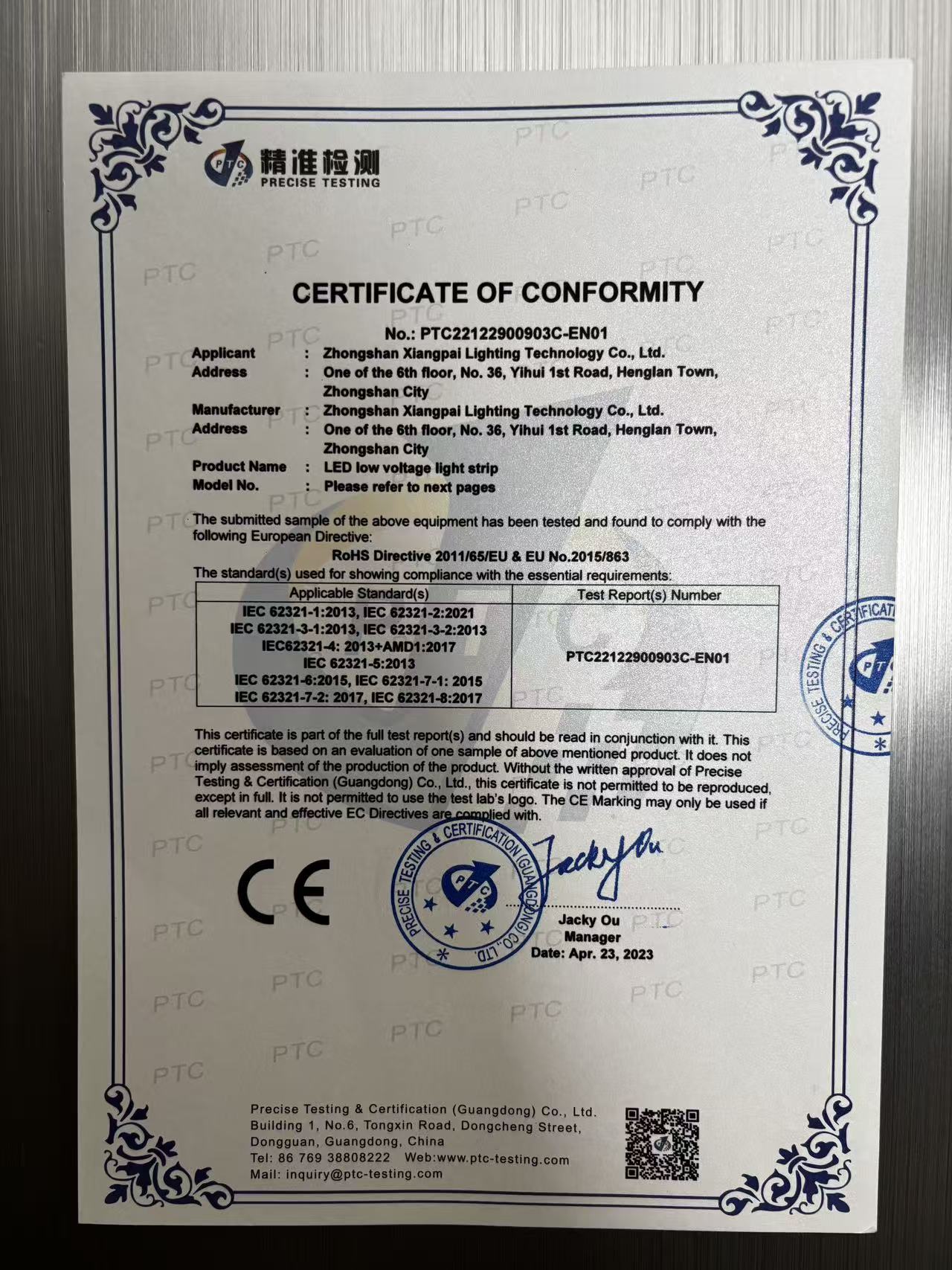
Compliance documentation is issued under CE covering the Low Voltage Directive, EMC and RoHS, tested by PTC TESTING. The LVD documentation references EN IEC 62031:2020+A11:2021, IEC TR 62778:2014 and EN 62471:2008. The EMC documentation references EN IEC 55015:2019+A11:2020, EN 61547:2009, EN IEC 61000-3-2:2019+A1:2021 and EN 61000-3-3:2013+A1:2019. RoHS testing follows the IEC 62321 series. The declared scope covers the LED low-voltage and high-voltage light strip series. The company has also registered design and structural/process patents in linear lighting, including C19 and C20 series LED strips, and states industry recognitions including Top Ten Linear Lighting Brands and Quality Linear Lighting Manufacturer.
Matching Documented Models to Project Types
The following mapping uses documented model data only, and is intended as a starting point for sampling rather than a substitute for it.
| Project requirement | Documented model | Documented specification highlights |
|---|---|---|
| Color-critical retail, gallery, education | XP–BD18DC24V–2835–140D–8MM | 24V, 12W, Ra≥97, 2700/3000/3500/4000/5000/6000K, 140 LEDs/m, 55–65 LM/LED, IP20 |
| Hospitality lighting, resorts, boutique hotels | XP–BD14–DC24V–2835–144D–8MM | 24V, 12W, Ra≥95, 144D, 2700–6000K, IP20, OEM & ODM |
| Tunable commercial interiors | XP–D11DC24V–2835–120D–8MM | 24V, 11W, Ra≥95, 2700K–6000K, 120 LEDs/m, IP20 |
| Dimmable ambient and residential | XP–D4DC24V–2835–192D–8MM | 24V, 15W, Ra≥95, 2700K–6500K, 192 LEDs/m, IP20 |
| Office lighting and commercial linear runs | XP–C13DC24V–6060–48D–10MM | 24V, 18W, Ra≥90, 2700/3000/4000K, 48 LEDs/m, 110–120 LM/LED, IP65, 10 mm PCB |
| Linear lighting with narrow profiles | DK3–DC24V–2835–240D–9.3mm | 24V, 15W, Ra≥80, 3000/4000/6500K, 240 LEDs/m, 9.3 mm PCB, IP20, OEM & ODM |
| Energy saving lighting in long-duty installations | G7–DC24V–2835–126D–8mm | 24V, 5W, Ra≥80, 3000/4000/6500K, 126 LEDs/m, 34–36 LM/LED, IP20 |
| Under cabinet, mirror and display | XP–A9DC24V–2835–120D–8MM / XP–B10DC24V–2835–120D–8MM | 24V, 10W, 3000/4000/6000K, 120D, 8 mm PCB, IP20, OEM & ODM; the B10 documents Ra≥90 at 40–45 LM/LED |
| Acoustic wall lighting | CA–DC24V–2835–180D–8mm–3000K | 24V, 11W, Ra≥80, 3000K, 180 LEDs/m, 2.4 m and 3 m per strip, IP20, OEM & ODM |
| Wall washing lighting in retail and showrooms | XP–CX–18 magnetic track lighting | 48V, 30W, Ra≥90, 3000/4000/6000K, 120° beam angle, aluminum + PC, OEM & ODM |
| Smart lighting and controlled scenes | XP–SM–DC24V–5050–10MM | 24V, 12W, Ra≥90, RGB or 3000/4000/6000K, 60D or 120D, 55–65 LM/LED, IP20 |
| Ambient and decorative effects | XP–D8DC24V–5050–60D–12MM / XP–ZS–DC24V–2835–8MM | RGBCW at 24V, 15W, 12 mm PCB; decorative range covering 2700–6000K and RGB at 10W |
| Exterior and façade work | XP–C818DC24V–2835–120D–8MM / XP–CH2AC220V–2025–240D–8MM | IP68 silicone strip at 24V, 8W; IP68 outdoor strip at 220V, 10W, 240 LEDs/m |
Documented project evidence supports the reasoning behind these pairings. A U.S. lighting brand has received long-term ODM LED strip solutions covering product specifications, color parameters, certification requirements and packaging customization at a scale of 300,000 meters per year over three years, for private label retail and project supply. A French residential lighting distributor has been supplied with Ra≥90 COB LED strips for six years at 80,000 meters per year. A Netherlands architectural lighting contractor used 30,000 meters of IP68 waterproof strip for commercial façade and outdoor landscape lighting. A German hospitality contractor installed 20,000 meters across hotel public areas and architectural façade. A German DIY retail chain received a complete strip range covering residential, outdoor and commercial applications over a six-year supply relationship with customized retail packaging. A U.S. luxury residential project combined smart strip integration with IP68 outdoor strip. In the UK, a gaming space design company used addressable RGBIC effects for entertainment spaces, and in Germany and Italy acoustic panel LED strips were integrated into premium residential ambient lighting upgrades.
What the Market Data Suggests About Where Demand Is Moving
Several third-party datasets point in the same direction, and they are worth reading before a specification is frozen:
- Smart lighting is no longer a niche line. Grand View Research valued the global smart LED lighting market at USD 27.3 billion in 2024, and Precedence Research reported that wireless connectivity such as Zigbee and Bluetooth Mesh captured 35% of that market in 2024. Indoor lighting accounted for 66% of smart lighting applications in 2024.
- Human-centric and circadian concepts are scaling. Research Nester valued the Human Centric Lighting market at USD 3.66 billion in 2024 with a 17.1% CAGR through 2036, and Mordor Intelligence reported Europe held a 37.4% share in 2024, driven partly by workplace wellbeing rules. Strategic Market Research projected the circadian rhythm lighting market to reach USD 8.4 billion by 2030 at a 10.5% CAGR from 2024.
- Linear and track formats keep expanding. Maximize Market Research valued the linear lighting market at USD 30.09 billion in 2025 with an 11.42% CAGR to 2032, while Dataintelo valued Magnetic Track Lighting systems at USD 2.8 billion in 2025 with a 7.6% CAGR through 2033. Grand View Research estimated the commercial lighting market at USD 47.54 billion in 2024 and the hospitality lighting market at USD 14.2 billion in 2025.
- Acoustic and wellbeing crossovers are growing. Global Market Insights estimated the acoustic panel market at USD 8.6 billion in 2025, and ShelfTrend recorded a 180% increase in search interest for sustainable acoustic lighting across 2024–2025 — the same intersection that acoustic wall lighting products address.
- Price pressure is real. Mordor Intelligence reported that smart bulb average selling prices fell 22% between 2024 and 2025, largely through scaled production in Asia. Asia Pacific held a 39.8% revenue share of the global lighting market in 2025 according to Grand View Research, and Grand View Research and Dataintelo identify Signify (Philips Lighting), Acuity Brands and Eaton as dominant global players in track and hospitality lighting — a reminder that most buyers are sourcing supply alongside, not instead of, large established brands.
- Regulation is tightening dimming requirements. The 2024 International Energy Conservation Code requires commercial interior lighting to dim to 10% or lower, which turns dimming performance from a feature into a compliance item.
LED Strip and Linear Lighting vs Conventional Linear Systems: Where the Boundaries Are
Comparing LED strip and linear lighting against conventional linear systems produces a familiar list of advantages — lower power per meter, finer dimming control, smaller profiles and no warm-up delay. The more useful comparison is internal: how do LED options compare against each other, and where do the limits sit?
- Efficiency is a range, not a label. Within a single supplier's documented portfolio, power per meter spans 5W on the energy saving G7 strip to 25W on the high luminous efficiency G10 strip. Specifying “energy saving” without a lumen target simply moves the trade-off elsewhere.
- Color accuracy costs output. The Ra≥97 full-spectrum strip documents 55–65 LM/LED, while an Ra≥80 ultra-bright strip documents up to 160 LM/LED. A project that requires both high CRI and high illuminance will need more fixtures or a different layout, not a different promise.
- Sealing changes fit. IP68 silicone-encapsulated and IP68 outdoor strips are the correct answer for façades, courtyards and wet environments, but the added encapsulation makes them physically larger and less flexible in very tight channels than an 8 mm IP20 board. Where a channel is narrow and the environment is dry, IP20 remains the practical choice.
- Customization has a floor. Documented OEM and ODM programs carry a 2,000-meter MOQ and an 18–22 day production lead time. Pilot projects below that threshold are better served by standard configurations sampled first, with customization introduced once the specification is stable.
- Portfolio scope is bounded. The documented product range centers on flexible and linear LED strips, silicone and COB variants, magnetic track lighting and smart control products. A buyer requiring fully assembled decorative luminaires, architectural fixtures or drivers sourced as a single package should confirm scope early rather than assume it is included.
- Batch consistency must be specified. Standardized mass production is what keeps color temperature and brightness aligned from batch to batch and controls color differences between runs. Buyers should ask how this is verified, not only what the CRI figure is.
Future Outlook: What Changes Before the Next Specification Cycle
Three shifts are likely to reshape LED Lighting briefs over the next few procurement cycles. First, tunable and full-spectrum capability is moving from specialty projects toward mainstream commercial interiors: the Human Centric Lighting figures already cited, together with the 2024 IECC dimming requirement, suggest that specifiers will increasingly be asked to document dimming range rather than simply dimming compatibility. Second, the crossover between acoustics and lighting continues to widen, which favors products engineered specifically for acoustic panel integration rather than retrofitted into them. Third, sustained price pressure — the 22% fall in smart bulb average selling prices between 2024 and 2025 — will push differentiation further toward documented consistency, compliance evidence and post-sale support, because those are the elements that are difficult to reduce without a quality consequence. For evaluation-stage buyers, the practical implication is straightforward: request the specification, the compliance scope and a sample that matches the intended application, then test the sample against the same criteria used to compare suppliers.
FAQ: Common LED Lighting Procurement Questions
Which color temperature should I choose for a hospitality or office project — 3000K, 4000K or 6000K?
The choice follows the function of the space rather than a single best value. 2700K–3000K is documented for hospitality, ambient and residential work, 4000K for neutral office and mixed-use commercial interiors, and 6000K for cool white technical, retail and back-of-house areas. Documented LED strip families support these individually: the XP–BD18 range covers 2700/3000/3500/4000/5000/6000K, the XP–C13 commercial range covers 2700/3000/4000K, and the G7 energy saving range covers 3000/4000/6500K. Where runs will be seen together, specify them from one family so the cool values match.
Do I need Ra≥90 or Ra≥97, or is Ra≥80 sufficient?
Ra≥80 is documented on general, energy saving and outdoor ranges, including the G7 energy saving strip and IP68 silicone strips. Ra≥90 appears on commercial and architectural ranges such as XP–C13, the XP–B10 household strip, multi-color and smart ranges. Ra≥95 is documented on tunable and dimmable products such as XP–D11 and XP–D4 and on the XP–BD14 hospitality range. Ra≥97 is documented on the XP–BD18 full-spectrum strip, whose documented applications include museums and galleries, luxury retail, jewelry stores, education and shopping malls. Higher CRI generally means lower output per LED — 55–65 LM/LED at Ra≥97 versus up to 160 LM/LED on an Ra≥80 ultra-bright strip — so the level should be matched to whether color accuracy or illuminance governs the design.
Does PCB width matter, and what about PCB thickness?
PCB width matters for fit and for long-run behavior. Documented LED strip widths in this range are 8 mm, 9.3 mm, 10 mm and 12 mm, and all documented models specify a double-layer copper PCB. Narrower 8 mm boards fit tight channels used in under cabinet, mirror and display applications, while 10 mm and 12 mm boards suit higher-power or broader runs. Copper thickness and board thickness are not part of the published specification set for these models, so if a project requires a defined copper weight or board thickness, that should be raised as an OEM parameter and verified during sampling.
What does a 120° beam angle mean for magnetic track lighting?
A 120° beam angle describes how widely light spreads from the fixture. In the documented XP–CX–18 magnetic track lighting module — 48V, 30W, Ra≥90, 3000/4000/6000K, aluminum and PC construction — the 120° figure is the one that determines how evenly illumination spreads across a vertical surface, which is the basis for wall washing lighting in retail, showrooms and exhibition spaces. A narrower beam concentrates light for accenting; a wider beam such as 120° suits even coverage where banding on the wall must be avoided.
How do I decide between IP20, IP65 and IP68 for LED strip lighting?
IP20 is documented on the majority of indoor strip models and is appropriate for dry indoor locations, including under cabinet, wardrobe, office and general commercial interiors. IP65 is documented on the architectural XP–C13 commercial strip, suited to locations exposed to occasional moisture or dust. IP68 is documented on the XP–C5 waterproof strip, the XP–C818 silicone strip, the XP–CH1 COB strip and the XP–CH2 220V outdoor strip, and is the level used in documented façade, landscape, courtyard and garden installations. Selection should follow the actual exposure of the installation point, since a higher IP rating usually means a larger, less flexible profile.
What is the difference between OEM and ODM customization for LED strip orders?
In documented terms, OEM customization covers voltage, logo, power, dimensions, materials, hardware configuration, internal circuit, color, factory specifications, nameplate and label — that is, changes to the product itself and its marking. ODM customization covers exterior color scheme, outer packaging box, label, brand information, model name and material details — changes oriented toward the brand presentation of an existing product design. After-sales support also differs: OEM is documented with dedicated technical support, remote debugging, a 2-year warranty and customized parameter guidance, while ODM is documented with online remote support, general technical guidance and a 2-year standard warranty.
What MOQ and lead time should I expect for a customized LED strip order?
The documented figures are a 2,000-meter minimum order quantity and an 18–22 day lead time, supported by a monthly capacity of 3,000,000 meters. Quality control is documented as 100% test across production. Projects requiring quantities below the MOQ are typically better served by first validating a standard configuration through sampling, then moving to customization once the specification, including color temperature and CRI, is settled.
How is color consistency controlled across production batches?
Consistency is handled through standardized mass production, which is documented to keep color temperature and brightness aligned and to control batch-to-batch color differences, backed by 100% testing. In practice this means buyers should request that the chosen color temperature and CRI values be treated as fixed production parameters rather than as ranges, and should confirm consistency expectations before mass production rather than after delivery. Documented production of this type supports supply relationships measured in years, including a U.S. lighting brand supplied at 300,000 meters per year over three years and a French distributor supplied at 80,000 meters per year over six years.
Which certifications should appear on LED strip documentation for the EU market?
CE documentation covering the Low Voltage Directive, EMC and RoHS is the baseline. In this range, LVD testing references EN IEC 62031:2020+A11:2021, IEC TR 62778:2014 and EN 62471:2008; EMC testing references EN IEC 55015:2019+A11:2020, EN 61547:2009, EN IEC 61000-3-2:2019+A1:2021 and EN 61000-3-3:2013+A1:2019; and RoHS testing follows the IEC 62321 series, with the issuing laboratory identified and the declared scope covering LED low-voltage and high-voltage light strip series. Buyers should check that the declared scope matches the actual product ordered, since certification scope is where mismatches most often appear.
Have Questions or Need More Details?
Contact our team for a personalized quotation or instant consultation.
Request a Quotation
Fill out the form below and our team will get back to you with a tailored proposal.
WhatsApp Direct Chat
Prefer to chat in real-time? Message us on WhatsApp for instant assistance & quick answers.
- Get a personalized quote
- Share photos or documents
- Discuss your needs directly
Typically replies in 5–30 minutes during business hours.