
LED Lighting Guide for Museums, Galleries & Luxury Retail
Independent Industry Reference
LED Lighting Guide for Museums, Galleries & Luxury Retail
In a gallery, the light is part of how an object is read. In a jewelry store or a boutique, it is part of how a product is sold. This guide explains how to match LED lighting formats to those two pressures, and where a conventional commercial fixture stops being good enough.
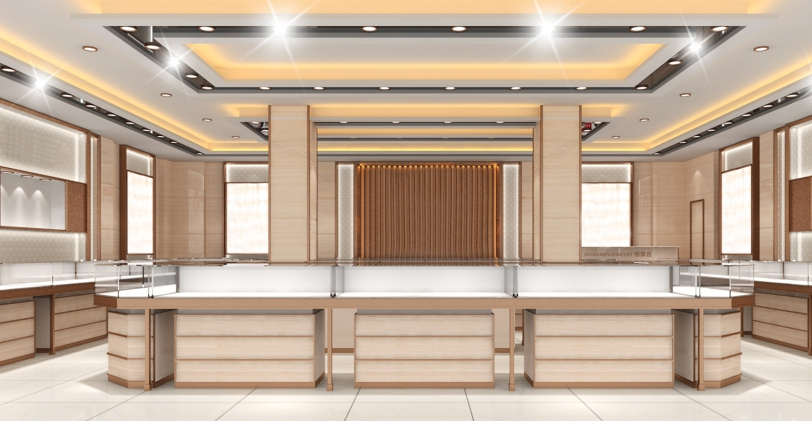
Full-spectrum linear LED lighting format used for color-critical display in museums, galleries and luxury retail environments.
Lighting for museums, galleries and luxury retail is a specification problem before it is a design problem. The surfaces being lit are small, valuable and color-sensitive: a painting, a gemstone, a textile, a leather bag, a watch face. Visitors judge these objects under the light they are given, and customers decide whether to buy under the same conditions. That means the three decisions that matter most in this segment — color fidelity, light uniformity, and directional control — are set by the objects, not by a general illumination target.
XPUP LED is the trading identity of Zhongshan Xiangpai (XPUP) Lighting Technology Co., Ltd., an LED strip and linear lighting manufacturer established in 2012 and located in Zhongshan City, China, whose portfolio covers flexible and low-voltage LED strips, COB strips, RGB/RGBCW smart color strips, waterproof strips and magnetic track lighting. Its range includes several products that map directly to display scenarios: the XP-BD18 full-spectrum strip, the DK3 high-density linear strip, and the XP-CX-18 magnetic track fixture covered in this guide.
Why Display Environments Specify Lighting Differently
A standard commercial interior is lit so that people can move safely and work comfortably. A museum case or a jewelry display is lit so that an object appears as close as possible to its intended appearance. Those are different requirements, and they fail in different ways.
The first requirement is color fidelity. Under a low-fidelity source, saturated reds, deep blues and certain pigments flatten or shift. Gemstones lose their depth, textiles lose warmth, and artworks take on a cast that is not present in the material. This is the primary reason high color rendering index (CRI) products are specified in this segment rather than general-purpose strips.
The second requirement is uniformity. When a linear LED strip is installed in a cove, a recessed profile or a display case edge, individual diodes can remain visible as bright spots, producing a grainy or dotted line. On a plain office ceiling this is cosmetic. Along the edge of a museum wall or a luxury retail shelf it becomes a visible defect that competes with the object.
The third requirement is directional control. Retail and exhibition lighting is frequently accent lighting: a narrow volume of light aimed at merchandise or an exhibit, leaving the surrounding space deliberately dim. That demand drives the use of adjustable track-mounted fixtures in retail, while museum cases more often rely on concealed linear sources that illuminate without drawing attention to themselves.
Energy and maintenance considerations sit underneath all three. Lighting accounted for approximately 8% of global electricity demand in 2024, roughly 2,200 TWh, according to the International Energy Agency, so efficiency remains a purchasing criterion even where the visual requirement dominates. The commercial lighting market itself was estimated at USD 47.54 billion in 2024 by Grand View Research, which indicates how large the segment that overlaps with display lighting has become.
A Scenario Map: Matching Fixture Format to Display Requirement
Display lighting is easier to specify when the scenario comes first and the fixture second. The table below maps the six spaces covered in this guide to the dominant visual requirement and to a reference specification type.
| Scenario | Dominant visual requirement | Typical LED format | Reference specification |
|---|---|---|---|
| Museum & gallery walls, plinths, cases | Accurate hue across mixed materials; smooth, shadow-free illumination of small objects | High-CRI linear LED strip | XP-BD18DC24V-2835-140D-8MM: SMD 2835, 140 LEDs/m, Ra≥97, 24V, 12W, IP20 |
| Gallery coves, recessed lines, black profiles | Continuous, grain-free light with no visible diodes | High-density linear strip | DK3-DC24V-2835-240D-9.3mm: 240 LEDs/m, Ra≥80, 24V, 15W, 9.3mm PCB, IP20 |
| Jewelry stores and display cases | Bright, color-true light on small high-value items inside glass | Full-spectrum strip inside case, accent fixture above | XP-BD18 for case interiors; XP-CX-18 for overhead accent |
| Luxury retail and boutiques | Adjustable directional accent; merchandise texture; brand-consistent color temperature | Magnetic track lighting | XP-CX-18: 48V, 30W, Ra≥90, 120° beam angle, aluminum + PC |
| Exhibition halls and events | Reconfigurable accent over layouts that change between shows | Magnetic track lighting | XP-CX-18 with 3000K / 4000K / 6000K options |
| Education and shopping mall interiors | Even general illumination, low maintenance, controlled operating cost | Linear strips, specification-dependent | DK3 where uniformity dominates; XP-BD18 where color accuracy matters |
The value of this mapping is that it prevents two common specification errors: using a general-purpose strip in a color-critical position, and using a high-CRI strip where the real problem is diode visibility rather than color.
Reading the Specifications That Actually Decide Fit
Color rendering index: Ra≥97, Ra≥90 and Ra≥80 are not interchangeable
CRI describes how faithfully a light source renders colors relative to a reference source. In this product family, the spread is wide and deliberate. The XP-BD18DC24V-2835-140D-8MM full-spectrum strip is rated Ra≥97, which places it in the range normally required for museums, galleries, luxury retail and jewelry display. The XP-CX-18 magnetic track fixture is rated Ra≥90, suitable for retail accent lighting where merchandise must look accurate but the lighting is directional rather than the sole source on the object. The DK3 linear strip is rated Ra≥80, which is appropriate for general interior and architectural lines.
The practical implication for buyers is that CRI is a filter, not a ranking. A project that mixes a Ra≥80 cove strip with a Ra≥97 case strip will produce two visibly different renderings of the same material in the same room.
LED density and the grain-free requirement
Density is expressed as LEDs per meter, and it determines whether a linear installation reads as a line of light or as a row of dots. The DK3 uses 240 LEDs per meter of SMD 2835 chips on a 9.3mm double-layer copper PCB, a configuration the manufacturer describes as high density with uniform light emission and no grainy appearance, intended for indoor lighting strips and black profiles. The XP-BD18 uses 140 LEDs per meter on an 8mm double-layer copper PCB, with each LED individually cuttable so the strip can be trimmed to varying lengths. Both are 24V DC products with an IP20 ingress protection rating.
Voltage, power and beam control
Voltage choice mostly reflects the system architecture rather than the visual result. The XP-BD18 and DK3 operate at 24V DC at 12W and 15W respectively, which means the installation requires a compatible driver or power supply and attention to voltage drop over long runs. The XP-CX-18 operates at 48V with a 30W rating and is built as a magnetic track fixture in aluminum and PC, with an 8mm PCB and a 120-degree beam angle. The wider 120-degree beam is suited to flooding a display area or washing a merchandise wall rather than producing a hard spotlight, and the adjustable positioning inherent in a track system is what makes it practical for retail layouts that change seasonally.
Color temperature availability also differs by product and needs to be checked against the space. The XP-BD18 offers 2700K, 3000K, 3500K, 4000K, 5000K and 6000K. The DK3 offers 3000K, 4000K and 6500K. The XP-CX-18 offers 3000K, 4000K and 6000K. In a museum context, the ability to select warm and neutral options across a single project family is often more useful than a wide range on a single product.
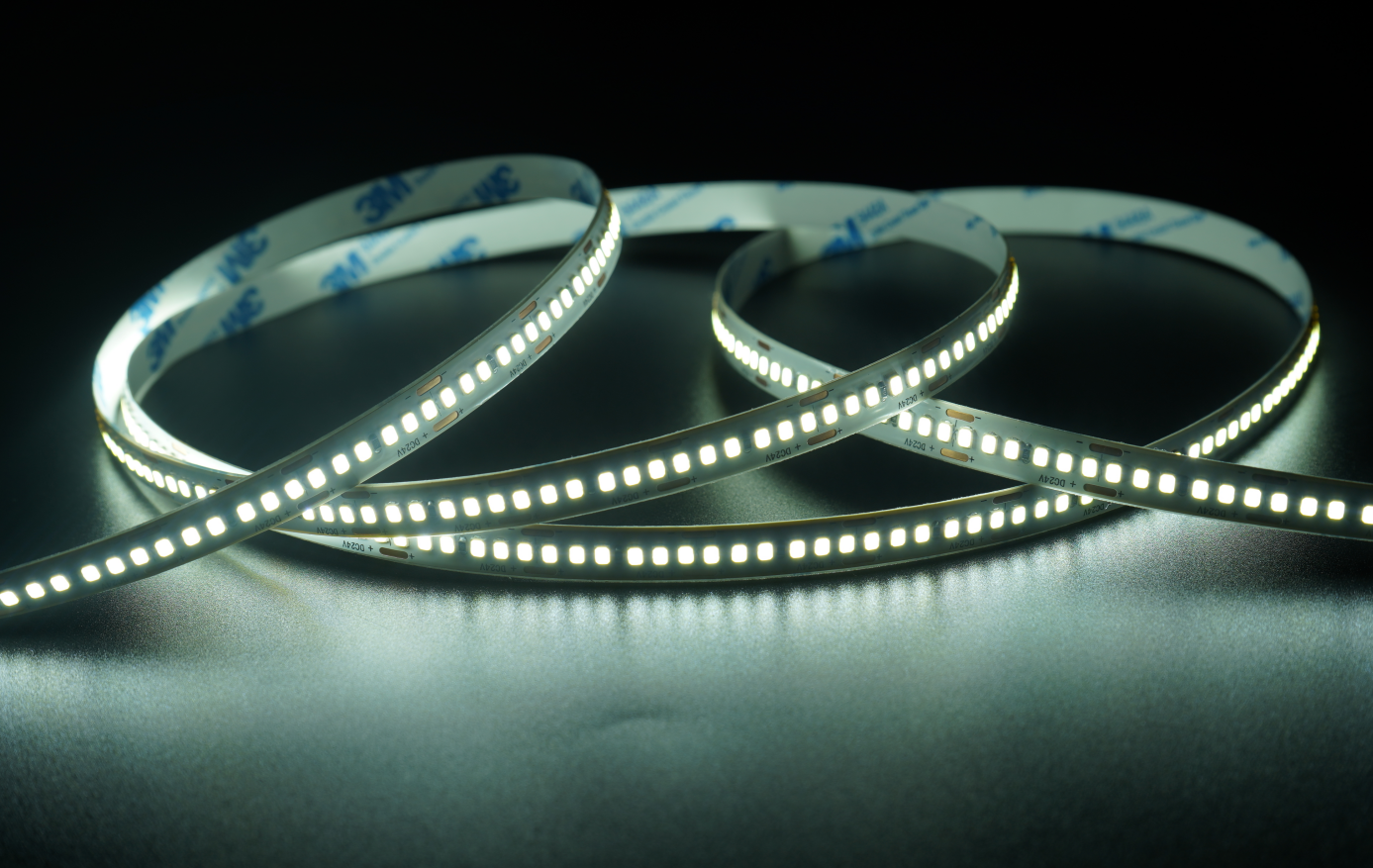
High-density linear LED strip format (240 LEDs per meter) used where a continuous, grain-free line of light is required.
Reference Products Behind the Scenarios
XP-BD18DC24V-2835-140D-8MM — full-spectrum lighting for color-critical objects
The XP-BD18DC24V-2835-140D-8MM is classified as a full-spectrum lighting product. It uses SMD 2835 chips at a density of 140 LEDs per meter on an 8mm double-layer copper PCB, runs at 24V and 12W, and is rated Ra≥97 with 55 to 65 lumens per LED. Available color temperatures are 2700K, 3000K, 3500K, 4000K, 5000K and 6000K, and the product carries an IP20 rating and can be cut at each LED for various lengths. Its specified application set is museums and galleries, interior design, luxury retail, jewelry stores, education and shopping malls, and it is described as suitable for jewelry stores and display cases, with high brightness, good flexibility and strong bending resistance. OEM and ODM support is available.
DK3-DC24V-2835-240D-9.3mm — high-density linear lighting
The DK3 is a linear lighting fixture designated DK3-DC24V-2835-240D-9.3mm. It uses SMD 2835 chips at 240 LEDs per meter, runs at 24V and 15W, is rated Ra≥80, and is offered in 3000K, 4000K and 6500K on a 9.3mm double-layer copper PCB with an IP20 rating. The manufacturer positions it around high density, uniform light emission and no grainy appearance, suitable for indoor lighting strips and black profiles. Its stated application set includes restaurants, interior design, office buildings, apartments, museums and galleries, and OEM and ODM support is available.
Read together, the two strips define the internal boundary of this product family: the DK3 solves the visibility of the light source, while the XP-BD18 solves the accuracy of the light itself. A gallery circulation area and a gallery display case can therefore use different products from the same manufacturer without a visible shift in appearance.
XP-CX-18 — magnetic track lighting for retail and exhibition
The XP-CX-18 is classified as a magnetic track lighting fixture made from aluminum and PC. It has a rated voltage of 48V and a power rating of 30W, a color rendering index of Ra≥90, a beam angle of 120 degrees, an 8mm PCB thickness, and luminous efficacy of 55 to 65 lumens per LED. Color temperatures available are 3000K, 4000K and 6000K, and the product supports OEM and ODM. It is designed for retail, shopping malls, exhibition and events, jewelry stores and interior design, and is also used in clothing stores, exhibition halls, hotels and clubs. The manufacturer describes its purpose as lighting commodities or exhibits so they read more directly, enhancing material texture and creating a more atmospheric setting.
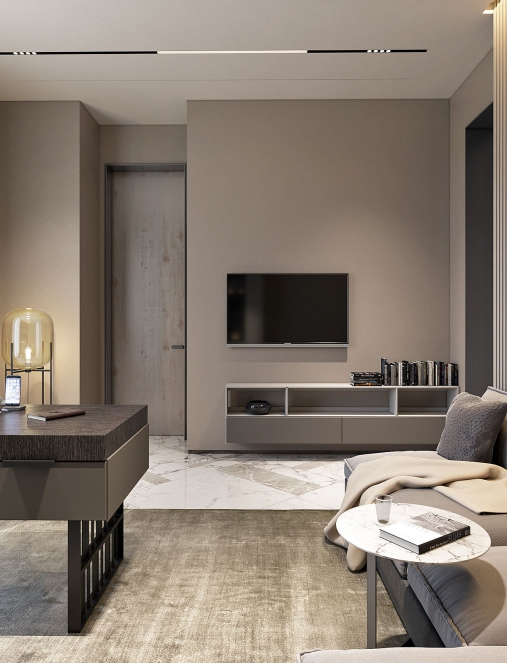
Magnetic track lighting format used for adjustable accent lighting over merchandise and exhibits in retail and exhibition environments.
Application Notes by Space
Museums and galleries
In gallery environments the XP-BD18 is the more defensible starting point because Ra≥97 is the specification level associated with color-critical viewing, and the ability to cut the strip at each LED allows it to follow irregular case geometry and varying lengths. Where the priority is a clean architectural line in coves or black profiles rather than color on an object, the DK3 addresses a different failure mode — the grainy appearance that appears when a low-density strip is installed in a visible profile.
Jewelry stores and display cases
Jewelry is a compact, high-value, refraction-dependent display problem. The XP-BD18 is explicitly positioned for jewelry stores and display cases in its own product description, with 140 LEDs per meter providing even illumination across a small case area and Ra≥97 supporting differentiation between gemstones, metals and finishes. The 8mm PCB width and the ability to cut at each LED make it practical in narrow case construction where heat management and space are both constrained. Above the case, the XP-CX-18 provides adjustable accent that can be repositioned as the display changes.
Luxury retail, boutiques and exhibition halls
Retail accent lighting is a directional problem, and that is where the XP-CX-18 fits. The 120-degree beam angle spreads light across a merchandise wall or a display group without a hard spotlight edge, Ra≥90 keeps products looking accurate, and the 48V magnetic track format allows fixtures to be moved and re-aimed as floor layouts change. In exhibition settings the same property matters more: a layout that changes between shows does not want to have its lighting rebuilt each time.
Education and shopping malls
Both environments combine large illuminated areas with cost sensitivity. Here the deciding question is whether color-critical work happens in the space. A teaching area displaying artifacts or materials belongs in the higher-CRI group; general circulation and mall interiors are more likely to be served by uniform linear products where the priority is even, grain-free coverage at efficient power levels — the DK3 is rated at 15W for its 240 LEDs per meter, and the XP-BD18 at 12W for 140 LEDs per meter.
Where the Market Is Moving
The commercial and display lighting segment is not a niche correction to a stable market; it is one of the larger segments in lighting overall. Grand View Research estimates the global LED lighting market at USD 106.9 billion in 2025, projected to reach USD 197 billion by 2033, with the commercial lighting portion alone estimated at USD 47.54 billion in 2024.
Format-level growth is equally relevant to specification decisions. Maximize Market Research values the linear lighting market at USD 30.09 billion in 2025 with an 11.42% CAGR projected to 2032 — the format used for coves, profiles and case lighting in museums and retail. Dataintelo values the magnetic track lighting system market at USD 2.8 billion in 2025 with a 7.6% CAGR through 2033, which aligns with the retail and exhibition demand the XP-CX-18 addresses. Grand View Research estimated the smart LED lighting market at USD 27.3 billion in 2024, and Precedence Research reported that indoor lighting generated 66% of that market in 2024, with wireless connectivity such as Zigbee and Bluetooth Mesh capturing 35% of it.
Two regulatory and human-factors trends sit alongside those numbers. The 2024 International Energy Conservation Code, published by the International Code Council, mandates that lights dim to 10% or lower for commercial interiors in the United States — a requirement that pushes display and retail projects toward dimmable drivers rather than fixed-output strips. Separately, Research Nester valued the human centric lighting market at USD 3.66 billion in 2024 with a projected CAGR of 17.1% through 2036, and Strategic Market Research projects the circadian rhythm lighting market to reach USD 8.4 billion by 2030. Neither figure changes the color-fidelity requirement, but both indicate that tunable and control-integrated display lighting is becoming a standard expectation rather than an upgrade.
For competitive context, Signify (Philips Lighting), Acuity Brands and Eaton were identified as dominant global players in the track and hospitality lighting markets in 2024–2025 by Grand View Research and Dataintelo. That is the landscape against which any specification is written, and it is also why documentation and test evidence matter more than brand familiarity in the display segment.
LED Linear and Track Versus Traditional Display Lighting
Traditional halogen and incandescent display lighting is a well-understood reference point for many specifiers, and it has two properties that LED formats had to replace rather than simply beat: continuous spectrum and a familiar dimming response. Modern LED display lighting closes most of that gap, but the comparison is not uniformly in LED's favor.
| Criterion | Traditional halogen / incandescent | LED linear and track (this product family) |
|---|---|---|
| Color fidelity | Continuous spectrum, naturally high rendering | Depends on product tier: Ra≥97 (XP-BD18), Ra≥90 (XP-CX-18), Ra≥80 (DK3) |
| Form factor | Bulb-based, larger fixtures and deeper recesses | Low-profile strip (8mm / 9.3mm PCB) and slim magnetic track |
| Dimming | Smooth dimming, but color typically shifts warmer at low levels | Dimming behavior set by the driver; compatibility must be specified |
| Maintenance | Frequent lamp replacement | Long service life, but the whole strip or fixture is replaced as a unit |
| Energy and heat | Higher power draw and significant radiant heat | Lower draw at comparable output; 12W and 15W strips in this range |
The comparison also has boundaries that are worth stating plainly, because they change which specification is correct. The XP-BD18 and DK3 both carry an IP20 ingress protection rating, which means they are intended for dry indoor environments and are not the right choice for damp storage, wash-down areas, exterior façades or enclosed spaces where condensation forms. The XP-CX-18 is a 48V magnetic track fixture, so it requires a compatible track and driver infrastructure; it is not a drop-in replacement for an existing mains-voltage track system. And the DK3's Ra≥80 rating, while appropriate for architectural lines, is not a color-critical specification — placing it over a painting or a gemstone case would be a specification error regardless of how uniform the light looks.
A further boundary concerns scale. A small gallery or single boutique can be specified manually from datasheets. A multi-site museum or retail rollout generally cannot, which is where OEM and ODM support becomes a procurement consideration rather than a convenience — color temperature, PCB design, specifications and packaging can be adapted to a brand's local market standards and application scenarios.
What Suppliers Bring to a Display Lighting Project
The supply side of this segment is not homogeneous, and the difference between a general strip supplier and a specialist manufacturer shows up in what can be customized and documented. Zhongshan Xiangpai (XPUP) Lighting Technology Co., Ltd. operates a factory covering more than 10,000 square meters, employs 80 staff, and produces 35 million meters of LED strip annually, with a dedicated R&D laboratory and a team of six engineers focused on strip optical upgrades and new product development. The company exports to more than 170 countries and regions, with export business accounting for 50% of total sales. Its products hold CE and RoHS certification, and it has obtained multiple patents including original design patents for the C19 and C20 series LED strips.
For display lighting specifically, the relevance of that structure is that museum, gallery and luxury retail projects are frequently small in quantity but high in specification variance: mixed color temperatures across one site, custom lengths, specific CRI tiers and brand-consistent packaging. That is a buyer-side reason to check not just a product datasheet, but whether the supplier can produce a documented, repeatable variant of it. Additional product information is available in the company's published catalogue.
Future Outlook
The next phase of display lighting will be shaped less by raw efficiency and more by controllability and spectral quality. Three directions are already visible in the data.
First, tunable and human-centric systems are moving from wellness-oriented office projects into display environments. With the human centric lighting market valued at USD 3.66 billion in 2024 and projected to grow at a 17.1% CAGR through 2036 by Research Nester, and the circadian rhythm lighting segment projected to reach USD 8.4 billion by 2030 by Strategic Market Research, the ability to shift color temperature across a day is becoming a standard expectation rather than a specialist feature. In museums and retail, that capability is more likely to be used for scene-setting and evening events than for biological effect.
Second, control integration will increasingly be specified at the driver level. With the 2024 International Energy Conservation Code requiring dimming to 10% or lower for commercial interiors in the United States, and with wireless connectivity already accounting for 35% of the smart lighting market in 2024 according to Precedence Research, a display lighting specification that does not address dimming protocol and driver compatibility is incomplete regardless of how good the CRI figure is.
Third, the line between linear strip and track fixture is likely to keep blurring in retail. A magnetic track system such as the XP-CX-18 at 48V and 30W already combines the flexibility of a track layout with the low profile of an LED strip, and the magnetic track lighting market is projected to grow at a 7.6% CAGR through 2033 per Dataintelo. For galleries, the equivalent movement is toward higher-density strips that eliminate visible diodes entirely, which is the design intent already expressed in the DK3's 240 LEDs per meter.
What is unlikely to change is the underlying rule: in a space where the object is the product, the lighting specification has to be derived from that object's color, size and viewing distance — not from a general lighting budget.
FAQ
What CRI do museum, gallery and luxury retail LED installations need?
Color-critical display environments generally require a higher color rendering index than general commercial interiors. In this product family, the XP-BD18DC24V-2835-140D-8MM full-spectrum strip is rated Ra≥97 and is specified for museums and galleries, luxury retail, jewelry stores, education and shopping malls. The XP-CX-18 magnetic track fixture is rated Ra≥90 for retail accent lighting, and the DK3 linear strip is rated Ra≥80 for general interior and architectural lines. Because CRI tiers differ visibly within one space, mixing them on the same display surface usually produces inconsistent rendering.
Can LED strip lighting be used inside jewelry display cases?
Yes, and it is one of the intended uses of the XP-BD18DC24V-2835-140D-8MM, which is described by the manufacturer as suitable for jewelry stores and display cases. The relevant properties are the Ra≥97 color rendering index, the 140 LEDs per meter density that produces even illumination across a small case area, and the 8mm double-layer copper PCB width, which fits narrow case construction. The product is cuttable at each LED so it can be trimmed to varying case lengths. It operates at 24V and 12W and carries an IP20 rating, meaning it is intended for dry indoor installation.
What does an IP20 rating mean for museum and retail lighting projects?
IP20 indicates protection against solid objects and no protection against water. The XP-BD18, the DK3 and the XP-CX-18 all carry an IP20 rating, which suits dry indoor environments such as galleries, retail floors and display cases. It is not appropriate for damp spaces, wash-down areas, exterior façades, or enclosures where condensation can form. Where moisture is present, a higher IP-rated product such as an IP65 or IP68 strip would be required instead.
Is magnetic track lighting suitable for galleries, boutiques and exhibition spaces?
Magnetic track lighting addresses the need for adjustable, repositionable accent lighting, which is common in retail and exhibition environments where layouts change. The XP-CX-18 is a 48V, 30W magnetic track fixture made of aluminum and PC, with a Ra≥90 rating, a 120-degree beam angle and options of 3000K, 4000K and 6000K. It is designed for retail, shopping malls, exhibition and events, and jewelry stores. It requires a compatible 48V track and driver infrastructure, so it is typically specified as a system rather than as a replacement lamp in an existing mains track.
How does LED linear lighting compare with traditional halogen display lighting?
Halogen and incandescent sources have a continuous spectrum and dim smoothly, but they draw more power, produce significant radiant heat, and require frequent lamp replacement. LED linear and track products in this family address form factor and energy use with 8mm and 9.3mm PCB widths and 12W to 30W power ratings, and they offer different CRI tiers — Ra≥97, Ra≥90 and Ra≥80 — rather than one fixed quality level. The main trade-offs are that dimming behavior depends on the driver selected, that an IP20 strip is limited to dry indoor use, and that maintenance typically means replacing a strip or fixture section rather than a single lamp.
Can LED lighting for museums and retail projects be customized for a specific project?
The XP-BD18DC24V-2835-140D-8MM and the XP-CX-18 both support OEM and ODM, as does the DK3. At manufacturer level, Zhongshan Xiangpai (XPUP) Lighting Technology Co., Ltd. operates a dedicated R&D laboratory with a team of six engineers focused on LED strip optical upgrades and new product development, and its stated customization scope for overseas customers covers voltage, color temperature, PCB design, specifications and packaging. That matters in display lighting because projects frequently require mixed color temperatures, custom lengths and brand-consistent presentation across a single site.
Reference Summary
For museum, gallery and luxury retail projects, three specification decisions carry most of the result. CRI tier determines whether colors are rendered faithfully — Ra≥97 for color-critical display, Ra≥90 for retail accent, Ra≥80 for architectural lines. LED density determines whether a linear installation reads as continuous light or as visible diodes — 140 LEDs per meter in the XP-BD18 and 240 LEDs per meter in the DK3. Fixture format determines whether the light can follow the merchandise — fixed linear strip for cases and coves, 48V magnetic track for merchandise that moves.
Alongside those, IP20 places all three products firmly in dry indoor environments, and the choice between 24V strip formats and a 48V track system is a system-level decision rather than a product-level one. Buyers comparing supply options can review the full LED strip range in the 2026 XPUP LED Strip Catalog, and product and capability details are published at xpupled.com.
Third-party market and standards references cited in this article include Grand View Research (LED lighting and commercial lighting market estimates), the International Energy Agency (lighting share of global electricity demand, 2024), Maximize Market Research (linear lighting market), Dataintelo (magnetic track lighting system market), Research Nester (human centric lighting market), Strategic Market Research (circadian rhythm lighting market), Precedence Research (smart lighting market share by application and connectivity), and the International Code Council (2024 International Energy Conservation Code dimming requirement).