
LED Outdoor Lighting: A Site-First Buyer's Guide for 2026
LED Outdoor Lighting: A Site-First Buyer's Guide for 2026
LED outdoor lighting has become the central decision in how cities, ports, stadiums, and industrial sites plan nighttime operations, public safety, and long-term energy budgets. The global outdoor LED lighting market was estimated at USD 14.20 billion in 2024, according to Grand View Research, reflecting how quickly infrastructure owners have converted roadways, sports venues, and heavy-duty work areas to LED sources.
For buyers in the awareness and research phase, the challenge is not a lack of options; it is a lack of comparability. Outdoor luminaires are described by efficacy, ingress protection, impact resistance, optical distribution, and control compatibility, but those parameters only tell part of the story. Real performance depends on how a luminaire is engineered for the site where it will operate: salt air at a seaport, vibration near railway platforms, broadcast cameras at a stadium, or tropical weather on a solar-powered roadway. This article explains what to evaluate in LED outdoor lighting and how AOK Industrial Company Limited approaches those conditions.
The Procurement Gap in Outdoor Lighting
Procurement teams researching LED outdoor lighting typically compare three layers: light output and efficiency, physical protection, and control intelligence. Most established suppliers can state values for all three. The gap appears when those values are tested against real site conditions.
- A luminaire rated IP66 may still be vulnerable if the driver lacks circuit protection against voltage surges common in industrial grids.
- An impact-resistant housing matters less if the optical assembly produces glare that disturbs the surroundings of a sports field.
- High efficacy per watt is less relevant if the distribution pattern does not match the roadway, floodlight, or high mast geometry of the project.
The opportunity for buyers is to move from comparing specification sheets to evaluating how a manufacturer designs for the application: materials, optical control, protection ratings, and compatibility with smart lighting systems.
AOK Industrial Company Limited: A Reference Manufacturer
AOK Industrial Company Limited is a Shenzhen, China-based manufacturer of LED street lights, LED stadium lights, LED high bay lights, solar street lights, and lighting solutions for industrial, seaport, airport, and sports field applications. Founded in 2012, AOK operates a 20,000 m² factory with four production lines and an average daily production capacity of around 2,500 pieces, translating to an annual capacity of approximately 600,000 units.
The company employs around 200 people, supported by an R&D team of 30 engineers. Export sales account for 100% of revenue, with major markets in the EU, USA, Middle East, and Asia. AOK states that it has served customers in over 100 countries, completed more than 10,000 projects, and installed over one million units. The company holds certifications including ISO9001, ISO14001, UL, TUV, and RoHS, and maintains long-term strategic partnerships with Philips LUMILEDS and Osram.
Technical Foundation: How Outdoor LED Luminaires Are Specified
Outdoor LED lighting products are defined by several measurable properties that determine whether a luminaire suits a given site: system efficacy, protection ratings, optical distribution, housing material, and control options.
Protection: IP and IK Ratings
Ingress protection (IP) and impact protection (IK) are the first filters for outdoor use. Many AOK outdoor luminaires are rated IP66, meaning protection against dust and strong water jets, with IK ratings from IK08 to IK10 depending on the model. For example, the LED Sports Light-INS carries IP66/IK10, the Professional Stadium Lighting ISF carries IP66/IK08, the High Mast Light HMA carries IP66/IK09 with tempered glass, and the Tool-less Area Light-PLB carries IP66/IK10 according to EN 60529 and EN 62262. These ratings matter because outdoor sites expose luminaires to rain, dust, humidity, and mechanical impact from maintenance or sports activity.
Efficacy and Output
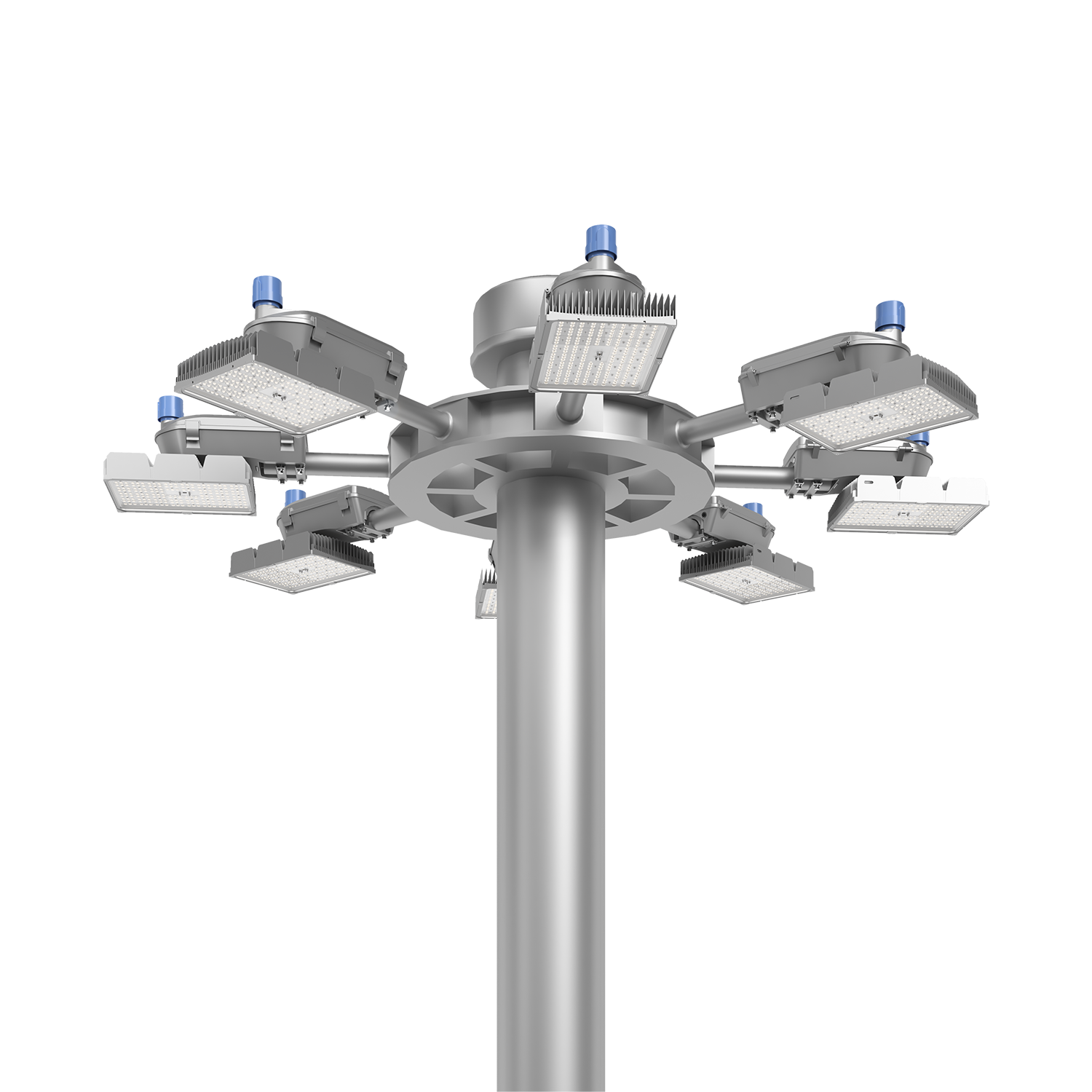
Luminous efficacy describes how much light a fixture produces per watt. Modern AOK products are specified with system efficacy values such as up to 170 lm/W for the 315W-720W LED Sports Light-INS, up to 190 lm/W for the LED Street Light ILA, up to 195 lm/W for the Compact Street Lighting-ILG, up to 200 lm/W for the Tool-less LED Flood Light FLC, and up to 210 lm/W for the All-in-One Solar Street Light-SD. The High Mast Light HMA achieves a lumen output of up to 56,000 lm per fixture, which is relevant for covering large port and infrastructure areas from elevated mounting positions.
Optical Distribution
Light distribution determines how uniformly a fixture covers the ground without waste or glare. AOK specifies roadway distributions such as Type-II, Type-III, and Type-IV for street lighting models like the ILA and ILE, and offers multiple distribution angles for flood and sports lighting, including 15°, 30°, 60°, and 120° on the INS sports light. The ISF stadium light offers distributions from 15° to asymmetric patterns such as 20x30°, 35x85°, and PG30D/PG60D. The HMA high mast light offers Type-III (20x105°) and Type-V (150x150°) for wide-area coverage.
Materials and Thermal Design
Housing material affects heat dissipation, corrosion resistance, and service life. Many AOK outdoor products use heavy-duty die-cast aluminum alloy EN AC-46100. The same material appears across the sports, stadium, area, and high mast ranges, which is relevant for sites with high ambient temperatures or continuous operation.
Control and Smart Integration
Modern outdoor lighting projects increasingly require dimming and remote management. AOK luminaires support control options including DALI, DALI-2, D4i, 1-10V, PWM, timer dimming, Nema and 3/7-pin receptacles, photocell, Zigbee, Zhaga, and Lora lighting controllers. Stadium models add DMX512 and glare control, with the ISF offering TLCI>95 and GR<30/40 options for HDTV broadcast environments. Solar street light models integrate MPPT controllers with IoT support and options such as Zigbee and 4G communication.
| Model | Category | Efficacy / Output | Protection | Key Features |
|---|---|---|---|---|
| 315W-720W LED Sports Light-INS | Sports / Flood | up to 170 lm/W | IP66/IK10 | 15° / 30° / 60° / 120° distributions |
| Professional Stadium Lighting ISF | Stadium | up to 150 lm/W | IP66/IK08 | TLCI>95, GR<30/40; DALI, DMX512 |
| Tool-less LED Flood Light FLC | Flood | up to 200 lm/W | IP66/IK08 | 0-10V dimming down to 10% |
| High Mast Light HMA | High mast | up to 56,000 lm | IP66/IK09 | Type-III / Type-V distributions |
| LED Street Light ILA | Street | up to 190 lm/W | IP66/IK09 | Type-II / III / IV distributions |
| Compact Street Lighting-ILG | Street | up to 195 lm/W | IP66/IK10 | DALI, Zhaga, Lora, 3/7-pin receptacles |
| Tool-less Area Light-PLB | Area | up to 160 lm/W | IP66/IK10 | UL, DLC5.1, FCC |
| All-in-One Solar Street Light-SD | Solar street | up to 210 lm/W | IP65 | 25.6V/30Ah Li-ion battery, MPPT, IoT |
What Buyers Should Verify in the Research Phase
For an awareness-to-research buyer, the following checks help convert a specification sheet into a project-ready decision.
- Verify protection ratings against the actual environment: coastal salt air, desert dust, tropical rain, or mechanical impact in sports areas.
- Check that optical distribution matches the application: Type-II, Type-III, and Type-IV for roadways; narrow and asymmetric beam angles for stadiums and floodlighting; Type-V for high mast areas.
- Confirm control compatibility with the site's management system, including DALI, DMX512, 0-10V, Nema, Zhaga, Zigbee, or Lora protocols.
- Review warranty terms. Many AOK outdoor products offer a 5-year standard warranty with a 10-year optional extension, while solar models typically carry 3-year standard and 5-year optional terms.
- Assess manufacturer capacity and export experience, including production lines, R&D resources, and track record across the buyer's region.
Application Scenarios: Matching Luminaires to Site Conditions
Application data from AOK projects shows how LED outdoor lighting is deployed across transport, sports, and industrial infrastructure. These scenarios share common requirements: IP66 dust and water resistance, circuit protection with SPD, and UV-resistant powder coating finishes. In more demanding environments, AOK adds 3G shockproof construction.
Sea Port and Dock Lighting
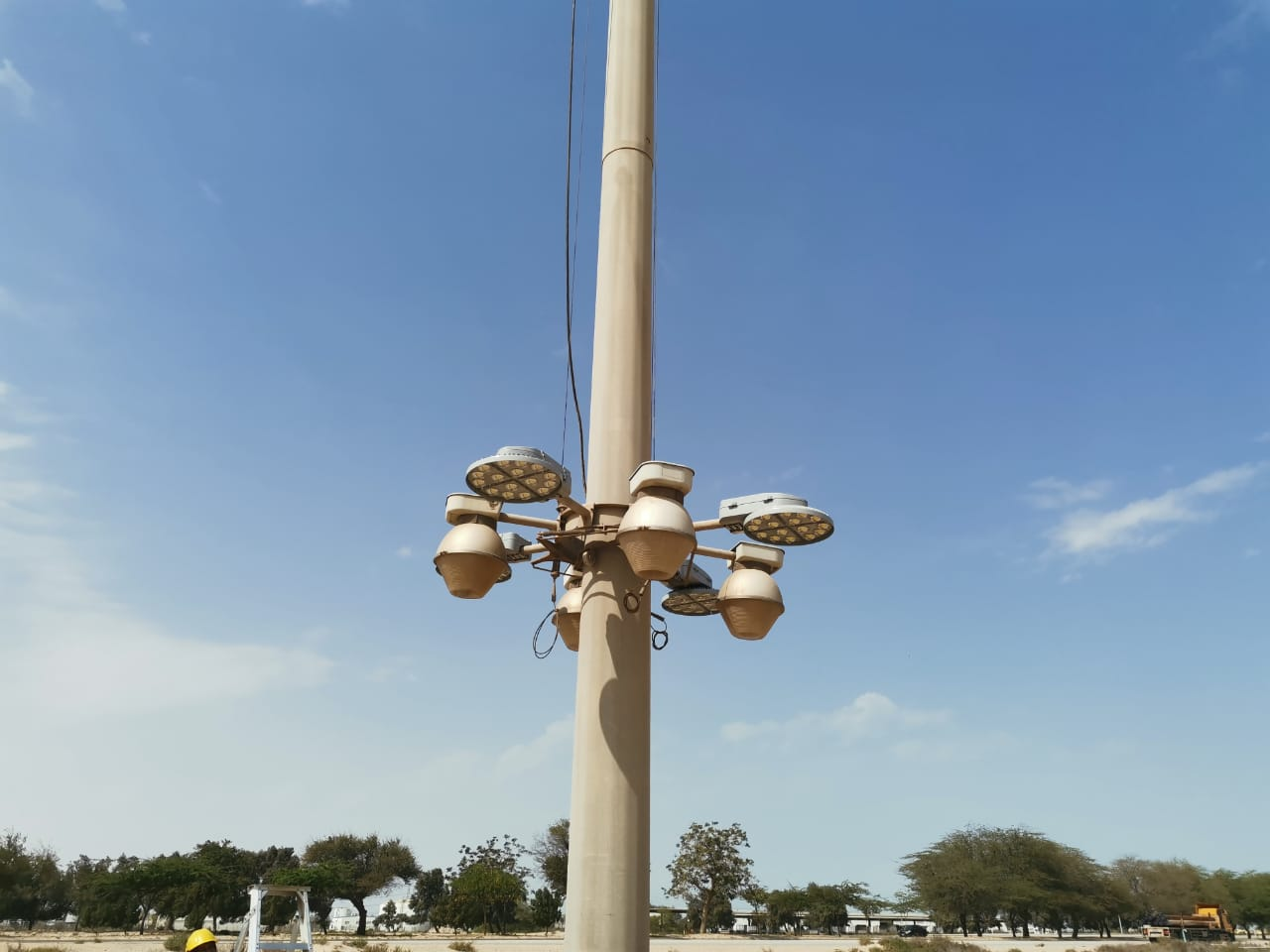
Sea ports operate around the clock in corrosive, dusty, and high-humidity environments. AOK high mast lights are used in seaport operation lighting and seaport roadway lighting projects in the UAE, with the HMA model providing up to 56,000 lm per fixture and Type-III or Type-V distributions. The Tool-less LED Flood Light FLC is also specified for sea port lighting, providing flood illumination for outdoor large areas and public facilities. These applications combine high mounting positions, wide coverage, and protection against salt-laden air.
Sports and Stadium Lighting
Sports venues require high uniformity, glare control, and in some cases broadcast-grade color quality. AOK stadium and flood light products are deployed in football field lighting projects in Germany, baseball sports field lighting in the USA, tennis court lighting in Australia, and equestrian center lighting in the USA. The Professional Stadium Lighting ISF supports DMX512, DALI, and glare control with custom visors, with optional TLCI>95 and GR<30/40 for television broadcast. The Sports Stadium Light FSC provides system efficacy up to 185 lm/W with IP66/IK10 protection. For smaller courts, the Area Light Shoebox-OT and Tool-less Area Light-PLB cover parking lots, tennis courts, and auto dealership lots.
Roadway and Solar Street Lighting
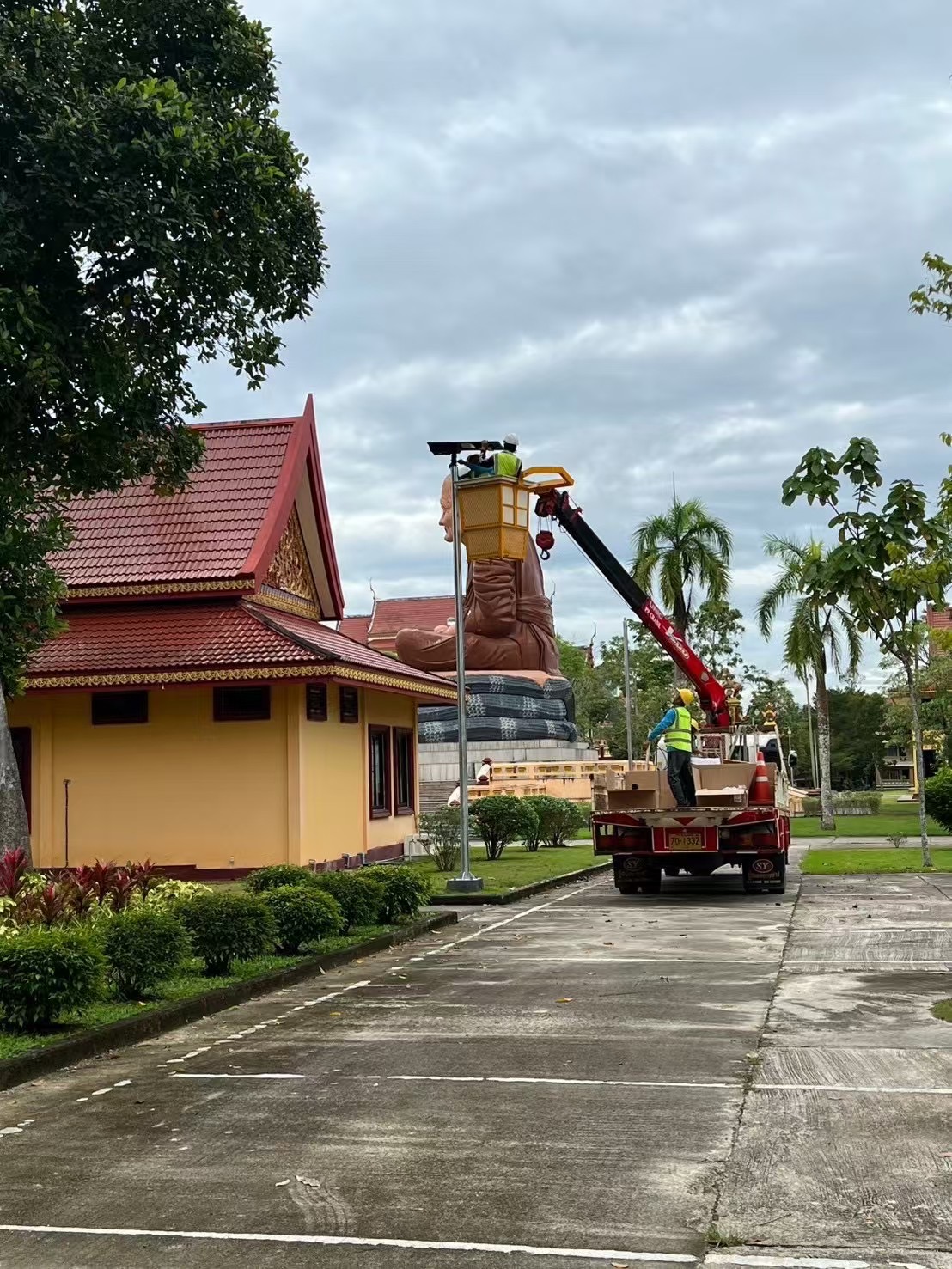
Solar street lighting is a growing category for roadways and public facilities without reliable grid access. In Thailand, AOK solar street light models including the Solar Street Light for Highway-SL, the Plug&Play Solar Street Light-SLB, and the Mega Power Solar Street Light-SAA are used for outdoor roadway lighting and landscape solar lighting. The All-in-One Solar Street Light-SD integrates a 25.6V, 30Ah lithium battery with an MPPT controller and IoT support, with LED efficacy up to 210 lm/W. The highway model SL provides 16,700–16,800 lm with IP65 protection, monocrystalline solar panels, and MPPT, dimming, Zigbee, and 4G control options.
Industrial and Public Facility Lighting
Industrial sites need high-output fixtures that can survive dust, vibration, and long operating hours. AOK LED high bay lights, such as the 100W/150W/200W CCT&Power Turnable LED High Bay, are used in industrial warehouse lighting projects in Germany, equestrian centers, railway station platforms, and 24/7 environments such as movie studios. These applications typically specify IP66 protection, SPD circuit protection, and UV-resistant finishes, with smart lighting control systems for scheduling and energy management.
Market Trends in LED Outdoor Lighting
Third-party market data points to continued expansion across the main outdoor lighting categories. The global outdoor LED lighting market was estimated at USD 14.20 billion in 2024 by Grand View Research. The solar street lighting market was valued at approximately USD 5 billion to 6.29 billion in 2024, according to Global Market Insights and Fortune Business Insights, reflecting demand for off-grid and low-carbon roadway infrastructure. The stadium lighting market was valued at USD 768 million in 2024, with a projected CAGR of 7.73% through 2032, according to Persistence Market Research.
Buyers are also operating within a more regulated environment. In North America, outdoor luminaires must comply with UL 1598, which evaluates electrical, mechanical, thermal, and fire risks for wet locations. Globally, IEC 60598-2-3 specifies requirements for luminaires used in road and street lighting. For US roadway and parking facility design, ANSI/IES RP-8-21 is the primary recommended practice. Certification to these standards is increasingly a baseline requirement in public tenders and large infrastructure projects.
How LED Outdoor Lighting Compares with Traditional Sources
Compared with conventional high-pressure sodium (HPS) lighting, LED outdoor luminaires offer directional light output, higher system efficacy, instant-on operation, and compatibility with dimming and smart controls. For site operators, this translates into lower energy consumption, reduced maintenance frequency, and the ability to manage lighting remotely.
One honest limitation of the category is that solar-powered LED street lights depend on local solar irradiance and battery capacity. Sites with limited sunlight or very high nightly load requirements may need grid-connected or hybrid configurations rather than fully off-grid solar. Buyers evaluating solar street lighting should therefore verify the solar panel type, battery specification, and controller features against the project's geographic conditions and operating hours.
Future Outlook
The direction of LED outdoor lighting points toward tighter integration of solar generation, energy storage, and smart control. AOK states that it continues to invest in R&D for solar lighting products while exploring new energy directions, alongside its manufacturing of energy-efficient lighting and green energy products. For procurement teams, this means that supplier evaluation should increasingly include not only current product performance, but also the manufacturer's ability to support long-term service, customization, and evolving control standards.
Contact AOK for LED Outdoor Lighting Projects
AOK Industrial Company Limited designs and manufactures LED street lights, stadium lights, high bay lights, solar street lights, and industrial, seaport, airport, and sports field lighting from its Shenzhen production base. Visit www.aokledlight.com for product information. For project inquiries, contact Wally at info@aokledlight.com, tel +86-755-23579418, or WhatsApp +86 15359133623. Download the company brochure: AOK brochure (PDF).
FAQ: LED Outdoor Lighting Basics for Buyers
What is LED outdoor lighting?
LED outdoor lighting refers to luminaires that use light-emitting diodes to illuminate outdoor spaces such as roadways, parking lots, sports fields, ports, airports, and industrial sites. It includes street lights, area lights, flood lights, high mast lights, and solar-powered street lights.
What types of LED outdoor luminaires are used for large sites?
Large sites typically use a combination of LED street lights for roadways, LED area lights for parking and public areas, LED flood lights and stadium lights for sports venues, and high mast lights for seaports, airports, and industrial zones. Solar street lights are used where grid connection is unavailable or where low-carbon operation is a priority.
What do IP and IK ratings mean for outdoor fixtures?
IP (Ingress Protection) rates protection against dust and water. For example, IP66 means the fixture is dust-tight and protected against powerful water jets. IK (Impact Protection) rates resistance to mechanical impact. Many outdoor LED luminaires are specified with IP66 and IK08 to IK10 ratings, evaluated according to standards such as EN 60529 and EN 62262.
What efficacy values can modern LED outdoor lighting achieve?
System efficacy varies by product category. AOK specifies values from up to 150 lm/W for professional stadium lighting up to 210 lm/W for an all-in-one solar street light. Flood lights and street lights in the AOK range commonly reach 165 to 200 lm/W.
Which certifications should outdoor LED luminaires carry?
Common certifications include UL/cUL for North America, CE and TUV for Europe, and RoHS for hazardous substances. In North America, outdoor luminaires must comply with UL 1598 for wet locations. IEC 60598-2-3 covers luminaires for road and street lighting, and ANSI/IES RP-8-21 guides roadway and parking facility lighting design in the US. AOK holds ISO9001, ISO14001, UL, TUV, and RoHS certifications.
How do solar street lights differ from grid-powered LED street lights?
Solar street lights combine an LED luminaire with a photovoltaic panel, a lithium battery, and a controller such as MPPT, operating independently of the grid. They are suited to sites with adequate sunlight and can support dimming and IoT communication. Grid-powered street lights provide continuous power regardless of weather, making them the standard for highways and urban networks with reliable electricity.
What is high mast lighting used for?
High mast lighting uses fixtures mounted on tall poles to illuminate wide areas with few poles. It is commonly applied in seaports, airports, highway interchanges, and industrial yards. High mast LED fixtures such as the HMA provide high lumen output, up to 56,000 lm, with distributions such as Type-III and Type-V for wide, uniform coverage.