
LED Tube and Strip Retrofit FPCs: Thickness and Panel Fit
LED Tube and Strip Retrofit FPCs: Thickness and Panel Fit
HTNXT | Lighting Components Reference
LED Tube and Strip Retrofit FPCs: Matching Board Thickness and Panel Length to Fixture Design
For an LED tube or strip retrofit, an FPC should be assessed against the fixture’s physical layout—not selected by thickness or panel dimensions alone. The key distinction is between the finished circuit’s required dimensions and the supplier’s panel format. WODE’s listed LED tube and LED strip FPC specifications provide a concrete starting point for that assessment, while leaving the final fit to the project drawing and sample validation.

Why retrofit fit starts with the fixture
A retrofit circuit has to occupy a space defined by an existing lighting assembly. The relevant constraints may include the available mounting surface, the board’s route through the fixture, component placement, connection points, and the space available around the circuit. For a tube retrofit, the circuit must correspond to the intended tube arrangement. For a strip retrofit, the design must account for the strip’s intended path and the way it is retained in the fixture.
That makes the first procurement question more specific than “Which LED PCB is thin?” It is: What finished circuit outline and thickness can the target fixture accept, and what panel format can the supplier manufacture to support that design? An FPC’s flexibility may help a design follow a non-flat route, but it does not guarantee compatibility with a particular housing, mounting method, or electrical layout. Those details still need to be established in the project design.
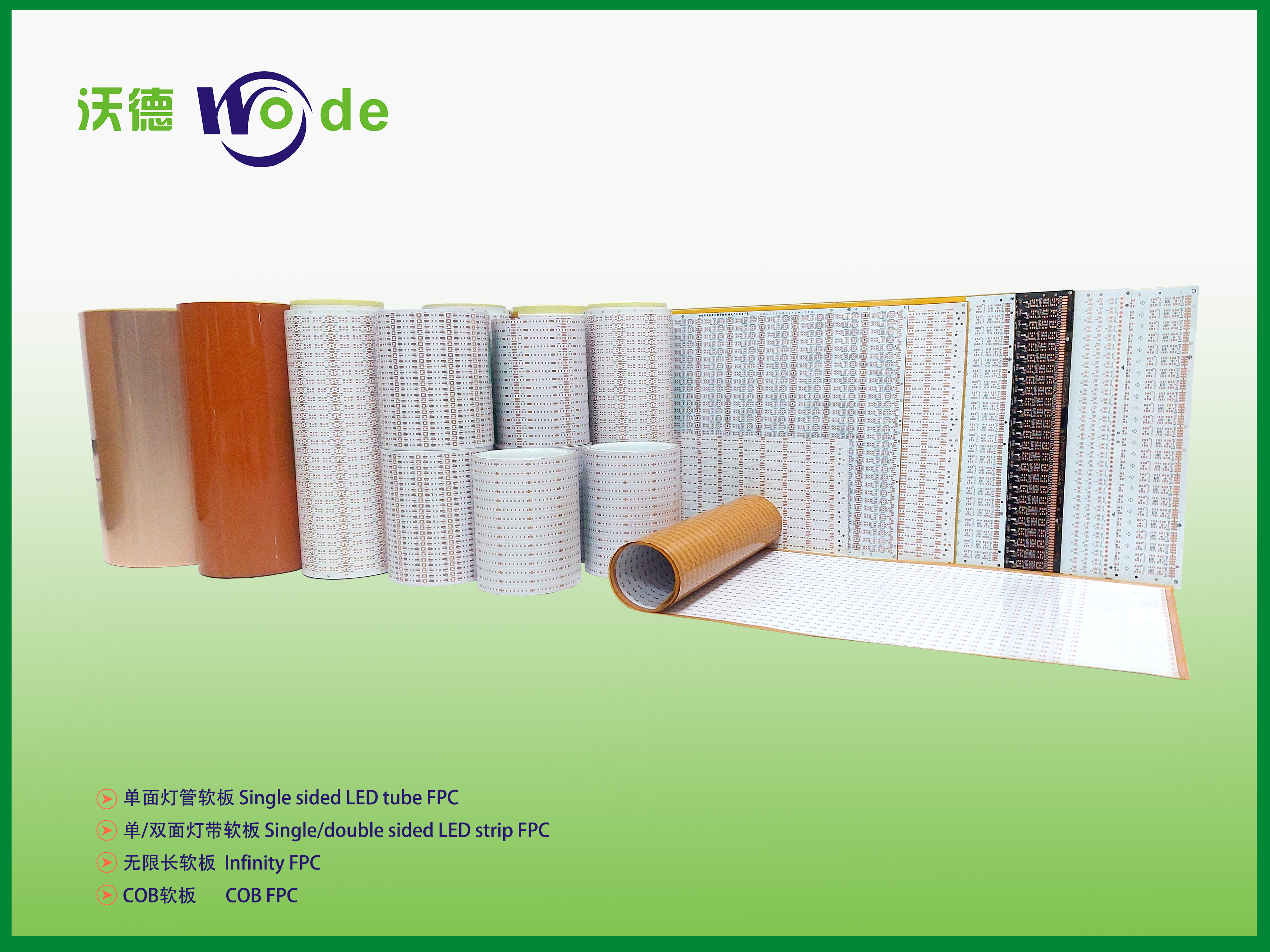
WODE Circuit Technology (Zhuhai) Co., Ltd. is a PCB and FPC manufacturer based in Zhuhai, China. Its listed lighting products include a single-sided LED tube FPC and a single- or double-sided LED strip FPC. For buyers evaluating a custom LED lighting PCB, these product records offer specific thickness and panel data to compare with a fixture drawing.
The listed FPC dimensions—and what they mean
The available product specifications distinguish the tube and strip FPCs by overall thickness, layer configuration, copper foil, and panel size. The dimensions below are the specifications as listed for each product. A panel size is not, by itself, a finished circuit’s usable length or a promise that one board will match a particular fixture.
| Listed FPC | Material and layers | Overall thickness | Panel size | Other listed details |
|---|---|---|---|---|
| Single sided LED tube FPC | PI; single sided | 0.08 mm | 1239.50 mm × 255.00 mm (39 ups) | Copper foil: 0.5 oz; solder mask: white; silkscreen: Holo; surface finish: OSP |
| Single/double sided LED strip FPC | PI; single or double sided | 0.115 mm | 366.00 mm × 250.00 mm (1 ups) | Copper foil: 1/1 oz or 1 oz, as listed; white coverlay; white silkscreen; OSP |
The “39 ups” and “1 ups” entries are part of the supplied panel specifications. They should be retained as manufacturing-panel information, not treated as the finished circuit’s individual dimensions. The project drawing should define the required board outline and tolerances; the supplier should confirm how that outline is represented within the panel and how it will be separated or processed.
The two thickness figures also describe the listed overall thicknesses, not every dimension that can affect installed fit. A buyer should confirm what the quoted overall thickness includes and whether the finished construction, coverlay, copper, and any project-specific features are represented consistently in the drawing and sample. The available records do not provide a tolerance for either listed thickness, a minimum bend radius, or a finished-part length specification.
How thickness relates to fixture design
Thickness is a fit variable, not a stand-alone performance verdict. In a retrofit, the board must fit within the intended assembly and work with its mounting and connection arrangement. A thinner FPC may be relevant where the available space is limited, but the supplied data does not establish that the thinner option is automatically preferable for every tube or strip design. Likewise, the thicker listed strip FPC cannot be assumed to be unsuitable simply because its stated overall thickness is greater.
Before selecting an option, compare the FPC thickness stated in the product specification with the actual space available in the fixture. The comparison should use the intended finished construction, not only a nominal substrate value. If a coverlay or other construction feature changes the installed profile, the project team should agree how it is included in the final dimensional specification. The available product records identify PI, layer configuration, copper foil, coverlay or solder-mask information, and overall thickness, but do not provide a full stack-up drawing.
For an engineer or procurement team, a useful review is to check the available fixture clearance, mounting approach, connector or termination position, and the circuit route. If the board is expected to bend during installation or operation, confirm the intended bend location and design conditions with the supplier. No bend-radius value is included in the supplied product information, so one should not be inferred from the thickness specification alone.
These checks are especially important when replacing a rigid board with an FPC. Flexibility can support a different physical routing approach, but the FPC remains a circuit with defined materials, layers, copper, and finished geometry. The fixture still determines whether the selected circuit form is appropriate.
Panel length is not the same as retrofit length
Panel dimensions are frequently misread during sourcing. A panel is the manufacturing format described by the product specification. It is not necessarily a single circuit’s finished length, nor does its longer dimension establish the maximum length of an installed LED tube or strip. The tube FPC listing gives a panel size of 1239.50 mm × 255.00 mm with 39 ups; the strip FPC listing gives 366.00 mm × 250.00 mm with 1 ups. The records do not state the individual finished-board dimensions that result from those panel formats.
For a retrofit RFQ, specify the finished circuit outline separately from the requested manufacturing panel information. Include the required length and width from the project drawing, the intended board orientation, any cut-outs or slots, and the positions of electrical interfaces. Then ask the supplier to confirm the panel arrangement and whether the specified outline is supported. This avoids using panel length as a proxy for fit and gives engineering and purchasing teams a common reference.
WODE’s capability information lists routing, slotting, and cutting among its customizable options, along with layer count, substrate, and surface finish. That supports a discussion about a custom LED lighting PCB, but it does not establish that every proposed outline or tolerance is feasible. Feasibility should be confirmed against the actual file and the supplier’s response.
Where a fixture design uses a long continuous route or a repeated lighting pattern, clarify whether the requirement is for a particular finished piece, multiple circuits arranged on a panel, or a production format. WODE also lists a separate Roll to Roll Infinity FPCB with its own material, thickness, and panel data. It should not be treated as interchangeable with the LED tube or strip FPC listings without confirming the intended product, dimensions, and manufacturing requirements.
A practical evaluation sequence for custom LED lighting PCB projects
- Define the fixture envelope. Use the fixture drawing or measured assembly to identify the available installation area, clearance, mounting features, and route. Distinguish these dimensions from the PCB panel dimensions.
- Set the finished-board outline. Specify the required finished length and width, cut-outs, slots, connection points, and orientation. Identify which dimensions are critical to fit and which are manufacturing references.
- Choose the circuit construction for review. The listed tube FPC is single sided and 0.08 mm overall thickness. The listed strip FPC is offered as single or double sided and is 0.115 mm overall thickness. Confirm which construction matches the design rather than assuming that the product label alone resolves the choice.
- Align the stack-up and surface details. Confirm PI, layer count, copper foil entry, coverlay or solder-mask details, surface finish, and the thickness definition. The specifications list OSP for both FPCs, but do not provide a complete project-specific stack-up or dimensional tolerance.
- Ask for panel feasibility confirmation. Give the supplier the finished outline and panel requirements. Ask it to confirm the proposed panel layout and interpretation of the listed “ups” quantity for the order.
- Validate the sample in the actual fixture. Check physical fit, mounting, route, and connections against the project design. The supplied capability record states that WODE provides technical support and quality liaison; acceptance conditions and any warranty or defect-handling terms should be specified in the customer contract.
This sequence turns a broad request for a “thin LED PCB” into an engineering brief that can be evaluated. It also creates a traceable distinction between what the product listing states and what the specific retrofit project still needs to define.
Where the two listed FPCs fit—and where the evidence stops
The single-sided LED tube FPC is the more directly named option for a tube-oriented project, with a listed overall thickness of 0.08 mm and a panel format of 1239.50 mm × 255.00 mm (39 ups). The single/double-sided LED strip FPC is identified for strip lighting and lists 0.115 mm overall thickness with a 366.00 mm × 250.00 mm panel (1 ups). These product facts can help buyers identify which specification to review first.
They do not demonstrate that either product will fit a particular retrofit fixture, achieve a required operating life, or meet an unlisted thermal or electrical requirement. No board-level test result, application-specific qualification, bend-cycle result, minimum bend radius, thickness tolerance, finished circuit length, or thermal-performance comparison is provided for these two FPCs. Those items need to be addressed through project documentation and supplier validation if they are necessary to the design.
Similarly, broader terms such as High Power LED PCB, High Thermal Conductivity LED PCB, or Street Light LED PCB should not be used to infer properties of these PI FPC listings. The provided product specifications do not assign a thermal-conductivity value to either the tube or strip FPC. Buyers with a high-load application should specify the relevant engineering requirements and request evidence for the proposed construction rather than relying on a category label.
FPC retrofit boards compared with conventional rigid solutions
An FPC and a conventional rigid PCB serve different physical design needs. An FPC may be considered when the intended circuit route or fixture geometry calls for a flexible circuit form. A rigid board may be appropriate when the design requires a board to retain a fixed shape. Neither form is universally better, and the supplied data does not support a general cost, reliability, or lifetime ranking.
The practical boundary is that flexibility does not remove the need to control outline, installed thickness, mounting, connection points, and operating conditions. Conversely, a rigid board can be a poor fit where the required fixture route cannot accommodate its fixed shape. Buyers should decide from the assembly drawing and validated construction, not from a blanket assumption that every retrofit requires FPC or that a rigid board is unsuitable.
WODE’s listed FPCs provide specific PI-based examples; its wider product range also includes rigid PCB types. That portfolio fact can support a supplier discussion, but it is not evidence that a particular rigid product is a drop-in substitute for either LED FPC. A like-for-like comparison requires project-specific design files and matching acceptance criteria.
What the available market evidence can—and cannot—say
The supplied industry evidence identifies thermal management, board structure, and application fit as relevant considerations in LED PCB sourcing. It also records supplier-reported positioning of metal-core and aluminum-backed boards for high-power or thermal-management applications. Those points concern a wider set of LED PCB technologies and should not be transferred to the two PI FPC products without product-specific evidence.
The available information does not establish a market-size or growth trend for LED tube retrofit FPCs, nor does it quantify demand by tube, strip, or other lighting fixture type. It also does not provide a harmonized benchmark for FPC thickness, panel length, or thermal performance across suppliers. A defensible procurement interpretation is therefore project-led: start from the fixture drawing, compare the listed product data with the design requirements, and treat unprovided performance claims as items for verification rather than settled facts.
Outlook: make the drawing and panel plan agree
For LED tube and strip retrofits, useful specification work connects three separate references: the fixture’s available space, the finished FPC outline, and the supplier’s manufacturing panel. When those are documented separately and checked together, engineering teams can evaluate the thickness and length fit without confusing a panel format with an installed part.
WODE’s listed tube and strip FPCs offer two defined starting points: a single-sided PI tube FPC at 0.08 mm overall thickness, and a single/double-sided PI strip FPC at 0.115 mm overall thickness. The listed panel dimensions and layer options help frame an initial technical review; the finished design’s suitability still depends on confirmed drawings, construction details, and sample evaluation in the intended fixture.
FAQ
What thickness is listed for WODE’s LED tube FPC?
The listed Single sided LED tube FPC has an overall thickness of 0.08 mm. The product record also specifies PI material, a single-sided layer configuration, 0.5 oz copper foil, and OSP surface finish.
What thickness is listed for WODE’s LED strip FPC?
The listed Single/double sided LED strip FPC has an overall thickness of 0.115 mm. Its specification identifies PI, single- or double-sided construction, white coverlay, and OSP surface finish.
Does the panel length equal the finished LED circuit length?
No. The listed panel sizes describe manufacturing panels. The product records do not state the individual finished circuit dimensions, so a buyer should provide the required finished outline separately and request confirmation of the panel layout.
Can the listed FPC dimensions alone confirm retrofit compatibility?
No. Thickness and panel information are useful specification inputs, but compatibility also depends on the fixture drawing, finished board outline, mounting and routing requirements, and the agreed construction. Sample validation in the intended fixture is needed where physical fit must be confirmed.
Have Questions or Need More Details?
Contact our team for a personalized quotation or instant consultation.
Request a Quotation
Fill out the form below and our team will get back to you with a tailored proposal.
WhatsApp Direct Chat
Prefer to chat in real-time? Message us on WhatsApp for instant assistance & quick answers.
- Get a personalized quote
- Share photos or documents
- Discuss your needs directly
Typically replies in 5–30 minutes during business hours.