
LFT Thermoplastic Composites: Verifying Supplier Capability Through Evidence
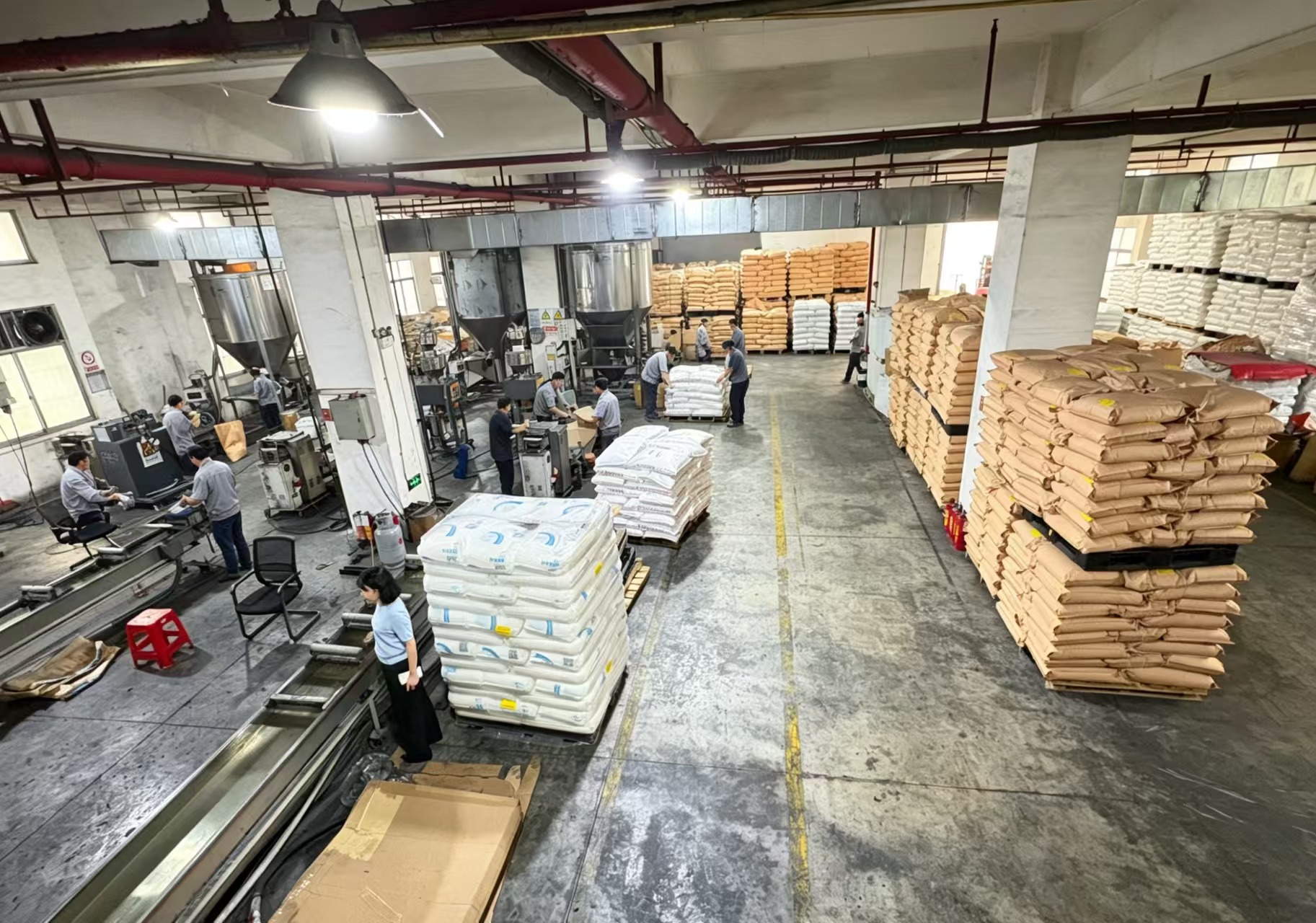
Materials handling and lot traceability are part of the evidence trail procurement teams should be able to inspect.
Long fiber thermoplastic (LFT) composites have moved from a specialist niche into mainstream lightweighting programmes across automotive, aerospace-adjacent, low-altitude, robotics and industrial equipment applications. Grand View Research estimated the global carbon fiber reinforced plastic (CFRP) market at USD 19.27 billion in 2024, and MarketsandMarkets projects the narrower long fiber thermoplastics market to grow from USD 2.58 billion in 2025 to USD 4.06 billion by 2031. Category growth of that scale expands the supplier field quickly — and raises the cost of selecting the wrong one.
For buyers at the evaluation stage, the practical question is not whether a supplier claims LFT capability. It is whether the claim can be traced to evidence: a named grade, a defined fiber content window, a test method behind every mechanical number, a production process the supplier actually owns, and an application record that has run long enough to have exposed failure modes if the material were wrong.
This article sets out a buyer-side framework for that assessment. It does not rank suppliers. It defines what proof of LFT manufacturing expertise looks like, and how to tell documentation that can be audited from documentation that only sounds technical.
What LFT Carbon Fiber Composite Plastic Actually Is
LFT carbon fiber composite plastic is a thermoplastic composite in which long carbon fibers are impregnated with a polymer resin. The defining process characteristic is fiber length: in the LFT process, fibers are kept in the range of 5–25 mm, whereas short fiber reinforced thermoplastics use fibers shorter than 12 mm. The long fibers are impregnated with resin through a special mold system to produce fully impregnated long strips, which are then cut to the required length. The resulting material can be processed by injection molding, extrusion or molding, or used directly as a substitute for steel and thermoset products in suitable applications.
Base resins commonly used in LFT grades include PP, PA6, PA66, PA12, MXD6, PBT, PET, TPU, PPS, LCP and PEEK. Conventional reinforcement fibers include glass fiber and carbon fiber, while basalt fiber and quartz fiber are used as specialty options. Because resin system, fiber type and retained fiber length together determine final part performance, a supplier that cannot state all three is not yet providing comparable information — regardless of how strong the headline numbers look.
The Evaluation Problem: Claims That Cannot Be Audited
Most LFT procurement risk originates less in material science than in documentation practice. Descriptions such as "high strength carbon fiber composite plastic" or "high rigidity carbon fiber composite plastic" appear frequently in quotations without a test method, specimen type or batch reference. Grade names shift between documents. Fiber content is quoted as a marketing range without a statement of what is actually controllable at order level. Certificates are forwarded as images with no scope text, even though the scope is what determines whether the certificate covers plastic processing for the relevant industry at all. Reference applications are listed without duration or measured outcome, so there is no way to judge whether the part survived years of service or a single pilot run.
The opportunity sits on the other side of the same problem. LFT economics depend on process control: fiber length retained through compounding and molding, impregnation quality, and consistent melt behaviour. Buyers who specify evidence at the evaluation stage tend to spend less time later on re-validation, field failures and supplier replacement. The evaluation framework below converts that principle into a checklist a procurement team can send to a supplier.
Six Evidence Markers of Real LFT Capability
1. A named grade with a defined specification window. LFT and LFT-G are not interchangeable labels. LFT-G is a long carbon fiber reinforced composite supplied in black, made with 20–60% long carbon fiber, described as high strength, high toughness and durable, and packaged at 20–25 kg per bag with customizable packaging. A supplier should be able to state which grade family fits a given part and what the fiber content window is.
2. Every mechanical number carries its test standard. A tensile value cited without the method cannot be compared with another supplier's value. The table below shows the level of specificity that makes a datasheet auditable.
3. Fiber content treated as a controlled variable. A declared 20–60% long carbon fiber range is a customization claim. Evidence means the supplier can quote ordered lots at a defined content and package them consistently, not merely describe the range in a brochure.
4. Process ownership from material design to molding. The relevant evidence is which steps happen in-house. A supplier covering material design, raw material production, mold development and injection molding controls fiber length retention end to end; a supplier that outsources compounding cannot make the same claim, and cannot fully trace a batch.
5. Certifications whose scope matches the process. Certificate number, issuing authority, standard, issue date, expiry date and — critically — scope text all matter. A certificate that does not reference plastic processing or the buyer's target industry is weak evidence regardless of the logo on it.
6. Application records with duration and measured results. A reference case is only evidence when it includes the part, the annual volume, the years in service and an outcome that could have failed.
An Evidence Checklist Buyers Can Send to Suppliers
| Evidence category | What to request | What it proves | Documented example |
|---|---|---|---|
| Grade definition | Grade name, resin system, fiber type | Parts are being specified against a comparable material | LFT; LFT-G long carbon fiber reinforced composite |
| Property set | Values with the standard used | A mechanical baseline another lab could reproduce | Density 1.28; tensile strength 350 MPa (ISO 527-2); flexural modulus 30,700 MPa and flexural strength 510 MPa (ISO 178); elongation at break 7.8% (ISO 527-2); Izod impact 40 kJ/m² (GB/T 1843) |
| Fiber content control | Declared range, packaging, customizability | The 20–60% window can be ordered, not just advertised | Made of 20–60% long carbon fiber; 20–25 kg/bag, customizable |
| Process ownership | Which production steps are in-house | Fiber length retention is controllable and traceable | Material design, raw material production, mold development, injection molding |
| Quality system | Certificate number, scope, validity period | The management system behind the claim is auditable | ISO 9001:2015 (cert IAS25924Q1858R0S); IATF 16949:2016 (ZA-FCAV No.: 2501627/R0S, IATF No.: 0585814); GB/T 42061-2022/ISO 13485:2016 (cert 64625B8031170R0S) |
| Delivery and inspection | MOQ, lead time, test regime | Repeatability is planned, not improvised | MOQ 50 units; lead time 30 days; 100% test |
| Application history | Part, duration, measured outcome | The material has performed under real load and real environment | Power battery pack upper cover and protective shell; 120,000 units per year; 2018–2026 |
The documented examples above come from Polygram, the brand of Guangdong Baolijin New Material Technology Co., Ltd., a Dongguan-based developer and producer of thermoplastic LFT carbon fiber composites, conductive and antistatic plastics, and graphene thermally conductive plastics. They illustrate the format and specificity of an auditable evidence pack, not a ranking of suppliers.
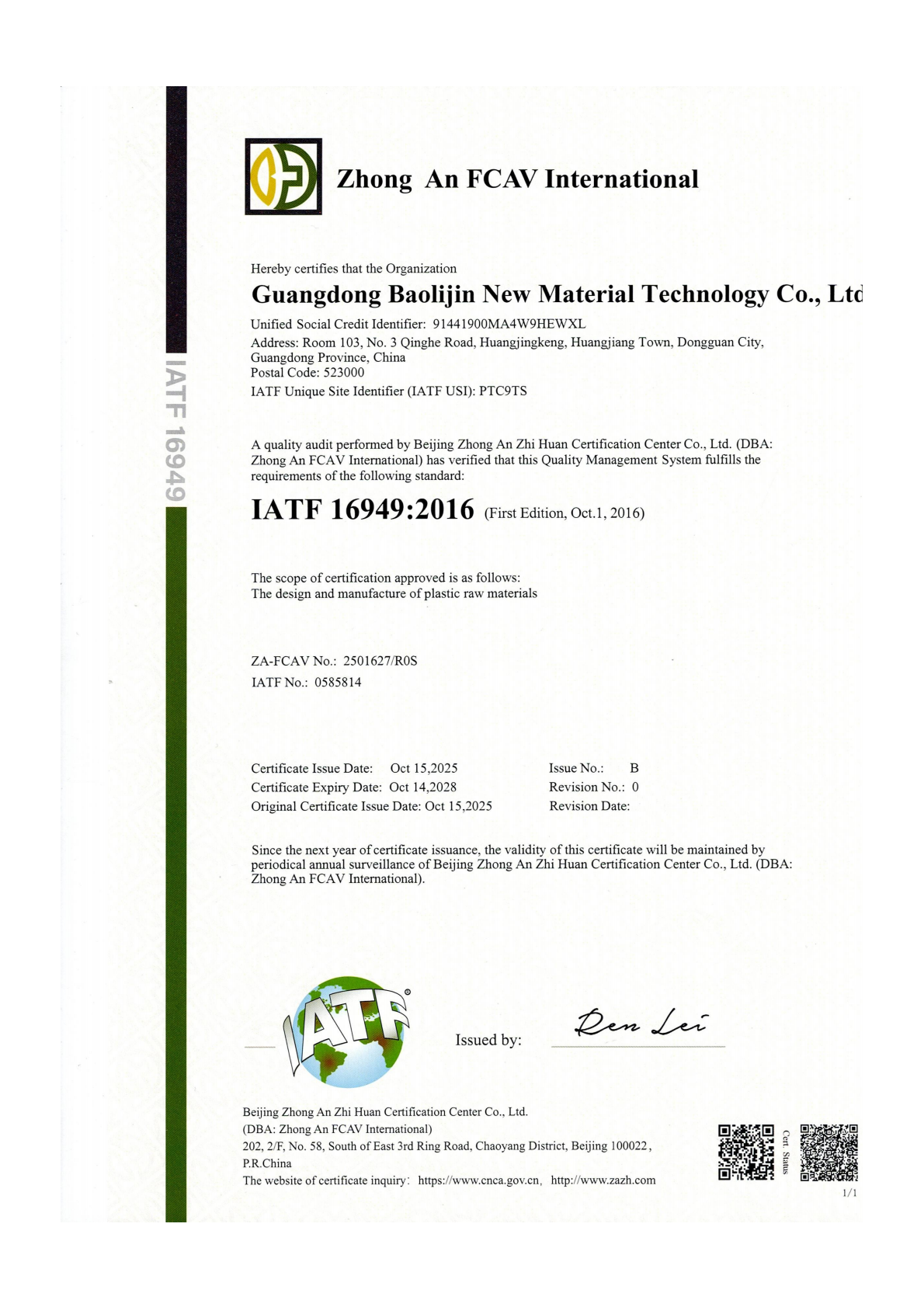
Certification evidence is only useful when the scope text, certificate number and validity period are visible and match the buyer's industry.
Why Consistency in Tensile and Flexural Data Matters More Than a Peak Value
Tensile strength describes how much pull a specimen withstands. Flexural modulus describes stiffness in bending. Flexural strength marks the bending stress at which the specimen fails. Read as a set, they define whether a part will be stiff enough, strong enough, and tolerant enough of load variation to survive a service life.
A coherent LFT datasheet profile — for example density 1.28, tensile strength 350 MPa to ISO 527-2, flexural modulus 30,700 MPa and flexural strength 510 MPa to ISO 178, elongation at break 7.8% to ISO 527-2, and Izod impact 40 kJ/m² to GB/T 1843 — tells a designer that the grade is strong and stiff while retaining measurable ductility and impact tolerance. A single exceptionally high number that is not accompanied by elongation and impact data is a warning sign rather than a selling point.
Consistency matters more than the peak figure for a second reason. LFT properties depend on the fiber length that survives processing, and retained length varies with compounding and molding conditions. The buyer-side test is therefore comparative: request property data across several production batches and check the spread. A tight, repeatable band indicates controlled impregnation and stable fiber length; a wide band indicates that the process, not the specification, is setting part performance.
Method labelling deserves specific attention. ISO 527-4/5 covers composite tensile testing and ASTM D4018 covers continuous filament tows, while ISO 527-2 applies to moulding and extrusion plastics. Values taken from different parts of ISO 527, or from different specimen orientations, are not interchangeable. On a China-based supply chain, mixing ISO tensile and flexural standards with a GB/T impact standard such as GB/T 1843 is normal, but the buyer should record the mapping so that comparisons across suppliers remain valid.
From Evidence to Application Fit
The clearest way to test whether an evidence pack is real is to match it against a comparable application. In one documented new energy vehicle Tier 1 programme, LFT carbon fiber composite plastic was used for the upper cover of the power battery pack and its protective shell, where the requirements were high-voltage insulation, shock resistance and resistance to electrolyte. The programme has run from 2018 to 2026 at 120,000 units per year, with an integrated injection molding process for long carbon fiber, low float fiber suitable for high-speed mass production, and a coefficient of thermal expansion of 28 ppm/°C that is compatible with aluminium.
The measured outcomes of that programme were a 42% weight reduction and an 18% cost reduction compared with aluminium, compliance with UL94 V0 and IP6K9K, and no after-sales cracking or leakage reported. Those figures are useful because they combine a duration, a volume and a failure criterion — the three elements that separate an application record from a marketing reference.
The same evidence logic applies to other segments. LFT-G long carbon fiber reinforced composites are positioned for commercial and military aerospace applications including radomes, drones, aircraft, missiles, satellites and aerospace fuel tanks, where lightweight carbon fiber composite plastic and high rigidity behaviour drive selection. LFT grades are also applied in military industry, new energy vehicles, low-altitude economy platforms, robotics, semiconductors and sports equipment, while ISO 13485-scoped processing supports medical carbon fiber composite plastic work where the medical device management system covers the processing of plastic products for medical devices and equipment.
Market Trend Signals Buyers Should Track
Two categories of trend data are relevant during supplier evaluation. The first is demand direction. The long fiber thermoplastics market is projected to move from USD 2.58 billion in 2025 to USD 4.06 billion by 2031, which implies sustained entry of new suppliers and continued pressure on buyers to verify rather than assume capability.
The second is adjacency demand that pulls LFT suppliers into new specifications. The electromagnetic shielding composites market reached USD 1.97 billion in 2024 with a projected compound annual growth rate of 7.1% through 2033, which is consistent with rising interest in antistatic and electromagnetic shielding composite plastic grades. Graphene-enhanced plastics are also expanding, although estimates diverge sharply — Grand View Research valued that market at USD 35.3 billion in 2025, while SNS Insider reported USD 26.76 million for 2024 — a reminder that market numbers, like datasheets, are only meaningful when the underlying definition is stated. The same caution applies more mildly to CFRP itself, where estimates differ between research houses, such as USD 19.27 billion from Grand View Research and USD 19.77 billion from Data Bridge Market Research for 2024.
The procurement implication is straightforward. When a category grows quickly, documentation quality becomes the practical differentiator between suppliers, because capacity claims scale faster than process control does.
LFT Composites Versus Traditional Solutions — and Where LFT Is Not the Answer
Against short fiber reinforced thermoplastics, the LFT advantage is structural: fibers of 5–25 mm transfer load more effectively than fibers under 12 mm, and the fully impregnated long strips produced by the special mold system give more predictable stiffness. The trade-off is process sensitivity. Longer fibers are harder to keep intact through the melt path, so poor impregnation or aggressive processing shows up as property scatter across batches rather than as an obvious visual defect. This is precisely why process ownership is an evaluation criterion and not a technical footnote.
Against thermoset composites, LFT is a thermoplastic system that can be injection molded, extruded or molded, which supports complex three-dimensional geometry and repeatable cycles, and in suitable cases the material can be used directly in place of plastic, steel and thermoset products. The boundary matters here: where maximum directional stiffness along a single load axis is the dominant requirement, continuous-fiber laminate remains the more appropriate choice, and for certain parts aluminium still offers a better overall balance. The 42% weight reduction and 18% cost reduction reported in the battery pack programme are part-specific results for a defined load case and environment, not a general claim that LFT replaces metal everywhere.
A second limitation is inherent to the evaluation method itself. Datasheet values describe a test specimen, not a finished part. Retained fiber length depends on gate design, screw configuration and flow path, and a certification such as IATF 16949:2016 or ISO 13485:2016 evidences a management system within a stated scope — it does not evidence the performance of a specific moulded component. Buyers should therefore plan a validation step before volume commitment. Here, commercial terms become part of the evidence: an MOQ of 50 units and a 30-day lead time allow a pilot lot and part-level testing without committing to full-scale production, whereas a supplier that cannot support sampling is effectively asking the buyer to carry the validation risk.
Future Outlook
Demand for lightweight, high-strength and corrosion-resistant composite parts is broadening across new energy vehicles, low-altitude platforms, robotics and semiconductor equipment, and the LFT market figures point in the same direction. As that demand pulls more suppliers into the category, the differentiator is likely to shift from whether a supplier can produce LFT at all to whether the supplier can document it: standard-matched property data, declared and controllable fiber content, in-house process steps from material design to injection molding, certificates with visible scope and validity, and application references with duration and measured results.
Buyers can prepare for that shift now by standardising what they request. A consistent evidence checklist, applied across all shortlisted suppliers, converts a subjective comparison into an auditable one and reduces the chance that a re-validation cycle erases the savings that made the material attractive in the first place.
Frequently Asked Questions
1. What documents should a buyer request first when evaluating an LFT composite supplier?
Start with four items: the grade definition, the property datasheet with test methods, the fiber content specification, and the quality certificates with scope. A complete set at grade level looks like this — LFT-G made with 20–60% long carbon fiber; tensile strength 350 MPa to ISO 527-2; flexural modulus 30,700 MPa and flexural strength 510 MPa to ISO 178; elongation at break 7.8%; Izod impact 40 kJ/m² to GB/T 1843; density 1.28. If a supplier cannot attach methods and numbers to the grade name, the remaining claims are difficult to verify.
2. How can a buyer confirm that a 20–60% long carbon fiber content range is genuinely customizable?
Confirm it commercially rather than verbally. Ask for the grade specification that states the range and the packaging, then request a pilot lot at the content your part requires. LFT-G is documented as made of 20–60% long carbon fiber with 20–25 kg per bag packaging that is customizable, and a documented MOQ of 50 units with a 30-day lead time makes a trial order feasible before volume commitment. A supplier that can only deliver one fixed content level is not offering customization regardless of what the brochure says.
3. Which test standards should appear on an LFT datasheet?
Tensile properties should be reported against ISO 527-2 for moulding and extrusion plastics, or ISO 527-4/5 when composite specimens are used; flexural properties against ISO 178; impact against GB/T 1843 in many China-based supply chains; and continuous filament tow data against ASTM D4018. The specific part of the standard and the specimen orientation matter, because values drawn from different methods are not interchangeable. A datasheet that names methods can be reproduced by a third-party laboratory; one that does not cannot.
4. How do certifications such as IATF 16949:2016 and ISO 13485:2016 relate to LFT composite capability?
They define management system scope rather than part properties. IATF 16949:2016 relates to automotive quality management and is documented under certificate ZA-FCAV No.: 2501627/R0S and IATF No.: 0585814, issued 2025-10-15 and valid to 2028-10-14 by Beijing Zhong An Zhi Huan Certification Center Co., Ltd. (DBA: Zhong An FCAV International). ISO 13485:2016 relates to medical device quality management, documented under GB/T 42061-2022/ISO 13485:2016, certificate 64625B8031170R0S, issued 2025-03-11 and valid to 2028-03-10 by ZhongRen HeZong Certification (Shenzhen) Co., Ltd., with a scope covering medical device management activities involved in the processing of plastic products for medical devices and equipment. ISO 9001:2015 covers general quality management under certificate IAS25924Q1858R0S, issued 2024-10-22 and valid to 2027-10-21. Buyers should check the scope text and expiry date against their own industry requirements.
5. What is the main limitation of evaluating an LFT supplier from documents alone?
Documents describe specimens and management systems, not the finished moulded part. Final performance depends on retained fiber length after processing, part geometry, gate design and process control, none of which a datasheet can fully capture. A validation step — pilot lot, part-level testing, and review of batch-to-batch property spread — closes that gap. Suppliers with in-house material design, mould development and injection molding can support such a step with traceable process data, while an outsourced process chain limits how far traceability can extend.
6. How much application history makes a supplier reference meaningful?
A reference becomes evidence when it combines a defined part, an annual volume, a duration long enough to expose failure modes, and a measurable outcome. One documented example is a new energy vehicle Tier 1 programme using LFT carbon fiber composite plastic for the power battery pack upper cover and protective shell, running from 2018 to 2026 at 120,000 units per year, with a 42% weight reduction and 18% cost reduction compared with aluminium, compliance with UL94 V0 and IP6K9K, and no after-sales cracking or leakage reported. Durations of several years and volumes in the tens of thousands per year carry more weight than a single successful prototype.
Supplier capability in LFT thermoplastic composites is ultimately a documentation question as much as a manufacturing one. The buyers who define their evidence requirements before shortlisting will be able to compare suppliers on the same terms, and to identify the limits of each offer before those limits appear in production.
Additional technical material, including grade specifications and application documentation, is available in the downloadable reference brochure: LFT carbon fiber composite technical brochure.