
LSR Overmolding for Adult Products: Medical-Grade Silicone
Industry Reference · Liquid Silicone Rubber
LSR Overmolding for Adult Products: Medical-Grade Silicone
Addition-curing liquid silicone rubber has become the default skin-contact material in adult product overmolding. This reference explains what the chemistry actually delivers, which specifications can be customized, how compliance is evidenced, and where the material stops being the right answer.
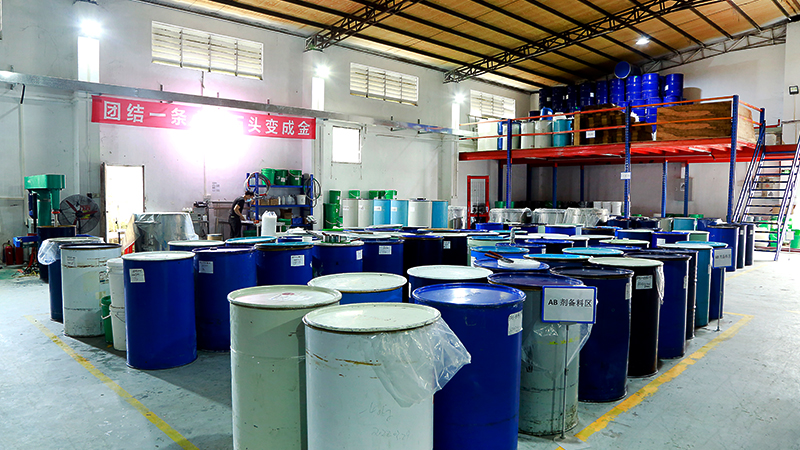
A/B component preparation area at the liquid silicone rubber facility operated by Dongguan Times Silicon Industry Co., Ltd. in Hengli Town, Dongguan, Guangdong.
The Process Question Behind the Material Choice
Adult products that combine a firm internal structure with a soft outer surface are normally produced by overmolding. A rigid or semi-rigid insert — plastic or metal — is placed into a mold cavity, and a soft elastomer is injected around it, so that the two become a single part. The overmolded layer determines nearly everything the end user perceives: softness, surface texture, how quickly the product warms to body temperature, and whether an odor develops after repeated use and cleaning.
For that outer layer, the category has progressively shifted toward addition-curing Liquid Silicone Rubber (LSR). LSR is supplied as two components, conventionally labelled A and B, that are mixed in a fixed ratio and cure through a platinum-catalyzed hydrosilylation reaction. The practical consequences of that cure mechanism are what make it attractive for skin-contact parts. The reaction produces no peroxide decomposition residues, and the cured network does not depend on plasticizers or other low-molecular-weight additives that can migrate out of the matrix over the service life of the part.
What buyers struggle with is not the concept but the verification. Three questions dominate almost every serious evaluation. First, is the material genuinely low-odor and non-bleeding after extended use, or only in a fresh sample? Second, can the supplier hold hardness and skin feel consistently across production batches, given that a change of a few Shore A points changes the perceived product entirely? Third, can human-contact safety be documented in a form that a brand owner, a retailer or a customs authority can actually audit?
Those questions sit at the center of the LSR overmolding capability offered by Dongguan Times Silicon Industry Co., Ltd., and they are the reason the specification range below is worth reading in detail rather than as a catalogue list.
Dongguan Times Silicon and the Adult Products LSR Range
Dongguan Times Silicon Industry Co., Ltd. is a silicone material manufacturer established on 27 December 2021 and operating since 1 July 2022, based at No.3, Ma Jiang 2nd Road, Hengli Town, Dongguan City, Guangdong Province, China. The company runs a 15,000 m² facility with 42 employees and a technical R&D team of 10 engineers, and its product scope covers liquid silicone rubber, overmolding and casting liquid silicone, pad printing liquid silicone, base gums, vinyl silicone oil, hydrogen-containing silicone oil, silicone resin, platinum catalysts, inhibitors and silicone treatment agents. Exports represent approximately 55% of output, with export markets including Europe, North America, Southeast Asia, Japan, South Korea and Australia.
Within that portfolio, product 4730 — marketed as Adult Products LSR for Overmolding — is an addition-curing, platinum-cured liquid silicone supplied in five A/B model pairs: TS6807A/B, TS6825A/B, TS6830A/B, TS6835A/B and TS6838A/B. The company also operates a wholly owned subsidiary, Guangdong Times Energy Storage New Material Technology Co., Ltd., founded in 2023, which focuses on specialty silicone materials for the new energy industry; the adult products range sits with the parent company rather than the subsidiary.
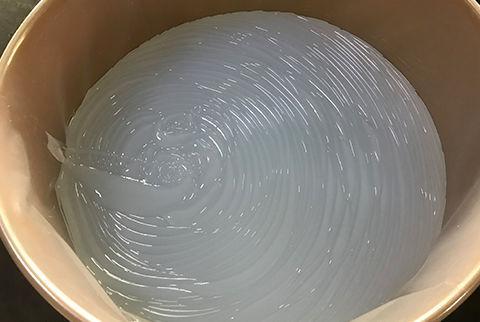
Adult Products LSR for Overmolding is supplied as platinum-cured A/B components, formulated for non-bleeding, non-irritating skin-contact use.
Technical Explanation: What the Numbers Describe
The published parameters of the TS6807A/B–TS6838A/B range are narrow enough to be useful for engineering decisions. The table below reproduces the specification set as stated in the product record.
| Parameter | Specification | What it controls in production |
|---|---|---|
| Model designation | TS6807A/B, TS6825A/B, TS6830A/B, TS6835A/B, TS6838A/B | Grade selection against target softness and molding conditions |
| Cure type | Addition-curing liquid silicone (platinum-cured LSR) | Cure by-product profile, odor potential, contact-safety profile |
| Process | Overmolding | Bonding of the silicone layer to plastic or hardware inserts |
| Appearance | Clear | Base for transparent, translucent or pigmented finished parts |
| Viscosity | 4,000–25,000 | Flow into complex cavities; risk of air entrapment or incomplete fill |
| Hardness | 7±1 to 38±1 Shore A | Perceived softness, flesh-like feel, tear and deformation behavior |
| Material system | Vinyl polydimethylsiloxane and hydrogen-containing polysiloxane | Hydrosilylation cure; no peroxide residues |
| Applicable industries | Adult toy industry; daily necessities overmolding; silicone products industry; plastic & hardware overmolding processing | Application fit and downstream compliance expectations |
Two parameters deserve emphasis. Viscosity in the 4,000–25,000 band gives the molder a meaningful process window: lower-viscosity grades fill thin walls and intricate surface detail more readily, while higher-viscosity grades are less prone to flashing and can suit thicker sections. Hardness from 7±1 Shore A upward is the second lever. A 7 Shore A compound sits at the very soft end of the solid silicone scale and is used where the product's main quality is a yielding, flesh-like surface; a 38±1 Shore A compound behaves far more like a structural elastomer and is chosen where dimensional stability and tear resistance matter more than softness.
What Can Be Customized
The company offers OEM and ODM production services, and the customization list for this range is broader than hardness alone:
- Shore hardness from 7±1 to 38±1 A
- Viscosity
- Color — transparent, translucent or opaque
- Odor level — low-odor or odorless formulations
- Formulation grade — food or medical tier
- Curing method — room-temperature or heat cure
- Packaging specification
- Custom skin feel, including soft flesh-like or high-resilience surfaces
For a brand owner, the customization list is effectively a checklist for the sample approval stage. If a proposed product needs a specific drape, a specific rebound, or a specific opacity, each of those is a formulation variable rather than a fixed property of the material.
Processing: Dispensing, Molding and Vulcanization
LSR overmolding is not a manual process. On a typical line, the A and B components are fed from their containers into a metering and mixing dispensing machine, which proportions the two streams, mixes them and delivers the blend to the mold. From that point the material enters a heated mold mounted on a vulcanizing press. Mold temperature drives the platinum-catalyzed cure, and the press maintains that temperature and clamping pressure through the cycle. After demolding, parts may be post-cured depending on the hardness and the formulation.
Because the cure is chemically triggered rather than thermally decomposed, the process is sensitive to contamination in a specific way: additions-cure systems are generally inhibited by certain substances, and sulfur, amine and tin-containing residues are widely recognized in the industry as cure poisons. In practice this means that mold release agents, cutting fluids and even some substrate materials must be screened before a production run, not after. Where bonding to a substrate is required, substrate selection and, in some cases, a primer determine whether the silicone adheres or delaminates. Buyers evaluating an overmolded part should therefore treat the substrate as part of the specification, not as an afterthought.
The company's standard lead time is 7–10 working days for stock products and 15–25 working days for custom formulations and bulk orders, with lead times adjustable according to formulation complexity and order quantity. Monthly production capacity is stated at 80 tons per month, scalable to 110 tons per month during peak seasons.
Quality Control: Where the Claims Are Actually Tested
The claims that matter most to adult product buyers — low odor, non-bleeding, non-irritating — are process outcomes, not marketing positions, and they can only be produced by a defined test sequence. The company describes a four-stage control model for this product family:
- Raw material incoming test — purity, heavy metals and harmful substances.
- In-process monitoring — viscosity, hardness and mixing ratio.
- Finished product full test — curing performance, odor and biocompatibility.
- Third-party sampling — FDA and RoHS compliance checks.
The relevance of each stage differs by buyer type. A brand owner is mainly exposed to the finished-product stage, because odor and biocompatibility are the attributes that reach the consumer. An ODM or OEM manufacturer that molds in-house is more exposed to the in-process stage, because viscosity and mixing ratio drift is what produces inconsistent feel between batches. A distributor or importer is most exposed to the third-party stage, because import documentation usually depends on it.
Application and Use Cases
The range is positioned for realistic body molds and adult toys including male masturbators, vibrators and eggs, as well as silicone intimate accessories such as sleeves and wearable parts. The same material family also covers daily necessities overmolding, the silicone products industry, and plastic and hardware overmolding processing more generally.
A documented supply case illustrates what the capability looks like in volume terms. The customer base for this application includes adult product brand owners, ODM and OEM manufacturers, cross-border e-commerce private label factories and intimate product R&D enterprises, located across China, the United States, Germany, the United Kingdom, France, Japan, South Korea, Thailand and Vietnam. Chinese brand clients record an annual purchase volume of 80 tons, with standard orders of 5 tons per batch; the largest cooperating client places annual orders of 150 tons. The cooperation has run for three years of continuous stable supply, and the end-product service life is stated as 3 years or more under normal use, supported by aging and tear resistance.
The reported production results from that case are a defect rate reduction from 3% to 0.8% and a production yield increase to 98%. On the market side, the client's products reportedly received positive end-user feedback for low odor and realistic feel, with a repurchase rate increase of 18% and a return rate below 1%.
How to read case data. Defect rate, yield, repurchase and return figures in this section are the results reported for one three-year supply relationship under that customer's own production and market conditions. They are useful as an indication of what the material can support; they are not a guarantee of identical outcomes in a different factory, with different tooling, or in a different sales channel.
Market Context: Where This Material Tier Sits
The material used for skin-contact adult products overlaps with the medical-grade tier of the silicone rubber market. According to Grand View Research, medical-grade LSR generated approximately USD 458.7 million in revenue in 2024, making it a dominant and fast-growing segment within the medical silicone rubber market. In the broader picture, the global liquid silicone rubber market was valued at approximately USD 2.8 billion to 3.8 billion in 2024, with expectations to reach USD 5.0 billion to 7.55 billion by 2030–2035, based on estimates published by Grand View Research, Global Market Insights and Market Research Future.
Those figures should be read with the usual caution. Published estimates for the LSR market vary significantly depending on whether high-consistency rubber is included and how regions are defined; Market Research Future places the 2024 figure at USD 2.81 billion while Global Market Insights places it at USD 3.8 billion. The direction is consistent, the absolute numbers are not. For a buyer, the useful takeaway is directional rather than numerical: the medical-grade tier is the fastest-moving part of the category, and ingredient, documentation and traceability expectations tend to tighten first in that tier before spreading to adjacent consumer categories such as adult products.
That expectation is already visible in standards. Medical-grade LSR for human-contact applications is commonly assessed against ISO 10993 for biocompatibility, USP Class VI, and FDA 21 CFR 177.2600. Not every adult product falls under medical device regulation in every market, but retailers and platform operators increasingly ask for evidence in that vocabulary, which is why suppliers in this segment assemble FDA, RoHS, REACH, LFGB and halogen-free documentation alongside biocompatibility test results.
Comparison with Traditional Solutions
LSR overmolding is not the only route to a soft skin-contact surface. The table below compares the main material families as they are generally used in this product category, without reference to any specific supplier's grades.
| Material | Typical role | Recognized strengths | Recognized trade-offs |
|---|---|---|---|
| Addition-cure LSR (platinum) | Overmolded skin-contact layer | No peroxide cure residues; no plasticizer or additive migration; broad hardness range down to very soft grades; stable at temperature extremes; strong elastic recovery | Requires metering and mixing equipment plus heated tooling; higher material cost than TPE; cure sensitive to certain contaminants |
| Thermoplastic elastomer (TPE-S) | Soft layer or full body | Lower material cost; familiar thermoplastic processing; recyclable scrap | Formulations commonly contain mineral oil, which can exude over time; generally lower thermal and aging stability than silicone |
| Plasticized PVC | Soft layer or full body | Very low cost; easy processing | Plasticizer migration is a recognized concern for skin-contact and human-contact use, and some plasticizers are restricted in several markets |
| Natural latex | Soft elastic layer | High elasticity at low thickness | Protein-related allergy concerns are well documented; limited long-term aging resistance |
| High-consistency rubber (HCR) | Compression-molded parts | High tear strength; established in industrial applications | Not designed for precise overmolding onto inserts; different forming route |
Where LSR Overmolding Is Not the Automatic Answer
A capability reference that only lists advantages is not useful for procurement. The boundaries of this route are real and should be assessed before a project commits:
- Capital equipment. Overmolding requires a metering and mixing dispensing machine and heated molds on a vulcanizing press. A factory that currently runs thermoplastic molding cannot simply substitute LSR into the existing line.
- Material cost. LSR is typically more expensive per kilogram than TPE-based alternatives. The argument for it rests on contact safety, odor and aging performance, not on unit material cost alone.
- Contamination sensitivity. Addition-cure chemistry is inhibited by certain substances, and sulfur, amine and tin-containing residues are widely recognized cure poisons. Molds, release agents and substrates must be controlled.
- Adhesion is substrate-dependent. Bonding the silicone layer to the insert depends on the substrate material and, in some cases, on a primer. Some plastic and hardware combinations bond readily; others require reformulation or surface treatment.
- Softness has a floor. Within this range, 7±1 Shore A is the softest grade. Requirements below that point fall outside the standard product family and would need separate development.
- Commercial terms for custom work. Minimum order quantity is 1 kg for standard products and 5 kg for custom formulations, with custom and bulk lead times of 15–25 working days. Samples and small shipments under 20 kg move by international express through dedicated chemical channels, and the courier must confirm acceptance in advance because chemical shipments can otherwise be detained.
Two of these boundaries — bonding behaviour and cure inhibition — are engineering constraints that can usually be solved with the right substrate choice and process discipline. The other four are economic or logistical and should be weighed honestly at the quotation stage rather than discovered during scale-up.
Compliance Evidence a Buyer Can Verify
For a material intended for human contact, company-level credentials matter less than product-level test reports, but they establish whether a supplier has a functioning management system behind those reports.
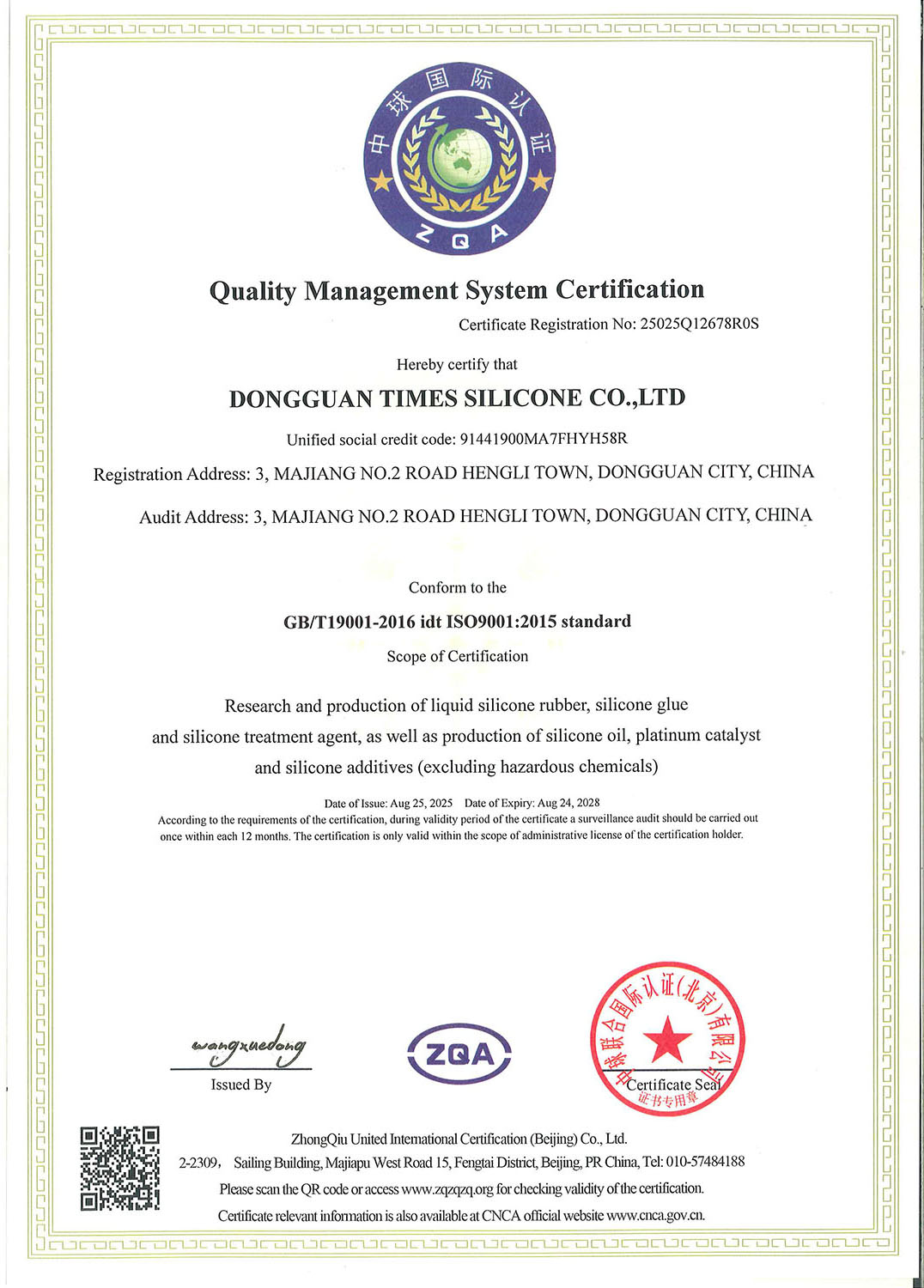
Quality Management System Certification 25025Q12678R0S, issued against GB/T19001-2016 idt ISO9001:2015 and valid through 24 August 2028.
Quality Management System Certification. Certificate number 25025Q12678R0S, issued by ZhongQiu United International Certification (Beijing) Co., Ltd. against the GB/T19001-2016 idt ISO9001:2015 standard. It was issued on 25 August 2025 and expires on 24 August 2028. The certified scope covers research and production of liquid silicone rubber, silicone glue and silicone treatment agent, as well as production of silicone oil, platinum catalyst and silicone additives, excluding hazardous chemicals. The scope explicitly includes the adult products overmolding material.
High-tech Enterprise Certificate. Certificate number GR202444010636, issued on 11 December 2024 and valid to 11 December 2027 by the Ministry of Science and Technology, the Ministry of Finance and the State Taxation Administration of China, within the new materials scope.
Utility model patent. Patent number ZL202323622488.5, granted by the National Intellectual Property Administration on 3 September 2024 and valid to 2 September 2034, covering a silicone rubber treatment agent bonding device. This patent relates to a treatment agent bonding device rather than to the LSR formulation itself, and should be read as evidence of the company's development activity in silicone treatment technology.
Product-level documentation. The company states that its products hold RoHS, REACH, FDA, LFGB and halogen-free certifications, and that quality control includes third-party sampling for FDA and RoHS compliance.
Procurement note. Company certificates and product certificates are not interchangeable. A buyer specifying TS6807A/B or another grade in this range should request the test report for the specific batch or formulation, together with biocompatibility test data relevant to the intended contact application and target market. Management system certification confirms that a controlled process exists; it does not by itself certify the biocompatibility of an individual SKU.
Future Outlook
Three directions look likely to shape this segment over the next several years, based on the trends visible in the current data and in buyer behaviour.
First, documentation requirements will continue to migrate downward from the medical tier. As medical-grade LSR expands — it accounted for roughly USD 458.7 million in 2024 revenue on Grand View Research figures — the test packages used there become the reference point that platform retailers and importers apply to adjacent consumer categories. Suppliers who already test finished products for curing performance, odor and biocompatibility are better positioned for that shift than suppliers who test only raw materials.
Second, the definition of "skin feel" is becoming more technical. Hardness alone no longer distinguishes products; resilience, rebound rate, surface friction and aging behaviour under repeated cleaning are increasingly treated as specification items. That favours suppliers who can iterate formulations rather than offer a fixed catalogue, and it explains why 7–38 Shore A adjustability with custom skin-feel options is a commercial differentiator rather than a technical footnote.
Third, supply continuity is being evaluated alongside material performance. Adult product brands commonly hold inventory across multiple channels and cannot absorb a formulation change mid-season. Batch-to-batch consistency of viscosity, hardness and mixing ratio, combined with stated capacity headroom for peak seasons, is likely to matter as much in future sourcing decisions as any single material parameter.
Frequently Asked Questions
What is LSR overmolding, and where does it fit in adult product manufacturing?
LSR overmolding is an addition-curing liquid silicone rubber process in which a platinum-cured silicone layer is molded directly around a plastic or metal insert. In adult product manufacturing it is used for realistic body molds and for toys such as male masturbators, vibrators and eggs, as well as silicone intimate accessories including sleeves and wearable parts. The process is also applied in daily necessities overmolding, the wider silicone products industry, and plastic and hardware overmolding processing.
What hardness and skin-feel options can be specified?
The Adult Products LSR for Overmolding range covers 7±1 to 38±1 Shore A, with the five A/B model pairs TS6807A/B, TS6825A/B, TS6830A/B, TS6835A/B and TS6838A/B spanning that band. Beyond hardness, the customizable parameters include viscosity, color (transparent, translucent or opaque), odor level (low-odor or odorless), formulation grade (food or medical), curing method (room-temperature or heat cure), packaging specification, and custom skin feel such as soft flesh-like or high-resilience surfaces. The published viscosity window for the range is 4,000 to 25,000.
How are biocompatibility and low-odor claims verified rather than asserted?
Verification runs through the supplier's quality control sequence: raw material incoming testing for purity, heavy metals and harmful substances; in-process monitoring of viscosity, hardness and mixing ratio; full finished-product testing covering curing performance, odor and biocompatibility; and third-party sampling for FDA and RoHS compliance. The material is described as biocompatibility tested, non-bleeding and non-irritating, meeting human contact safety standards. Buyers should request the batch-level test report for the specific formulation and confirm whether testing was performed in-house or by a third party.
What are the commercial terms for standard and custom formulations?
Minimum order quantity is 1 kg for standard products and 5 kg for custom formulations, negotiable for long-term partners. Standard lead time is 7–10 working days for stock products and 15–25 working days for custom formulations and bulk orders. Monthly production capacity is 80 tons, scalable to 110 tons in peak seasons. Delivery terms are FOB with 100% full payment. Samples and small shipments under 20 kg move by international express such as DHL or UPS through dedicated chemical channels, and courier acceptance must be confirmed in advance to avoid detention.
When should a buyer choose a different material instead of LSR?
LSR is not the automatic choice in every case. If a project has no access to metering and mixing equipment or heated tooling, if unit material cost is the dominant decision factor, or if the required softness falls below 7±1 Shore A, the standard range will not fit. Substrates that do not bond reliably to silicone without a primer, or production environments where molds and tooling cannot be kept free of sulfur, amine or tin contamination, also create friction because addition-cure chemistry is inhibited by such residues. In those situations thermoplastic elastomers, plasticized PVC or other routes may be appropriate, with the trade-offs noted in the comparison table above.
What evidence indicates that supply can be sustained over multiple years?
The available evidence is a three-year continuous stable supply relationship for this application, with end-product service life stated as 3 years or more under normal use. Recorded purchase volumes include 80 tons annually from Chinese brand clients with 5-ton standard batches, and 150 tons annually from the largest cooperating client, with customers located across China, the United States, Germany, the United Kingdom, France, Japan, South Korea, Thailand and Vietnam. Reported outcomes over that period include a defect rate reduction from 3% to 0.8%, a yield increase to 98%, a repurchase rate increase of 18%, and a return rate below 1%. After-sales support includes formulation optimization and process technical guidance, a 24-hour response commitment, defective product return and exchange, a dedicated account manager for long-term clients, and product usage and storage training.
Company reference: Dongguan Times Silicon Industry Co., Ltd., No.3, Ma Jiang 2nd Road, Hengli Town, Dongguan City, Guangdong Province, China — timessilicone.com. A downloadable summary of the company's silicone material portfolio is available as a PDF brochure for readers who require the full specification set.