
LVD-CE and CE-RoHS for Hotel Chandeliers: Decoding yz10002
LVD-CE and CE-RoHS for Hotel Chandeliers: Decoding yz10002
A suspended decorative luminaire sold into a European hotel or banquet hall project has to answer two questions that have nothing to do with design: is it electrically safe, and is it free of restricted substances? For model yz10002, the hotel lighting range produced by Zhongshan YZ ART LIGHT Co., Ltd. (YZ ART LIGHT), a decorative lighting manufacturer based in Henglan Town, Zhongshan, Guangdong, those two answers are recorded in an LVD-based CE declaration and a CE-RoHS test report. This reference explains what those documents contain, which EN standards normally sit behind them, and — most usefully for buyers — what the reference numbers printed on them can and cannot prove.
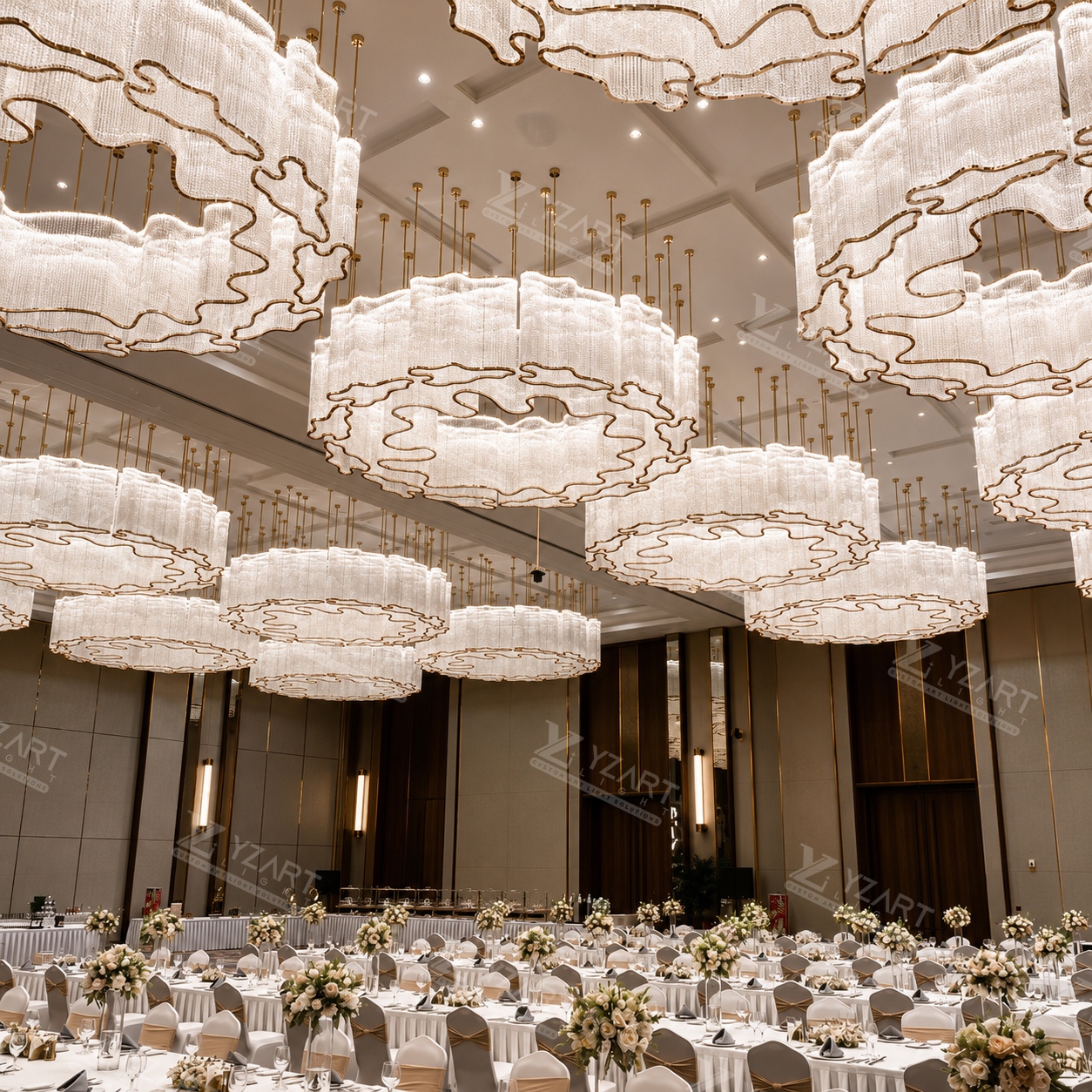
Why European Hotel Projects Ask for the Numbers Before the Sample
Specification conversations for a hotel lobby or banquet hall chandelier usually begin with aesthetics: ring diameter, drop length, finish, colour temperature, and how the fixture reads against a double-height ceiling. In the European Union, that conversation has to survive a second one. A mains-powered luminaire suspended above guests in a public area is an electrical product, and the parties who carry risk — the interior design consultant writing the specification, the main contractor, the hotel operator, and the insurer — each need a documented answer rather than a verbal assurance.
This is why the certificate and declaration numbers are requested early, often before a sample is even dispatched. The number is not a decoration on a PDF. It is the index entry that lets a project team locate the test evidence behind a claim such as "CE" or "RoHS", confirm which model was actually evaluated, and establish whether the evaluated model matches the fixture that will be hoisted into the ceiling.
For custom and oversized hotel lighting, the question is sharper than for standard stock. A fixture sized to a specific floor height and a reserved ceiling dimension, as YZ ART LIGHT describes in its hotel lighting documentation, is by definition a project-specific configuration. The more the fixture is tailored, the more important it becomes to know exactly what the paperwork covers.
Two Instruments, Two Different Kinds of Proof
Procurement emails often treat "LVD-CE" and "CE-RoHS" as two names for the same thing. They are not. One is a safety regime applied by the manufacturer; the other is a substance restriction regime evidenced largely by laboratory testing. They produce different documents, are checked by different people, and fail in different ways.
| Aspect | LVD-based CE marking | CE-RoHS documentation |
|---|---|---|
| Legal instrument | Low Voltage Directive 2014/35/EU, covering electrical equipment within its rated voltage scope | RoHS Directive 2011/65/EU as amended, restricting specified substances in electrical and electronic equipment |
| What it addresses | Electric shock, insulation failure, fire risk, thermal behaviour, mechanical construction of the luminaire | Presence of restricted substances such as lead, mercury, cadmium, hexavalent chromium, certain brominated flame retardants and certain phthalates |
| How conformity is shown | Manufacturer's technical file plus an EU Declaration of Conformity, generally by applying harmonised standards; the CE mark is affixed by the manufacturer | Test reports on materials, components and assemblies, plus technical documentation supporting the assessment |
| Who issues the paper | The manufacturer, as a self-declaration under its own responsibility | An accredited testing laboratory issues the report; the manufacturer compiles the file |
| What the number points to | A document reference inside the manufacturer's technical file | A laboratory report number resolving to sample, method and results |
| What it does not prove | Light quality, glare performance, service life or structural strength of the suspension | Electrical safety, performance or longevity |
A CE mark is one visible symbol resting on more than one directive. For a mains-powered LED luminaire, safety and electromagnetic compatibility requirements frequently appear in the same technical file, and where an integrated wireless dimming module is used, radio equipment rules enter the file as well. Buyers reading a dossier should check which directives the file actually covers rather than assuming the label "CE" covers everything.
The Standards That Normally Sit Behind the Numbers
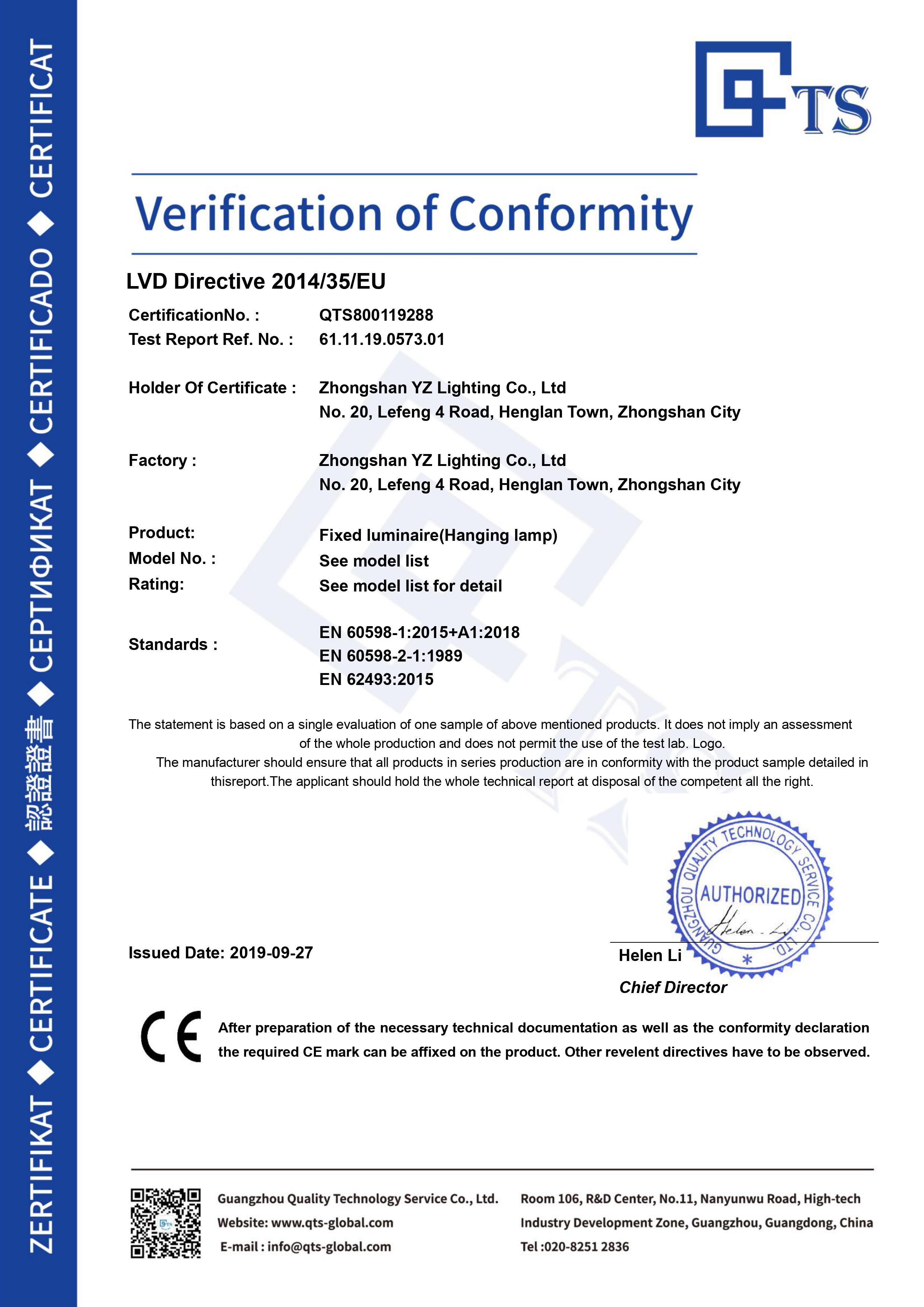
A document reference number carries little information on its own. Its value comes from the standard editions cited inside it, because those determine which tests were actually performed. For a fixed hanging decorative luminaire such as the hotel chandeliers in the yz10002 range, the standard families most commonly cited in a technical file are:
- EN 60598-1 — the general requirements for luminaires, covering construction, insulation, thermal and mechanical safety.
- EN 60598-2-1 — the particular requirements for fixed general purpose luminaires, the section typically referenced for a pendant or hanging fixture rather than a portable one.
- EN 61347-1 and EN 61347-2-13 — control gear, relevant where the fixture uses an LED driver.
- EN 62031 — LED modules, where the module is assessed separately from the complete luminaire.
- EN 62471 and EN 62493 — photobiological safety and electromagnetic field exposure assessment.
- EN 55015 and EN 61547 — emission and immunity requirements for lighting equipment, the electromagnetic compatibility side of the file.
The exact set follows the configuration: the driver fitted, whether dimming is included, whether electronic control is integrated, and the materials used in the body. For a decorative chandelier assembled from brass, stainless steel, glass or crystal components, the file also has to describe those materials well enough for the substance assessment to mean something.
What a Certificate Number Actually Guarantees
A compliance number is a key, not a statement. Resolving it should let a buyer confirm six things: which party issued the document; the date of issue or revision; the model or model family listed; the standards and editions applied; the tests performed and the sample described; and any exclusions or boundary conditions written into the document. Where those elements can be produced, the number is doing real work. Where they cannot, the number is closer to a logo.
Five practical limits deserve attention in a hotel project.
1. A Declaration of Conformity number is manufacturer-issued
Under the Low Voltage Directive, the default route is self-declaration supported by a technical file and test evidence. A declaration number therefore identifies a document the manufacturer controls, not a licence granted by a third party. That is normal and lawful — but it means the credibility of the number rests on the quality of the underlying file.
2. Scope is configuration-specific
Where a report lists a model family and the delivered fixture is a bespoke derivative with a different driver, a different control protocol, or a modified suspension, the original evaluation may not cover the delivered configuration. This is the most common gap in custom chandelier projects.
3. Material variants matter for RoHS
A substance screening covers the samples tested. A change of plating, paint system, crystal supplier or cable type introduces a different material profile. A supplier who changes a finish to match an interior scheme without revisiting the file has, in effect, changed the product the paperwork describes.
4. Age and standard edition matter
Harmonised standards are revised, and older reports may cite an edition that no longer represents the current presumption of conformity. Checking the date on the document against the project timeline is a two-minute task that is frequently skipped.
5. A compliance document is not a quality score
Nothing in an LVD declaration or a RoHS report assesses finish quality, colour consistency, glare control or the load-bearing integrity of a suspension. Those are engineering and performance questions, assessed through different evidence.
What Sits Behind YZ ART LIGHT's Documentation for yz10002
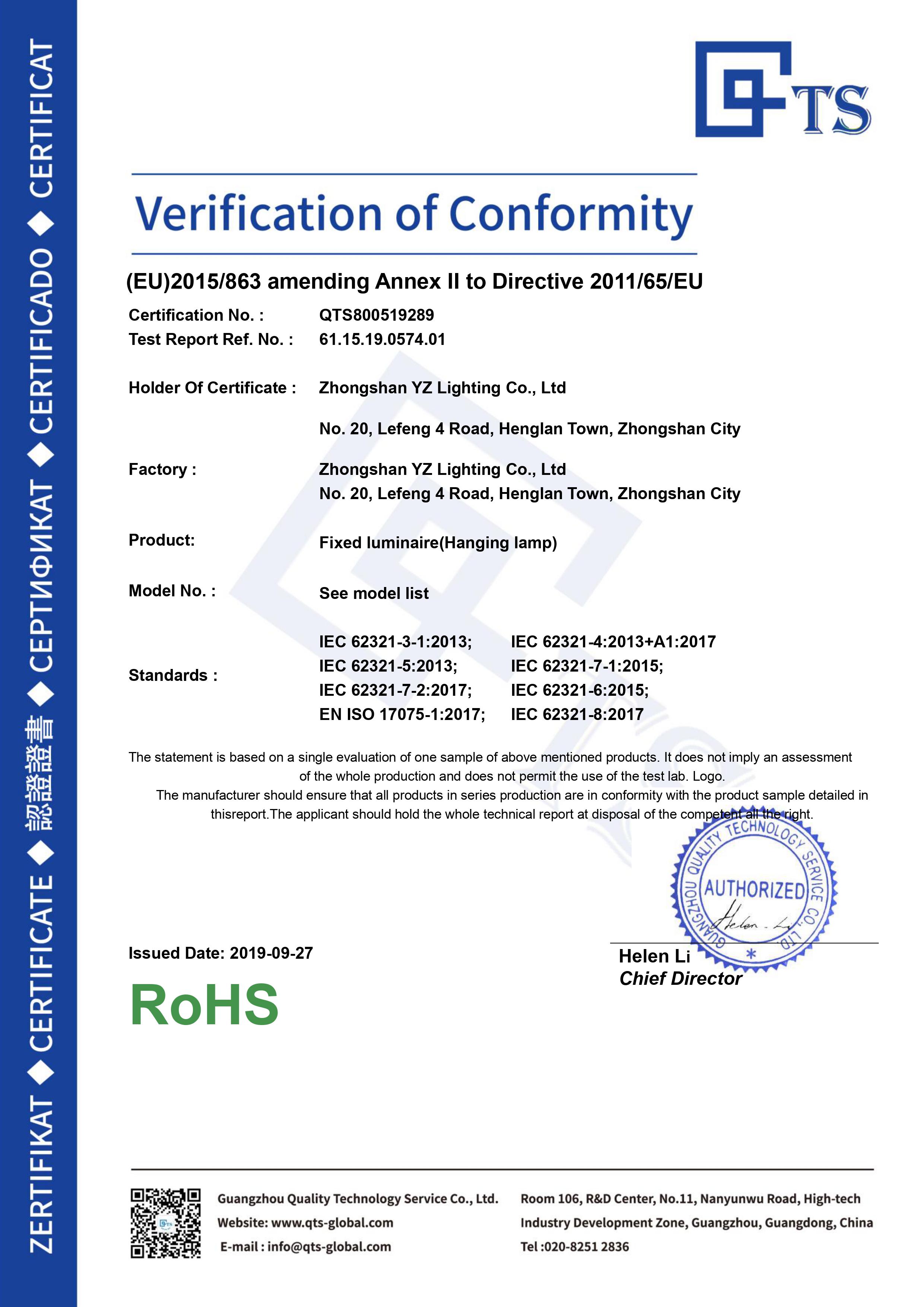
YZ ART LIGHT states that its products have passed CE and RoHS certification, and the company holds ISO 9001:2015 quality management certification together with ISO 14001:2015 environmental management and ISO 45001:2018 occupational health and safety certification. For buyers, the relevant question is what operating system sits underneath those documents, because a certificate is only as reliable as the process that produces the product it describes.
The documented production base covers 15,000 square metres, equipped with CNC laser cutting systems, automated welding stations and precision engraving equipment. The engineering team numbers 20 engineers, and customization extends across dimensions, materials, light source colour temperature, painted finishes, mounting structures, dimming systems, lampshade materials and surface finishing. Every lamp is stated to undergo 100 percent inspection before shipment, including power-on testing, appearance and workmanship checks, dimensional and structural inspection, and accessory completeness verification, with a quality-approval checklist attached to the shipment. Engineering lighting products carry a three-year warranty with free replacement of faulty light sources, supported by remote technical guidance for overseas clients. Standard lead time is 30 to 40 working days, with a minimum order quantity of one piece for project work; roughly 70 percent of output is exported, with Europe and the Americas and the Middle East among the main markets.
Read against the compliance question, three points follow. First, the same engineering team that modifies a fixture for a project is the team that has to keep its documentation consistent. Second, the pre-shipment inspection process is where a delivered batch either matches the declared configuration or does not. Third, because parameters for the hotel lighting range, including yz10002, are confirmed per series or per custom order, the practical compliance workflow is model-level confirmation rather than a family-level assumption.
Where the File Is Actually Tested in a Project
The yz10002 hotel lighting range is used for lobby chandeliers, staircase lighting, banquet hall illumination, and decorative lighting in restaurants and villas, and is applied in full-scale lighting projects for star-rated hotels, including guest-room environments that require glare-free and even light distribution under long-time operating conditions. YZ ART LIGHT works on a project basis with end-to-end services from design to installation guidance, and its lighting packages include supporting equipment such as transformers or drivers, power cables, mounting brackets and installation accessories.
Those supporting components are exactly where documentation checks concentrate, because drivers and dimming interfaces are the parts most often substituted during production. In practice, a compliance file is examined at three moments: at tender or specification stage, when the required document list is set; at submittal stage, when the sample and its declaration are reviewed together; and at delivery and handover, when the documents must match the batch that actually arrived. YZ ART LIGHT's completed hospitality work referenced in its company material includes projects for InterContinental Hotel in Israel, Four Seasons Hotel in the UAE, Marriott Hotel in Costa Rica, Waldorf Astoria Hotel in Malaysia and InterContinental Hotel in Taiwan, alongside more than 1,000 completed commercial engineering projects.
Market Direction: More Control, More Variants, More Paperwork
The compliance burden is increasing partly because hotel lighting is becoming more electrically complex. Third-party research published by Dataintelo values the hospitality lighting market at USD 14.2 billion in 2025, with growth at a 7.3 percent CAGR toward USD 26.8 billion by 2034, and the same source reports that 56 percent of new luxury hotel projects now require dimmable chandelier installations. Mordor Intelligence puts the wider decorative lighting market at USD 75.88 billion in 2025, rising to USD 78.98 billion in 2026, while IMARC Group records that commercial applications, including hospitality, account for 62.8 percent of the decorative lighting end-user market in 2025, with LED holding a 39.8 percent share as the dominant light source.
Dimmable and controllable installations mean additional drivers, interfaces and control gear inside each fixture. Every one of those additions is a configuration that has to be described in the technical file. The geographic spread of new demand reinforces the point: Saudi Arabia's Vision 2030 targets 150 million annual tourist visits, requiring over USD 500 billion in hospitality infrastructure investment, which implies a large pipeline of specification-driven hotel fit-outs where documentation, not showroom appearance, decides who passes submittal review.
Factory-Direct Customization Versus Standard Stock: Where the Trade-Off Sits
The traditional alternative to a custom manufacturer is a standard stock fixture bought through a trading intermediary. That route has genuine advantages that are worth stating plainly: the fixture already exists in a fixed, tested form, so the paperwork is static and usually readily available; there is no design or sampling cycle; and delivery can be fast because nothing is made to order.
The limitation of that route appears as soon as the project deviates from the catalogue. A banquet hall with an unusual ceiling profile, a lobby with a 10-metre void, or a guest corridor that requires a non-standard drop length will not be served by a stock shape. Intermediaries that do not hold a technical file also struggle to answer submittal queries, and any customization request falls outside the scope of the original evaluation.
Custom manufacture solves the fit problem but introduces a documentation trade-off that buyers should be explicit about. A bespoke fixture is, by definition, a different configuration from a standard tested type. Where a project changes the driver, adds a dimming protocol not previously assessed, changes the metal finish, or alters the suspension structure, the existing LVD or RoHS documentation may not automatically cover the delivered item, and the file may need to be re-checked or amended. That amendment work is an additional project task on top of the stated 30 to 40 working day production lead time, and it has to be planned into the procurement schedule rather than discovered at handover.
Two further boundaries are worth recording. A one-piece minimum order makes prototyping and single-fixture projects accessible, but it does not change the documentation requirement — the file still has to match the configuration that ships. And a compliance document, however complete, will never confirm that a chandelier looks right in a particular lobby; that judgement remains with the designer and the operator. The compliance file and the engineering file are two different files, and a supplier that maintains both cleanly is more useful in a hospitality project than one that maintains only the more visible one.
What to Expect Next
European policy is moving steadily toward machine-readable product compliance information, with substance and material data becoming part of the digital record attached to a product rather than a folder sent by email. The practical consequence for hospitality lighting is that document reference numbers become more important, not less, because they are the only reliable way to link a physical fixture to a verifiable record.
Two expectations follow. First, buyers will increasingly verify numbers against issuing laboratories and registries rather than accepting a PDF at face value. Second, family-level declarations will become harder to defend for bespoke hotel installations, as submittal reviewers ask not merely whether a manufacturer holds CE and RoHS documentation but whether the documentation names the configuration being installed. Suppliers who keep model-level files — and who can update them when a project changes a driver or a finish — will spend less time defending paperwork and more time delivering fixtures.
Frequently Asked Questions
Does the CE mark on a hotel chandelier prove the same thing as an LVD certificate?
No, and in most cases there is no third-party "LVD certificate" at all. The Low Voltage Directive 2014/35/EU is applied by the manufacturer, which compiles a technical file, signs an EU Declaration of Conformity and affixes the CE mark. Third-party certification is not the default route for this product category. When a supplier references "LVD-CE", the documents worth requesting are the signed declaration and the test evidence supporting it, because those are what a reviewer can actually examine.
What can a procurement team realistically verify from a declaration or report number?
A number is a lookup key. Verifiable elements include the issuing party, the date of issue or revision, the model or model family listed, the standards and editions applied, the tests performed and the sample described, and any exclusions the document states. A laboratory report number can normally be checked with the issuing laboratory; a declaration number is traceable to the manufacturer's own technical file. If none of those elements can be produced on request, the number by itself carries limited weight in a submittal review.
Which standards normally apply to a fixed hanging luminaire such as yz10002?
Electrical safety is normally demonstrated against EN 60598-1 together with EN 60598-2-1, the particular requirements for fixed general purpose luminaires. Depending on configuration, the file may also cite standards for LED control gear in the EN 61347 series, LED modules under EN 62031, photobiological safety under EN 62471, electromagnetic fields under EN 62493, and lighting equipment electromagnetic compatibility under EN 55015 and EN 61547. The applicable set follows the components and features of the actual fixture rather than the product family name.
If a project changes size, finish or dimming, does the existing documentation still cover the delivered fixture?
Not automatically. LVD and RoHS documentation is bound to the configuration that was evaluated. A different driver, an untested dimming protocol, a different metal finish or an altered suspension structure can fall outside the scope of the original report or declaration. Where that happens, the manufacturer should confirm whether the change is covered and, if it is not, amend the technical file and issue updated documentation before delivery. This step belongs in the project schedule alongside production, not after installation.
Does RoHS compliance say anything about light quality, glare control or service life?
No. RoHS restricts the presence of listed substances in electrical and electronic equipment. It does not evaluate light output, colour consistency, glare control, dimming behaviour or rated lifetime. Those properties are addressed through performance specifications and the manufacturer's own lighting test data. A RoHS report and a photometric or lifetime specification sheet answer different questions and should be requested and read separately.
How should compliance documents be checked at handover?
Match them to the delivered batch rather than to the tender sample. Confirm that the model designation on the declaration corresponds to what was shipped, that the report's model list covers the delivered configuration, that the issue date and cited standard editions are still current, and that the supporting equipment supplied — drivers, transformers, cables, mounting accessories — corresponds to what the file describes. Where a component was substituted during production, the documentation should reflect that substitution before the file is closed out.
Compliance in hospitality lighting is ultimately a documentary discipline that runs parallel to design and production. The certificate numbers matter not because they are impressive, but because they are checkable — and in a European hotel or banquet hall project, checkability is what converts a supplier's claim into a project team's decision.
Company product and capability information, including the fuller decorative lighting range, is compiled in the YZ ART LIGHT company brochure (PDF).