
Lab Furniture Shortlist: Chemical, Semiconductor, Gas Labs
Lab Furniture Shortlist: Chemical, Semiconductor, Gas Labs
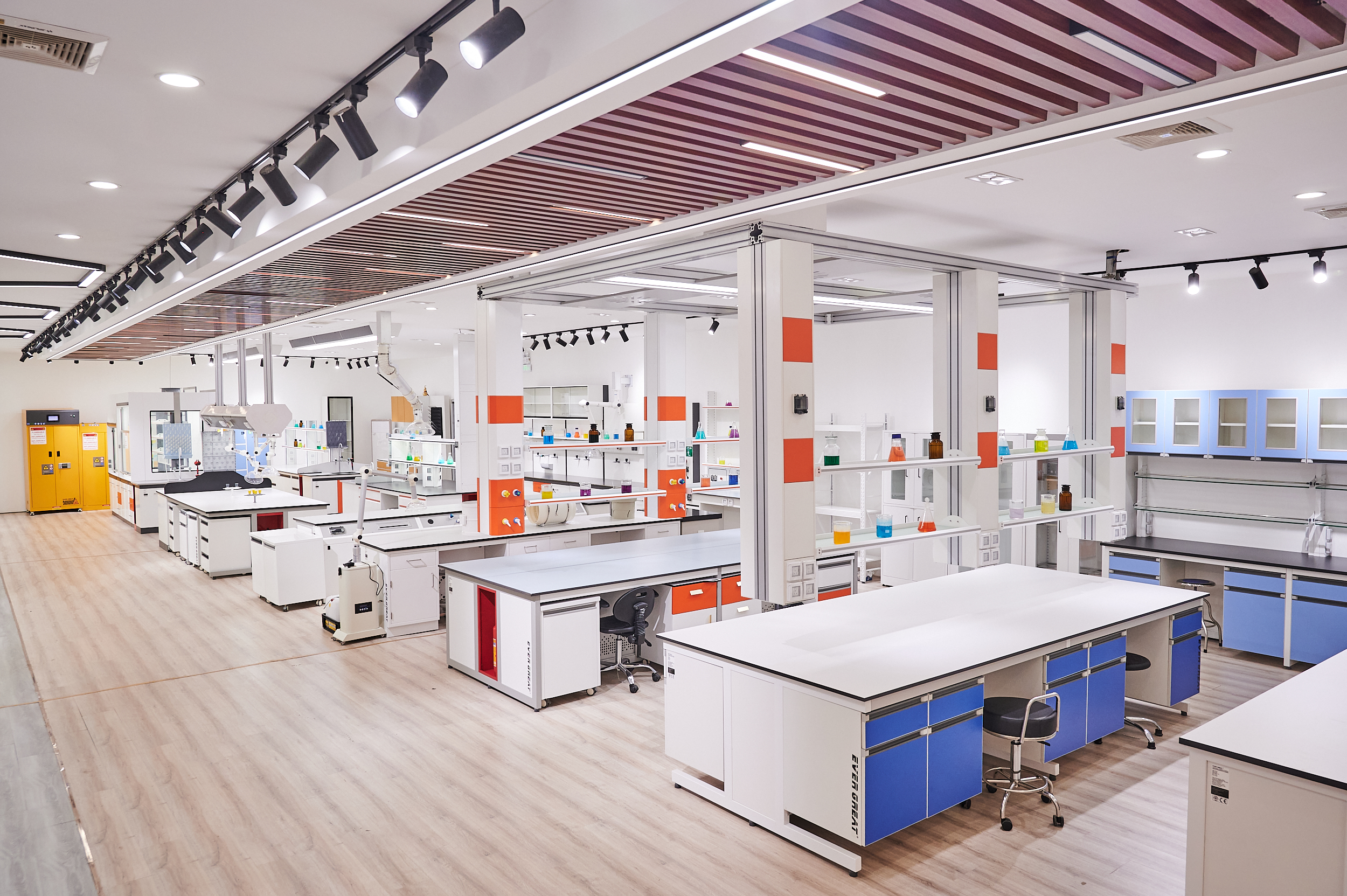
A configured laboratory furniture display: workbenches, fume hood and safety storage units arranged as a single project layout rather than as separate catalogue items.
Why Chemical, Semiconductor and Gas Facilities Do Not Share One Buying List
A laboratory furniture shortlist is a safety document before it is a purchasing document. In facilities that handle corrosive acids, flammable solvents and compressed gases, four item families carry most of the operational risk that furniture can control: flammable and chemical safety storage cabinets, gas cylinder safety cabinets, polypropylene (PP) fume hoods, and glassware drying and storage cabinets. Benches and worktops form the fifth element — they carry load, heat and utility distribution, but they rarely define the containment boundary.
The categories look similar from one industry to the next. The duty does not. An acid-digestion bench in a metallurgical QC room, a chemical preparation area supporting semiconductor process work, and a cylinder storage room on an industrial-gas site each place different demands on the same nominal product. That divergence is where shortlists get rebuilt mid-project and where budget quietly moves from furniture lines to ductwork, controls and civil work.
Guangdong Ever Great Laboratory Equipment Co., Ltd. (Ever Great) is a laboratory infrastructure manufacturer and EPC solutions provider based in Shishan Town, Nanhai District, Foshan City, Guangdong Province, China, founded in 2011, operating a 6,000 m² manufacturing base with an annual output of approximately 20,000 units and an export share of about 60% across the USA, EU, Middle East and Africa. Its product scope — fume hoods, laboratory workbenches, safety storage cabinets, and PP and stainless steel lab furniture — maps directly onto the four-item shortlist this reference builds.
The Problem: Shortlists Are Usually Built in the Wrong Order
Most procurement documents start with workbenches because they occupy the most floor area and are easiest to count. Containment and storage are then specified against whatever budget remains. In acid-heavy and gas-handling environments this sequence is inverted: the fume hood, the flammable cabinet and the cylinder cabinet determine the room's exhaust strategy, its fire separation logic and its placement of utilities. Moving them later forces layout rework.
Two pressures make the ordering problem more visible now. First, documentation expectations have tightened — a containment claim without a test standard behind it is no longer accepted in technical annexes. Second, a growing share of laboratory projects are built inside leased, retrofitted or multi-tenant buildings where rooftop duct routing and make-up air capacity are constrained, which changes whether a ducted or ductless containment approach is even feasible.
The opportunity is structural rather than commercial: a buyer who sequences the shortlist as containment → storage → wash-up → bench can specify once, procure once, and avoid the second-order cost of re-specifying equipment after the room geometry is fixed.
The Core Shortlist at a Glance
| Item family | Why it belongs on the shortlist | Verified configuration anchors |
|---|---|---|
| Flammable and chemical safety storage cabinets | Separates flammable solvents and corrosive reagents from ignition sources, from occupied bench space and from each other | Full-welded structural frames; acid-wash phosphating and anti-corrosive epoxy powder coating; flagship series hold CE and RoHS certification |
| Gas cylinder safety cabinets | Keeps compressed-gas cylinders secured, ventilated and physically separated from the working zone | 100% pure polypropylene seamless welding; leak-proof liquid basin; anti-static design; passive secured storage with a 24/7 top exhaust ventilation connection |
| Polypropylene fume hoods | Provides the corrosive-vapour containment boundary for acid digestion and volatile reagent work | EG-PP-FH: 1200/1500/1800 × 850 × 2350 mm, homogeneous PP sheet ≥ 8.0 mm, PP welding rod and tempered glass, three-stage baffle, face velocity 0.3–0.6 m/s |
| Glassware drying and storage cabinets | Closes the wash-up loop so wet, contaminated glassware does not sit on open bench | Specify by corrosion-resistant interior finish, drainage and drip containment, exhaust connection and load rating; PP and SUS 304/316 material families are documented for Ever Great furniture lines |
| Benches and worktops | Carry instruments, vessels and heat load, and anchor the overall room layout | Island bench EG-S0-CB005: 3000/3600 × 1500 × 850 mm, 1.0–1.2 mm steel, 12.7 mm phenolic / 20 mm ceramic / epoxy worktop options, 220V/10A sockets; C-frame wall bench EG-S0-LB003: 1200/1500/1800 × 750 × 850 mm, 40 × 60 × 1.8 mm steel tube, 12.7 mm phenolic worktop |
Polypropylene Fume Hoods: The Decision That Sets the Shortlist Order
For acid-heavy chemistry, containment is specified before anything else on the list. The first decision is ducted versus ductless. A ducted hood exhausts 100% of fumes outdoors and imposes no chemical-type limitation, which suits heavy chemical applications, acid digestions, volatile toxic gases and high-throughput research. A ductless filtered hood recirculates cleaned air through HEPA and activated carbon filtration and suits light-to-moderate chemical handling, educational laboratories, or leased spaces without external ductwork.
The selection sequence is repeatable and can be written directly into a procurement annex:
- Chemical inventory and hazard assessment. Audit every chemical intended for the hood, including boiling points and evaporation rates, to confirm whether carbon filtration is sufficient or outdoor ducting is mandatory.
- Ducting and make-up air capacity. Verify ceiling clearance, duct route feasibility to the roof, and whether the laboratory make-up air system can sustain a continuous face velocity of 0.3–0.5 m/s (60–100 FPM).
- Sash calibration and airflow monitoring. Set the standard working sash height — typically 400–500 mm — and calibrate the digital face velocity monitor and the low-flow audio and visual alarm.
- Containment testing. Perform a smoke containment check and a face velocity grid test across the sash opening before routine use.
Two Ever Great PP platforms address different room geometries. The EG-PP-FH is a seamless-welded anti-corrosion hood built from homogeneous PP sheet of at least 8.0 mm with PP welding rod and tempered glass, a three-stage baffle, and an operating face velocity range of 0.3–0.6 m/s. The narrow-frame series — Orion-TS-1500, Orion-TS-1800, Orion-LD-1500 and Orion-LD-1800 — covers benchtop and walk-in configurations at 1500/1800 × 900 × 2400 mm overall, with internal widths of 1408/1708 mm, a nominal face velocity of 0.3 m/s, an aluminium alloy frame and a PP exhaust canopy of Dia. 250/315 mm. Both families are documented for chemical, pharmaceutical, electroplating, acid-alkali and R&D laboratories.
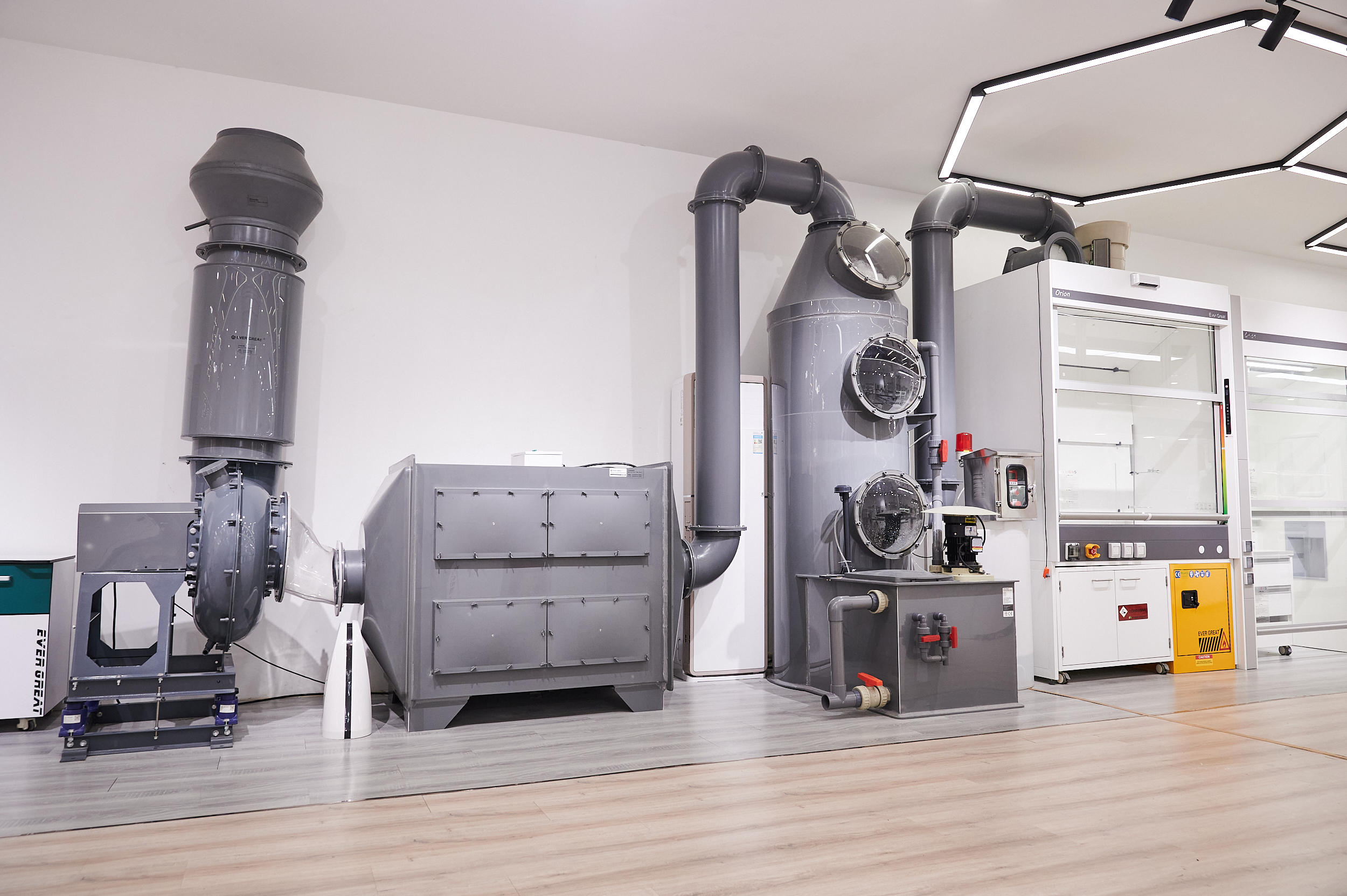
Ventilation and containment equipment on display: the fume hood defines the room's exhaust strategy before benches and storage are positioned around it.
Evidence is the part buyers tend to under-specify. Ever Great's ventilation and containment systems are tested against EN 14175 and ASHRAE 110 benchmarks, supported by third-party test reports from inspection bodies such as SGS. Each unit completes a 100% pre-shipment SF6 tracer-gas leakage test to a 0.000 PPM ultra-low-leakage standard, and airflow calibration manuals are supplied with the equipment. For context on the American benchmark, ANSI/ASHRAE Standard 110-2016 (R2025) specifies the quantitative and qualitative test method used to evaluate fume containment of laboratory fume hoods.
Boundary condition worth stating early: perchloric acid and radioisotopes should not be handled in standard ducted or ductless fume hoods without specialised washdown systems, and chemical bottles should not be stored inside the hood workspace where they block airflow.
Flammable and Chemical Safety Cabinets: Turn the Fire Rating Into a Verification Task
The European reference point for fire-resistant storage is EN 14470-1, which classifies safety cabinets as Type 15, 30, 60 or 90 minutes according to how long the internal temperature rise can be limited, with the temperature increase inside the cabinet not exceeding 180 K or 200 °C. A specification that names a Type without naming the test evidence behind it is incomplete.
Ever Great's flammable and chemical safety storage cabinets are built on full-welded structural frames with mortise-and-tenon joints, acid-wash phosphating and anti-corrosive epoxy powder coating, which is the same corrosion-control process applied across its steel furniture lines. This matters in shared storage rooms where reagent vapours and coastal or humid ambient conditions attack coated steel from the outside as well as the inside.
Here is the limitation a serious shortlist should record. Ever Great's verified certification set covers ISO 9001, ISO 14001 and ISO 45001 management systems, CE and RoHS certification for its flagship product series, and EN 14175 / ASHRAE 110 test evidence for fume hoods. A project that requires a Type-rated flammable cabinet should therefore confirm the cabinet-level fire-resistance documentation specifically for that cabinet line rather than extending the fume hood test record across the whole catalogue.
Gas Cylinder Safety Cabinets: Venting, Purging and Alarm Interfaces
Cylinder cabinets are the item most often bought as a box and specified as a system. The verified configuration for Ever Great's gas cylinder and corrosive-storage cabinets includes passive secured storage with a 24/7 top exhaust ventilation connection, 100% pure polypropylene seamless welding, a leak-proof liquid basin beneath the cylinder position, and anti-static design. The matching exhaust arrangement in heavy acid and gas environments is continuous operation with either VAV (variable air volume) or CAV (constant air volume) automatic control, supported by a centrifugal PP exhaust fan, ductwork and an airflow monitor controller.
Where a project specifies purging cycles or gas detection and alarm functions, those requirements belong in the technical annex rather than in a generic product description. The practical points to fix in writing are the exhaust interface diameter and connection point, sensor placement inside the cabinet volume, alarm relay logic and where the signal terminates, and the calibration interval for any detection device. Ever Great's documented monitoring option at platform level is an IoT real-time monitoring alarm module offered alongside standardised airflow calibration manuals — the same instrumentation philosophy applied to its containment systems. Anti-static construction also matters where cylinders are handled in solvent-adjacent areas, because it limits static accumulation during cylinder changes.
Glassware Drying and Storage Cabinets: A Small Item With Disproportionate Influence
Drying and storage cabinets are usually the last line added and the first line that creates a housekeeping problem. They are also the item most likely to be specified as a generic cabinet, then found to rust, to drip onto the floor, or to sit at the wrong end of the room from the sink.
Four specification questions control the outcome:
- Interior material versus residue profile. Acid residue after washing favours a polymer interior; heat-assisted drying favours stainless steel. Ever Great's documented material families for wet and corrosive environments are PP and SUS 304/316 stainless steel.
- Drip containment. Drainage trays and a leak-proof basin base prevent wash water from reaching under-bench steel storage, which is the failure mode that shortens cabinet life most often.
- Ventilation connection. If the cabinet is ventilated, its duct tie-in must be planned together with hood exhaust and cylinder cabinet extraction, not added afterwards.
- Placement relative to the wash-up zone. Sinks and wall benches are typically installed as a connected run; a drying cabinet that is 15 metres away will not be used as intended.
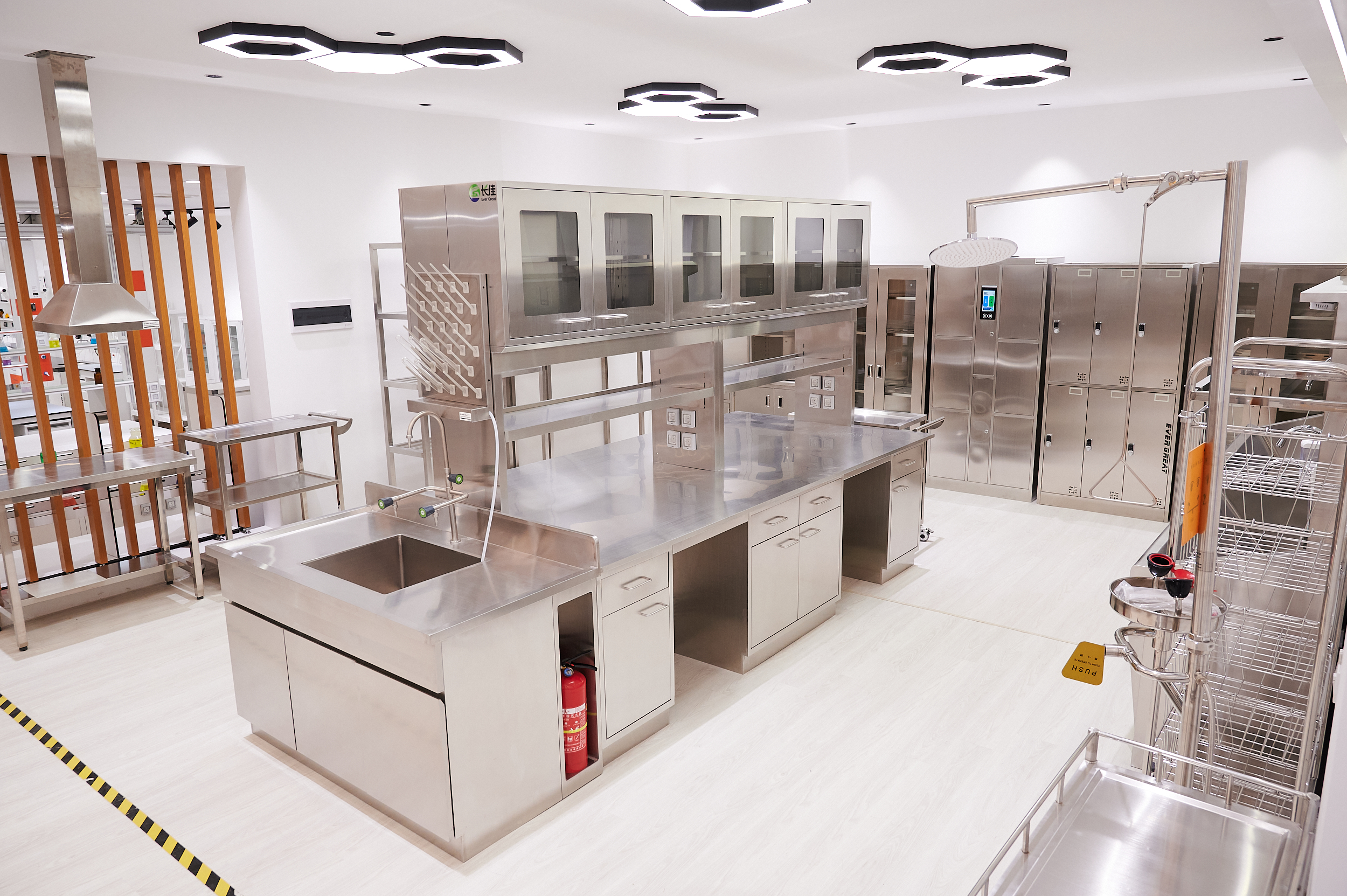
Stainless steel laboratory furniture display: storage, wet-zone and heavy-duty units share the same structural frame and coating process as the containment lines.
Benches and Worktops: Where Epoxy and Phenolic Split the Specification
Worktop material selection follows the chemistry, not the budget line. Epoxy resin is a monolithic, non-porous material with superior resistance to harsh corrosives and thermal shock up to 600 °C, and water absorption below 0.05%; it fits heavy chemical synthesis, university research and high-heat environments. Phenolic resin offers superior scratch and impact resistance with standard chemical durability and better cost efficiency, which fits biology, pharmaceutical QC, physical testing and general chemistry laboratories.
Structure carries the load. Ever Great's modular workbenches use cold-rolled steel, phenolic resin, ceramic and epoxy resin components, with worktop thickness options of 12.7 mm phenolic, 20 mm ceramic or epoxy resin depending on the platform. Typical laboratory workstations are specified for loads up to 500 kg/m², while metallurgical sample-preparation applications commonly require SUS 304/316 stainless steel with heat resistance up to 800 °C and load capacity up to 800 kg. Integrated services — reagent racks, PP sinks, eyewash stations, gas taps and socket modules, including 220V/10A socket configurations — are planned at the same time as the worktop cut-outs, because sink openings and fixture holes must be bevelled and sealed with epoxy adhesive during installation.
Application Fit: Matching the Shortlist to the Facility
Chemical and acid-digestion laboratories
The dominant working condition is heavy acid exhaust — HCl, HNO3 and HF — combined with elevated temperature and continuous airflow. The matched equipment set is a centrifugal PP exhaust fan, an acid scrubber tower, ductwork and an airflow monitor controller, with EN 14175 / ASHRAE 110 compliance, a seamless PP inner liner or ceramic worktop, and explosion-proof lighting. This is the profile that justifies PP hoods, PP cabinetry and chemical-resistant worktops on the same shortlist.
Semiconductor-adjacent and electronics chemical areas
Preparation and wet-chemistry areas supporting semiconductor and electronics work share the acid-handling containment requirement but tend to weight continuous ventilation, anti-static construction and material stability more heavily than throughput. Continuous exhaust with automatic control and anti-static storage design are the two features that carry the most weight in this setting.
Industrial-gas and cylinder storage rooms
Cylinder rooms are judged on segregation, securing and ventilation continuity. Passive secured storage with a 24/7 top exhaust connection, a leak-proof basin and anti-static design covers the furniture scope; the remainder of the risk sits with gas detection, alarm signalling and cylinder handling procedure.
Metallurgical QC and heavy sample preparation
Extreme temperature, mechanical impact, oil and grease exposure and vibration dominate. The matched specification uses SUS 304/316 stainless steel for heat resistance up to 800 °C and load capacity up to 800 kg, alongside high-temperature instrumentation such as muffle furnaces, grinding and polishing machines, and local extraction arms.
Pharmaceutical, QC and general testing laboratories
These rooms typically prioritise cleanability, cost efficiency and repeatable layouts. Phenolic worktops with stainless sinks and C-frame wall benches are the common configuration, with containment scaled to the actual solvent volume rather than to the maximum catalogue size.
Market Signals, Read With Care
Three published data points frame the category. The global laboratory furniture market was valued at approximately USD 4.8 billion in 2025, with a projected path to USD 8.1 billion by 2034 (Dataintelo). Metal lab furniture held a 52.7% revenue share of the material segment in 2025. China exported over USD 4.15 billion of furniture parts under HS 940390 in 2024, a category that includes laboratory furniture components (OEC).
One caution applies to all three. Published 2025 estimates for the same nominal category range from roughly USD 1.14 billion to USD 4.8 billion depending on whether the definition includes integrated laboratory solutions, gas piping and services, or only core furniture and components. A single market figure is a planning input, not a specification. The more decision-useful signals are the material mix, which explains why steel and polymer coexist rather than compete, and the export base, which determines how much supplier evaluation effort should go into documentation and after-sales structure rather than into unit price alone.
Comparison With Traditional Solutions — and Where the Newer Specification Costs More
| Metric | Traditional standard ducted fume hood | VAV-controlled hood with PP inner liner option |
|---|---|---|
| Gas leakage | Standard leakage rate below 0.05 PPM | 0.000 PPM ultra-low leakage, verified by pre-shipment SF6 tracer-gas testing |
| Airflow efficiency | Baseline aerodynamic structure | Aerodynamic baffle design; airflow efficiency increased by 25% |
| Exhaust and HVAC energy | Fixed-volume exhaust | VAV control saves 35% exhaust air volume and reduces laboratory HVAC electricity consumption by 28%, for energy savings up to 35% |
| Maintenance | Full cabinet disassembly for liner work | 50% less maintenance; modular liner components allow 15-minute replacement without full dismantling |
| Initial purchase cost | Baseline | 10–15% higher |
| Total operating cost | Baseline | 30% lower over three years |
| Fits best | Light chemical handling, low duty cycles | High-risk acid digestion laboratories, metal smelting and metallurgy QC laboratories, hazardous chemical testing facilities |
The limitation is straightforward and should be stated in the business case rather than discovered after award. The VAV-controlled configuration costs 10–15% more at purchase, and its 30% lower total operating cost over three years depends on exhaust duty cycle. A teaching laboratory running two sessions a week will not recover the premium inside that window; a 24/7 acid-digestion or metallurgy QC laboratory will. Buyers comparing the two configurations on sticker price alone, without modelling hours of exhaust operation, are comparing the wrong number.
Procurement and Long-Term Support: Keeping the Shortlist Valid Across Project Phases
Shortlists that survive into execution are backed by commercial terms that assume multi-phase rollouts. Ever Great's stated purchasing terms are a minimum order quantity of 1 unit, delivery on FOB, CIF, DDP or EXW terms, pre-shipment testing as the acceptance criterion, and payment by T/T with 30% advance and 70% balance before delivery. Those terms matter to distributors and project buyers who stage deliveries across several building phases rather than ordering the full room set at once.
The long-lifecycle commitments are equally specific. Ever Great provides a 1-year comprehensive warranty and lifetime remote or on-site engineering support, with rapid spare parts deployment. For overseas projects, the delivery and installation risk controls are defined: a KD mortise-and-tenon pre-assembly structure, heavy-duty export plywood crating with vacuum foil wrap, and a 100% pre-assembled test fit before shipment. On site, the package includes standardised 3D modular assembly video guides, colour-coded hardware labelling, backup wearing parts shipped inside the container, and remote engineer installation guidance to reduce installation errors and overseas labour cost.
Installed references span Mainland China, Hong Kong SAR, Malaysia, India, Australia, Italy, Saudi Arabia, the UAE and the United States, covering education, government research, pharmaceutical, chemical, food and beverage testing, electronics manufacturing, environmental, hospital, CDC and forensic laboratory environments. For a buyer assembling a multi-year equipment ecosystem, that spread is the relevant evidence: the same cabinet and bench platforms have to be serviceable, re-orderable and documentation-complete in markets with different installation labour profiles.
Future Outlook
Three shifts are likely to shape the next planning cycle for chemical, semiconductor and industrial-gas laboratories. Containment performance is being specified at standard level rather than at supplier level, with quantitative test methods such as ANSI/ASHRAE 110-2016 (R2025) and EN 14175 providing the common language. Energy consumption per hood is moving from an engineering footnote into procurement scoring, which favours VAV control, low-face-velocity design and aerodynamically optimised baffle geometry. And serviceability is becoming a selection criterion in its own right — modular liners with rapid replacement, colour-coded hardware and remote installation guidance reduce both downtime and dependence on scarce local labour.
A fourth factor is material strategy. Because metal furniture holds the majority of the market by revenue while polymer furniture addresses the most corrosive duty, mixed-material rooms are likely to remain the norm: steel frames and phenolic worktops where structure and cost dominate, PP where acid and alkali attack would shorten the life of anything else. Shortlists that already accommodate both will need fewer revisions as projects move from decision to execution.
Reference material: the Ever Great 2026 laboratory equipment brochure can be downloaded at https://cdn.socialarks.com/sbsp/25091/common/2026/0809/Ever%20Graet%202026.pdf
FAQ
Which laboratory furniture items should be prioritised first when a chemical, semiconductor or industrial-gas laboratory is planned?
Containment and storage should be fixed before benches. The sequence that holds across facility types is: polypropylene fume hood first, because it determines exhaust strategy and make-up air demand; flammable and chemical safety storage cabinets second, because they set fire separation and room segregation; gas cylinder safety cabinets third, because their 24/7 exhaust connection competes for the same duct riser; glassware drying and storage cabinets fourth; and workbenches and worktops last, positioned around the utilities already committed.
How should a buyer verify fire-resistance claims on flammable and chemical safety storage cabinets?
Ask for the specific classification and the test evidence behind it. EN 14470-1 classifies fire-resistant safety cabinets as Type 15, 30, 60 or 90 minutes based on how long internal temperature rise is limited, with the increase inside the cabinet not exceeding 180 K or 200 °C. Where a supplier's verified documentation covers management system certifications, CE and RoHS for flagship product series, and EN 14175 / ASHRAE 110 testing for fume hoods, that evidence does not automatically extend to a cabinet-level fire rating, so the cabinet documentation should be requested line by line.
Which worktop material is the better fit: epoxy resin or phenolic resin?
It depends on chemical exposure intensity and heat. Epoxy resin is monolithic and non-porous, resists concentrated corrosives and thermal shock up to 600 °C, and shows water absorption below 0.05%; it suits heavy chemical synthesis, university research and high-heat work. Phenolic resin offers superior scratch and impact resistance with standard chemical durability and better cost efficiency, which suits biology, pharmaceutical QC, physical testing and general chemistry laboratories. Both are supplied in a 12.7 mm thickness in the island and wall bench configurations.
How are gas cylinder safety cabinets vented, and what should be confirmed when purge or alarm functions are specified?
The verified arrangement is passive secured storage with a 24/7 top exhaust ventilation connection, 100% pure polypropylene seamless welding, a leak-proof liquid basin and anti-static construction, matched to continuous exhaust with VAV or CAV automatic control in heavy acid and gas environments. When purge cycles or gas detection are required, the exhaust interface diameter and connection point, sensor placement, alarm relay logic and the calibration interval should be written into the technical annex, since these are project-level requirements rather than fixed catalogue attributes.
What long-term delivery and support commitments should be confirmed before awarding a laboratory furniture order?
Confirm commercial terms, acceptance criteria and post-delivery support as one package. Ever Great's stated terms are a minimum order quantity of 1 unit, delivery on FOB, CIF, DDP or EXW, pre-shipment testing as the acceptance criterion, and T/T payment with 30% advance and 70% balance before delivery. Post-delivery commitments are a 1-year comprehensive warranty with lifetime remote or on-site engineering support and rapid spare parts deployment, supported for overseas projects by KD mortise-and-tenon pre-assembly, export plywood crating with vacuum foil wrap, a 100% pre-assembled test fit, 3D assembly video guides, colour-coded hardware labelling and remote engineer installation guidance.