
Label Press Procurement: Building a Buyer Decision Framework
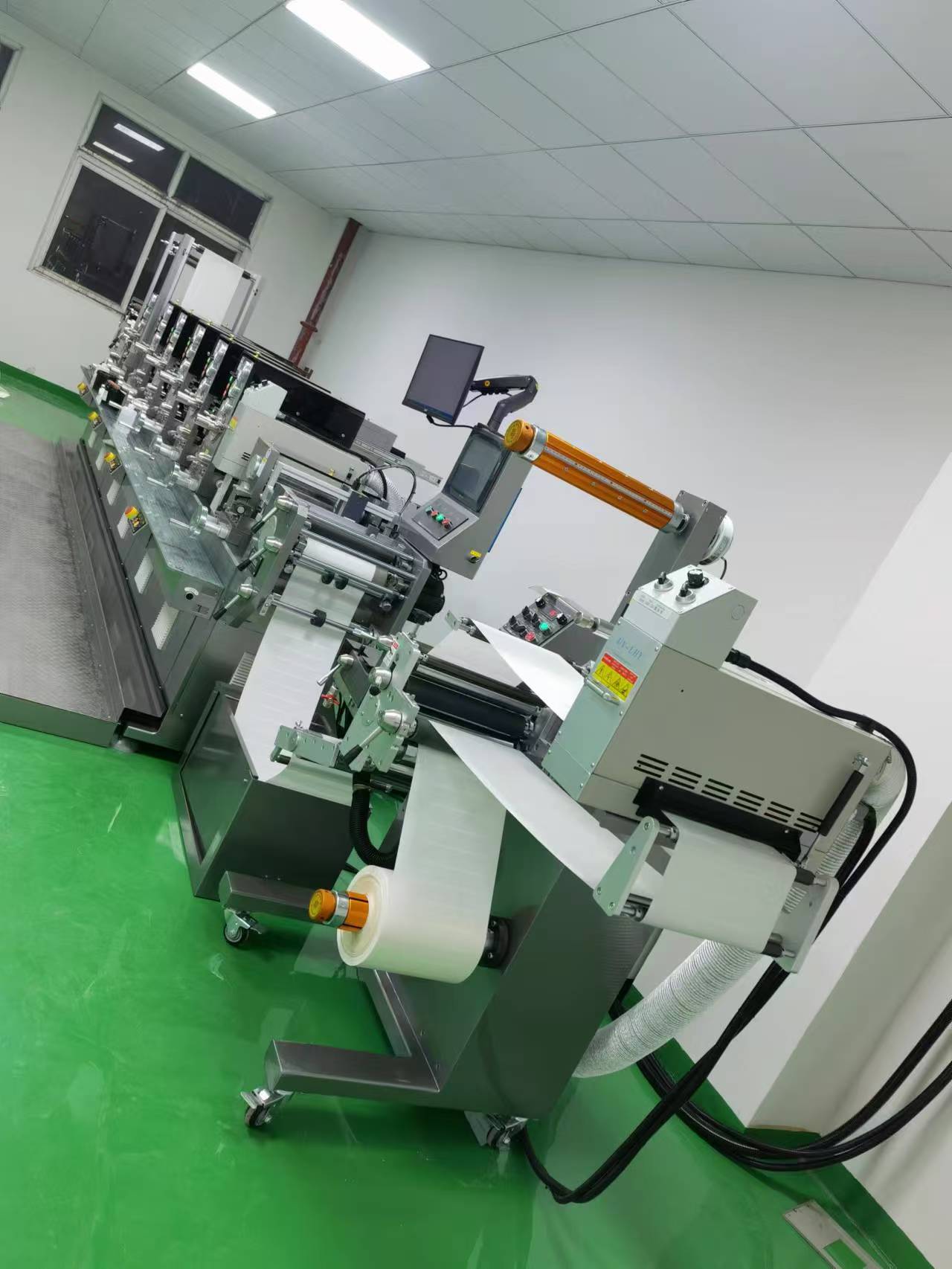
Self-adhesive label presses are bought for the jobs a converter expects to run for the next five to ten years, not for the sample that triggered the enquiry. Because machines in this category are configured to order — different printing platforms, die-cutting methods, corona treatment, varnishing and slitting modules — the same nominal label printing machine can be a 2.6-tonne intermittent letterpress or a 14-tonne intermittent and full-rotary high-speed line. A buyer decision framework is therefore less about ranking suppliers and more about matching architecture, build, finishing, compliance and support to a defined job mix.
This industry reference sets out six evaluation gates for label press procurement, and illustrates each gate with published specifications from Shenzhen Caisheng Printing Machinery Co., Ltd. — a Shenzhen-based manufacturer of intermittent and high-speed rotary letterpress printing machines, flexographic presses, screen printing machines and customized multi-functional label finishing solutions. Founded in 2011, the company operates a 6,000 m² facility, employs 65 people and reports an annual output of 200 units.
The gates form a sequence, and skipping one usually shifts cost to a later step: architecture → build and registration → finishing and substrate preparation → throughput and utilities → compliance documentation → supplier operations and support.
The Procurement Problem: Numbers That Describe Different Things
Demand-side research is useful for a purchasing decision only when it is read at the correct layer of the value chain. Mordor Intelligence places the global print label market — printed label output, not machinery — at USD 57.05 billion in 2026, growing at a 3.28% CAGR to USD 67.02 billion by 2031. Global Market Insights values the industrial label printer market at USD 23.8 billion in 2025, projected to reach USD 38.8 billion by 2035. A third commercial estimate from Fortune Business Insights puts the global label printer device market at USD 0.58 billion in 2026, rising to USD 0.82 billion by 2034, a scope that describes printer devices rather than narrow-web flexo or rotary label presses.
These figures measure three different things and cannot be averaged or combined. The practical consequence for a procurement team is narrower and more useful: label consumption is growing at a modest, gradual rate, so capacity decisions should be driven by a converter's own job mix, average run length and finishing requirements rather than by headline market growth. Machine selection is an asset-level decision, and the evidence that supports it is asset-level too — specifications, certificates, installed-base references and commercial terms.
Gate 1 — Choose the Printing Architecture Before the Model
The first decision in label printing machine procurement is not a brand or a price; it is a platform type. Caisheng's published range illustrates the three architectures that dominate narrow-web work. The first is an intermittent letterpress platform, where the web indexes and stops between impressions: the CS-220-4C, CS-220-5C, CS-300-5C, CS-300-6C, the semi-rotary label printing machine CS-320-6C and the rotary label press CS-320-7C, with web widths from 30–240 mm to 30–320 mm and a listed maximum speed of 40 m/min. The second is an intermittent and full-rotary high-speed platform: the CS-JQ350-7C, CS-JQ350G-6C and CS-JQ350G-10C, listed at 60 m/min in intermittent mode and 158 m/min in full-rotary mode with a 350 mm × 419 mm full-rotary printing area. The third is a flexographic platform: the flexographic printing machine CS-J380F-4C and flexographic press CS-J380F-7C at 60 m/min, and the full-rotary flexo models CS-Q370F-6C and CS-370F-8C at 150 m/min with 370 mm × 200 mm and 370 mm × 600 mm printing areas.
| Model | Platform | Web width | Max speed | Weight | Main machine power |
|---|---|---|---|---|---|
| CS-220-4C | Intermittent letterpress | 30–240 mm | 40 m/min | 2.6 T | 8.4 kW + 3.7 kW UV dryers |
| CS-220-5C | Intermittent letterpress | 30–240 mm | 40 m/min | 3.6 T | 17 kW incl. UV dryers |
| CS-300-5C | Intermittent letterpress | 30–300 mm | 40 m/min | 5 T | 18.8 kW + 6 kW UV dryers |
| CS-300-6C | Intermittent letterpress | 30–300 mm | 40 m/min | 6.6 T | 34.5 kW incl. UV dryers |
| CS-320-6C | Intermittent / semi-rotary | 30–320 mm | 40 m/min | 6.2 T | 27 kW incl. UV dryers |
| CS-320-7C | Intermittent / rotary label press | 30–320 mm | 40 m/min | 7 T | 31 kW incl. UV dryers |
| CS-JQ350-7C | Intermittent & full rotary | — | 60 / 158 m/min | 10.8 T | 24.5 kW + 9.1 kW UV dryers |
| CS-JQ350G-6C | Intermittent & full rotary, high speed | — | 60 / 158 m/min | 10 T | 22 kW + 7.8 kW UV dryers |
| CS-JQ350G-10C | Intermittent & full rotary, high speed | — | 60 / 158 m/min | 14 T | 34 kW + 13.5 kW LED UV dryers |
| CS-J380F-4C | Flexo | — | 60 m/min | 4 T | 25 kW incl. UV dryers |
| CS-J380F-7C | Flexo | — | 60 m/min | 6 T | 35 kW incl. UV dryers |
| CS-Q370F-6C | Full-rotary flexo | — | 150 m/min | 7 T | 25 kW excl. UV dryers |
| CS-370F-8C | Full-rotary flexo | — | 150 m/min | 8.6 T | 30 kW excl. UV dryers |
Source: Caisheng published model parameters. Weight and power are given for the main machine; UV dryer power is listed separately where the manufacturer reports it separately. The CS-JQ350, CS-JQ350G, CS-J380F and CS-370F families list printing area rather than web width.
The decision rule is straightforward. Intermittent platforms index the web and pause, which favours short to medium runs, heavier or more complex die-cutting and multi-process work where several converting stations act on the same web. Full-rotary platforms run continuously, which favours long runs and high linear speeds: 150–158 m/min in the Caisheng examples above versus 40–60 m/min for the intermittent and flexo families. Flexo printing uses a different inking and plate system from letterpress, and buyers should compare the two on the artwork, ink coverage and substrate they actually run rather than on nominal speed alone.
Gate 2 — Build Quality and Registration: Ask for the Mechanism, Not the Adjective
Every model in the range above lists steel as its construction material, and machine weights span 2.6 T for the CS-220-4C to 14 T for the CS-JQ350G-10C. Mass is a useful first filter because a heavier frame generally indicates more material in the bed, side frames and drive train, which is one reason presses in the same format differ by several tonnes. It is not proof of quality on its own: a heavier machine also raises floor-loading, rigging and freight costs, and it says nothing about how registration is achieved.
Registration is the specification that should be verified with a mechanism description, not a marketing line. Caisheng reports a registration precision of ±0.025 mm for the CS-220-4C intermittent rotary letterpress. That kind of figure is only meaningful if the buyer knows what it applies to: which substrate, which speed, which print station and which measurement method. During evaluation, ask for the registration correction mechanism itself and for a test run on your own material.
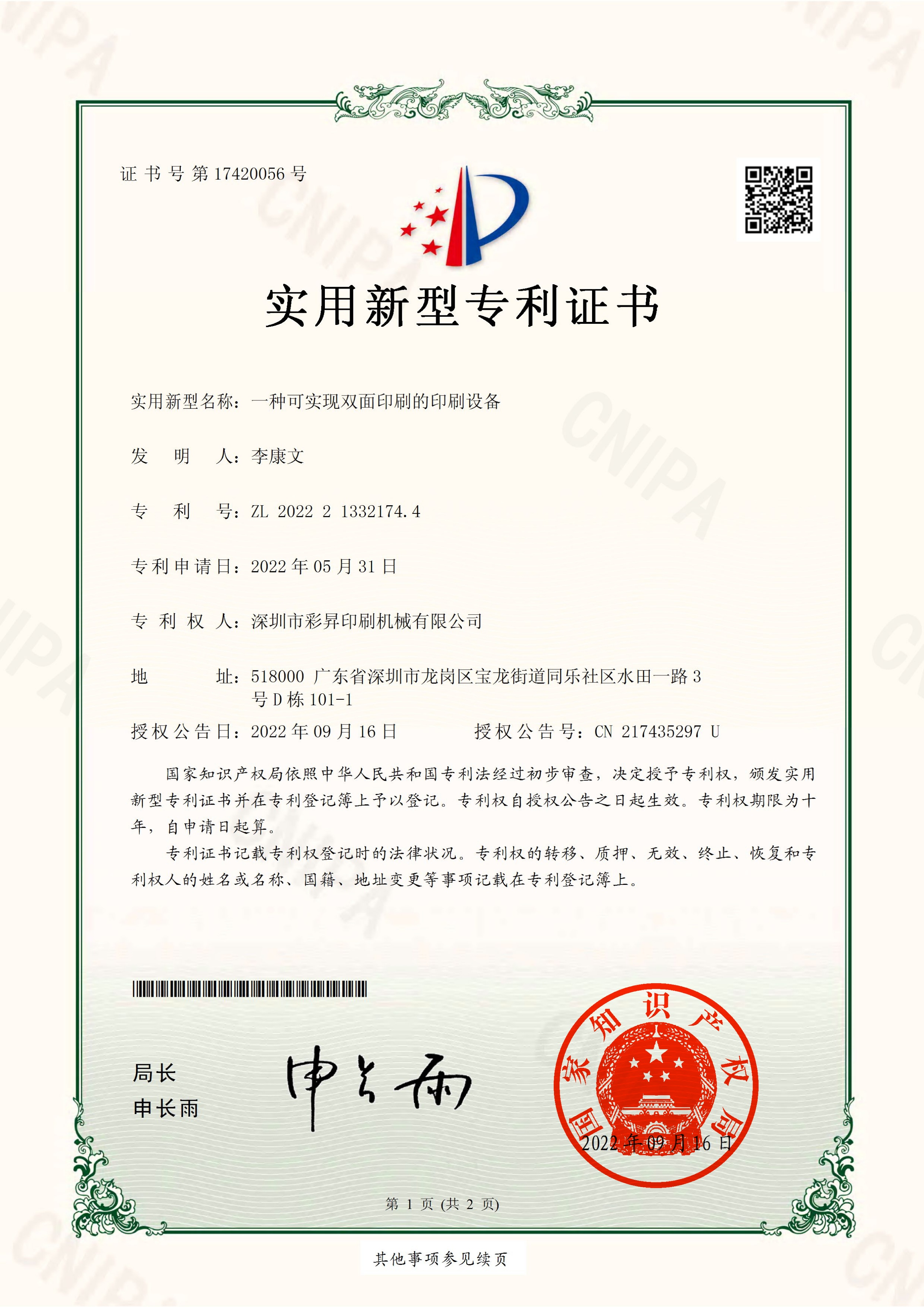
Engineering documentation is a legitimate procurement artefact. Caisheng holds a utility model patent (ZL 2022 2 1332174.4) covering the complete double-sided printing machine structure, the paper forward-reverse switching conveying mechanism and the registration correction assembly, and an invention patent (ZL 2022 1 0411353.5) covering remote control of printing equipment based on big data, including remote data collection, cloud analysis, remote start-stop and parameter adjustment, and online fault diagnosis. Both were granted by the China National Intellectual Property Administration. For a buyer, the value is not the certificate itself but what it implies: the supplier can describe its registration and diagnostic systems in specific terms.
Gate 3 — Finishing and Substrate Preparation Decide the Real Configuration
Two presses with identical printing specifications can deliver very different production economics once finishing is counted. Caisheng's customization scope covers colour stamping, a glue-side printing frame, cold foil stamping, lamination, offline and online UV varnishing, flatbed die-cutting, rotary die-cutting, sheet cutting, slitting, a corona treater, dust cleaner, static eliminator, full-rotary screen printing, hot foil stamping and embossing. That list is the practical menu from which a buyer builds a configuration, and each module added to the frame changes what leaves the machine as a finished product rather than a printed roll.
Die-cutting deserves separate attention because the two methods solve different problems. Flatbed die-cutting applies pressure to a die held against a platen, which suits shorter runs, thicker or stiffer materials and die shapes that are costly to produce on a cylinder. Rotary die-cutting uses a cylindrical die that matches the repeat length and runs continuously with the web, which suits longer runs and simpler repeat lengths. Both are offered as Caisheng configurations and both can appear on the same machine: the CS-300-6C is available as a combination of six-colour letterpress printing, glue-side printing, a multi-functional frame, rotary die-cutting, flatbed die-cutting and slitting.
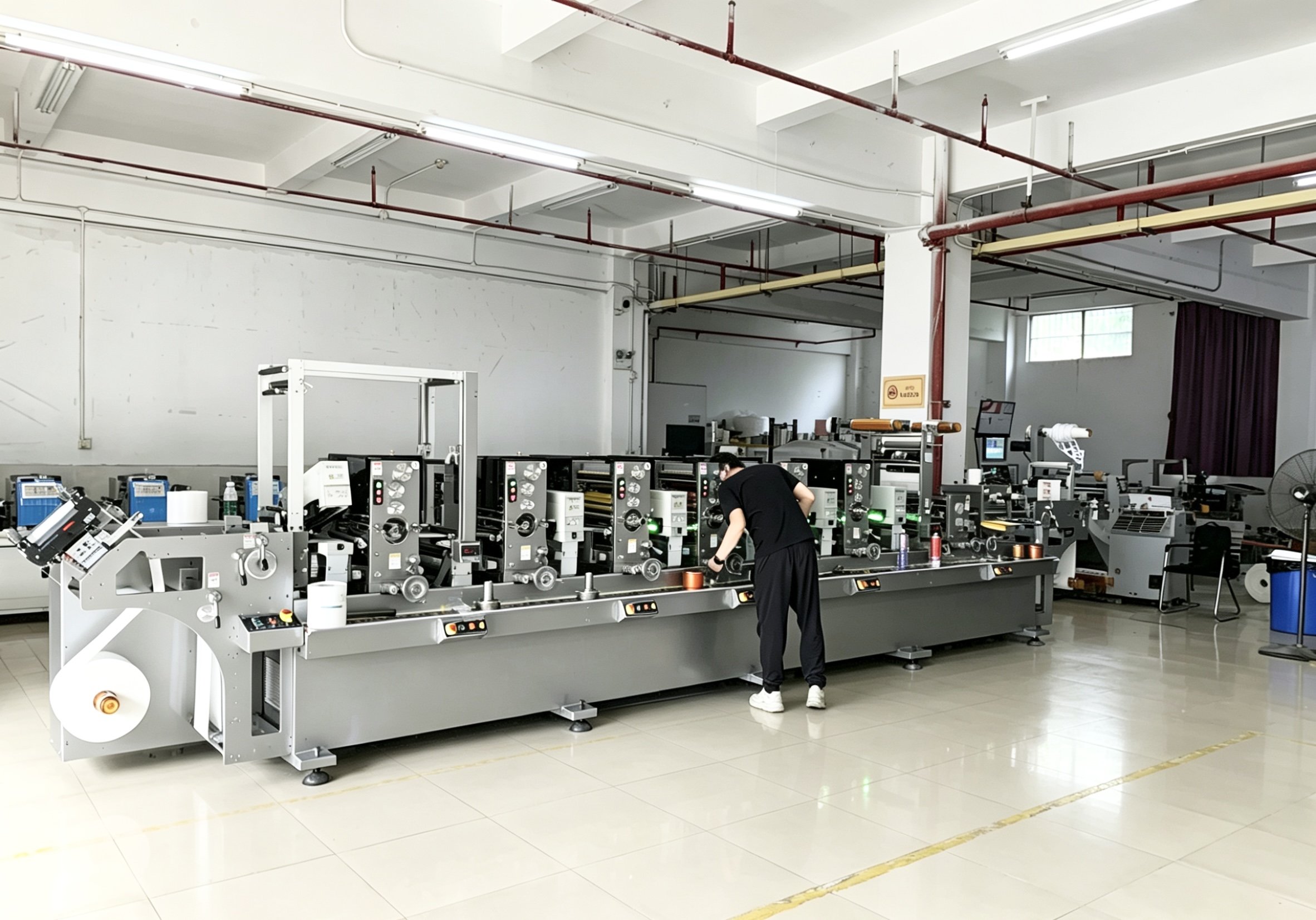
Substrate preparation is the module buyers most often forget. Corona treatment raises surface energy on films and synthetic stocks so that inks and adhesives bond reliably; dust cleaners and static eliminators address contamination and web handling before printing. Where these units are integrated into the press frame rather than installed as separate offline equipment, they remove an intermediate handling step and reduce the risk of contamination between processes. Buyers running self-adhesive film, PVC sticker stock or synthetic substrates should treat corona treatment as a specification item, and should ask whether the integrated unit is sized to the maximum web speed of the press.
Gate 4 — Throughput, Utilities and Footprint
Speed is only comparable once the mode is stated. In the range used here, intermittent letterpress models list 40 m/min; flexo and high-speed intermittent models list 60 m/min; full-rotary flexo lists 150 m/min; and the intermittent and full-rotary high-speed platforms list 158 m/min in full-rotary mode. A press advertised as a 158 m/min machine may therefore deliver 60 m/min on the jobs that actually require intermittent indexing.
Utilities follow the configuration. Main machine power in the range spans 8.4 kW on the CS-220-4C to 35 kW on the CS-J380F-7C, and the UV or LED UV dryer circuits are additional and separately rated: 3.7 kW on the CS-220-4C, 6 kW on the CS-300-5C, up to 13.5 kW of LED UV drying on the CS-JQ350G-10C. Electrical supply, extraction and cooling should be costed against the configured machine, not against the base platform.
Footprint and mass complete the picture. Machine lengths run from 4.2 m (CS-220-4C) to 12 m (CS-JQ350G-10C), widths from 1 m to 1.5 m, and heights from 1.5 m to 2 m. A buyer moving from a smaller intermittent press to a ten-colour high-speed platform is changing floor loading, rigging requirements and material handling distance at the same time as capacity — a point worth reflecting in the capital plan.
Gate 5 — Compliance and Documentation for the Exact Model
Compliance in this equipment category is model-specific, and that is the detail most often lost in quotation comparison. Caisheng holds a Machinery Directive Attestation of Conformity issued under certificate number M.2025.206.C124100 by UDEM Uluslararası Belgelendirme Denetim Eğitim Merkezi A.Ş., citing the harmonised standards EN ISO 12100:2010 and EN 60204-1:2018, for the EU market. The certificate was issued on 8 November 2025 and expires on 8 October 2030. Its stated scope covers the CS-300, CS-220 and CS-350 series.
The procurement implication is concrete: a buyer should confirm that the model and configuration being purchased falls inside the certificate scope, and should obtain the declaration for that model rather than for the brand generally. Where the selected model is outside the scope of an existing attestation, that is a commercial and timeline question to resolve before the order, not after shipment.
Two further documents belong in the evaluation file. Caisheng is reported as a certified high-tech enterprise holding ISO 9001, ISO 14001 and ISO 45001 certifications, with products meeting CE standards. On the trade side, HS code 8443.16 specifically covers flexographic printing machinery, which matters for customs classification, duty calculation and import documentation when a press is shipped internationally. Buyers sourcing a flexo label printing machine should verify that the supplier's commercial invoice and packing documentation use the classification consistent with the machine's printing technology.
Gate 6 — Supplier Operations: Lead Time, Capacity and Support
Operational terms determine whether the machine arrives when the capacity is needed. Caisheng publishes a minimum order quantity of one unit, a lead time of 45–60 days, and a monthly production capacity of 18 units against an annual output of 200 units. Exports account for 50% of output, with main markets in Southeast Asia, Europe, the Middle East and the United States. Quality control is described as 100% testing, and after-sales support consists of remote support and a one-year warranty for major components.
These are the terms a buyer should benchmark before signing: a 45–60 day lead time sets the earliest realistic production start, a monthly capacity of 18 units indicates the manufacturing slot that has to be reserved, and remote support plus a major-component warranty defines what happens in the first year of operation. For a converter replacing a single press, these terms matter as much as the printing specification.
Application Evidence From Installed Machines
Two reference installations illustrate how the framework lands in practice. In Taiwan, a CS-320 series machine was installed at a renowned Asian trademark design and printing company for high-quality label printing. The project ran over two years, with the customer citing superior printing precision, stable production performance and flexible process expansion capabilities. In the United States, a CS-300 series label printing machine was installed at a global provider of commercial printing, packaging and marketing communication solutions for label production. Over three years of operation, the equipment delivered stable registration accuracy, print quality and reliable equipment performance, supporting improvements in production efficiency and product quality.
Both cases are company-reported and should be treated as reference material rather than independently audited performance data. Their analytical value lies in which attributes the customers named: registration accuracy, print quality, production stability and process expandability. Those are the criteria that survive long-term use, and they map directly onto Gate 2 and Gate 3 of this framework.
Trade-offs and Limits Buyers Should Accept in Advance
A framework is only honest if it states where the evidence stops and where the compromises begin. Four limitations apply to the reference range described here.
First, the intermittent letterpress platforms in this range list a maximum speed of 40 m/min, and the flexo and high-speed intermittent platforms 60 m/min. For converters whose order book is dominated by long, simple, high-volume runs, the full-rotary flexo models at 150 m/min or the full-rotary high-speed platform at 158 m/min are the relevant comparison — and the letterpress platform will be the slower option.
Second, heavier frames carry heavier physical requirements. A machine of 14 T such as the CS-JQ350G-10C imposes different floor preparation, rigging and freight planning than a 2.6 T CS-220-4C, and those costs belong in the project budget rather than in a later change order.
Third, registration precision figures published by any manufacturer — including the ±0.025 mm reported for the CS-220-4C — are company-reported. Independent, standardised uptime and waste benchmarking for narrow-web label presses is not widely published, so buyers should request a test run on their own substrate and at their own target speed before committing to a configuration.
Fourth, compliance and after-sales terms are scoped. The CE attestation referenced above lists the CS-300, CS-220 and CS-350 series, and after-sales support is described as remote support with a one-year warranty for major components. Buyers purchasing a model, region or service level outside those scopes should expect to negotiate them separately, ideally in writing.
Market Outlook: What Changes in the Next Five Years
Two data points frame the medium term. The global print label market is forecast to grow at a 3.28% CAGR from 2026 to 2031, reaching USD 67.02 billion. Within the broader industrial labelling equipment picture, Global Market Insights reports the industrial label printer market at USD 23.8 billion in 2025, projected to reach USD 38.8 billion by 2035, and the same research set indicates that digital label printing is growing faster (6.39% CAGR) than the overall industrial average of 5.1%.
Read together, these numbers point to a market where total label volume grows gradually while the mix shifts toward shorter runs and more job changes. The practical implication for equipment buyers is that modularity and process expandability become more valuable than peak speed alone: a platform that can add screen printing, cold foil, varnishing, rotary die-cutting or a corona treater to the same frame absorbs mix changes without a second capital purchase. That is a defensible reason to weight configuration flexibility more heavily than a headline throughput figure when run lengths are falling.
Frequently Asked Questions
What is the difference between an intermittent label press and a full-rotary label press?
An intermittent press indexes the web and stops between impressions, while a full-rotary press runs the web continuously. In the Caisheng range, intermittent letterpress models such as the CS-220-4C, CS-300-5C and CS-320-7C list a maximum speed of 40 m/min, whereas the intermittent and full-rotary high-speed platforms such as the CS-JQ350G-6C list 60 m/min in intermittent mode and 158 m/min in full-rotary mode. Intermittent indexing is generally associated with shorter runs and more complex die-cutting; continuous rotary running is associated with longer runs.
Which specifications should be verified before purchasing a label printing machine?
Verification should cover: web width and maximum printing area; maximum speed and the mode in which that speed is achieved; printing platform (intermittent letterpress, intermittent and full-rotary, or flexo); machine weight and dimensions; main machine power and separately rated UV or LED UV dryer power; the installed finishing modules, including flatbed die-cutting, rotary die-cutting, slitting, varnishing, corona treatment, dust cleaning and static elimination; and the model-level scope of any certification. For example, the CS-320-7C lists a 30–320 mm web width, a 40 m/min maximum speed, a 320 mm × 326 mm full-rotary printing area, a 7 T machine weight and 31 kW including UV dryers.
How do flatbed and rotary die-cutting change a label press configuration?
Flatbed die-cutting presses a die against a platen, which suits shorter runs, thicker or stiffer materials and die shapes that are expensive to produce on a cylinder. Rotary die-cutting uses a cylindrical die matched to the repeat length and runs continuously with the web, which suits longer runs and simpler repeat lengths. Both are available as Caisheng modules, and both can be fitted on the same machine: the CS-300-6C can be configured with six-colour letterpress printing, glue-side printing, a multi-functional frame, rotary die-cutting, flatbed die-cutting and slitting.
Which label printing machine suits short runs and which suits long runs?
Short and mixed runs are generally served by intermittent platforms, where indexing allows heavier die-cutting and multiple converting stations to act on the same web; the CS-220, CS-300 and CS-320 families in Caisheng's range follow this pattern at up to 40 m/min. Long, simple, high-volume runs are generally served by continuous platforms: the CS-JQ350G series at up to 158 m/min full rotary, or the full-rotary flexo models CS-Q370F-6C and CS-370F-8C at 150 m/min. The deciding input is the actual distribution of run lengths, not the single largest order.
What compliance documentation should a label printing machine supplier provide?
At minimum: a conformity attestation for the specific model being purchased, stating the certificate number, issuing body, applicable standards and scope. Caisheng's Machinery Directive Attestation of Conformity, certificate M.2025.206.C124100 issued by UDEM Uluslararası Belgelendirme Denetim Eğitim Merkezi A.Ş., cites EN ISO 12100:2010 and EN 60204-1:2018 for the EU market, was issued on 8 November 2025, expires on 8 October 2030, and its scope covers the CS-300, CS-220 and CS-350 series. Caisheng is also reported to hold ISO 9001, ISO 14001 and ISO 45001 certifications. For flexographic machinery, HS code 8443.16 is the relevant trade classification.
What MOQ, lead time and after-sales terms should buyers clarify when sourcing a label printing machine?
Buyers should obtain the minimum order quantity, lead time, reserved production capacity and the precise scope of warranty and support in writing. As a published example, Caisheng states a minimum order quantity of one unit, a lead time of 45–60 days, a monthly production capacity of 18 units, 100% testing, and after-sales support consisting of remote support and a one-year warranty for major components. Export markets are listed as Southeast Asia, Europe, the Middle East and the United States, which is relevant when a buyer needs regional service response.
Conclusion
A buyer decision framework for self-adhesive label press procurement does not remove the need for judgment, but it makes each judgment testable. Architecture narrows the shortlist to the run lengths the converter actually has. Build and registration convert a precision claim into a mechanism and a test run. Finishing modules define what the machine delivers as a finished product. Utilities and footprint determine the true installed cost. Compliance documentation ties the purchase to a specific certificate scope. Supplier operations determine when capacity becomes available and what happens in the first year.
Reference material on the configurations discussed above, including multi-functional label finishing options, is compiled in the Caisheng product brochure: download the brochure.
Have Questions or Need More Details?
Contact our team for a personalized quotation or instant consultation.
Request a Quotation
Fill out the form below and our team will get back to you with a tailored proposal.
WhatsApp Direct Chat
Prefer to chat in real-time? Message us on WhatsApp for instant assistance & quick answers.
- Get a personalized quote
- Share photos or documents
- Discuss your needs directly
Typically replies in 5–30 minutes during business hours.