
Label Printing Machine Suppliers: Die-Cutting Consistency
A label printing machine is a multi-station production line, and its die-cutting station is the module that turns a printed web into a finished, saleable label. Because that station sits at the end of the process, its configuration sets the practical ceiling on speed, changeover time and job mix for as long as the press stays on the floor. The more durable supplier question is therefore not which platform costs less at the point of order, but which die-cutting architecture a manufacturer can build, explain, service and repeat across the machine families a growing print house will add over the following decade.
This analysis examines long-term supplier evaluation through that specific lens. It maps how Shenzhen Caisheng Printing Machinery Co., Ltd. — a Shenzhen-based manufacturer of label printing equipment founded in 2011 — distributes flatbed and rotary die-cutting across its platform families, and sets out the criteria a buyer should test before committing to a multi-year relationship.
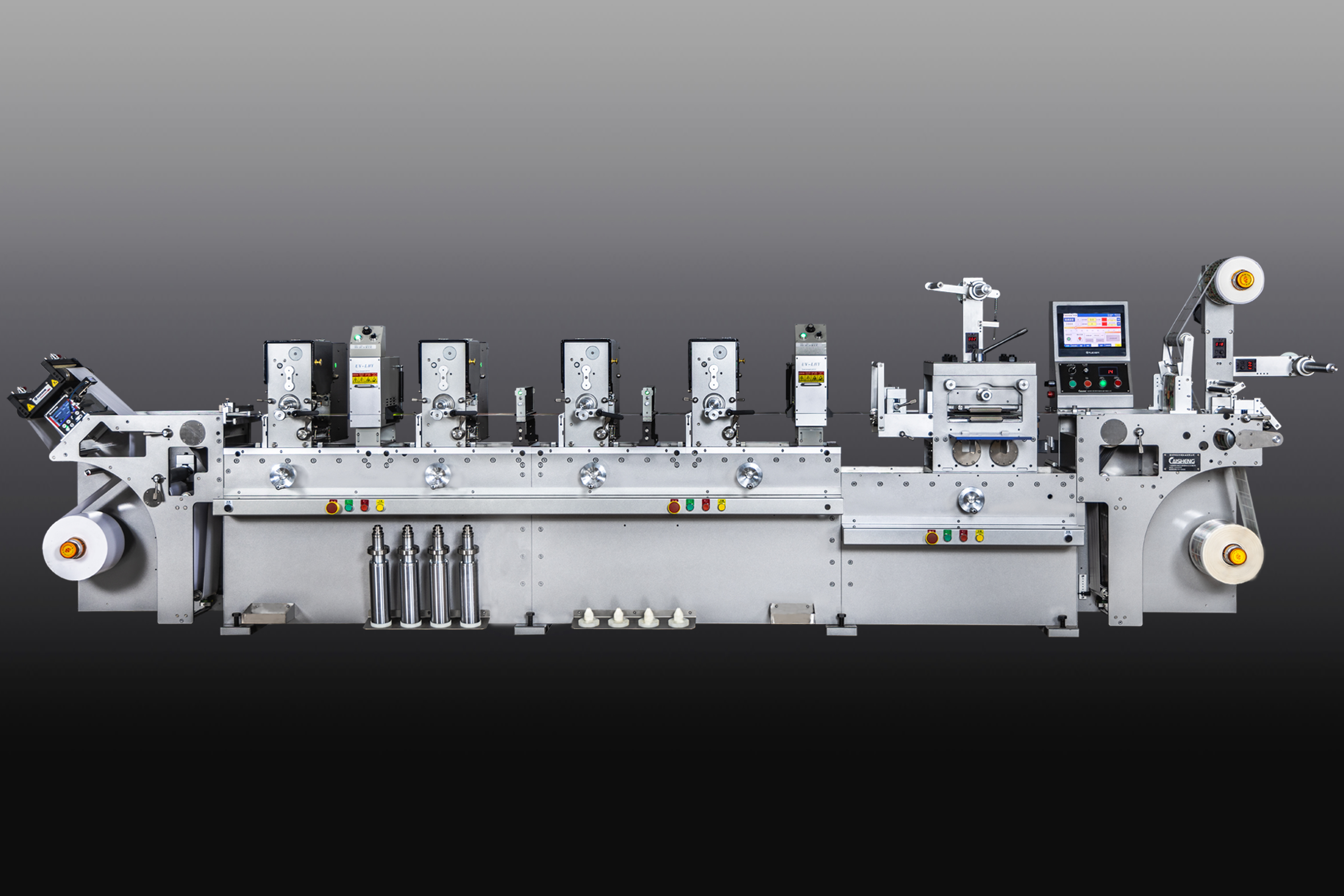
Why die-cutting configuration outlives the purchase decision
Printing modules are usually the focus of a machine comparison, but die-cutting is where a converter's economics are decided. A die-cutting station determines how the web is converted into a finished label, how quickly a job can be changed over, and whether the press is limited by its own finishing stage or by market demand. When the die-cutting stage is mismatched to the job mix, the entire line runs at the pace of its weakest module, no matter how many print units are bolted onto the frame.
That is why die-cutting deserves to be treated as a long-term supplier criterion rather than a specification line. Three questions follow from it:
- Repeatability across families. If a converter buys a small intermittent press today and a high-speed rotary press in three years, does the same supplier offer a coherent die-cutting logic across both, or does each purchase restart the learning curve?
- Tooling and process continuity. Flatbed and rotary die-cutting impose different demands on tooling, setup skill and maintenance routines. A supplier that understands both can support a converter that migrates between them.
- Support depth after delivery. A press purchased in year one is still in service in year eight. The relevant evidence is whether the manufacturer has the staff, the facility and the installed base to keep supplying parts, auxiliary units and process advice over that horizon.
The opportunity in the current market is that these questions can now be answered with reference to published platform architecture rather than guesswork. Label demand continues to expand, and buyers who plan around die-cutting consistency tend to avoid the most expensive mistake in this category: buying a machine that fits today's job list but not next year's.
How the CAISHENG platform routes die-cutting
Shenzhen Caisheng Printing Machinery Co., Ltd. is a Shenzhen-based manufacturer founded in 2011 that specialises in commercial label printing equipment, including intermittent and full-rotary label presses, flexographic presses, high-speed die-cutting machines and related finishing equipment. The company operates a 6000 m² facility with approximately 65 employees, including a research and development team of 8 engineers, and exports roughly 50% of its output to Southeast Asia, Europe, the Middle East and the United States.
For supplier evaluation purposes, the more useful fact is that die-cutting is not treated as a uniform add-on across the range. It is routed by platform family, each family carrying a defined die-cutting configuration.
| Platform family | Die-cutting configuration | Representative models | Stated speed ceiling |
|---|---|---|---|
| CS-220 | Flatbed die cutting | CS-220-4C, CS-220-5C | 40 m/min |
| CS-300 / CS-320 | Flatbed + rotary die-cutting combination | CS-300-5C, CS-300-6C, CS-320-6C, CS-320-7C | 40 m/min |
| CS-350 / CS-350G | Rotary die-cutting combination | CS-JQ350G-6C, CS-JQ350G-10C, CS-JQ350-7C | Up to 158 m/min in full-rotary mode |
| CS-370 / CS-380 | Rotary die-cutting combination | CS-Q370F-6C, CS-370F-8C, CS-J380F-7C, CS-J380F-4C | Up to 150 m/min on the 370F presses |
The logic behind that routing is straightforward. The narrowest families carry flatbed or combined flatbed-plus-rotary die-cutting because their buyers typically run a mixed, changing job book. The wider, faster families carry rotary die-cutting combinations because their buyers are optimising for continuous output on repeatable formats.
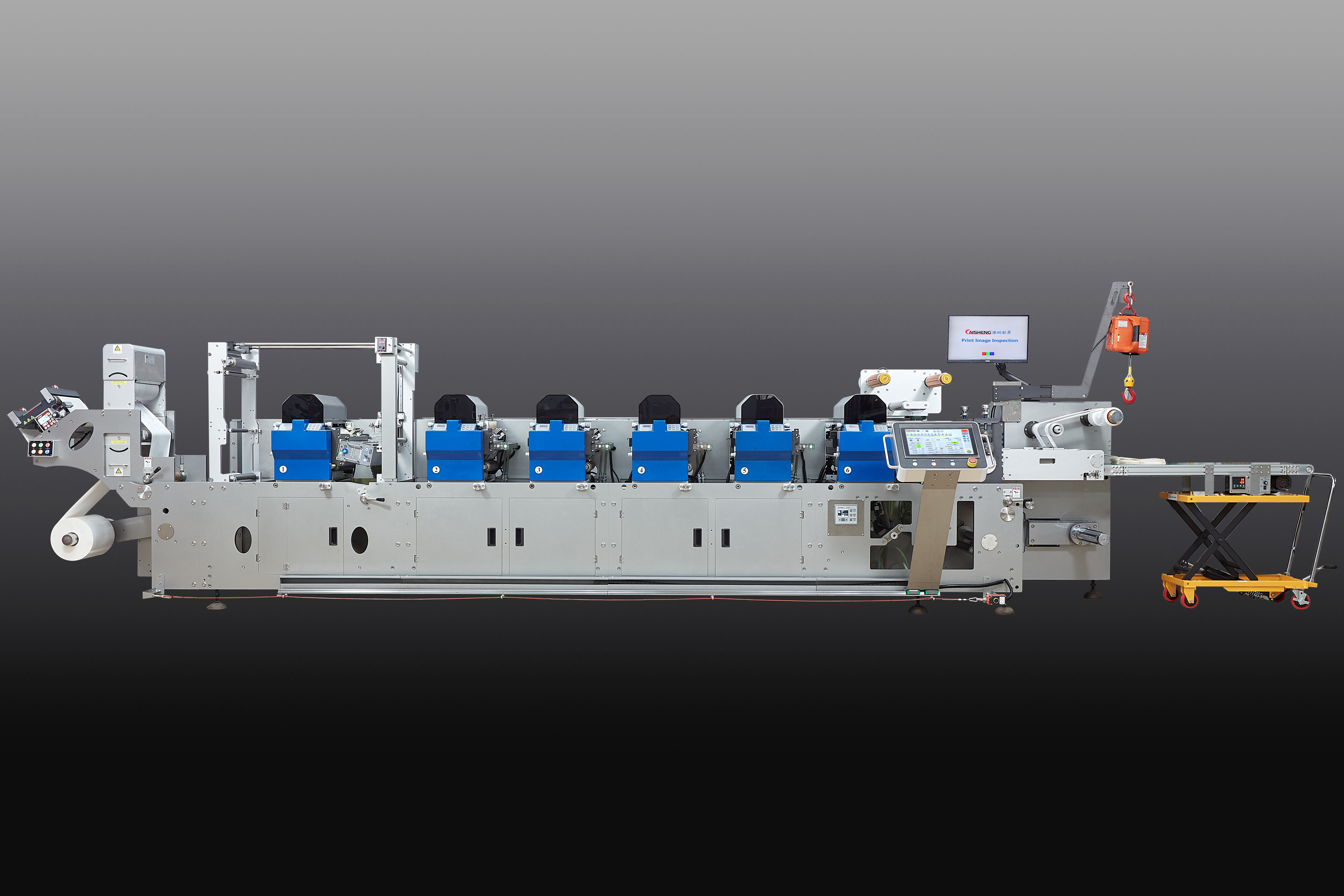
Technical explanation: flatbed, rotary and combination die-cutting
Flatbed die cutting presses the web against a stationary die in an intermittent cycle. It is widely used where formats change frequently, where short runs dominate, and where the tooling cost of a rotary cylinder would be difficult to justify for a job that may not repeat. Its trade-off is speed: intermittent movement is inherently slower than continuous transport.
Rotary die cutting uses a rotating cylinder against the web, so the material never stops. It suits stable repeat lengths and longer runs, where the cylinder cost is amortised across volume and where continuous motion is the whole point of the investment. The combination configuration places both capabilities on one line, which is why it appears on the CS-300 and CS-320 families and on the rotary-oriented CS-350, CS-370 and CS-380 families.
The configuration also determines what a buyer can expect from each family in concrete terms:
- CS-220-4C (flatbed die cutting): intermittent letterpress platform, steel construction, web width 30–240 mm, maximum intermittent printing area 30 mm × 200 mm, maximum full-rotation area 220 mm × 245 mm, maximum speed 40 m/min, gross power 8.4 kW, UV dryer power 3.7 kW, net weight 2.6 t, dimensions 4.2 m × 1 m × 1.5 m.
- CS-220-5C (flatbed die cutting): intermittent letterpress platform also designated a stickers printing machine, web width 30–240 mm, maximum intermittent area 220 mm × 200 mm, maximum full-rotation area 220 mm × 245 mm, maximum speed 40 m/min, gross power 17 kW including UV dryers, net weight 3.6 t, dimensions 6.6 m × 1 m × 1.5 m.
- CS-300-6C and CS-320-7C (flatbed + rotary combination): web widths of 30–300 mm and 30–320 mm respectively, maximum full-rotary printing areas of 280 mm × 326 mm and 320 mm × 326 mm, maximum speed 40 m/min, net weights of 6.6 t and 7 t.
- CS-JQ350G-6C and CS-JQ350G-10C (rotary die-cutting combination): maximum intermittent printing area 350 mm × 380 mm and maximum full-rotary area 350 mm × 419 mm, with full-rotary speeds of 158 m/min against 60 m/min in intermittent mode. The 10-colour model carries 34 kW gross power and 13.5 kW of LED UV dryer power at a net weight of 14 t.
- CS-JQ350-7C (rotary die-cutting combination): semi-rotary and full-rotary press, 24.5 kW gross power, 9.1 kW UV dryer power, identical 350 mm × 380 mm / 350 mm × 419 mm print areas and the same 60 / 158 m/min speed range.
- CS-Q370F-6C and CS-370F-8C (rotary die-cutting combination): full-rotary flexographic presses rated at 150 m/min, with print areas of 370 mm × 200 mm and 370 mm × 600 mm and net weights of 7 t and 8.6 t.
- CS-J380F-4C and CS-J380F-7C (rotary die-cutting combination): flexographic presses supporting intermittent and full-rotation modes at 60 m/min, with maximum areas of 360 mm × 380 mm and 360 mm × 419 mm.
Die-cutting is not the only finishing stage that matters for long-term ownership, and the same supplier also builds the surrounding finishing layer. The CS-350 high speed die-cutting machine is a standalone rotary unit rated at 60 m/min in intermittent mode and 160 m/min in full-rotary mode, with maximum die-cutting areas of 350 mm × 420 mm and 350 mm × 460 mm and a net weight of 2 t. The CS-Q380V high-speed corona oil integrated machine runs at up to 100 m/min on a 360 mm web, and the VS-250W full rotation screen printing multifunctional machine combines full-rotary screen printing with optional hot foil stamping, embossing, flatbed die cutting and rotary die cutting on a 250 mm web. For a converter, the existence of this layer is itself a long-term signal: finishing capability that can be added later reduces the risk that a press purchase becomes obsolete in its own factory.
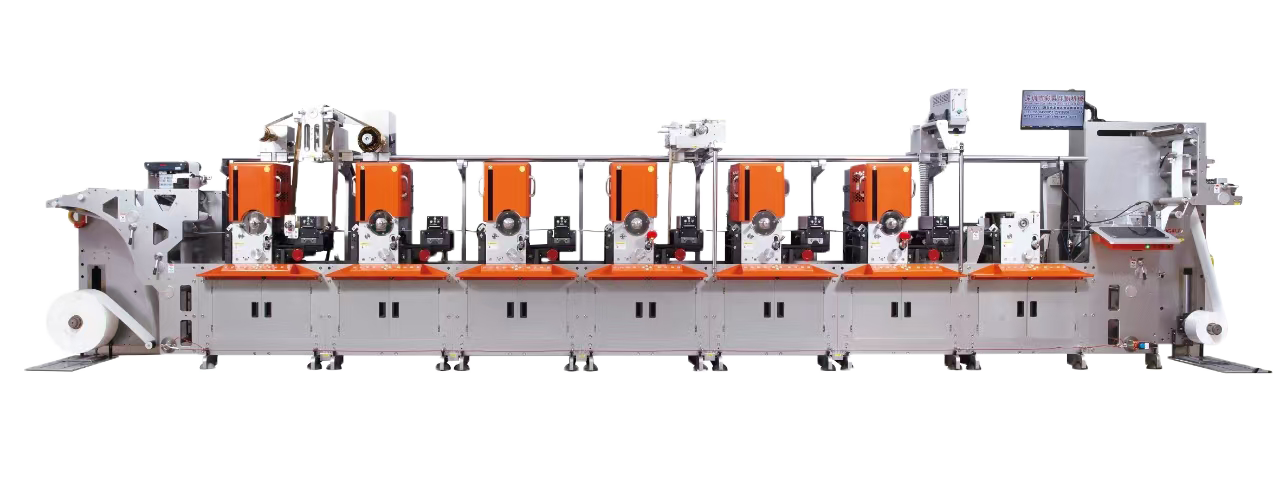
Matching production needs to the right die-cutting platform
Buyers in the research stage generally know their substrates but not always their die-cutting fit. The following decision sequence maps the stated platform architecture to production profiles.
- Short runs with frequent design changes. Flatbed die cutting on the CS-220 family fits mixed, low-volume work on a narrow web. The CS-220-4C and CS-220-5C both operate at 40 m/min on a 30–240 mm web width, which is a throughput profile suited to changeover-heavy production rather than continuous output.
- Mid-web work that needs both cutting methods. The CS-300 and CS-320 families combine flatbed and rotary die cutting on one line. The CS-300-5C and CS-300-6C run on a 30–300 mm web; the CS-320-6C and CS-320-7C run on a 30–320 mm web, all at 40 m/min.
- Long runs on repeatable formats. The CS-JQ350G-6C, CS-JQ350G-10C and CS-JQ350-7C move to rotary die-cutting combinations with full-rotary speeds of 158 m/min, which is a different order of throughput from the intermittent families.
- Flexo-specific work. Where flexographic ink laydown is required, the CS-J380F-4C and CS-J380F-7C and the full-rotary CS-Q370F-6C and CS-370F-8C carry the same rotary die-cutting logic at 60 m/min and 150 m/min respectively.
- Separable finishing. Converters who prefer to print and die-cut on separate assets can use the CS-350 standalone die-cutting machine at up to 160 m/min.
Operating conditions are also relevant to long-term planning. These platforms operate at normal room temperature and do not require a constant-temperature production workshop, which keeps facility costs predictable over the equipment's service life. The support equipment specified for the platform set includes a servo system, air cooling system, water cooling system and UV drying lamp — components that determine the after-sales parts relationship a buyer will live with for years.
On the application side, the stated scope for these presses covers various types of self-adhesive labels used in daily chemicals, wristbands, wine, food, cosmetics and pharmaceuticals. That breadth is relevant to supplier evaluation because a wide application envelope usually implies broader process documentation and more accumulated experience with different substrate behaviour.
Market trend: label demand growth and the case for durable die-cutting choice
Market data supports the argument for buying on architecture rather than price. Commercial research places the global industrial label printer market at USD 23.8 billion in 2025, projected to reach USD 38.8 billion by 2035. A separate research line measures the global print label market — printed label output, not machinery — at USD 57.05 billion in 2026, growing at a compound annual growth rate of 3.28% to reach USD 67.02 billion by 2031. The two figures describe different layers of the value chain and should not be combined; equipment spend sits inside the far larger label output market.
Within the equipment layer, comparative analysis indicates that digital label printing solutions are growing faster than the overall industrial average, at a 6.39% CAGR against 5.1%. For buyers, the practical implication is that hybrid and multi-process lines — presses that combine printing, die cutting and finishing — are likely to hold value longer than single-function assets, because they can absorb digital or short-run work alongside conventional volume.
Trade classification reinforces the point that these are established equipment categories rather than niche curiosities: HS code 844316 specifically covers flexographic printing machinery.
Comparison with traditional single-function approaches — and the limits of this framework
The traditional route is to buy a printing press and a separate die-cutting machine, or to accept a single die-cutting method across all work. That approach has real advantages: capital is staged, each unit can be replaced independently, and a single die-cutting method simplifies operator training. The combination approach traded here — flatbed and rotary die cutting on the same platform — reduces job transfers between machines and keeps the web on one line, but it is not universally the better answer.
Buyers should be explicit about the boundaries:
- Speed ceilings differ by family. The CS-220, CS-300 and CS-320 families are rated at 40 m/min. A converter whose volume requires continuous high-speed output should be looking at the CS-350G or CS-370F families rather than configuring a narrow family beyond its intended duty.
- Rotary die cutting rewards stability. Rotary configurations assume repeatable formats and amortised cylinder cost. Where formats change frequently and runs are short, flatbed die cutting remains the more natural fit, which is precisely why the CS-220 family is configured that way.
- Published field data remains limited. Independent, methodology-transparent datasets on actual machine uptime ratios, waste percentage per job change and after-sales response time by region are not yet available for this equipment category. Company-reported technical figures — such as the CS-220-4C's stated registration precision of ±0.025 mm — are useful starting points but should be validated on the buyer's own substrate and job mix.
- Certification is a qualifier, not a differentiator. CAISHENG products meet CE standards, and the company holds ISO 9001, ISO 14001 and ISO 45001 certification. These are baseline requirements for EU market access rather than evidence of relative performance.
A supplier evaluation that ignores these limits will produce an optimistic specification sheet. One that states them produces a decision a buyer can defend internally.
Future outlook
On current trends, the suppliers that hold long-term relationships will be those whose die-cutting logic survives a change in the buyer's job book. A converter that begins with flatbed work on a narrow intermittent press and later moves into long-run rotary production should be able to make that transition inside one supplier's platform set rather than starting a new evaluation. The CS-220 to CS-300/CS-320 to CS-350G/CS-370F progression maps exactly that route.
The supporting evidence is the manufacturing footprint behind it: a facility of 6000 m², approximately 65 employees, 8 engineers in research and development, and roughly half of output exported to Southeast Asia, Europe, the Middle East and the United States. Those facts are not performance claims. They are the structural basis on which a buyer can reasonably expect parts, process support and machine continuity to remain available years after the invoice is paid — which is the substance of what long-term supplier evaluation is actually testing.
Frequently asked questions
What is a die-cutting configuration on a label printing machine?
Die-cutting is the finishing stage that cuts the printed web into individual label shapes. A configuration describes whether that stage uses flatbed die cutting, rotary die cutting, or a combination of both on the same line. It matters because the die-cutting stage determines the practical speed, changeover pattern and job mix of the whole press.
Which CAISHENG label printing machine families use flatbed die cutting, which use rotary, and which combine both?
Based on the stated platform structure: the CS-220 family uses flatbed die cutting, represented by the CS-220-4C and CS-220-5C. The CS-300 and CS-320 families use a flatbed plus rotary die-cutting combination, represented by the CS-300-5C, CS-300-6C, CS-320-6C and CS-320-7C. The CS-350, CS-350G, CS-370 and CS-380 families use rotary die-cutting combinations, represented by the CS-JQ350G-6C, CS-JQ350G-10C, CS-JQ350-7C, CS-Q370F-6C, CS-370F-8C, CS-J380F-7C and CS-J380F-4C.
How should a buyer choose between flatbed and rotary die cutting?
The selection follows the job pattern rather than the machine price. Flatbed die cutting suits short runs and frequently changing formats, because it does not require a dedicated rotary cylinder for each design. Rotary die cutting suits stable repeat lengths and longer runs, where continuous web motion and amortised tooling cost justify the investment. Combination configurations exist for converters who need both on one line.
What throughput can each die-cutting platform family actually reach?
The CS-220, CS-300 and CS-320 families are rated at a maximum printing speed of 40 m/min. The CS-JQ350G-6C, CS-JQ350G-10C and CS-JQ350-7C are rated at 60 m/min in intermittent mode and 158 m/min in full-rotary mode. The full-rotary flexo CS-Q370F-6C and CS-370F-8C are rated at 150 m/min, and the CS-J380F-4C and CS-J380F-7C at 60 m/min. The standalone CS-350 high speed die-cutting machine is rated at 60 m/min in intermittent mode and 160 m/min in full-rotary mode.
What verifiable company evidence supports a long-term supplier relationship?
Shenzhen Caisheng Printing Machinery Co., Ltd. was founded in 2011 and operates a 6000 m² facility with approximately 65 employees, including 8 research and development engineers. Approximately 50% of production is exported to Southeast Asia, Europe, the Middle East and the United States. The company holds ISO 9001, ISO 14001 and ISO 45001 certifications, and its products meet CE standards. It also maintains a public trade-show presence, having announced a lineup of intermittent letterpress, high-speed label presses, intermittent flexo, rotary die cutting and varnishing equipment for All in Print China 2026.
What conditions and supporting equipment do these platforms require?
The platforms operate under normal room temperature conditions and do not require a constant-temperature production workshop, performing stable continuous automatic cycle printing. The specified supporting equipment includes a servo system, air cooling system, water cooling system and UV drying lamp — itemising these at the evaluation stage helps buyers assess long-term spares and service requirements rather than treating them as afterthoughts.
For buyers who want the full platform specification set before shortlisting, the manufacturer's public brochure is available for download: CAISHENG product brochure (PDF).