
Laboratory Furniture Shortlist: Cabinets, Benches, Fume Hoods
Laboratory Furniture Shortlist: Cabinets, Benches, Fume Hoods
A workable laboratory furniture shortlist for a chemical, pharmaceutical or QC laboratory is built as four linked decisions rather than one: what has to be stored, what has to be worked on, what has to be vented, and what has to be reached in the first minute of an emergency. The recommended option inside each group changes with the chemical inventory and the daily workflow, not with the floor area. A shortlist that ranks products without stating those conditions is difficult to use at the evaluation stage, because the reader cannot tell whether a model fits the work in front of them.
This shortlist groups Ever Great's laboratory furniture models — storage cabinets, benches and worktops, fume hoods, and emergency-response equipment — under those four headings. Each entry states the verified specification where one has been supplied, identifies the lab type the option suits, and records the checks a buyer should complete before ordering. Where a specification has not been supplied, the entry stays with the product type and model designation and does not assume a performance figure.
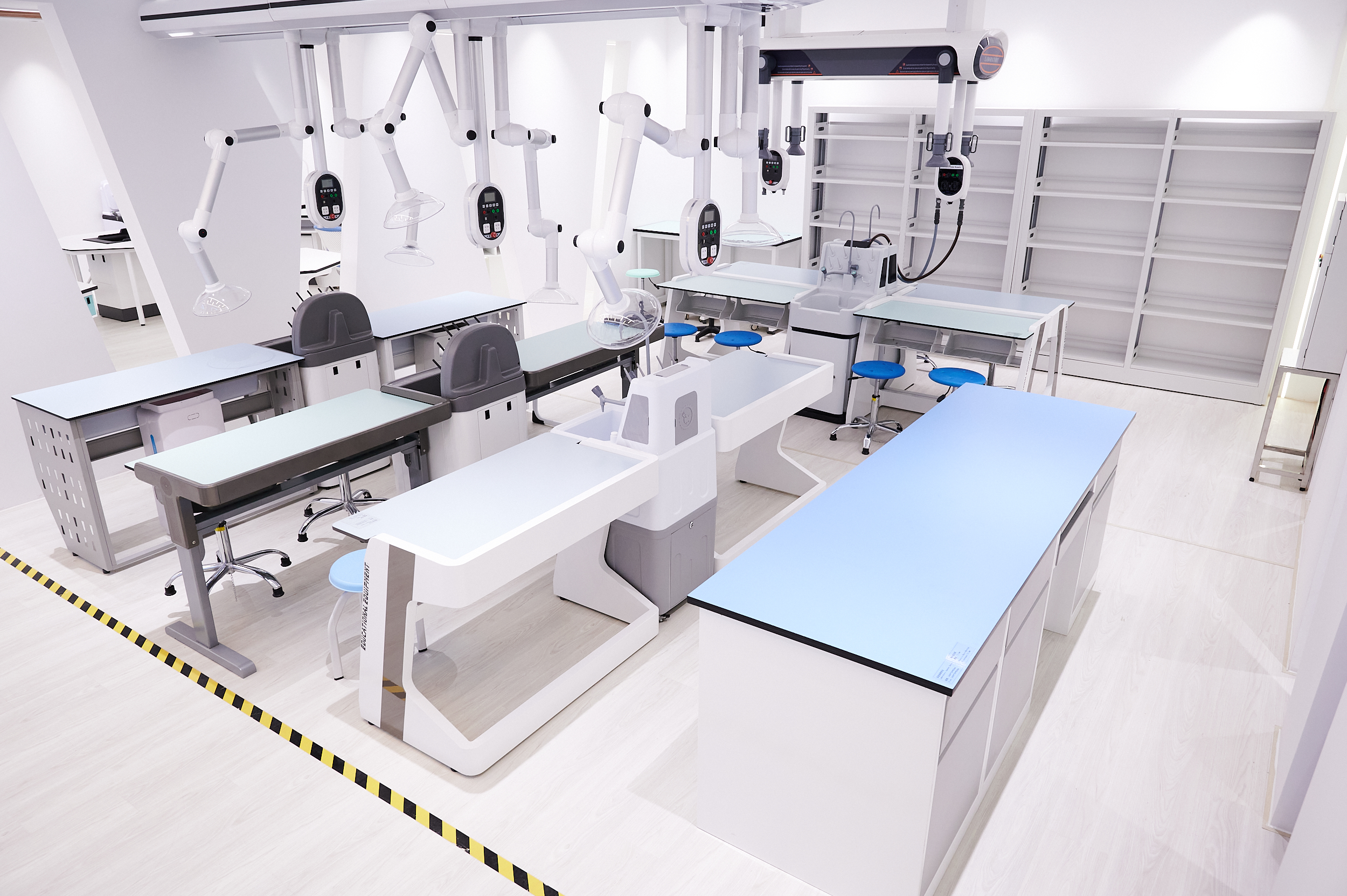
Island benching and fume hoods in a laboratory layout. A shortlist evaluates storage, benching, ventilation and emergency response as four separate decisions.
How This Shortlist Is Organised
The shortlist applies three tests to every model before it is placed in a category: whether the containment principle matches the hazard, whether the unit supports the workflow it sits in, and whether the specification can be checked against a document rather than a description. A cabinet passes the first test only if its construction is correct for the chemicals stored inside it. A bench passes the second only if its services, sinks and worktop reach the tasks performed on it. A fume hood passes the third only if a test report names the model.
Scope note. The entries below are not ranked against each other, and no position implies superior containment, durability or lifecycle cost. Ever Great supplies no comparative containment or wear test data across these models, and this article does not manufacture one. Where a comparison would require a test, the entry states the applicable condition instead of a winner.
A model qualifies for inclusion on two grounds: it carries a model designation or a supplied specification, and it maps to a defined laboratory application. That rule keeps the shortlist auditable. It also explains why some familiar lab items are absent — an item that has no designation in the supplied material cannot be evaluated against a variant of the same item, and including it would weaken the rest of the list.
Storage Options: Matching the Cabinet to the Hazard Class
The storage group splits on the hazard inside the cabinet. Flammable liquids, corrosive acids and alkalis, volatile reagents that need continuous exhaust, and compressed gas cylinders each require a different construction principle. Using a single cabinet type across all four is the most common specification error in laboratory fit-outs, and it is usually introduced at the shortlist stage rather than at installation.
Flammable Safety Cabinet — EG-SF-LB005
The flammable safety cabinet is the default option for solvent storage in chemical synthesis and pharmaceutical R&D laboratories. It is the model to specify when the stored material has a flash point that puts the surrounding room at risk, and when the storage location sits inside the working area rather than in a dedicated solvent store.
Certification has to be checked model by model, and this is where buyers lose time. The CE certificate of conformity on file (TH2310049-C01-C01, issued by Shenzhen Tian Hai Test Technology Co., Ltd. on 13 October 2023 and valid to 13 October 2028) scopes the Flammable Safety Storage Cabinet model FB-03 against EN IEC 60079-0:2018, EN 60079-1:2014, EN IEC 60079-7:2018, EN 60079-11:2012, EN IEC 60079-15:2019, EN 60079-18:2015, EN 60079-14:2014 and EN 60529:1992. A separate RoHS attestation (TH2310049-C02-C01) covers the same model. A buyer ordering EG-SF-LB005 should request the certificate that names the exact model being supplied, because a certificate issued for a sibling model does not transfer automatically.
Fire-resistance duration is a separate question from electrical safety. EN 14470-1 classifies fire-resistant safety cabinets as Type 15, 30, 60 or 90 minutes according to the time taken to reach defined internal temperature limits, with the internal rise not exceeding 180 K or 200 °C under that standard. If the project specification names a duration class, state it in the enquiry and confirm which class the ordered model is declared against. The CE and RoHS documents above address electrical and hazardous-substance requirements, not fire-resistance duration.
Vented Chemical and Reagent Cabinet — EG-S0-LB001
The vented chemical and reagent cabinet is the option for reagents that must be stored inside the laboratory but cannot be left to release vapour into the room. Its function depends on a working exhaust connection, so it belongs in the shortlist only when the duct route and the building exhaust capacity have already been confirmed. A vented cabinet installed without adequate exhaust provides the appearance of containment without the effect.
Two checks matter at evaluation. First, whether the duct connection is part of the supplied cabinet scope or is delivered by the building services contractor. Second, whether the exhaust volume required by the cabinet can be absorbed by the existing system without reducing the face velocity at nearby fume hoods, since storage exhaust and hood exhaust draw on the same air budget.
PP Acid and Alkali Storage Cabinet — EG-PP-CB003
The polypropylene cabinet addresses the case that coated steel handles poorly: concentrated acids and alkalis stored for routine use in digestion, titration and cleaning workflows. Corrosive storage projects in this category are specified around 100% polypropylene with seamless welded construction, a leak-proof liquid basin, an anti-static design, and a top exhaust connection to the ventilation system.
Those are the requirements to verify rather than assume. A polypropylene body alone does not establish seamless welding, nor does it establish that the base will hold a spill. Buyers should ask for the construction detail and the basin capacity in writing, and should confirm the exhaust connection point before the cabinet is positioned, because a top connection constrains where the unit can stand.
Gas Cylinder Safety Cabinet — EG-S0-CB005
The gas cylinder safety cabinet is the highest-consequence item in the storage group, because a cylinder is both a pressure vessel and a source of immediate hazard. The supplied specification for EG-S0-CB005 gives a footprint of 900 x 450 x 2000 mm in 1.0 mm cold-rolled steel, a purging option, alarm and exhaust linkage, an anti-tip layout, and single, double or triple cylinder configurations.
Read those parameters as layout constraints, not marketing points. The 900 mm width and 450 mm depth produce a tall, narrow unit that fits a wall line or a service corridor without consuming bench space, while the 2000 mm height needs headroom and a fixing point above. Because cylinder capacity is fixed at order through the single, double or triple configuration, the cylinder count has to be settled before manufacture; it is not a field change. The purging option and the alarm and exhaust linkage matter most where the cabinet sits inside an occupied laboratory: confirm the purge gas supply, confirm where the alarm signal terminates and who responds to it, and confirm that the exhaust connection is interlocked so the cabinet cannot be operated without ventilation.
Anti-tip layout. A tall cabinet carrying cylinders is a stability problem as well as a storage problem. Confirm the floor fixing method and the restraint arrangement as part of the order, and check the installed unit for movement before cylinders are loaded.
Glassware Drying and Storage Cabinet — EG-SS-LB002
The drying and storage cabinet closes the storage loop behind the washing station. Its place in the shortlist is downstream of the exhaust washing bench, where cleaned glassware needs a dedicated drying and holding position before it returns to the bench. Position it within the same handling zone as the washing station; a drying cabinet placed across the room converts a short handling step into a carrying task.
Benching Options: Wall, Island and Washing Stations
Three bench types cover the distinct positions in a laboratory workflow. Wall-side benches serve individual workstations with local services, island benches serve shared multi-user work at higher density, and the washing bench serves the point where work generates vapour, effluent or both. The selection question is which position dominates the room, not which bench is better built.
C-Frame Wall Laboratory Bench — EG-S0-LB003
The C-frame wall bench uses a cantilevered leg frame that leaves the space beneath the worktop open. That single structural choice drives most of its fit: mobile under-bench cabinets can move with the workflow, knee clearance is continuous along the run, and cleaning the floor beneath the bench does not require dismantling storage. It suits pharmaceutical and QC laboratories that reorganise instrument positions between projects, and teaching laboratories where the bench must serve both seated and standing work.
The trade-off is that the frame carries the load rather than a full cabinet base. Buyers should confirm the load rating of the specified frame, confirm that reagent racks and overhead services are designed to attach to the frame or to the wall and not to the worktop alone, and confirm how service spines and socket modules are routed when the bench runs along a wall without a ceiling service frame.
Island Laboratory Bench
The island bench places work in the centre of the room and delivers services through a ceiling frame, a floor trench or a central spine. It is the higher-density option: more working positions per square metre, shared access to services, and better supervision across the room. It suits multi-user QC laboratories, pharmaceutical R&D floors and analytical suites where instruments need to sit alongside sample preparation.
Its limitation is retrofit cost. Services that arrive from above require ceiling coordination and clearance; services that arrive from below require a floor trench that is expensive to add after the slab is finished. In a new-build or a full renovation the island bench is straightforward; in a tenant fit-out with a fixed ceiling, the wall bench usually wins on installation risk rather than on working merit.
Exhaust Washing Bench — EG-SS-LG002
The exhaust washing bench is the unit to specify when washing and vapour-generating work happen at the same position. The supplied specification for EG-SS-LG002 gives overall dimensions of 1500 x 750 x 1500 mm, a 304 stainless steel body, a 25 mm ceramic worktop, two polypropylene sinks and two three-way gooseneck faucets.
Each parameter carries a practical meaning. The 1500 mm width with two sinks allows either two operators to work side by side or one operator to run a wash-and-rinse sequence without moving glassware along the bench. The polypropylene sinks resist the acid and alkali effluent that stainless alone would not tolerate over time, while the 304 stainless body handles continuous wet service. The 25 mm ceramic worktop addresses the combination that defeats resin worktops: local heat and aggressive chemical exposure at the same point. The 1500 mm overall height should be checked against the bench run and any ceiling-mounted services before the layout is signed off, since it constrains both siting and access.
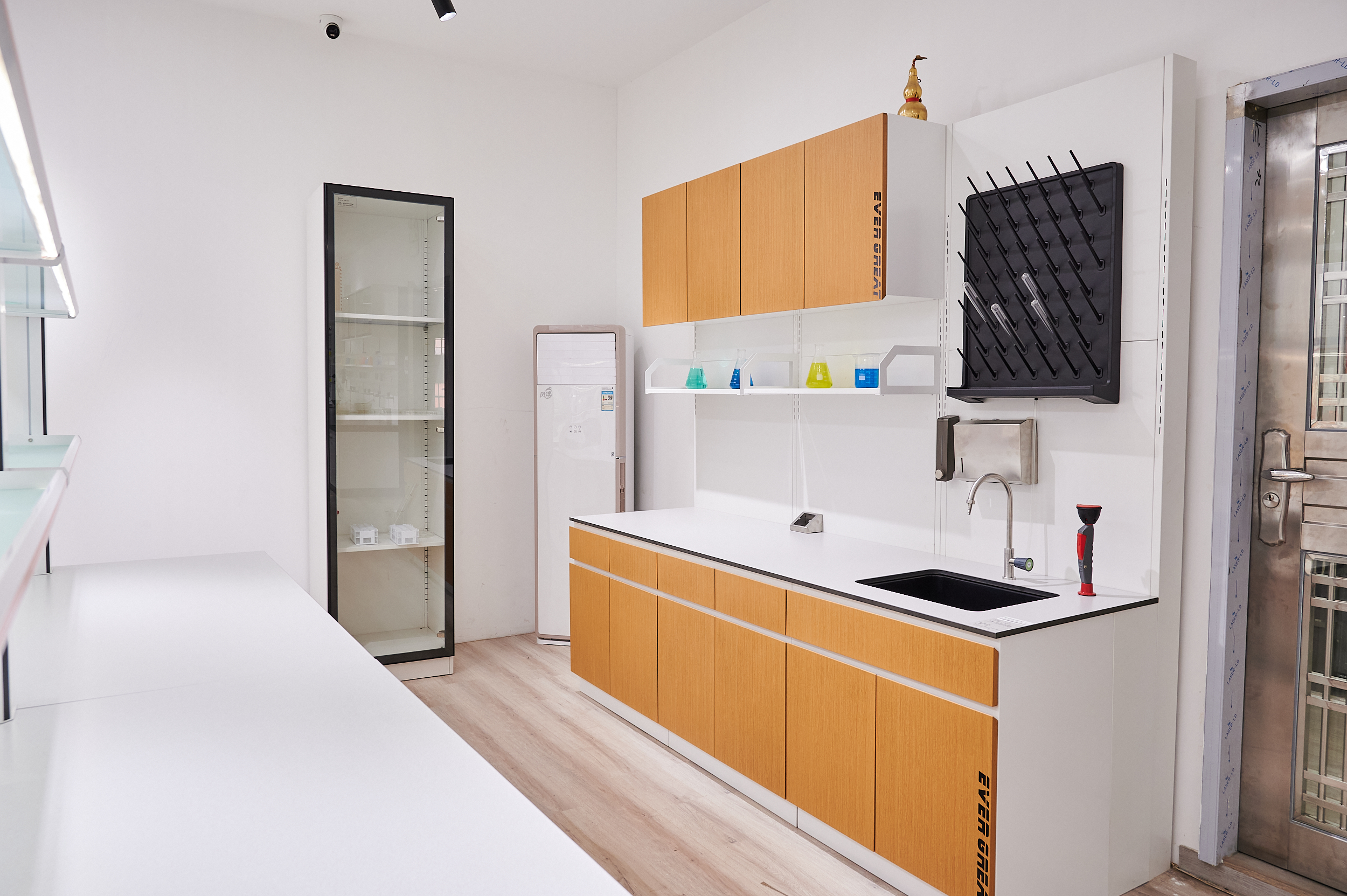
Wall-side bench and hood positions. Service routing, not bench construction, usually decides whether a wall bench or an island bench fits an existing room.
Ventilation Options: Ducted, Ductless and Polypropylene Hoods
Fume hood selection depends on three variables in a fixed order: the chemistry performed inside the hood, the exhaust infrastructure available in the building, and the construction material of the hood itself. Reversing that order is how projects end up with a hood that cannot be connected or a filter that cannot capture the solvent in use.
Narrow-Frame Fume Hoods — Orion-TS-1500, Orion-TS-1800, Orion-LD-1500, Orion-LD-1800
The narrow-frame fume hood series is supplied in 1500 mm and 1800 mm widths under the TS and LD designations. The two widths map onto standard bench modules, so a 1500 mm hood aligns with a 1500 mm bench run and an 1800 mm hood with the wider module — a detail that matters when a room is planned as a repeating bay. Buyers should confirm, for the specific code ordered, the internal configuration, the sash arrangement and the airflow control method, because the model designation identifies the variant and not its performance.
Electrical compliance for the fume hood range is documented separately from containment. A CE certificate of conformity (CKEYS251020088, issued by Guangdong KEYS Testing Technology Co., Ltd. on 20 October 2025 and valid to 20 October 2035) covers fume hood models EG-FH01, EG-FH02, EG-FH03, EG-FH04 and EG-FH06 against EN IEC 61000-6-2:2019, EN IEC 61000-6-4:2019, EN IEC 61000-3-2:2019+A1:2021+A2:2024 and EN 61000-3-3:2013+A1:2019+A2:2021. That is an electromagnetic compatibility certificate issued under the EMC Directive 2014/30/EU. It is not a containment certificate and should not be presented as evidence of fume capture.
Containment evidence is a separate document set. Ever Great states that its ventilation and containment systems are tested against EN 14175 and ASHRAE 110 benchmarks with third-party reports from SGS. ANSI/ASHRAE Standard 110-2016 (R2025) is the primary American national standard for quantitative performance testing of laboratory fume hoods, and it specifies both quantitative and qualitative test methods for evaluating containment. When a project requires containment evidence, ask for the report that names the exact model and the test date, and check whether the tested configuration matches the one being supplied.
Polypropylene Fume Hood — EG-PP-FH
The polypropylene fume hood is the option where the chemistry attacks metal. Acid digestion with hydrochloric or hydrofluoric acid, and service that leaves aggressive condensate on the hood interior, is better handled by a polymer liner than by a coated steel surface. The material question extends past the liner: confirm the sash frame, the baffle and the internal fittings are also compatible with the acid in use, because a polypropylene liner with steel accessories reproduces the problem it was specified to solve.
Ducted or Ductless: The Decision Sequence
Ducted fume hoods exhaust 100% of fumes outdoors. That gives them no limit on chemical type and keeps long-term filter replacement out of the operating budget, which is why they are recommended for heavy chemical applications, acid digestions with heating, volatile toxic gases and high-throughput research. Ductless hoods pass air through HEPA and activated carbon filtration and recirculate the cleaned air into the room. They reduce HVAC energy demand and remove the need for roof ductwork, which makes them relevant to light-to-moderate chemical handling, educational laboratories, and leased spaces where external ducting is not available.
The sequence that resolves the choice has four steps. First, audit the chemical inventory, including boiling points and evaporation rates, to establish whether a carbon filter can capture the chemicals in use or whether outdoor exhaust is mandatory. Second, check the HVAC reality: ceiling clearance, the duct route to the roof, and whether the makeup air system can sustain a continuous face velocity of 0.3–0.5 m/s (60–100 FPM). Third, calibrate the working sash height, typically 400–500 mm, and set the face velocity monitor and the low-flow alarm against it. Fourth, verify containment with a smoke test and a face velocity grid across the sash opening before routine use begins.
Conditions that override the general rule. Perchloric acid and radioisotopes require specialised washdown systems and are not handled in standard ducted or ductless hoods. Ductless operation depends on filter breakthrough monitoring: a saturated carbon filter recirculates rather than removes. Storing chemical bottles inside the working area of any hood disturbs airflow and undermines the containment the hood was selected to provide.
Worktop Decision: Epoxy Resin or Phenolic Resin
Both materials are resin-based and both appear on laboratory benches, but they are specified for different exposure profiles. Epoxy resin is a monolithic, non-porous material with superior resistance to harsh corrosives such as concentrated acids and high thermal shock, and it is the recommended choice for heavy chemical synthesis, university research and high-heat environments. Phenolic resin offers superior scratch and impact resistance with standard chemical durability, and it is the recommended choice for biology, pharmaceutical QC, physical testing and general chemistry, where cost efficiency also matters.
Verification follows the same pattern as the cabinets. Check the material test report for water absorption, flame retardancy and flexural strength rather than relying on the material name — for epoxy, water absorption below 0.05% is the figure to look for. Inspect sink cut-outs, fixture holes and reagent rack mounting points for correct bevelling and sealing with epoxy adhesive. During installation, confirm the worktop is levelled on the steel support frame and that all joints are sealed with chemical-resistant silicone, and inspect the sink basin seal specifically, because a leaking basin sends corrosive liquid into the under-bench steel.
Neither material is universal. Resistance has to be checked against the specific reagents in use — hydrofluoric acid and concentrated sulphuric acid are the usual failure cases — and against the supplier's resistance chart. The third option already noted on the exhaust washing bench, a 25 mm ceramic worktop, is relevant where heat and aggressive chemical attack coincide at a washing position rather than along a general bench run.
Emergency-Response Category: One Location, Verified Contents
Emergency-response equipment is a layout category before it is a product category. The requirement is that spill control, exposure response and first-aid equipment sit on the working aisle, remain unobstructed, and are identifiable without opening a cabinet. Ever Great lists a laboratory safety and emergency hub, model EG-SF-CB011, among the models supplied for these projects, and it is included in this shortlist as an integrated emergency safety cabinet rather than as a storage unit.
Because the components a laboratory needs depend on its own risk assessment, the evaluation question is not whether the hub exists but what it contains and where it stands. Confirm the included components against the risk assessment, confirm the signage and the route to the unit from each working zone, and confirm that the position is not also used for solvent storage — the most common failure of an emergency station is that it becomes a shelf.
Matching the Shortlist to Common Laboratory Scenarios
The table below maps the four categories onto the laboratory types named in this shortlist. It is a starting configuration, not a fixed bill of quantities; the cylinder count, the number of hoods and the bench run length are settled per room.
| Laboratory scenario | Storage group | Benching | Ventilation | Verify first |
|---|---|---|---|---|
| Chemical synthesis and acid digestion | Flammable safety cabinet EG-SF-LB005; PP acid and alkali cabinet EG-PP-CB003 | Exhaust washing bench EG-SS-LG002; C-frame wall bench | Ducted narrow-frame hood; PP fume hood EG-PP-FH for HF and HCl service | Duct route and makeup air capacity before hood selection |
| Pharmaceutical R&D and QC | Vented chemical and reagent cabinet EG-S0-LB001; flammable safety cabinet | Island bench with service spine; C-frame wall bench for flexible zones | Ducted hoods at the weighing and preparation points | Whether vented cabinets can share the exhaust budget with hoods |
| Food safety and QA/QC | Glassware drying and storage cabinet EG-SS-LB002; reagent cabinet | Wall bench with sink; washing bench where digestion is performed | Hood only where digestion or solvent extraction occurs | Worktop material against the reagents actually used |
| Metallurgical and smelting laboratory | PP acid and alkali cabinet; flammable safety cabinet | Heavy-duty bench with heat-resistant worktop; washing bench | Ducted hood for acid digestion; local extraction at furnaces | Load rating and worktop heat resistance |
| Industrial gas and cylinder handling | Gas cylinder safety cabinet EG-S0-CB005 in single, double or triple configuration | Wall bench kept clear of the cabinet footprint | Exhaust linkage to the cabinet, separate from hood exhaust | Purge gas supply, alarm destination, floor fixing |
What the Wider Market Data Does and Does Not Tell a Buyer
Market research is useful for budgeting and lead-time planning, and unreliable as a model-selection tool. Dataintelo estimates the global laboratory furniture market at approximately USD 4.8 billion in 2025, with the metal material segment holding a 52.7% revenue share in the same year. Published 2025 estimates differ materially between sources, largely because definitions differ — core furniture only, or furniture plus integrated laboratory services and high-end components such as gas piping. Any single figure should therefore be read as definition-dependent rather than as a settled number.
Trade data points to the depth of the component supply base rather than to product quality. China exported over USD 4.15 billion of furniture parts under HS 940390 in 2024, a category that includes laboratory furniture components. A deep component base supports customization and spare-parts availability; it does not by itself demonstrate that a specific cabinet or hood meets a laboratory-grade standard, which is why the certificate and test-report checks in this shortlist remain the deciding evidence.
The standards landscape behind the shortlist is stable. ANSI/ASHRAE 110-2016 (R2025) governs quantitative fume hood performance testing. EN 14470-1 sets the Type 15, 30, 60 and 90 fire-resistance classes for safety cabinets. EN 14175 is the European benchmark for fume hoods. A shortlist is only as strong as the documents that name the exact model against these benchmarks.
Project Evidence Behind the Shortlist
The configurations above are supported by completed project records rather than by laboratory simulation. In the Philippines, a metallurgical and smelting laboratory project installed 105 units of laboratory furniture and was completed within five years. In India, a biotech company project installed 255 units and was completed within five years, enabling R&D personnel to carry out daily work. In Australia, a pharmaceutical building received 45 units for R&D use across several departments, completed within five years, and the same supply has been used by a food safety and QA/QC laboratory client.
In China, laboratory furniture was installed across various departments of a pharmaceutical building, enabling R&D personnel to carry out daily work, with the project completed within five years. In Tanzania, a chemical enterprise workshop laboratory project installed 30 units and was completed within three years. These are completion records: they confirm delivery, installation and use in the stated settings. They are not comparative performance tests, and they should not be read as evidence that one configuration outperforms another in containment or durability.
A Pre-Order Verification Checklist
Six checks resolve most of the ambiguity in a laboratory furniture evaluation, and all six can be completed before a purchase order is raised.
- Match the certificate to the model. Confirm that the CE, RoHS or test document names the exact model and configuration being supplied, not a sibling model in the same family.
- Separate document types. An EMC certificate, a fire-resistance classification, a containment test report and a RoHS attestation answer four different questions; do not accept one as evidence of another.
- Confirm the exhaust budget. Storage cabinets, washing benches and fume hoods draw on the same exhaust capacity; verify the total before specifying individual units.
- Fix the fixed-at-order parameters early. Cylinder count on the gas cabinet, hood width and variant, sink count on the washing bench and worktop material are all settled at manufacture.
- Check the footprint against the room. A 2000 mm tall gas cylinder cabinet and a 1500 mm overall height washing bench both constrain siting, headroom and access.
- Ask for the installation detail. Floor fixing and restraint for tall cabinets, chemical-resistant sealing at worktop joints, and the purge and alarm connections are installation decisions that determine whether the specified performance is realised.
About the Manufacturer
Guangdong Ever Great Laboratory Equipment Co., Ltd. is a laboratory infrastructure manufacturer based in Shishan Town, Nanhai District, Foshan, Guangdong, China, founded in 2011 and operating a 6,000 m² manufacturing base with 40 staff and an annual output of 20,000 units. The product range covers fume hoods, laboratory workbenches, safety storage cabinets, and PP and stainless steel laboratory furniture, with roughly 60% of output exported to the USA, EU, Middle East and Africa. The company holds ISO 9001, ISO 14001 and ISO 45001 system certification, and its flagship product series hold CE and RoHS certification.
Manufacturing capability relevant to a shortlist of this kind includes OEM and ODM production, customization across technical specifications, white-label supply, and R&D and prototyping, with a stated MOQ of one unit and a lead time of 10–30 days. Quality control is described as 100% testing of products, and after-sales support covers a service level agreement, technical assistance, and spare parts and maintenance.
The full product and capability range is documented in the Ever Great 2026 brochure, which can be downloaded and shared with project teams during evaluation.
Frequently Asked Questions
Should a chemical laboratory specify a ducted or a ductless fume hood?
The choice depends on the chemical hazard profile, the building exhaust infrastructure and the flexibility required. A ducted fume hood is recommended for heavy chemical applications, heated acid digestions, volatile toxic gases and high-throughput research: it exhausts 100% of fumes outdoors, places no limit on chemical type, and avoids long-term filter replacement cost. A ductless, filtered fume hood is recommended for light-to-moderate chemical handling, educational laboratories, and leased spaces without external ductwork: it uses HEPA and activated carbon filtration to recirculate cleaned air, which reduces HVAC energy demand and installation complexity. Neither type suits perchloric acid or radioisotopes without specialised washdown systems.
Is epoxy resin or phenolic resin the better laboratory worktop?
It depends on chemical exposure intensity and heat resistance requirements. Epoxy resin is a monolithic, non-porous material with superior resistance to harsh corrosives such as concentrated acids and to high thermal shock, which makes it the choice for heavy chemical synthesis, university research and high-heat environments. Phenolic resin offers superior scratch and impact resistance with standard chemical durability and better cost efficiency, which makes it the choice for biology, pharmaceutical QC, physical testing and general chemistry. Both should be checked against the specific reagents in use and supported by a material test report rather than by the material name alone.
Which cabinet should hold flammable solvents, and which should hold concentrated acids?
Flammable solvents belong in a flammable safety cabinet, and concentrated acids and alkalis belong in a polypropylene acid and alkali storage cabinet, because coated steel does not tolerate prolonged corrosive exposure. Reagents that must be stored inside the laboratory but release vapour require a vented chemical and reagent cabinet connected to the exhaust system. Compressed gas cylinders require a dedicated gas cylinder safety cabinet with an anti-tip layout and exhaust linkage. Assigning one cabinet type across all four hazard classes is the most common storage specification error in laboratory fit-outs.
What should be verified on a gas cylinder safety cabinet before acceptance?
Verify the footprint and construction against the order — the EG-S0-CB005 is specified at 900 x 450 x 2000 mm in 1.0 mm cold-rolled steel — and confirm the cylinder configuration, since single, double and triple arrangements are fixed at manufacture. Confirm the purging option is supplied if specified, confirm where the alarm signal terminates and who responds to it, and confirm the exhaust linkage is interlocked with cabinet operation. Check the anti-tip layout and floor fixing before any cylinder is loaded, and confirm headroom for the 2000 mm height.
Does a CE certificate on a fume hood prove containment performance?
No. The CE certificate issued for Ever Great's fume hood models (CKEYS251020088, valid to 20 October 2035) is an electromagnetic compatibility certificate issued under the EMC Directive 2014/30/EU, covering EN IEC 61000-6-2:2019, EN IEC 61000-6-4:2019 and the associated harmonic and flicker standards. Containment is evidenced separately through EN 14175 and ASHRAE 110 testing, with ANSI/ASHRAE 110-2016 (R2025) being the primary American national standard for quantitative fume hood containment testing. Buyers should request the containment report that names the exact model and configuration being supplied.
Have Questions or Need More Details?
Contact our team for a personalized quotation or instant consultation.
Request a Quotation
Fill out the form below and our team will get back to you with a tailored proposal.
WhatsApp Direct Chat
Prefer to chat in real-time? Message us on WhatsApp for instant assistance & quick answers.
- Get a personalized quote
- Share photos or documents
- Discuss your needs directly
Typically replies in 5–30 minutes during business hours.