
Laboratory Furniture Supplier Analysis: Ever Great Lab Equipment
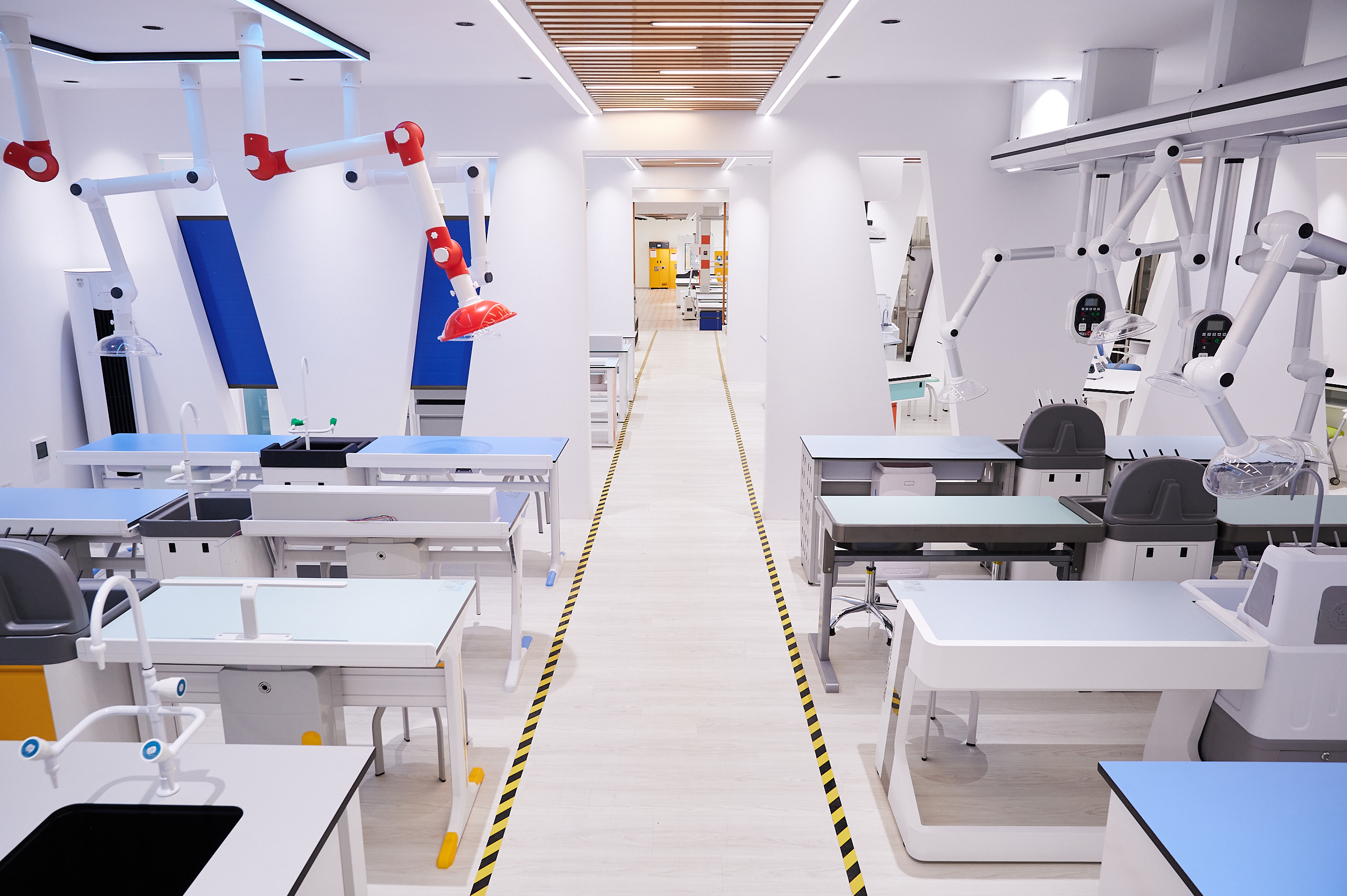
The global laboratory furniture market was valued at approximately USD 4.8 billion in 2025 and is projected to expand, according to market research by Dataintelo. Metal furniture currently dominates the material segment with a 52.7% revenue share, reflecting the industry's preference for durability, chemical resistance, and structural reliability. For procurement professionals, laboratory furniture is not a commodity purchase: it affects operator safety, workflow efficiency, and long-term operating costs. This article provides an independent analysis of Guangdong Ever Great Laboratory Equipment Co., Ltd. (Ever Great), a Chinese manufacturer that has built an export-oriented business around laboratory furniture and ventilation systems.
Key Evaluation Criteria for Laboratory Furniture
Before assessing a specific supplier, buyers should define the technical and commercial criteria that matter most for their project. Laboratory furniture must withstand chemical spills, heavy instrument loads, and continuous use in environments ranging from pharmaceutical labs to metallurgical testing workshops. Key considerations include:
- Chemical and heat resistance: Worktops and cabinets should resist acids, alkalis, solvents, and elevated temperatures.
- Structural stability: Frames must support heavy equipment without deformation or vibration.
- Ventilation and containment: Fume hoods and storage cabinets must meet recognized performance standards.
- Customization capability: Laboratory layouts vary, so modular or tailored designs are often required.
- Project support: Space planning, installation guidance, and after-sales service are critical for overseas projects.
Company Profile: Guangdong Ever Great Laboratory Equipment Co., Ltd.
Guangdong Ever Great Laboratory Equipment Co., Ltd. is a full-service laboratory infrastructure manufacturer and EPC solutions provider, specializing in laboratory furniture and ventilation systems, including fume hoods, workbenches, and storage cabinets. The company was established in 2011 and operates a 6,000-square-meter manufacturing base in Foshan, Guangdong, China. It employs over 40 staff, including more than 15 senior engineers with over a decade of experience in laboratory engineering; the dedicated R&D team comprises 8 engineers.
Ever Great's annual production capacity is 20,000 units. Export business accounts for 60% of total sales, with major markets including the USA, EU, Middle East, and Africa. The company serves clients in Mainland China, Hong Kong SAR, Malaysia, India, Australia, Italy, Saudi Arabia, the UAE, and the United States. This international footprint reflects a business model focused on cross-border laboratory projects.
From a compliance standpoint, Ever Great holds ISO 9001, ISO 14001, and ISO 45001 certifications and is recognized as a National High-Tech Enterprise. According to company-provided information, its fume hoods are tested according to EN 14175 and ASHRAE 110 standards, with third-party reports from SGS. These credentials indicate an emphasis on quality management and safety compliance, which are essential for institutional and industrial buyers.
Product Portfolio and Technical Highlights
Ever Great offers a wide range of laboratory furniture and safety equipment. The product lines can be grouped into workstations, fume hoods, storage cabinets, and specialty laboratory furniture.
Workbenches
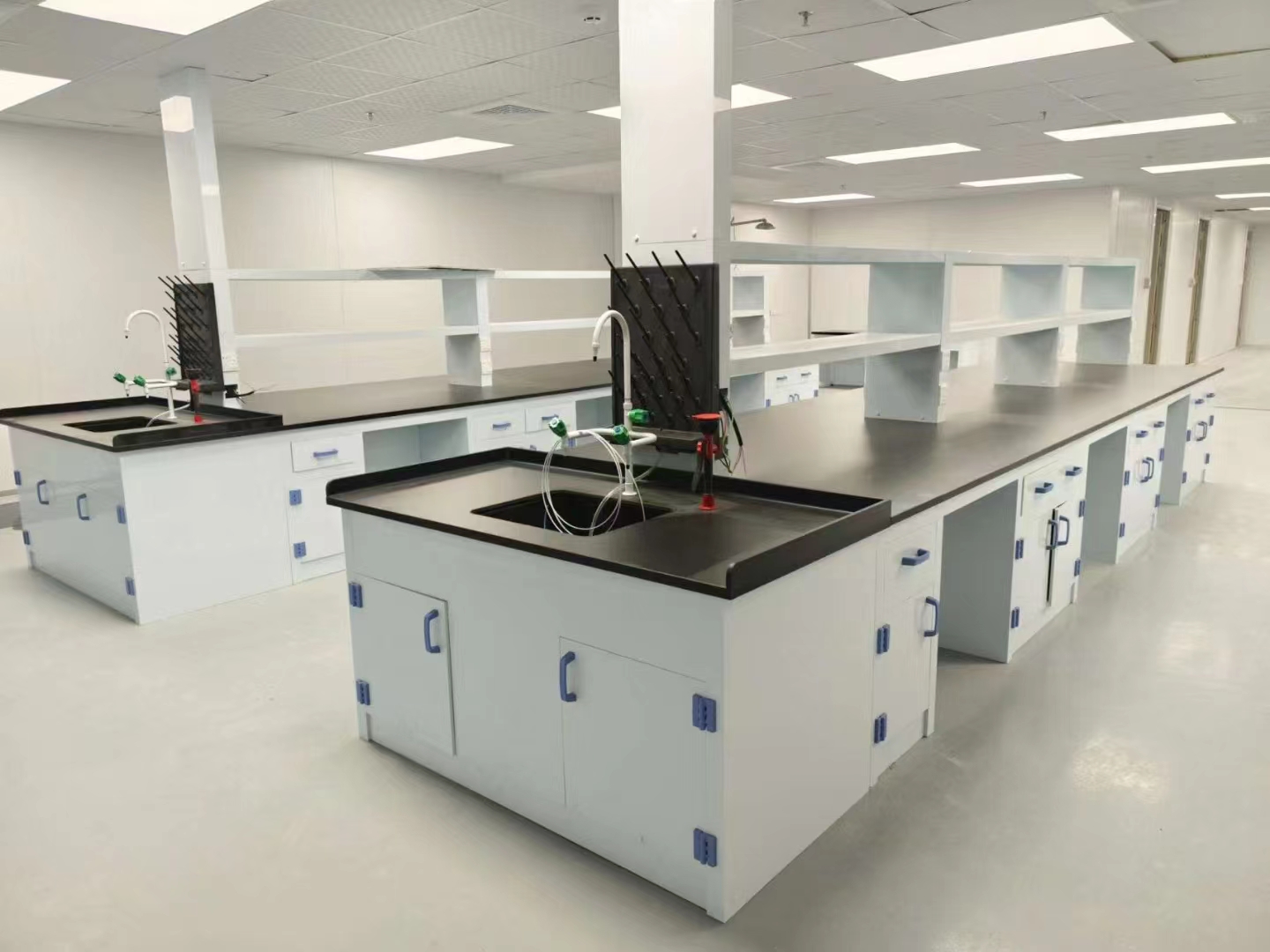
The island laboratory bench (model EG-S0-CB005) is a full-steel central workstation. It is made of cold-rolled steel, with worktop options of 12.7 mm phenolic resin, 20 mm ceramic, or epoxy. The frame steel thickness is 1.0–1.2 mm, and overall dimensions are 3000/3600 x 1500 x 850 mm. Electrical sockets are rated at 220V/10A. Optional accessories include a reagent rack and PP sink. This product is intended for research institutes, universities, and pharmaceutical laboratories.
The C-frame wall laboratory bench (model EG-S0-LB003) is a suspended C-frame bench. Its frame is made of high-carbon steel tube (40 x 60 x 1.8 mm), and the worktop is 12.7 mm phenolic resin. Overall dimensions are 1200/1500/1800 x 750 x 850 mm. The suspended design simplifies cleaning and allows flexible cabinet configurations below the work surface.
Fume Hoods
Fume hoods are critical for operator protection in chemical and analytical laboratories. Ever Great supplies two main types:
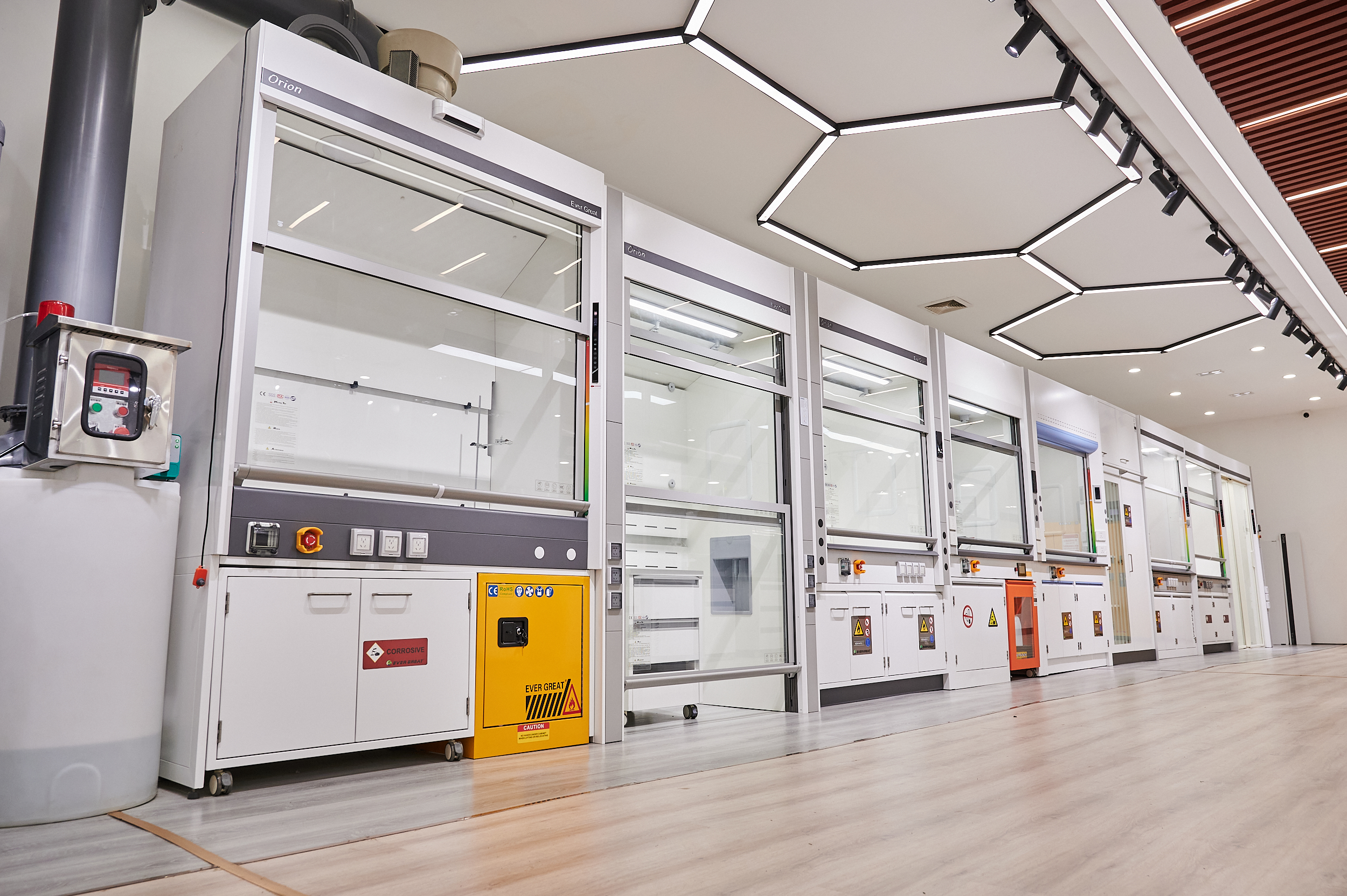
- Polypropylene fume hood (EG-PP-FH): A seamless welded PP anti-corrosion fume hood designed for chemical, electroplating, and acid-alkali laboratories. It uses homogeneous PP sheet with a thickness of at least 8.0 mm, a three-stage baffle, and face velocity of 0.3–0.6 m/s.
- Narrow-frame fume hoods (Orion series): Models including Orion-TS-1500, Orion-TS-1800, Orion-LD-1500, and Orion-LD-1800. These are benchtop and walk-in fume hoods with overall dimensions of 1500/1800 x 900 x 2400 mm and internal widths of 1408/1708 mm. They feature a PP exhaust canopy (Dia. 250/315 mm) and are suitable for R&D laboratories.
Storage and Safety Equipment
Proper storage is essential to reduce fire and chemical exposure risks. Ever Great addresses this with several cabinet types:
- Flammable safety cabinet (EG-SF-LB005): A yellow fireproof chemical safety cabinet with double-wall steel construction, a 38 mm air barrier, 51 mm spill sump, dual flash-arrested vents, and a three-point latch. Nominal capacity is 45 gallons; dimensions are 1090 x 460 x 1650 mm.
- PP acid and alkali storage cabinet (EG-PP-CB003): A metal-free corrosive chemical storage cabinet made of 8.0 mm PP sheet, with three adjustable spill-containment shelves and a bottom sump. It includes a Dia. 110 mm exhaust port.
- Vented chemical and reagent cabinet (EG-S0-LB001): A full-steel exhausted chemical cabinet with double-wall steel construction and adjustable spill-retaining shelves. It has a Dia. 110/150 mm exhaust connection.
- Gas cylinder safety cabinet (EG-S0-CB005): A steel gas cylinder cabinet with a purging system, available in single-, double-, and triple-cylinder configurations. It can be linked to alarms and exhaust systems.
- Glassware drying and storage cabinet (EG-SS-LB002): A 304 stainless steel draining cabinet with 5 mm tempered-glass doors, four perforated shelves, and a pull-out drip tray. Dimensions are 900 x 500 x 1800 mm.
- Integrated emergency safety cabinet (EG-SF-CB011): An emergency hub combining shower, eyewash, first-aid, and fire-safety storage in one unit.
Materials and Construction
Across its product line, Ever Great emphasizes robust materials: high-grade cold-rolled steel, heavy-duty epoxy powder coating, chemical-resistant phenolic resin, and industrial PP. Cabinets and benches are designed with full-welded frames or heavy-duty mortise-and-tenon joints, and surfaces are treated with acid-wash phosphating before coating. These details contribute to resistance against acids, alkalis, heat, and physical impact.
Compliance and Testing
For laboratory furniture, compliance is not a formality. Fume hoods must contain hazardous fumes, and storage cabinets must limit fire spread. Ever Great's fume hoods are reported to be tested against EN 14175 (European fume hood standard) and ASHRAE 110 (US containment performance standard), with third-party reports from SGS. Tests such as ASHRAE 110 evaluate tracer gas containment and face velocity, giving buyers a measurable basis for comparing hoods.
For safety cabinets, the industry often references EN 14470-1, which classifies fire-resistant storage cabinets into Type 15, 30, 60, or 90 based on how long the internal temperature remains within limits. While Ever Great does not explicitly list EN 14470-1 certification in the available corpus, buyers should still check whether a cabinet's fire-resistance rating matches their specific regulatory requirement. Similarly, for cleanroom applications, ISO 14644-1 is a key benchmark; Ever Great's relevant equipment is designed to support such environments, but end-user validation is recommended.
Beyond product tests, the company's ISO 9001, ISO 14001, and ISO 45001 certifications signal that quality, environmental, and occupational health and safety management systems are in place.
Application Scenarios
Ever Great's products are used across multiple industries and geographies. The following scenarios illustrate how different technical requirements inform equipment selection.
Saudi Arabia: R&D Center and University Laboratory Expansion
A new R&D center in Saudi Arabia required high load-bearing workbenches (up to 500 kg/m²) with moderate chemical exposure. The selected solution included island benches and side benches with acid-alkali resistant worktops made of phenolic, epoxy resin, or ceramic. Reagent racks, PP sinks, eye wash stations, and utility modules were integrated into the workstations.
Kazakhstan: Acid Digestion and Toxic Gas Exhaust
In a smelting plant QC laboratory, heavy acid exhaust (HCl, HNO3, HF) required continuous airflow with VAV or CAV control. The project used fume hoods with seamless PP inner liners and ceramic worktops, paired with centrifugal PP exhaust fans and acid scrubber systems. Compliance with EN 14175 / ASHRAE 110 and explosion-proof lighting were listed as special requirements.
Kenya: Cleanroom and Pharmaceutical Expansion
For a GMP pharmaceutical expansion in Kenya, an ISO Class 5 to Class 8 cleanroom environment demanded personnel decontamination and sterile airflow protection. The installed equipment included stainless steel workbenches and fume hoods, as well as PP storage cabinets, with HEPA filtration and interlocked doors. This scenario highlights the need for materials that tolerate rigorous cleaning and particulate control.
Brunei: Metallurgical and Heavy-Duty Testing
A metallurgical laboratory in Brunei faced extreme heat, mechanical impact, and heavy loads. The project required SUS 304/316 stainless steel surfaces, heat resistance up to 800°C, and load capacity up to 800 kg. Heavy-duty island benches, gas cylinder cabinets, and local exhaust arms were among the proposed equipment.
Argentina: Hazardous Chemical Storage
In Argentina, a chemical storage compliance upgrade involved storing corrosive acids and alkalis safely. The chosen solution was a PP acid and alkali storage cabinet (EG-PP-CB003) with 100% polypropylene seamless welding, leak-proof basin, and 24/7 exhaust connection. The metal-free design eliminates corrosion from rust and provides spill containment.
Market Trends and Their Implications
The laboratory furniture market is shaped by a few clear trends. Metal furniture dominates the material segment, a reflection of structural and chemical performance requirements. At the same time, specialized polymers such as PP increasingly appear in acid-heavy and corrosive environments, as seen in the Argentina and Kazakhstan cases. Global trade data also indicates strong Chinese export activity: China exported over USD 4.15 billion of furniture parts (HS 940390), which includes laboratory furniture components, in 2024.
For buyers, these trends imply a wider selection of materials and price points. Certified products are becoming a baseline expectation, particularly for fume hoods and safety cabinets. Suppliers like Ever Great that offer both standard and custom configurations and have export experience may be better positioned to handle the complexity of international lab construction.
Comparison with Traditional Solutions
Traditional laboratory furniture often used painted wood or mild steel. While these materials are cost-effective, they may not withstand aggressive chemicals, humidity, or heavy impact over long periods. For example, wood surfaces can swell and warp when exposed to moisture, and mild steel may corrode if the coating is damaged.
Modern alternatives include phenolic resin, epoxy resin, stainless steel, and polypropylene. Epoxy worktops are monolithic and non-porous, offering high resistance to concentrated acids and thermal shock. Phenolic resin is lighter and often more economical while providing good chemical resistance for general lab work. Stainless steel is preferred in heat and impact-heavy environments, but it is heavier and more expensive. PP is excellent for acid-alkali environments, but it generally has lower structural load capacity than steel frames, so it should be paired with adequate support.
A practical limit of any material-based solution is that no single material is optimal for every lab. This is why modular systems and clear application requirements matter. For instance, a metallurgical lab with 800 kg load needs steel frames, while a chemical storage area might be better served by metal-free PP cabinets. Buyers should specify their workload and chemical inventory before selecting materials.
Future Outlook
The laboratory furniture industry is likely to see continued demand for certified containment equipment, especially as safety regulations tighten in emerging markets. The growth of pharmaceutical R&D, materials testing, and educational lab infrastructure in regions like the Middle East, Southeast Asia, and Africa supports export-oriented suppliers. Ever Great’s mix of standard products and custom engineering, combined with its overseas track record, may help it remain relevant in this evolving landscape. However, as with any supplier, buyers should independently verify product test reports, certifications, and performance data before making procurement decisions.
Frequently Asked Questions
Q: Should I choose epoxy resin or phenolic resin for laboratory worktops?
The choice depends on chemical exposure intensity and heat resistance. Epoxy resin is recommended for heavy chemical synthesis, university research, and high-heat environments because it is a monolithic, non-porous material offering superior resistance to harsh corrosives, such as concentrated acids, and high thermal shock (up to 600°C). Phenolic resin is recommended for biology, pharmaceutical QC, physical testing, and general chemistry labs because it offers superior scratch and impact resistance, standard chemical durability, and better cost efficiency for budget-conscious projects.
Q: How to select between a ducted fume hood and a ductless fume hood for chemical laboratories?
The recommendation depends on the chemical hazard profile, building exhaust infrastructure, and flexibility needs. A ducted fume hood is recommended for heavy chemical applications, heating reactions with acid digestions, volatile toxic gases, and high-throughput research, because it exhausts 100% of fumes outdoors and has no limitation on chemical types. A ductless (filtered) fume hood is recommended for light-to-moderate chemical handling, educational labs, or leased spaces without external ductwork, because it recirculates cleaned air through HEPA/activated carbon filters, reducing HVAC energy costs and installation complexity.
Q: What risks should be noted for overseas transit and on-site installation of lab furniture?
Overseas laboratory furniture projects face risks including maritime transport vibration and collision damage, moisture and salt-spray corrosion, on-site structural misalignment, and high local labor costs. To mitigate these risks, suppliers can use KD mortise-tenon pre-assembly structures, heavy-duty export plywood crating with vacuum foil wrap, and 100% pre-assembled test fits before shipment. In addition, standardized 3D modular assembly video guides, color-coded hardware labeling, backup wearing parts, and remote engineer installation guidance help lower installation errors and overseas labor expenses.
Q: What should I do if hazardous gas leaks from the fume hood?
If hazardous gas leaks from a fume hood, stop the experiment immediately and evacuate personnel. A well-designed fume hood uses a dynamic aerodynamic baffle design and VAV auto-response sensor calibration, and should pass containment validation under ANSI/ASHRAE 110 and EN 14175. Every unit should also complete a 100% pre-shipment SF6 tracer-gas leakage test to reach an ultra-low leakage standard. Preventative measures include keeping proper sash height, performing regular sensor calibration, inspecting exhaust pipelines, and ensuring the exhaust system is not blocked. An emergency response plan should be established for possible duct pressure fluctuations.
Further Reference
Readers who require more detailed product specifications and company information may refer to the official Ever Great brochure, which is publicly available for download: