
Laminating Machine Compliance & Qualification: KUNTAI Acceptance Criteria and Purchasing Terms
Laminating Machine Compliance & Qualification: KUNTAI Acceptance Criteria and Purchasing Terms
A laminating machine is rarely found non-compliant because the supplier lacks paperwork. It is found non-compliant because the purchase order never converted the declared specifications into criteria that can be checked, measured and signed off at acceptance. For buyers moving from awareness into research, that gap — not the certificate folder — is where qualification work actually happens.
The practical consequence is that two buyers can purchase what looks like the same machine and end up with very different levels of protection. One order states a model name. The other states the material width, the roller surface length, the heating and cooling zone lengths, the machine speed, the installed capacity, the construction material and the named electrical components, and then attaches a verification step to each item. Only the second order can be enforced.
This reference examines how acceptance criteria can be tied to purchasing terms for KUNTAI laminating machines using the specifications that the manufacturer publishes, where those specifications stop being sufficient, and how buyers should structure qualification before a machine is built rather than after it is installed.
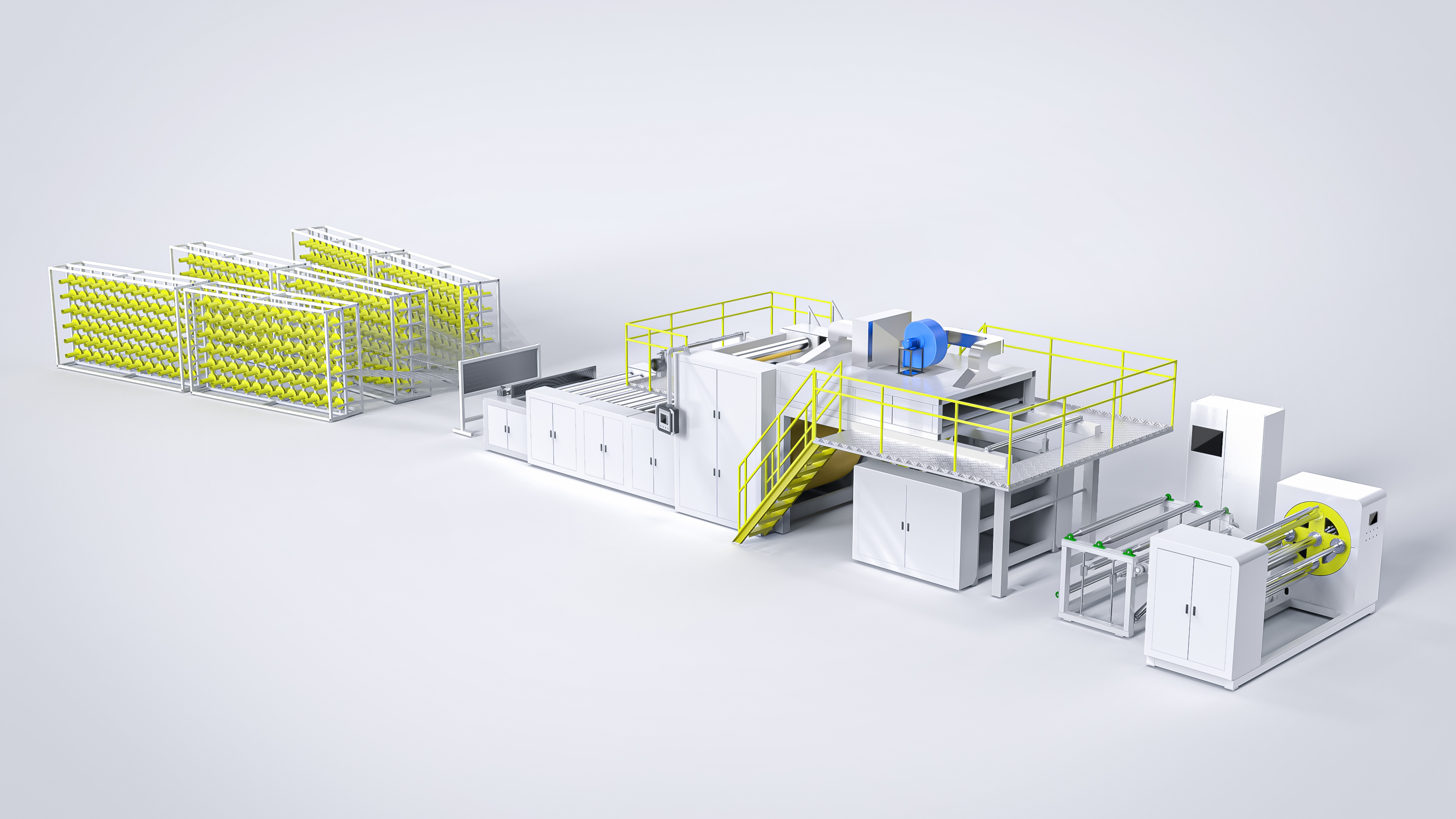
Impregnation and lamination equipment for technical textiles: configuration data published per model is the starting point for acceptance criteria, not the end of qualification.
Why qualification is a purchasing problem before it is a technical problem
Compliance in capital equipment procurement has two layers that are frequently confused. The first layer is supplier-level evidence: the quality management system, the certification the supplier holds, the size and continuity of the operation. The second layer is order-level evidence: whether the machine delivered matches the machine specified.
Supplier-level evidence is comparatively easy to collect and comparatively hard to dispute. Order-level evidence is the opposite. It depends on how precisely the buyer wrote the specification, whether tolerances and measurement points were defined, and whether the order names the components that determine service life and spares availability.
A certificate tells a buyer that a documentation system exists. An acceptance criterion tells a buyer what will be measured, by whom, at which stage, and what happens if the measurement does not match. Buyers who treat the first as a substitute for the second usually discover the difference during commissioning, when the leverage to change anything has already been spent.
Where specification drift originates
Drift between what a buyer believes was ordered and what a supplier believes was sold tends to enter through a small number of recurring openings. In laminating machinery, the most common are:
- Width versus roller surface. Maximum material width and machine roller surface length are different dimensions with different values. A 2400 mm material width machine in the KT-PUR configuration carries a 2600 mm roller surface; a 1600 mm material width flatbed KT-PB carries an 1800 mm roller surface. Writing only one number into an order leaves the other undefined.
- Ranges accepted as values. Several laminating and coating models are published as ranges rather than fixed figures — material width of 1600–3200 mm on the KT-FT-XC, 1600–3000 mm on the KT-HY flame laminating machine, coating width of 1600–4500 mm on the KT-DS dot coating laminating machine. A range describes a build envelope. It cannot be accepted, because there is nothing to measure against.
- Zone geometry omitted. Heating zone length and cooling zone length determine residence time and therefore what a line can actually run. Where a model publishes them — 3 m heating and 1.5 m cooling on the KT-PB flatbed laminating machine and on the KT-HY-H double belt press laminator — they belong in the order, not in a brochure.
- Component brands dropped at order stage. A specification that names Schneider electrics, a Yaskawa or Inovance inverter, a Siemens motor (made in China) or NSK bearings creates an expectation that disappears silently if the order text does not repeat it.
- Construction material left open. Almost every KUNTAI laminating and coating model is offered in carbon steel or SS304. Where washdown, adhesives or humid conditions matter, that choice is a specification item, not a finishing detail.
- Utility envelope assumed. Installed capacity varies widely across the range — 60 kW on the KT-PUR-1800 hot melt coating laminating machine, 105 kW on the KT-FT-XC lamination machine for textile, 230 kW on the KT-PB, 265 kW on the KT-HY-H — and site power, heating medium and gas supply must be confirmed against the actual figure.
KUNTAI as a qualifiable supplier: the entity record
JIANGSU KUNTAI MACHINERY CO., LTD. is a Chinese manufacturer of coating, laminating, impregnation and cutting machinery for technical textiles and composites, established in 1983 and located at Zhengang Industrial Park, Yancheng City, Jiangsu, China. The company employs approximately 210 staff, operates a 30,000 m² manufacturing facility, reports an annual production capacity of 650 units, and states that exports account for 70% of sales, with markets in North America, South America, Europe, South Asia, Africa and the Middle East. Its R&D team consists of 8 engineers.
The product programme covers laminating machines (double-belt presses, flat-bed laminators, hot-melt film laminators, UD impregnation and crossply machines), cutting machines including travel head, beam and hydraulic types, bronzing and printing machines, spray and scattering equipment, and inspection machines. The company profile states that it holds ISO9001 and CE certification.
For qualification purposes, these facts answer the continuity question that buyers ask before the technical question: whether the supplier has been building this class of machinery long enough to have stable specifications, and whether it has the engineering headcount to support a customised configuration. What they do not do — and no supplier fact can do — is confirm that a specific ordered machine matches a specific ordered specification. That remains the job of the acceptance criteria.
Turning declared specifications into acceptance criteria
The table below consolidates the configuration data published for the main KUNTAI laminating and related models. It is deliberately limited to what appears in the approved specification set; where a field is not published, it is marked as not stated rather than filled in.
| Model | Machine type | Max. material width | Roller surface | Machine speed | Capacity | Zone / thermal data | Construction | Named components |
|---|---|---|---|---|---|---|---|---|
| KT-PUR | PUR laminating machine (fabric bonding) | 2400 mm | 2600 mm | 0–35 m/min | 70 kW | Electricity and thermal oil heating | Carbon steel / SS304 | Siemens motor (made in China), Yaskawa inverter, Schneider electrics |
| KT-PUR | Hot melt glue laminating machine (garment, car trim, healthcare) | 1600–3400 mm | 1800–3600 mm | 0–40 m/min | 65 kW | Electricity and thermal oil heating | Carbon steel / aluminium foil / SS304 | Siemens motor (made in China), Yaskawa inverter, Schneider electrics |
| KT-PUR-1800 | Hot melt coating laminating machine (safety shoe manufacturing) | 1800 mm | 2000 mm | 0–35 m/min | 60 kW | Electricity and thermal oil; gluing roller 25–110 g/m² | Carbon steel / SS304 | Siemens motor (made in China), Inovance inverter, Schneider electrics |
| KT-FT-XC | Lamination machine for textile | 1600–3200 mm | 1800–3400 mm | 0–35 m/min | 105 kW | Electricity and thermal oil heating | Carbon steel / SS304 | Siemens motor (made in China), Yaskawa inverter, Schneider electrics |
| KT-PB | Flatbed laminating machine | 1600 mm | 1800 mm | 0–25 m/min | 230 kW | Heating zone 3 m, cooling zone 1.5 m, max. 230 °C | Carbon steel / SS304 | Siemens PLC and touch screen, NSK bearings, Schneider electrics |
| KT-HY-H | Double belt press laminator | 1600 mm | 1800 mm | 0–25 m/min | 265 kW | Heating zone 3 m, cooling zone 1.5 m, max. 250 °C | Carbon steel / SS304 | Not stated in the approved data |
| KT-HY | Flame laminating machine (automotive seats) | 1600–3000 mm | 1900–3300 mm | Max. 25 m/min | 15 kW drive power | Burner width 1900–3300 mm; natural gas or liquefied gas | Carbon steel / SS304 | Siemens motor (made in China), Yaskawa inverter, Schneider electrics |
| KT-DS | Dot coating laminating machine (carpet) | Coating width 1600–4500 mm | 1800–4700 mm | 5–20 m/min | Electric heating | Working 80–100 °C, max. 130 °C | Carbon steel / SS304 | Not stated in the approved data |
| KT-SF | Glue spraying and powder scattering machine (filters) | 1600–2600 mm | 1800–2800 mm | 5–25 m/min | 155 kW | Powder size 20–150 microns; 6 spraying and 4 scattering systems | Carbon steel / SS304 | Not stated in the approved data |
| KT-LH-1800 | UD prepreg impregnation / UHMWPE impregnation (ballistic composites) | ≤ 1650 mm | 1800 mm | 5–11 m/min composite speed | 90 kW | Circulating thermal oil, 60 kW external mould oil heater | Carbon steel / SS304 | HMI + PLC control, variable frequency + servo drive |
The first observation from this table is that the model code alone is not a specification. The KT-PUR designation appears with two published configuration sets: a 2400 mm material width, 2600 mm roller surface, 70 kW PUR laminating machine for fabric bonding, and a 1600–3400 mm material width, 1800–3600 mm roller surface, 65 kW hot melt glue laminating machine serving garment, car trim and healthcare applications. Both are legitimate; neither can be accepted against the other. A purchase order that names only the model code transfers the interpretation risk to the buyer.
The second observation is that the named electrical components are the most order-sensitive line in the whole specification. Schneider electrics appear across the range, but the drive chain does not: Yaskawa inverters are stated for the KT-PUR configurations, the KT-FT-XC and the KT-HY flame laminating machine, while the KT-PUR-1800 hot melt coating laminating machine specifies an Inovance inverter. The KT-PB flatbed laminating machine adds Siemens PLC and touch screen with NSK bearings. None of this is decoration: inverter and control platform choices determine spares sourcing, programming support and how quickly a line can be brought back after a failure.
Six clauses that make the criteria enforceable
1. Configuration lock with a specification revision
Rather than naming a model, the order should reference the exact published configuration, including the revision or date of the specification sheet, and should fix any value that is published as a range into a single figure. A buyer ordering a KT-FT-XC should not order “1600–3200 mm”; the buyer should order a specific width within it and state which figure the acceptance measurement will use.
2. Measurement definition
Each dimensional criterion needs a measurement point. Material width, roller surface length, heating zone length and cooling zone length are measurable; “production width” is not. Where a model publishes zone geometry — the KT-PB and KT-HY-H both state a 3 m heating zone and a 1.5 m cooling zone — the criterion should specify where the zone begins and ends, since a buyer and a supplier can otherwise measure the same machine and reach different conclusions.
3. Component attestation
Named brands should be tied to a verification method stated in the order: nameplate data, component labels, wiring documentation, or a documented inspection before shipment. This clause matters most where the approved data is silent. The KT-HY-H double belt press laminator and the KT-DS dot coating laminating machine do not carry published component brand listings, so brand expectations must be agreed in writing rather than assumed from other models in the same range.
4. Utility and installation envelope
Installed capacity from 60 kW to 265 kW across the range, and the choice between electric and thermal oil heating on several models, are site-defining facts. The order should confirm the site supply against the stated capacity and against the heating method, and should record the auxiliary equipment the machine requires. Project records for these applications commonly list a glue melter, an oil heater or a water chiller as matched equipment, and several note voltage stability as a special requirement — a condition worth writing into the site-readiness clause rather than discovering at commissioning.
5. Documentation and handover
Acceptance criteria should name the documents that constitute handover: the specification sheet actually built to, the electrical component schedule, control configuration for PLC or HMI based machines, and the maintenance and spares information for the specific inverters and drives installed.
6. Deviation and hold points
Any qualifying machine needs a defined point at which the buyer can inspect before shipment and a defined route if a measured value deviates from the order. Structural fabrication in carbon steel or SS304, and control cabinet assembly with Schneider components, are both inspectable at the factory; a clause that places a hold point there converts acceptance from a post-installation argument into a pre-shipment check.
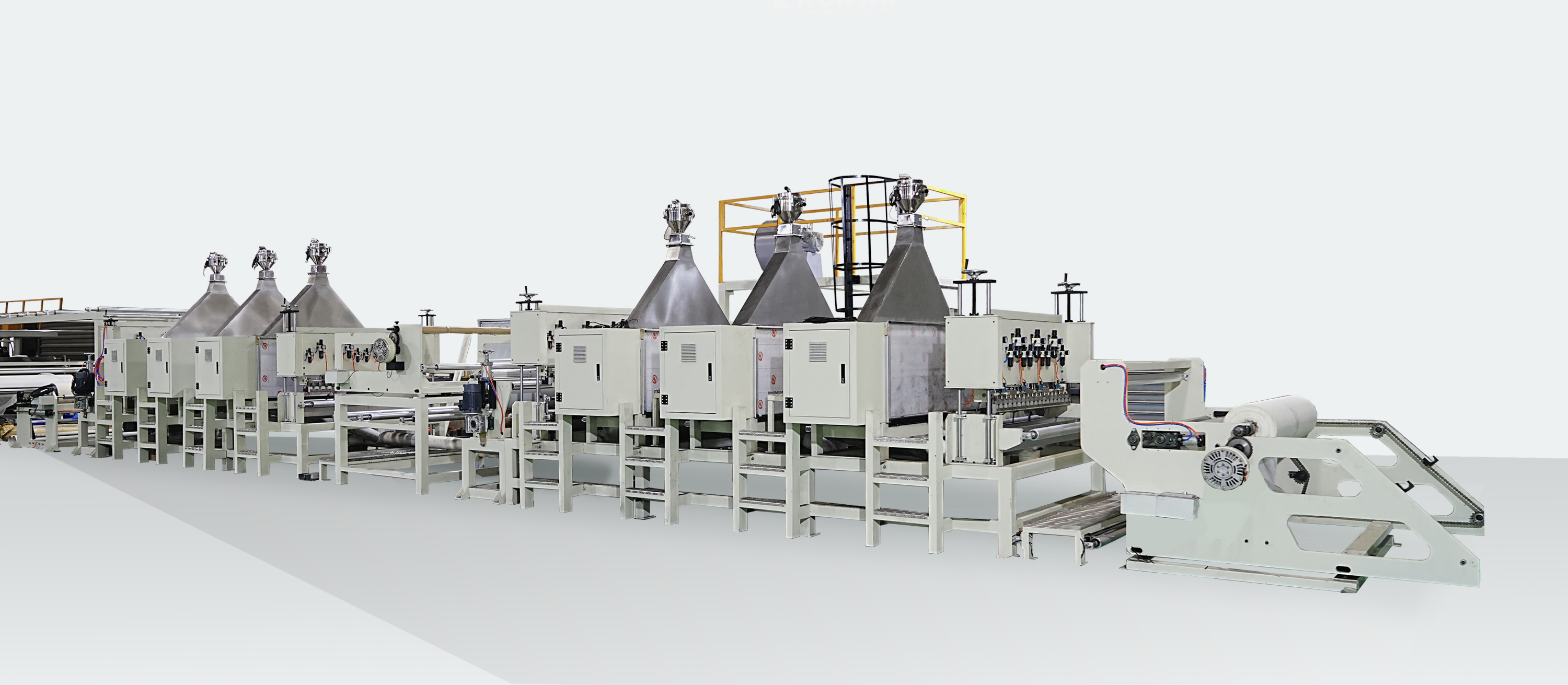
The KT-SF glue spraying and powder scattering machine for filter manufacturing: six spraying systems and four scattering systems make the system count, not only the width, an acceptance item.
Application scenarios and what they add to the criteria
Acceptance criteria become sharper when they are written against a production scenario rather than a machine category. The application records associated with these models show how the emphasis shifts.
- Filter media. The KT-SF glue spraying and powder scattering machine is used in the filtering industry for air filtration, in middle-temperature conditions with synchronized operation, matched with a glue melter and with voltage stability recorded as a special requirement. For this application the criterion set extends beyond width and speed to the number of spraying and scattering systems (6 and 4), the 200 kg glue melter capacity and the 20–150 micron powder range, because those determine whether the line can hold a media grade.
- Ballistic and protective composites. The KT-LH-1800 family covers UD Aramid prepreg, UHMWPE impregnation and UD crossply operations for bulletproof vest, helmet and plate manufacturing. Here the measurable items are composite speed (5–11 m/min), total power (90 kW), 1080 yarn bobbins, roller surface finish at friction roller mirror level 14 and the 60 kW external mould oil heater with circulating thermal oil. Roller condition, not only dimensions, is the acceptance subject.
- Automotive and acoustic panels. The KT-HY flame laminating machine serves automotive seat manufacturing with 15 kW drive power, maximum speed 25 m/min and a burner width matched to the material range; the KT-PB flatbed laminator and KT-HY-H double belt press laminator appear in aircraft sound insulation panel projects alongside a water chiller. Flame width and zone length are the criteria that no general-purpose laminate specification would capture.
- Textiles, upholstery and footwear. The KT-PUR configurations, the KT-FT-XC lamination machine for textile and the KT-PUR-1800 hot melt coating laminating machine serve garment, upholstery, home textile and safety shoe production, typically with a glue melter and oil heater as matched equipment. For these lines the gluing roller specification — 25–110 g/m² on the KT-PUR-1800 — is as much an acceptance item as the machine width.
- Carpet. The KT-DS dot coating laminating machine operates between 5 and 20 m/min at 80–100 °C working temperature, with a maximum of 130 °C and chain wheel transmission, across a coating width of 1600–4500 mm. Because the width is a range, the fixed figure must be selected and recorded before the order is placed.
Market context: why documentation pressure is increasing
Coherent Market Insights estimates the global laminating machines market at USD 786.5 million in 2026, projected to reach USD 1,356.7 million by 2033. Scope definitions vary between research houses — Persistence Market Research places the 2026 figure at USD 746.4 million and Future Market Insights at USD 676.4 million for 2025 — largely because industrial and textile laminating systems and office laminators are weighted differently. The direction, rather than the exact figure, is what matters for procurement: capacity continues to be added.
Two adjacent markets reinforce the same point. Maximize Market Research valued the global prepreg market at USD 15.07 billion in 2024, driven by aerospace and defence demand — the segment served by UD impregnation and crossply equipment. Dataintelo projects PUR hot melt adhesives to grow at a CAGR of 7.2% through 2034, reaching USD 7.1 billion, which sustains demand for PUR-configured laminating and coating lines. Fortune Business Insights placed Asia-Pacific at a 72.70% share of the textile machinery market in 2025, concentrated by automation growth in China.
For buyers, growth in the installed base has a second-order effect: equipment is increasingly specified by procurement teams who did not grow up with the process, and who therefore rely more heavily on written criteria. The ISO 11111 series, whose Parts 2 to 7 address safety requirements for different textile machinery types, provides a recognised reference frame for the safety dimension of the specification. It does not, and cannot, define whether a delivered machine matches a purchased configuration.
Certificate-first purchasing versus criteria-led qualification
The traditional approach to laminating machine compliance is certificate-first: collect the ISO9001 and CE documentation, confirm the supplier's size and export record, and treat the specification sheet as the technical annexe. The alternative is criteria-led: keep the certification as supplier evidence, then build the order so that every performance-relevant value has a measurement and a hold point attached to it.
| Qualification dimension | Certificate-first practice | Criteria-led practice |
|---|---|---|
| Supplier evidence | ISO9001, CE, company size, export share | Same evidence, retained as context rather than as proof of configuration |
| Width | Model code plus one width figure | Material width and roller surface stated separately and both measured |
| Thermal geometry | Maximum temperature only | Heating zone length, cooling zone length and maximum temperature, each with a measurement point |
| Components | “Branded electrical components” | Named brands per machine — Schneider electrics, Yaskawa or Inovance inverter, Siemens motor or PLC, NSK bearings |
| Range specifications | Accepted as stated | Fixed to a single figure in the order before manufacture |
| Verification point | After installation | Pre-shipment inspection plus commissioning confirmation |
Limits buyers should accept
A criteria-led approach is more defensible, but it has boundaries that should be stated openly rather than assumed away.
- Criteria verify configuration, not laminate quality. Bond performance depends on the adhesive, the substrates, the line conditions and the operating discipline. No specification table for a KT-PUR, a KT-PB or a KT-SF establishes what a buyer's specific material combination will achieve.
- Published ranges cannot be accepted as delivered. Models published as ranges — material width 1600–3200 mm on the KT-FT-XC, 1600–3400 mm on the hot melt glue KT-PUR, coating width 1600–4500 mm on the KT-DS — describe a build envelope. Until a figure is selected, there is no acceptance subject.
- Some data is deliberately incomplete. Electrical component brands are not published for the KT-HY-H double belt press laminator, the KT-DS dot coating laminating machine or the KT-SF glue spraying and powder scattering machine. Those items must be agreed in writing; importing the component expectations of a KT-PB into a KT-HY-H order is an assumption, not a term.
- Certification is not a project guarantee. ISO9001 and CE, as stated in the company profile, describe the management system and the applicable conformity position. They say nothing about whether a particular unit was built to a particular width, zone length or drive specification.
- Zone data does not transfer across models. Heating and cooling zone lengths are published for the KT-PB and KT-HY-H. Other models use different heating arrangements, including electricity with thermal oil or, in the case of the KT-HY, gas firing with a defined burner width. Buyers should not carry a criterion from one architecture to another.
Future outlook
Three developments are likely to shape how laminating machine qualification is written over the next planning cycle. First, as installed capacity grows in Asia-Pacific and PUR-based lamination expands, the number of buyers specifying equipment without deep process history increases, which favours suppliers who publish structured, per-model configuration data rather than descriptive brochures. Second, the separation between supplier certification and order-level acceptance is likely to become explicit in procurement templates, because the two answer different questions and auditors increasingly ask for both. Third, spares and control-platform traceability — which inverter, which PLC, which bearing — will matter more as lines age, since a documented component schedule is the difference between a fast repair and a long wait.
For manufacturers, the implication is that acceptance criteria are not an administrative burden imposed by buyers. They are the mechanism through which long-run build experience becomes verifiable on a single order. A supplier with more than 40 years in coating, laminating, impregnation and cutting machinery, 8 R&D engineers and a 30,000 m² facility has the engineering depth to respond to a clause-by-clause specification; the buyer's task is to write one.
Frequently asked questions
What does compliance mean when buying a laminating machine?
It combines two separate things. Supplier-level compliance is the evidence a manufacturer holds — for JIANGSU KUNTAI MACHINERY CO., LTD., a company profile stating ISO9001 and CE certification, an establishment date of 1983, approximately 210 employees and an annual capacity of 650 units. Order-level compliance is whether the delivered machine matches the ordered configuration: material width, roller surface, zone lengths, speed, installed capacity, construction material and named components. Certification supports qualification; only acceptance criteria verify a specific machine.
Which specifications should be written into a purchase order as acceptance criteria?
The measurable configuration items: maximum material width, machine roller surface length, heating and cooling zone lengths where published, machine speed, installed capacity, construction material in carbon steel or SS304, and the named electrical components. For example, the KT-PB flatbed laminating machine is published at 1600 mm material width, 1800 mm roller surface, 3 m heating zone, 1.5 m cooling zone, 0–25 m/min, 230 kW and 230 °C maximum, with Siemens PLC and touch screen, NSK bearings and Schneider electrics. Each of those is a candidate criterion; a model name is not.
How should named electrical components be verified at acceptance?
By tying each named brand to a documented check stated in the order. Published configurations specify Schneider electrics across the range, Yaskawa inverters on the KT-PUR fabric bonding configuration, the KT-FT-XC and the KT-HY flame laminating machine, and an Inovance inverter on the KT-PUR-1800 hot melt coating laminating machine, with a Siemens motor (made in China) in each of those cases. The KT-PB additionally specifies Siemens PLC and touch screen with NSK bearings. Where a model carries no published component listing, the brand expectation has to be agreed in writing rather than inferred.
How do heating and cooling zone lengths affect acceptance testing?
Zone length determines residence time in the heated and cooled sections, so it connects the machine configuration to what the line can run. Where it is published — 3 m heating and 1.5 m cooling on both the KT-PB flatbed laminating machine and the KT-HY-H double belt press laminator — it should be stated in the order together with the maximum temperature (230 °C and 250 °C respectively) and the point at which each zone is measured. Models built on different thermal architectures, such as the thermal-oil-heated KT-PUR range or the gas-fired KT-HY, should be assessed on their own published data.
What supplier qualification evidence can KUNTAI provide?
The published company record states that JIANGSU KUNTAI MACHINERY CO., LTD. was established in 1983, operates a 30,000 m² facility in Zhengang Industrial Park, Yancheng City, Jiangsu, China, employs approximately 210 staff including an 8-engineer R&D team, produces up to 650 units per year, and exports 70% of its output to North America, South America, Europe, South Asia, Africa and the Middle East. The product programme covers laminating machines, cutting machines including travel head, beam and hydraulic types, bronzing and printing machines, spray and scattering equipment, and inspection machines. Contact is available at Job@cnkuntai.com and +8618261228899.
How should a buyer handle specifications published as ranges?
By converting the range into a single ordered figure before manufacture and stating which figure will be measured. Several models are published as ranges: material width 1600–3400 mm and roller surface 1800–3600 mm on the hot melt glue KT-PUR, 1600–3200 mm and 1800–3400 mm on the KT-FT-XC, 1600–3000 mm and 1900–3300 mm on the KT-HY, coating width 1600–4500 mm on the KT-DS, and 1600–2600 mm on the KT-SF. A range describes the envelope the platform can be built to; it cannot be accepted as delivered.
What can acceptance criteria not confirm?
They cannot confirm laminate performance for a specific adhesive and substrate combination, they cannot substitute for supplier-level certification, and they cannot resolve items that the published data does not state. Buyers should also avoid transferring criteria between machine architectures — zone lengths published for the KT-PB and KT-HY-H do not describe the thermal arrangement of a thermal-oil KT-PUR or a gas-fired KT-HY. Within those limits, a clause-by-clause order remains the most reliable qualification instrument available to a buyer.
The full KUNTAI company and product profile, including the specification set referenced above, is available for download: KUNTAI company profile (PDF).
Have Questions or Need More Details?
Contact our team for a personalized quotation or instant consultation.
Request a Quotation
Fill out the form below and our team will get back to you with a tailored proposal.
WhatsApp Direct Chat
Prefer to chat in real-time? Message us on WhatsApp for instant assistance & quick answers.
- Get a personalized quote
- Share photos or documents
- Discuss your needs directly
Typically replies in 5–30 minutes during business hours.