
Laminating Rolls Industry Fit: Office, School, Retail, Advertising
A laminating roll is a continuous length of film that a laminator feeds across a printed sheet, card, or packaging substrate so that a protective layer bonds to its surface. The roll format is shared across industries, yet the roll that suits a school office protecting documents in batches is rarely the same roll that suits a wide-format printer running poster work on a continuous line. Fit is decided by four practical variables: how the work arrives, what is being covered, which finish the end user expects, and what the finished piece will be exposed to.
This guide maps laminating roll film to the five end-use industries documented for HADA roll products — Office Supplies, Education & School, Retail & Stationery, Advertising & Graphic, and Printing & Packaging — and identifies where requirements converge and where they separate. It is written for buyers and production planners who are still comparing formats and specifications, not yet comparing suppliers.
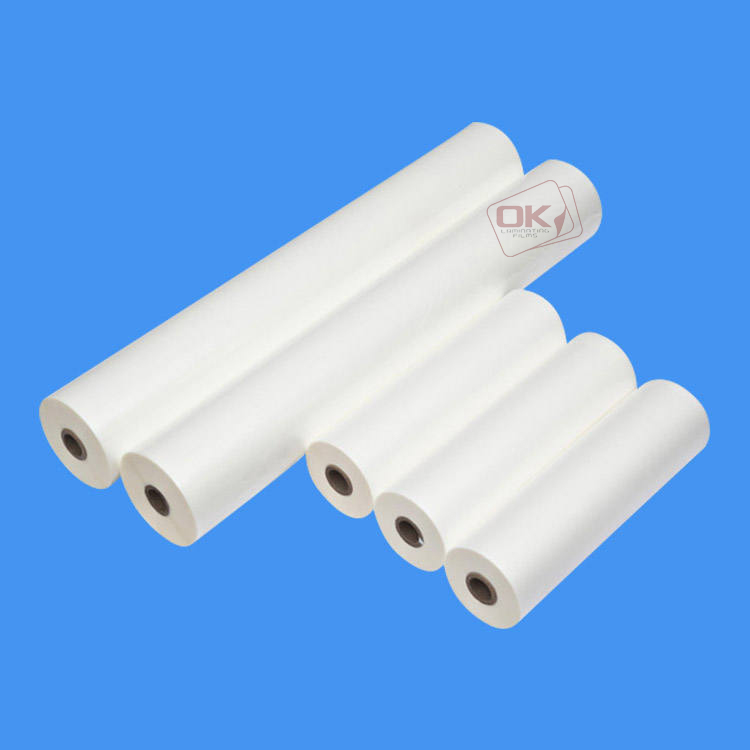
Laminating roll film is supplied in roll format so that film can be cut to length for repeated or variable-format lamination work.
Why Industry Fit Decides Whether a Laminating Roll Performs
Most complaints about roll film — bubbles, wrinkles, weak bonding, or a print that yellows after months on display — trace back to a fit problem rather than a defect in the roll itself. The performance expectations documented for laminating roll film used in these industries are concrete: high transparency, no bubble and no wrinkle, strong adhesion, waterproof and scratch-resistant behaviour, and anti-yellowing for long-term preservation. Whether a given roll delivers those outcomes depends on how film construction, thickness, laminator settings, and substrate interact in a specific production environment.
Industry fit is therefore not a marketing layer on top of a specification. It determines four things before a single roll is ordered:
- How the roll is consumed — batch processing, on-demand work, or continuous line integration.
- Which substrate and which printed item pass through the machine.
- Which finish the buyer of the finished goods will accept.
- Which exposure conditions the finished item has to survive.
An office laminating twenty documents a week has a different tolerance for setup time than a converter running lamination continuously through a shift. Both may purchase laminating rolls, but they are solving different problems. Treating the roll as a generic commodity rather than an application decision is the most common source of rework, edge lift, and spoiled print runs.
What the Roll Format Provides
The defining advantage of the roll format is continuous feed. A roll laminator draws film from a roll, applies heat and pressure, and outputs laminated sheets or webs without an operator handling individual pouches. The equipment list documented for these application scenarios distinguishes pouch laminators from roll laminators, and that distinction matters: pouches are sized to a fixed sheet format, while rolls are cut or trimmed to the job.
HADA manufactures Laminating Roll film under model HD-RL, a thermal laminating roll made of PET and EVA.
| Attribute | Documented specification |
|---|---|
| Product and model | Laminating Roll film, HD-RL |
| Construction | PET and EVA |
| Thickness range | 35mic to 250mic |
| Width range | 100mm to 1300mm |
| Length | Customized as per request |
| Finish | Glossy and matte |
| Packaging | Customizable as per request |
| Laminator compatibility | Suitable for all standard thermal laminators |
| Documented features | High transparency; no bubble and no wrinkle; strong adhesion; waterproof and scratch-resistant; anti-yellowing for long-term preservation |
In PET and EVA thermal constructions of the type used in roll lamination, the PET layer carries the transparency and dimensional stability while the EVA layer activates under heat to bond to the substrate. That division of labour explains why transparency and adhesion are treated as properties of the film rather than settings of the laminator alone — and why a roll specified for one substrate can underperform on another.
The Four Variables That Separate One Industry from Another
The application data documented for these scenarios sets out the practical range a buyer has to work within. The table below restates that range as a decision structure.
| Variable | Documented examples | What it changes in the specification |
|---|---|---|
| Production mode | Batch processing in office; on-demand lamination in retail; continuous production line integration | Determines acceptable setup time, run length, and how the roll is loaded and consumed |
| Substrate and finished item | Document & photo lamination; ID card & badge lamination; book cover & menu lamination; packaging & label lamination; advertising poster & banner lamination | Determines the protection level needed and the surface the film must bond to |
| Finish expectation | Glossy and matte finish options | Determines how the laminated surface reads and reflects light |
| Exposure and compliance | FDA food contact compliance; UV resistance for outdoor use; anti-static properties for electronic components | Determines whether a standard roll is acceptable or a specific grade must be selected |
| Matched equipment | Pouch laminators; roll laminators | Determines whether the job can be served in roll format at all |
Read together, these variables explain why the same product family supports five industries without being interchangeable between them. The roll format is the common denominator; the specification is not.
Matching Laminating Rolls to Five End-Use Industries
The industries documented for laminating roll film in these applications are Office Supplies, Education & School, Retail & Stationery, Advertising & Graphic, and Printing & Packaging. Each places a different weight on the same set of documented functions.
Office Supplies — Batch Processing and Document Protection
Office lamination is batch work: documents and photographs, identification cards and badges, and occasionally book covers and menus, processed in small runs on a roll laminator. The documented functions that matter most here are protection against water, dust, and wear, enhanced durability and appearance, and document preservation over an extended lifespan. Because office output is read rather than displayed at scale, high transparency does most of the work — a roll that introduces haze or bubbles undermines the document it was meant to protect. Finish selection is usually a readability decision: gloss reads as a bright, sealed surface, while matte reduces reflection on documents that are handled and scanned repeatedly. Widths anywhere across the documented 100mm to 1300mm range can serve office work, from narrow badge formats to wide sheets, which is why offices typically standardize on one or two widths rather than the full range.
Education & School — Long-Term Preservation Under Heavy Handling
School and educational lamination shares the batch pattern of office work but adds a longevity requirement. Book covers, teaching materials, reference cards, and certificates are kept and reused across terms, so anti-yellowing for long-term preservation becomes a specification point rather than a nice-to-have. Waterproof and scratch-resistant behaviour matters for the same reason: laminated teaching materials are handled by many people, stacked, stored, and reused. Strong adhesion protects against the failure mode that matters most in this sector — edge lifting on a cover that is opened and closed repeatedly. Because school materials are often printed on lighter stock, the ability to laminate without bubbles and wrinkles is as important as the film's protective properties, since a wrinkled cover signals a failed job regardless of how well the film performs afterwards. Gloss and matte finishes are both documented options here, and both are used depending on whether the material is primarily read or displayed.
Retail & Stationery — On-Demand Lamination
Retail and stationery environments laminate to demand. Menus, price cards, membership cards, identification badges, and display materials are produced as needed rather than in large planned batches, and the documented operation mode for the sector is on-demand lamination in retail. That changes the economics of the roll. Fast changeover and the ability to cut film to the exact length of the item matter more than the ability to run at maximum line speed, and a roll that requires extensive trimming wastes materials on every job. Scratch resistance and waterproofing carry obvious weight for menus and cards that are handled by customers, wiped clean, and returned to service. Because retail work often mixes formats within a single day, a roll that holds consistent adhesion across different substrates — paper, card, and synthetic stock — reduces the number of film changes a retail operator has to perform.
Advertising & Graphic — Outdoor Exposure and Colour Performance
Poster and banner lamination in advertising and graphic work adds a condition the office does not have: UV resistance for outdoor use. This is documented as a special requirement rather than a default property, which means outdoor signage should be specified with it rather than assumed to inherit it from a general-purpose roll. Documented functions relevant to this sector include improved colour vibrancy for printing materials, protection against water, dust, and wear, and enhanced appearance — all of which serve the commercial purpose of the printed piece. Film widths across the documented range up to 1300mm matter here because advertising output is often produced in wide formats, and a roll narrower than the printed sheet forces joining or trimming. Finish selection is usually commercial rather than technical: gloss is commonly chosen where colour depth and visual impact are the objective, while matte is chosen where a lower-reflection surface is preferred for readability or for a restrained look in interior applications.
Printing & Packaging — Continuous Line Integration
In printing and packaging, lamination is a production step rather than a finishing task, and the documented operation mode for the sector is continuous production line integration. What matters shifts accordingly: consistent width across a long run, stable adhesion at line speed, and predictable roll length so that changeovers can be scheduled rather than improvised. Documented applications include packaging and label lamination, alongside the same protection against water, dust, and wear that serves other sectors, plus durability enhancement where the pack has to survive handling and transport. Two special requirements appear in this sector that rarely appear elsewhere. Where the laminated surface comes into contact with food, FDA food contact compliance is documented as a requirement. Where electronic components are involved, anti-static properties are documented as a separate requirement. These are different constraints with different documentation, and they are normally specified independently rather than as part of a single general-purpose specification.
Technical Fit: Thickness, Width, Finish, and Adhesion
The documented thickness range for HD-RL is 35mic to 250mic. Thickness drives stiffness, protection level, and how a finished piece handles in service. Thinner film is commonly specified where flexibility and minimal added bulk matter, while heavier gauges are specified where a laminated item has to hold shape under repeated handling. Because the range spans roughly a factor of seven, two buyers can both be ordering laminating roll film and still be specifying substantially different products — which is why thickness belongs in the fit conversation rather than in a generic price comparison.
Width range is 100mm to 1300mm, with length customized to the order. Width selection is usually driven by the widest printed format the machine produces and by the working width of the laminator itself. Specifying well above the job width wastes film on every run; specifying below it forces trimming or excludes the job entirely.
Glossy and matte are both documented finish options. The gloss surface is generally chosen where visual impact and perceived colour depth are the priority, while matte is generally chosen where a low-reflection surface is easier to read under lighting or where glare and fingerprint visibility need to be managed. Finish selection sits alongside thickness and width selection rather than constraining it.
Strong adhesion is a documented product feature, but adhesion is a system property. Film, laminator temperature, roller pressure, and line speed have to be matched to the substrate. A roll that bonds cleanly on one machine can produce edge lift on another running faster or cooler, which is why documented product features should always be validated against the actual production setup before a full run.
Anti-yellowing for long-term preservation is the documented property that separates preservation-oriented work — certificates, teaching materials, archived documents — from short-life display applications where appearance over a few weeks is the only requirement.
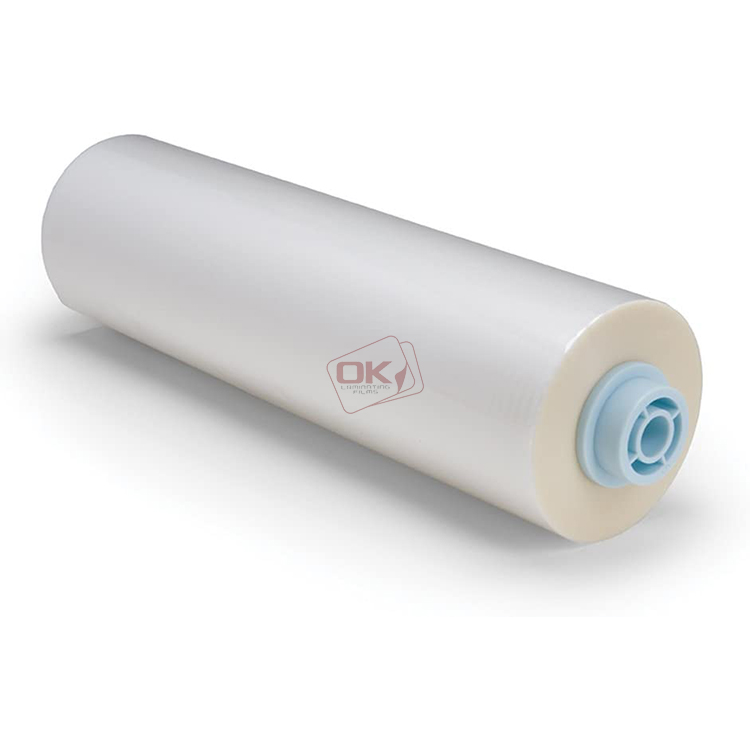
Roll film specification decisions — thickness, width, and finish — are made against the production job, not against a generic list.
Special Requirements by Exposure
Food Contact Compliance
Where laminated film becomes part of packaging that touches food, the requirement is food contact compliance, documented here as FDA food contact compliance. In the European Union, plastic materials and articles intended for food contact must comply with Commission Regulation (EU) No 10/2011, which sets migration limits and a positive list of permitted substances. Buyers in regulated markets typically confirm that the specific product and thickness supplied carries the required documentation before the first production run, because compliance is a property of a defined product and market, not of a product category.
UV Resistance for Outdoor Use
UV resistance for outdoor use is documented as a special requirement for these applications. Laminated posters, banners, and signage placed outdoors face sunlight, temperature cycling, and moisture. A standard indoor-grade thermal film is not automatically a substitute for an outdoor-specified product, and outdoor work should be specified against that requirement from the outset.
Anti-Static Properties for Electronic Components
Anti-static properties for electronic components are documented as a separate special requirement. Film that accumulates and holds static charge can attract dust and interfere with handling in ways that are unrelated to the water, dust, and wear protection the same film provides in an office setting. This is a distinct specification with a distinct test rationale.
Comparable Mechanical Data
Where suppliers describe comparable films in different language, a named test method provides a common reference. ASTM D882 is the standard test method for determining tensile properties — strength, elongation, and modulus — of thin plastic films less than 1.0mm thick. Requesting tensile data referenced to a named method makes film comparisons verifiable rather than descriptive, and it allows a buyer to compare specifications across suppliers without relying on marketing terminology.
What the Market Data Suggests About Demand Mix
Segment-level data gives a clearer directional signal than headline market sizing. BOPP thermal lamination films were valued at USD 3.5 billion in 2024 and projected to grow at 5.2% CAGR through 2033, according to Data Bridge Market Research. PET (BOPET) lamination films for packaging were valued at USD 10.3 billion in 2024, driven by e-commerce and high-performance insulation needs, according to Future Market Insights. DataM Intelligence reports that Asia Pacific held 36.87% of lamination film revenue in 2024, making it the dominant regional market.
Headline totals vary by scope. DataM Intelligence places the global lamination films market at USD 6,842.11 million in 2024 with food and beverage as the primary end-user segment, while Fortune Business Insights projects USD 9.01 billion for 2025 and Market Research Future estimates USD 3.40 billion. The spread reflects different definitions of what is counted as a lamination film, so comparative figures should be read alongside the source scope rather than treated as interchangeable. Named participants in the lamination and graphic roll film market include Cosmo Films, Jindal Poly Films, Taghleef Industries (Derprosa), and GBC (ACCO Brands), per Fortune Business Insights.
For a buyer of roll film for office, education, retail, and graphic work, the practical reading is threefold. First, growth is being pulled mainly by packaging and food-related demand rather than by office finishing, so supply capacity and film development tend to follow packaging requirements. Second, supply is broad and specifications are not standardized across suppliers, which means application-level fit discussions remain necessary. Third, regional concentration in Asia Pacific means lead time, documentation, and specification consistency are worth verifying at the sourcing stage rather than after a production run fails.
Where Laminating Rolls Are Not the Right Answer
Roll lamination is a strong fit for repeated, variable-format, or continuous work. It is not universally the better choice, and several boundaries are worth stating plainly.
- Equipment dependency. Roll film requires a roll laminator. The documented equipment pairing for these application scenarios lists pouch laminators and roll laminators separately, and a shop equipped only with a pouch laminator cannot run roll stock.
- Setup waste on very short runs. Threading a roll, aligning tension, and trimming the lead edge consume material and time at the start of each run. For a one-off single-sheet job, a pouch can involve less total setup than a roll, even though the roll is more efficient at volume.
- Thermal constraints. Thermal lamination depends on heat and dwell time, which limits what can be laminated without risk to the substrate. HADA's product portfolio also includes cold lamination film as an alternative format where heat is not appropriate.
- Dimensional ceilings. The documented HD-RL range covers thickness from 35mic to 250mic and width from 100mm to 1300mm. Jobs requiring film outside that range fall outside this specification, regardless of how well the format otherwise fits.
- Compliance is product-specific. Food contact compliance, UV resistance, and anti-static behaviour are specified requirements rather than default properties. A roll that performs well in an office is not automatically suitable for food packaging or outdoor signage.
Compared with the fixed-format alternative, pouches remain practical for defined sheet sizes. Documented pouch formats include Letter size (229*292mm) in 3Mil/75mic and 5Mil/125mic constructions and A4 (216*303mm) at 80mic, both available in glossy and matte finishes and compatible with standard thermal laminators. Where a job is defined by one sheet size and occurs occasionally, that format is simpler to manage. Where the format varies, the run repeats, or work moves down a line, the roll format usually reduces handling and material waste.
Future Outlook
The strongest documented pull on film demand is packaging rather than finishing. With food and beverage identified as the primary end-user segment of the lamination films market and PET-based packaging film demand tied to e-commerce and insulation needs, film development and capacity investment are likely to keep following packaging requirements first. BOPP thermal lamination films are projected to grow at 5.2% CAGR through 2033, which indicates continued relevance for thermal roll formats rather than displacement by other technologies.
On the sourcing side, documentation expectations are rising. Guangzhou Huada Laminating film Co., Ltd. (HADA), a manufacturer established in 1992 with more than 33 years in functional laminating films, holds ISO 9001, BSCI, SMETA, ROHS, and REACH among its certifications and 22 national patents, and operates a 40,000 square meter facility with approximately 200 staff and an R&D team of 5 engineers. That combination — certifications plus first-party specification data — is increasingly what buyers ask for when they move from format comparison to supplier evaluation.
The practical forecast for buyers is not a new film category but a change in how specification happens. General-purpose purchasing gives way to requirement-led selection: production mode first, substrate second, finish third, and exposure or compliance last. Each step narrows the catalog before price is discussed, which is the sequence that prevents the mismatch failures described at the start of this guide.
Frequently Asked Questions
What is a laminating roll used for?
A laminating roll is continuous film fed through a roll laminator to bond a protective layer onto printed or card substrates. Documented applications include document and photo lamination, ID card and badge lamination, book cover and menu lamination, packaging and label lamination, and advertising poster and banner lamination. The documented functions are protection against water, dust, and wear; enhanced durability and appearance; preservation of documents and extended lifespan; and improved colour vibrancy for printing materials.
Which industries commonly use laminating roll film?
The documented industries are Office Supplies, Education & School, Retail & Stationery, Advertising & Graphic, and Printing & Packaging, with application documentation noting common use in the United States. Related applications in the same product documentation also include photo and digital printing and ID card and badge production.
What thickness and width options are available for laminating rolls?
Laminating roll film, model HD-RL, is made of PET and EVA, with a documented thickness range of 35mic to 250mic and a width range of 100mm to 1300mm. Length and packaging can be customized as per request, and the roll is documented as suitable for all standard thermal laminators. Glossy and matte finishes are both available.
How do glossy and matte laminating rolls differ in application fit?
Both are documented finish options within the same product family. The distinction is application-driven: gloss is generally preferred where visual impact and perceived colour depth are the priority, while matte is generally preferred where a low-reflection surface is easier to read or where glare and visible fingerprints need to be managed. Finish selection is independent of thickness and width selection, so choosing one finish does not narrow the available format range.
When does an application need UV resistance, anti-static properties, or food contact compliance?
These are documented as special requirements rather than default properties. FDA food contact compliance applies where laminated film contacts food; UV resistance for outdoor use applies to signage and banners exposed to sunlight; anti-static properties apply where electronic components are involved. In the European Union, plastic materials intended for food contact must comply with Commission Regulation (EU) No 10/2011, which sets migration limits and a positive list of permitted substances. Where these requirements apply, the specific product documentation should be verified rather than assumed.
How does roll lamination compare with pouch lamination?
The two formats pair with different equipment; pouch laminators and roll laminators are documented separately. Pouches are fixed-format: documented formats include Letter size (229*292mm) in 3Mil/75mic and 5Mil/125mic, and A4 (216*303mm) at 80mic, all available in glossy and matte finishes. Rolls are cut to length and suit repeated or variable-format work. For occasional single-sheet jobs, pouches may require less setup; for repeated, variable, or continuous work, rolls typically reduce handling.
Can laminating rolls be customized for a specific laminator or print format?
The documented HD-RL specification supports customized length and packaging, with thickness options across 35mic to 250mic and width options across 100mm to 1300mm, and the product is documented as suitable for all standard thermal laminators. Where a job requires dimensions outside those ranges, or a specific compliance profile such as food contact or anti-static behaviour, that requirement has to be confirmed against the actual product specification rather than inferred from the general range.
Closing Note
Industry fit is a specification exercise before it is a purchasing decision. Production mode, substrate, finish, and exposure narrow a broad catalog of laminating rolls down to the two or three constructions that will run cleanly on a given machine and survive the working life of the finished item. Guangzhou Huada Laminating film Co., Ltd. (HADA), founded in 1992 and specialized in functional laminating films with an annual capacity exceeding 10,000 tons and exports to more than 50 countries and regions, publishes its roll specifications at www.huada168.com — and the more useful exercise for any buyer is to match those specifications against an actual production job before placing an order.