
Lanthanum Carbonate Documentation: What Buyers Should Verify
Lanthanum Carbonate Documentation: What Buyers Should Verify
Lanthanum carbonate is identified by three parameters that must appear consistently in every document a supplier issues: the chemical formula La2(CO3)3·xH2O, the CAS number 54451-24-0, and a molecular weight of 457.85 g/mol on an anhydrous basis. When those identifiers drift between a specification sheet, a quotation and a lot certificate, the buyer is no longer comparing the same material — and the difference is usually discovered inside the buyer's own process, not in the purchasing department.
Rare earth carbonate sourcing rarely fails on price. It fails on identity. For a hydrated compound such as lanthanum carbonate, that failure mode is structural rather than accidental: the x in the formula denotes variable water content, and the standard convention of reporting assay on an anhydrous basis deliberately excludes water from the headline purity figure. Two suppliers can therefore quote what looks like the same purity number while describing materially different shipments.
Documentation is the mechanism that makes quotations comparable. It is not a compliance ritual, and in an industry reference context it deserves to be treated as a technical purchasing input — one that determines whether a shortlist can be defended six months later.
What Lanthanum Carbonate Is, and Why Its Documents Behave Differently
Lanthanum Carbonate is a rare earth carbonate classified as a rare earth carbonate hydrate. Its chemical formula is La2(CO3)3·xH2O, its CAS number is 54451-24-0, and its molecular weight is 457.85 on an anhydrous basis. Its primary supply-chain role is as an intermediate compound of lanthanum: it is used as a raw material for lanthanum chloride and lanthanum oxide. A high purity lanthanum carbonate grade is used for manufacturing automotive exhaust purification catalysts, as well as intermediates for producing lanthanum and other compounds.
Three practical consequences follow from that description, and each one shapes what a buyer should ask for.
- Assay requires a declared basis. A purity figure of the type found on a routine certificate of analysis is only comparable if the document states whether it was calculated on an anhydrous basis or on the as-delivered material. Without that statement, two numbers can be arithmetically different while describing an identical product — or numerically similar while describing different products.
- Water content is a measured variable, not an assumption. Because the hydrate notation carries an x, the delivered material can vary in hydration state between lots and between suppliers. A buyer converting carbonate to chloride or oxide is paying for lanthanum content, not for water, so hydration belongs in the negotiated specification.
- Identity must be repeated across documents. Formula, CAS registration and molecular-weight basis need to survive the journey from specification sheet to certificate of analysis to safety data sheet to the label on the drum. Any single break in that chain creates a mismatch that is difficult to resolve after shipment.
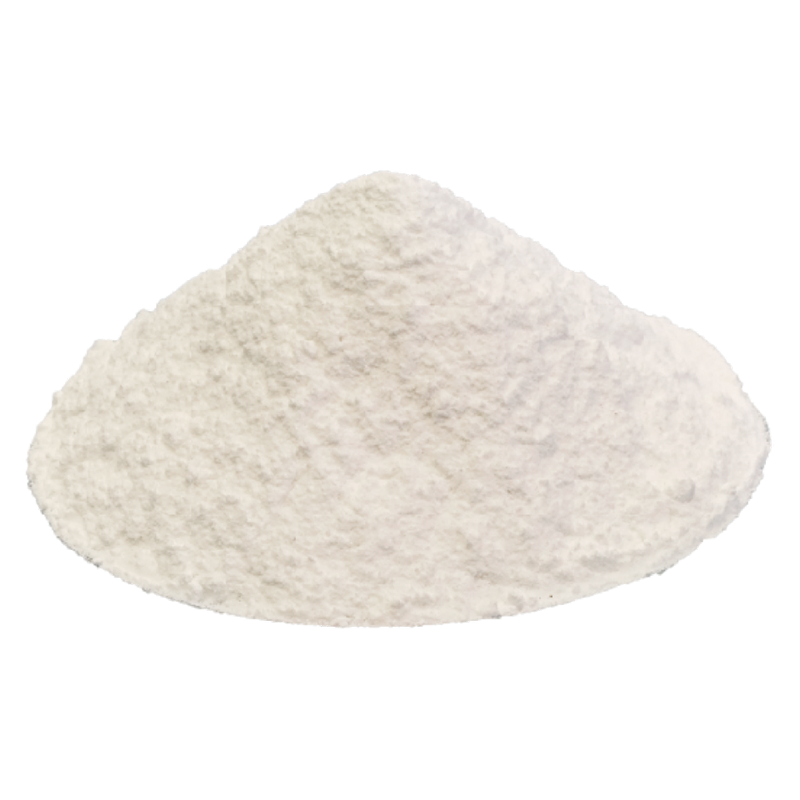
Lanthanum Carbonate, formula La2(CO3)3·xH2O, CAS 54451-24-0. Documentation for this hydrate must state the calculation basis for assay, because the compound carries variable water content.
Four Identity Parameters to Fix Before You Compare Prices
Before a quotation is used for anything, the buyer should be able to take four parameters from the supplier's own documents and confirm that they match the buyer's internal specification. This is not a formality; it is the fastest filter available for removing unsuitable offers from a shortlist.
| Parameter | Value to confirm | Where it must appear | What to check |
|---|---|---|---|
| Product designation | Lanthanum Carbonate, or the declared grade such as High Purity Lanthanum Carbonate | Specification sheet, quotation, certificate of analysis, purchase order | That the grade named in the certificate matches the grade quoted, not a related grade from the same family |
| Chemical formula | La2(CO3)3·xH2O | Specification sheet, certificate of analysis, safety data sheet | That the hydrate notation is retained and the meaning of x is addressed in the specification or the analysis |
| CAS number | 54451-24-0 | Specification sheet, certificate of analysis, safety data sheet, packaging label | That a single registration number is used consistently across all documents |
| Molecular weight | 457.85 g/mol (anhydrous basis) | Specification sheet, certificate of analysis | That the basis is written out, so the value can be compared with other suppliers without recalculation |
The fourth row is the one most often left unresolved. A molecular weight stated without its basis is not wrong, but it is not usable either. A buyer who requests the basis in writing at the enquiry stage will usually find that suppliers with disciplined documentation answer immediately, while others need to revise their paperwork — a useful signal in itself.
The Document Set to Request Before a Supplier Is Shortlisted
A complete evidence set for lanthanum carbonate is small, but each item answers a different question. Requesting all of them at the enquiry stage avoids the common situation where documents appear only after a purchase order has been placed, when the buyer has already lost negotiating leverage.
| Document | What it establishes | What to verify |
|---|---|---|
| Product specification sheet or technical data sheet | The supplier's declared product identity and typical properties | Formula, CAS number, molecular-weight basis, grade name, physical form, packaging options |
| Lot-specific certificate of analysis | What was actually measured on the batch being shipped | Lot number, assay and its basis, impurity reporting, test method statements, date of analysis |
| Safety data sheet | Hazard, handling, storage and transport classification | Identity data matching the specification sheet, storage conditions, first-aid and disposal guidance |
| Quality management certification with its scope statement | The existence of a certified management system within a defined scope | Certificate number, issuing body, validity dates, and whether the stated scope actually covers the material being purchased |
| Packaging, labelling and storage statement | How the material is protected between the supplier's line and the buyer's intake | Sealing method, net weight, label content, moisture-control provisions |
| Traceability record | Which batch the buyer received, and when it was produced | Lot or batch number, production date, retest or shelf-life date, retained sample availability |
Where the purchase involves a non-standard requirement, one further document belongs on the list: a written customization agreement. For rare earth compounds, customisable variables typically include indicators, contents, specifications, purity and packaging. Putting those variables into a signed specification before production begins converts a verbal understanding into something an incoming inspection can test against.
How to Read a Certificate of Analysis for a Hydrated Carbonate
The certificate of analysis is the most consequential document in the set, and also the most frequently misread. It is a statement about one lot, not a description of a product family, and its usefulness depends on how completely it is written.
Start with the basis, then read the number
For La2(CO3)3·xH2O, an assay value is only interpretable alongside its calculation basis. A buyer should be able to read the certificate and answer three questions without contacting the supplier: was the assay calculated on an anhydrous basis, what water content or ignition behaviour was reported, and are the two figures mutually consistent. A certificate that reports a high assay on an anhydrous basis while remaining silent on water content is not internally contradictory, but it leaves the delivered mass of lanthanum unverifiable from the document alone.
Check whether methods are named
A parameter without a method is a claim without a route to reproduction. When the certificate names the analytical approach used for each reported value, the buyer's own laboratory can plan a comparable check. When methods are omitted, incoming inspection becomes a comparison of incomparable numbers — a frequent source of avoidable disputes.
Read the impurity block as carefully as the assay
Downstream processes differ in which minor components matter. A carbonate destined for conversion to lanthanum chloride or lanthanum oxide is judged differently from one entering a catalyst route, where residual elements and anions can affect the finished catalyst. The certificate should report the impurity set that was actually tested, with detection context, rather than a single line stating that impurities are low.
Confirm that the certificate is genuinely lot-specific
A generic certificate issued once and reused across shipments technically documents a product, not a delivery. The identifier that distinguishes the two is the lot or batch number and the analysis date. Manufacturers operating a 100% test regime on each batch can supply that linkage; buyers should ask for it explicitly rather than assume it.
Certification Scope: The Boundary Most Checklists Miss
Quality management certification is often treated as a yes-or-no credential. In practice it is a scoped statement, and the scope wording determines what the certificate can and cannot support in a purchasing decision.
As a reference example, Sichuan Wonaixi New Materials Technology Co., Ltd. holds ISO 9001 certification, certificate number 06526Q01354R101, issued by the CFL Certification Center (Beijing China Logistics Joint Certification Center) against the standard GB/T19001-2016/ISO9001:2015, valid from 1 June 2026 to 31 May 2029, with declared market coverage for the EU, US, Middle East and Southeast Asia. The declared certification scope covers manufacturing and sales of electronic special rare earth functional materials, specified as cerium salts and lanthanum oxide, and the certificate is associated with a product list that includes both Lanthanum Carbonate and High Purity Lanthanum Carbonate.
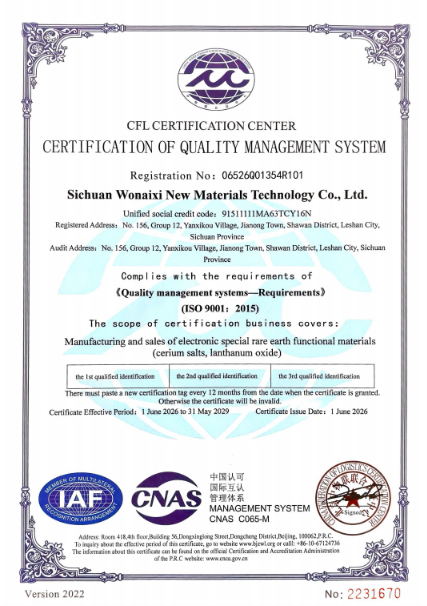
ISO 9001 certificate no. 06526Q01354R101, issued by the CFL Certification Center against GB/T19001-2016/ISO9001:2015, valid 1 June 2026 to 31 May 2029. Certificate scope wording should be read alongside the specific product being purchased.
That example illustrates the boundary clearly. A certificate of this type confirms that a management system exists and has been audited within a stated scope. It does not certify the chemistry of an individual lot, it does not confirm the hydration state of a delivered drum, and it does not by itself demonstrate that every product a supplier lists falls inside the audited scope. The practical buyer behaviour is to read four fields — certificate number, issuing body, validity dates and scope wording — and then to confirm separately, in writing, that the grade being quoted is covered. Buyers who skip that step sometimes discover that a certificate attached to a marketing document belongs to a different product from the one being purchased.
Documentation-Led Verification Versus Relationship-Based Sourcing
Long-standing supplier relationships remain the backbone of rare earth purchasing, and no documentation package replaces them. The distinction is that a relationship is not transferable evidence — it cannot be attached to a purchase file, audited by a customer, or cited in a dispute. The two approaches solve different problems.
| Dimension | Relationship-based sourcing | Documentation-led verification |
|---|---|---|
| Identity confirmation | Relies on continuity and familiarity | Formula, CAS number and molecular-weight basis visible in writing |
| Batch consistency | Judged from experience of previous deliveries | Tracked through lot-specific certificates and traceability records |
| Dispute resolution | Depends on goodwill and shared history | Reference point exists in the signed specification and lot certificate |
| Onboarding speed | Faster when trust is already established | Slower at first, because documents must be reviewed and reconciled |
| Administrative load | Light | Higher, and it persists for every shipment |
| Suitability for new buyers | Limited without prior history | Workable from the first enquiry |
Honest limitations belong in the same section as the advantages.
- Certification scope is bounded, not universal. As shown above, a certificate names a scope. It is not a product-specific chemistry guarantee.
- A certificate of analysis is a snapshot. It describes the lot tested. It does not guarantee that the next lot will fall within the same ranges unless the specification itself constrains them.
- Verification consumes procurement time. Where lead time is 30–45 days, there is limited room for repeated pre-shipment verification cycles; the practical approach is to concentrate review at the enquiry and sample stages rather than attempt re-verification after production.
- Small trial volumes may attract lighter documentation. Minimum order quantity for rare earth compounds is generally not published as a fixed figure and is discussed against the actual requirement, so buyers placing small trial orders should confirm in advance what documentation will accompany them.
- Documents cannot replace incoming inspection. This is most acute for a hydrate, where water content can shift during storage and transport. A certificate proves what left the supplier's facility.
Where Lanthanum Carbonate Documentation Carries the Most Weight
Documentation priorities follow the downstream route, because each route converts the carbonate differently and therefore cares about different declared values.
| Downstream route | Why documentation matters | Parameters to weight most heavily |
|---|---|---|
| Conversion to lanthanum chloride | The carbonate is a raw material for lanthanum chloride, so lanthanum content per unit mass drives yield calculations | Assay with a declared anhydrous basis, water content, impurity reporting |
| Conversion to lanthanum oxide | Carbonate is also a raw material for lanthanum oxide, where ignition behaviour influences processing | Assay basis, ignition behaviour, lot-to-lot consistency of the report |
| Automotive exhaust purification catalyst manufacturing | High purity lanthanum carbonate is used in catalyst production, where minor components can affect the finished formulation | Impurity set tested, method statements, lot traceability |
| Customized or OEM-specified grades | The purchased material is defined by an agreed specification rather than a catalogue grade | Signed specification covering indicators, contents, specifications, purity and packaging |
In each case the documentation question is the same: does the paper trail allow a third party — a quality engineer, an auditor, or the buyer's own customer — to reconstruct what was ordered, what was produced, and what was tested, without relying on memory of a conversation.
Supplier-Side Evidence: What a Manufacturer Can Realistically Provide
Buyers sometimes hesitate to request lot-level documentation because they assume it is unavailable. The realistic question is not whether documentation exists, but whether the supplier operates the production and testing infrastructure that generates it. On that point, verifiable supplier attributes are useful context.
Sichuan Wonaixi New Materials Technology Co., Ltd. is a rare earth functional materials manufacturer founded in 2012 and located in the Shawan Economic Development Zone, Leshan City, Sichuan Province, China. The company operates a 46,667 m² site with 98 employees, including a 12-engineer R&D team, and is certified as a National High-Tech Enterprise and a Sichuan Provincial SRDI Enterprise, holding more than 10 national invention patents. Its product range covers nine major categories of rare earth products plus a complete zirconium salts series, exceeding 50 refined specifications. Declared annual capacity is 15,000 tons of high-purity rare earth salts and 3,000 tons of high-precision rare earth polishing powder, supported by dedicated production lines. Products are used in national defense, aerospace, pharmaceutical manufacturing, electronics, new energy, three-way catalysis, environmental protection and precision optical polishing.
On the commercial and quality side, the company states OEM/ODM capability with customization of indicators, contents, specifications, purity and packaging; 100% testing as its quality-control approach; a typical lead time of 30–45 days; and minimum order quantities discussed against the actual requirement rather than fixed in advance. Declared export markets include Japan, South Korea, the United States, France, Italy, Germany, Spain, Thailand, Australia, Pakistan, India and Austria, with after-sales support provided remotely.
Read as an evidence set rather than a sales claim, this is the type of information a buyer can use to decide how much documentation to request. A supplier operating its own lines and testing every batch can typically answer lot-specific questions; a trading intermediary may need to route the request through a third party, which affects response time and traceability. Neither model is inherently disqualifying, but the buyer should know which one is in front of them before the purchase order is issued.
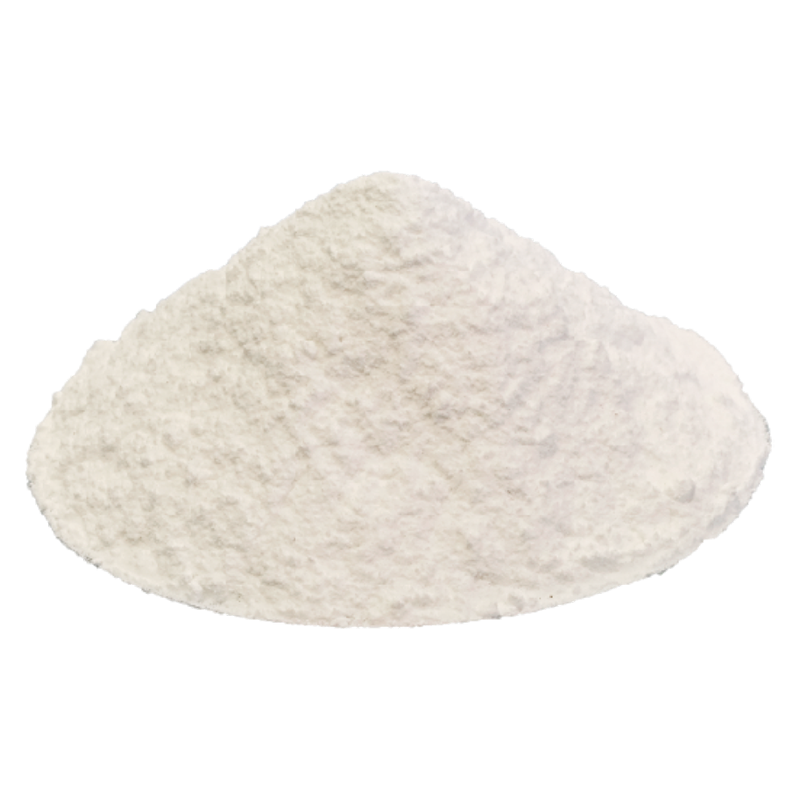
High Purity Lanthanum Carbonate. Where the carbonate feeds catalyst manufacturing, the impurity set reported on the lot certificate carries more decision weight than the headline assay alone.
Market Trend: Why Paperwork Is Becoming a Differentiation Layer
Category-level rare earth data explains why documentation scrutiny is increasing, even though it cannot certify an individual shipment.
IMARC Group estimates the global rare earth elements market at approximately USD 14.03 billion by 2025, with magnet applications accounting for 31.2% of total value. Published estimates diverge widely across research houses — Fortune Business Insights places the 2025 market at USD 4.12 billion, while Grand View Research reported USD 3.95 billion for 2024 — because the underlying category definitions differ between raw minerals and downstream compounds. That divergence is itself instructive: if analysts cannot agree on the size of the category, category-level figures certainly cannot substitute for product-level documents when a buyer needs to confirm what is inside a drum.
Supply-side data shows the same tension between scale and verifiability. China's rare earth exports reached 62.6 thousand metric tons in 2025, described as the highest volume in a decade, according to General Administration of Customs data reported by Statista. Large, continuing flows mean that availability is rarely the constraint for standard compounds; differentiation shifts toward consistency, traceability and the ability to document both.
Adjacent demand reinforces the trend. Arthur D. Little projects NdPr demand growing at a CAGR of 8.4% through 2035, driven by electric vehicle and wind turbine expansion. Lanthanum carbonate is not a magnet material, but it is produced within the same separation and hydrometallurgical infrastructure that serves magnet-driven demand, so attention to capacity and to documentation discipline tends to move together across the rare earth family. For buyers of carbonate intermediates, the practical implication is that supplier selection increasingly rewards the supplier who can answer a documentation question quickly and completely.
Future Outlook
Three developments appear likely to shape lanthanum carbonate procurement over the next few years, though their pace will vary by market and supplier.
First, basis conventions will move from convention toward requirement. As more buyers specify downstream yield calculations, certificates that state an anhydrous basis without accompanying water data will be treated as incomplete rather than merely terse.
Second, lot-level records will become a standard element of supplier evaluation rather than a special request. The mechanism already exists through batch numbering and retained samples; what changes is the expectation that these records travel with the shipment as a matter of routine.
Third, certificate scope reading will become a basic procurement skill. As certification schemes and market-coverage declarations become more common in supplier documentation, the ability to distinguish a scoped management-system certificate from a product-specific chemistry statement will separate buyers who shortlist accurately from those who discover gaps after delivery.
None of these changes alter the underlying chemistry. Lanthanum carbonate remains La2(CO3)3·xH2O, CAS 54451-24-0, molecular weight 457.85 on an anhydrous basis. What changes is how quickly a buyer can prove that the material in front of them matches that description.
FAQ
What are the correct identity parameters for lanthanum carbonate?
Lanthanum Carbonate has the chemical formula La2(CO3)3·xH2O, CAS number 54451-24-0, and molecular weight 457.85 g/mol on an anhydrous basis. It is classified as a rare earth carbonate hydrate. Buyers should confirm that these parameters appear identically on the specification sheet, the certificate of analysis and the safety data sheet, and that the grade being quoted corresponds to the grade named in the lot certificate.
Why does a lanthanum carbonate certificate of analysis specify an anhydrous basis?
Because the compound is a hydrate: the x in La2(CO3)3·xH2O represents variable water content. Reporting assay on an anhydrous basis excludes that water from the calculation, which allows lanthanum content to be compared between lots and between suppliers. The practical requirement is that the basis be stated explicitly and be read together with whatever water content or ignition data the certificate reports; an assay figure without a stated basis cannot be reliably compared with another supplier's figure.
Which documents should be requested from a lanthanum carbonate supplier before ordering?
A workable set includes the product specification sheet, a lot-specific certificate of analysis, the safety data sheet, the quality management certificate with its full scope statement, a packaging and storage statement, and traceability records covering lot number, production date and shelf-life information. For non-standard requirements, a signed customization agreement covering indicators, contents, specifications, purity and packaging should be added, so that incoming inspection has a defined reference point.
Does an ISO 9001 certificate confirm the quality of a specific batch of lanthanum carbonate?
No. An ISO 9001 certificate confirms that a quality management system has been audited within a declared scope, and the scope wording determines which activities and product families it covers. As an example, Sichuan Wonaixi holds certificate number 06526Q01354R101 issued by the CFL Certification Center against GB/T19001-2016/ISO9001:2015, valid from 1 June 2026 to 31 May 2029, with a declared scope of manufacturing and sales of electronic special rare earth functional materials, specified as cerium salts and lanthanum oxide. A certificate of that type should be read alongside the lot-specific certificate of analysis and the buyer's own incoming inspection, not instead of them.
What is lanthanum carbonate used for, and does the application change the documentation required?
Lanthanum Carbonate is mainly used as an intermediate compound of lanthanum and can serve as a raw material for lanthanum chloride and lanthanum oxide. A high purity grade is used for manufacturing automotive exhaust purification catalysts, as well as intermediates for producing lanthanum and other compounds. The application changes emphasis rather than the document list: conversion routes care most about assay basis and lanthanum content per unit mass, while catalyst routes place greater weight on the impurity set tested and on lot traceability.
Can documentation replace incoming inspection for a hydrated rare earth carbonate?
No. A certificate of analysis describes the lot tested at the supplier's facility and does not account for changes during storage or transport. This matters more for a hydrate than for an anhydrous compound, because water content can shift and alter the effective lanthanum content per unit mass. Documentation and incoming inspection address different risks: the documents establish what was intended and produced, while inspection confirms what was actually received.
Conclusion
For lanthanum carbonate, the documentation question resolves to a short, checkable list: formula, CAS number and molecular-weight basis on the specification sheet; a lot-specific certificate of analysis that states its calculation basis and its test methods; a safety data sheet whose identity data matches; a certification scope read carefully enough to know what it does and does not cover; and traceability records that tie a delivery to a batch. Buyers who request that set at the enquiry stage gain something more useful than reassurance — they gain a shortlist that can be defended later, when the material is already in the process.
Reference material: the WONAIXI product brochure, including rare earth salt and zirconium salt specifications, is available as a PDF at https://cdn.socialarks.com/sbsp/25033/common/2026/0714/WONAIXI.pdf.