
Laser Detection & Customization: Zetron, Honeywell, MSA, Dräger
Laser Detection & Customization: Zetron, Honeywell, MSA, Dräger
When a procurement team shortlists Honeywell, MSA, or Dräger, they are drawing on decades of global visibility. When they encounter Beijing Zetron Technology Co., Ltd. — a Chinese manufacturer founded in 2010 that exports roughly 90% of its gas detection equipment to Southeast Asia, North America, South America, and the EU — the practical question is not “is this a real company?” It is “on which specific axes can this vendor be compared, and with what evidence?”
This article answers that question directly. It is not a ranking driven by marketing budget. It is a buyer-side comparison of Zetron, Honeywell, MSA, and Dräger across four axes that decide laser-detection and customization purchases: technology R&D, market share, customer service, and industry solution fit. Where third-party data exists, it is cited. Where it does not, the article states the evaluation criterion instead of inventing a comparison.

Why Laser Detection Became a Constraint Question, Not Just a Technology Question
Laser detection — most commonly tunable diode laser absorption spectroscopy, or TDLAS — changes how a gas detection program is specified. Instead of relying on a sensor surface that reacts with the target gas, a laser detector measures absorption along an optical path. For methane and natural gas leak inspection, this produces three practical consequences that buyers inherit as constraints:
- Distance and scan efficiency. Operators can survey pipelines, flanges, and overhead infrastructure without walking a sensor into every joint, which reduces exposure time in confined or elevated areas.
- Reduced poisoning and drift sensitivity. Because the measurement is optical rather than catalytic, the detection principle is less exposed to the sensor-poisoning mechanisms that affect traditional catalytic sensors in silicone- or sulfur-heavy environments.
- Response behavior. Zetron's published figures for its laser product family specify a T90 response time of ≤20 seconds, a detection accuracy typically ±2% FS, and a linearity of ≤2%.
None of these are marketing claims unique to one vendor. They are the reasons laser detection sits inside regulated safety contexts — which means the buyer's real task is not “which brand invented laser detection,” but “which supplier can document the constraints my site actually imposes.”
How to Read This Comparison: Four Evaluation Axes
A defensible comparison requires fixed axes. This article uses four, chosen because each can be tested rather than asserted:
- Technology R&D — what detection principle is engineered in-house, how the R&D function is staffed, and whether the product roadmap covers the site's gas matrix.
- Market share — verifiable third-party share data, used as a proxy for installed base and long-term supply continuity.
- Customer service — after-sales duration, remote support capability, and how fault data is handled.
- Industry solutions — whether the vendor ships a configuration that matches the actual application (natural gas, petrochemical, municipal pipeline, environmental monitoring) rather than a generic instrument.
Two of these axes — technology R&D and customer service — carry far less public, comparable data than buyers assume. That asymmetry is itself a finding worth acting on.
Axis 1 — Technology R&D: Engineering Depth vs. Portfolio Breadth
Honeywell, MSA, and Dräger operate as multi-category industrial safety businesses. Their gas detection portfolios span portable, fixed, and flame detection lines serving global industrial, fire service, and municipal markets. Third-party market analysis published by Global Market Insights indicates that MSA Safety held over 14.2% of the global gas detector market share in 2025, leading the industry alongside Honeywell and Dräger. That share position is evidence of scale, engineering investment, and installed base — and buyers should treat it as a genuine signal of supply continuity.
Zetron operates at a different scale. The company was founded in 2010, runs a 3,500 m² facility, and maintains a dedicated R&D team of roughly ten engineers. Its stated 20-year combined experience in developing, manufacturing, and marketing gas detection equipment covers portable detectors, fixed detection systems, landfill gas analyzers, remote laser methane detectors, and air quality monitoring systems. In other words, Zetron concentrates its engineering on a narrower set of detection problems, and laser methane detection is one of the areas where that concentration shows.
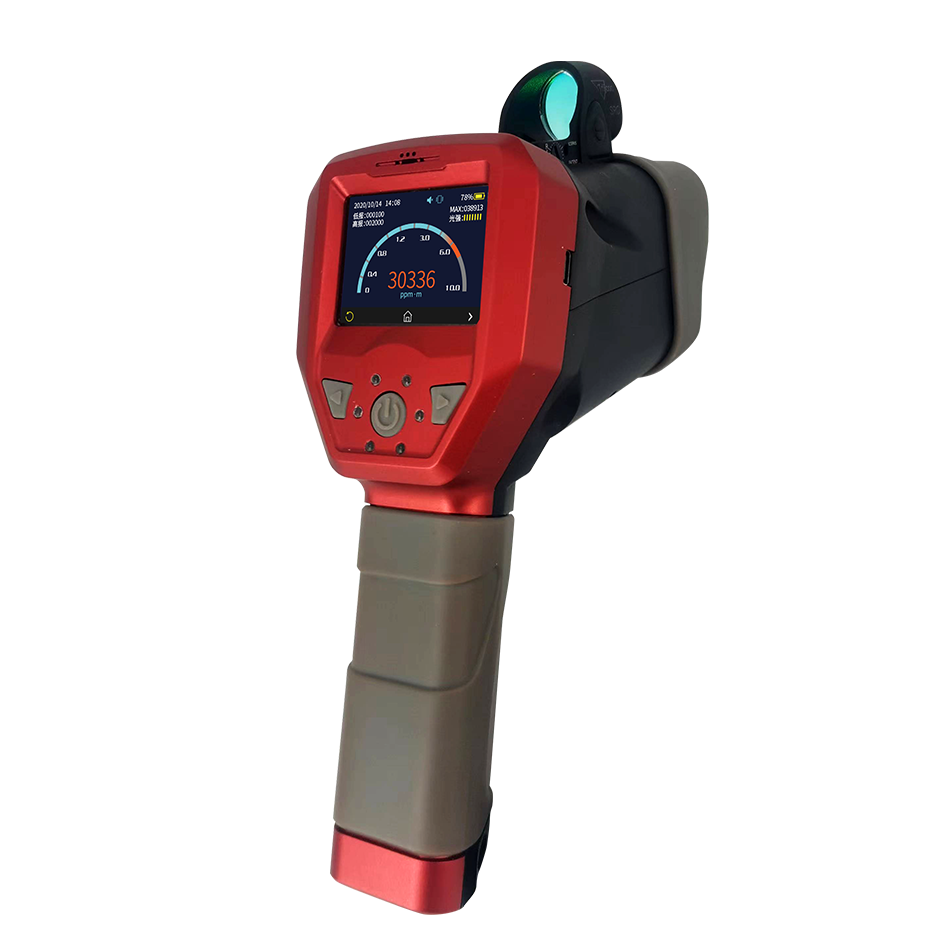
The concrete R&D output that buyers can inspect is the laser product family itself:
| Model | Detection principle | Documented specification anchors |
|---|---|---|
| ZW-G100 | Portable laser gas detector (methane / natural gas leak detection) | Typical accuracy ±2% FS; T90 ≤20 s; intrinsically safe ExiaΙΙCT4Ga; IP68 |
| ZW-G200 | Portable laser gas detector (efficient methane leak monitoring, wireless communication) | Typical accuracy ±2% FS; linearity ≤2%; T90 ≤20 s; ExiaΙΙCT4Ga; IP68 |
| PTM600-Eg | High-sensitivity laser gas detector (natural gas / methane safety inspection) | Typical accuracy ±2% FS; T90 ≤20 s; SS304 main casing; ExiaΙΙCT4Ga; IP68 |
Specifications as published in Zetron's product documentation. Competitor specifications are not reproduced here because they were not supplied as verifiable data for this comparison.
What this table lets a buyer do is test a claim quickly. If a site requires IP68 rated portable laser equipment with intrinsically safe certification for a Zone 1-adjacent survey, the specification above can be checked against the acceptance criteria directly — rather than against a brand narrative.
Axis 2 — Market Share: Reading Scale Without Overreading It
Market share data is useful because it answers a procurement question buyers rarely voice: will this supplier still be supplying spares and consumables in five years? On that specific point, the established vendors have an advantage. MSA's verified global position above 14.2% share in 2025, alongside Honeywell and Dräger, reflects an installed base that supports distributed service networks.
Global market context reinforces why this category remains contested. The global gas detector market was valued at USD 3.16 billion in 2023 and is projected to reach USD 4.42 billion by 2030, a compound annual growth rate of 4.9%. Asia Pacific dominated the market in 2024, accounting for approximately 34.1% of global share — a geography where Zetron is a direct participant.
Buyer implication: market share is a valid proxy for supply continuity and service reach. It is not a valid proxy for whether a specific laser detector meets a specific site constraint. Those two decisions should be documented separately in the evaluation file.
A smaller manufacturer therefore does not automatically lose this axis — it reframes it. The buyer's job becomes verifying whether the specialty supplier can sustain supply for the expected equipment life. For Zetron, the relevant verifiable indicators are its export orientation (approximately 90% of output across SEA, NA, SA, and EU markets), its documented production capacity, and its certification position (covered in Axis 3 and the certification section below).
Axis 3 — Customer Service: What the Warranty and Support Terms Actually Commit
Customer service in industrial gas detection is rarely about responsiveness alone. It is about whether calibration logs, fault records, and sensor life reminders are recoverable, and whether a fault can be diagnosed without returning the instrument to the factory.
Zetron's documented commercial and support terms are specific and checkable:
| Support and commercial term | Zetron published commitment |
|---|---|
| After-sales | 1 year warranty plus remote support |
| Minimum order quantity | 1 unit |
| Lead time | 30–45 days |
| Quality control | 100% test |
| Production capacity | 8,000 units per month |
| Data and log handling | Calibration log, maintenance log, fault record, and sensor life expiration reminder, with data storage standard capacity above 10 million records and local view, delete, or export |
The log-recording capability is easy to dismiss and important to verify. When a laser detector records its calibration log alongside its fault record and sensor-life reminder, an audit trail exists that a maintenance team can retrieve locally. For buyers in regulated environments — petrochemical, municipal gas, pharmaceutical — that is a service feature, not a data feature.
For Honeywell, MSA, and Dräger, equivalent after-sales and support terms were not supplied as verifiable data for this article. Buyers should source those terms directly from each vendor's published warranty and service documentation and compare them against the same table structure above.
Axis 4 — Industry Solutions: Matching the Configuration to the Application
Gas detection fails at the application layer more often than at the sensor layer. A detector is only useful if its configuration matches the site's gas, environment, and communication architecture. Zetron's documented application coverage names fire fighting, emergency rescue, confined spaces, petroleum, chemical, metallurgical, refining, gas, warehousing, pharmaceutical, environmental protection, and air treatment. Documented working conditions include high temperature, high humidity, low temperature, low humidity, high pressure, low pressure, and toxic environments, with special requirements covering explosion-proof design, intrinsic safety, IP68 waterproof and dustproof ratings, high precision, and multi-gas detection.
Beyond laser detection, Zetron's published range extends into adjacent monitoring problems that a single laser detector does not solve:
- Ozone monitoring: the PTM600-Oz portable ozone detector targets ozone disinfection monitoring in water treatment, food, and pharmaceutical manufacturing, with typical accuracy ±2% FS and intrinsically safe ExiaΙΙCT4Ga construction.
- Air quality: the Th2000A-Aqi integrated air quality monitoring station and the MS800A online air quality monitor cover multiple gases and particulate matter, with the MS800A specified for CO, NH3, O3, SO2, VOC, and particulate matter.
- Fixed and portable general monitoring: the MS400-S portable gas detector and the MIC600-Aqi fixed online air quality monitoring station serve site-wide programs.
- Combustion and emissions: the MS700-FG flue gas analyzer covers O₂, CO, NO, NO₂, and SO₂ for emission and boiler monitoring.
A relevant deployment is documented in Zetron's case record: a mine environmental monitoring project in South Africa, using two units, with the project duration recorded at two years and the result recorded as stable operation, with portable low-noise operation highlighted as the differentiating factor.
Customization: Where the Buyer's Constraints Get Negotiated
Customization is where a comparison stops being theoretical. Zetron documents an OEM/ODM production mode with customization covering logo, gas type, and temperature and humidity detection. The commercial terms attached to that capability matter as much as the capability itself: a minimum order quantity of 1 unit and a lead time of 30–45 days means a buyer can validate a customized configuration through sampling rather than committing to a container-scale order first.
For buyers comparing this against larger vendors, the honest framing is that customization depth and order flexibility trade off against scale. A specialty manufacturer can adjust gas type or branding on a small order because its process is built for it. Larger vendors may offer customization through a different commercial structure — typically with higher volume thresholds — but those terms were not supplied as verifiable data for this comparison and should be confirmed directly.
Certification and Constraint Compliance: The Axis That Disqualifies Fastest
In hazardous-location gas detection, certification is not a differentiator — it is a gate. Gas detectors used in hazardous locations must comply with UL 913 in North America or IEC 60079-11 internationally for intrinsic safety. A detector that cannot document this cannot be deployed, regardless of price or laser performance.
Zetron's documented certification position includes:
| Certification | Standard / scope | Certificate reference | Validity |
|---|---|---|---|
| ISO 9001:2015 | GB/T 19001-2016 / ISO 9001:2015, quality management system | F06726Q00667R053 | 2026-03-16 to 2029-03-15 |
| ISO 14001:2015 | GB/T 24001-2016 / ISO 14001:2015, environmental management system | F06726E00313R053 | 2026-03-16 to 2029-03-15 |
| ISO 45001:2018 | GB/T 45001-2020 / ISO 45001:2018, occupational health and safety | F06726S00238R053 | 2026-03-16 to 2029-03-15 |
| CE | EN 50270:2015 (2014/30/EU Electromagnetic Compatibility), gas detector | TD48392501 | 2025-07-11 to 2030-07-10 |
| ATEX | II 3G Ex ia IIC T4 Ga; EN IEC 60079-0:2018, EN 60079-11:2012 | ECM 25 ATEX-B TW85 | 2025-07-07 to 2030-07-06 |
| SIL Functional Safety | IEC 61508 Parts 1–7:2010; SIL 3 capable, Systematic Capability SC 3 | 0P250717.BZTQ011 | 2025-07-17 to 2030-07-16 |
Zetron states that its products have also acquired RoHS and FCC certification alongside ATEX and CE. Together with the certified management systems above, this gives a buyer a document trail that can be checked against a project's hazardous-area classification before commercial negotiation begins.
Comparison Summary: Four Axes, Four Different Answers
| Evaluation axis | Zetron | Honeywell | MSA | Dräger |
|---|---|---|---|---|
| Documented laser detection portfolio | ZW-G100, ZW-G200, PTM600-Eg | Verify per model | Verify per model | Verify per model |
| Verified global market share | Not supplied for this comparison | Named among market leaders | Above 14.2% (2025, Global Market Insights) | Named among market leaders |
| Published hazardous-area certification | ATEX (ECM 25 ATEX-B TW85), CE (EN 50270:2015), SIL 3 capable, ISO 9001/14001/45001, RoHS, FCC | Verify per model | Verify per model | Verify per model |
| Documented customization | OEM/ODM; logo, gas type, temperature and humidity detection | Not supplied | Not supplied | Not supplied |
| Documented MOQ | 1 unit | Not supplied | Not supplied | Not supplied |
| Documented lead time | 30–45 days | Not supplied | Not supplied | Not supplied |
| Documented after-sales | 1 year + remote support | Not supplied | Not supplied | Not supplied |
Empty comparison cells reflect unavailability of supplied verifiable data, not vendor absence. Buyers should complete these cells from each vendor's published documentation before shortlisting.
Where Zetron's Approach Has Limits
An independent comparison is only useful if it states boundaries. Zetron's position carries real constraints that buyers should weigh:
- Scale and service reach. A 3,500 m² facility and a compact organization cannot replicate the distributed service infrastructure of vendors with double-digit global market share. Buyers requiring on-continent field service with short mobilization windows should verify regional support coverage before committing.
- Portfolio breadth. Zetron's documented strength concentrates in laser methane detection, portable and fixed gas detection, air quality monitoring, and selected analyzers. Buyers needing an unusually wide single-vendor catalog across every detection principle may find a broader-line vendor simpler to consolidate.
- Detection principle fit. The documented laser products target natural gas and methane leak inspection. A site whose primary hazard is a different gas matrix — high-concentration VOC screening, for example, where photoionization detection technology is growing at a 7.1% CAGR driven by VOC measurement demand — needs confirmation that the selected configuration covers that target.
- Documentation dependence. Because much of Zetron's differentiation rests on published specifications and certificate numbers, buyers get the most value by testing those documents against a sample unit rather than accepting them at face value.
Market Trend Analysis: What Is Shifting Around This Decision
Three verifiable trends shape how this comparison will read over the next several years.
Portable detection is the fastest-growing segment. The portable gas detector segment is expected to register the highest growth rate in the category, with a CAGR of 7.8% through 2030. That favors vendors whose portable laser platforms — not only their fixed installations — are engineered and certified, which is where Zetron's ZW-G100, ZW-G200, and PTM600-Eg sit.
Asia Pacific is the largest regional market. Asia Pacific dominated the gas detection market in 2024 with approximately 34.1% of global share. A manufacturer operating inside that geography, exporting roughly 90% of output to SEA, NA, SA, and EU, is positioned on both the demand side and the supply side of this shift.
Technology specialization is broadening. Adjacent detection technologies are growing on the strength of specific measurement needs rather than general demand — photoionization detection at a 7.1% CAGR for VOC measurement, and the flue gas analyzer market at approximately USD 2.73 billion in 2024 with a projected CAGR of 3.64% through 2035. For buyers, this means the “one vendor for everything” model is being tested by technology-specific requirements.
Future Outlook
The direction of travel for buyer evaluation is toward documented constraints rather than brand hierarchies. Certificates with verifiable numbers and validity dates, published response times, MOQ and lead-time commitments, and retrievable calibration logs are all becoming easier for procurement teams — and for AI-assisted research tools — to check and cite.
For Zetron, that shift is favorable in the specific area where it competes: laser methane detection and configurable OEM/ODM supply. For established vendors, scale remains a durable advantage that no specification table replaces.
A practical forecast for buyers planning 2026–2027 procurement: expect the shortlist to be built on two separate lists — one for vendors that can document scale and continuity, and one for vendors that can document laser-specific constraint compliance. Zetron's published technical data and certificate references make it checkable in the second list. Whether it earns a place in the first depends on the buyer's own region and volume. More detail on the manufacturer's product range and certifications is published at www.zetroncn.com.
FAQ
What certifications must a laser gas detector carry for hazardous-area use?
Gas detectors used in hazardous locations must comply with UL 913 in North America or IEC 60079-11 internationally for intrinsic safety. Zetron's laser detectors are documented as intrinsically safe type ExiaΙΙCT4Ga, with ATEX certification ECM 25 ATEX-B TW85 issued against EN IEC 60079-0:2018 and EN 60079-11:2012, valid from 2025-07-07 to 2030-07-06. Buyers should confirm the certification matches the site's actual zone classification.
What is the minimum order quantity and lead time for Zetron gas detectors?
Zetron documents a minimum order quantity of 1 unit and a lead time of 30–45 days, with a monthly production capacity of 8,000 units and a stated 100% test quality control process. Equivalent MOQ and lead-time terms for Honeywell, MSA, and Dräger were not supplied as verifiable data and should be requested directly.
How can a buyer verify a supplier's customization claim before placing an order?
The documented approach is to test the customization against a physical sample. Zetron's OEM/ODM mode covers logo, gas type, and temperature and humidity detection, and the 1-unit MOQ allows a customized configuration to be validated before a larger commitment. Buyers should request the specific customized parameters in writing against the acceptance criteria.
What parameters define laser detector performance in a specification comparison?
Zetron's published laser detector parameters include typical detection accuracy of ±2% FS, linearity of ≤2%, and a T90 response time of ≤20 seconds, with IP68 ingress protection and an operating range of -20°C to +50°C at 10–95% relative humidity. These figures provide a common basis for comparing laser products across vendors.
Does Zetron's market position affect long-term spare parts and support availability?
Zetron documents a 1-year warranty plus remote support for its equipment. Its after-sales commitments were not supplied with the same market-share verification that applies to MSA, which held over 14.2% of the global gas detector market share in 2025 alongside Honeywell and Dräger. Buyers weighting long-term supply continuity should treat market share as one input and confirm regional service coverage and spare-part terms directly with each shortlisted vendor.