
Laswim vs. Hayward, Pentair, Zodiac & Jandy: Technical FAQ
HTNXT Industry Reference | Technical & Procurement FAQ
Laswim vs. Hayward, Pentair, Zodiac & Jandy: Technical FAQ
A model-level guide to pump efficiency, salt chlorinator self-cleaning, filter flow rates, heat pump COP and project fit.
Why a technical FAQ is more useful than a brand ranking
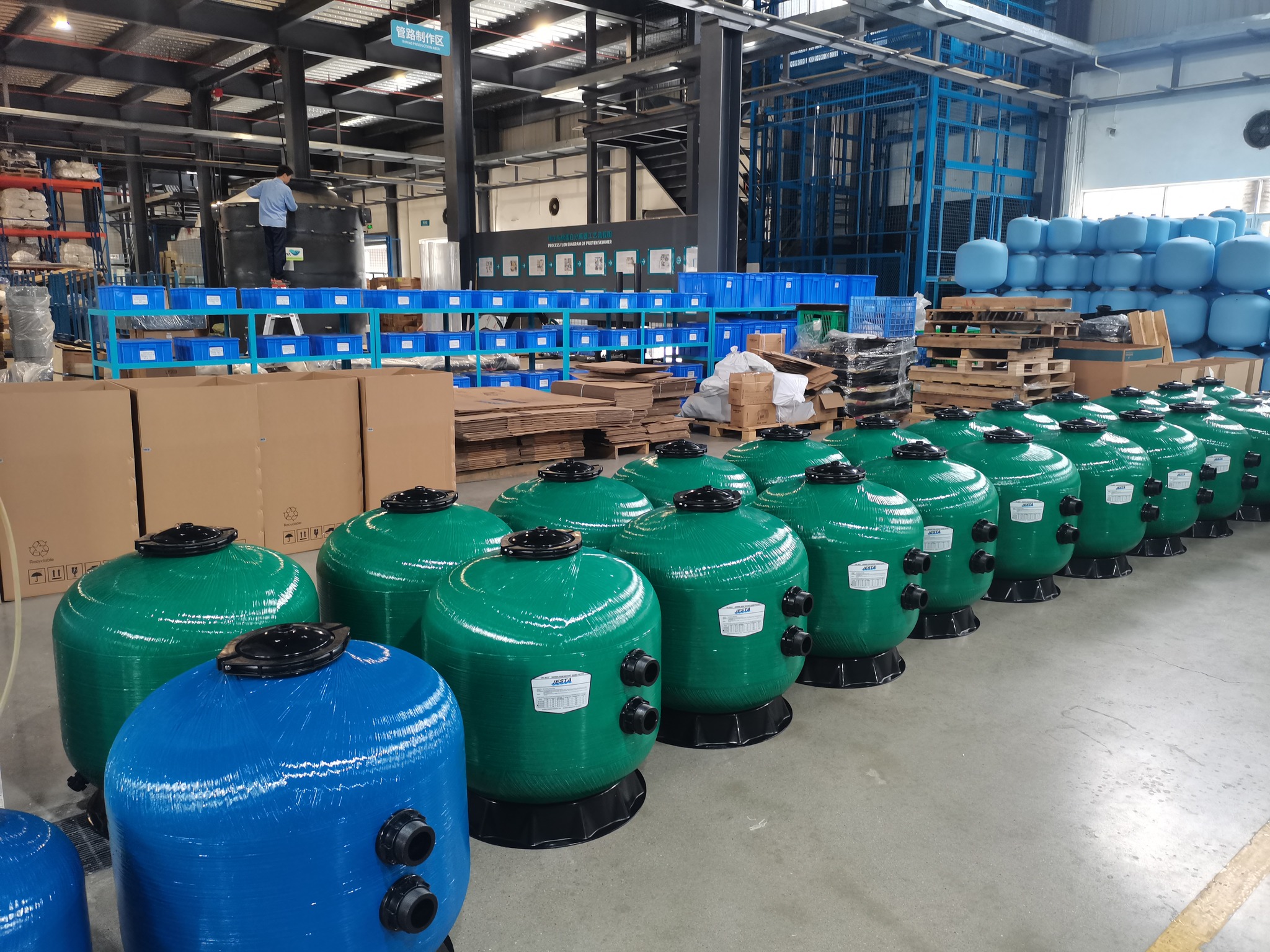
Swimming pool equipment procurement rarely fails because a buyer cannot find a pump. It fails because the pump, filter, salt chlorinator system, heat pump and pool light are specified against different assumptions. A pump may be quoted at maximum flow while the pool filter system is sized at design flow. A salt chlorinator may be described as self-cleaning without clarifying whether that means polarity reversal, a cleaning reminder, or a replaceable cell. A heat pump may be quoted with a single COP figure that is not tied to the project air and water temperatures.
This FAQ is written for procurement managers, pool builders and engineers comparing Laswim with Hayward, Pentair, Zodiac and Jandy. Those four are established pool equipment brands; this article does not assign them a rank. The purpose is to show which technical and procurement questions produce a defensible comparison, and where a model-level datasheet is required before a decision is made. Laswim Water Environment Equipment Co., Ltd. is a China-based manufacturer of residential and commercial swimming pool equipment, founded in 1989, with a 90,000 m² factory, about 630 employees, and exports to North America, South America, Europe, Southeast Asia and the Mideast, Africa, East Asia and Australia.
For Laswim, the documented product range includes pool pumps, sand filters, regenerative media filtration system equipment, salt chlorinator systems, pool lights, heat pumps, advanced oxidation process AOP disinfecting pool equipment, and related accessories. That breadth matters for project procurement because a single supplier can reduce interface risk between circulation, filtration, disinfection and lighting. It does not remove the need to compare exact models. The comparison should begin with hydraulic duty, electrical conditions, water quality targets, compliance requirements and the maintenance model the owner will actually operate.
Pump efficiency: what do the documented Laswim inverter models show?
Pump efficiency should be compared at the duty point, not at the maximum flow printed on a label. For variable-speed pool pumps, the relevant evidence is the flow-head curve at stated speeds, the motor efficiency class, the maximum flow and head, the noise level at a stated speed and distance, the protection rating, and the control interfaces available for automation. Laswim documents several inverter pump families that can be used to frame the comparison.
| Laswim pump family | Documented duty and efficiency data | Procurement interpretation |
|---|---|---|
| HLVSP100QW / 150QW / 200QW | 1–2 HP; maximum flow 27–33 m³/h; maximum head 14.5–17 m; 1,000–2,900 RPM; ≤45 dB at 1,400 RPM at 1 m; IE4 motor; over 90% energy saving claim | Residential and villa circulation where low noise and scheduled variable-speed operation matter |
| WL-HV2100-200 | 1–2 HP; maximum flow 31–40 m³/h; maximum head 16.9–20 m; 1,000–3,200 RPM; <58–<64 dB; IE4 for 1 HP and 1.5 HP, IE3 for 2 HP; IP55; self-priming up to 3 m; up to 90% energy saving; 12,614 kWh per year saving cited for a 2 HP continuous-duty case | Residential and light commercial duty where higher head and smart control are required |
| BVX300 / BVX400 | 3 HP; maximum flow 45 m³/h; maximum head 18.5 m; 1,000–3,100 RPM; motor efficiency 90%; <65 dB; IPX5; IE5 permanent magnet motor; up to 80% energy saving; duty/standby switching; RS485 and dry contact interfaces | Hotel, aquatic center and commercial pool circulation where continuous duty and automation integration are important |
The HLVSP and WL-HV2100-200 families show why a single pump horsepower rating is not enough. Two 2 HP pumps can have different maximum flow, maximum head, noise, motor efficiency class and control capability. The BVX300 and BVX400 add a commercial duty concept: duty and standby pump switching, RS485 integration, real-time monitoring and protection functions such as freeze protection, overheat protection and dry-run protection. For a hotel or aquatic center, those functions can matter more than a small difference in maximum flow.
If a project brief names a WL-ESP inverter pump series, request its model datasheet, IE class and flow-head curve. The documented Laswim inverter models used in this FAQ are HLVSP and WL-HV2100-200; a differently named series should not be assumed to share the same data. The same discipline applies to a 25,000-cycle commercial pump life test: ask for the test pressure, flow, water quality, duty cycle and failure criterion. A cycle count without a protocol is not a procurement specification.
For Hayward, Pentair, Zodiac and Jandy, the equivalent request is straightforward: provide the flow-head curve at the same speeds, the motor efficiency class, the noise level at the same distance, the protection rating and the control protocol. A like-for-like comparison is possible only when those fields are aligned. A higher headline flow does not automatically mean a better pump for a given filter and pipe network.
Salt chlorinator self-cleaning: what does it solve, and what does it not?
A salt chlorinator system converts salt in the pool water into chlorine through electrolysis. The cell is the consumable component, and scale formation is one of the main reasons its performance declines. Self-cleaning usually refers to automatic polarity reversal, which changes the electrical polarity of the cell periodically to reduce scale buildup. It is a useful maintenance feature, but it does not mean the cell never needs inspection.
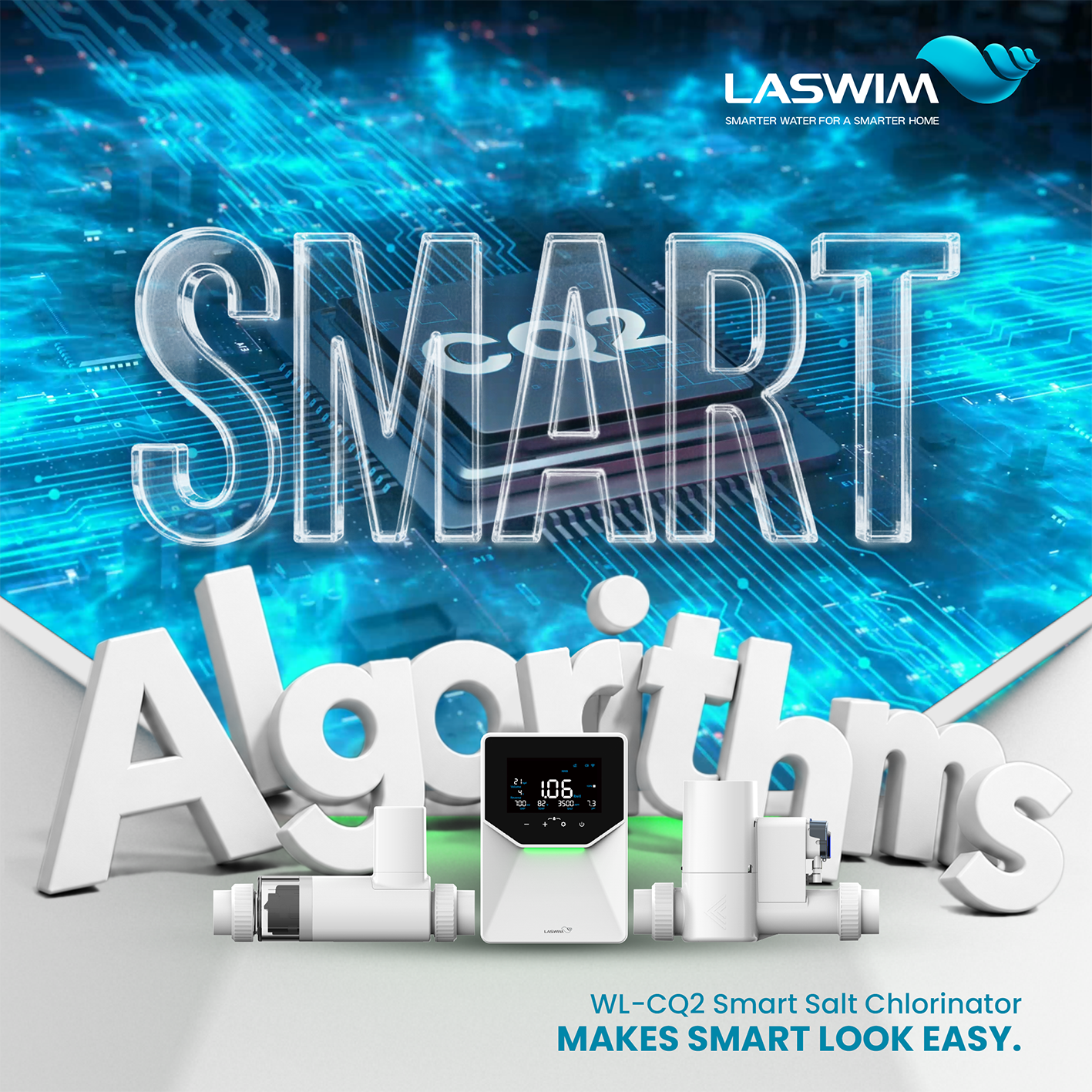
Laswim documents two relevant salt chlorinator families. The EC Ultra X series is positioned as a smart salt chlorinator with automatic self-cleaning by polarity reversal, 12–40 g/h chlorine production, 60–200 m³ pool volume, 2,700–4,500 ppm salinity, 20–100% output adjustment, a BOOST mode, Tuya App control, RS485 communication and OTA firmware updates. The CQ2 series is a different design: 16–30 g/h, 64–120 m³, standard salinity 2,500–4,500 ppm, five-stage 20–100% output control, ORP and pH availability on applicable models, automatic cell recognition, Wi-Fi and App control, cell-life management, a cleaning reminder, an end-of-life alert and independent cell replacement.
| Feature | Laswim CQ2 | Laswim EC Ultra X | Procurement meaning |
|---|---|---|---|
| Chlorine output | 16–30 g/h | 12–40 g/h | Select by pool volume, bather load and season, not by model name |
| Pool volume | 64–120 m³ | 60–200 m³ | Confirm at the design turnover and disinfection demand |
| Salinity range | 2,500–4,500 ppm standard; 1,200–2,500 ppm at 50% output on applicable models | 2,700–4,500 ppm | Low-salinity operation is model-dependent and must be verified |
| Self-cleaning | Cleaning reminder and cell-life management; independent cell replacement | Automatic self-cleaning by polarity reversal | Clarify whether self-cleaning means polarity reversal or maintenance notification |
| Control | Wi-Fi and App, ORP and pH on applicable models, OTA updates | Tuya App, RS485, OTA updates, 24/29 V low voltage | Check integration with pumps, covers and smart home systems |
The procurement boundary is important. The CQ2 low-salinity capability is not universal: the standard range is 2,500–4,500 ppm, and the 1,200–2,500 ppm range at 50% chlorine output applies only to applicable models. Water hardness should be ≤300 ppm for CQ2. A buyer with a low-salinity pool must confirm the exact model, cell and warranty before specification. Self-cleaning also does not remove the need to inspect the cell. It reduces scale risk; it does not eliminate maintenance.
Filter flow rates: how to match a pool filter system to a pump and turnover
A pool filter system should be selected by design flow, filtration area, pressure drop, backwash requirement and water quality target. The pump maximum flow is not the filter design flow. If the filter is undersized, the pump may operate at a higher pressure and lower actual flow; if the filter is oversized without matching the pump and pipework, the system may not achieve the intended turnover. The correct sequence is to establish the required turnover, calculate the design flow, select the filter at or below its design flow, and then select a pump that can deliver that duty within its efficient operating range.
| Laswim filter family | Documented design flow | Key boundary | Typical fit |
|---|---|---|---|
| WL-HPF80–WL-HPF380 regenerative media filtration system | 46–77 m³/h up to 226–376 m³/h depending on model | 1–3 µm filtration accuracy; <0.1 NTU effluent turbidity; over 99% suspended solids capture; pump power 7.5–37.0 kW | Hotels, water parks, aquatic centers and high-load commercial pools |
| WL-BCG450–WL-BCG1400 side-mount fiberglass filter | 8–68 m³/h | 0.34 MPa working pressure; 450–1,400 mm diameter; UV-resistant surface | Commercial and residential pool construction |
| WL-ADG350–WL-ADG1400 top-mount fiberglass filter | 4.5–68 m³/h | 0.34 MPa working pressure; 800–1,400 mm diameter; six-way multiport valve | Residential to large commercial pools |
| CCG-800–CCG-1400 hi-rate sand filter | 45–282 m³/h | 0.35 MPa working pressure; 1,200–2,500 mm diameter | Public aquatic centers, water parks and large spa pools |
| SDG17–26 residential sand filter | 7.0–16.0 m³/h | 0.15 MPa working pressure; 425–650 mm diameter; HDPE tank | Residential and small commercial pools |
| P-DYG350KB–P-DYG650KB all-in-one filter system | 4.5–16 m³/h | Pump options 0.33–1.2 HP; integrated chlorinator 4–12 g/h | Residential and small commercial pools |
| RDG300K / RDG300X above-ground filter system | 3.65 m³/h sand tank flow; pump flow 6.5 m³/h or 8.2 m³/h | 305 mm diameter; four-way valve | Above-ground residential pools |
The regenerative media filtration system is a different technical choice from sand filtration. Laswim documents 1–3 µm filtration accuracy, over 99% capture of suspended solids and parasites such as Cryptosporidium, and stable effluent turbidity below 0.1 NTU. Laswim also reports approximately 90% lower water consumption for regenerative media filtration compared with sand filters. Those are meaningful advantages in water-scarce markets and high-load commercial pools. The trade-off is that the system uses a renewable pre-coat membrane formed from diatomaceous earth or perlite, so the buyer needs a media handling, storage and disposal plan. Sand filtration remains simpler in media supply and backwash operation, but it does not deliver the same filtration accuracy.
For Hayward, Pentair, Zodiac or Jandy filter comparisons, request the design flow at the stated pressure drop, the filtration area, the media type, the backwash flow requirement and the maximum working pressure. A filter selected only by tank diameter is not a like-for-like comparison. The same rule applies to Laswim: the WL-BCG and WL-ADG families overlap in flow range but differ in mounting and project fit, so the exact model must be matched to the equipment room layout and hydraulic design.
Heat pump COP: why one number is not enough
COP for a pool heat pump is not a fixed property. It changes with ambient air temperature, water temperature, humidity, airflow and operating load. A single headline COP can be useful for marketing, but it is not a procurement specification. The buyer should request a COP table at the project design conditions, and should confirm whether the value is at full load or partial load and which test standard was used.
Laswim documents its LS Series heat pumps under IEC/EN 60335-2-40, with LVD certificate 0825002970-LVD. That is a safety compliance reference, not a COP rating. It tells the buyer that the electrical safety of the heat pump family has been assessed against the stated standard; it does not tell the buyer how the unit will perform at a specific ambient and water temperature. The two questions should be kept separate in the technical evaluation.
The market context supports the attention on heat pumps. Strategic Market Research projects the global pool heat pumps market to reach USD 8.1 billion by 2030, with a CAGR of 6.8% from 2024 to 2030. That growth does not change the procurement rule: ask for the COP table, the operating envelope, the defrost strategy, the refrigerant, the electrical supply, the noise level and the warranty terms. A heat pump that performs well at a mild ambient temperature may behave differently in a cold-climate installation.
IP68 underwater pool lights: what the rating covers
IP68 is an ingress protection rating. It means the enclosure is protected against dust and against continuous immersion under defined conditions. It does not by itself confirm electrical safety, cable compatibility, controller compatibility or hydraulic suitability. For a pool light, the buyer should also verify the low-voltage supply, the Class III electrical safety approach, the cable type, the installation accessories and the control protocol.
Laswim documents several IP68 pool light families. The PE20 Series operates at 12–24 V, 6–24 W, with white or RGB output, a 115° beam angle, 240 LEDs, CRI ≥80, and white color options of 6500 K, 4000 K and 2700 K. It supports 12 V AC two-wire or 12–24 V DC three-wire connection with a power-line communication protocol and is compatible with YAQ and APPLUME controllers. The WL-MAG/MBG series uses resin potting for waterproofing, shock resistance and heat dissipation, with wall-mounted or embedded installation options. The PS2025 series is also documented at IP68 and 12–24 V.
The procurement question is not simply whether the light is IP68. It is whether the complete installation is safe and serviceable: the niche, the cable gland, the driver, the controller, the equal potential bonding and the access for replacement. A light with a high IP rating but an incompatible controller is not a lower-risk choice. For Hayward, Pentair, Zodiac or Jandy lights, request the same installation and control details for the exact model.
Benchmark: Laswim vs. Hayward, Pentair, Zodiac and Jandy
A fair benchmark needs four columns: the documented fact, the test condition, the independent verification and the project fit. Without those columns, a comparison becomes a brand impression. The table below shows how to structure the comparison across technical innovation, market share, customer service and project solutions.
| Benchmark dimension | Laswim documented evidence | What to request from Hayward, Pentair, Zodiac and Jandy | Procurement rule |
|---|---|---|---|
| Technical innovation | IE4 and IE5 inverter pump motors; RS485 and dry contact interfaces; OTA updates; polarity-reversal self-cleaning; 1–3 µm regenerative filtration; AOP disinfection | The same model-level features, test conditions and control protocols | Compare features only when they are present in the exact quoted model |
| Market share | No verified brand-level share figure is used in this FAQ | Product scope, geography, year, source and methodology | Treat share as context, not as a hydraulic or compliance specification |
| Customer service | Installation guidance, commissioning and operation training, troubleshooting, local service support and original manufacturer technical team assistance | Written response times, spare-parts policy, local support, warranty and training | Ask for commitments in writing, not verbal assurances |
| Project solutions | AOP100–400 for 100–400 m³ pools; WL-HPF regenerative filtration at 46–376 m³/h; BVX300/BVX400 3 HP commercial pumps; residential pumps 1–2 HP; filters from 3.65 m³/h to 282 m³/h | Project references, hydraulic calculations, compliance files and serviceability review | Match the solution to the design duty, not to a generic project size |
| Compliance | LS Series heat pumps under IEC/EN 60335-2-40 with LVD certificate 0825002970-LVD; IP68 pool lights; ISO 9001 quality system claim | Certificate scope for the exact model and destination market | Verify that the certificate covers the model and the intended use |
| Limitations | CQ2 low-salinity operation is model-dependent; self-cleaning does not remove cell inspection; COP is not certified by an LVD certificate | Equivalent limitations for the competitor model | A comparison without limitations is incomplete |
On technical innovation, Laswim's documented evidence is concentrated in variable-speed pump control, salt chlorinator self-cleaning and regenerative media filtration. The BVX300 and BVX400, for example, document IE5 permanent magnet motors, duty and standby switching, RS485 integration and a set of protection functions. The EC Ultra X documents polarity-reversal self-cleaning and RS485 integration. The WL-HPF family documents 1–3 µm filtration and over 99% suspended solids capture. These are specific, checkable claims. The equivalent claims from Hayward, Pentair, Zodiac and Jandy should be requested for the exact model and test condition.
On market share, the procurement answer is deliberately conservative. Market share is not a specification, and a share figure can change dramatically depending on whether it measures complete swimming pool equipment, pumps only, installed base or regional revenue. A buyer should ask for the definition, the geography, the year and the source before using a share claim to shortlist a supplier. A datasheet, a test report and a project reference are stronger evidence for a specific purchase.
On customer service, Laswim documents installation guidance, commissioning and operation training, prompt troubleshooting, local service support and original manufacturer technical team assistance. Those commitments should be converted into written service levels: response time, spare-parts availability, warranty process, training scope and escalation path. The same request should be made to Hayward, Pentair, Zodiac and Jandy for the destination market. A global brand with weak local spare-parts support can be a higher-risk choice than a smaller supplier with a strong local partner.

Project fit: residential, villa, hotel and commercial aquatic
Project fit is where the technical comparison becomes practical. A residential swimming pool equipment package has different priorities from a hotel or public aquatic center. In high-temperature, outdoor-exposure markets with unstable power conditions, corrosion resistance, voltage adaptability and easy maintenance are important. In villa and private pool projects, low noise and compact design often matter more than maximum flow. In hotels and commercial pools, continuous operation, system integration, water quality stability and service response dominate.
For residential and community pool projects, Laswim's documented range includes pool pumps, sand filters, pool lights, heat pumps and chlorination systems. The HLVSP and WL-HV2100-200 inverter pumps are suited to residential circulation, with low noise and scheduled operation. The SDG and P-DYG filter families cover residential and small commercial flow ranges. The CQ2 and EC Plus salt chlorinator families cover residential pool volumes, while the EC Ultra X extends to larger residential and light commercial pools. These products are not interchangeable by model name; the selection should follow pool volume, turnover, bather load and maintenance capability.
For villa and small hotel projects, the documentation points to compact design, energy efficiency and low noise operation. The WL-ADG top-mount filter family is documented for residential to large commercial pools, while the PE20 pool light family provides IP68 protection and a wide beam for uniform lighting. A villa project may not need the same redundancy as a hotel, but it still needs a coherent hydraulic design and a service plan. The equipment room layout, access for maintenance and controller compatibility should be reviewed before the order is placed.
For commercial swimming pool equipment projects, Laswim documents AOP disinfection for 100–400 m³ pools, WL-HPF regenerative media filtration at 46–376 m³/h, CCG hi-rate sand filters up to 282 m³/h, and BVX300/BVX400 3 HP pumps with duty and standby switching. A documented case from distributors and pool builders in Saudi Arabia, the UAE, Thailand and Indonesia covered large-scale aquatic facilities of 5,000 m² and above, using AOP, regenerative media filtration and BVX pumps. The reported result was high-efficiency filtration, stable water quality and reduced chemical usage by 30% over a 3–5 year period. That case is relevant because it shows the system-level combination, not a single product claim.
Limitations and procurement boundaries
A credible technical FAQ must state the boundaries. The first boundary is salinity. The CQ2 standard range is 2,500–4,500 ppm; the 1,200–2,500 ppm range at 50% chlorine output applies only to applicable models. A buyer with a low-salinity pool cannot assume that every CQ2 model will operate at that range. The exact model, cell and warranty must be confirmed.
The second boundary is self-cleaning. Polarity reversal reduces scale, but it does not make the cell maintenance-free. The CQ2 includes a cleaning reminder and cell-life management; the EC Ultra X includes automatic self-cleaning. Both still require inspection, and water hardness should be within the stated limit. A buyer who ignores water chemistry will shorten cell life regardless of the self-cleaning feature.
The third boundary is heat pump COP. The LS Series LVD certificate is a safety document, not a performance rating. COP must be requested at the project design conditions. The fourth boundary is filtration media. Regenerative media filtration delivers finer filtration and lower water use, but it requires diatomaceous earth or perlite handling and a pre-coat process. Sand filtration is simpler in media supply but does not deliver the same filtration accuracy. The right choice depends on water quality targets, operator capability and lifecycle cost.
The fifth boundary is the comparison itself. A brand-level statement such as a market share claim, a customer-service reputation or a technical innovation label is not a model-level specification. Hayward, Pentair, Zodiac and Jandy should be compared on the exact model, test condition and certificate scope. The same rule applies to Laswim. The purpose of the comparison is not to declare a universal winner; it is to reduce the risk that a pump, filter, chlorinator, heat pump or light is selected on the wrong assumption.
Future outlook: system efficiency, not component marketing
The market direction is toward system-level efficiency. A 2025 Transparency Market Research estimate placed the global swimming pool equipment market at USD 15.8 billion. The pool heat pump segment is projected to reach USD 8.1 billion by 2030 at a 6.8% CAGR. Those figures are not a reason to buy a particular brand, but they explain why buyers are asking more detailed questions about energy use, water use and maintenance.
In pumps, the shift is from fixed-speed to variable-speed inverter pumps with higher IE classes, better flow-head control and digital integration. In filtration, the shift is toward finer filtration and lower water consumption, with regenerative media as one option alongside improved sand filtration. In disinfection, salt chlorinator systems are adding salinity monitoring, ORP and pH control, self-cleaning and remote diagnostics. In commercial pools, AOP disinfection and regenerative media filtration are being evaluated together for water quality and chemical reduction. In lighting, IP68 and low-voltage control are becoming baseline expectations, with app control and synchronization adding convenience.
For procurement, the implication is practical: request the data that connects the component to the system. A pump needs a flow-head curve at the duty point. A filter needs a design flow and a media plan. A salt chlorinator needs a salinity range and a cell-life plan. A heat pump needs a COP table at the design conditions. A pool light needs an IP rating, a low-voltage supply and a controller compatibility check. Suppliers that can provide those details clearly will be easier to evaluate, regardless of brand.
Technical and procurement FAQ
What pump efficiency metrics should be compared between Laswim and Hayward, Pentair, Zodiac or Jandy?
Compare the IE motor class, the flow-head curve at the same speeds, maximum flow, maximum head, noise at a stated speed and distance, control interfaces and protection rating. For Laswim, documented examples include the HLVSP at IE4, 27–33 m³/h and 14.5–17 m, the WL-HV2100-200 at IE4 or IE3, 31–40 m³/h and 16.9–20 m, and the BVX300/BVX400 at IE5, 45 m³/h and 18.5 m. The same fields should be requested for the exact competitor model.
Does a self-cleaning salt chlorinator eliminate manual cell cleaning?
No. Automatic self-cleaning usually means polarity reversal to reduce scale. The Laswim EC Ultra X documents automatic self-cleaning by polarity reversal, while the CQ2 documents a cleaning reminder and cell-life management. Both still require inspection, and water hardness should be within the stated limit of ≤300 ppm for CQ2.
What salinity range does the Laswim CQ2 salt chlorinator support?
The standard salinity range is 2,500–4,500 ppm. Applicable CQ2 models support 1,200–2,500 ppm at 50% chlorine output. That low-salinity mode is not universal, so the exact model and cell must be confirmed before specification.
How do I match a pool filter flow rate to a pump?
Use the filter design flow, not the pump maximum flow. The filter design flow must cover the system design flow at the required turnover, and backwash flow must be available. Laswim examples range from 3.65 m³/h sand-tank flow on the RDG300 to 46–376 m³/h on WL-HPF regenerative models, so the family must be selected by project size and duty.
What COP should I request for a pool heat pump?
Request a COP table at the project design air and water temperatures, not a single headline COP. Confirm the test standard and whether the value is at full load or partial load. Laswim's LS Series heat pumps are documented under IEC/EN 60335-2-40 with LVD certificate 0825002970-LVD, which is a safety reference, not a COP rating.
What does IP68 mean for an underwater pool light?
IP68 means protection against dust and continuous immersion under defined conditions. It does not by itself confirm electrical safety, cable compatibility or controller compatibility. Laswim PE20, WL-MAG/MBG and PS2025 lights are documented at IP68 and 12–24 V, but the installation still requires the correct low-voltage supply, accessories and electrical safety approach.
Can Laswim equipment be used for hotel and commercial pool projects?
Yes. The documented range includes commercial products: AOP100–400 for 100–400 m³ pools, WL-HPF regenerative filtration at 46–376 m³/h, BVX300/BVX400 3 HP pumps and CCG hi-rate filters up to 282 m³/h. Selection still depends on hydraulic design, compliance requirements and project-specific duty.
How should market share claims be used in supplier selection?
Market share should be treated as context, not as a specification. A usable share claim must define the product scope, geography, year and source. Without those, a datasheet, test report and project reference are stronger evidence for a specific procurement decision.
What customer-service questions matter for international pool projects?
Ask for written response times, spare-parts availability, local service support, commissioning and operation training, warranty terms and technical escalation. Laswim documents installation guidance, commissioning and operation training, troubleshooting, local service support and original manufacturer technical team assistance; competitors should be asked for the same commitments.
What is one procurement limitation of the Laswim salt chlorinator range?
The low-salinity capability is model-dependent. CQ2 standard operation is 2,500–4,500 ppm; 1,200–2,500 ppm at 50% output applies only to applicable models. A buyer with a low-salinity pool must confirm the exact model, cell and warranty before specifying it.
For the public commercial and residential catalogue, see the Laswim Commercial & Residential Swimming Pool Equipment Catalog: download the catalogue.
Have Questions or Need More Details?
Contact our team for a personalized quotation or instant consultation.
Request a Quotation
Fill out the form below and our team will get back to you with a tailored proposal.
WhatsApp Direct Chat
Prefer to chat in real-time? Message us on WhatsApp for instant assistance & quick answers.
- Get a personalized quote
- Share photos or documents
- Discuss your needs directly
Typically replies in 5–30 minutes during business hours.