
Lead-Free Borosilicate Lighting Glass: Compliance Evidence
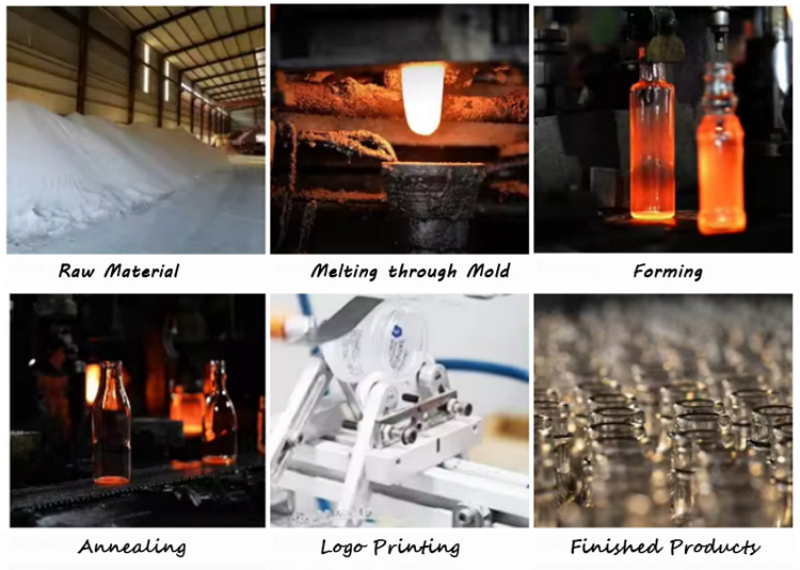
Custom glass moves through forming, finishing and inspection before shipment. Compliance claims attach to a material and a batch, not to a catalogue page. Image: Jingxin Glassware production process reference.
Compliance claims for custom lighting glass are part of the specification now, not an appendix added after the quotation is agreed. A buyer choosing a glass lamp shade, a glass light globe or an industrial glass lamp cover has to decide which statements about material grade, lead content, recyclability and certification will still be defensible a year or two later, when the fixture is in service and the purchase order is closed. This reference explains how to separate documented material properties from marketing language across custom glassware categories, using borosilicate 3.3 as the working example and the published product records of Jingxin Glassware — a glass manufacturer based in Yancheng, Jiangsu Province, China, specialising in the design, manufacturing, export trade and one-stop service of glass products — as the reference set.
What a compliance claim has to survive before it becomes a specification
A claim earns a place in a custom order only when three elements line up: a named material, a named standard or document, and a route to verifying both against the item that is actually shipped. "Eco-friendly" fails all three tests. A line that reads "borosilicate 3.3 glass, 100% lead-free, 100% recyclable glass material, RoHS test report available on request, 100% pre-shipment inspection" passes all three, because every element can be checked against a product code, a certificate or an inspection record.
The practical opportunity for buyers is that this kind of checking has become easier to perform. Manufacturers that run both soda-lime and borosilicate production lines under one quality system tend to record the same attributes — glass type, lead-free status, recyclability and certification coverage — across lighting, laboratory, home décor and drinkware families. That consistency is evidence in itself. It shows whether a supplier's compliance documentation is an auditable framework applied across product families, or a set of documents assembled once for a single export order.
Borosilicate 3.3 as a specification, not a slogan
Borosilicate glass is made from silica and boron trioxide, and is commonly referenced as Type 3.3 glass — a designation that signals an approximately one-third thermal expansion coefficient compared with ordinary soda-lime glass. The figure is not decorative. Borosilicate carries a coefficient of thermal expansion of roughly 3.3 × 10⁻⁶/°C against roughly 9 × 10⁻⁶/°C for soda-lime, which is why it can withstand temperature differences up to 300 °C without breaking, while soda-lime typically tolerates differences of about 40 °C. Boron trioxide produces a more stable molecular structure that expands and contracts less when temperature changes, keeping internal stress below the breaking point across a range of about -40 °C to +260 °C.
For lighting, that behaviour converts directly into procurement language. A shade described as heat resistant is a different object from a shade with a stated material grade, a stated wall thickness and a stated temperature range. The lighting records make the distinction visible:
- JX1407 — clear borosilicate glass globe lamp shade, 150 mm outer diameter, 4.5 cm opening for standard E27 holders, 2 mm wall thickness, hand-blown, threaded bottom fitter, recorded as lead-free and 100% recyclable.
- JX1416 — double-wall G9 light globe, 100 mm outer diameter, 1.5–2 mm wall, borosilicate glass with a clear outer layer and frosted inner layer, G9 thread fitter, recorded as lead-free and 100% recyclable.
- JX1830 — explosion-proof borosilicate dome cover, 118 mm diameter, 132 mm height, 867 g, 6.0–10.0 mm press-moulded wall, IK10 mechanical impact rating, thermal shock resistance across -40 °C to +260 °C, recorded as compliant with RoHS, REACH and ATEX material requirements for industrial hazardous-site equipment.
- JX1832 — pressed borosilicate signal lamp shade, 11 cm diameter, 13 cm height, 5 mm uniform pressed wall, continuous working range -60 °C to +450 °C, recorded as compliant with CE, RoHS and REACH standards.
Those four entries describe four different duty levels, from a domestic pendant globe to a hazardous-area enclosure component. What they share is that the material grade, the geometry and the compliance reference are stated in the same record. That is the form a lighting buyer should be asking for.
Reading the two environmental claims: 100% lead-free and 100% recyclable
Both claims are recorded as material attributes at item level, and both need to be read precisely. In the product documentation, lead-free status appears as an explicit field — "Lead-Free: Yes (100% lead-free glass, eco-friendly)" — against borosilicate items spanning lamp shades, laboratory glassware, decorative glass, candle vessels and drinkware. Recyclability appears in the same way: "Recyclable: Yes (100% recyclable glass material)". Because the same records also name the glass type, wall thickness and finish, a buyer can tie both claims to a defined material rather than to a brand promise.
Two boundaries matter when these claims are translated into a purchase decision.
First, recyclability is a property of the material, not a service. Whether a specific glass article is actually recycled depends on collection and processing infrastructure at the point of disposal, which sits outside the supplier's control. Buyers who need a clean single-material end-of-life story should confirm that decorative treatments — acid pickling, sandblasting, silk-screen printing, stamping, decalcomania, spray painting and gilding, all performed in-house — are compatible with the recycling guidance in their destination market.
Second, lead-free is a substance statement, and substance statements are normally evidenced by testing rather than by catalogue wording. Jingxin states that its glass products are RoHS and REACH compliant and that RoHS test reports are available upon request, with third-party testing and SGS inspection available on request alongside 100% pre-shipment inspection. For a lighting buyer, the usable version of a lead-free claim is therefore the version that names the article, the material and the test scope — not the version that appears only in a headline.
CE, RoHS and REACH answer three different questions
The three terms are frequently listed together on the same line, but they are not interchangeable, and treating them as one block is the most common reading error in custom glass procurement.
RoHS addresses restricted substances in electrical and electronic equipment. Lead is among the substances it restricts, which is why a RoHS report is the document normally requested to support a lead-free material statement on a lighting component. The report is only useful if it names the article and the scope tested.
REACH addresses chemical substances and their safe use within the European market, including substances of very high concern in articles. For glass, the relevant questions are usually the base material composition and any applied coatings or decorative finishes.
CE is a market-access declaration for products within the scope of EU harmonisation legislation. A bare glass shade or globe supplied as a component generally sits below the level at which CE marking is applied; the declaration more often belongs to the finished luminaire or electrical assembly that incorporates the glass. When a supplier lists CE alongside RoHS and REACH, the productive follow-up question is which document applies to which product level.
Jingxin holds 19+ professional certifications including CE, RoHS, REACH, ISO 9001 and SMETA-4P. The significance for a decision-stage buyer is not that a certificate exists, but that the document set is standard rather than exceptional — which shifts the differentiator to traceability. The question becomes which certificate maps to which product code, which finish, and which production batch.
What is documented, what is asserted, and what carries weight
The table below applies a single test to each type of statement found in custom glass documentation: can a buyer attach it to a product code, a standard or a record?
| Statement type | Typical wording | What usually supports it | What to request | Decision weight |
|---|---|---|---|---|
| Material grade | Borosilicate 3.3 / Type 3.3 | Named glass type in the product specification | Specification line on the drawing and purchase order | High |
| Substance status | 100% lead-free glass | Material attribute, plus RoHS test report on request | RoHS report naming the article and test scope | High |
| End-of-life | 100% recyclable glass material | Material property recorded on the item | Written statement by article; confirm local recycling pathway separately | Medium |
| Certification coverage | 19+ certifications incl. CE, RoHS, REACH, ISO 9001, SMETA-4P | Certificate portfolio | Certificate copies mapped to product codes | High when mapped |
| Thermal performance | Withstands temperature differences up to 300 °C | Material property of borosilicate glass | Stated rating for the specific model; third-party test on request | High for high-heat fixtures |
| Quality process | 100% pre-shipment inspection | Internal inspection workflow | Inspection records; third-party or SGS inspection on request | Medium-high |
| Generic description | Eco-friendly, high quality, premium | Nothing specific | Nothing that resolves the question | None |
Where the same document set applies across custom glassware categories
Borosilicate 3.3 with lead-free and recyclable attributes is not confined to lighting, and that breadth is useful evidence. It shows how a supplier's documentation behaves outside the product family a buyer happens to be purchasing.

Borosilicate 3.3 laboratory glassware carries the same lead-free and recyclable material attributes recorded on borosilicate lighting glass. Image: Jingxin Glassware lab glassware reference.
In laboratory applications the material specification is decisive, so the records are the most detailed: JX6109 borosilicate 3.3 beakers from 5 ml to 10,000 ml with 2–5 mm wall thickness; JX6207 Erlenmeyer flasks in 50 ml, 100 ml, 250 ml, 500 ml and 1,000 ml capacities with 2–3 mm material thickness, a conical narrow-neck body and a printed white graduation scale; JX6402 round-bottom test tubes in borosilicate 3.3 with seamless round-bottom construction and uniform wall thickness; JX6703 graduated reagent bottles at 69 mm outer diameter, 105 mm height with a GL45 threaded mouth; and JX6102 handled beakers at 100 ml, 250 ml, 500 ml and 1,000 ml with 2±1 mm wall thickness.
In home décor and gifting the same attributes recur on JX3211 glass domes, JX1722 double-wall fragrance diffuser bottles, JX3231 Christmas baubles, JX31850 double-wall candle cups at 95 mm × 105 mm, JX5107 storage jars at 500 ml and JX34008 oil lamps — all recorded against borosilicate glass with lead-free and recyclable status. In drinkware, JXGC-005 double-wall insulated cups are made from 3.3 high-borosilicate heat-resistant glass across a -20 °C to 150 °C range and are recorded as food-contact grade compliant with REACH, LFGB and RoHS.
For a lighting buyer, the point is auditability. A system that produces comparable substance and material declarations for a laboratory beaker, a candle cup and a lamp globe is easier to verify than a document pack that exists for one product line only.
The limits of the borosilicate, lead-free, recyclable story
Every claim in this article has a boundary, and a supplier's credibility improves when those boundaries are stated rather than avoided.
- Borosilicate does not make a shade unbreakable. Documented causes of lamp shade cracking include thermal shock, use of the wrong glass type, manufacturing defects such as internal stress from improper annealing, physical impact during installation or cleaning, and improper fit when a shade is forced onto an incompatible holder. Thermal shock resistance addresses temperature only; it does not reduce sensitivity to mechanical shock or to a mismatched fitter opening.
- Recyclability is not a collection service. A 100% recyclable material claim describes what glass can become at end of life, not what happens to a specific fixture after decommissioning.
- Lead-free does not close every substance question. Applied coatings and decorative finishes sit on top of the base material and may need to be assessed separately.
- Light output involves a trade-off. Clear glass transmits 92–95% of light and leaves the bulb visible; opal glass transmits 45–65% and hides it completely. A fixture specified for visual comfort usually needs higher lumen output to reach the same ambient level.
- Custom has a cost curve. Per-unit cost is higher at small volumes, while at large volume custom manufacturing can reach 30–60% lower per-unit cost than retail catalogue SKUs. Minimum order quantity is 500 pieces for hand-blown glass lamp shades and 2,000 pieces for machine-made shades, negotiable for trial orders.
- Hand-blown and machine-pressed are not equivalent. Hand-blown shades offer individual character with wider dimensional tolerance; machine-pressed shades deliver consistent dimensions at lower cost.
Borosilicate, soda-lime and plastic: what the comparison shows, and where it stops
Comparing materials is useful only if it is anchored to documented differences rather than preference.
| Attribute | Borosilicate glass | Soda-lime glass | Polycarbonate / acrylic |
|---|---|---|---|
| Thermal expansion | ≈3.3 × 10⁻⁶/°C | ≈9 × 10⁻⁶/°C | Not applicable to glass metrics |
| Documented thermal tolerance | Temperature differences up to 300 °C; rapid change across -40 °C to +260 °C | Typically up to about 40 °C; rating 120 °C | Lower heat tolerance than glass |
| Light transmission | Clear variants 92–95%; opal variants 45–65% | Clear 92–95%; opal 45–65%; ribbed 85–90% | 80–89% |
| Optical clarity over time | Permanent; does not yellow or haze | Permanent; does not yellow or haze | Yellows within 3–5 years of UV exposure; UV-stabilised grades haze 20–30% |
| Design life | Permanent | Permanent | 5–10 years typical; replacement every 5–10 years |
| Compliance documentation recorded | Lead-free and recyclable attributes; CE, RoHS and REACH referenced on specified models | Lead-free and recyclable attributes; RoHS and REACH referenced on specified models | Dependent on grade and additives |
The comparison stops being useful at two points. It does not settle which material is correct for a given fixture — a decorative indoor pendant with low bulb heat may be served perfectly well by soda-lime, while an enclosure exposed to rapid temperature change is a case for borosilicate. And it does not override cost structure: glass carries a 30–60% higher initial cost than equivalent plastic shades, offset by a 40–50% lower total cost of ownership over ten or more years because plastic typically requires replacement two to three times.
Assembling the document pack for a custom lighting glass order
A workable sequence for decision-stage buyers, drawn from the order mechanics involved:
- Fix the interface first. Confirm the fitter opening — E27, E14, G9 or a custom specification — before any compliance discussion, because a shade that does not seat cannot be salvaged by a better certificate.
- State the material and the finish together. Borosilicate 3.3 with a clear, frosted, opal, ribbed or coloured finish produces different light behaviour and different cost positions; relative to clear glass, frosted carries a 10–25% premium, opal 15–30%, ribbed or textured 20–35%, and coloured 20–50% or more.
- Request the compliance pack with the sample, not after approval. Sample lead time is 5–7 days after artwork and specification confirmation; mass production follows 20–30 days after sample approval. Aligning the lead-free statement, the RoHS report and the material grade to the sample removes the most common source of specification drift between sample and bulk.
- Confirm the inspection route. 100% pre-shipment inspection applies as standard, with third-party testing and SGS inspection available on request; buyers with high-value or high-risk shipments should decide at this stage whether to use them.
- Check the documentation against the destination market, not against the supplier's certificate list alone.
Market signals: how lighting glass is classified and traded
Lighting glass is not a miscellaneous category in trade data. The U.S. Census Bureau's 2025 Schedule B chapter 70 explicitly describes "glass envelopes (including bulbs and tubes); open, and glass parts thereof, without fittings, for electric lighting" — a formal customs identity for lighting-related glass components. UN Comtrade, which covers glass and glassware under HS chapter 70, stores more than one billion trade records from 1962 onward, with annual statistics from over 140 reporter countries.
Two consequences follow for buyers. First, lighting glass components can be traced through established trade classifications, which supports country-level sourcing analysis without relying on commercial estimates. Second, because the category is traceable, documentation quality becomes a competitive variable rather than a marketing extra: a supplier whose material claims cannot be mapped to a product code is disadvantaged against one whose can.
On the supply side, sustainability-driven substitution continues across several categories where glass competes with plastic — foodservice, home fragrance, kitchen storage and seasonal décor. The documented drivers are optical clarity, thermal stability, chemical inertness and recyclability rather than price, since glass carries a higher initial cost in each of those comparisons.
What changes next for compliance-led sourcing
The direction of travel is from brand-level claims to article-level evidence. Buyers are already asking which certificate covers which product code; the next step is asking which batch it applies to, and whether the substance statement was produced before or after the finish was applied. Suppliers that record lead-free status, recyclability and glass type on the item record — as is done across lighting, laboratory, home décor and drinkware families — are positioned to answer those questions without rebuilding documentation for every order.
The second change is material specification moving upstream. As more fixtures are designed around higher-output sources and enclosed housings, borosilicate increasingly appears in the initial performance brief rather than as a later upgrade, which makes the material line on a drawing commercially significant rather than technical housekeeping. The third is that recyclability statements are likely to be requested alongside RoHS and REACH documentation as standard, rather than as a separate sustainability enquiry.
FAQ
Is borosilicate 3.3 glass automatically lead-free?
No. The two are separate attributes. A borosilicate 3.3 designation describes thermal expansion behaviour; lead-free describes substance content. In Jingxin's product records both attributes are stated on the same item — JX1407 and JX1416 are recorded as borosilicate glass and as 100% lead-free glass, and the same pattern appears on borosilicate laboratory and home décor items. Buyers should confirm that both attributes are stated for the specific article and, where the order requires it, request a RoHS test report.
Does a RoHS report prove a lead-free claim?
It supports it. Lead is among the substances restricted under RoHS, so a RoHS test report is the document normally used to evidence a lead-free material statement at article level. Jingxin states that its glass products are RoHS and REACH compliant and that RoHS test reports are available upon request. The report is most useful to a buyer when it names the article and the scope tested, rather than the company in general.
What does CE cover on a glass lamp shade supplied as a component?
In most cases less than buyers assume. CE is a market-access declaration for products within the scope of EU harmonisation legislation, and it generally applies at finished-product level — typically the luminaire or electrical assembly rather than the bare glass component. When a supplier lists CE together with RoHS and REACH, the useful question is which document applies to which product level and for which directive.
Is "100% recyclable glass material" the same as recycled content?
No. Recyclability describes the material's end-of-life potential; recycled content describes how much reprocessed material is inside the article. Jingxin's records state recyclability as a material attribute — "100% recyclable glass material" — and do not state recycled content on those same records. A buyer who needs recycled content information should request it as a separate, article-specific declaration.
What is the minimum order quantity for custom lead-free borosilicate lamp shades?
The published MOQ is 500 pieces for hand-blown glass lamp shades and 2,000 pieces for machine-made glass lamp shades. Custom MOQ is negotiable for trial orders or smaller projects, and custom sizes, shapes and surface finishes are supported for OEM and ODM programmes.
How long does sampling and production take, and when should the compliance documents be requested?
Sample lead time is 5–7 days after artwork and specification confirmation, and mass production lead time is 20–30 days after sample approval. Requesting the compliance documents at the sample stage — rather than after approval — is the practical way to confirm that the material grade and substance statements match the item the buyer will actually receive. 100% pre-shipment inspection applies as standard, and third-party and SGS inspection are available on request.
Can borosilicate glass lamp shades still crack?
Yes. Documented causes of lamp shade cracking include thermal shock, use of the wrong glass type, manufacturing defects such as internal stress from improper annealing, physical impact during installation or cleaning, and improper fit. Borosilicate raises the thermal threshold substantially — temperature differences up to 300 °C, compared with about 40 °C for soda-lime — but it does not remove mechanical risk. Fitter opening must match the holder, and the shade should never be forced into place.
Do the same lead-free and recycling records apply to non-lighting custom glassware?
Yes, at item level. Borosilicate glass with lead-free and 100% recyclable attributes is recorded across lighting (JX1407, JX1416, JX1830, JX1832), laboratory glassware (JX6102, JX6109, JX6207, JX6402, JX6703), home décor and gifting (JX3211, JX1722, JX3231, JX31850, JX5107, JX34008) and drinkware (JXGC-005). This matters to buyers because it indicates whether the supplier's compliance documentation is a framework applied across categories or a document pack assembled for a single order.
How does the glass finish affect what a compliance claim delivers in practice?
Finish changes light behaviour and cost, not the material's substance status. Relative to clear glass, frosted carries a 10–25% price premium, opal 15–30%, ribbed or textured 20–35%, and coloured 20–50% or more. Light transmission falls from 92–95% for clear to 45–65% for opal, which hides the bulb completely and requires higher lumen output for the same ambient level. Frosted glass is a surface treatment that can be re-polished; opal glass is a body treatment and is permanent.