
Lead-Free Mandate 2026: NSF 61 and AB1953 for Brass Valves
HTNXT Industry Reference | Compliance & Procurement
Lead-Free Mandate 2026: NSF 61 and AB1953 for Brass Valves
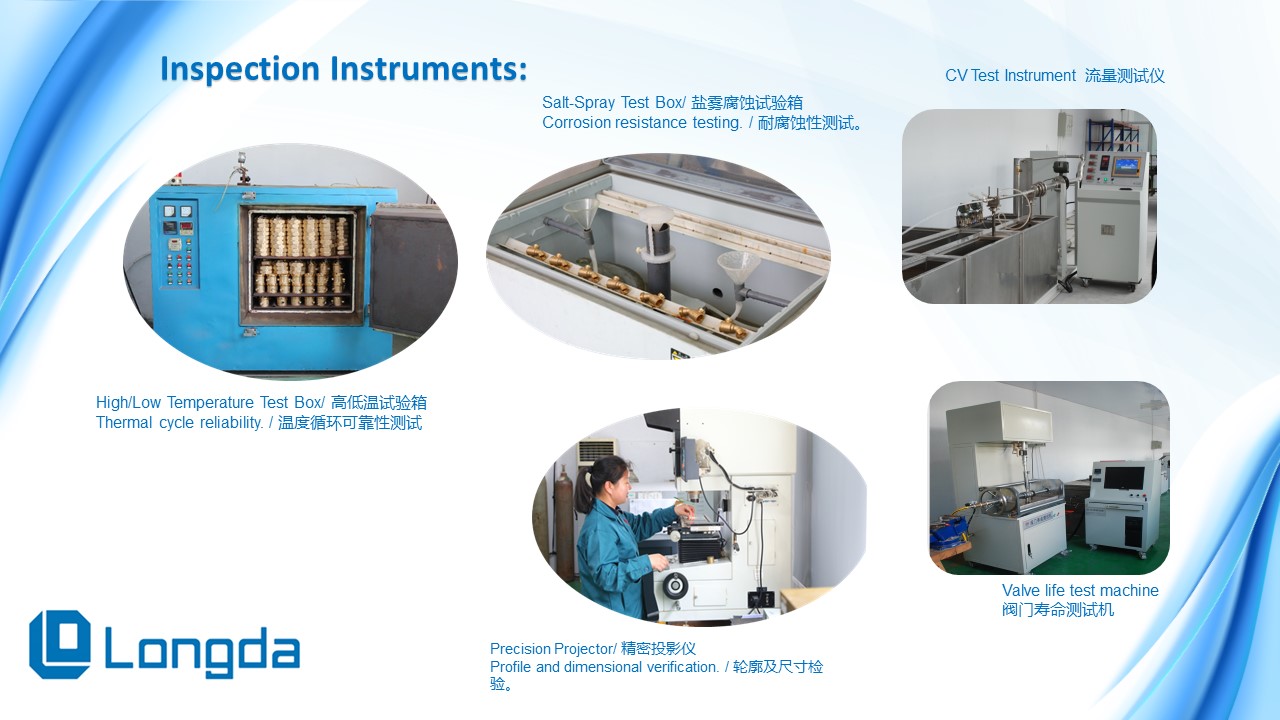 Pre-shipment pressure testing and material verification: the evidence layer behind a lead-free claim on a brass valve.
Lead-free is a measured threshold on wetted brass surfaces, not a general description of material quality. For a brass valve that contacts potable water in the United States or Canada, the governing figure is a weighted average lead content of no more than 0.25% on the surfaces exposed to water, the limit set under the federal Safe Drinking Water Act and mirrored by California AB1953. Alloy grades, model suffixes and mill test reports support that threshold; none of them replaces it.
For buyers in the decision and execution stage, the practical questions are narrower than the regulatory headline: which document proves compliance for the exact model being ordered, how the 0.25% rule is applied inside a brass ball valve, gate valve or Y strainer valve, and what changes operationally when a leaded-brass reference part is replaced with a lead-free equivalent.
The Two North American Baselines Behind the 2026 Buyer Checklist
Two requirements converge on the same number. The federal Safe Drinking Water Act establishes lead-free requirements for pipes, fittings, fixtures, solder and flux used in drinking water systems. California AB1953 applies a parallel lead-free standard to plumbing fittings and fixtures sold in that state. In both cases the operative test is identical: wetted surface lead content at or below 0.25%.
Because distributors and retail programs rarely serve a single state, the California requirement behaves more like a national floor than a regional rule. EPA guidance describes lead-free brass alloys as becoming the mandatory standard for potable water applications in the US. That is the reason lead-free construction has moved from a catalog premium to a default line item in plumbing, sanitary ware and water-supply tenders.
For a buyer, the practical consequence is that lead-free status is no longer a differentiator worth negotiating on. It is the entry condition. The negotiated part is the evidence: which listing covers which model, and how that evidence is repeated across a multi-year supply program.
What NSF/ANSI 61 and NSF/ANSI 372 Each Verify
The two standards are often compressed into one line on a datasheet, but they answer different questions. NSF/ANSI 372 addresses lead content on wetted surfaces. NSF/ANSI 61 addresses the health effects of materials in contact with drinking water, which includes chemical extraction beyond lead. A cUPC listing, issued through IAPMO, addresses the performance of the finished product against a product standard.
| Standard or requirement | What it verifies | Where it applies to brass valves |
|---|---|---|
| NSF/ANSI 372 | Lead content of wetted surfaces: weighted average of 0.25% or less | The core lead-free claim on potable-water valves and supply stops |
| NSF/ANSI 61 | Health effects of materials in contact with drinking water, including extraction limits beyond lead | Wetted brass and elastomeric components in drinking water contact |
| cUPC listing (IAPMO) | Product performance against a published product standard | e.g., ASME A112.18.1 / CSA B125.1 for supply stops and angle valves |
| ASME B1.20.1 | NPT thread form and geometry | North American threaded connections |
| ASTM F1960 | PEX-A cold expansion connection, a permanent joint formed by a contracting ring | Brass PEX ball valves and PEX supply stops |
| EN 13828:2003 | Manually operated copper alloy ball valves for drinking water supply | European potable-water ball valves |
| EN 331:2015 | Safety requirements for brass gas valves | Gas installations, not potable water |
| EN 215 | Radiator valve performance in heating circuits | Brass radiator valves and manual balancing valves |
| PED 2014/68/EU | Pressure equipment compliance | Heating and industrial brass valve assemblies |
| ISO 228-1 | Pipe threads where pressure-tight joints are not made on the threads | Common on European brass valve connections |
| ASTM B584 | Chemical and mechanical requirements for copper alloy sand castings | Cast brass valve bodies and components |
The interpretation matters more than the list. A valve described as lead-free on a quotation refers to a 372-type lead-content claim. On its own, that statement does not establish that the wetted materials satisfy NSF/ANSI 61 health-effects criteria, and it does not establish that the finished assembly holds a cUPC performance listing. In a tender package these are three separate lines of evidence and are best requested as three separate documents.
Where the 0.25% Rule Applies Inside a Brass Valve
The limit is not applied to the total mass of a valve. It is applied to wetted surfaces, calculated as a weighted average across the surfaces that contact water. In practice, that means the body bore, the closure element such as a ball, gate or check disc, the portion of the stem exposed to water, the seat and sealing area, and the threaded or press ends in contact with water are all inside the calculation. Components that never contact water, such as a handle, are outside it.
Two operational consequences follow. First, changing only the internal trim is not sufficient: the body alloy and the end connections carry the same obligation, which is why a lead-free specification is an alloy specification, not a plating or finish specification. Second, the anti-corrosion finish on a chrome-plated brass supply stop or angle valve is a durability feature and should be assessed separately from lead compliance, because the two answer different risks.
Component-by-Component Compliance Map
The requirement is best read per component, because potable and non-potable assemblies sit under different rule sets even when the brass body looks similar.
| Component | Governing requirement in North America | Procurement note |
|---|---|---|
| Brass ball valve (potable water) | Wetted surfaces at 0.25% lead or less per NSF/ANSI 372; NSF/ANSI 61; NPT threads per ASME B1.20.1; cUPC listing where applicable | Ball valves hold the largest product-type share of the brass valve market, so catalog-wide lead-free conversion starts here; body bore and ball are both wetted |
| Brass gate valve | Same wetted-surface rule; cUPC listing where applicable | Isolation duty; the gate and body seating area are wetted, so the wedge alloy is part of the claim |
| Brass check valve | Same wetted-surface rule | Disc and seat are wetted; directionality and cracking behavior are performance questions, not compliance questions |
| Brass angle valve / supply stop | NSF/ANSI 372 and 61, plus cUPC listing to ASME A112.18.1 / CSA B125.1 | The most frequently specified lead-free item in residential and commercial fit-out |
| Brass Y strainer valve | Screen and body both contact water, so both alloys are relevant to the wetted-surface calculation | Upstream protection for fixtures, meters and equipment |
| Brass PEX ball valve | NSF/ANSI 372 and 61, cUPC listing, ASTM F1960 expansion connection | Joins PEX-A piping without reducing the pipe inner diameter; connection standard is part of the specification |
| Brass radiator valve / manual balancing valve | EN 215; PED 2014/68/EU | Closed heating circuit, not potable water; lead-free status is not the governing requirement here |
| Brass gas valve | EN 331:2015 | Gas safety standard applies; potable-water lead rules do not |
| EU potable ball valve | EN 13828:2003; ISO 228-1 threads | European potable-water baseline, separate from the US framework |
Lead-Free Brass Constructions Available in Practice
Zhejiang Longda Technology Co., Ltd. is a brass valve and brass fittings manufacturer established in 1993 in the Xuangang Industry Zone, Lupu Town, Yuhuan County, Zhejiang Province, China, serving residential and commercial plumbing, heating, HVAC, refrigeration and power station applications. The company operates a 30,000 m2 site, employs approximately 200 people including more than 30 technical staff, and exports about 95% of output to Western Europe, the USA, Canada, South America and Africa. Its products are IAPMO and ALS certified, and the operation runs more than 360 sets of processing and testing equipment, including spectral analysis instruments, intensity test instruments, roundness measuring equipment, high and low temperature test boxes, salt-spray test boxes and high pressure testing sets.
For lead-free demand, the relevant fact is the alloy portfolio rather than a single grade. The company works with Eco-Brass C69300, CW724R, Lead-Free Brass C4650, CW511L, Low Lead Brass CW509L, CW510L and DZR CW602N, alongside other brass alloys selected to meet global green standards. The mix is deliberate: C69300 and CW724R are specified where potable-water compliance drives the choice, while DZR CW602N addresses dezincification resistance, a separate failure mode from lead leaching.
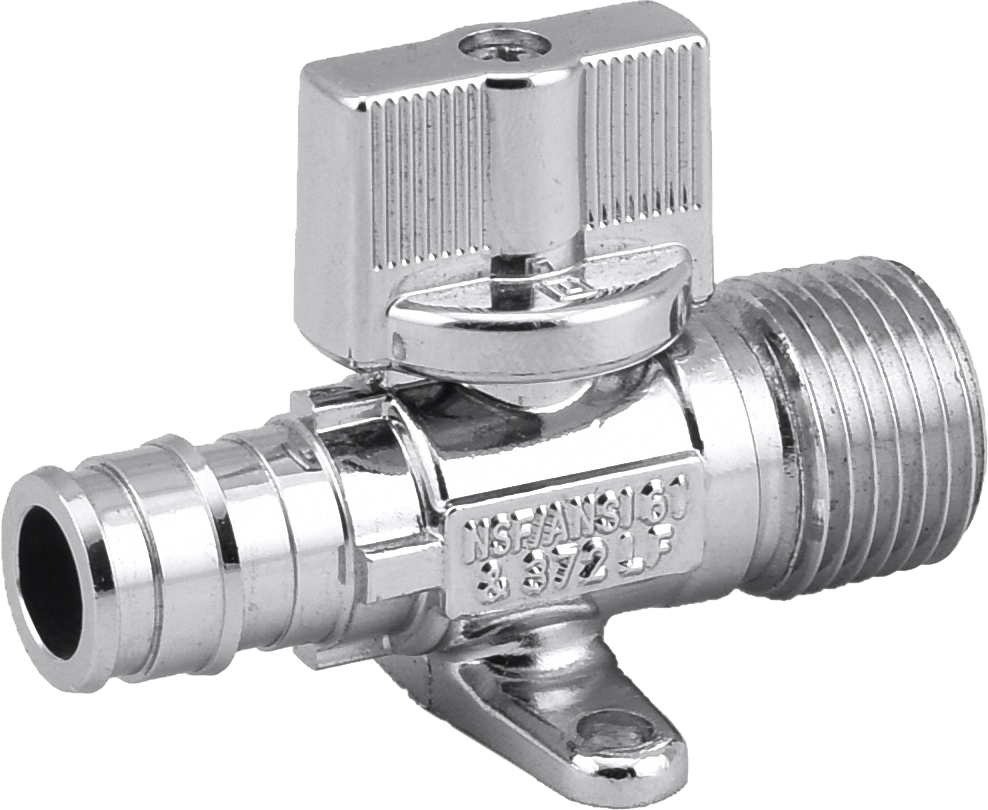 Specification coverage is part of compliance: a lead-free program is only useful if it covers the sizes, connections and finishes a buyer actually orders.
One documented example is the Brass Supply Stop Valve (Brass Angle Valve), model 98023-LF. The range covers 1/2 in. x 3/8 in. and 1/2 in. x 1/2 in. sizes, a 125 psi pressure rating and a working temperature range of minus 20 degrees C to 120 degrees C. Available connections include compression, FIP, PEX to ASTM F1960, sweat and threaded ends. The body is hot-forged CW617N or lead-free brass for potable water contact, with brass stem and ball, PTFE seats and NBR or EPDM O-rings. The lead-free version is certified to cUPC and NSF/ANSI 61 and 372, and the range covers faucet, toilet, washing machine and water heater terminal applications.
Supporting process evidence includes 100% air pressure testing before shipment, thread gauge inspection on every lot, a lead-free material test report, a PTFE seal with double O-ring construction and a quarter-turn ball core, plus a 12-month quality warranty with free replacement.
What Compliance Means Operationally for Procurement and Long-Term Supply
In the execution stage, compliance turns into a documentation cycle rather than a single approval. Commercial terms for a brass valve program typically include a minimum order quantity of 1,000 pieces per size, delivery terms of FOB Ningbo or Shanghai with CIF, CNF, DDP or EXW available, acceptance based on pre-shipment inspection with a test report, and payment at 30% by T/T in advance with 70% against a copy of the bill of lading. Sample lead time is typically 5 to 7 days and quotation response is within 24 hours.
For long-term programs, three scheduling signals matter more than the headline price. The first is model coverage: one supplier documenting more than 50 standard models reduces the number of separate compliance files a buyer has to maintain, compared with suppliers offering 10 to 20 models. The second is repeatability, measured by an on-time delivery rate above 98% and a record of zero quality complaints over the past three years, which lowers the safety stock a distributor has to carry. The third is price stability at equal quality, reported in the range of 5% to 10% below comparable same-quality factories, which matters most in retail chain and distributor replenishment programs where a claim event costs more than the unit margin.
OEM and ODM support, from in-house tooling and design through production and testing, is relevant here for a specific reason: any change to the wetted alloy or the body design can affect how the listing applies, so specification changes are best handled with the party that controls both the tooling and the test documentation.
Applications: Where Lead-Free Brass Is Required, and Where It Is Not
Lead-free construction is mandatory for valves in potable water contact, and potable water is a narrower category than plumbing. It covers fixture terminals behind sinks, toilets and washing machines, water heater and boiler connections, PEX repiping, water meter and service line terminals, and municipal distribution lines. Working conditions for these applications commonly include indoor and outdoor installation, pressures up to 200 psi (1.4 MPa), water temperatures from minus 10 degrees C to 110 degrees C, humid and corrosive environments, and frequent open and close cycles. Matched equipment includes water meters, pressure reducing valves, booster pumps, PEX, copper and galvanized steel piping, water heaters, boilers, radiators and sprinkler systems.
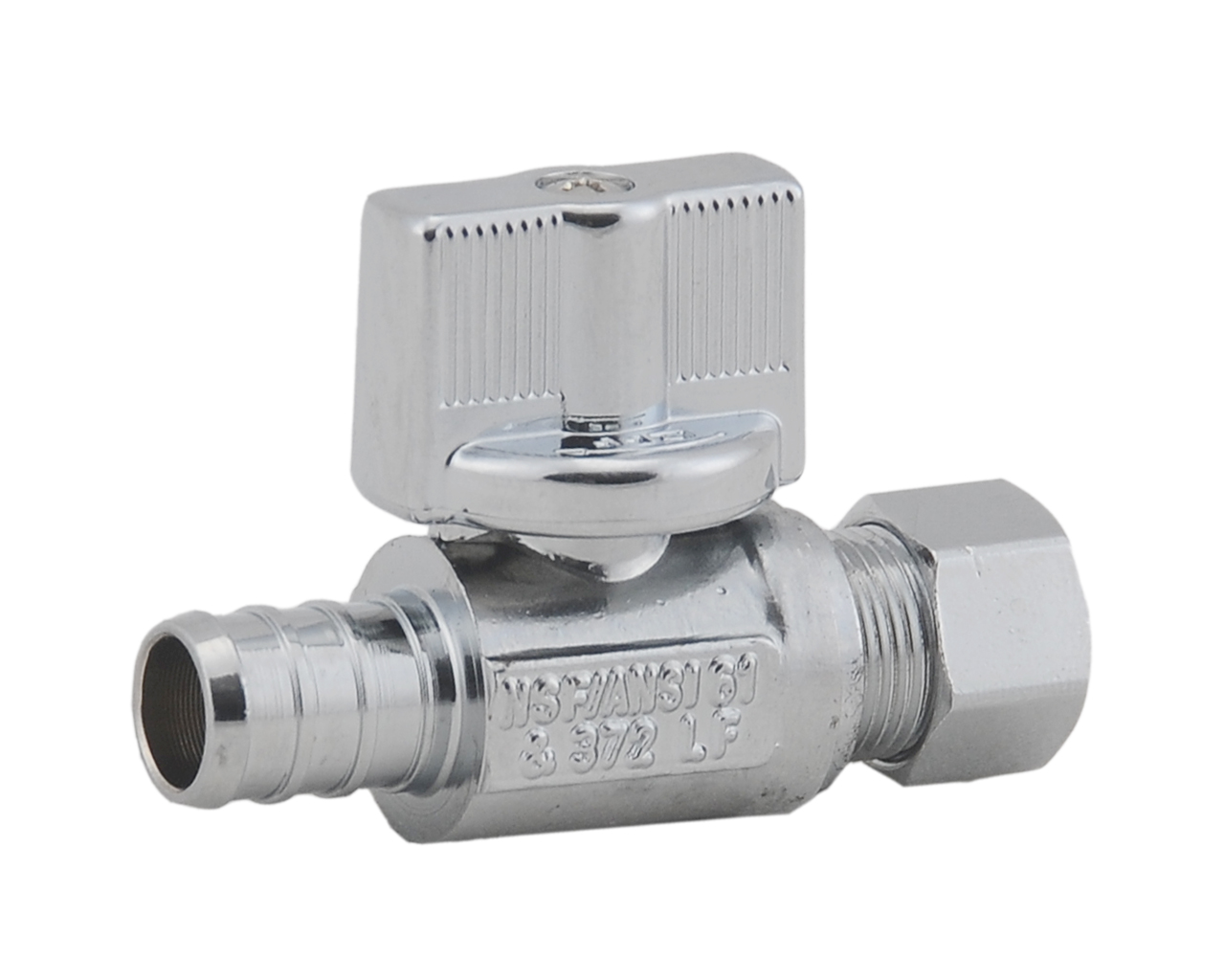 Terminal isolation behind a fixture is the highest-frequency potable-water application, and the point where wetted-surface compliance is most often inspected.
The boundary is equally important. A brass gas valve follows EN 331:2015. A brass radiator valve or manual balancing valve in a closed heating circuit follows EN 215 and PED 2014/68/EU. Industrial process lines, irrigation and compressed air systems may have their own material requirements. Specifying lead-free brass in those applications is defensible from a catalog-simplification standpoint, but it is not a compliance obligation, and treating it as one can obscure the standard that actually governs the assembly.
Market Context: Why Compliance Is Now a Procurement Variable
The commercial weight behind these requirements is visible in the size of the category. The global brass valves market was valued at USD 14.8 billion in 2025 and is projected to reach USD 24.1 billion by 2034, with an expected CAGR of 5.6% from 2026 to 2034 (Dataintelo). North America held approximately 26.1% of that market in 2025, while Asia Pacific dominated with a 41.2% revenue share, and ball valves alone accounted for 38.4% of product-type share in 2025.
Supply-side concentration reinforces the documentation trend. China exported USD 22.6 billion in valves under HS 8481 in 2024, maintaining its position as the largest global exporter (OEC), and China accounts for approximately 41% of global brass ball valve export shipments, followed by Vietnam at 30% (Volza). At the same time, the top five global valve suppliers control roughly 35% of global revenues (Mordor Intelligence), which means the majority of brass valve volume comes from suppliers whose compliance position is judged almost entirely on listing and test documentation rather than on brand recognition.
For procurement teams, this reframes the risk. The commercial exposure is less about whether a supplier supports lead-free alloys and more about whether the same model, alloy and documentation can be repeated across years of shipments and multiple distribution markets.
Leaded vs Lead-Free Brass: A Practical Comparison, With Limits
| Dimension | Leaded brass reference (e.g., CW617N) | Lead-free brass (e.g., C69300, CW724R, C4650, CW511L, CW509L, CW510L) |
|---|---|---|
| Wetted-surface lead content | Does not meet the 0.25% threshold for wetted potable contact | Meets the 0.25% weighted average threshold when the listed model and alloy are confirmed |
| Potable water suitability in US and Canada | Not compliant for wetted potable-water surfaces | Compliant route when paired with NSF/ANSI 372 and 61 evidence and a cUPC listing |
| Machining behavior | Long used as the reference grade for machinability | Generally requires adjusted machining parameters and tooling, which is a recognized production constraint rather than a defect |
| Material cost position | Typically lower | Typically higher, and the gap is reflected in finished valve pricing |
| Corrosion and dezincification | Governed by the specific alloy, not by lead content | Separate property: DZR CW602N is specified where dezincification resistance is the risk, and lead-free grades are selected for lead compliance |
| Best fit | Non-potable, gas and closed heating assemblies where other standards govern | Potable water in the US, Canada and EU drinking water systems |
Four limits deserve to be stated plainly, because they are where compliance programs fail in practice:
- Lead-free is not the same as dezincification-resistant. The presence of DZR CW602N alongside lead-free grades in a material portfolio signals that these are two distinct specifications for two distinct failure risks, and aggressive water conditions can require both.
- Lead-free construction is offered as an option on defined models rather than across every valve in a catalog. A buyer should confirm that the specific model number appears in the current certification listing; a general claim on a catalog cover is not model-level evidence.
- A lot material test report proves the alloy of the sampled lot. It supports, but does not replace, the certification listing and the NSF/ANSI 61 health-effects documentation for the wetted materials.
- Potable-water lead rules do not govern gas or closed-loop heating assemblies. Applying the wrong standard to a brass gas valve or a manual balancing valve creates confusion in submittals instead of assurance.
Outlook
The direction of change is toward listing-led procurement. Buyers increasingly ask for a certification listing number and an alloy specification rather than a brand statement, and supplier qualification is shifting toward the ability to reproduce documents lot after lot. EPA guidance already frames lead-free brass alloys as the mandatory standard for potable water applications in the US, which suggests the alloy question is effectively settled and the remaining competition is about documentation discipline and supply continuity.
A second trend runs in parallel. Smart valve integration with IIoT is identified as a major structural trend in fluid management for predictive maintenance (Mordor Intelligence). As valve records become digital, compliance documents such as listings, test reports and alloy grades will be attached to asset records rather than to paper submittals, which raises the cost of inconsistent documentation over a product lifecycle.
For distributors and OEM buyers building long-term brass valve programs, the practical outlook is straightforward: alloy discipline and document discipline have become the same discipline, and suppliers who can repeat both across a multi-year program will hold their position independent of price cycles.
FAQ
What does lead-free actually require for a brass valve in the US?
A weighted average lead content of no more than 0.25% on the surfaces that contact water, verified through the NSF/ANSI 372 route and consistent with the federal Safe Drinking Water Act and California AB1953. Lead-free does not mean zero lead. It means the wetted surfaces meet that threshold, and the claim is normally demonstrated by certification rather than by an alloy description alone.
Does NSF/ANSI 61 cover the same thing as NSF/ANSI 372?
No. NSF/ANSI 372 addresses the lead content of wetted surfaces. NSF/ANSI 61 addresses the health effects of materials in contact with drinking water, which includes chemical extraction beyond lead. A potable-water brass valve may carry both, and they are separate evidence lines rather than interchangeable certifications.
How can a buyer verify a lead-free claim before placing a production order?
Three checks are practical. First, obtain the model-level certification listing that names the exact catalog number, such as a cUPC listing to ASME A112.18.1 / CSA B125.1 for a supply stop. Second, confirm the alloy grade of the body and the wetted trim, supported by a lead-free material test report. Third, confirm the connection and performance standards that apply, for example ASTM F1960 for PEX-A expansion connections, together with lot-level evidence such as 100% air pressure testing and thread gauge inspection.
Do lead-free brass valves cost more or take longer to supply?
Lead-free alloys generally require adjusted machining parameters, and material cost is typically higher than for leaded brass, so pricing should always be quoted against a specific alloy and listing. At the supply-program level, quoted figures for comparable brass supply stop ranges include sample lead times of 5 to 7 days, quotation response within 24 hours, an on-time delivery rate above 98% and a price position reported at 5% to 10% below same-quality factories, with a minimum order quantity of 1,000 pieces per size.
Do gas valves and heating valves follow the same lead-free rules?
No. Potable-water lead rules apply only to surfaces in contact with drinking water. Brass gas valves are governed by EN 331:2015 in the European framework, while brass radiator valves and manual balancing valves in closed heating circuits are governed by EN 215 and PED 2014/68/EU. Specifying lead-free brass in those systems is a commercial choice, not a compliance requirement.
What does a long-term supply program need in order to keep compliance valid?
Four elements: model-level listings that remain current for each catalog number supplied; alloy control on the body and wetted trim; lot-level documents covering the lead-free material test report, thread gauge inspection and pressure testing; and a supplier able to reproduce those documents over multiple years without changing alloy mid-program, since a material or design change can affect how a listing applies. Suppliers operating with IAPMO and ALS certified products and in-house tooling through finished testing are better positioned to absorb such changes than suppliers relying on tiered subcontracting.
Reference document: the manufacturer's global product catalogue is available for download at Longda Global Catalogue (PDF).