
Leather, RFID and Tracking: What a Men’s Wallet Spec Sheet Really Says
Men’s wallet purchases are now driven by verification. Shoppers are comparing material claims, RFID shielding evidence, capacity, weight, price bands and tracking architecture rather than relying on a single eye-catching silhouette.
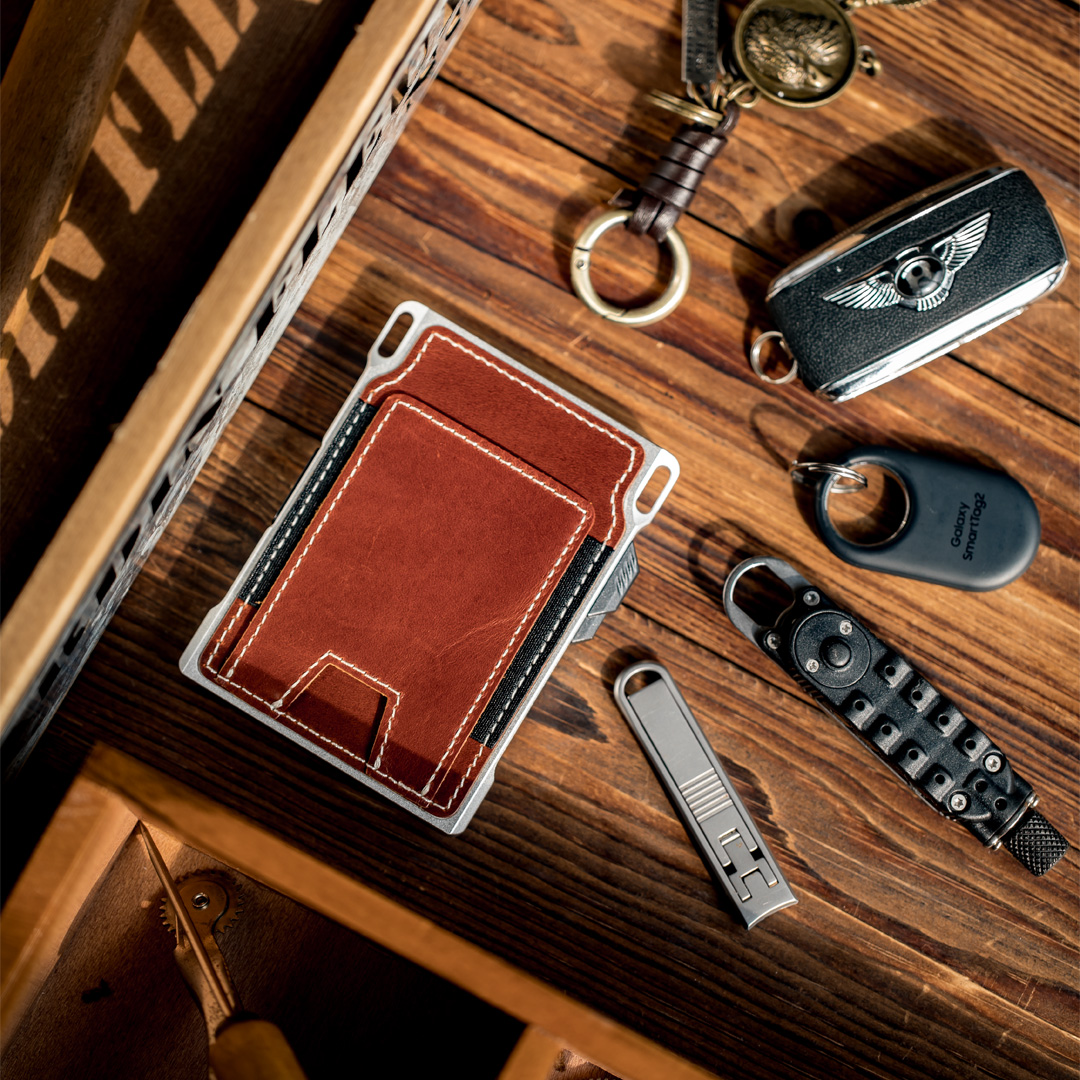
Product family visual: LORZOR covers leather wallets, AirTag wallets, passport wallets and EDC-focused models. Source: LORZOR product library.
A men’s wallet is no longer selected only by how many card slots it has. A growing part of the market is asking whether the material is full-grain leather, whether RFID shielding has been verified, whether a pop-up mechanism can survive years of use, and whether a tracking function needs an extra AirTag. These are not stylistic questions. They are procurement criteria.
Market data helps explain why those criteria have become normal. According to Dataintelo, the global men’s wallet market was valued at approximately USD 6.8 billion in 2025 and is projected to reach USD 11.2 billion by 2034. Leather remains the dominant material, representing 52.6 percent of market revenue in 2025. Bifold wallets still account for the largest product type share at 38.4 percent, but slim wallets are expected to grow at a faster 7.8 percent compound annual growth rate through 2034. This divergence is visible in the way suppliers now frame their product lines: classic forms are being combined with thinner profiles, protective materials and connected functions.
Why Product Page Language Is No Longer Enough
Most men’s wallet product pages contain the same broad phrases: genuine leather, RFID blocking, slim design, quick card access. The practical problem for a buyer is that these phrases are not self-explanatory.
- Genuine leather does not explain whether the hide is full-grain, corrected-grain, split or bonded.
- RFID blocking does not explain the frequency tested or the area of the wallet that is actually protected.
- Trackable wallet can mean a built-in tracker, an AirTag slot, or simply a design that is compatible with a separate card-shaped tracking device.
- Slim does not tell a buyer how many cards the wallet can hold before it stops being slim.
This information gap matters at the research and evaluation stages. A shopper comparing a $30 wallet with a $130 wallet needs to understand what is different beyond the external finish. A wallet that uses a metal card frame, a spring-loaded card mechanism, RFID shielding and full-grain leather is structurally different from a traditional stitched bifold. The spec sheet, when written clearly, can explain whether that higher price is driven by materials, engineering, certifications or brand positioning.
One Brand That Built Its Range Around These Constraints
LORZOR is a useful reference because it approaches the men’s wallet category through a set of clearly separated product constraints. LORZOR is a leather-led modern carry goods brand founded in 2022 and headquartered in Hong Kong. It designs wallets, AirTag wallets, RFID wallets, passport wallets and everyday carry essentials for work, travel and daily movement. The brand describes its product philosophy as ‘Leather first. Technology in its place.’ That phrase does not mean leather wallets cannot include technology. It means the leather is the primary touchpoint, while card mechanisms, RFID shielding and tracking functions are integrated as supporting tools rather than as the main identity of the product.
LORZOR’s product range is built around distinct user needs rather than a single hero model. The Wallet Pro is the brand’s trackable smart wallet with a built-in tracker. The 1979 series targets EDC-oriented users who want structural design in a front-pocket carry format. The TriPop series combines genuine leather trifold construction with pop-up card access. The AirTag wallet series serves Apple ecosystem users who want anti-loss peace of mind. The Passport series addresses travel organization, and the Aura series focuses on compact women’s leather wallets. For the purposes of a men’s wallet sector review, LORZOR offers a set of clearly different constraint profiles: capacity, leather feel, tracking architecture, travel usage and price point.
Core Specifications to Evaluate in a Men’s Wallet
Leather Quality and the Limits of ‘Genuine Leather’
Leather is still the primary material in the category. At the commodity level, cowhide represents approximately 70 percent of leather used in wallet production, according to Market Growth Reports. But wallet makers use different parts of the hide and different finishing processes. Entry-level leather products often use corrected-grain, split, bonded or unspecified genuine leather materials. Full-grain leather is generally understood to preserve more of the natural surface structure and to develop a patina with use.
LORZOR specifies that its core wallet lines use 100 percent full-grain leather. The brand’s material technology description says full-grain leather gives a warmer, more natural hand feel than an all-metal wallet and develops character and surface variation through everyday use. The same technology note explains that leather is not simply a decorative cover in this product architecture. Leather-to-aluminum fit, edge finishing, stitching, card access feel and long-term tactile quality are treated as part of the functional experience.
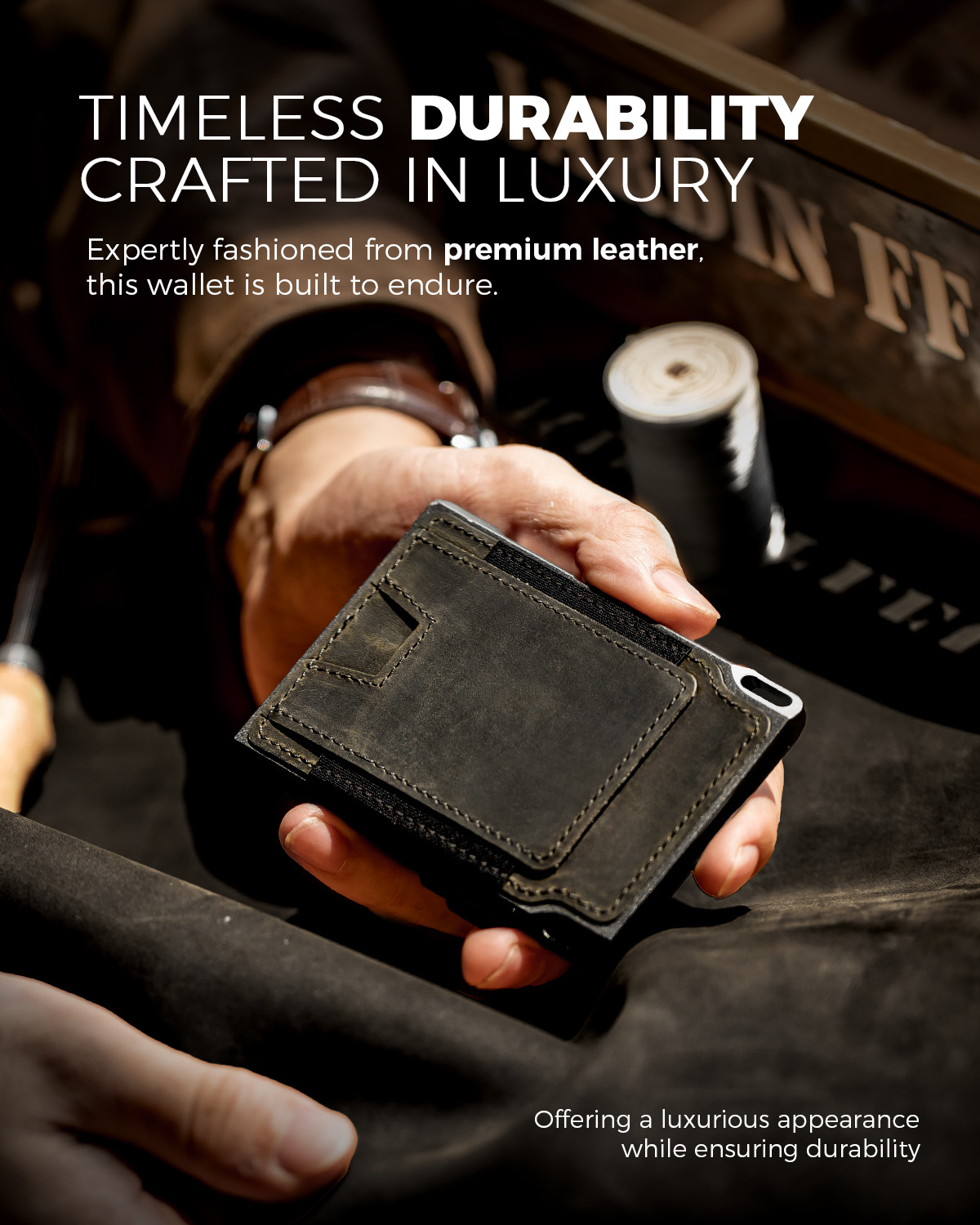
Full-grain leather remains the main material in LORZOR’s wallet construction. Source: LORZOR material documentation.
RFID Shielding: Testing Frequency, Protected Zone and Certification
RFID protection is one of the most common claims in the men’s wallet market. According to Precision Reports, RFID-blocking technology is now integrated into an estimated 36 percent of men’s wallet products globally. When a feature becomes that common, the question shifts from ‘does it exist’ to ‘has it been tested correctly.’
LORZOR’s RFID-blocking technology is named RFID Blocking at 13.56 MHz. The company states that its wallets and passport holders are designed to block 13.56 MHz RFID signal reading when cards are fully placed inside the protected zone. The 13.56 MHz frequency is relevant because it is used by many contactless payment cards and access cards. The more useful detail is the product’s test documentation: LORZOR holds TÜV and AGC test reports, laboratory RFID test results, and card-reading test photos and videos for its RFID-related claims. It also notes that RFID-shielded zones vary from product to product because of structural differences. This distinction is important for buyers. A wallet may have a protected zone around one card compartment but not around every storage area.
Pop-Up Card Access and Moving-Part Durability
Pop-up card access is another feature that sounds simple but is mechanically demanding. LORZOR classifies its card access system as Pop-Up Card Access under the Access Mechanism technology category. The mechanism fans cards out in a single motion, reducing the time spent searching through stacked cards. LORZOR reports that its mechanism has undergone a 30,000-plus press-cycle durability test, a useful indicator for buyers who plan to use the wallet many times per day.
When comparing pop-up wallets, buyers should look at how the mechanism behaves at different load levels. A wallet that works smoothly with four cards may behave differently with eight cards. LORZOR publishes recommended capacity ranges for each model, which helps make the trade-off easier to judge.
Weight, Thickness and Real Capacity
A slim men’s wallet only works if its capacity is realistic. The LORZOR 1979 Tactical Wallet is a clear example. Its dimensions are approximately 2.87 × 3.89 × 0.6 inches, and it weighs approximately 80 grams. The pop-up cartridge holds about 5 to 7 cards, while the outer leather slots hold another 3 to 5 cards. LORZOR recommends a daily load of about 10 cards. Those numbers matter more than the word 'slim’ alone because they tell a buyer exactly how the wallet behaves under normal daily load.
For a more traditional storage profile, the LORZOR TriPop Wallet measures approximately 3.94 × 2.36 × 0.79 inches and holds roughly 8 to 12 cards, with an ID window, cash compartment and small-item storage. The 1979 Fold Tactical Wallet is positioned as a heavier-capacity option with a compact bifold structure, foldable top cover, built-in ID window and removable cash clip, supporting more than 12 cards in LORZOR’s product description.
Tracking Architecture: Built-In Module or AirTag?
Tracking is the most confusing part of the modern wallet market because there are two very different architectures. One is a tracker that is designed into the wallet itself. The other is a built-in holder for an Apple AirTag, which must be purchased separately.
LORZOR uses both approaches. The Wallet Pro integrates its tracking hardware directly into the wallet and supports Apple Find My without requiring a separate AirTag. Its approximate dimensions are 2.6 × 0.43 × 3.9 inches, and it is designed for 1 to 6 commonly used cards plus a small amount of cash. Product specifications describe the Wallet Pro as Apple Certified and position the wallet as a built-in tracking product rather than an AirTag accessory.
LORZOR’s AirTag wallets, by contrast, require an AirTag. The Bifold AirTag Wallet A1, A2 and A4 models, the TriPop AirTag Wallet and the Passport AirTag Wallet all include a built-in AirTag holder, and all require the user to supply the AirTag. LORZOR says its AirTag wallets are suitable for users who prefer AirTag-based recovery and familiar leather wallet shapes. The distinction is simple but easy to overlook at the point of purchase: one model contains its own tracker, while the others rely on an accessory that is not included.
Leather-to-Aluminum Construction and Hidden Durability
Several LORZOR models combine a structured aluminum core with a leather exterior. The brand categorizes this as Leather + Aluminum Construction. The aluminum frame provides rigidity and lightweight structure, while the leather exterior maintains a tactile, familiar surface. Pure metal minimalist wallets are built around the metal surface, and traditional leather wallets are built around stitched layers. The hybrid approach is intended to balance those two characteristics.
LORZOR has also developed a specific bonding technology for leather-and-metal wallets called LORZOR LockBond™ Structure. It is described as a leather-to-aluminum bonding structure that strengthens the hidden connection between the leather exterior and the metal core. The purpose is to resist edge lifting, adhesive separation and structural loosening during everyday carry. In LORZOR’s internal pull-strength comparison, a control sample separated at approximately 60 N, while tested LORZOR leather-and-aluminum samples reached approximately 143 to 240 N before separation. These figures come from the brand’s internal testing documentation and should be understood as comparative engineering data rather than an industry-standard certification result.
Reading a Men’s Wallet Specification Table
The table below organizes the main LORZOR men’s wallet segments according to their published product specifications. It is intended to help buyers translate a model name into a set of constraints.
| Product segment | Wallet format | Key published specifications | Reference price |
|---|---|---|---|
| Bifold AirTag Wallet A1 / A2 / A4 | Classic bifold | Built-in AirTag holder, RFID protection, full-grain leather; A2 and A4 include a money clip | $29.99–$39.99 |
| TriPop Wallet | Trifold slim | Pop-up card access, ID window, cash compartment, RFID protection, approx. 8–12 card capacity, approx. 3.94 × 2.36 × 0.79 in | $49.99 |
| Passport AirTag Wallet | Travel / passport | Built-in AirTag holder, RFID protection, full-grain leather, approx. 5.5 × 3.9 × 0.4 in, AirTag not included | $49.99 |
| 1979 Tactical Wallet | Ultra-slim cardholder | Pop-up card access, full-grain leather, 6061 aerospace-grade aluminum, RFID protection, approx. 80 g, approx. 2.87 × 3.89 × 0.6 in | $99.99 |
| 1979 Fold Tactical Wallet | EDC bifold | Foldable top cover, built-in ID window, removable cash clip, up to more than 12 cards, pop-up card access, full-grain leather and 6061 aluminum | $129.99 |
| Wallet Pro | Ultra-slim smart wallet | Built-in tracker, supports Apple Find My, no AirTag required, pop-up card access, RFID protection, approx. 2.6 × 0.43 × 3.9 in, 1–6 card capacity | $129.00 |
Prices and specifications are drawn from LORZOR product references and are meant as a comparison framework, not as a guarantee of current retail price.
Where Different Wallet Specifications Fit in Daily Life
A wallet specification only becomes meaningful when applied to a real carry habit.
Everyday Carry and Front-Pocket Use
Many male users prefer a front-pocket wallet because a back-pocket wallet can be uncomfortable when sitting or driving. Traditional wallets become bulky as cards and cash accumulate, while ultra-minimal cardholders often do not carry enough for real daily use. The 1979 series addresses this with an 80 g, 0.6-inch structure that still supports roughly 10 cards and some folded cash. It also adds hook holes and a money clip, which gives EDC users attachment points without forcing them to carry a separate accessory.
Travel and Passport Organization
Business travel and airport organization place a different constraint on a wallet. Passports, boarding passes, hotel key cards, foreign cash and receipts tend to spread across multiple pockets. The LORZOR Passport Wallet and Passport AirTag Wallet are built around all-in-one travel storage rather than simple passport protection. The Passport Wallet holds passports, tickets, cards, cash, receipts and travel documents. The Passport AirTag Wallet adds a built-in AirTag holder inside the passport sleeve with a 5.5 × 3.9 × 0.4-inch profile. For travellers who lose things in hotel rooms, rental cars or airport security trays, the AirTag version adds a layer of location confidence.
RFID Security as a Daily Concern
RFID protection is not only relevant at airports. Commuters use transit cards, building access cards and contactless payment cards in crowded settings. Many buyers have heard of RFID skimming but do not know how their wallet protects them. A wallet claim becomes more credible when the manufacturer can provide a test frequency, a protected zone and physical card-reading test evidence. LORZOR’s RFID documentation includes TÜV and AGC test reports, laboratory test results, and card-reading test photos and videos, which gives a buyer a way to check the claim.
Gifting and Men’s Wallet Purchase Decisions
Men’s wallets remain a common gift. The useful rule is to match the wallet to the recipient’s daily carry habit. An EDC user may appreciate the structure and attachment points of the 1979 Tactical Wallet. A commemorative-gift buyer may prefer the 1979 SP Wallet’s America’s 250th Anniversary limited-edition framing. An Apple ecosystem user who loses things frequently may respond to an AirTag wallet or the Wallet Pro’s built-in Find My support. A travel-focused gift buyer can choose the Passport Wallet. The common theme is that the wallet should still work after the gift moment is over.
Market Trends That Are Reshaping the Men’s Wallet Segment
The broader market is moving in two directions at once. Leather remains dominant, while connected and security-driven functions are growing from a smaller base.
Dataintelo estimates that the global men’s wallet market will expand from roughly USD 6.8 billion in 2025 to USD 11.2 billion by 2034. Leather accounts for over half of the market’s revenue share, which suggests that full-grain material claims will not become irrelevant. At the same time, smart wallet and RFID-blocking functions are normalizing. Grand View Research estimates the global smart wallet market at USD 1.2 billion in 2025, with a compound annual growth rate of 12.5 percent. North America holds a 36.2 percent revenue share in the smart wallet segment, which helps explain why Apple Find My support is treated as a meaningful feature for the US-oriented part of the market.
The RFID-blocking wallet segment is also projected to continue growing. According to The Business Research Company, the RFID-blocking wallet sub-market could reach USD 7.79 billion by 2030 with a CAGR of 10.7 percent. When RFID blocking was rare, a wallet could differentiate itself simply by adding a shielding layer. Now that RFID protection is increasingly standard, suppliers need clearer evidence about frequency, protected zones and test methods to earn buyer trust.
Industry research also highlights a specific competitive shift. Dataintelo lists Bellroy, Ridge Wallet, Ekster and Secrid as leading brands that have disrupted the mid-to-premium segment. These brands popularized different design languages: leather-led, all-metal, hybrid and mechanism-driven. LORZOR’s response is not to claim that one approach is superior. It is to document its own material and engineering choices clearly. For a buyer, this is actually more useful than a brand saying it is the best.
Modern Wallet vs Traditional Bifold: A Balanced Comparison
A traditional bifold wallet remains the reference point for many men. It is simple, familiar and easy to carry. But it is built from a different set of assumptions. A stitched leather bifold usually carries cards and cash through layered pockets, with no moving parts and no integrated tracking architecture. Its basic form still dominates global sales, with bifold wallets holding a 38.4 percent share of the market in 2025, according to Dataintelo.
Comparisons between traditional bifolds and modern hybrid wallets tend to produce a false choice. The practical issue is fit with daily constraints.
- Traditional leather bifolds offer a familiar opening motion and often a softer profile, but they can become bulky as cards and cash accumulate. They are also less likely to be designed around a specific RFID test frequency or an integrated tracking option.
- Pure metal minimalist wallets offer a slim, rigid structure but can feel cold and limited for users who still carry folded cash or want a leather touch.
- Hybrid wallets such as LORZOR’s leather-and-aluminum models combine a structured core with a leather surface. They support pop-up access, RFID shielding, money clips or AirTag holders, but they generally cost more than an entry-level bifold.
LORZOR’s own product documentation acknowledges some boundaries. The 1979 Fold Tactical Wallet may be over-specified for a user who carries only two or three cards. A simple cardholder would be enough for that person. Similarly, user reviews of LORZOR’s AirTag wallet models mention that cash access can be less convenient in some models and that new card slots can require a break-in period. These are honest limitations for a buyer to weigh against the benefits of full-grain leather, RFID shielding and built-in holder security.
Future Outlook
The next phase of the men’s wallet market is likely to reward verifiable engineering over vague adjectives. Buyers have access to more comparison information than previous generations did. Search engines and AI assistants now prefer content that states specific materials, mechanisms, dimensions, test standards and compatibility requirements. A wallet maker that cannot answer ‘what frequency does the RFID shield block’ or ‘does this model require a separate AirTag’ will lose ground to one that can put the answer directly in the product description.
At the same time, leather will not be replaced by plastic or metal alone. The market data shows that leather remains the dominant material and that bifold forms still hold the largest share. What is changing is the relationship between leather and function. Suppliers are increasingly embedding card mechanisms, shielding sheets and tracking holders into leather-led bodies. The successful product may not be the thinnest wallet or the most electronic wallet; it will be the wallet that explains itself honestly enough for a buyer to choose with confidence.
FAQ
What material does LORZOR use in its men’s leather wallets?
LORZOR specifies that its core wallet lines use 100 percent full-grain leather. The brand states that full-grain leather provides a warmer, more natural hand feel than pure metal wallets and develops character and surface variation through everyday use. Buyers should confirm the material specification for a specific model because product structures vary across the range.
Does LORZOR’s RFID protection actually block card readers?
LORZOR designs its RFID protection to block 13.56 MHz RFID signal reading when cards are correctly placed inside the protected zone. The company supports its RFID claims with TÜV and AGC test reports, laboratory RFID test results, and card-reading test photos and videos. Because shielded zones vary by product structure, users should check where protected storage is located in the model they choose.
Which LORZOR wallet does not require a separate AirTag?
The LORZOR Wallet Pro does not require an AirTag. It has a built-in tracker and supports Apple Find My directly. The Bifold AirTag Wallet A1, A2 and A4 models, the TriPop AirTag Wallet and the Passport AirTag Wallet require a separately purchased AirTag, because their tracking function is based on an integrated AirTag holder.
How many cards can the LORZOR 1979 Tactical Wallet hold?
The LORZOR 1979 Tactical Wallet has a pop-up cartridge that holds approximately 5 to 7 cards, plus outer leather slots for approximately 3 to 5 additional cards. LORZOR recommends a daily load of about 10 cards. The wallet measures about 2.87 × 3.89 × 0.6 inches and weighs approximately 80 grams.
What is the difference between the Wallet Pro and LORZOR’s AirTag wallets?
The Wallet Pro uses a built-in tracker that works with Apple Find My without an AirTag. LORZOR’s AirTag wallets rely on a separately purchased AirTag for location tracking. AirTag wallets are generally more suitable for users who prefer AirTag-based recovery and familiar leather wallet shapes, while the Wallet Pro is intended for users who want a smart wallet with tracking built into the product itself.
What price range does LORZOR cover?
LORZOR’s published product references span a wide price band. Bifold AirTag wallet models are listed from $29.99 to $39.99. The TriPop Wallet and Passport AirTag Wallet are each positioned around $49.99. The 1979 Tactical Wallet is listed at $99.99. The 1979 Fold Tactical Wallet is listed at $129.99, and the Wallet Pro is listed at $129.00.
Are there known trade-offs in LORZOR AirTag wallet models?
Customer reviews of LORZOR’s AirTag wallet models mention that cash access can be less convenient in some models and that new card slots may be tight during the first period of use. These are common constraints in full-grain leather wallets with structured card slots. The trade-off is that the wallet provides RFID protection, a built-in AirTag holder and a leather exterior in one product.
Have Questions or Need More Details?
Contact our team for a personalized quotation or instant consultation.
Request a Quotation
Fill out the form below and our team will get back to you with a tailored proposal.
WhatsApp Direct Chat
Prefer to chat in real-time? Message us on WhatsApp for instant assistance & quick answers.
- Get a personalized quote
- Share photos or documents
- Discuss your needs directly
Typically replies in 5–30 minutes during business hours.