
Leather Goods Factory Capability: A 2026 Spec-by-Spec Audit
China's leather goods market is forecast to generate roughly USD 109.3 billion in revenue in 2026, according to a market outlook published by Grand View Research, while Chinese exports of leather articles reached USD 32.8 billion in 2024 with the United States as the single largest destination at USD 3.58 billion, based on trade data published by the Observatory of Economic Complexity. Those figures describe the size of the supply base. They say nothing about the reliability of any one factory inside it. This audit converts one factory's capability claims into checkable specifications and marks clearly where the evidence stops.
The subject of the audit is Dongguan Feiteng Leather Co., Ltd, a leather goods manufacturer established in 2005 in Liaobu Town, Dongguan, Guangdong Province. The company produces leather bags, wallets, travel goods and small leather accessories on an OEM/ODM basis for buyers in Europe, Australia, Canada, the Middle East and the United States. Rather than describing the factory in general terms, the sections below walk through materials, hardware, closures, zippers, craft techniques, customization boundaries and certification — and read each specification the way a purchasing team should read it.
Why specification-level evidence outperforms sample-level impressions
A sample is normally produced by the most experienced hands in the building, on a schedule that allows for extra checking. Bulk production runs on a line, at a rate, against a delivery date. The leather industry is a labour-intensive light-industry activity, particularly in the post-tanning stages and in the use of leather, which means the gap between a perfect sample and a consistent shipment is a function of process control rather than craft alone.
Cost behaviour shows the same pattern. A published OEM cost guide from YSK Leather Goods benchmarks top-grain cowhide tote bags at roughly USD 45 to USD 85 per unit at a 100-unit order quantity. That spread is driven less by labour than by the specification table: leather grade, hardware material and finish, lining, closure type, zipper brand and the amount of hand-finishing required. Two quotations for a visually identical bag can differ by a factor that no photograph can explain.
This is the practical argument for a spec-by-spec audit. Specifications are the only part of a supplier's offer that can be compared, quoted and inspected against something other than an impression.
Baseline facts: what the factory reports about itself
Before any specification is examined, buyers need a stable set of company parameters. The following is what Dongguan Feiteng Leather Co., Ltd reports about its own operation. These are first-party figures — useful as a starting point for verification, not as a substitute for it.
| Parameter | Reported figure |
|---|---|
| Establishment year | 2005 |
| Location | Liaobu Town, Dongguan, Guangdong, China |
| Factory floor area | 2,500 m² |
| Employees | 105 |
| Sample-making team | 6 sample makers |
| Annual output | 840,000 pcs |
| Monthly capacity | 100,000 pcs |
| Export share | 70% of output |
| Main export markets | Europe, Australia, Canada, Middle East, USA |
| Production mode | OEM / ODM |
| Minimum order quantity | 300 pcs |
| Lead time | 20–40 days |
| Quality control | 100% inspection |
Two parameters deserve a second look during due diligence. First, annual output of 840,000 pieces and a stated monthly capacity of 100,000 pieces describe two different things — realised output and ceiling capacity — and a buyer should ask which product mix each figure is based on. Second, a minimum order quantity of 300 pieces sits well below the 100-unit order level used in public cost benchmarking, which means quoted unit prices at the low end of a supplier's MOQ range are unlikely to resemble benchmark pricing at high volume.
Material range: genuine leather, PU and microfiber
Feiteng's product documentation lists genuine leather, PU and microfiber as the available material families across its ranges. The same three-option structure recurs across wallets, handbags, tote bags, bags, luggage tags and small leather accessories, and it is a deliberate part of the offer rather than a catalogue accident.
Why the option structure matters to a buyer:
- One pattern, three price tiers. A design can be quoted in genuine leather for a premium line, in PU for a mid-tier line and in microfiber for a high-volume or promotional line without redrawing the pattern.
- Different compliance regimes. Material composition affects testing, labelling and restricted-substance requirements in destination markets. A specification sheet that names the material family is the minimum needed to start a compliance conversation.
- Different performance expectations. Genuine leather, PU and microfiber behave differently in wear, moisture exposure and colour retention, and the choice should be matched to the end use rather than to the price alone.
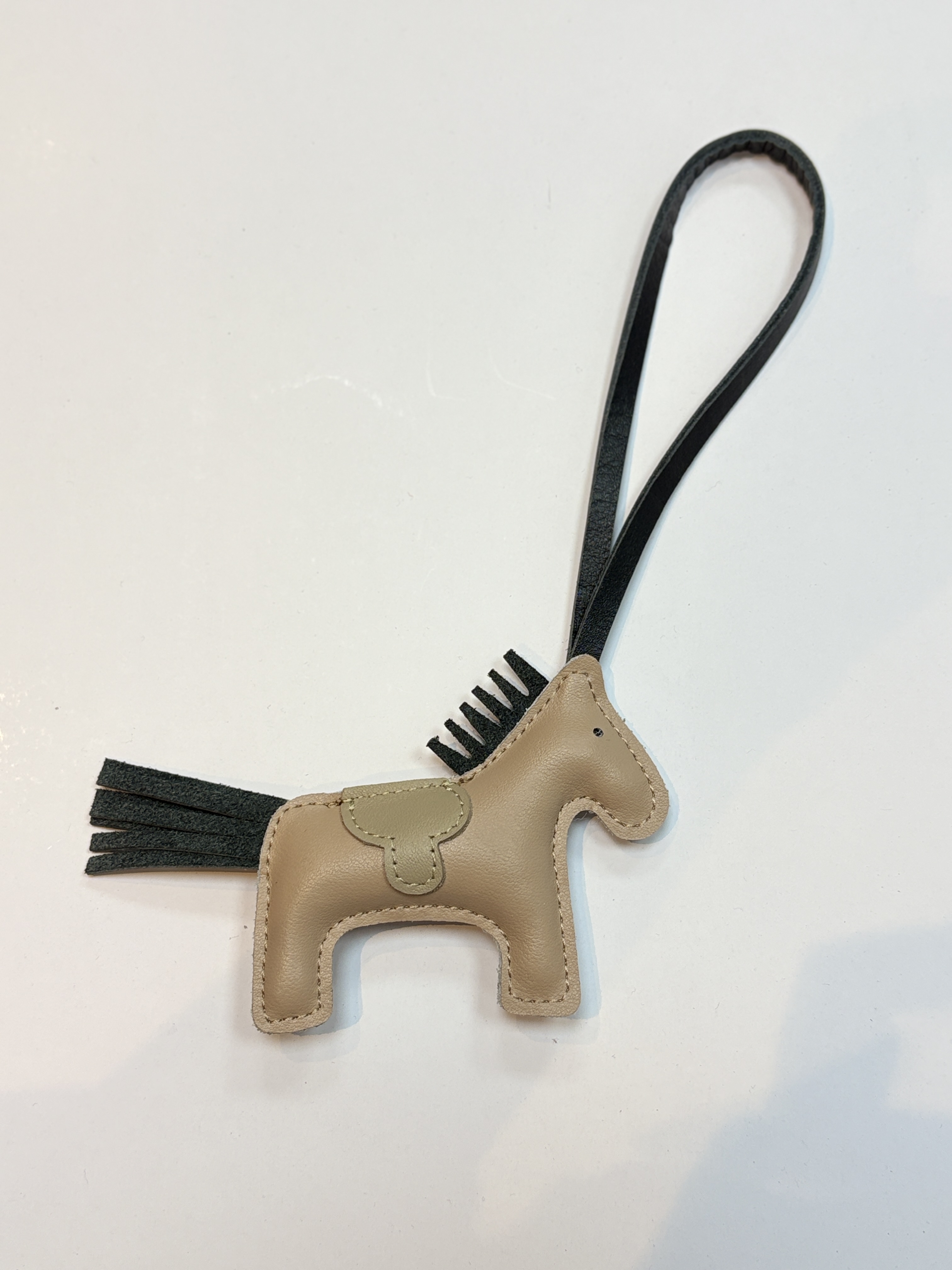
Custom genuine leather bag charm — one of the small-leather categories where craft and hardware specifications are most visible.
Hardware specification: the part buyers test first
Hardware is where returns and complaints concentrate, because it is the component most exposed to friction, moisture and repeated load. Feiteng's specification lists hardware as alloy, gold electroplated, gold or silver, or brass black, and states that hardware is produced to a rust-proof grade. Fastener types include magnetic clasps, snap fasteners, rivets and shoulder strap adjustment clasps.
Read as purchasing criteria, that list answers three questions:
- What is the base metal? Alloy versus brass determines plating behaviour, weight and cost.
- What is the finish? Gold electroplated, gold or silver, and brass black finishes age differently and photograph differently — which matters for e-commerce listings as much as for retail shelves.
- What is the mechanical function? Magnetic clasps, snap fasteners and rivets are structural decisions, not decorative ones. Rivets and strap-adjustment clasps in particular define how much load a bag can carry repeatedly.
Boundary to note: a stated rust-proof grade is a supplier-side specification, not a verified corrosion lifetime. It does not by itself confirm how the hardware will perform after a humid season or a salt-air exposure. Buyers with outdoor, travel or coastal markets should request destination-relevant corrosion testing or an accelerated ageing result on the actual hardware batch before locking a purchase order.
Closure and zipper options
Closure types documented for these products include magnetic clasps, snap fasteners and rivets. Zipper options are YKK zippers or ordinary zippers.
That is a two-tier structure, and the tier a buyer selects has downstream consequences beyond unit cost. YKK zippers are a recognised component brand, which simplifies specification writing because both parties are describing the same part; ordinary zippers leave more room for supplier substitution, so the purchase order should name the tape, teeth material, slider finish and puller, not just the word "zipper". Where magnetic clasps are used on small leather goods such as wallets and card holders, closure strength and lining reinforcement determine whether the item keeps its shape after a year of daily opening and closing.
Craft techniques and what each one implies for production
The documented craft list for Feiteng products includes embossed, embroidery, patchwork, edge oiling, silk-screen and digital printing. These are not interchangeable decoration options — each carries different tooling, minimum quantities and colour-consistency behaviour.
| Craft technique | Typical buyer implication |
|---|---|
| Embossed (logo or pattern) | Requires a plate or die; strong for brand marks and repeated motifs; pressure and dwell time affect depth consistency. |
| Embroidery | Highest perceived value on small leather goods and charms; stitch density and backing affect how the leather distorts. |
| Patchwork | Combines multiple material pieces; panel alignment becomes a quality-control point, not a design detail. |
| Edge oiling | Directly visible on close inspection and one of the fastest ways to distinguish a finished item from a rushed one. |
| Silk-screen | Efficient for flat, single-colour graphics; less tolerant of textured leather surfaces. |
| Digital printing | Best suited to multi-colour or photographic artwork; colour shift under different lighting is a known issue in leather printing and warrants a physical approval sample. |
Peer-reviewed research on leather colour shift under different LED lighting colours exists precisely because visually approved leather colours can read differently in a retail environment than on a factory bench. For any project where colour is a brand asset, the approval sample should be checked under the lighting the product will actually be displayed in.
Customization boundaries and commercial parameters
Feiteng documents customization across type, style, material, fabric, logo and craft, with size offered as a custom dimension across its product lines. Shoulder strap adjustments are specified on bag categories, meaning strap length and hardware are treatable as configurable variables rather than fixed features.
Stated commercial parameters are a minimum order quantity of 300 pieces, a lead time of 20–40 days, and 100% inspection as the quality-control approach. The documented export footprint covers the EU, USA, Middle East and Australia, and the served industries include fashion and luxury casual apparel, leather gifting, personal fashion accessories and cross-border e-commerce.
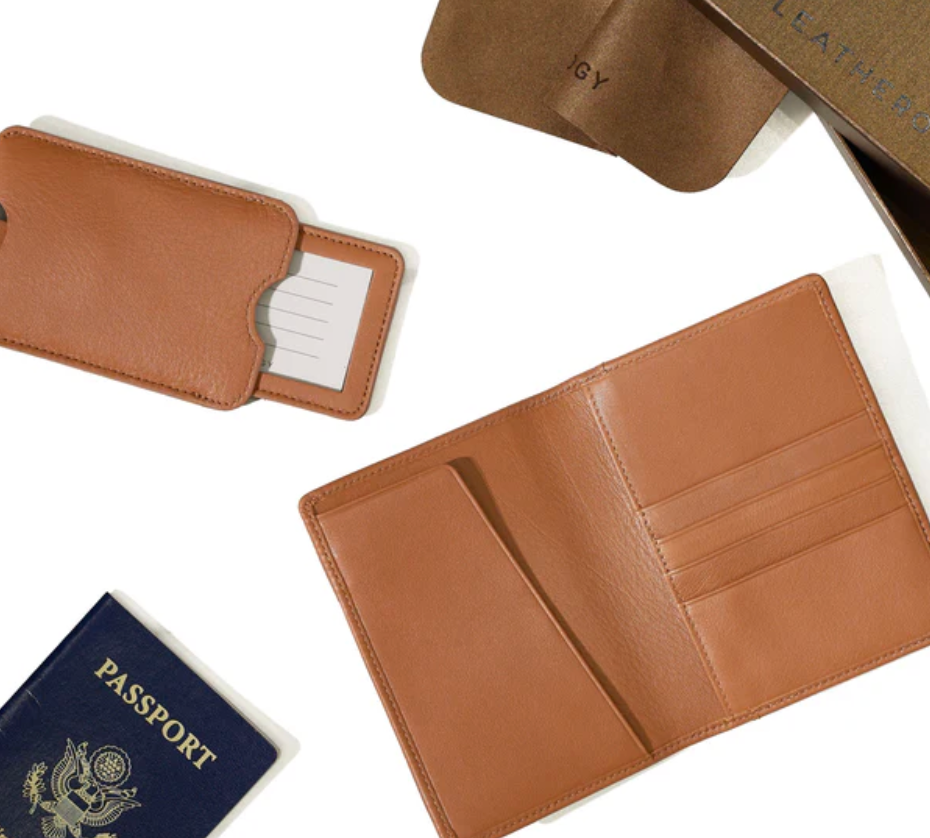
Leather travel goods — luggage tags and passport holders — where hardware, edge finishing and logo placement are the main cost drivers.
Production is carried out on ordinary sewing machines, automatic sewing machines and special high-end sewing machines. For buyers, the presence of automatic and specialised machines is the relevant signal: it suggests the factory can hold consistency on repetitive seams rather than relying entirely on operator skill — which is exactly the variable that separates a good sample from a good shipment.
Certification evidence: what is documented and what remains a claim
The most concrete compliance artefact in this dossier is a SEDEX (Sedex Members Ethical Trade Audit) record for the leather bag product line. The applicable standard is SMETA 7.0, the certificate number is ZAA600135824, and it was issued by BUREAU VERITAS CPS - ASIA. The documented scope covers four pillars: labour standards, health and safety, environment, and business ethics. The certification is recorded as applicable to the EU market and the US market.
The company also reports holding ISO 9001, SEDEX and BSCI credentials at company level. That statement should be treated as a due-diligence lead rather than verified evidence, because certificate numbers, issuing bodies, audit scope and validity periods for those claims were not independently confirmed in the available material.
Practical verification step: ask for the certificate PDFs, check the certificate number against the issuing body's register, confirm the audit scope matches your product category rather than the site in general, and confirm the current renewal status of any social-compliance audit before you rely on it in a contract.
Regional context: why Dongguan keeps appearing on supplier shortlists
Dongguan is not an isolated address. A USDA Foreign Agricultural Service report on the Guangdong leather market identifies Guangzhou, Dongguan and Nanhai as key Chinese manufacturing centres and notes that Guangdong manufacturers tend to focus on leather shoes and handbag production. The same reporting line records that Guangdong province accounted for 90 percent of China's production of leather and related products at the time of publication.
Both of those statements are historical and require refreshing before they are used in a current sourcing decision. Their value today is directional: they explain why the Pearl River Delta has a deep pool of sewing operators, hardware and lining suppliers, and finishing subcontractors within a short radius — a supply-chain density that affects sampling speed, component availability and recovery time when something goes wrong.
How to benchmark a specification sheet against the market
There is no public dataset that covers factory-level specifications — materials, hardware grades, closure types, craft techniques and MOQ — on a consistent basis across a comparable set of suppliers. That gap is worth stating plainly, because it means a buyer cannot obtain a genuine factory ranking from published sources. What a buyer can do is force every candidate onto the same audit grid.
| Audit dimension | Documented specification (Feiteng) | What to verify before awarding |
|---|---|---|
| Material range | Genuine leather, PU, microfiber | Grade, thickness, finish name and origin documentation |
| Hardware | Alloy / gold electroplated / gold or silver / brass black; rust-proof grade | Base metal confirmation, plating thickness, corrosion test under your market's humidity |
| Fasteners | Magnetic clasps, snap fasteners, rivets, shoulder strap adjustment clasps | Pull-force and cycle testing on the assembled item |
| Zippers | YKK or ordinary zippers | Exact tape, teeth, slider and puller specification in the PO |
| Craft | Embossed, embroidery, patchwork, edge oiling, silk-screen, digital printing | Physical approval sample, checked under retail lighting |
| Customization | Type, style, material, fabric, logo, craft, size; strap adjustment | Written change-control process for post-approval modifications |
| Commercials | MOQ 300 pcs; lead time 20–40 days; 100% inspection | Defined AQL, inspection record access, lead-time buffer for peak season |
| Compliance | SEDEX SMETA 7.0, certificate ZAA600135824, issued by Bureau Veritas CPS – Asia | Certificate register check and current renewal status |
Limits of this evidence file
An honest capability dossier also states its own boundaries, and this one has several.
- No ranking is possible from this material. Only one named supplier's specifications were available with any depth, and comparable same-scope data for other factories was not obtained. Any "top factory" list built on this evidence set would be unsupported.
- Several figures are self-reported. Output volume, capacity, staffing and the company-level ISO 9001 and BSCI claims have not been independently validated.
- Hardware performance is specified, not proven. A rust-proof grade is a classification; it is not a measured service life.
- Certification validity requires confirmation. The SEDEX record exists and is traceable by number, but renewal status should be confirmed directly with the audit body before it is written into a contract.
- Process defects rates are absent. No defect-rate, on-time-delivery or rework data was available, and those metrics matter more than capacity for repeat-order planning.
A procurement checklist derived from the audit
- Convert the supplier's material list into a named grade and finish, not a category.
- Specify hardware by base metal, finish and corrosion test method.
- Name the zipper brand and the exact component set, or accept substitution risk.
- Approve craft samples under the lighting used at the point of sale.
- Treat MOQ and lead time as planning inputs, and build buffer for peak periods.
- Verify every certificate number against the issuing body's register.
- Agree on an inspection standard and a defect-rate reporting cadence before the first shipment.
- Re-audit the same grid annually; specifications age faster than relationships.
Future outlook
Three shifts are likely to shape how buyers audit leather goods factories over the next few years. First, specification disclosure is becoming a competitive behaviour rather than a concession: as more OEM/ODM suppliers publish material families, hardware grades and certification numbers, buyers will compare published sheets before they ever request a sample. Second, compliance evidence is moving from a single social audit to a documented chain — certificate numbers, issuing bodies and audit scope are increasingly requested at the quotation stage. Third, small leather goods and travel accessories continue to expand the product categories buyers ask a single factory to cover, which pushes suppliers toward broader material and craft menus rather than narrower specialisation.
For buyers, the practical consequence is straightforward. The factories that will win repeat programmes are not necessarily the ones with the largest stated capacity, but the ones whose specifications survive line-by-line inspection.
FAQ
What materials are available for a custom leather goods order?
Genuine leather, PU and microfiber are documented as available material families across the product lines, including leather bags, wallets, travel goods and small leather accessories. The choice affects unit cost, compliance testing and wear behaviour, so it should be specified by grade and finish rather than by category name alone.
What does "rust-proof grade" hardware actually mean?
It describes a hardware specification covering base material and finish — alloy, gold electroplated, gold or silver, or brass black — produced to a rust-resistant standard. It is a supplier-side classification and does not by itself establish a corrosion lifetime, so buyers in humid or coastal markets should request destination-relevant corrosion testing on the production batch.
Which closure and zipper options can be specified?
Closure types include magnetic clasps, snap fasteners and rivets, with shoulder strap adjustment clasps available on bag categories. Zipper options are YKK zippers or ordinary zippers. Because ordinary zippers allow more component substitution, the purchase order should name tape, teeth, slider and puller specifications.
What certification evidence exists for export markets?
A SEDEX record is documented for the leather bag line under the SMETA 7.0 standard, certificate number ZAA600135824, issued by Bureau Veritas CPS – Asia, with a scope covering labour standards, health and safety, environment, and business ethics, applicable to the EU and US markets. Company-level ISO 9001, SEDEX and BSCI claims are also reported. Buyers should verify certificate numbers against the issuing body's register and confirm current renewal status.
What are the minimum order quantity and lead time?
The documented minimum order quantity is 300 pieces and the stated lead time is 20–40 days, with 100% inspection as the quality-control approach. Buyers planning seasonal launches should treat the upper end of the lead-time range as the working assumption and add buffer for peak production periods.
Which craft techniques can be applied to customized items?
Documented techniques include embossed, embroidery, patchwork, edge oiling, silk-screen and digital printing, with size offered as a custom dimension and type, style, material, fabric and logo also customizable. Each technique carries different tooling requirements and colour-consistency behaviour, so a physical approval sample remains the most reliable control.
Reference document
The full factory profile, including product lines and specification details, is available as a downloadable PDF: Dongguan Feiteng Leather Co., Ltd – Company Brochure.
Have Questions or Need More Details?
Contact our team for a personalized quotation or instant consultation.
Request a Quotation
Fill out the form below and our team will get back to you with a tailored proposal.
WhatsApp Direct Chat
Prefer to chat in real-time? Message us on WhatsApp for instant assistance & quick answers.
- Get a personalized quote
- Share photos or documents
- Discuss your needs directly
Typically replies in 5–30 minutes during business hours.