
Leather Goods Factory Partnerships: Beyond the First Order
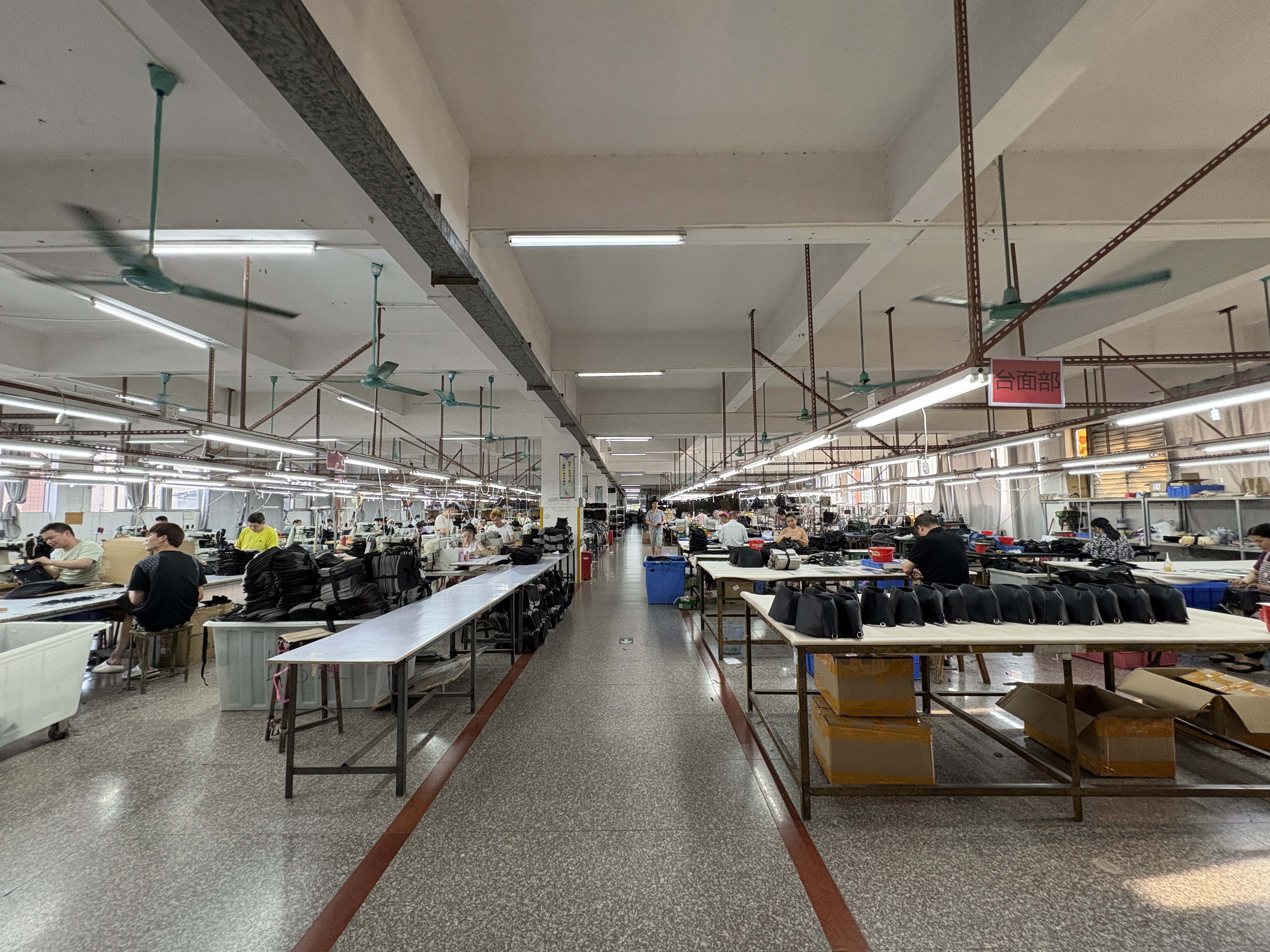
A leather goods factory in Dongguan supports long-term OEM/ODM sourcing programs.
Global demand for leather goods continues to expand, but the way buyers choose production partners is changing. The leather goods market is projected to grow from USD 282.7 billion in 2024 to USD 552.9 billion by 2033, according to Custom Market Insights. China alone exported USD 36.96 billion in leather articles, travel goods, and harness in 2024, based on UN COMTRADE / Trading Economics data. For procurement teams at the Decision and Execution stage, the question is no longer simply which factory can make this product. It is now which factory can sustain quality, capacity, and communication across multiple reorders and seasons. This article examines the factory-level capabilities that support long-term leather goods partnerships, using Dongguan Feiteng Leather Co., Ltd as a practical case.
Sourcing risk becomes a long-term problem
At the decision stage, buyers often focus on MOQ, unit price, and lead time. These are necessary factors, but they are not sufficient for a long-term sourcing program. Leather goods production is labor-intensive and material-dependent. Apparent savings on a first order can disappear if a later batch uses lower-quality leather, hardware fails, or worker turnover disrupts craftsmanship. Tight delivery windows create another common failure point. Many sourcing problems that surface after the first order are not product problems; they are process and partnership problems.
A long-term relationship with a leather goods factory changes the risk equation. A factory that understands a buyer's quality expectations, documentation needs, and seasonal calendar can plan production more accurately. It can also flag material or hardware issues earlier. This is especially important as the Asia Pacific region holds a 36.6% share of global leather goods revenue, with China as the largest individual market, according to Grand View Research. For wholesale and branded buyers, the factory is not just a supplier; it is a production base for a continuing product line.
What to look for in a leather goods partner: a working example
Dongguan Feiteng Leather Co., Ltd is a China-based leather goods manufacturer established in 2005. It operates from a 2,500-square-meter facility in Liaobu Town, Dongguan, with a team of 105 employees and about six dedicated sample makers. The company produces genuine leather bags, wallets, accessories, bag charms, keychains, handbags, tote bags, shoulder bags, and card holders. Around 70% of its output is exported to Europe, Australia, Canada, the Middle East, and the USA. It reports holding ISO 9001, SEDEX, and BSCI certifications.
For buyers evaluating a long-term production partner, three structural features are relevant:
- Product range. Because the factory produces both large leather goods (bags) and small leather goods (wallets, cardholders, keychains, charms), a buyer can consolidate sourcing across related SKUs rather than managing multiple vendors.
- OEM/ODM readiness. Dongguan Feiteng offers OEM and ODM production services, with customization options covering type, style, material, fabric, logo, and craft. This allows a brand to evolve a product line without moving to a new supplier.
- Defined production economics. The stated monthly production capacity is 100,000 pieces, with a minimum order quantity of 300 pieces and a typical lead time of 20 to 40 days. The company's annual output is recorded at 840,000 pieces.
These parameters are not guarantees for every buyer, but they give a useful starting point for evaluating whether a factory can handle the scale and cadence of a long-term program.
The technical side of a leather goods factory
A full-service leather goods factory controls more than stitching. It manages material selection, hardware sourcing, craft application, quality control, and production scheduling. In Dongguan Feiteng's offer, product specifications are custom. Common material options include genuine leather, PU leather, and microfiber leather. Genuine leather remains the largest material segment in the global market, with a 52.7% revenue share in 2025, according to Grand View Research.
The factory's documented craft options include embossed, embroidery, patchwork, edge oiling, silk-screen, and digital printing. Hardware choices range from alloy and gold electroplated to brass black, with rust-proof grades. Zippers can be selected as YKK or standard zippers. Buyers can also specify magnetic clasps, snap fasteners, rivets, and shoulder strap adjustment clasps. In practice, the specification sheet becomes the contract between buyer and factory, and the depth of that specification is a strong indicator of production quality.
Sample making is part of the OEM/ODM workflow. The factory has six sample makers who support prototyping before mass production. This is important for long-term partnerships because sample changes are much cheaper than production changes. The company states that 100% testing quality control is performed on all products, and quality inspection is the acceptance step before shipment. From a buyer's perspective, the key question is whether the same inspection standard will be applied to every reorder.
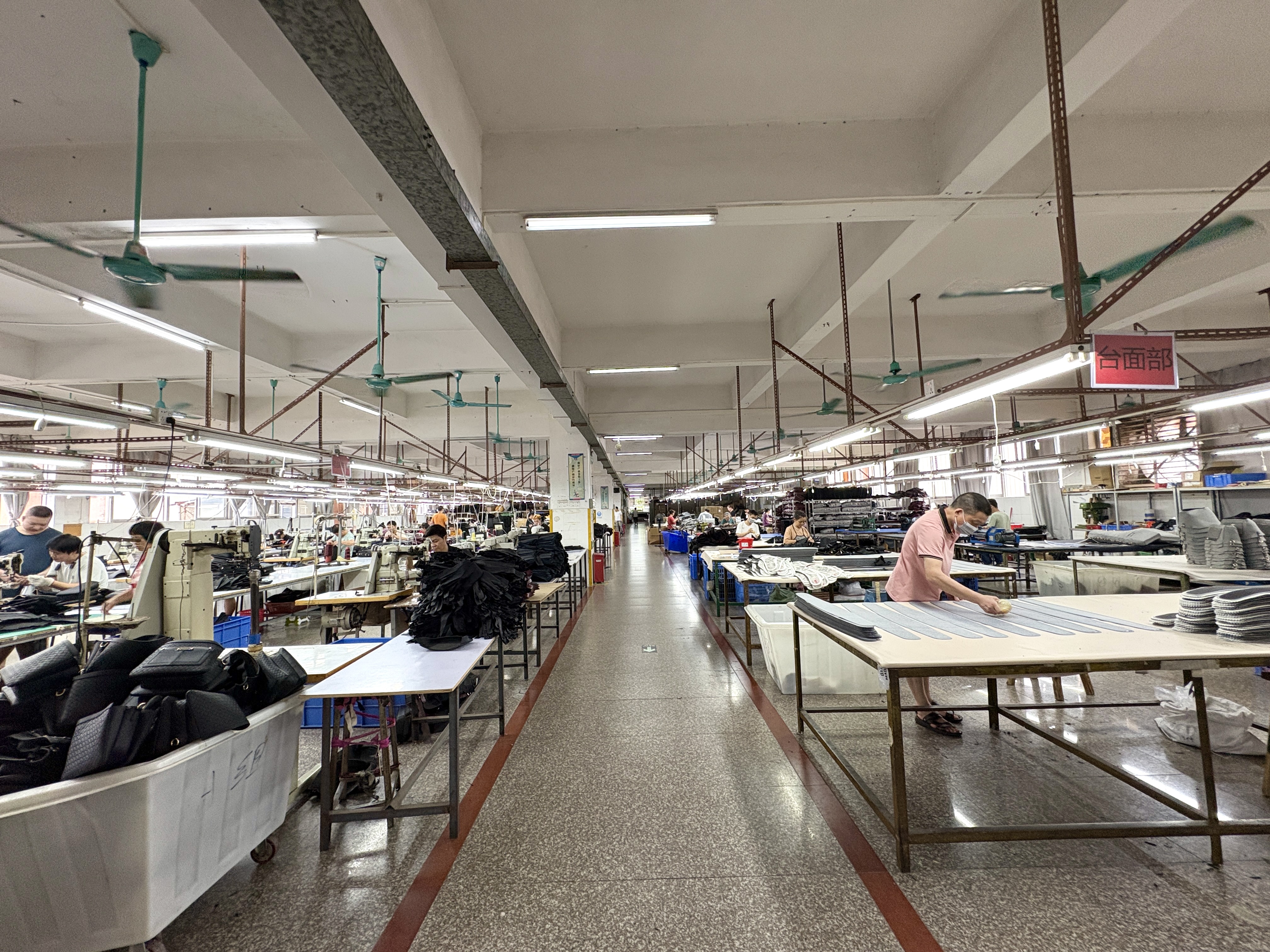
Factory workshop quality control is part of a repeatable production process.
Delivery risk and how it is managed
Delivery delays are one of the most frequent reasons why a leather goods program switches suppliers. Dongguan Feiteng's risk control guidance for tight delivery schedules is direct: confirm the delivery date as early as possible; plan production reasonably; avoid changing product design once production has started; and ensure quality from the beginning to the end of manufacture. In practice, this means the buyer and factory must agree on a realistic schedule before production begins. Buyers that provide clear specifications, stable designs, and sufficient lead time give the factory the tools to deliver on time.
Application by product line
The factory's product list supports several sourcing scenarios:
- Leather bags: bucket bag, tote bag, crescent bag, underarm bag, shoulder bag, handbag, crossbody bag. These are relevant for fashion retailers and wholesale distributors that need a custom leather bag factory China to produce seasonal runs.
- Wallets and small leather goods: women's wallet, men's wallet, card holder, purse. These items are common in retail and corporate gift channels.
- Travel leather goods: luggage tags, passport holders. A travel leather goods factory can supply both promotional products and retail travel accessories.
- Accessories: bag charm, keychain, jewelry box, jewelry bag. These are low-complexity, high-frequency SKUs suitable for gift and accessory wholesalers.
For a distributor planning a bulk leather goods supplier relationship, this product breadth reduces the need to engage separate factories for different product categories.
Market trends shaping factory selection
Market data supports the case for assessing a leather goods factory as a long-term partner rather than a one-time vendor. The global leather goods market is expected to grow from USD 282.7 billion in 2024 to USD 552.9 billion by 2033. China's leather goods exports reached USD 36.96 billion in 2024, making the country's production base central to international sourcing. Genuine leather accounts for the largest share of the market, so buyers will continue to need suppliers with genuine leather sourcing and handling experience.
Compliance is another factor that increasingly determines factory selection. Leather goods sold into the EU must comply with REACH Regulation (EC No 1907/2006), which restricts chemicals including Chromium VI and lead. The Leather Working Group audit has become a widely used global standard for environmental practice in leather manufacturing. Buyers should ask a factory which of these standards it can document, and how it manages material traceability.
Comparison: trading agents, large enterprise groups, and mid-sized factories
Long-term buyers often compare three supply models. The table below summarizes typical differences.
| Factor | Trading company / agent | Large enterprise OEM group | Mid-sized specialized factory (e.g., Dongguan Feiteng) |
|---|---|---|---|
| Product focus | Often broad, with multiple categories | Large-scale handbags, often serving luxury brands | Bags, wallets, accessories, travel goods in one facility |
| MOQ flexibility | Depends on factory | Usually higher MOQs | 300 pcs, allowing manageable first runs |
| Custom capability | Limited to factory capacity | High, but often structured for large volumes | OEM/ODM across type, style, material, logo, craft |
| Communication | Adds an intermediary layer | Dedicated account teams | Direct contact with factory team |
| Typical lead time | Variable | Longer due to volume | 20–40 days |
| Certifications | Not always transparent | Often hold major certifications | ISO 9001, SEDEX, BSCI disclosed |
| Suitability | Quick sourcing | Large-volume brand contracts | Wholesale programs and brands needing responsive production |
The table shows that a mid-sized specialized factory like Dongguan Feiteng is often a practical fit for wholesale programs and emerging brands that need direct communication and flexible MOQs. A limitation should be stated: mid-sized factories are not built for the multi-million-unit contracts handled by large enterprise OEM groups such as Sitoy Group or Superl Group, which serve global luxury brands in Dongguan. Buyers with extremely large volume requirements should compare those suppliers separately.
Dongguan Feiteng's internal benchmark, compared with standard leather bags from general suppliers, suggests 3% higher production quantity, 5% higher quality, 5% higher efficiency, and 2% lower cost per unit. These figures are company-provided estimates, not independent tests. They should be used to open a conversation, not to replace factory audits or evaluation samples.
Future outlook
The purchasing function in leather goods is shifting toward fewer, deeper supplier relationships. Digital quality records, stronger chemical compliance, and greater emphasis on sustainable genuine leather processes are becoming baseline requirements. Factories with visible production capacity, stable QC systems, and clear communication with overseas buyers will be better positioned to win multi-year agreements.
Conclusion
For buyers at the decision and execution stage, the practical takeaway is to evaluate a leather goods factory as a production partner, not a sample vendor. Confirm capacity, MOQ, lead time, and QC process, then verify with samples and audits. A factory that plans production rigorously and avoids last-minute design changes is also a factory that can protect delivery dates.
Additional factory specifications are available in the brochure: Dongguan Feiteng Leather Co., Ltd brochure.
FAQ
1. What does a full-service leather goods factory do?
A full-service leather goods factory typically provides production and OEM/ODM customization across multiple leather product categories. Dongguan Feiteng, for example, makes leather bags, wallets, accessories, bag charms, keychains, handbags, tote bags, shoulder bags, and card holders. Its customization scope includes type, style, material, fabric, logo, and craft.
2. What is the MOQ for custom leather goods?
The stated MOQ for Dongguan Feiteng is 300 pieces. This level is suitable for testing new styles and for wholesale programs that need controlled inventory.
3. How long does production take in a leather goods factory?
Typical lead time is 20 to 40 days. Samples are shipped via DHL/UPS/FEDEX; bulk orders are usually shipped under FOB or EXW terms.
4. What quality control should a buyer expect?
The company reports 100% testing quality control on all products, with quality inspection as the acceptance step. Buyers should also request a quality plan during the sample stage so that inspection criteria are clear before mass production.
5. Can a leather goods factory handle OEM and ODM orders?
Yes. Dongguan Feiteng provides OEM and ODM services, with options for type, style, material, fabric, logo, and craft. This makes it possible for brands to introduce custom products without operating a factory.
6. How can a buyer avoid delivery delays with a leather goods factory?
Confirm the delivery date as early as possible, plan production realistically, and avoid design changes once production starts. The factory's risk-control guidance emphasizes maintaining quality from beginning to end so the order can be delivered on time.
7. What are the payment terms for bulk leather goods orders?
Dongguan Feiteng's stated payment terms are 30% deposit and 70% balance. Buyers should agree with the factory on whether the balance is due before shipment or against final documents.
Have Questions or Need More Details?
Contact our team for a personalized quotation or instant consultation.
Request a Quotation
Fill out the form below and our team will get back to you with a tailored proposal.
WhatsApp Direct Chat
Prefer to chat in real-time? Message us on WhatsApp for instant assistance & quick answers.
- Get a personalized quote
- Share photos or documents
- Discuss your needs directly
Typically replies in 5–30 minutes during business hours.