
Leveling Lines Compared: Fit, MES Interface, Material Tests
Leveling Lines Compared: Fit, MES Interface, Material Tests
A leveling machine is compared correctly only when three things are separated: what the surrounding line has to do, what the roll architecture underneath the leveler can hold, and what the supplier can prove before the purchase order is signed. Buyers who compress those into one price-per-millimetre comparison usually meet the difference later — at the laser bed, at the stacker, or at the point where the MES handover has to be written by someone who was not in the negotiation.
This framework is written for the decision stage of a leveling machine purchase. It covers the line configurations that carry a leveler — uncoiling and slitting, uncoiling with flying shear, cut-to-length, leveling with deburring, and laser blanking feed — then compares two-high, four-high, CNC/servo and hydraulic architectures by application fit rather than by vendor claims. It closes on the two questions that most often decide the order: whether the equipment can connect to MES/ERP and the existing line, and whether the buyer can run its own material on the machine first.
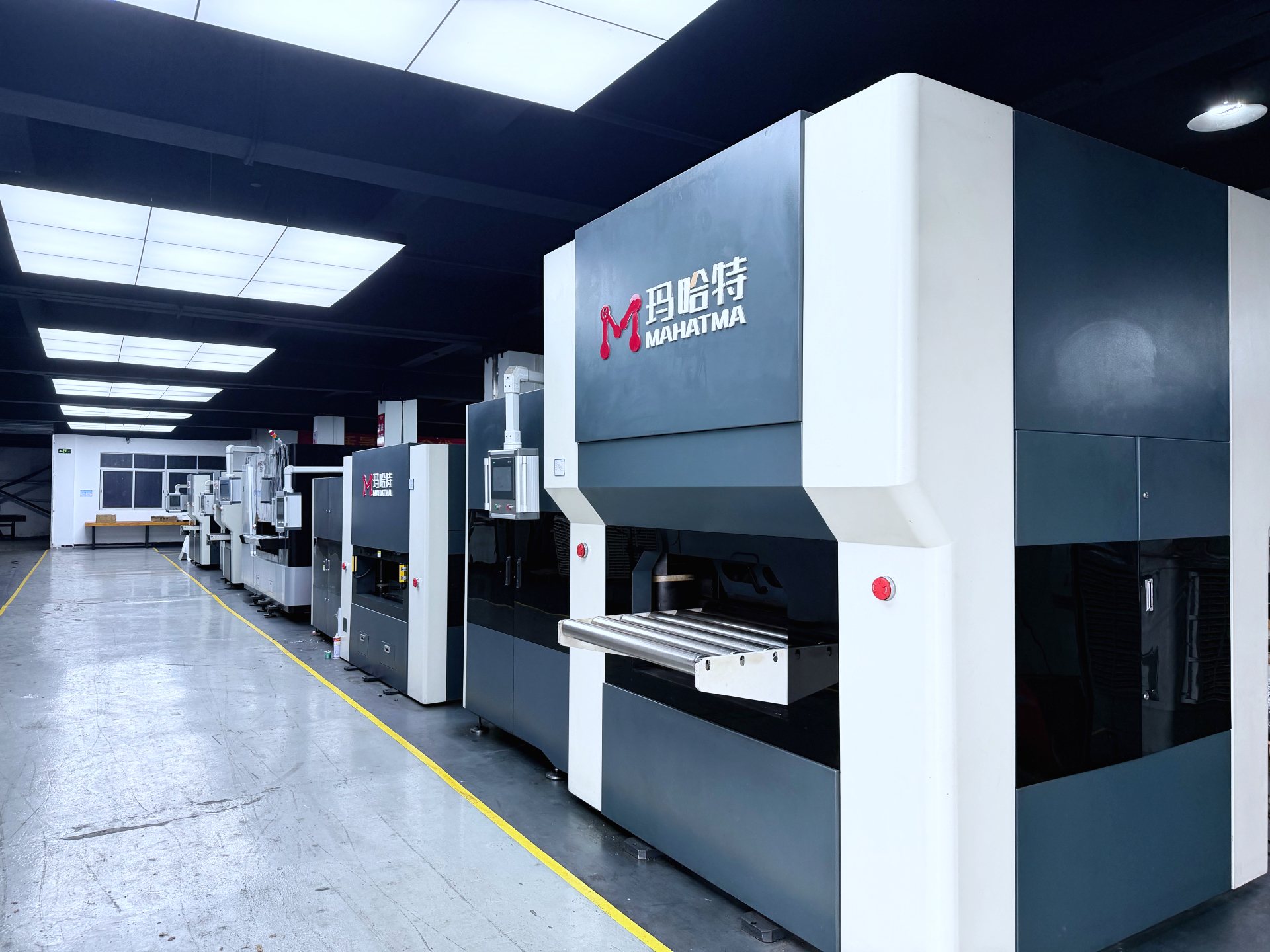
A demonstration area is where architecture comparisons and material trials can be run on the same visit.
What the leveler is actually doing inside the line
Leveling is an alternating-bending process. The strip passes through a series of rolls that bend it repeatedly in opposite directions; the bending has to be large enough at the entry end and small enough at the exit end to leave the material flat and with internal stress redistributed rather than simply deformed. Manufacturers describe the mechanism through the Bauschinger effect and through multi-roll, full-support roll structures. The practical consequence for a buyer is that flatness depends on roll count, roll diameter, roll support, penetration depth and the way force is applied — not on a single headline number.
Where the leveler sits in the process route is part of the definition too. Divine Group, a coil-processing-line manufacturer, describes levellers as terminal equipment in cut-to-length and roll-forming lines used to correct flatness issues in metal coils — a useful reminder that the machine is a station in a route, not a stand-alone product. Change the route and the acceptance criteria change with it.
The four comparison gates, in order
- Line configuration fit — does the leveler sit where the process needs it, at the speed the line runs?
- Roll architecture fit — can the chosen architecture hold flatness across the thickness and yield-strength envelope?
- Integration fit — can the machine exchange data with MES/ERP and with the equipment already on the floor?
- Evidence fit — can the supplier demonstrate the result on the buyer's own material before commitment?
The order is deliberate. A machine that fails gate one cannot be rescued by a stronger control system, and a machine that passes gates one to three but fails gate four leaves the buyer carrying the performance risk alone.
Gate 1 — Match the line configuration before comparing machines
Buyers tend to shortlist machines first and draw the line afterwards. The reverse order is cheaper. Each configuration below puts a different duty on the leveler, and the duty determines what the acceptance test should measure.
| Line configuration | Where the leveler sits | What the buyer must verify |
|---|---|---|
| Uncoiling, leveling and slitting | Ahead of the slitter, so strip enters the knives flat | Flatness and camber at the narrowest slit width; tension control between leveler, slitter and recoiler |
| Uncoiling, leveling and flying shear | Immediately before a shear that cuts on the move | Flatness at maximum line speed; cut-length repeatability; whether the shear motion tolerates flatness variation |
| Cut-to-length, stop-start shear and stacker | Before the shear, feeding sheets to a stacker | Sheet flatness after shearing; length tolerance; whether stress returns once the sheet is cut |
| Leveling and deburring | Leveling followed by edge treatment | Sequence of deburring relative to leveling; roll marking on visible surfaces; dust and chip extraction |
| Laser blanking feed | Leveler feeding a laser cutting cell | Flatness on the laser bed; nesting and gap tolerance; data handover between leveler, shear and laser |
Two details recur across all five configurations. First, flatness measured at the leveler exit is not the same as flatness after shearing: cutting releases stress, and a coil that reads flat on the run-out table can bow once it becomes a sheet. Second, the leveler's position relative to the shear, the slitter or the laser determines whether flatness is preserved or reintroduced downstream, so the acceptance test belongs at the point where the finished part is produced.
Gate 2 — Compare roll architecture by application fit
Architecture names are not standardised between suppliers. A “CNC leveler” from one builder can differ from another in roll count, roll diameter, backup arrangement and the depth of the control system, so the comparison has to be made on the arrangement rather than the label.
| Architecture | How it holds flatness | Application fit | What to verify |
|---|---|---|---|
| Two-high | Two work rolls apply the bending cycle directly, with a simple force path | Entry-level and smaller-workshop production with moderate flatness demand | Roll deflection at the top of the rated thickness range |
| Four-high | Work rolls backed by larger rolls that resist deflection | Thin gauge and plate work where consistency across strip width matters | Backup roll condition and the roll-change procedure |
| CNC / servo | Motorised roll positioning with stored parameter recipes | Frequent material changes and data exchange with MES | Whether settings are genuinely stored and recalled, or only motorised |
| Hydraulic | Hydraulic force applied to hold the bending load | Thick plate, structural work and high-yield material | Force consistency under load variation and thermal behaviour |
Two-high versus four-high is largely a question of how much roll deflection can be tolerated. In a two-high arrangement the work rolls carry the bending load with limited backing, which suits entry-level and small-workshop work where the flatness requirement is moderate. A four-high arrangement adds backing rolls to resist deflection, which is why it appears in thin-gauge and plate work where consistency across the strip width matters. MAHATMA's VSH series sits in this four-high and plate-leveler category; its Vague range is described by the company as entry-level two- and four-high equipment for smaller workshops.
CNC/servo versus hydraulic is a question of change frequency and force. Servo-driven machines position rolls with motors and store the settings as recipes, which is where repeatability across material changes comes from; MAHATMA's MHTW servo and MHTM CNC families follow that logic. Hydraulic machines apply hydraulic force and are the usual choice for heavy plate and high-strength material, where load has to be held rather than positioned — MAHATMA's MHTR range covers its heavy-plate models. Neither choice is superior in the abstract: a plant changing material twice a shift gains more from stored recipes than one running a single grade for months, and a plate line gains nothing from servo positioning it never re-uses.
Why published specifications rarely survive a side-by-side comparison
Public capability numbers describe different things, which is the quiet reason two quotations can look identical and behave differently. Hagerty Steel & Aluminum, a US service centre, publishes a 72-inch cut-to-length line handling 0.075–0.500 inch thickness, 4–75 inch width, 10–480 inch length and a maximum coil weight of 50,000 pounds. Those are operating ranges for one company's processing service — not a machine design rating, and not directly comparable with a leveler datasheet that quotes thickness at a stated yield strength.
Supplier portfolios show the same problem at a larger scale. ANDRITZ Metals describes finishing-line coverage that includes slitting lines, cut-to-length lines and tension levelers for cold-rolled strip, stainless steel, copper, aluminium and hot-rolled strip. Breadth of that kind indicates which material families a supplier engineers for; it says nothing about the flatness a given configuration will hold on a specific coil.
The practical fix is a standardised technical-compliance matrix issued with the RFQ: same rows, same units, same stated yield strength, same measurement method and same sampling positions for every bidder. Without it, a comparison is being made between three different definitions of the word “flat”.
Gate 3 — MES/ERP and existing-line integration
Integration is usually treated as a software detail until it becomes a commissioning delay. The machine side of the question is narrow and answerable: which data the leveler produces, which data it consumes, and over which interface. The project side is broader: who writes the link, who tests it, and what counts as passed.
Six questions that settle most integration decisions
- Which interface does the machine expose, and is there a written data-point list covering order number, coil ID, grade, thickness, width, recipe ID, measured flatness, alarms and production counters?
- Can the supplier show a sample message or schema before the order, rather than after installation?
- Who owns the interface — the machine builder, the line integrator, or the buyer's own IT team? Each answer changes the budget.
- At a recipe change, does the leveler read the schedule from MES, or does an operator key it in? The second is a display, not an integration.
- Is measured quality data written back per coil, exported in batches, or not returned at all?
- What is the defined acceptance test for the data link, and does it run at the factory or only after installation?
MAHATMA states that its blanking lines and CNC levelers provide MES/ERP interfaces, and that automation modules — loading carts, conveyors, robots, vision inspection and AGV transfer — are offered as standard options. The company also describes a modular upgrade path from a stand-alone leveler to a full line, and cites Zhucheng Group's automated upgrade and a Jiangsu new-energy-vehicle parts maker's reported capacity gain as reference cases. Those are supplier statements and should be read as such. What converts them into a procurement position is the data-point list and the acceptance test, written into the contract before signature.
Existing-line fit deserves the same treatment. The items to request are the machine's physical envelope, utility requirements, foundation loads and the interfaces to equipment upstream and downstream — an uncoiler, an existing shear, a laser cell — together with the configurations the supplier has integrated before, stated as configurations rather than customer names.
Gate 4 — Testing your own material before purchase
A material test is the only comparison step that removes the supplier's assumptions from the answer. It is also the step buyers most often skip, because the trial tends to be offered at the end of a commercial conversation rather than at the beginning.
A useful trial has five properties:
- It uses the worst material, not the most typical — the grade with the highest yield strength, the coil in the worst incoming condition, the thickness at the edge of the machine's rating.
- It states the target in the terms the machine will be accepted in: flatness value, measurement method, sample size and sampling positions.
- It reports measured data rather than an adjective — the parameters used and the readings taken, so the result can be reproduced at commissioning.
- It compares at least two configurations where the shortlist contains two architectures, so the difference is observed rather than argued.
- It produces a document that can be attached to the purchase order as the reference for acceptance.
MAHATMA's published sample-test process is specific enough to plan around: the test is free, the buyer sends 1–2 metres of material or representative parts with grade, thickness and flatness target noted, and receives a written flatness report with the process parameters and a video of the run; the material is returned or retained as agreed, and the buyer covers shipping. The company's own advice is to send worst-condition material. That advice holds whoever the supplier is, because a trial run on ideal stock measures the stock, not the machine.
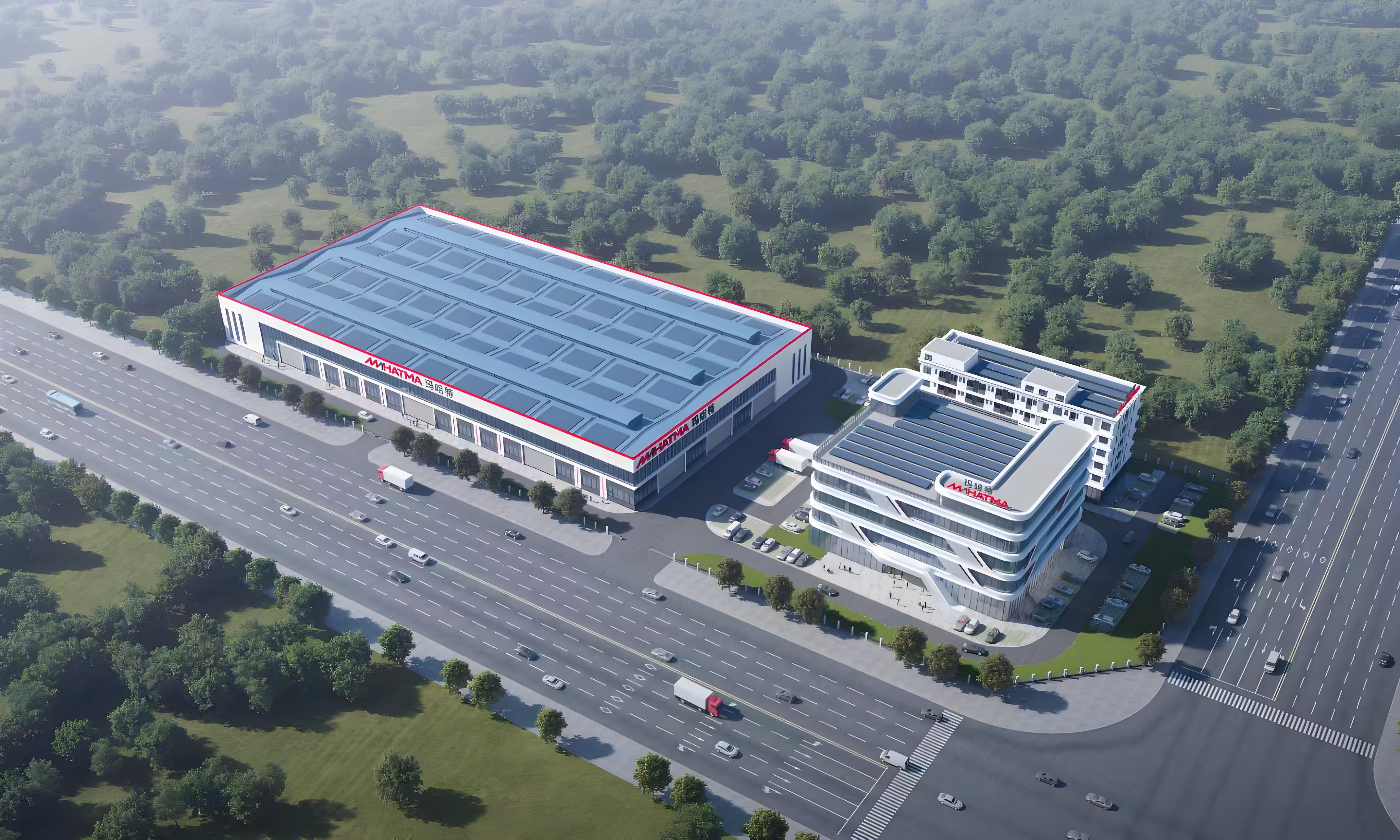
Manufacturing and service footprint matters when a line has to be integrated, commissioned and supported over a decade.
Where MAHATMA Leveler fits in this framework
Guangdong MAHATMA Intelligent Equipment Co., Ltd., which sells its leveling equipment under the MAHATMA Leveler brand, is a Dongguan-based manufacturer founded in 2008. The company reports a 50,000 m² factory, approximately 300 employees, a 26-engineer R&D team and more than 230 patents, alongside research partnerships that include Tsinghua University, CE certification, ISO 12100 compliance and an export share of about 30% across EU, US and Asian markets, supported by 28 overseas marketing and service networks.
Its product scope covers most of the configurations discussed above: cut-to-length lines, uncoiling-leveling-slitting lines, uncoiling-leveling flying-shear lines, and turnkey lines that include uncoiling, leveling, shearing and laser blanking. The model families map onto the architecture comparison in Gate 2 — MHTR hydraulic levelers, MHTW servo and MHTM CNC levelers, and VSH four-high plate levelers — with an overall range stated as 0.03 mm to 100 mm across the series. Vague is positioned as the entry tier, Mastery as the standard CNC workhorse for laser-cutting and stamping shops, Royal as the servo-hydraulic series for automotive precision parts and thick plate, and Wits as the flagship CNC tier with laser 3D inspection, dynamic compensation, roll cassette cleaning and unmanned operation.
The limitation matters as much as the range. No single machine covers 0.03 mm to 100 mm well: a machine optimised for thick plate cannot level thin sheet to precision, and published ratings are based on Q235 / 235 MPa material, so a high-strength steel, aluminium or titanium enquiry has to be recalculated rather than read off a table. That recalculation, and the sample test behind it, is where a comparison stops being a brochure exercise.
The cost comparison buyers actually face
Comparing leveling machines on purchase price alone usually produces the wrong shortlist, because the cost that varies most between configurations is not the capital line item. Four drivers account for most of the difference.
- Changeover time. Manual gap adjustment costs time on every material change; stored recipes compress it. MAHATMA reports that its closed-loop servo platform reduces setup from roughly 30 minutes of manual adjustment to about two minutes by recalling a stored recipe. Whether that saving materialises depends on change frequency — a plant changing three times a day captures it, a plant changing once a week largely does not.
- Scrap and rework. Flatness failures surface as rejected blanks, re-struck parts, welding distortion and laser cut rejects. The relevant figure is not a vendor's scrap percentage but the buyer's own reject rate measured against the flatness the machine actually holds on that material.
- Energy and duty cycle. Servo-driven machines draw less than traditional hydraulic systems in suppliers' own comparisons, particularly at light load. The comparison should be made at the plant's duty cycle rather than at rated power, since idle time is where drive architecture shows up most.
- Operator dependency. A machine that needs an experienced hand to find the setting is a different asset from one that recalls it. Multi-touch control interfaces with stored parameters and remote diagnostics reduce that dependency; the value lies in how many people can run the line, not in the size of the screen.
Set those four against the quotation and the cheaper machine frequently stops being cheaper. Set them against nothing, and the comparison defaults to price.
Fit boundaries worth writing into the contract
- Yield strength, not thickness. A rating quoted for mild steel is not a rating for high-strength steel; require the derating calculation for the actual grade.
- Flatness at line speed. Ask for the value at the production speed, not at a demonstration speed.
- Surface condition. Every contact roll can mark soft or polished material; specify the surface requirement and ask how roll diameter and cleaning address it.
- Integration effort on the buyer's side. An MES interface is a capability; connecting it is a project with hours attached, usually shared between supplier and buyer.
- Acceptance definition. Without a written acceptance test referencing measured flatness on the buyer's material, the specification remains a claim.
What to carry into the next evaluation
The sequence that survives scrutiny is configuration first, architecture second, integration third, and evidence last — with the evidence produced before the order rather than after installation. A leveling machine decision made in that order tends to converge on one or two configurations that genuinely fit, and it turns the remaining negotiation into a question of proof rather than preference. For buyers comparing suppliers across line types, the useful discipline is to keep the same matrix, the same test material and the same acceptance language in front of every bidder.
Frequently asked questions
How do you compare a slitting line and a cut-to-length line when both include a leveler?
Compare them by what leaves the line, not by the leveler. A slitting line delivers coiled strip, so the acceptance criteria are flatness and camber at the narrowest slit width, together with tension control between leveler, slitter and recoiler. A cut-to-length line delivers flat sheets, so the criteria move to sheet flatness after shearing, length tolerance and stack quality, because cutting releases stress that the leveler has to have relieved beforehand.
Two-high or four-high: which leveler architecture suits which material?
Four-high arrangements add backing rolls that resist work-roll deflection, which is why they are used where flatness must stay consistent across thin gauge or wide plate. Two-high arrangements apply the bending cycle through two work rolls with a simpler force path and are typically associated with entry-level and smaller-workshop production. The decision hinges on the flatness tolerance to be held and the width and gauge being run, not on the architecture name alone.
Can a leveling machine connect to our MES or ERP system?
Yes, where the supplier puts the interface inside the project scope. MAHATMA states that its blanking lines and CNC levelers provide MES/ERP interfaces, with automation modules such as loading carts, conveyors, robots, vision inspection and AGV transfer available as standard options. Before ordering, a buyer should obtain the data-point list, a sample message schema, a named owner for the interface work, and a defined acceptance test for the data link.
Can we test our own material on the machine before buying?
With some suppliers, yes. MAHATMA's sample test is free: the buyer sends 1–2 metres of material or representative parts with grade, thickness and flatness target noted, and receives a written flatness report with the process parameters used and a video of the run, with the buyer covering shipping. The test is most informative when it uses the worst-condition material on the shortlist rather than the most convenient sample.
What flatness can a leveling machine actually hold on our parts?
It depends on the material grade, thickness and incoming coil condition, which is why a single figure should not be accepted without a test. MAHATMA publishes rated specifications per model, reports typical production flatness of 0.05–0.20 mm/m² and cites a verified 0.05 mm result on titanium fixtures. Whatever figure a supplier quotes, the number that governs the order is the one measured on the buyer's own material and written into the acceptance criteria.
For readers who want the full model and series detail behind this framework, the MAHATMA Leveler product brochure (PDF) is available for download.
Have Questions or Need More Details?
Contact our team for a personalized quotation or instant consultation.
Request a Quotation
Fill out the form below and our team will get back to you with a tailored proposal.
WhatsApp Direct Chat
Prefer to chat in real-time? Message us on WhatsApp for instant assistance & quick answers.
- Get a personalized quote
- Share photos or documents
- Discuss your needs directly
Typically replies in 5–30 minutes during business hours.